 Purdue University - Extension - Forestry and Natural Resources
Got Nature? Blog
Purdue Landscape Report: Now that we’ve reach midsummer, many people tending to small plants and bushes may notice small odd round grey objects attached to their plants that are made by potter wasps. Do you need to do anything about them? Do these nests help or harm your plants? And are they dangerous to people?
What do they look like?
You are more likely to notice the nests of potter wasps than the adults. Potter wasp nests often look, like the name suggests, like a small grey pot (figure 1). They are rounded with a small opening that looks like the neck of a vase and are about the size of a cherry tomato. These wasps will attach their nests to many different surfaces but tend to prefer plant and bush stems. Potter wasp nests are often found hidden behind foliage in bushes.
Potter wasp adults come in a variety of colors but all of them look like small hornets. The most common species found in Indiana are mostly black with pale yellow bands around their abdomen (figure 2).
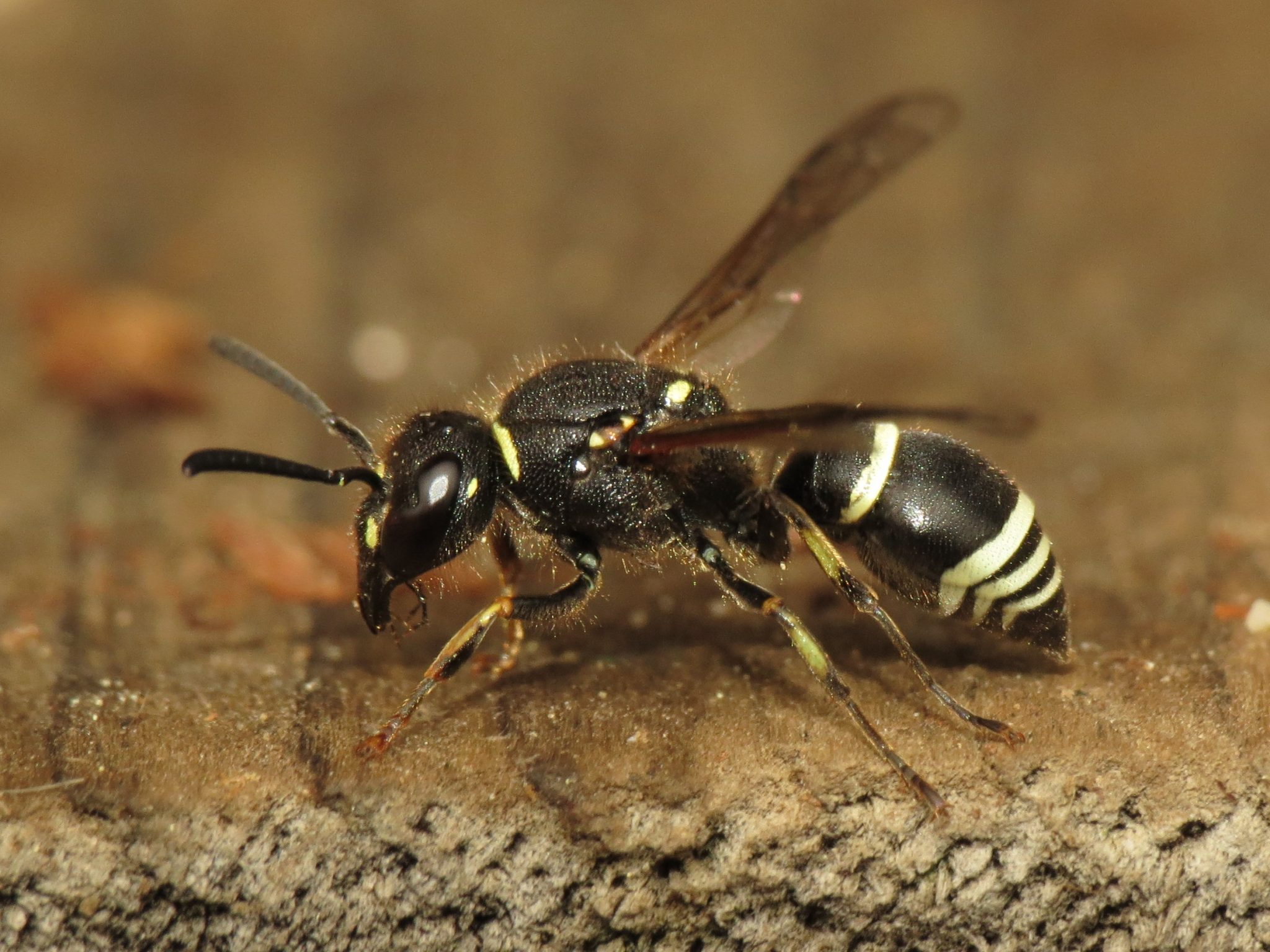
Figure 2. An adult potter wasp resting. This is just one of many different species of potter wasps. Photo by Fyn Kynd on flickr
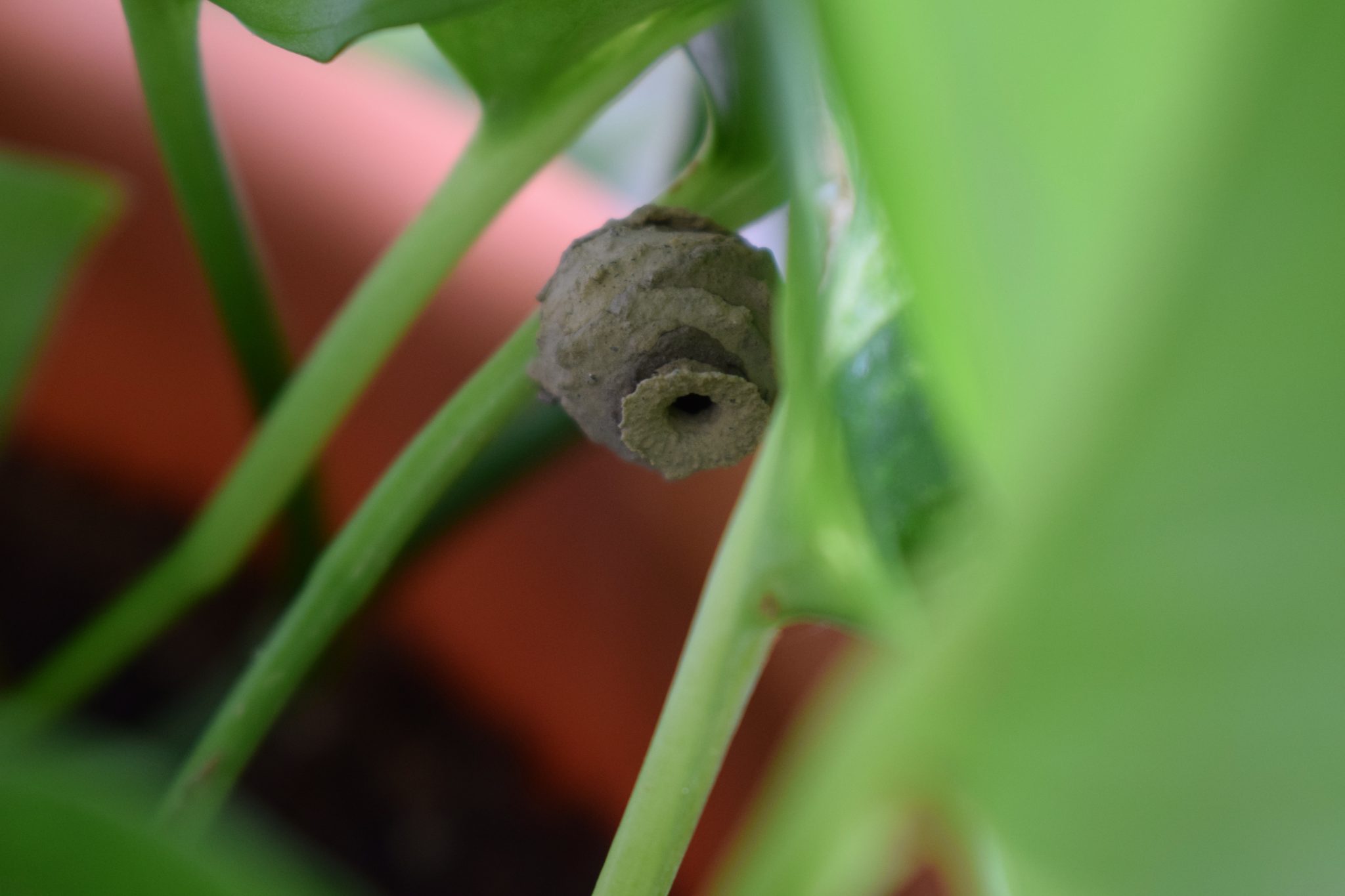
Figure 1. Close up of a potter wasp nest attached to the stem of a house plant. Photo by Elizabeth Barnes, Department of Entomology, Purdue University.
How do they help plants?
Each “pot” that the wasps build is a tiny nursery for a single wasp. Adult potter wasps lay a single egg in each “pot” and then fill it with paralyzed caterpillars and small beetle larvae. When the wasp egg hatches it has all the food it needs to develop into an adult contained in the pot. Each wasp does a small part to keep down the number of caterpillars in the landscape which can reduce the amount of leaf damage on nearby plants.
Will they hurt me?
Probably not! Potter wasps don’t defend their nests and are generally not aggressive. Unless you actively try to bother them they will probably not bother you. If you need to remove one of their nests, you can simply pull it off the plant or object that it’s attached to. However, since they help with pest control, you may want to either leave the nest be or relocate it to a different section of the landscape.
Does anything else look like the “pots”?
Although the “pots” have a very distinct shape there are a few other things that could be confused with them at first glance. Mantis egg masses (ootheca) and some types of galls are both about the same size as potter wasp nests and also often grey. However, they both lack the vase neck-like opening that potter wasp nests have.
What should I do if I see one?
Let it be! Since these wasps rarely sting and help keep caterpillar populations down leave them alone so that they can continue to act as biocontrol agents. If you think you’ve seen a potter wasp or one of their nests and would like help identifying it, take a picture and either upload it to a community science project like iNaturalist or send a picture to the author of this article.
Resources
Social Bees and Wasps, The Education Store, Purdue Extension resource center
Parasitic Wasps, The Education Store
Mud Daubers, The Education Store
Cicada Killers, The Education Store
Industrial, Institutional, Structural and Health-Related Pest Management, The Education Store
Elizabeth E Barnes, Exotic Forest Pest Educator
Purdue University Department of Entomology
Across the entire United States, and into Canada and Mexico, coyotes can be found just about everywhere. But what would you do if you encountered a coyote while out all alone? Would you feel comfortable knowing how to act? How about how to keep your children or pets safe in such an encounter?
In our June 11th Ask the Experts series, “Coexisting with Coyotes,” Purdue researchers Brian MacGowan and Bee Overbey talked about these topics and more. As a keystone species in their ecosystem, coyotes play an extremely important role in maintaining population levels of other animals, such as deer, rabbits, raccoons, and voles. By keeping these populations in check, plants and trees are better able to grow, and this creates greater biodiversity and healthier habitat. And coyotes are not going anywhere! This resilient, intelligent species has learned to adapt around humans and every change that we bring.
Check out the video below to learn more about coyotes, how important they are to the lands where they are found, and tips on how to coyote-proof your property and keep yourself and your loved ones safe in coyote encounters. By working together, we can easily and safely coexist with this vital native species.
Resources
Ask an Expert, Playlist, Purdue Extension – Forestry and Natural Resources (FNR) YouTube Channel
Coyotes, IN DNR
Coyotes (PDF), Wildlife Conflicts, Department of Entomology, Purdue University
Coexisting With Coyotes, Wild Bulletin, Indiana Department of Natural Resources, Division of Fish and Wildlife
Urban Coyotes – Should You Be Concerned?, Purdue Extension – FNR Got Nature? Blog
Pets Disappearing? The Cause May Be Coyotes, Purdue Extension – FNR Got Nature? Blog
Question: Which is the correct species of coyotes I have on my land here in Indiana, coyote or coywolf?, Purdue Extension – FNR Got Nature? Blog
Permitted Wildlife Rehabilitators, Indiana Department of Natural Resources
Dealing with Nuisance Coyotes, Indiana Department of Natural Resources (IN DNR)-Fish and Wildlife
Urban Coyote Research Center, Urban Coyote Ecology & Management, Cook County, Illinois
Brian MacGowan, Wildlife Extension Specialist
Purdue Forestry and Natural Resources
Brande (Bee) Overbey
Purdue Forestry and Natural Resources
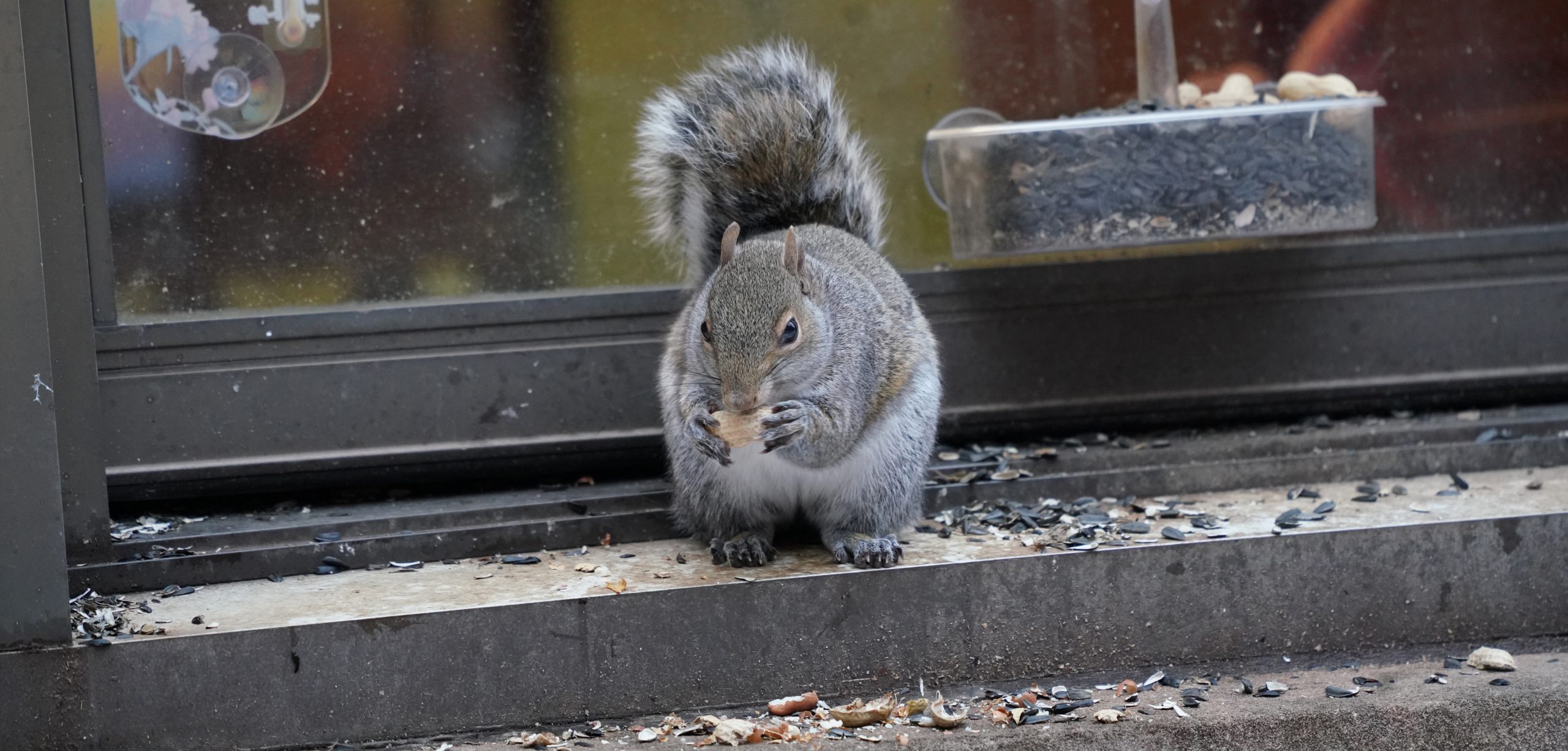
Question: We live in eastern Tippecanoe county and have a couple of adult squirrels that seem to be sick. They act like they are drunk — falling over frequently. We have two apple trees in blossom, and they come and nibble on fallen branches/blooms. As they sit on their hind legs to eat, they fall over on the ground like they are dead. Then after a few minutes/flip around and get up again, only to fall over “dead” again. This has been going on for a few weeks. We also have a baby that is not afraid of people – does not run away from me or our dog. This baby appears to have missing hair/or possible mange? We also had a raccoon in early March that came toward my husband in the yard – was not afraid of him. It did not appear rabid, but did not run away either. We do have several bird feeders, one of which squirrels and chipmunks sit on and eat the bird food. Is what they are eating making them “sick/drunk” or is this something else? I googled and found possible raccoon roundworm? What do YOU think this is — and could these cases be related? How should I dispose of any dead animals, and should I be concerned for us or our dog?
Answer: What you describe could be a number of wildlife diseases. The clinical signs of many of these diseases are often similar and infection can only be determined through specific examinations, tests or lab work. It may be canine distemper. Both squirrels and raccoon can carry canine distemper. The disease is spread by direct contact with body fluids or droppings of an infected animal. Humans cannot get distemper. However, it may also be another disease or a separate disease for each species. Your choices are really to 1) do nothing or 2) contact a wildlife rehabilitator (see below). In Indiana, wildlife rehabilitators have necessary state and federal permits to house and care for sick or injured wild animals. No federal or state agencies will provide care for sick and injured animals.
Since wild animals can carry diseases that are dangerous to people, direct contact with wildlife is discouraged. Just as the case with people, you can’t tell if an animal is sick just by looking at them. Expression of clinical signs of diseases are not the same for every animal. It may also take a period of time for clinical signs to present themselves. An animal that appears perfectly healthy may have a disease, and may be able to transmit the disease.
I could find no specific guidelines for the disposal of dead wild animals. The Indiana State Board of Animal Health lists allowable methods of dead animal disposal, but these do not apply to wildlife, which they specify as creatures not under someone’s care. This is guidance on the DNR website for:
Dead Birds: “According to Indiana State Department of Health guidelines, if you need to dispose of a dead bird, do not handle it with your bare hands. Use gloves or a plastic bag turned inside out over your hand to pick up the bird and dispose of the bird/bag in the trash. You can follow these recommended disposal procedures regardless of the cause of death, if testing is not available.”
Dead Bats: “Do NOT pick up a bat with your bare hands. Any wild animal can carry disease, therefore precautions should be taken if an animal needs to be moved. Wear heavy-duty leather gloves and scoop up the bat with a shovel or container. If the bat is alive move it to a tree branch, away from nearby buildings if possible. To dispose of a dead bat, scoop it into a plastic bag. Place it into another plastic bag, close it securely, spray with disinfectant, and dispose of it in your trash.”
• Indiana Licensed Wildlife Rehabilitators, Indiana Department of Natural Resources – Fish and Wildlife.
Other Resources
Protecting Yourself from Wildlife Diseases: Raccoon Roundworm (Baylisascaris procyonis), The Education Store, Purdue Extension resource center
Indiana Animal Disease Diagnostic Laboratory
Orphaned Wildlife, Got Nature? blog
Orphaned & Injured Animals, Indiana Department of Natural Resources (IDNR)
Purdue Extension – FNR: Ask An Expert, Video, Purdue Extension – Forestry and Natural Resources YouTube channel
Brian MacGowan, Wildlife Extension Specialist
Purdue University, Department of Forestry and Natural Resources
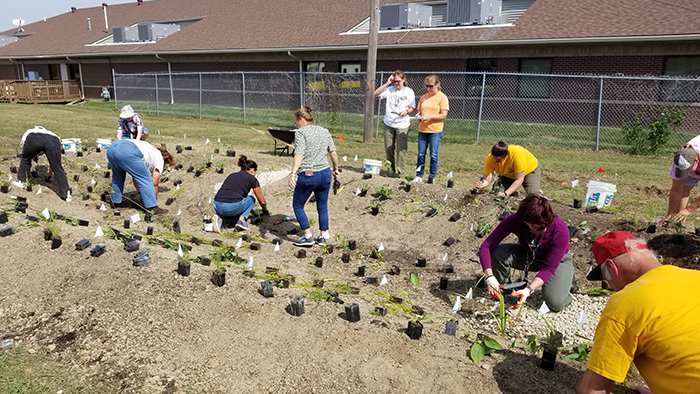
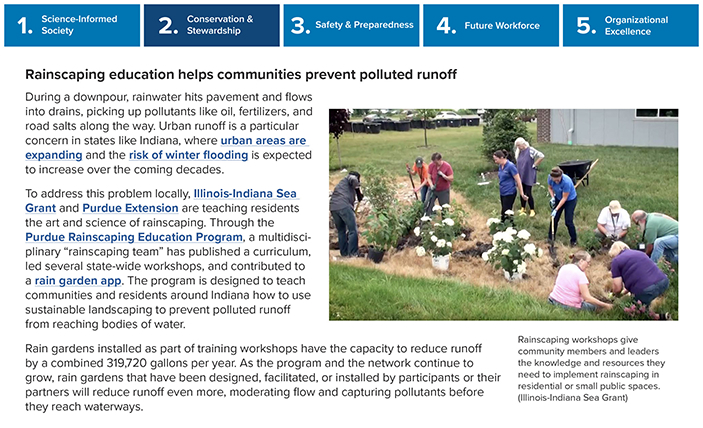
The Purdue Extension and Illinois-Indiana Sea Grant Rainscaping Education Program was highlighted in the National Oceanic and Atmospheric Administration’s Education Accomplishments Report for fiscal year 2019.
This report highlighted all of NOAA’s greatest accomplishments related to education in five main goal areas: science informed society, conservation and stewardship, safety and preparedness, future workforce and organizational excellence.
The Rainscaping Education Program was featured in the Conservation and Stewardship section of the report. The Purdue Rainscaping Education Program offers state-wide training for Purdue Master Gardeners, conservation agencies and organizations, stormwater professionals and landscape companies and consultants. Through two-day workshop sessions, the program provides an introduction to rainscaping and rain gardens, including segments on site selection, plant selection, garden design, installation, maintenance and community engagement.
“It is wonderful to have the innovative and collaborative work of the Purdue Rainscaping Education Team recognized for its efforts,” Kara Salazar, assistant program leader and extension specialist for sustainable communities said. “The team has been working together since 2013 to develop and implement the interdisciplinary program addressing the need for community education on sustainable landscape practices to prevent polluted runoff.”
Salazar and John Orick, Purdue Master Gardener State Coordinator, are co-leads on the project. View the full Rainscaping Team.
The featured segment on the Rainscaping program from the NOAA annual report is below.
Resources
What is Rainscaping? Purdue Rainscaping Education Program Video, Purdue Extension
Q&A About Drainage Water Recycling for the Midwest, The Education Store, Purdue Extension resource center
Become a Purdue Master Gardener, The Education Store
Plan Today For Tomorrow’s Flood, The Education Store
Kara Salazar, Assistant Program Leader and Extension Specialist for Sustainable Communities
Department of Forestry and Natural Resources
ArcGIS.com
Unmanned Aerial Systems and Burn Management Strategies
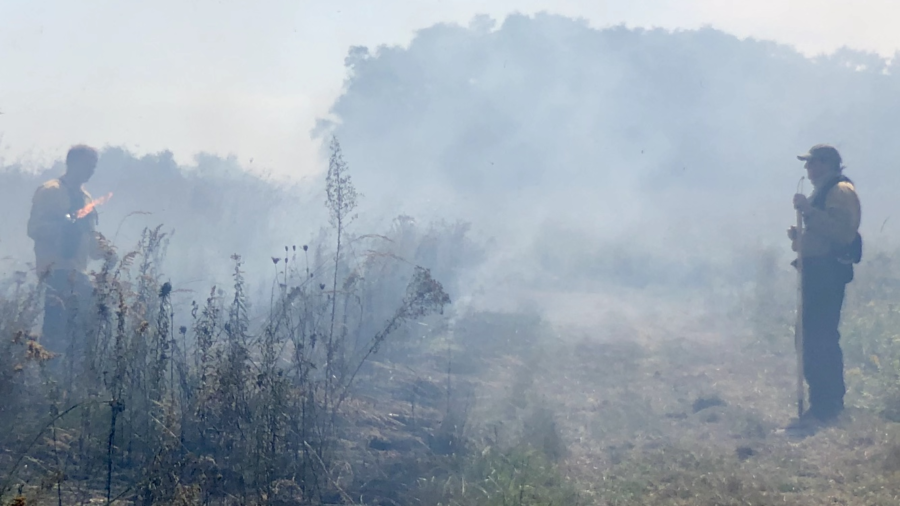
On September 19, 2019 a controlled burn was conducted on the Doak grassland and forest property, owned and managed by the Department of Forestry and Natural Resources at Purdue University. Burn events such as this one present a unique opportunity to demonstrate how UAS can be utilized as an effective tool to both monitor the burn events in real time, but also to effectively gather data before and after the burn to map and better manage vegetation. This collection of maps, videos, and images provide a narrative on how UAS can be used as an effective tool in controlled burn management practices. Beyond controlled burns, the story should demonstrate how UAS can be used to better monitor and inventory other disturbance events, whether they are planned or unexpected.
A Collaborative Effort
The data collected for this event represents a collaborative effort between multiple colleges at Purdue University and private industry. Employees with Purdue Forestry and Natural Resources (College of Agriculture) performed and managed the burn while data collection for the pre and post-burn mapping was conducted by student researchers and pilots from the Purdue School of Aviation and Transportation Technology (SATT; Polytechnic Institute). Peter Menet and Chris Johnson from MenetAero provided aerial monitoring support throughout the controlled burn. A total of three different aircraft were used during this event. The SATT student pilots deployed a C-Astral Bramor PPX equipped with a MicaSense Altum 6 band multispectral sensor at 121 meters before and after the event for mapping purposes. MenetAero deployed a C-Astral C4Eye to monitor the burn in real time using EO/Thermal IR video with real time geographic coordinates at 121 meters while SATT students monitored the burn with a DJI M600 equipped with a Zenmuse XT2 sensor at lower altitudes.
Monitoring the Burn:
The nimble nature of UAS makes them ideally suited to deploy rapidly, and into tight situations otherwise too dangerous for ground crews and manned aircraft. Add to this the aerial perspective offered by UAS via real-time video feed, and you have the perfect platform to assist in hazard events such as fire. The real-time video feed allows the UAS pilot and crew to communicate with ground-based fire crews, providing information on potential hazards and overall fire behavior patterns. For this aerial perspective to be effective, however, the video needs to have geospatial context so what the UAS operator is seeing is effectively communicated to ground-based fire crews. Full-Motion-Video, or video that has metadata with geospatial coordinate information, is a game changer in this regard. The video below shows how software such as Remote Geosystems Line Vision Ultimate can place video in a geospatial context. The video below is being played after the flight, but Pete Menet from MenetAero had the video live streaming to his Ground Station during the flight and was able to effectively serve as an ‘eye in the sky’ to provide real time information to ground based crews. This was all done in a controlled burn, but this same technology and method is used by MenetAero during Wild Fire Events where MenetAero provides UAS services as a contractor with the U.S. Department of Interior. Peter Menet and the MenetAero crew were kind enough to donate their services and time to the controlled burn event this day as part of a collaborative research effort between industry and Purdue.
A Before and After Comparison
Prior to recent advances in UAS technology, gathering imagery at sub-centimeter accuracy and resolution immediately before and after a planned burn event would prove difficult at best. The PPK technology on the C-Astral PPX allowed us to conduct the flights without the need to layout and survey ground control markers, but still achieve centimeter level accuracy by post-processing our data with a Continuously Operating Reference Stations in close proximity. Without UAS, getting satellite data within this time frame would have been pretty much impossible, and getting a manned aircraft to do this prohibitively expensive.
Making Sense of it all through Classification Analysis
Pre-Burn Land Cover Classification
When we think of disturbance events, we often think of the unplanned ones – fire, ice storms, wind storms, floods, etc. But what about planed disturbances such as a controlled burn, or a timber harvest operation? In the case of a planned disturbance, we have the ability to inventory land cover immediately before an event, and then with classification methods, quantify that land cover. Land Use/Cover classification methods are nothing new, and go back to the very beginnings of GIS/Remote Sensing, but new here is the ability to deploy a UAS to get this data in a way that is accurate and precise enough to classify down to resolutions of several square centimeters. Add to that the imagery was gathered less than an hour before the burn and you have some amazing potential for forestland management.
*Thank you to ArcGIS.com for sharing the great work of our FNR specialists as they continue to “strengthen lives and livelihoods” here in Indiana and around the world.
Resources
Unmanned Aerial Systems and Burn Management Strategies, Unmanned Aerial Systems and Burn Management Strategies webpage
Effective Firebreaks for Safe Use of Prescribed Fire, Got Nature? Blog, Purdue University Forestry and Natural Resources Extension
Prescribed fire: 6 things to consider before you ignite, Got Nature? Blog
Renovating native warm-season grass stands for wildlife: A Land Manager’s Guide, The Education Store, Purdue Extension resource center
Calibrating a No-Till Drill for Conservation Plantings and Wildlife Food Plots, The Education Store
Jarred Brooke, Extension Wildlife Specialist
Purdue Department of Forestry and Natural Resources
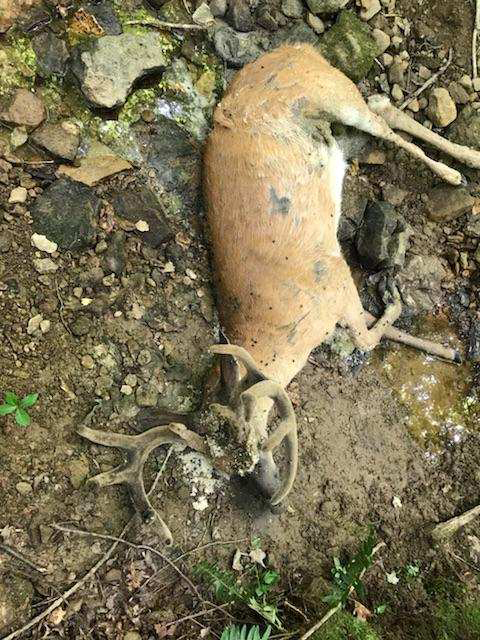
Deer that die from EHD are often found around water. This deer was found in August 2019 in Crawford County and was likely killed by EHD. Photo courtesy of Brody Wade.
Be on the watch for deer with EHD in Indiana
Recently, a white-tailed deer in Clarke County Indiana tested positive for Epizootic Hemorrhagic Disease (EHD), and potential EHD cases have been reported in 26 other Indiana counties. Here are a few things you should know about how EHD, how to spot it, and how to report it.
What is EHD and BTV?
Epizootic hemorrhagic disease (EHD) and bluetongue virus (BTV) are viral diseases, collectively called hemorrhagic diseases (HD), and are common in white-tailed deer. Both diseases are transmitted by biting midges often called “no-see-ums” or gnats. Neither disease is a human health issue, but they can cause significant mortality in white-tailed deer. Outbreaks of HD tend to impact deer populations locally, meaning an outbreak may occur in one part of a county but not in other parts.
When do EHD outbreaks occur?
EHD and BTV outbreaks often occur in late summer and early fall (August-September), especially in years with drought-like conditions. Drought causes water sources to shrink, which creates warm, shallow, and stagnant pockets of water creating ideal breeding habitat for the midges that transmit EHD. Deer also congregate in these areas to find water, which helps the midges pass the disease between infected and healthy deer. EHD outbreaks can last until a frost that kills the midges.
What are the signs of a deer with EHD?
Deer with EHD often appear weak, lethargic, and disoriented. Other signs of EHD in deer are ulcers in the mouth or on the tongue, swollen face, neck, or eyelids, and a bluish color to the tongue. Deer with EHD often search for water to combat the fever caused by the disease. EHD can be confirmed by testing blood and tissue (i.e., spleen) samples, but samples must be collected shortly after death.
Where am I likely to find a deer with EHD?
Because deer with EHD often seek out water to combat the resulting fever, deer killed by EHD are commonly found around water. If you have a stream, creek, river, or other source of water on your property, looking in the vicinity of those areas can help you locate deer that have succumb to EHD.
What do I do if I find a deer I think has EHD?
If you come across a sick or dead deer that you think has EHD you can report it through an online reporting system run by the Indiana DNR. Here is a link to the reporting system: Report a Dead or Sick Deer.
Can deer survive an EHD outbreak?
Yes, some deer will survive EHD. While up to 90% of deer that contract EHD may die from the disease, the deer that survive build up antibodies to EHD, which may make them immune to future outbreaks. Additionally, does may pass the antibodies and immunity to their offspring.
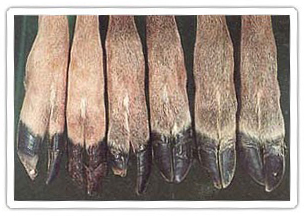
Sloughing or splitting hooves on two or more feet of a deer taken during the fall hunting season are typical of chronic HD. Photo courtesy of the Southeastern Cooperative Wildlife Disease Study.
How can I tell if a deer I killed during hunting season has survived EHD?
If you kill a deer during the hunting season this year, pay attention to the hooves. Deer that survive an EHD outbreak often have indentions or cracks on their hooves (see picture).
Sloughing or splitting hooves on two or more feet of a deer taken during the fall hunting season are typical of chronic HD. Photo used courtesy of the Southeastern Cooperative Wildlife Disease Study.
Are deer that have survived EHD safe to eat?
Yes, deer that have survived EHD are safe to eat.
For updated information on EHD in Indiana check out the Indiana DNR – Epizootic Hemorrhagic Disease web page.
Resources:
Report a Sick or Dead Deer, Indiana Department of Natural Resources (IN-DNR)
EHD Virus in Deer: How to Detect and Report video, Quality Deer Management Association
Epizootic Hemorrhagic Disease, Cornell University
How to Score Your White-Tailed Deer video, Purdue Extension – FNR YouTube Playlist
Deer Harvest Data Collection, Purdue FNR Got Nature? blog
Jarred Brooke, Wildlife Extension Specialist
Purdue Forestry and Natural Resources
United States Department of Agriculture Animal and Plant Health Inspection Service Bulletin: USDA declares August Tree Check Month and urges public to look for Asian longhorned beetle.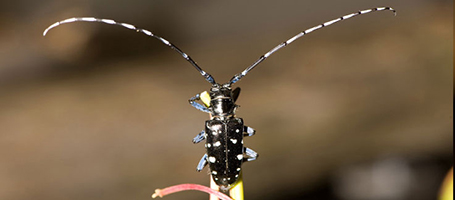
WASHINGTON, July 23, 2019 — August is the height of summer, and it is also the best time to spot the Asian longhorned beetle (ALB) as it starts to emerge from trees. The U.S. Department of Agriculture (USDA) is asking the public to take five minutes to step outside and report any signs of this invasive pest. Checking trees for the beetle will help residents protect their own trees and better direct USDA’s efforts to eradicate this beetle from the United States.
“It’s important to look for signs of the beetle now, because it’s slow to spread during the early stages of an infestation,” said Josie Ryan, APHIS’ National Operations Manager for the ALB Eradication Program. “With the public’s help, we can target new areas where it has spread and provide a better chance of quickly containing it.”
The Asian longhorned beetle feeds on a wide variety of popular hardwood trees, including maple, birch, elm, willow, ash and poplar. It has already led to the loss of more than 180,000 trees. Active infestations are being fought in three areas of the country: Worcester County, MA, Long Island, NY (Nassau and Suffolk Counties), and Clermont County, Ohio.
“Homeowners need to know that infested trees do not recover and will eventually die, becoming safety hazards,” warned Ryan. “USDA removes infested trees as soon as possible because they can drop branches and even fall, especially during storms, and this keeps the pest from spreading to nearby healthy trees.”
The Asian longhorned beetle has distinctive markings that are easy to recognize:
- Antennae that are longer than the insect’s body with black and white bands.
- A shiny, jet-black body with white spots, about 1” to 1 ½” long.
- Six legs and feet, possibly bluish-colored.
Signs of infestation include: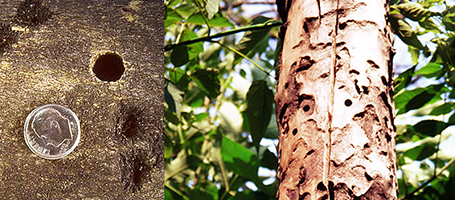
- Round exit holes in tree trunks and branches about the size of a dime or smaller.
- Shallow oval or round scars in the bark where the adult beetle chewed an egg site.
- Sawdust-like material called frass, laying on the ground around the tree or in the branches.
- Dead branches or limbs falling from an otherwise healthy-looking tree.
After seeing signs of the beetle:
- Make note of what was found and where. Take a photo, if possible.
- Try to capture the insect, place in a container, and freeze it. This will preserve it for easier identification.
- Report findings by calling 1-866-702-9938 or completing an online form at USDA Animal and Plant Health Inspection Service.
It is possible to eliminate this pest and USDA has been successfully doing so in several areas. Most recently, the agency declared Stonelick and Batavia Townships in Ohio to be free of the Asian longhorned beetle. We also eradicated the beetle from Illinois, New Jersey, Boston, MA, and parts of New York. The New York City boroughs of Brooklyn and Queens are in the final stages of eradication.
For more information about the Asian longhorned beetle, other ways to keep it from spreading—such as not moving firewood—and eradication program activities, visit USDA Animal and Plant Health Inspection Service. For local inquiries or to speak to your State Plant Health Director, call 1-866-702-9938.
Other Resources:
Report Invasive Species, Purdue Agriculture & Indiana Invasive Species Council
Great Lakes Early Detection Network, Bugwood Apps
New Hope for Fighting Ash Borer, Got Nature? Blog
Mile-a-Minute Invasive Vine Found Indiana, Got Nature? Blog
Sericea Lespedeza: Plague on the Prairie, Got Nature? Blog
Invasive Plants: Impact on Environment and People, The Education Store, Purdue Extension
Invasive Plant Species in Hardwood Tree Plantations, The Education Store
Invasive Plant Species: Callery Pear, Purdue Extension The Education Store
United States Department of Agriculture Animal and Plant Health Inspection Service
Purdue Landscape Report: When was the last time you really looked at your trees? It’s all too easy to just 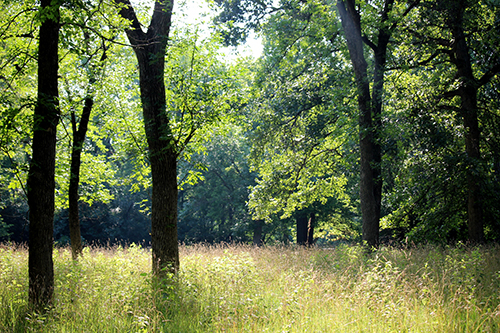 enjoy their cool shade and the sound of their leaves, but if you don’t know what to look for you could miss deadly diseases or dastardly demons lurking in their leaves and branches. A quick check can help you stop a problem before it kills your tree or your local forest!
National Tree Check Month is the perfect time to make sure your tree is in tip-top shape! Our checklist will help you spot early warning signs of native pests and pathogens and invasive pests like Asian longhorned beetle, spotted lanternfly, and sudden oak death. You can stop invasive pests in their tracks by reporting them if you see them.
Is your tree healthy and normal?
Start by making sure you know the type of tree you have. Is it a deciduous tree like an oak or maple? Or is it an evergreen that like a spruce or a pine? Don’t worry about exactly what species it is. It’s enough for you to have a general sense of what the tree should look like when it’s healthy.
Check the leaves
- Are the leaves yellow, red or brown?
- Are they spotted or discolored?
- Do the leaves look distorted or disfigured?
- Is there a sticky liquid on the leaves?
- Do the leaves appear wet, or give off a foul odor?
- Are leaves missing?
- Are parts of the leaves chewed?
Check the trunk and branches
- Are there holes or splits in the trunk or branches?
- Is the bark peeling from a tree that shouldn’t shed its bark?
- Are there tunnels or unusual patterns under the bark?
- Is there sawdust on or under the tree?
- Is there sap oozing down the tree?
- Does the sap have a bad odor?
- Do sticky drops fall on you when you stand under the tree? You might have spotted lanternfly. Please report it right away!
Now what? If you answered YES to any of the questions above, there’s a good chance something is wrong. To decide if and how you should treat or report the problem, you’ll need to have a tentative diagnosis. Luckily, there are many ways to get one!
Know the tree species? Use the Purdue Tree Doctor to get a diagnosis and a recommendation on whether treating or reporting is needed. This app allows you to flip through photos of problem plagued leaves, branches and trunks to help you rapidly identify the problem. If you have an invasive pest, it will guide you how to report it.
Don’t know the tree species and still need help? Reach out to local experts. We’re happy to help!
- Purdue Cooperative Extension Service (https://extension.purdue.edu/) can answer your questions or direct you to a local tree care professional with the right expertise.
- Contact an arborist who can give you an assessment of your tree and specific treatment recommendations (https://www.treesaregood.org/findanarborist).
Confused but think something is TERRIBLY WRONG? Contact Purdue’s Exotic Forest Pest Educator, report online, or call 1-866-NOEXOTIC.
Resources:
Trees and Storms: Understanding Damage, Risk and Recovery – Got Nature? Blog, Purdue Extension – FNR
Why Is My Tree Dying? – Got Nature? Blog, Purdue Extension – Forestry and Natural Resources
Caring for storm-damaged trees/How to Acidify Soil in the Yard, In the Grow, Purdue Extension
Tree Risk Management, The Education Store
Mechanical Damage to Trees: Mowing and Maintenance Equipment, The Education Store
Tree Installation: Process and Practices, The Education Store
Tree Planting Part 1 & Tree Planting Part 2, videos, The Education Store
With all of the recent rain we have had throughout the state, I have received several inquiries about effects on wildlife and what we can expect. While some flooding is natural in low areas and wildlife are adapted to respond, extreme flooding can impact wildlife. Flood waters can wash away nests or drown developing or very young animals for those living in low-lying areas. For example, heavy spring rains can reduce nest success of wild turkeys.
In many cases, wildlife will adapt by simply moving to higher ground. I tend to get an increase in inquiries about snakes after flooding. They begin showing up in neighborhood homes when they have never been observed in years past. Certainly our environment changes over time and wildlife can and do respond to these changes. However, sudden changes are likely due to a response of snakes moving to drier ground. The good news is this and other similar displacement of wildlife is usually temporary.
What can we do? I’m afraid not much for our currently flooded friends. However, in the long-term, times like this reinforce the need to create and enhance quality wildlife habitat. Providing wildlife with quality habitat that contains the necessary food, cover and water resources gives them a fighting chance to deal with issues that inevitably arise. In addition, wetlands that landowners build and restore on their properties not only enhance wildlife habitat, but also help retain moderate flood waters and recharge groundwater supplies.
If some unwanted wildlife has overstayed their welcome in and around your home, check out the Purdue Education Store publication, Considerations for Trapping Nuisance Wildlife with Box Traps. If you think you have found a sick or injured animal, you can find a list of licensed Wild Animal Rehabilitators in your area on the DNR Division of Fish and Wildlife’s Orphaned and Injured webpage. In Indiana, wildlife rehabilitators have necessary state and federal permits to house and care for sick or injured wild animals.
Additional Resources
Preventing Wildlife Damage – Do You Need a Permit? The Education Store, Purdue Extension
The Basics of Managing Wildlife on Agricultural Lands, The Education Store, Purdue Extension
Brian J. MacGowan, Extension Wildlife Specialist
Department of Forestry and Natural Resources, Purdue University
Cockroaches are serious threats to human health. They carry dozens of types of bacteria, such as E. coli and salmonella, that can sicken people. And the saliva, feces and body parts they leave behind may not only trigger allergies and asthma but could cause the condition in some children.
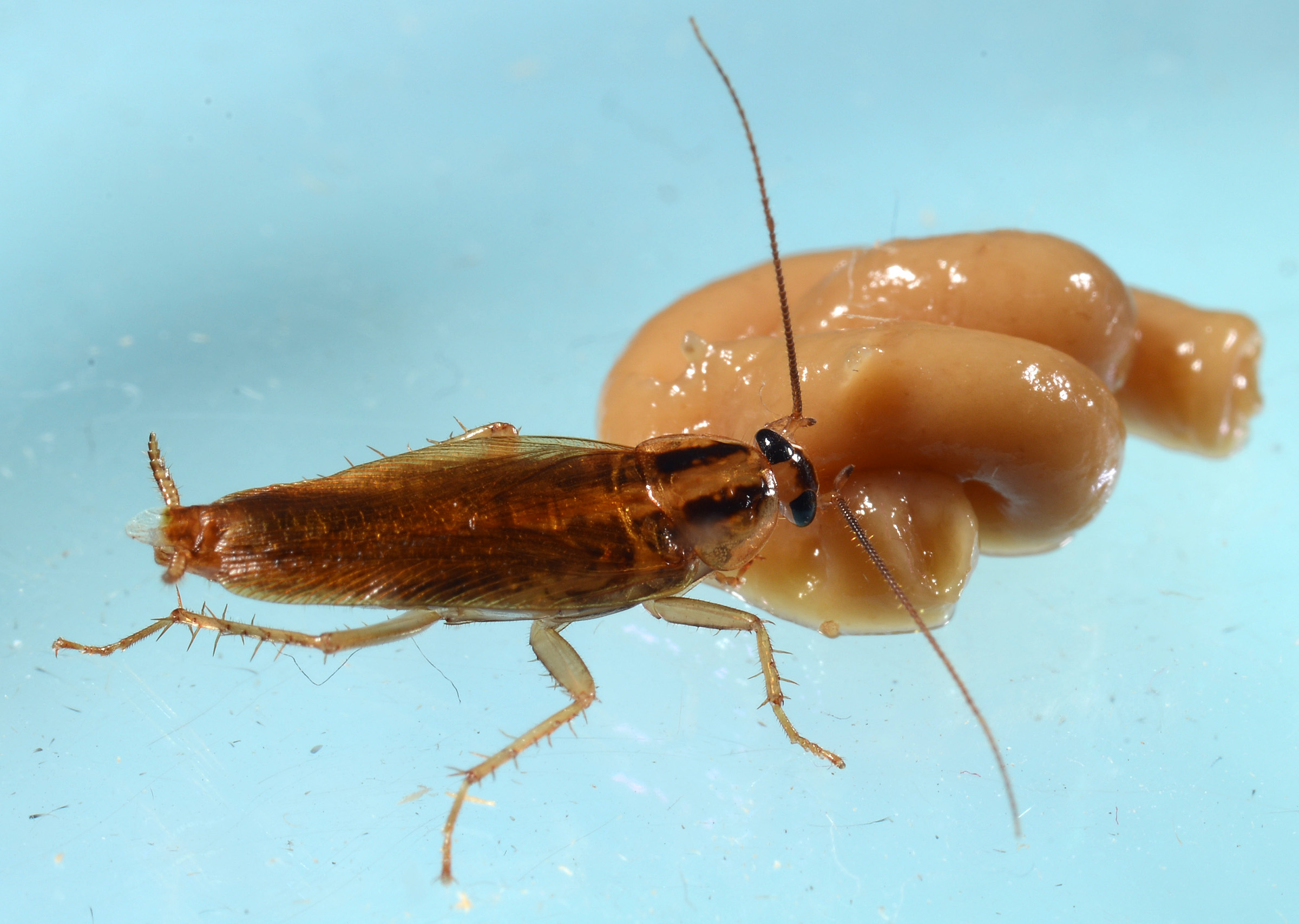
A German cockroach feeds on an insecticide in the laboratory portion of a Purdue University study that determined the insects are gaining cross-resistance to multiple insecticides at one time. (Photo by John Obermeyer/Purdue Entomology)
A Purdue University study led by Michael Scharf, professor and O.W. Rollins/Orkin Chair in the Department of Entomology, now finds evidence that German cockroaches (Blattella germanica L.) are becoming more difficult to eliminate as they develop cross-resistance to exterminators’ best insecticides. The problem is especially prevalent in urban areas and in low-income or federally subsidized housing where resources to effectively combat the pests aren’t as available.
“This is a previously unrealized challenge in cockroaches,” said Scharf, whose findings were published in the journal Scientific Reports. “Cockroaches developing resistance to multiple classes of insecticides at once will make controlling these pests almost impossible with chemicals alone.”
Each class of insecticide works in a different way to kill cockroaches. Exterminators will often use insecticides that are a mixture of multiple classes or change classes from treatment to treatment. The hope is that even if a small percentage of cockroaches is resistant to one class, insecticides from other classes will eliminate them.
Scharf and his study co-authors set out to test those methods at multi-unit buildings in Indiana and Illinois over six months. In one treatment, three insecticides from different classes were rotated into use each month for three months and then repeated. In the second, they used a mixture of two insecticides from different classes for six months. In the third, they chose an insecticide to which cockroaches had low-level starting resistance and used it the entire time.
In each location, cockroaches were captured before the study and lab-tested to determine the most effective insecticides for each treatment, setting up the scientists for the best possible outcomes.
“If you have the ability to test the roaches first and pick an insecticide that has low resistance, that ups the odds,” Scharf said. “But even then, we had trouble controlling populations.”
For full article: Rapid cross-resistance bringing cockroaches closer to invincibility.
Resources
Report Invasive Species, Purdue Agriculture & Indiana Invasive Species Council
Purdue experts encourage ‘citizen scientists’ to report invasive species, Purdue Agriculture News
New Hope for Fighting Ash Borer, Got Nature? Blog, Purdue Forestry and Natural Resources
Mile-a-Minute Invasive Vine Found Indiana, Got Nature? Blog
Sericea Lespedeza: Plague on the Prairie, Got Nature? Blog
Michael E. Scharf, Professor and O.W. Rollins/Orkin Chair
Purdue Department of Entomology
Brian J. Wallheimer, Science Writer
Purdue College of Agriculture

Recent Posts
- Deer and Turkey Archery Seasons Opening Soon, MyDNR
Posted: October 13, 2026 in Alert, Safety, Wildlife - Burning for Benefits: Why Fire Belongs in Indiana
Posted: October 12, 2026 in Forestry, Safety, Woodlands - Is It Too Early to Think About Christmas Tree Pests?
Posted: September 22, 2026 in Christmas Trees, Invasive Insects, Safety - Heavy August Rains Bring More Mosquitoes to Indiana
Posted: September 9, 2026 in How To, Invasive Insects, Safety, Wildlife - Lighting a Spark: Prescribed Burn Associations
Posted: August 6, 2026 in Community Development, Forestry, Safety, Wildlife - Jarred Brooke Receives Early Career Award for Prescribed Fire Work
Posted: July 20, 2026 in Forestry, Forests and Street Trees, Natural Resource Planning, Safety - IN-PREPared: Essential Resources for Indiana’s Severe Weather Season
Posted: March 11, 2026 in How To, Safety - Fall Tree Care Tips
Posted: September 20, 2025 in Forestry, Forests and Street Trees, Gardening, How To, Land Use, Plants, Safety, Timber Marketing, Urban Forestry, Wood Products/Manufacturing, Woodlands - Researchers Study Deer-Vehicle Collision Reduction Method
Posted: July 31, 2024 in Safety, Wildlife - MyDNR – First positive case of chronic wasting disease in Indiana
Posted: April 29, 2024 in Alert, Disease, How To, Safety, Wildlife
Archives
Categories
- Alert
- Aquaculture/Fish
- Aquatic/Aquaculture Resources
- Ask the Expert
- Christmas Trees
- Community Development
- Disease
- Drought
- Forestry
- Forests and Street Trees
- Gardening
- Got Nature for Kids
- Great Lakes
- How To
- Invasive Animal Species
- Invasive Insects
- Invasive Plant Species
- Land Use
- Natural Resource Planning
- Nature of Teaching
- Plants
- Podcasts
- Ponds
- Publication
- Safety
- Spiders
- Timber Marketing
- Urban Forestry
- Webinar
- Wildlife
- Wood Products/Manufacturing
- Woodland Management Moment
- Woodlands