 Purdue University - Extension - Forestry and Natural Resources
Got Nature? Blog
“Why is my tree starting to die just after I built my house?”
This is a common question following new construction. Typically, trees don’t die immediately from construction damage. It often takes several years for the symptoms to develop. Connecting today’s dying tree to the damage of a few years ago is difficult for homeowners to recognize and diagnose. So what actually kills trees in a formerly wooded lot turned into a subdivision or home lot? The words “formerly wooded” should be a clue.
After selectively clearing all but the best trees on the building site, landscape equipment such as bulldozers, skid steer loaders and excavators begin to grade the lot surface into a level, compacted plane. Building infrastructure, such as the foundation, utilities, walks and driveways, is cut into place for the site. As the building process occurs, several things may happen, none of which is good for trees.
Soil and Root System Changes
Oftentimes, the below ground damage to trees is the most significant and most difficult to diagnose and remedy. Even minor changes to the soil grade or soil profile can produce negative responses from trees. Whether removing or adding soil around the roots of trees, extreme caution is advised.
Undisturbed soils, such as those found in a forested area, are composed of layers, or horizons. The lop layer occupies the upper 6 inches to 12 inches and is rich in nutrients and organic matter. This is the soil component usually missing in new home construction because of the grading and leveling process. The topsoil is typically removed, stockpiled or used elsewhere in random areas around the site.
Important chemical processes take place in this topsoil/root layer that enable trees to absorb essential nutrients and water. If a tree is unable to obtain these in sufficient quantities, decline and, eventually, death will occur. This is typical on construction sites because disturbed soils lack good structure and composition.
 Soil consists of various sized particles depending upon type and composition: sand, silt and clay. In addition to the solid parts of the soil, plants need open spaces between the particles. It is recommended that soils should contain at least 12 percent oxygen for good root growth.
The compaction from equipment running over the soil in the leveling process forces these spaces together, leaving as little as 2 to 4 percent of the necessary oxygen in the soil. Unfortunately, once the soil is ready for the home, sidewalk and driveway, it’s no longer suitable for root growth or tree survival.
A relatively flat, compacted surface is required to build a home. This is achieved by grading the existing soil surface. Large equipment is used to level and compact the soil to get the bulk density necessary to support the home or structure. Soil conditions required to support a house and the necessary infrastructure are different from, and in sharp contrast to, the soils of the formerly wooded lot. Undisturbed soils, such as those in a forest, are pliable and easily penetrated by the roots because needed open spaces or pores in the soil are filled with life supporting oxygen and water.
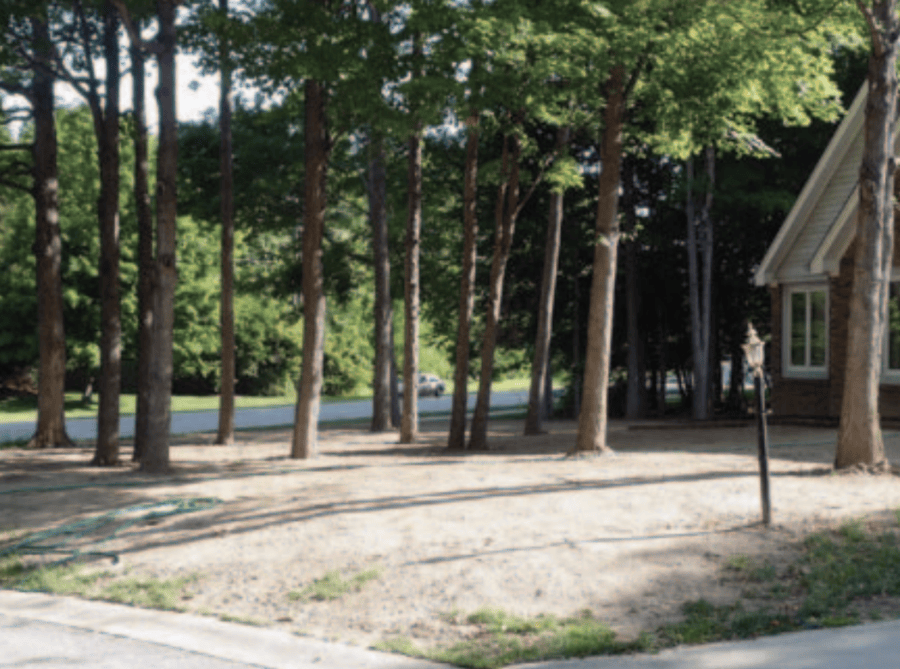 The excavation and grading processes create a “hard pan” and remove the valuable topsoil, leaving the remaining topsoil to be used for leveling and covering the lot. This subsoil usually is compacted, nutrient-poor and lacking pore space for water and oxygen, and not suitable for long-lasting, healthy trees.
Soil Grade Changes
One of the most common causes of decline in trees on the construction site is raising the grade or soil level around existing trees. “Filling” graded areas on the site raises the level of soil and covers the original soil. This causes damage to tree root systems by cutting off the oxygen supply, preventing gas exchange between soil and air. In addition, an existing tree grows accustomed to a certain amount of water it receives. Cutting or filling soil around a tree disrupts normal water flow and either deprives the tree of water or creates excessive soil moisture. Trees can decline and die with as little as 1 inch of clay-type soils added to the existing grade. So changing the level of soils around a tree and allowing these fill soils to touch the tree can be fatal!
Studies have shown that fill soil over the root system greatly reduces the root system. In a short time, roots begin to decay and die back, causing overall decline in the tree and significantly increasing the risk of tree failure. Often this type of root damage doesn’t reveal itself for several years. Symptoms may be observed, such as untimely fall color or declining and dying branches in the upper and outermost parts of the tree canopy.
Physical Damage
Careless operation of equipment around trees can cause severe damage to trees and compromise their future health. Any damage to the tree trunk can create conditions that affect health and safety.
Construction equipment can injure the aboveground and below ground parts of a tree by breaking branches, tearing the bark, wounding the trunk or cutting trunk flares and roots. These injuries are permanent and can kill a tree.
Root Cutting
Excavating for foundations and other structures on the site severs the roots of those chosen trees remaining on the site. Since a majority of a tree’s root system is found in the topsoil area, these building processes can be devastating.
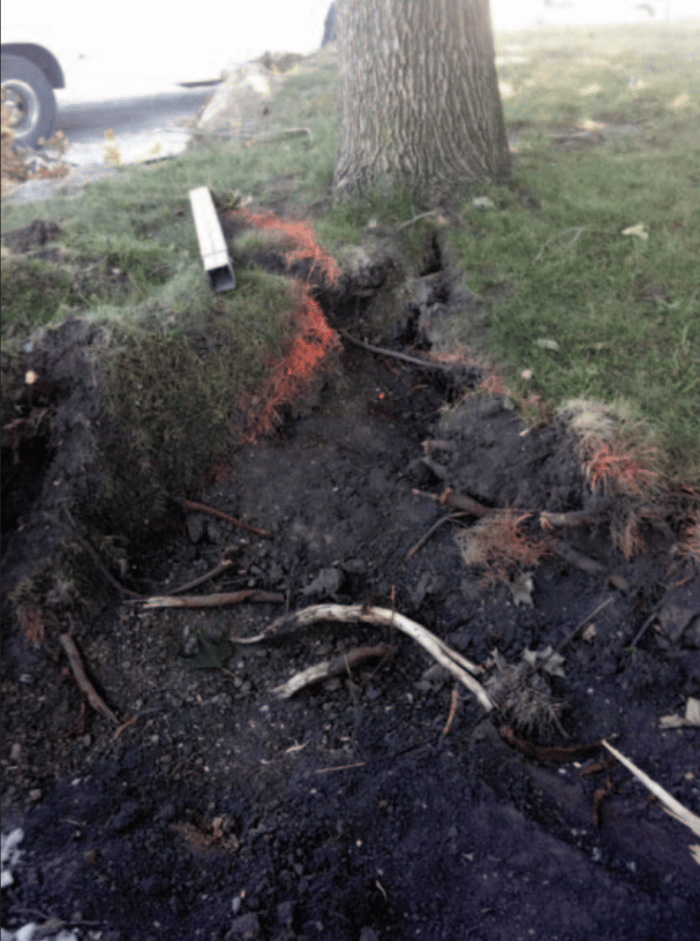
Research indicates that a large portion of most tree roots grow in the upper 12 inches of the soil profile and can spread laterally up to 2 to 3 times the height of the tree. For example, the root system of a 50-foot shade tree can be found in a 150-foot circle around the trunk. Therefore, digging foundations, sidewalks or driveways drastically reduces important root structures of these carefully selected trees. Reducing the root system lessens a tree’s ability to absorb the water and nutrients that are essential for growth. This root loss also places additional stress on the tree as it tries to recover by using stored carbohydrate reserves, further weakening the tree and making it more susceptible to insects and disease.
Root cutting near a tree also reduces stability and increases risk to the owner. Research indicates if 40 percent of the roots are cut, the tree becomes 40 percent less stable, making it more susceptible to windthrow.
Trunk and Crown Damage
The vascular system of a tree lies just beneath the bark in an area called the cambium layer. This includes the water and food-conducting tissue known as the xylem and phloem. Any injury to the cambium layer on the trunk and branches creates a wound disrupting the flow of the conducting tissue. If the damage is severe enough, the tree can die. The affected area on the trunk or branches takes months to years to heal. In some tree species which don’t heal well, the wound may never close. In this time, fungi and other wood-decaying organisms can enter the tree. This decay can begin spreading to other parts of the tree, causing more health issues for the tree and risk for the owner.
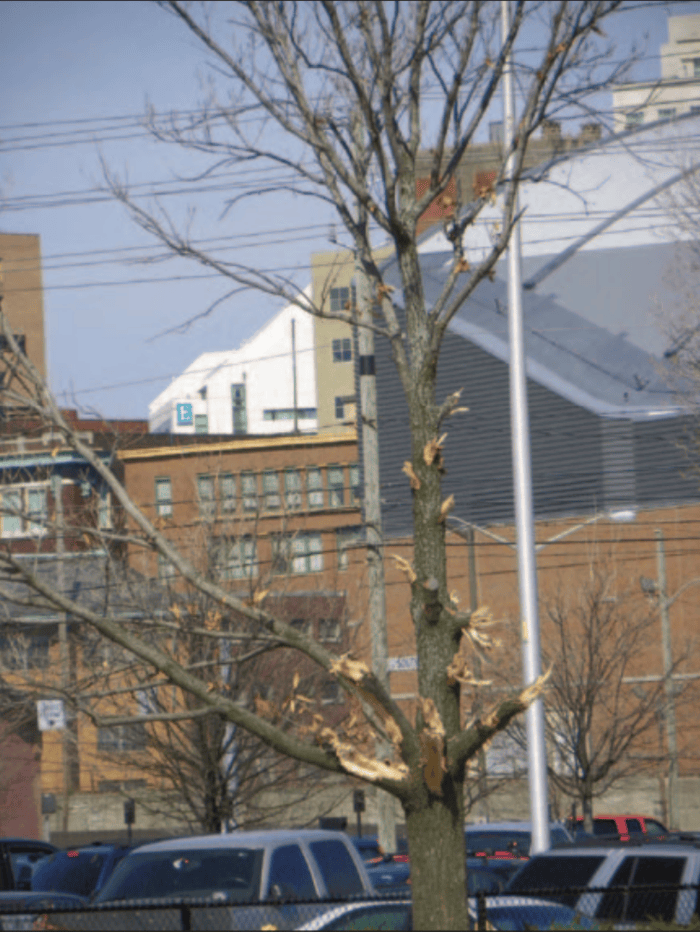 Construction damage causes health and survival issues for trees and creates risk issues for people and the property around them. Tree damage above and below ground creates weaknesses in the tree structure and reduces its ability to withstand storms and other weather-related events.
So, why does the tree seem to decline and die within a few years of construction?
The answer is reduced health and inability to perform critical plant functions because of direct or indirect damage to the tree or its soil environment.
For example, as normal photosynthesis occurs, trees store carbohydrates for next year’s growth. If a tree was healthy and growing before construction, functions such as processing food for energy storage were in effect for the coming year. When that process and any other critical function is interrupted by root damage and soil changes, the tree begins to use up its food reserves and becomes unable to replace them. This drastically weakens the tree and predisposes it to other issues such as insect and disease infestations. Trees unable to continue their basic processes won’t function well and the result is gradual decline, dieback and death. Protecting trees now prevents problems in the future. Preservation is critical for those who would save existing trees on a construction site.
To prevent this type of tree damage during construction also refer to Purdue Extension publication FNR-463-W, Construction and Trees: Guidelines for Protection.
Resources:
Planting Your Tree Part 1: Choosing Your Tree, Purdue Extension YouTube Channel
Tree Planting Part 2: Planting a Tree, Purdue Extension YouTube Channel
Tree Installation: Process and Practices, The Education Store
Tree Pruning Essentials, The Education Store
Tree Pruning Essentials Video, Purdue Extension YouTube Channel
Drought Information, Indiana Department of Natural Resources
Drought? Don’t forget the trees!, The Education Store
Tree Defect Identification, The Education Store
Tree Wound and Healing, Got Nature? Blog, Purdue Extension – Forestry and Natural Resources
Surface Root Syndrome, The Education Store
Find an Arborist video, Trees are Good-International Society of Arboriculture (ISA)
Trees and Storms: Understanding Damage, Risk and Recovery – Got Nature? Blog, Purdue Extension – FNR
Indiana Invasive Species Council
ID That Tree, Playlist, Purdue Extension – FNR YouTube Channel (Invasive White Mulberry, Siberian Elm, Tree of Heaven)
Fifty Common Trees of Indiana
An Introduction to Trees of Indiana
Native Trees of the Midwest, The Education Store
Subscribe – Purdue Extension-FNR YouTube Channel
Lindsey Purcell, Executive Director
Indiana Arborist Association

Recent Posts
- Disease May Cause Wilting and Eventual Death of Certain Trees and Shrubs, Purdue Landscape Report
Posted: October 5, 2026 in Disease, Forestry, Plants - October Is Firewood Month: Protect Indiana’s Forests by Making Smart Choices
Posted: October 1, 2026 in Forestry, Forests and Street Trees, How To, Invasive Insects, Urban Forestry - Minecraft Meets the Hellbender
Posted: September 22, 2026 in Aquaculture/Fish, Aquatic/Aquaculture Resources, Wildlife - Is It Too Early to Think About Christmas Tree Pests?
Posted: in Christmas Trees, Invasive Insects, Safety - What You Plant Matters to Wildlife
Posted: September 16, 2026 in Plants, Urban Forestry, Wildlife - Woodland Flowers of Late Summer
Posted: September 14, 2026 in Forestry, Gardening, Wildlife, Woodlands - Heavy August Rains Bring More Mosquitoes to Indiana
Posted: September 9, 2026 in How To, Invasive Insects, Safety, Wildlife - Question: Why Did the Shagbark Hickories Survive the Tornado?
Posted: August 27, 2026 in Forests and Street Trees, How To, Urban Forestry - New Indiana Woodland Steward Newsletter
Posted: August 12, 2026 in Forestry, Urban Forestry, Wildlife, Woodlands - Indiana Fall Hunting Licenses on Sale and New Mobile App Available
Posted: in Forestry, How To, Wildlife
Archives
Categories
- Alert
- Aquaculture/Fish
- Aquatic/Aquaculture Resources
- Ask the Expert
- Christmas Trees
- Community Development
- Disease
- Drought
- Forestry
- Forests and Street Trees
- Gardening
- Got Nature for Kids
- Great Lakes
- How To
- Invasive Animal Species
- Invasive Insects
- Invasive Plant Species
- Land Use
- Natural Resource Planning
- Nature of Teaching
- Plants
- Podcasts
- Ponds
- Publication
- Safety
- Spiders
- Timber Marketing
- Urban Forestry
- Webinar
- Wildlife
- Wood Products/Manufacturing
- Woodland Management Moment
- Woodlands