Purdue Landscape Report: Recently, there has been an uptick in questions related to one of Indiana’s most notorious invasive pests: the emerald ash borer. Homeowners, businesses, even professionals have asked if ash trees are still present in Indiana, and if the insect is still a threat to our ecosystem. Emerald ash borer wreaked significant havoc among Indiana’s hardwoods, and a person could be forgiven for believing that there are no ash trees at all in our state, but this is simply not true. Ash still survives in Indiana and can be found both as ornamental plantings and in untended woodlots; unfortunately, emerald ash borer is also still present and just as deadly to them as ever. The question of protecting ash versus removal them is complex, but entomologists and tree specialists have learned from this insect’s invasion.
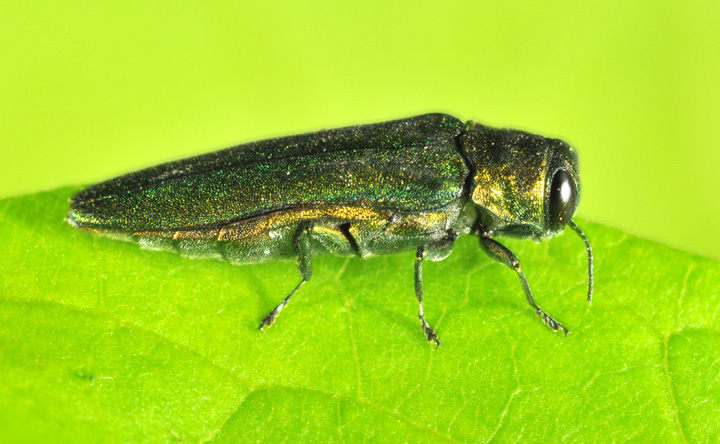
Figure 1. Side view of EAB, John Obermeyer
The emerald ash borer (Agrilus planipennis), a wood-boring insect native to Asia, is responsible for decimating ash (Fraxinus spp.) throughout the United States and elsewhere. In Indiana, this insect’s presence was confirmed in 2004, though it had probably been in the state for some time before then. Since its arrival, Hoosiers have been forced to watch as ash trees have rapidly declined and died due to the insect’s feeding and life cycle. The insect lays its eggs in crevices in the bark of an ash that is 8 to 10 years old, and after hatching, the new larvae begin to bore through the tree’s cambium tissue. The tree relies on its cambium tissue to transport water and nutrients and supply cells for new growth. Often, the only signs of the insect’s presence are a reduction in canopy coverage and D-shaped exit holes in the bark, indicating adult emergence. As time goes on, however, the tree will continue to lose canopy, experience limb death, and often have large chunks of bark detach. Unprotected trees will typically die within 2 to 5 years of infestation. Dead and dying ash trees represent a serious hazard to health and property as infestation will leave them extremely brittle. Brittle ash will often fall during weather events or even collapse over time as limbs fall off.
While emerald ash borer did significant damage to ash tree populations in Indiana, they did not destroy the population entirely. While virtually all untreated trees will eventually become infested, saplings with a trunk diameter of ½ to 1 inch will remain untouched, allowing annual replacement of trees to continue. Since the initial invasion killed so many trees, the borer’s populations have been proportionally reduced as well due to a lack of a food source. This combination of factors has created a cycle of growth and infestation that allows both populations to survive, but at significantly lower levels as compared to the period of the initial infestation. Unfortunately, this also means that emerald ash borer is now a permanent fixture in the hardwood ecosystem in Indiana.
Figure 2. This photo illustration shows three ash trees in Bloomington, Indiana, with different levels of canopy lost to the emerald ash borer. (Purdue Tree Doctor app illustration/Cliff Sadof)
While many may believe ash trees are a total loss, there are still options to protect ash tree and even rescue ash that have already been infested. The first step in this process is to determine the extent of damage in a given tree. As the cambium tissue is consume by ash borer larvae, the tree will experience a steady loss of canopy and limb death. The proportion of lost canopy makes a great indicator for treatment viability. For example, a tree that has only lost 10% of its canopy will normally respond well to treatment. As more canopy is lost, recovery is more challenging, until the tree has lost %30 of canopy coverage. After that point, there is very little chance that a rescue treatment will be successful, and removal will most likely be necessary. It is also important to remember that limb death may occur; these limbs will not recover and will need to be removed to avoid any potential hazards.
There are several insecticides with varying ranges of efficacy that can be used to manage emerald ash borer. These include imidacloprid, dinotefuran, azadirachtin, and emamectin benzoate. Several studies have been conducted to find the best combination of chemical and application type, such as the difference between using a soil drench compared to a trunk injection. While all of the above chemicals can be effective against the insect, the combination of emamectin benzoate applied through a trunk injection offers the best, longest lasting protection from infestation. This combination has a durable effect lasting for two years under dense infestations. However, the reduction in emerald ash borer populations have spread the distribution of the insect thinner, and longer intervals between treatments are possible. A ten-year study conducted by Purdue University demonstrated that treating trees once every three years provided sufficient protection from the beetles, while also showing that 4 to 5 years after last treatment coincided with an increase in damage to the trees. This same study also found that by six years post-treatment, the trees would decline to the point of making removal a necessity. This research concluded that increasing time between intervals after three years increased the risk of catastrophic damage due to emerald ash borer activity, thus the recommendation for three-year intervals.
Ultimately, many will see this as a financial issue: the cost of treatment over time against the cost of removal to avoid potential damages. The above study estimated the cost of treating a single tree with an emamectin benzoate injection at $300 per treatment. Since treatment only needs to happen once every three years, the cost per year per tree would be $100, approximately. Tree removal was estimated between $1800 and $3600, depending on tree location and other factors. Also consider replacement costs if you wanted to continue to grow ash in that area, and how long the tree would need to grow to match the size of the tree you just replaced. Additionally, add in any treatment costs to make sure it survives infestation. When looked at from this angle, maintaining regular treatment on rescuable trees would appear to be the most cost-effective route for managing ash. Any treatment plan should be discussed with a professional, such as a certified arborist.
Purdue Landscape Report:April showers bring May Flowers. Many of us were taught this little rhyme to describe the weather of Spring. April has arrived along with the beginning of the Spring storm season and damage to and from trees is a topic of concern on many minds. Depending on the intensity of the storms and the condition of the trees, damage from high winds, heavy rainfall, and lightning can be quite severe. Cracked or broken branches, stem failure, and root failure are some of the main concerns, but also the risk and liability of damage to people and property.
Storm season is upon us. There are a number of resources from Purdue to help dealing with storm-damaged trees.
If your tree is damaged, there are some steps to deal with the situation. First and foremost, consider the safety of yourself and others around you. Inspect the tree from a distance first, looking for the following:
Heaving of the ground, indicating potential root failure
Damage to limbs and/or the trunk of the tree
Hanging branches can fall to the ground, resulting in injury or death
Be aware of utility and power lines. Trees can become charged by coming in contact with live wires. All utility lines should be considered energized and dangerous.
If you find your trees damaged from a storm hiring an International Society of Arboriculture (ISA) Certified Arborist to perform a risk assessment will help guide your decision of how to manage your tree. To find an arborist near you and verify credentials, use the link at Find an Arborist, Trees are Good, International Society of Arboriculture (ISA). For more information, you can also view the publication Trees and Storms, located in The Education Store, Purdue Extension’s resource center.
Lenny Farlee, sustaining hardwood Extension specialist for Purdue’s Department of Forestry and Natural Resources (FNR), has been named a 2024 Fellow of the Society of American Foresters (SAF). The SAF Fellow Award, one of the highest honors bestowed on an SAF member by their peers, recognizes long-standing service to forestry at the local, state, regional and national levels.
Farlee was honored with the award during the 2024 SAF National Convention, which took place in Loveland, Colorado from Sept. 17-20.
Zhao Ma accepts the 2024 Family Forests Education Award on behalf of Lenny Farlee and the other project team members.
“Being named a Fellow of the Society of American Foresters is particularly meaningful to me since it originates from a nomination by my peers at the state level,” Farlee said. “I am very grateful that my colleagues in forestry here in Indiana considered my service worthy of recognition, and I owe much of the credit to them for their support of me through my career. It has been my privilege to serve the people and the profession as an Extension forester here at Purdue.”
Farlee educates people about forestry in many ways, including through the popular Extension YouTube series “ID That Tree,” which has over 100,000 views.
Farlee, Ronald Rathfon, Don Carlson, Jonathan Ferris,Dave Osborne and Phil Woolery worked together to develop the course. The course introduces forest landowners to the biology and management of forests and what resources and professional assistance are available. According to survey results from 2021 participants, “94.4% stated that the information was useful to help them make future decisions and 92.5% stated that the information was useful to help act to manage their property objectives.”
“We in FNR, along with forestry professionals in Indiana and the landowners who have communicated with Lenny and his colleagues through the ‘Forest Management for the Private Woodland Owner’ course, know how valuable this program has been to sustainable forest management in Indiana,” said Zhao Ma, interim department head and professor of forestry and natural resources. “So it is absolutely wonderful when others outside of our FNR community and beyond Indiana also recognize the excellent work that Lenny and his colleagues have been doing…, I would also like to share one more note about Lenny – not only has Lenny been a highly valued and respected member of FNR and the forestry profession for many years, but he is also one of the nicest people I have met. He is knowledgeable yet humble, effective yet gentle, serious about his work yet able to have fun, very busy yet always willing to help others and try to be present. We are lucky to have Lenny as our colleague in FNR.”
Purdue Landscape Report: August was National Check Your Tree Month, but this is something that every tree owner/manager should be doing year-round. As the last hot days of summer are finishing up and we look forward to cooler fall days, we can look to our trees for different signs of trouble.
Most people tend to look up at the canopy before anything else in trees. Check leaves for dieback, discoloration, stickiness or signs of chewing. Check branches and the main stem for damage like splits and breaks, peeling bark, tunneling patterns under the bark, oozing wet spots, or sawdust around the tree. These could be signs of issues in the root system, pathogens like bacteria or fungal organisms, insect problems, or structural damage.
This is not an exhaustive list and if you notice these or anything else that seems off, it could be time for a deeper dive into what might be wrong. If you know the species of your tree the Purdue Plant Doctor is a great tool to narrow down a diagnosis. You can also contact your local Extension office or an ISA Certified Arborist.
On a more positive side, you don’t have to be on the lookout for damage, decline, or signs of pathogens and pests. It is also a matter of enjoying the trees in your landscape. Take some time out of your day to sit in the shade especially as we transition from hot summer temperatures into the cooling of autumn. Revel in the color changes as chlorophyll production slows revealing the carotenoids (that give us yellows, oranges, and browns) and anthocyanin (that produces reds and purples). In winter, not only can you better see damage in the canopy hidden by leaves in the growing seasons, but also the structure and architecture of the canopies in different tree species and the differences in bark textures. And in Spring, new growth of leaves and flowers shows us Winter is nearing its end, bringing warmer days.
So check your trees throughout the year. But not only for potential issues and risk management but also for enjoyment. Trees offer us no many benefits and sometimes it takes a little reminder. If you do see any signs of decline or damage, again, be sure to contact your local Extension office or an ISA Certified Arborist.
In this edition of ID That Tree, Purdue Extension forester Lenny Farlee takes us through the different characteristics of coniferous trees found here in Indiana, particularly their foliage and the features that pertain to them. Come along as we look through real examples of shape, scales, leaf and branches of various local trees. The featured species include Eastern red cedarwood, Northern white cedar, and more.
If you have any questions regarding wildlife, trees, forest management, wood products, natural resource planning or other natural resource topics, feel free to contact us by using our Ask an Expert web page.
In this episode of A Woodland Management Moment, Purdue Extension forester Lenny Farlee talks about the importance of oak regeneration. Oak is a ‘keystone’ species, integral to supporting many different facets of wildlife. This includes insects to large mammals all across the environment in Indiana and the central hardwood region. This video also shares details regarding Purdue’s initiatives to ensure the diverse ecosystems maintained by oak and to provide the resources needed to keep regenerating this integral tree
If you have any questions regarding trees, forests, wildlife, wood products or other natural resource topics, feel free to contact us by using our Ask an Expert web page.
The long lifespan of many trees, which could be centuries or even millennia in the case of a few species, is a source of awe and inspiration for many. The bark of trees can often tell some stories about their life and history, if we know how to interpret what we see. Here are a few examples you may run across in Indiana.
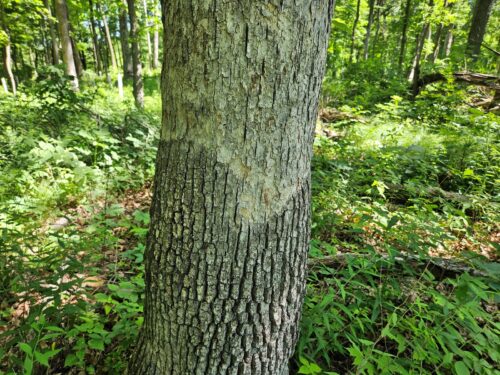
Is this tree sick? That may be a natural question to ask when looking at the striking difference in the bark pattern on this white oak. In fact, it is an infection, but not a harmful one to the survival of the tree. This is called smooth patch and is caused by a fungus that infects the outer bark of oak and some other tree species. There are several species of fungus that may cause this appearance, but the most common is Aleurodiscus oakesii. The fungus gradually decomposes the outer layers of bark, producing the flattened and smooth surfaces which contrast with the rough bark that is uninfected. If you look closely during moist periods, you may see the small cup-shaped fruiting bodies of the fungus on the bark. It is not a threat to the health or integrity of the tree as only the outer bark is impacted.
Figure 1 – Smooth patch on white oak. The normal bark pattern can be seen on the lower trunk.
Figure 2 – Smooth patch fungus, Aleurodiscus oakesii, fruiting body on white oak bark.
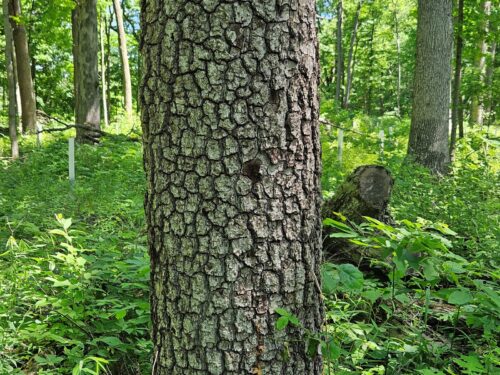
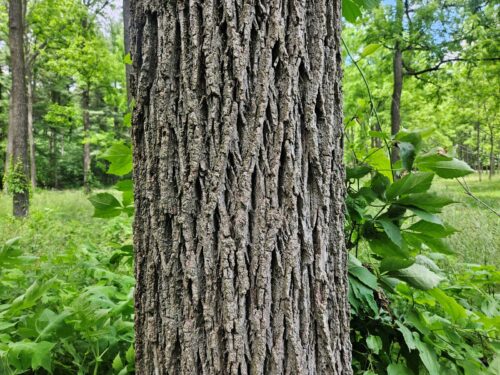
This isn’t the same species of tree, is it? Yes, it is! Bark pattern differences in some species may reflect the growth rate or relative vigor of the tree. These photos show black walnut bark from two very different growing sites. The blocky, alligator-hide bark pattern is often an indication of slow growth and may result from a tree growing on a very difficult site, like the dry hilltop where this tree is located, or severe competition from surrounding trees. The strongly interlacing ridges of the bark in the second photo are from a black walnut growing in a plantation on a creek bench with deep, moist and fertile soils, resulting in more vigorous growth.
Figure 3 – Black walnut with slow-growth bark pattern.
Figure 4 – Black walnut with vigorous growth bark pattern.
What happened here? The pattern in a horizontal line across these trees looks too perfect to be natural, but it was not produced by a human. This is the feeding activity of the yellow-bellied sapsucker, a species of woodpecker that migrates through Indiana. The sapsucker, true to its name, uses its sharp bill to create holes through the bark that ooze sap. The sapsucker feeds on the sap and may also feed on insects drawn to the sap. They tend to create straight lines of holes that leave this diagnostic pattern behind, even long after the birds have ceased their activity. This activity is usually not fatal to the tree, but does cause some damage to the wood beneath the bark, so trees that have been used by sapsuckers may have discolored spots or other blemishes in the wood revealed when processed for wood products.
Figure 5 and 6 – Yellow-bellied sapsucker feeding activity on sugar maple trees. These are older holes being covered by wood growth.
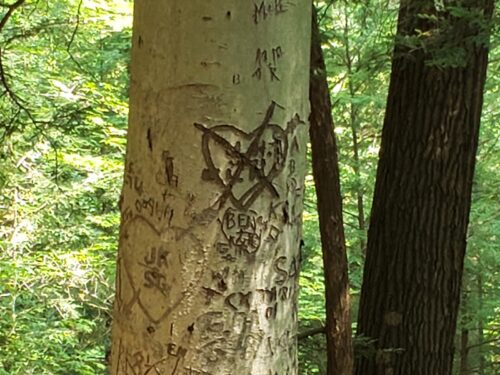
Humans also may leave a history of our presence on trees. This American beech tree in a recreation area has recorded the comings and goings of visitors, with some apparent editing as well! I do not endorse this activity as it can be harmful to the tree by introducing avenues for decay and disease, and is generally prohibited on public property. Instead, enjoy reading the nature stories found in bark.
Figure 7 – American beech bark defaced by carving.
Oak-hickory forests, which are comprised of a variety of different tree species, shrubs, grasses, sedges and wildflowers, as well as wildlife, including songbirds, are important to Indiana’s biodiversity. Learn how you can support oak-hickory ecosystems on your property through a new publication, “Forest Stewardship for Oak-Hickory Ecosystems in Indiana,” produced by Let the Sun Shine In – Indiana.
“The goal of this publication is to provide woodland owners with information about the stewardship practices they can use to sustain and enhance oak-hickory ecosystems on their land,” said co-author Jarred Brooke, Purdue Extension wildlife specialist. “Having this information will help them make informed decisions about how to manage their land to meet their forestry and wildlife objectives.”
The publication discusses various methods landowners can use on their properties, from midstory removal to overstory thinning, prescribed fire, supplemental planting, controlling deer browsing, crop tree release and invasive species control. It also details options for timber harvest, which can be used to regenerate the next generation of a forest. Additional resources from forestry and wildlife professionals as well as other publications discussing current research and management tips also are included in this document.
“Oak ecosystem management is confusing,” said co-author Dan Shaver, state forester for the Indiana Natural Resources Conservation Service. “This publication provides easy to understand basic concepts to help landowners see where their property fits in the oak restoration process. It does not answer all questions or provide all the technical details, but it will help reduce confusion and foster better communication and understanding between landowners and foresters.”
“The oak-hickory ecosystem of southern Indiana is incredibly important to birds, other wildlife, and overall biodiversity,” Brazil said.
“Unfortunately, it’s continued persistence isn’t a given. Lack of management, and specifically lack of fire, over the past century has left it in peril. Restoring the oak-hickory ecosystem will require a concerted effort and private landowners are a key part of the solution. This publication is intended to help landowners understand how to manage oak ecosystems on their properties, and give them a roadmap for getting started.”
Let the Sun Shine In – Indiana is a collaboration of several organizations with a shared goal of maintaining oak-hickory ecosystems for the benefit of the people and wildlife of Southern Indiana.
“The LSSI IN collaboration utilizes education and outreach opportunities for landowners, to inform them of the imperiled Oak-Hickory Ecosystem,” explained Judi Brown, coordinator of the Let the Sun Shine In – Indiana. “Part of this outreach includes providing the Oak Hickory Stewardship Guide to landowners. The Stewardship Guide explains common forest management concepts that they can utilize on their properties, and encourages the growth of oak and hickory trees from the acorn or nut into the forest canopy.”
The primary method of distribution of the Stewardship Guide is through the Indiana DNR district foresters, but the guide also is available online. LSSI IN is providing metal gate signs to recognize the stewardship of forest landowners who are actively managing their forest land.
Support for the stewardship guide was provided by the Central Hardwoods Joint Venture, the American Bird Conservancy, the Indiana Department of Natural Resources Division of Forestry, Let the Sun Shine In – Indiana, Purdue Forestry and Natural Resources Extension, the United States Department of Agriculture Natural Resources Conservation Service and the United States Forest Service.
Drones can be used to assess crop health, monitor livestock, disperse cover crop seed, optimize natural resources, for public safety, and much more. Purdue Extension’s UAV pilots are flying fields, forests, and urban areas through Indiana to help farmers, land and business owners, and government officials turn images into insights. Purdue Extension’s personnel are learning how to help farmers and agricultural professionals more easily analyze and apply data from UAVs or drones.
To legally fly an unmanned aerial vehicle (UAV) or unmanned aerial system (UAS), several steps must be taken. This document provides checklists to assist you in that process. The primary regulatory agency for UAVs is the Federal Aviation Administration (FAA). FAA puts drones in three main categories: 0.55 pounds or less, greater than 0.55 pounds to 55 pounds, and more than 55 pounds. The regulation and registration of drones varies, depending sometimes on usage but mostly on weight.
For more information regarding Purdue Extension and Purdue Agriculture’s outreach through the agricultural use of unmanned aerial vehicles (UAVs) view Purdue Extension-UAV.
In this episode of A Woodland Management Moment, Purdue Extension forester Lenny Farlee talks about the high deer populations around forest land, which can make it difficult to get hardwood seedlings established. This video brings more details and introduces a revised less expensive design option as it coincides with our first deer fencing video.
If you have any questions regarding trees, forests, wildlife, wood products or other natural resource topics, feel free to contact us by using our Ask an Expert web page.