 Purdue University - Extension - Forestry and Natural Resources
Got Nature? Blog
Purdue Landscape Report: Besides nursery inspections, our division assists with phytosanitary inspections in partnership with the USDA’s APHIS Plant Protection and Quarantine staff. In my area, I assist mainly with log inspections and ensure the commodities are relatively pest-free before leaving the country or, if not, that they will be treated beforehand.
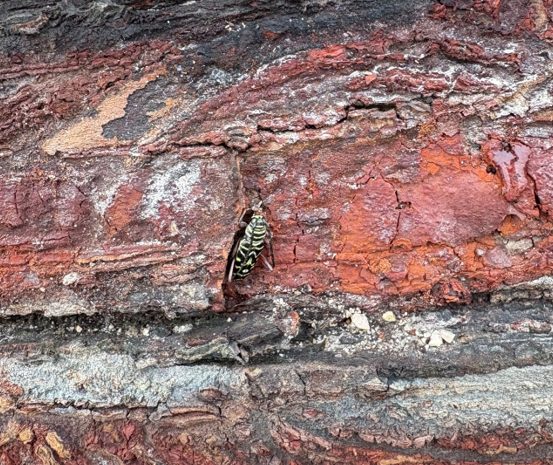
Figure 1: Painted hickory borer (Megacyllene caryae) emerging from a hickory (Carya spp.) log.
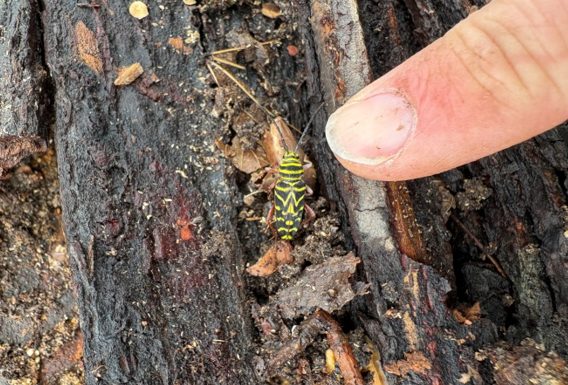
Figure 2: Painted hickory borer (Megacyllene caryae) on a hickory (Carya spp.) log with finger for size reference. Note the distinct “w” marking on elytra.
Recently I found an interesting pest on a hickory (Carya spp.) log. I occasionally find round-headed borers infesting logs, which are fairly common pests that often mine in or between the bark and sapwood of logs. Round-headed borers are the larval form of longhorned beetles (a.k.a. cerambycids [or beetles in the Cerambycidae family]). I normally just find the larvae during inspections, not the future life cycle stages like pupae or adults. However, I recently was able to spot painted hickory borer (Megacyllene caryae) adults emerging from a hickory log I inspected.
Painted hickory borers are colorful distinct longhorn beetles in the Cerambycidae family that can be distinguished by their yellow bands on an otherwise black body, including a “w” shaped band on the elytra (or wing coverings). They are important decomposers which help break down fallen logs for hickory trees as well as other hardwood species. However, because they bore into logs and firewood, they are considered pests for those commodities and are a species we look for when we perform inspections.
Painted hickory borers can be confused with their very similar relative, the locust borer (Megacyllene robiniae), but there are some easy ways to distinguish these longhorned beetle species. First, the host is important to note since locust borers only infest black locust (Robinia pseudoacacia) trees. Also, painted hickory borer adults are active in spring, while locust borer adults are active in late summer/fall.
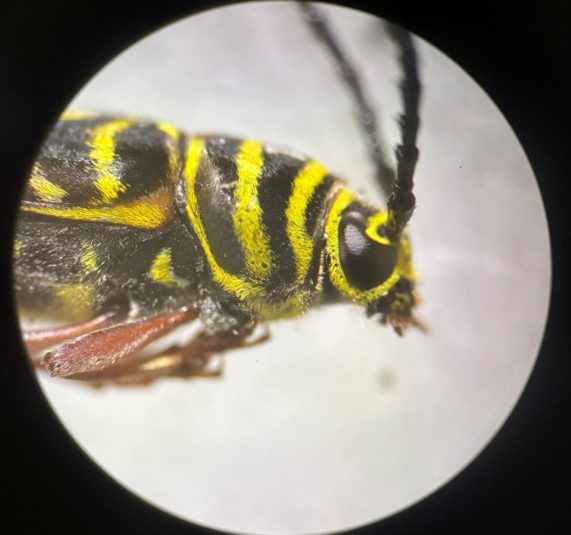
Figure 3: Painted hickory borer (Megacyllene caryae) lateral view under 20x magnification. Note the dense hairs, which also are what give the beetle its distinct coloration.
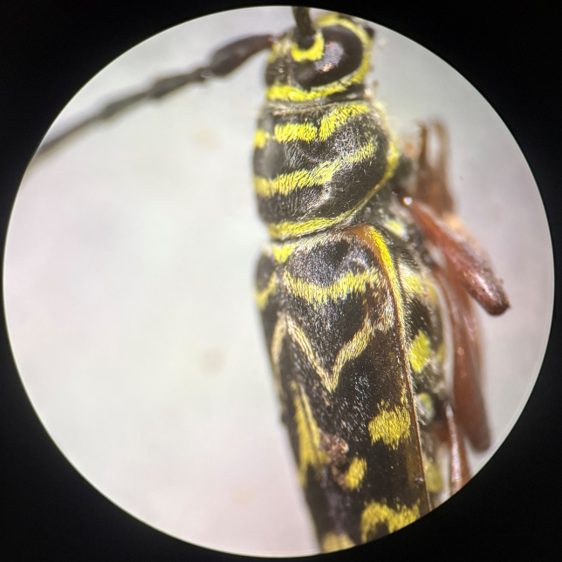
Figure 4: Painted hickory borer (Megacyllene caryae) dorsolateral view under 20x magnification.
Painted hickory borers do not often warrant management as they generally feed only on dead and decaying wood and do not affect living trees. Larvae generally feed on the inner bark of dead logs initially but can bore into the sapwood and heartwood as they develop. The biggest impact this has is on the lumber production since scarring to the wood can occur. Very few management activities will be successful once the borers are inside the logs, except for fumigation activities from a state-approved facility. The best method of control is preventative such as not leaving logs lying around for long periods of time before processing or treating susceptible logs with an insecticide like bifenthrin to create an insecticidal barrier and prevent infestation. Otherwise, painted hickory borers are harmless, colorful longhorned beetles to be admired as they emerge in spring.
This article appeared in the Indiana Department of Natural Resources-Department of Entomology’s Weekly Review. You can find past reports and subscribe to their newsletter by visiting IN DNR – Entomology Weekly Review.
Resources:
ID That Tree, Purdue Extension-Forestry & Natural Resources (FNR) YouTube Playlist:
Intro to Trees of Indiana: Pignut Hickory
Intro to Trees of Indiana: Mockernut Hickory
Intro to Trees of Indiana: Shagbark Hickory
Intro to Trees of Indiana: Bitternut Hickory
ID That Tree: Red Hickory
ID That Tree: Shellbark Hickory
Learn How to Support Oak-Hickory Ecosystems, Got Nature? Blog, Purdue Extension – FNR
An Introduction to Trees of Indiana, The Education Store, Purdue Extension’s resource center
Native Trees of the Midwest, The Education Store
Shrubs and Woody Vines of Indiana and the Midwest, The Education Store
Investing in Indiana Woodlands, The Education Store
Forest Improvement Handbook, The Education Store
Woodland Management Moment , Purdue Extension-FNR YouTube playlist
Invasive Species, Purdue Extension – FNR YouTube Playlist (Asian Bush Honeysuckle, Burning Bush, Callery Pear, Multiflora rose)
What are invasive species and why should I care?, Got Nature? Blog, Purdue Extension – FNR
Spotted Lanternfly Found in Indiana, Purdue Landscape Report
Keep An Eye Out for Hammerhead Worms, Purdue Landscape Report
New Threat to North American Elms, Purdue Landscape Report
Finding help from a professional forester, Indiana Forestry & Woodland Owners Association
Find an Arborist video, Trees are Good, International Society of Arboriculture (ISA)
Will Drews , Nursery Inspector & Compliance Officer
Indiana Department of Natural Resources (DNR) Division of Entomology & Plant Pathology

Recent Posts
- Disease May Cause Wilting and Eventual Death of Certain Trees and Shrubs, Purdue Landscape Report
Posted: October 5, 2026 in Disease, Forestry, Plants - October Is Firewood Month: Protect Indiana’s Forests by Making Smart Choices
Posted: October 1, 2026 in Forestry, Forests and Street Trees, How To, Invasive Insects, Urban Forestry - Minecraft Meets the Hellbender
Posted: September 22, 2026 in Aquaculture/Fish, Aquatic/Aquaculture Resources, Wildlife - Is It Too Early to Think About Christmas Tree Pests?
Posted: in Christmas Trees, Invasive Insects, Safety - What You Plant Matters to Wildlife
Posted: September 16, 2026 in Plants, Urban Forestry, Wildlife - Woodland Flowers of Late Summer
Posted: September 14, 2026 in Forestry, Gardening, Wildlife, Woodlands - Heavy August Rains Bring More Mosquitoes to Indiana
Posted: September 9, 2026 in How To, Invasive Insects, Safety, Wildlife - Question: Why Did the Shagbark Hickories Survive the Tornado?
Posted: August 27, 2026 in Forests and Street Trees, How To, Urban Forestry - New Indiana Woodland Steward Newsletter
Posted: August 12, 2026 in Forestry, Urban Forestry, Wildlife, Woodlands - Indiana Fall Hunting Licenses on Sale and New Mobile App Available
Posted: in Forestry, How To, Wildlife
Archives
Categories
- Alert
- Aquaculture/Fish
- Aquatic/Aquaculture Resources
- Ask the Expert
- Christmas Trees
- Community Development
- Disease
- Drought
- Forestry
- Forests and Street Trees
- Gardening
- Got Nature for Kids
- Great Lakes
- How To
- Invasive Animal Species
- Invasive Insects
- Invasive Plant Species
- Land Use
- Natural Resource Planning
- Nature of Teaching
- Plants
- Podcasts
- Ponds
- Publication
- Safety
- Spiders
- Timber Marketing
- Urban Forestry
- Webinar
- Wildlife
- Wood Products/Manufacturing
- Woodland Management Moment
- Woodlands