 Purdue University - Extension - Forestry and Natural Resources
Got Nature? Blog
Purdue Landscape Report: Pollarding is a tree pruning method in which the upper branches of a tree are cut back to the same points on a regular schedule, creating a framework of knobby growth points from which new shoots emerge. The practice has been used for centuries and is especially common in landscapes where trees must be kept at a controlled height or width. Pollarding is not the same as topping, which is generally considered harmful because it removes branches without a long-term management plan. Instead, pollarding is a deliberate, repeated technique that can shape a tree into a compact, manageable form.
One of the main advantages of pollarding is size control. In urban areas, along streets, and near buildings or utility lines, trees often need to fit within tight spaces. Pollarding can reduce conflicts with overhead wires, streetlights, sidewalks, and traffic while still allowing a tree to remain in place. It can also reduce shade, which may be useful in courtyards, parking areas, and other sites where too much canopy cover is a problem. Some trees also respond by producing dense, attractive new growth, which can give them a distinctive architectural look.
Pollarding may also extend the usable life of certain trees when it is started early and maintained properly. Because the tree is kept smaller and more compact, it may be less likely to fail under wind or storm stress than a large tree with heavy limbs. In some settings, the regular cutting of new shoots can even provide a source of small-diameter wood or fodder, which helps explain why pollarding developed historically as a practical land-management method.
That said, pollarding has real drawbacks. It must be done correctly and consistently; if a tree is pollarded at the wrong age, on the wrong species, or after long neglect, the result can be stress, decay, weak regrowth, or structural problems. Not all trees tolerate the practice well, and some may decline if pollarded too aggressively. Pollarding also creates a very artificial appearance, which some people dislike. A freshly pollarded tree can look bare or severe for a time, and the repeated cuts require ongoing maintenance.

Figure 1: New growth on pollarded tree. Photo credit: Ben McCallister

Figure 2: Pollarded street trees in Shibuya, Tokyo. Photo credit: Ben McCallister
Pollarding is most strongly associated with Europe, especially Britain, France, the Netherlands, Italy, and parts of Spain, where it has a long history in both rural and urban landscapes. Today, it is still widely seen in European cities and towns, particularly on street trees and in managed public spaces. It also appears in some parts of North America, but it remains much more culturally visible and historically rooted in Europe. In many places, it is valued both for its practical function and for the distinctive form it creates over time.
Used thoughtfully, pollarding is a useful tool rather than a universal solution. It works best when matched to the right species, the right site, and a long-term maintenance plan. For the right tree in the right place, it can be both functional and visually striking.
Resources:
Tree Pruning Essentials Video, Purdue Extension YouTube Channel
Surface Root Syndrome, The Education Store, Purdue Education’s resource center
Find an Arborist video, Trees are Good-International Society of Arboriculture (ISA)
Report INvasive, Purdue Extension
Indiana Invasive Species Council
ID That Tree, Playlist, Purdue Extension – Forestry and Natural Resources (FNR) YouTube Channel (Invasive White Mulberry, Siberian Elm, Tree of Heaven)
Planting Your Tree Part 1: Choosing Your Tree, Purdue Extension YouTube Channel
Tree Planting Part 2: Planting a Tree, Purdue Extension YouTube Channel
Tree Selection for the “Un-natural” Environment, The Education Store
Tree Installation: Process and Practices, The Education Store
Tree Defect Identification, The Education Store
Why Is My Tree Dying?, Got Nature? Blog, Purdue Extension – FNR
Tree Wound and Healing, Got Nature? Blog, Purdue Extension – FNR
Fifty Common Trees of Indiana
Native Trees of the Midwest, Purdue University Press
Subscribe – Purdue Extension-FNR YouTube Channel
Ben McAllister, Urban Forestry Specialist
Forestry & Natural Resources
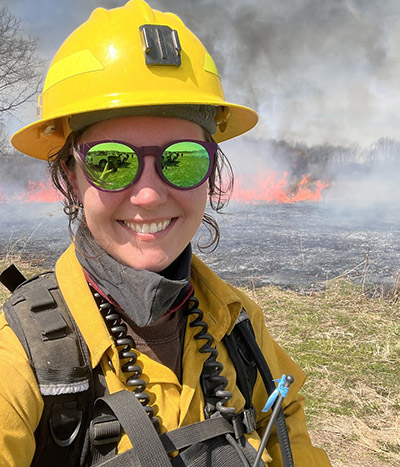
Danielle Howard stands in front of a field on fire from a prescribed burn.
Danielle Howard has been hired as an Extension prescribed fire specialist housed with the Department of Forestry and Natural Resources at Purdue
The prescribed fire specialist position, funded by the Sam Shine Foundation, aims to increase prescribed fire capacity in Indiana by coordinating, conducting, and leading prescribed fires and prescribed fire training and outreach statewide.
In this role, Howard also will support the formation of prescribed burn associations (PBAs) and the Indiana Prescribed Fire Council (INPFC). She will work closely with Indiana conservation partners to develop prescribed fire training and outreach that builds capacity and support for prescribed fire on public and private land in Indiana.
“Prescribed fire is key to maintaining healthy ecosystems in Indiana, and I’m very excited to be at the forefront of increasing its use across the state,” Howard said.
Co-PIs on the supporting grant titled “Building Capacity for Prescribed Fire in Indiana” are Extension wildlife specialists Jarred Brooke and Brian MacGowan, Extension forester Lenny Farlee, natural resources training specialist Jessica Outcalt and Dr. Zhao Ma.
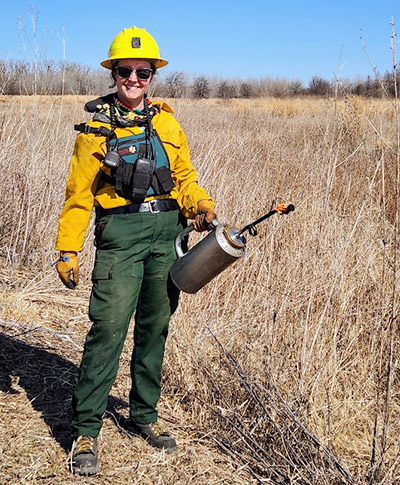
Danielle Howard holds a drip torch while starting a prescribed burn.
Howard, who previously worked in FNR as the field coordinator for the Hardwood Ecosystem Experiment from 2020 to 2023, comes to her new role after spending the last three years as the central region ecologist for the Indiana Department of Natural Resources Division of Fish, Wildlife and Nature Preserves. In that role, she managed 71 state-dedicated nature preserves and multiple privately-owned conservation easements across 26 counties in central Indiana. She also planned, prepared and implemented prescribed fire, invasive species control measures, native plantings, forest stand management and other restoration activities. She also established and sampled research plots for post-fire vegetation monitoring in Brown County State Park.
Howard also has taught Applied Ecology as an adjunct professor at Indiana University since January 2025.
In her previous stint in FNR as part of the HEE project, Howard coordinated forest management research activities, including bird surveys, overstory plots, small mammal trapping and more, conducted by various universities and partners at sites in Morgan-Monroe and Yellowwood State Forests.
Previously, she acted as an intermittent bird biologist for the Indiana DNR, the whooping crane outreach program assistant in Indiana for the International Crane Foundation and as a farm bill wildlife biologist for Pheasants Forever/Quail Forever.
Howard is a type II certified wildland firefighter and has certifications in prescribed fire for managers, wildlife fire chainsaws (S-212), wildlife fire pumps (S-211) and a pesticide applicator’s license for core and forests.
Howard began her new role on May 18. She will be based remotely in Bloomington, Indiana.
To view this article along with other news and stories posted on the Purdue Forestry and Natural Resources website view: Danielle Howard Hired as FNR Extension Prescribed Fire Specialist.
Resources:
Wildlife Habitat Hint: Prescribed Fire Techniques – Backing Fire, Video, Purdue Extension – Forestry and Natural Resources YouTube channel
Wildlife Habitat Hint: Prescribed Fire Techniques – Flanking Fire, Purdue Extension – FNR Video
Wildlife Habitat Hint: Late Growing Season Prescribed Fire, Purdue Extension – FNR Video
FNR Ask The Expert: Prescribed Fire with Jarred Brooke and Mike Saunders, Purdue Extension – FNR Video
Prescribed fire: 6 things to consider before you ignite, Got Nature? Blog, Purdue Extension – FNR
Indiana Prescribed Fire Council (IPFC)
Hardwood Ecosystem Experiment (HEE)
Finding help from a professional forester, Indiana Forestry & Woodland Owners Association (IFWOA)
Wildlife Management & Grassland Management, Pond and Wildlife Management, Purdue Extension
Forest Improvement Handbook, The Education Store, Purdue Extension resource center
Woodland Stewardship for Landowners YouTube Playlist, Purdue Extension – FNR
Woodland Management Moment YouTube Playlist, Purdue Extension – FNR
Subscribe – Purdue Extension-FNR YouTube Channel, find natural resources, forestry, wildlife, urban forestry and much more.
Wendy Mayer, FNR Communications Coordinator
Purdue University Department of Forestry and Natural Resources
Entomology Weekly Review: Purdue Forestry & Natural Resources (FNR) Extension would like to share a timely update from the Indiana Department of Natural Resources – Division of Entomology newsletter regarding a wood-boring insect that may be encountered in hardwood logs across the state. Will Drews, Entomology staff member located in south-central Indiana (Bloomington area), recently reported activity from one of the more common round-headed borer pests found in hardwood logs: the flat-faced longhorn beetle, Graphisurus fasciatus. Will shares in the Entomology Weekly Review how to identify the borer, their habitat and if we need to be concerned.
What to Look For
On the wing recently is one of the more common round-headed borer pests I find in hardwood logs, and that is the flat-faced longhorn beetle without a common name: Graphisurus fasciatus (Photos 2 – 5). This longhorn beetle (in the family Cerambycidae) is quite large as far as longhorn beetles go, reaching up to 0.6 inches in length, and features two long antennae (aka “horns”) characteristic of most of its family (Photo 3).
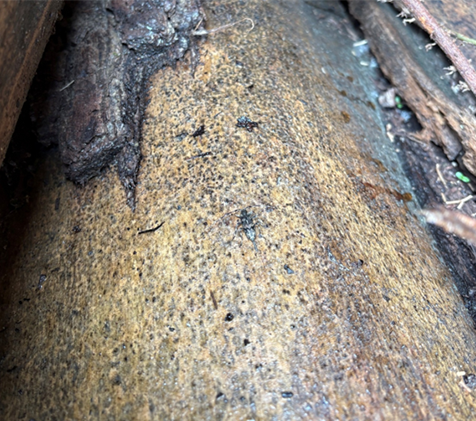
Photo 2 – Flat-faced longhorn beetle (Graphisurus fasciatus) adult found on a black walnut (Juglans nigra) log during a recent phytosanitary inspection.
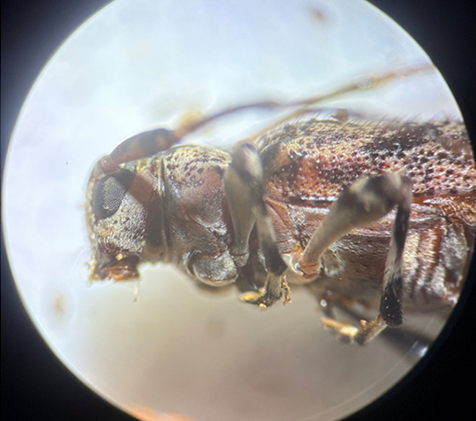
Photo 3 – Flat-faced longhorn beetle (Graphisurus fasciatus) adult female lateral view at 10X magnification. Note the long “horns” or antennae which are a little longer than the main body.
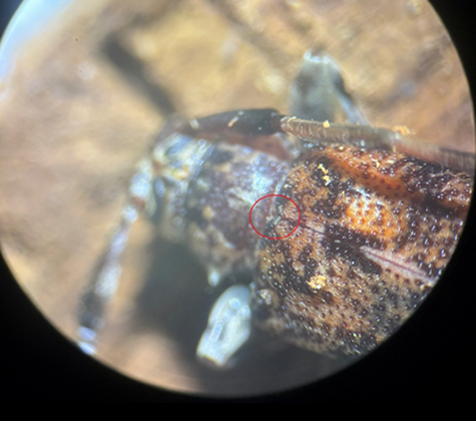
Photo 4 – Flat-faced longhorn beetle (Graphisurus fasciatus) adult female dorsal view at 10X magnification.
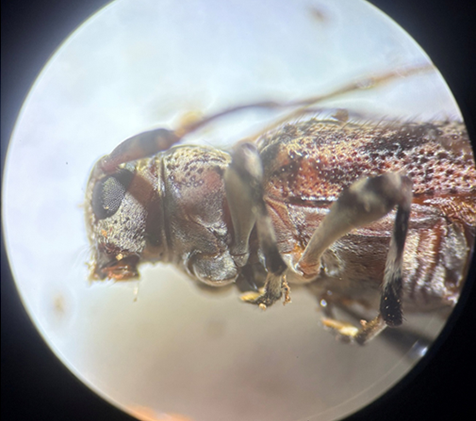
Photo 5 – Flat-faced longhorn beetle (Graphisurus fasciatus) adult female lateral view at 20x magnification. G. Fasciatus is parte of the flat-faced longhorn beetle subfamily (Lamiinae), which its membes are characterized by a long, usually flat face, shown here.
Host Trees and Habitat
As a larva, Graphisurus fasciatus feeds on a variety of hardwoods and is reported to feed on pine trees as well. I generally find G. fasciatus larvae feeding between
the bark and sapwood of black walnut (Juglans nigra), white oak (Quercus alba ) and red oak (Quercus rubra) logs (Photo 6).
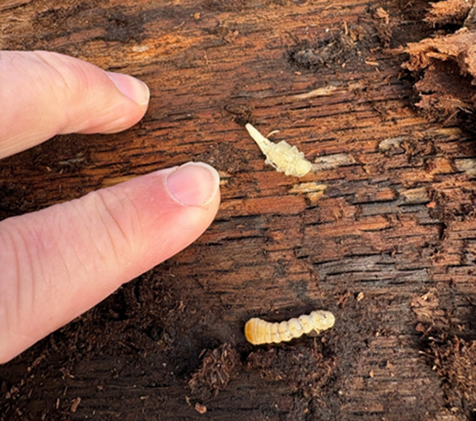
Photo 6 – Flat-faced longhorn beetle (Graphisurus fasciatus) larva (below) and pupa (above) with signs of larval mines on a red oak (Queracus rubra) log.
Identification Tips
There are several ways to differentiate this species from the less common but closely related Graphisurus despectus, but one of the surest ways is to examine the scutellum (aka the small shield-like plate at the top/between the elytra [wing covers]). In G. fasciatus, the scutellum has two small whitish patches of hair, not present on G. despectus (Photo 7). Another diagnostic characteristic of G. fasciatus is that it has elytra with emarginate (or notched) tips (Photo 8).
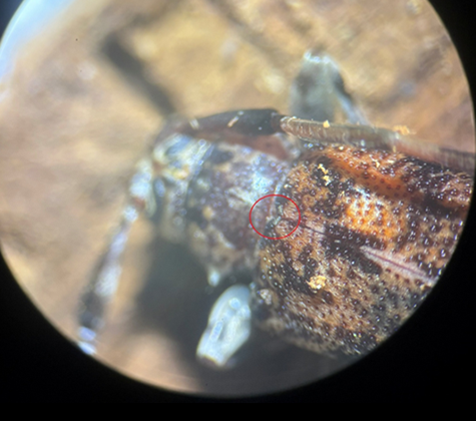
Photo 7 – Flat-faced longhorn beetle (Graphisurus fasciatus) adult female dorsal view at 20X magnification showing scutellum (cirecled in red). Note the two light/whitish patches of hair on the scutellum. This is one of the best ways to distinguish G. fasciatus from G. despectus.
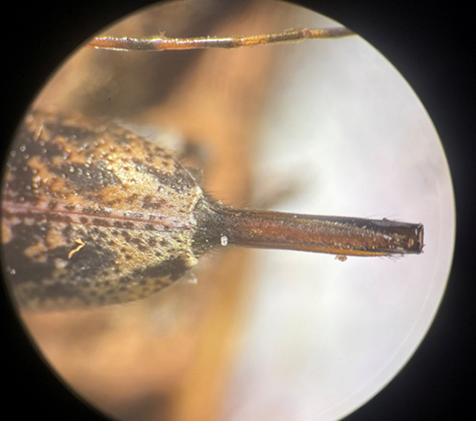
Photo 8 – Flat-faced longhorn beetle (Graphisurus fasciatus) adult female dorsal view at 20X magnification showing its elongated ovipositor. the ovipositor of G. fasciatus is quite unusual and proturberant for a longhorn beetle species and makes the females closer to 0/75 inches in length counting it. Also present in this image is the emarginate (or notched) tips of the elytra. This is another distinguishing characteristic of G. fasciaturs.
Should You Be Concerned?
This species can be alarming by its noticeable size and relative abundance but is not necessarily a major pest of concern as it does not usually bore into the sapwood and cause defects to the wood.
Stay Informed
FNR Extension encourages landowners and natural resource professionals to remain observant when working with hardwood logs and report unusual insect activity when found.
To stay up to date on forest health and insect alerts, consider subscribing to the Indiana Department of Natural Resources – Entomology Weekly Review for regular updates on insects affecting Indiana’s forests and natural areas.
Will Drews, Nursery Inspector & Compliance Officer
Indiana Department of Natural Resources
Division of Entomology & Plant Pathology
Resources:
Spotted Lanternfly, Indiana Department of Natural Resources Entomology
Box Tree Moth Range is Expanding, Purdue Landscape Report
Beetle that attacks Tree-of-Heaven found in Indiana, Purdue Landscape Report, Got Nature? Blog, Purdue Extension – FNR
Sawflies: Caterpillar Pests but not Caterpillars – PLR, Got Nature? Blog, Purdue Extension – FNR
Prepared for Insects Waking Up? – PLR, Got Nature? Blog, Purdue Extension – FNR
Case Study: Maple Tree Pests – PLR, Got Nature? Blog, Purdue Extension – FNR
Invasive Species, Purdue Extension – FNR YouTube Playlist (Asian Bush Honeysuckle, Burning Bush, Callery Pear, Multiflora rose)
What are invasive species and why should I care?, Got Nature? Blog, Purdue Extension – FNR
Finding help from a professional forester, Indiana Forestry & Woodland Owners Association
Find an Arborist video, Trees are Good, International Society of Arboriculture (ISA)
Agricultural & Natural Resources (ANR) Newsletter: On May 5, Natural Resources professionals gathered at the Davis Purdue Agricultural Center (DPAC) in Farmland, Indiana, for a forestry and wildlife management training led by Purdue Forestry and Natural Resources’ Brian MacGowan, wildlife extension specialist and extension coordinator; Don Carlson, forester; Jarred Brooke, wildlife extension specialist; and Jessica Outcalt, natural resources training specialist. The program combined classroom updates with field-based learning focused on active land stewardship, habitat management and conservation planning.
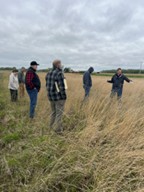
Jarred Brooke provided an overview of prairie grass plantings, including seed mixes, establishment methods and species composition.

Don Carlson discussing the 2014 planting and the management goals involved at Herrmann Property.
During the field tour of DPAC and Herrmann Properties, participants explored topics including native warm-season grass management using prescribed fire, Sericea lespedeza control in native grass plantings, prairie restoration, young forest management, and oak forest management for multiple objectives. Don Carlson discussed the history and management goals of DPAC, emphasizing how tree spacing, mowing and the use of crop and nurse trees influence tree establishment and growth. Jarred Brooke highlighted challenges such as rabbit damage to young trees and invasive species management. Participants learned key wildlife habitat principles, including a practical guideline for quail habitat: If a baseball tossed into the grass rolls, the habitat structure is suitable for quail; if it does not roll, the vegetation is too dense. The day concluded with updates on the NR Training Hub, prescribed fire and evaluation efforts.
If you’re interested in bringing a program like this to your area, we’d love to hear from you, submit a request at fnrextension@purdue.edu.
Emily Kring, Extension Educator
Agriculture & Natural Resources, Purdue Extension Jay County
Jessica Outcalt, Natural Resources Training Specialist
Purdue Extension – Forestry & Natural Resources
Resources:
Natural Resources Training Hub
Explore the Rich World of Oaks with Purdue FNR Extension & Partners
Forestry for the Birds Pocket Guide, The Nature Conservancy
Natural Resources Conservation Service (NRCS)
Community Planning for Agriculture and Natural Resources: A Guide for Local Government, The Education Store, Purdue Extension’s research center
The Nature of Teaching
Help the Hellbender
Let the Sun Shine in Indiana
Community Development, Purdue Extension
Subscribe – Purdue Extension-FNR YouTube Channel, find natural resources and much more in playlists.
Most of us have probably heard or seen a lot about pollinators in the media recently. The reason why is that pollinators are really, really important. We simply can’t live without them. Researchers estimate that one out of every three bites of food we eat is made possible by pollinators. More than 100 food crops in the U.S. depend on pollinators, including almost all fruit and grain crops.
There are many different types of pollinators including native bees, butterflies and moths, beetles, flies, wasps, and of course hummingbirds. But perhaps one of the more interesting pollinators is the Monarch. Millions of Monarchs congregate in a relative small area in Mexico each winter. In March they start their journey north which has occurred over several generations. Unfortunately, the number of Monarchs counted in overwintering colonies has declined over the past 25 years.
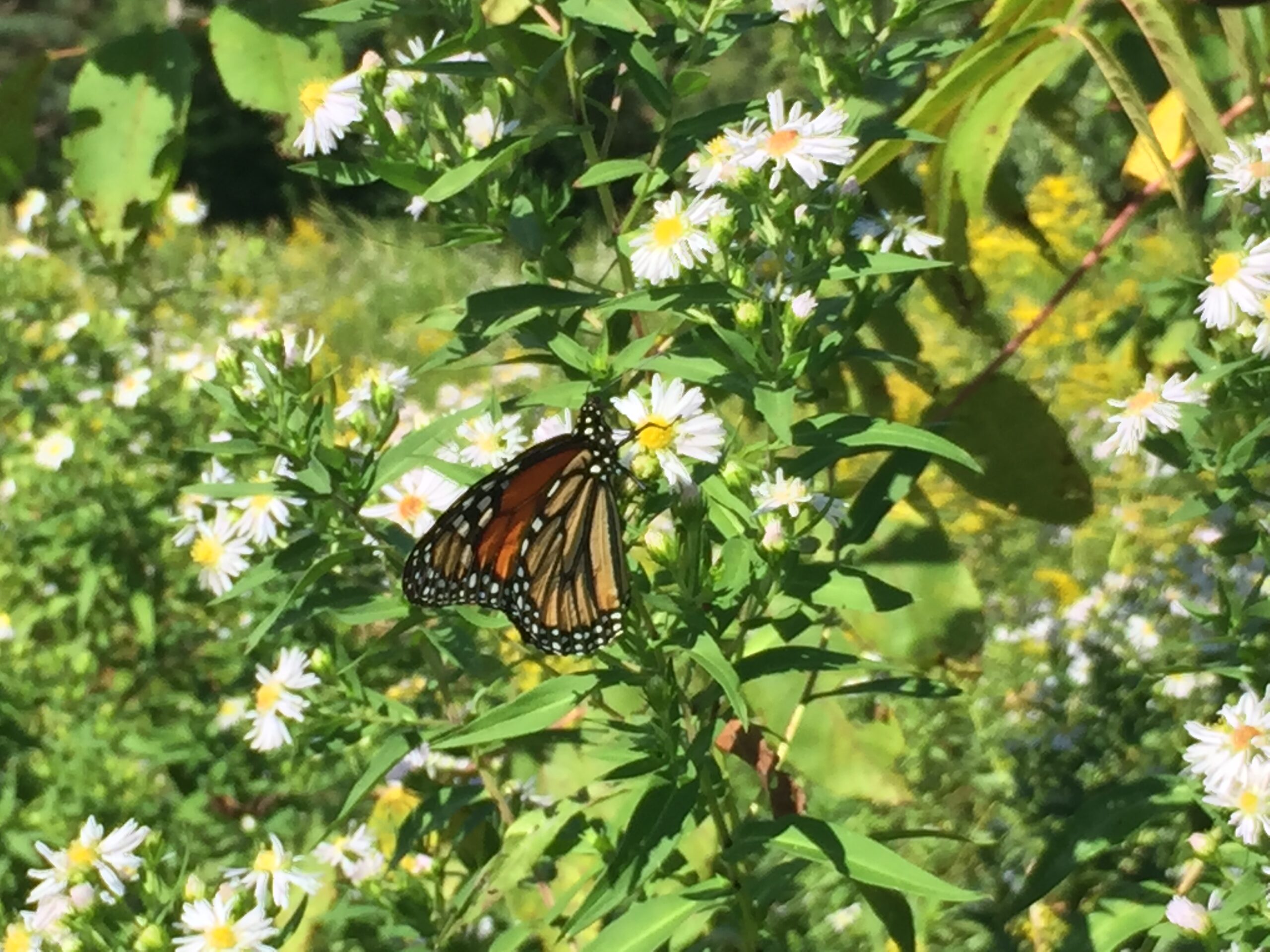
In response, many states including Indiana have developed a state Monarch Conservation Plan. With input from many stakeholders over several years, the Indiana Monarch Conservation Plan was released in December 2020. One goal of the plan was to create an online resource that would act as a clearinghouse for Indiana monarch and pollinator conservation data, research, best management practices (BMPs), and events. I invite you to visit the Indiana Monarch and Pollinator Conservation Hub at indianawildlife.org/monarchs.
You might be asking yourself, ‘Why is a wildlife specialist writing about pollinators?’ It turns out that quality habitat for wildlife is often quality habitat for pollinators. The diversity of wildflowers, along with the structure provided by native grasslands, trees, and shrubs, benefits all of them. Native grasslands that have a diverse mixture of wildflowers provide food, bare ground, and structure desirable for a wide variety of pollinators.
Resources
Protecting Pollinators: Why Should We Care About Pollinators?, The Education Store, Purdue Extension resource center
Ask The Expert: What’s Buzzing or Not Buzzing About Pollinators , Purdue Extension – Forestry & Natural Resources (FNR) YouTube Channel
Purdue Pollinator Protection publication series, Purdue Extension Entomology
Is My Urban Garden Helping Native Pollinators?, Purdue Landscape Report
Indiana Monarch & Pollinator Conservation Hub, Indiana Wildlife Federation
Monarch Watch, University of Kansas
100 Plants to Feed the Monarch/Other Resources Available, Xerxes Society for Invertebrate Conservation
Brian MacGowan, Wildlife Extension Specialist & Extension Coordinator
Purdue Department of Forestry and Natural Resources
Purdue Landscape Report: Earlier this year, Ohio expanded its quarantine for box tree moth (Cydalima perspectalis) to include seven additional counties, bringing the total number of quarantined counties in the state to 14 (ODA, 2026). Michigan currently has 13 counties under quarantine as well. Although this invasive pest has not yet been detected in Indiana, populations close to our borders are continuing to spread. It is important to remain vigilant, particularly in the northeastern and southeastern regions of the state where the risk of introduction is greatest. Landscape professionals, nursery workers, and homeowners can all assist with early detection by monitoring boxwood plantings for signs of infestation.
Signs and Symptoms
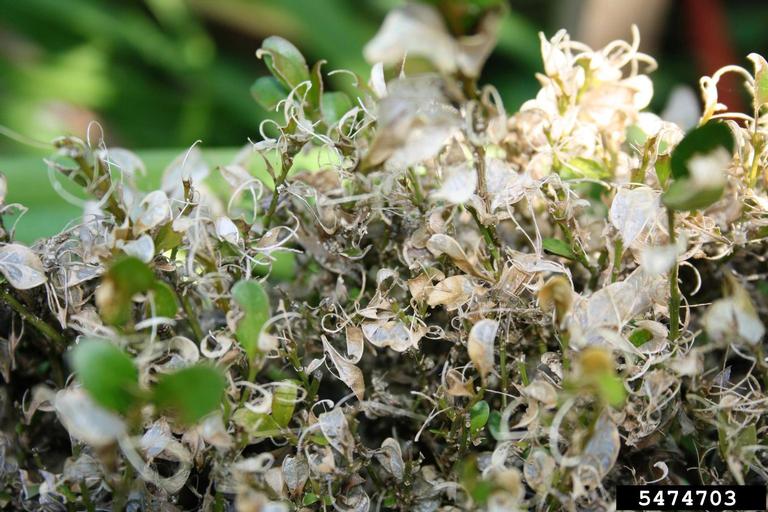
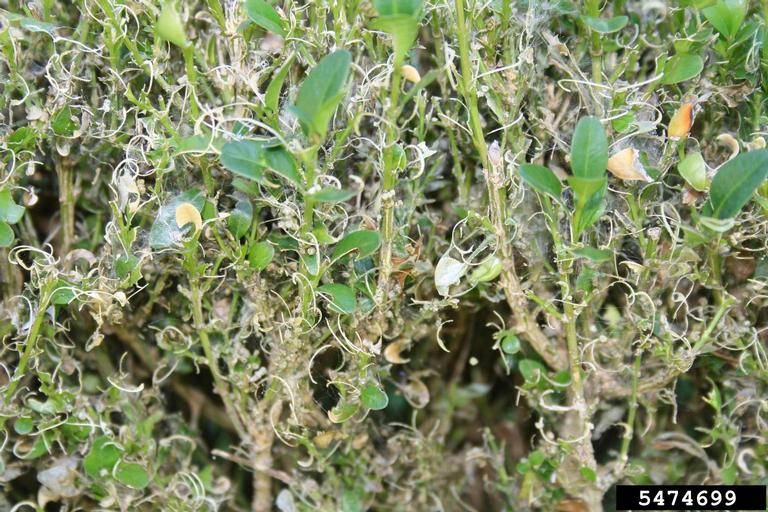
The caterpillar stage of box tree moth is responsible for the damage to boxwoods. Caterpillars are aggressive foliage feeders and often leave behind only the leaf margins or midribs, giving damaged plants a characteristic “stringy” appearance (Figs. 1, 2). As they feed, the larvae also produce large amounts of webbing throughout the shrub canopy.
One of the challenges in detecting infestations is that damage often begins deep within the interior of the shrub. Boxwoods may appear healthy from the outside even while caterpillars are actively feeding inside the canopy. As feeding progresses outward, severe defoliation can develop rapidly. When scouting plants, carefully inspect interior branches for webbing, brown or dried leaves, and feeding injury.
Identification
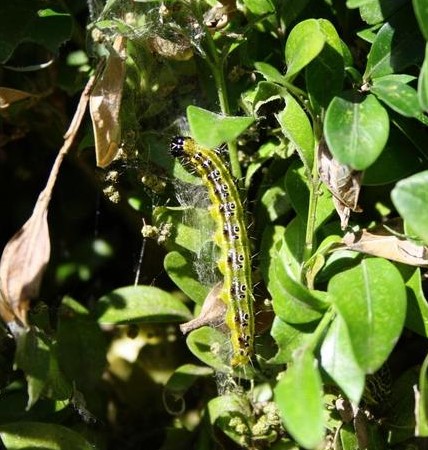
Box tree moth caterpillars are bright yellow-green with black stripes and rows of black spots running the length of the body (Fig. 3). This is the time of year when the caterpillars are active, so take a few minutes to check any boxwoods for them.
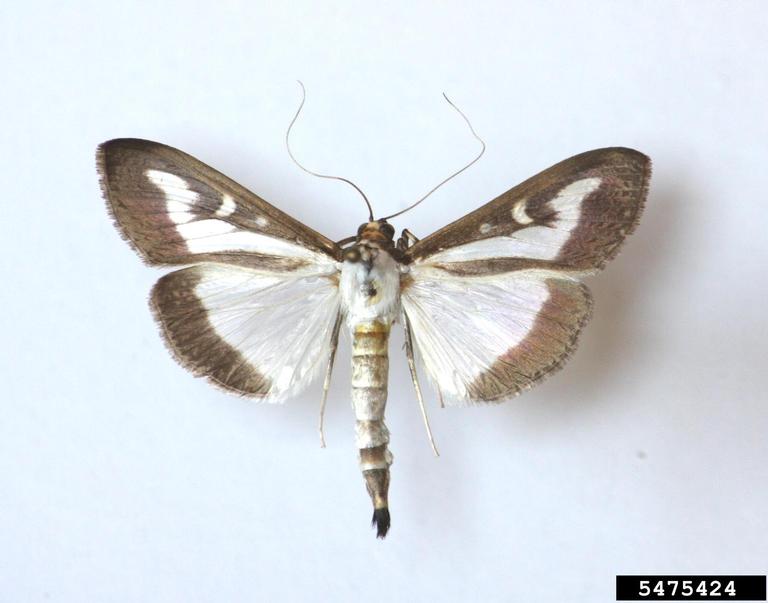
Adult moths are primarily night fliers, so they are less commonly observed during the day. Adults are typically white with broad brown wing borders and a distinctive white crescent-shaped marking within the brown band on the forewing (Fig. 4).
Resources:
ID That Tree, Purdue Extension – Forestry & Natural Resources (FNR) YouTube Playlist:
An Introduction to Trees of Indiana, The Education Store, Purdue Extension’s resource center
Native Trees of the Midwest, The Education Store
Shrubs and Woody Vines of Indiana and the Midwest, The Education Store
Forest Improvement Handbook, The Education Store
Invasive Species, Purdue Extension – FNR YouTube Playlist (Asian Bush Honeysuckle, Burning Bush, Callery Pear, Multiflora rose)
What are invasive species and why should I care?, Got Nature? Blog, Purdue Extension – FNR
Finding help from a professional forester, Indiana Forestry & Woodland Owners Association
Find an Arborist video, Trees are Good, International Society of Arboriculture (ISA)
Box Tree Moth (Cydalima perspectalis), Animal and Plant Health Inspection Service, U.S. Department of Agriculture
Beetle that attacks Tree-of-Heaven found in Indiana, Purdue Landscape Report, Got Nature? Blog, Purdue Extension – FNR
Sawflies: Caterpillar Pests but not Caterpillars – PLR, Got Nature? Blog, Purdue Extension – FNR
Prepared for Insects Waking Up? – PLR, Got Nature? Blog, Purdue Extension – FNR
Case Study: Maple Tree Pests – PLR, Got Nature? Blog, Purdue Extension – FNR
Alicia Kelley, Cooperative Agricultural Pest Survey (CAPS) State Survey Coordinator
Purdue Extension – Entomology
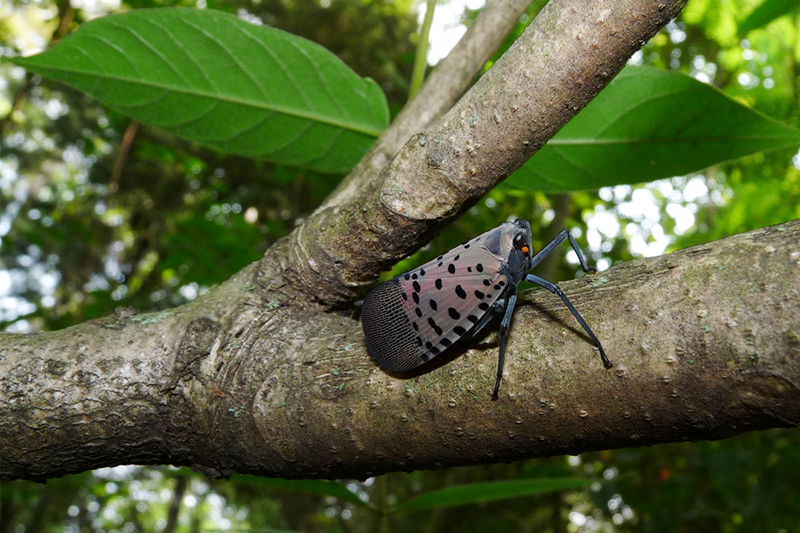 Spotted lanternfly (SLF) is a major pest of concern across most of the United States. Spotted lanternfly (SLF) is an invasive planthopper native to China that was first detected in the United States in Pennsylvania in 2014. SLF feeds on over 70+ plant species including fruit, ornamental and woody trees with tree-of-heaven as its preferred host. Spotted lanternfly is a hitchhiker and can easily be moved long distances through human assisted movement.
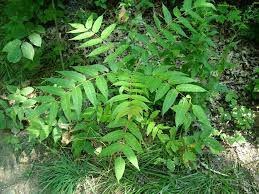
Know the Primary Host: Tree -of-Heaven
Tree of heaven (TOH) is the preferred host for the spotted lanternfly (SLF). The ability to identify TOH will be critical to monitoring the spread of this invasive pest as the 4th-stage nymphs and adult spotted lantern-flies show a strong preference for TOH.
Report a Sighting
If you suspect you’ve seen a spotted lanternfly, please take the following steps:
- Take a picture and note your location.
- If you can, collect a sample of the insect by catching it and placing it in a freezer. You can use any container available as long as it has a tight seal (like a water bottle) so that the spotted lanternfly can’t escape.
- Report your sighting through one of the following channels:
Email: DEPP@dnr.in.gov
Online: eddmaps.org or ReportINvasive
Phone: 1-866-663-9684
 Help Stop the Spread
Everyone can play a role in slowing the spread of spotted lanternfly:
- Inspect vehicles, trailers and outdoor equipment for spotted lanternfly eggs, nymphs, and adults before driving or moving to a new location.
- Avoid moving firewood, as it can transport SLF and other invasive pests.
- Stay informed by subscribing to trusted resources like the up to date with the latest newsletters: Purdue Landscape Report and Indiana Department of Natural Resources – Entomology & Plant Pathology Weekly Review E-newsletter.
- Follow updates and management tips on social media by connecting with ReportINvasive on Facebook (@reportINvasive) and Indiana Department of Natural Resources, which shared information acrossa Facebook, Twitter and Instagram (@INdnrinvasive).
Spread Awareness
Share your spotted lanternfly knowledge with others! Share about SLF with neighbors, colleagues and your communit to help protect Indiana’s natural and agricultural resources.
Resources:
Spotted Lanternfly, Indiana Department of Natural Resources Entomology
Prepare to Manage Spotted Lanternfly, Purdue Landscape Report
Spotted Lanternfly is on the Move!, Purdue Landscape Report
Spotted Lanternfly Egg Hatch is Here, Purdue Landscape Report
Spotted Lanternfly Found in Indiana, Purdue Landscape Report
Invasive plants: impact on environment and people, The Education Store, Purdue Extension’s resource center
Woodland Management Moment: Invasive Species Control Process, Video, Purdue Extension – Forestry and Natural Resources YouTube Channel
Invasive Species, Playlist, Purdue Extension – FNR YouTube Channel
What are invasive species and why should I care?, Got Nature? Blog, Purdue Extension – Forestry and Natural Resources
Report Invasive
Diana Evans, Extension and Web Communication Specialist
Purdue University Department of Forestry and Natural Resources
Purdue Landscape Report: Besides nursery inspections, our division assists with phytosanitary inspections in partnership with the USDA’s APHIS Plant Protection and Quarantine staff. In my area, I assist mainly with log inspections and ensure the commodities are relatively pest-free before leaving the country or, if not, that they will be treated beforehand.
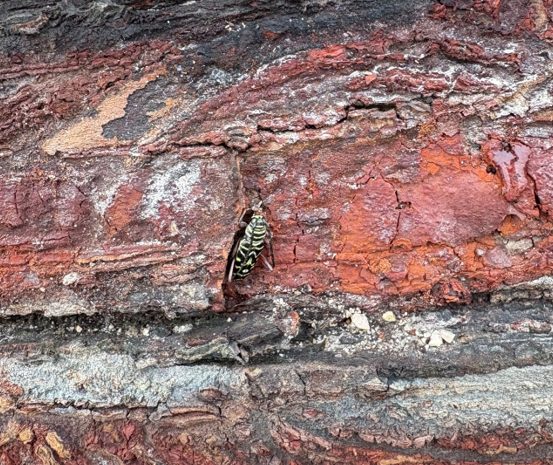
Figure 1: Painted hickory borer (Megacyllene caryae) emerging from a hickory (Carya spp.) log.
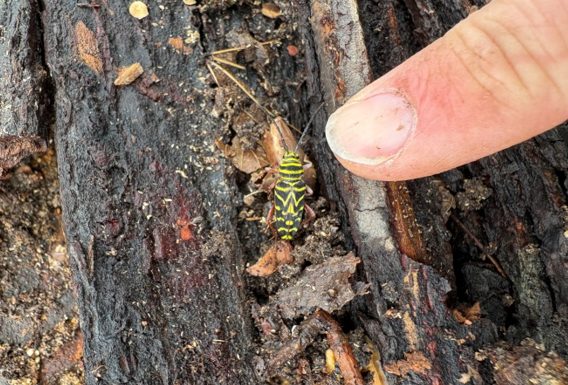
Figure 2: Painted hickory borer (Megacyllene caryae) on a hickory (Carya spp.) log with finger for size reference. Note the distinct “w” marking on elytra.
Recently I found an interesting pest on a hickory (Carya spp.) log. I occasionally find round-headed borers infesting logs, which are fairly common pests that often mine in or between the bark and sapwood of logs. Round-headed borers are the larval form of longhorned beetles (a.k.a. cerambycids [or beetles in the Cerambycidae family]). I normally just find the larvae during inspections, not the future life cycle stages like pupae or adults. However, I recently was able to spot painted hickory borer (Megacyllene caryae) adults emerging from a hickory log I inspected.
Painted hickory borers are colorful distinct longhorn beetles in the Cerambycidae family that can be distinguished by their yellow bands on an otherwise black body, including a “w” shaped band on the elytra (or wing coverings). They are important decomposers which help break down fallen logs for hickory trees as well as other hardwood species. However, because they bore into logs and firewood, they are considered pests for those commodities and are a species we look for when we perform inspections.
Painted hickory borers can be confused with their very similar relative, the locust borer (Megacyllene robiniae), but there are some easy ways to distinguish these longhorned beetle species. First, the host is important to note since locust borers only infest black locust (Robinia pseudoacacia) trees. Also, painted hickory borer adults are active in spring, while locust borer adults are active in late summer/fall.
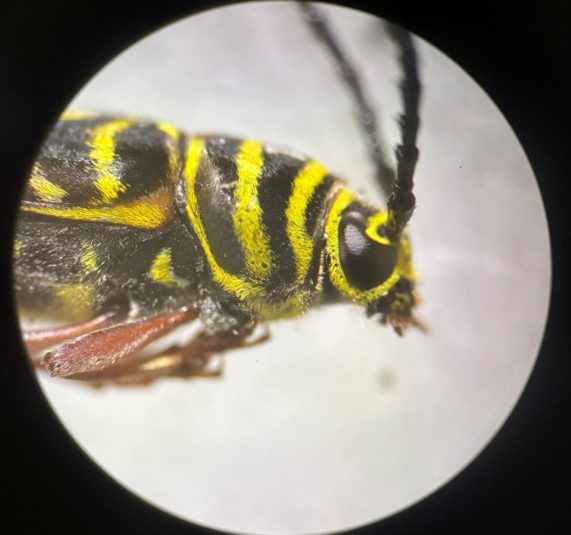
Figure 3: Painted hickory borer (Megacyllene caryae) lateral view under 20x magnification. Note the dense hairs, which also are what give the beetle its distinct coloration.
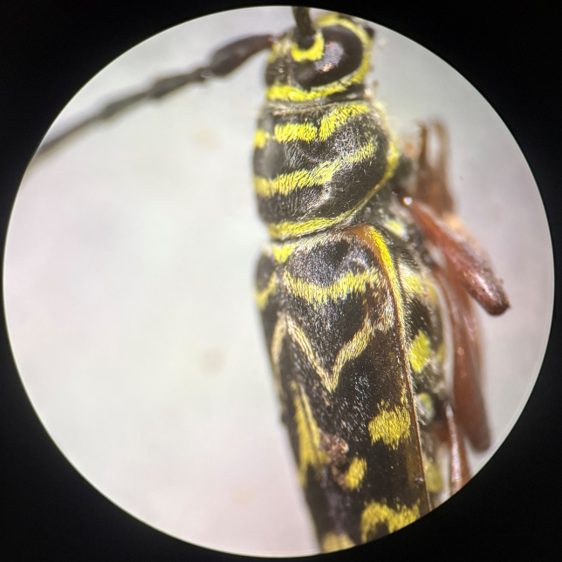
Figure 4: Painted hickory borer (Megacyllene caryae) dorsolateral view under 20x magnification.
Painted hickory borers do not often warrant management as they generally feed only on dead and decaying wood and do not affect living trees. Larvae generally feed on the inner bark of dead logs initially but can bore into the sapwood and heartwood as they develop. The biggest impact this has is on the lumber production since scarring to the wood can occur. Very few management activities will be successful once the borers are inside the logs, except for fumigation activities from a state-approved facility. The best method of control is preventative such as not leaving logs lying around for long periods of time before processing or treating susceptible logs with an insecticide like bifenthrin to create an insecticidal barrier and prevent infestation. Otherwise, painted hickory borers are harmless, colorful longhorned beetles to be admired as they emerge in spring.
This article appeared in the Indiana Department of Natural Resources-Department of Entomology’s Weekly Review. You can find past reports and subscribe to their newsletter by visiting IN DNR – Entomology Weekly Review.
Resources:
ID That Tree, Purdue Extension-Forestry & Natural Resources (FNR) YouTube Playlist:
Intro to Trees of Indiana: Pignut Hickory
Intro to Trees of Indiana: Mockernut Hickory
Intro to Trees of Indiana: Shagbark Hickory
Intro to Trees of Indiana: Bitternut Hickory
ID That Tree: Red Hickory
ID That Tree: Shellbark Hickory
Learn How to Support Oak-Hickory Ecosystems, Got Nature? Blog, Purdue Extension – FNR
An Introduction to Trees of Indiana, The Education Store, Purdue Extension’s resource center
Native Trees of the Midwest, The Education Store
Shrubs and Woody Vines of Indiana and the Midwest, The Education Store
Investing in Indiana Woodlands, The Education Store
Forest Improvement Handbook, The Education Store
Woodland Management Moment , Purdue Extension-FNR YouTube playlist
Invasive Species, Purdue Extension – FNR YouTube Playlist (Asian Bush Honeysuckle, Burning Bush, Callery Pear, Multiflora rose)
What are invasive species and why should I care?, Got Nature? Blog, Purdue Extension – FNR
Spotted Lanternfly Found in Indiana, Purdue Landscape Report
Keep An Eye Out for Hammerhead Worms, Purdue Landscape Report
New Threat to North American Elms, Purdue Landscape Report
Finding help from a professional forester, Indiana Forestry & Woodland Owners Association
Find an Arborist video, Trees are Good, International Society of Arboriculture (ISA)
Will Drews , Nursery Inspector & Compliance Officer
Indiana Department of Natural Resources (DNR) Division of Entomology & Plant Pathology
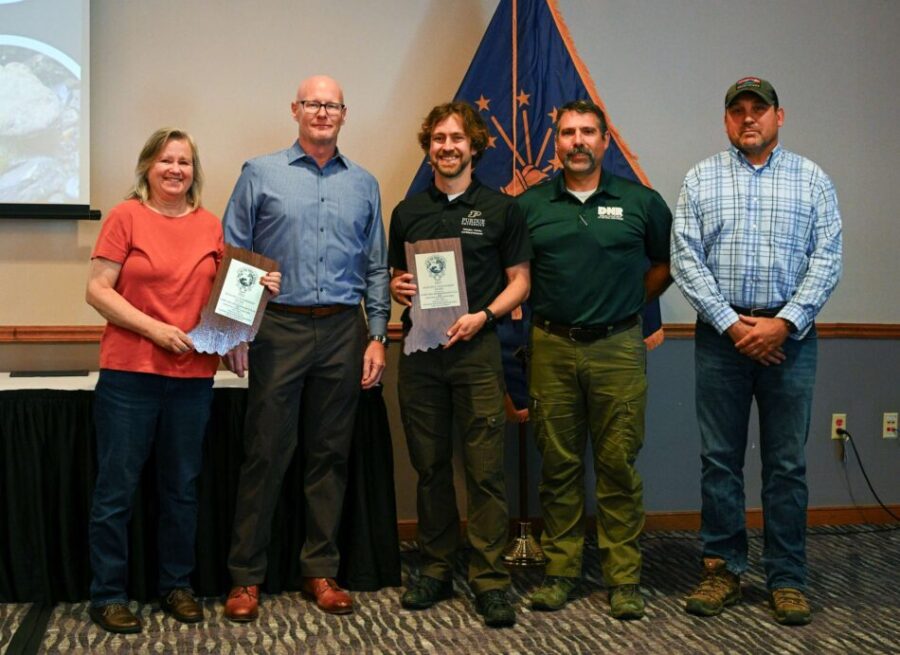
Pictured left to right: Leslie Grow, assistant manager O’Bannon Woods SP, Brandt Baughman, State Parks Director, Nick Burgmeier, Purdue Research Biologist and Wildlife Extension Specialist, Jarrett Manek, Interpretive Naturalist O’Bannon Woods SP, Stanley Baelz, property manager O’Bannon Woods SP.
Indiana State Parks Facebook, Indiana Department of Natural Resources: The Purdue Hellbender Research Team and O’Bannon Woods State Park were recognized for their excellence in resource management at this year’s State Parks division meeting.
Since 2007, the Purdue University Hellbender Research Team has been an invaluable partner at O’Bannon Woods State Park, spearheading the successful recovery of the endangered Eastern hellbender in the Blue River. Their work reintroduced more than 800 individuals with a 75% survival rate, and provided critical educational support through programs and the 5k Hellbender Hustle. Their statewide work has expanded and includes habitat protection efforts, and they provide unique public opportunities at the O’Bannon Woods Nature Center for visitors to enjoy and learn while visiting the Park.
The project is funded by the Indiana Department of Natural Resources – Division of Fish and Wildlife, and the animals released are from eggs provided by the Ohio Department of Natural Resources – Division of Wildlife and Kentucky Department of Fish and Wildlife Resources.
Learn about the hellbenders by visiting the Nature Center at O’Bannon Woods State Park, Indiana.
Resources:
Help the Hellbenders, Purdue Extension
USDA Awards Farmers Helping Hellbenders Project in Funding, Purdue Extension – Forestry and Natural Resources (FNR) Got Nature? Blog
Improving Water Quality by Protecting Sinkholes on Your Property, Purdue Extension – FNR YouTube Channel
Improving Water Quality Around Your Farm video, Purdue Extension – FNR YouTube Channel
Adaptations for Aquatic Amphibians, The Education Store, Purdue Extension’s resource center
Hellbenders Rock! Nature of Teaching Lesson Plan, The Education Store
Nature of Teaching – Hellbenders Rock Sneak Peek video, Purdue Extension – FNR YouTube Channel
Nature of Teaching – Hellbenders Rock webinar video, Purdue Extension – FNR YouTube Channel
Learn about hellbenders and take a tour of Purdue’s hellbender rearing facility video, Purdue Extension – FNR YouTube Channel
Learn about the hellbender work at Mesker Park Zoo video, Purdue FNR Facebook
Learn about hellbender work at The Wilds video, Purdue FNR Facebook
Dr. Rod Williams’ 2017 TEDx Talk Help the Hellbenders video, Purdue Extension – FNR YouTube Channel
A Moment in the Wild – Hellbender Hides video, Purdue Extension – FNR YouTube Channel
A Moment in the Wild – Hellbender Release video , Purdue Extension – FNR YouTube Channel
Help the Hellbender Facebook Post, Original post from Help the Hellbender Facebook account
Diana Evans, Extension & Web Communications Specialist
Purdue University Department of Forestry and Natural Resources
The Natural Resources Conservation Service (NRCS) highlights a powerful example of how conservation practices on working lands can support both farm productivity and wildlife habitat in their recent story, Restoring Roots to Save the Salamanders.

Image from U.S. Department of Agriculture – Natural Resources Conservation Service
On a stretch of farmland in southern Indiana, deep ruts once cut through fields so severely that, as landowner Ben Shireman recalls, “we had ditches in the field that you could park pickup trucks in.” Years of continuous row cropping by a previous owner had taken a toll on the land, leaving behind eroded hillsides, depleted soils and a system that was no longer sustainable both economically and environmentally. What followed for the Shireman family was not a quick fix. It was a transformation rooted in conservation, partnership and a willingness to rethink how their land could work for them and the environment around them.
Today, that same farm is a small but vital part of a growing effort to improve water quality and restore habitat for one of Indiana’s most unique aquatic species called the Eastern Hellbender.
Read how one southern Indiana farm transformed degraded soils and severe erosion into a more resilient system through conservation practices and partnerships here: Restoring Roots to Save the Salamanders.
At the center of this effort is the Farmers Helping Hellbenders initiative, a Regional Conservation Partnership Program (RCPP) focused on improving water quality in the Blue River watershed while supporting habitat for the Eastern Hellbender, one of Indiana’s most unique aquatic species. By implementing practices like rotational grazing, cover crops and nutrient management, farmers can improve soil health and contribute to cleaner waterways that benefit both agriculture and wildlife.
This story highlights how targeted conservation programs and local collaboration can create lasting impacts, helping farms remain productive while protecting natural resources for future generations. It also emphasizes the importance of outreach, technical assistance and farmer-led innovation in building more sustainable systems across Indiana landscapes.
Learn more about the Farmers Helping Hellbenders program.
Resources:
USDA Awards Farmers Helping Hellbenders Project in Funding, Purdue Extension – Forestry and Natural Resources (FNR) Got Nature? Blog
Improving Water Quality by Protecting Sinkholes on Your Property, Purdue Extension – FNR YouTube Channel
Improving Water Quality Around Your Farm video, Purdue Extension – FNR YouTube Channel
Adaptations for Aquatic Amphibians, The Education Store, Purdue Extension’s resource center
Hellbenders Rock! Nature of Teaching Lesson Plan, The Education Store
Nature of Teaching – Hellbenders Rock Sneak Peek video, Purdue Extension – FNR YouTube Channel
Learn about hellbenders and take a tour of Purdue’s hellbender rearing facility video, Purdue Extension – FNR YouTube Channel
Learn about the hellbender work at Mesker Park Zoo video, Purdue FNR Facebook
Learn about hellbender work at The Wilds video, Purdue FNR Facebook
A Moment in the Wild – Hellbender Release video , Purdue Extension – FNR YouTube Channel
Help the Hellbender, Purdue University College of Agriculture
Diana Evans, Extension & Web Communications Specialist
Purdue University Department of Forestry and Natural Resources
U.S. Department of Agriculture – Natural Resources Conservation Service

Recent Posts
- Purdue Extension’s Regional Teams Are Here: Connecting Communities with Expertise and Opportunity
Posted: October 14, 2026 in Community Development, Forestry, Forests and Street Trees, Gardening, How To, Timber Marketing, Urban Forestry, Wildlife, Woodlands - Deer and Turkey Archery Seasons Opening Soon, MyDNR
Posted: October 13, 2026 in Alert, Safety, Wildlife - Distinguishing Dogwoods
Posted: in Forestry, Urban Forestry, Wildlife, Woodlands - Can I Plant Trees in the Fall?
Posted: October 12, 2026 in Forestry, How To, Land Use, Plants, Urban Forestry, Wildlife - Publication Helps Midwest Fish Producers “Catch a Following” with Consumers
Posted: in Aquaculture/Fish, Aquatic/Aquaculture Resources, Wildlife - Minecraft Meets the Hellbender
Posted: September 22, 2026 in Aquaculture/Fish, Aquatic/Aquaculture Resources, Wildlife - What You Plant Matters to Wildlife
Posted: September 16, 2026 in Plants, Urban Forestry, Wildlife - Woodland Flowers of Late Summer
Posted: September 14, 2026 in Forestry, Gardening, Wildlife, Woodlands - Heavy August Rains Bring More Mosquitoes to Indiana
Posted: September 9, 2026 in How To, Invasive Insects, Safety, Wildlife - New Indiana Woodland Steward Newsletter
Posted: August 12, 2026 in Forestry, Urban Forestry, Wildlife, Woodlands
Archives
Categories
- Alert
- Aquaculture/Fish
- Aquatic/Aquaculture Resources
- Ask the Expert
- Christmas Trees
- Community Development
- Disease
- Drought
- Forestry
- Forests and Street Trees
- Gardening
- Got Nature for Kids
- Great Lakes
- How To
- Invasive Animal Species
- Invasive Insects
- Invasive Plant Species
- Land Use
- Natural Resource Planning
- Nature of Teaching
- Plants
- Podcasts
- Ponds
- Publication
- Safety
- Spiders
- Timber Marketing
- Urban Forestry
- Webinar
- Wildlife
- Wood Products/Manufacturing
- Woodland Management Moment
- Woodlands