 Purdue University - Extension - Forestry and Natural Resources
Got Nature? Blog
 With storm season just around the corner, one topic of concern on many minds is damage to and from trees. Depending on the intensity of the storms and the condition of the trees, damage from high winds, heavy rainfall, and lightning can be quite severe. Cracked or broken branches, stem failure, and root failure are some of the main concerns, but also the risk and liability of damage to people and property.
If your tree is damaged, there are some steps to deal with the situation. First and foremost, consider the safety of yourself and others around you. Inspect the tree from a distance first looking for the following:
- Heaving of the ground indicating potential root failure
- Damage to limbs and/or the trunk of the tree
- Hanging branches can fall to the ground resulting in injury or death
- Be aware of utility and power lines. Trees can become charged by coming in contact with live wires. All utility lines should be considered energized and dangerous.
If you find your trees damaged from a storm hiring an International Society of Arboriculture (ISA) Certified Arborist to perform a risk assessment will help guide your decision of how to manage your tree. To find an arborist near you and verify credentials use the link at Find an Arborist, Trees are Good, International Society of Arboriculture (ISA). For more information, you can also view Trees and Storms: Understanding Damage, Risk and Recovery, an informational Got Nature? Blog article from Purdue Extension.
Resources:
Find an Arborist video, Trees are Good-International Society of Arboriculture (ISA)
Caring for storm-damaged trees/How to Acidify Soil in the Yard – In the Grow, Purdue Extension
Tree Risk Management – Got Nature? Blog, Purdue Extension – FNR
Why Is My Tree Dying? – Got Nature? Blog, Purdue Extension – Forestry and Natural Resources (FNR)
Mechanical Damage to Trees: Mowing and Maintenance Equipment – Got Nature? Blog, Purdue Extension – FNR
Trees and Electric Lines – The Education Store
Planting Your Tree Part 1: Choosing Your Tree, video, Purdue Extension – FNR YouTube Channel
Tree Installation: Process and Practices, The Education Store
Tree Wound and Healing, Got Nature? Blog, Purdue Extension – FNR
Subscribe – Purdue Extension-FNR YouTube Channel
Lindsey Purcell, Executive Director
Indiana Arborist Association
Question: “Have whippoorwill birds disappeared in our area?” We recently received this question from a bird enthusiast in southern Indiana who has noticed the absence of Eastern Whip-poor-wills in his area. He shared that when he was younger, Whip-poor-wills were common and their calls were regularly heard in the evenings. However, over time, sightings and calls have become rare or have seemingly disappeared altogether.

Photo: Matt Williams Nature Photography.
Resource Request: “As a landowner with access to a significant amount of family-owned property, I am interested in learning whether any programs exist in Indiana that focus on raising and releasing Eastern Whip-poor-wills or otherwise supporting their return to suitable habitats. I would also like to know if there are opportunities for private landowners to participate in conservation or habitat management efforts that could benefit this species in southern Indiana.”
Answer: Your observation of the decline is accurate. Breeding bird surveys have documented a population decline in the U.S. over the past 40-50 years. The primary reasons for this is loss of forest habitat, loss of young forests, and declines in old-fields (many converted to other cover types – crops, pastures, houses). There is no raise and release programs for whip-poor-wills. In fact, these are rarely done and only in very unusual circumstances when a species faces extinction. It’s very expensive, logistically challenging or impossible, and it doesn’t work. This is true even if we have appropriate habitat available, which we do not in many parts of its range.
The good news is that more groups and agencies are starting to pay attention and work to improve habitat for this charismatic and unique bird. I provided a couple resources below that you may find of interest.
Check out these resources to learn more along with resources listed below:
The Birders’ Dozen Profile 9: Eastern Whip-poor-will, Indiana Woodland Steward
Antrostomus Vociferus, Eastern Whip-poor-will, Fire Effects Information System, US Forest Service Research and Development
More Resources:
Natural History – Whip-poor-will, Indiana Woodland Steward
Virtual Tour Brings Forest Management for Birds to Life, Purdue Extension – Forestry and Natural Resources (FNR) Got Nature? Blog
Breeding Bird Atlas, Indiana Department of Natural Resources
Forestry for the Birds, Pond and Wildlife, Purdue Extension
IN DNR Shares How to Keep Your Backyard Birds Healthy, Purdue Extension – FNR Got Nature? Blog
Question: Is there any risk of becoming infected with avian influenza virus by feeding backyard birds?, Purdue Extension – FNR Got Nature? Blog
Breeding Birds and Forest Management: the Hardwood Ecosystem Experiment and the Central Hardwoods Region, The Education Store, Purdue Extension resource center
Forest Birds, Purdue Extension – FNR YouTube Channel
Managing Woodlands for Birds Video, Purdue Extension – FNR YouTube Channel
The Birders’ Dozen, Profile: Baltimore Oriole, Indiana Woodland Steward
Ask An Expert, Playlist, Purdue Extension – FNR YouTube channel
Birds and Residential Window Strikes: Tips for Prevention, The Education Store
No Room at the Inn: Suburban Backyards and Migratory Birds, The Education Store
Putting a Little Wildlife in Your Backyard This Spring, The Education Store
Subscribe, Purdue Extension – FNR YouTube Channel
Dr. Brian MacGowan, Extension Wildlife Specialist & Certified Wildlife Biologist
Department of Forestry & Natural Resources, Purdue University
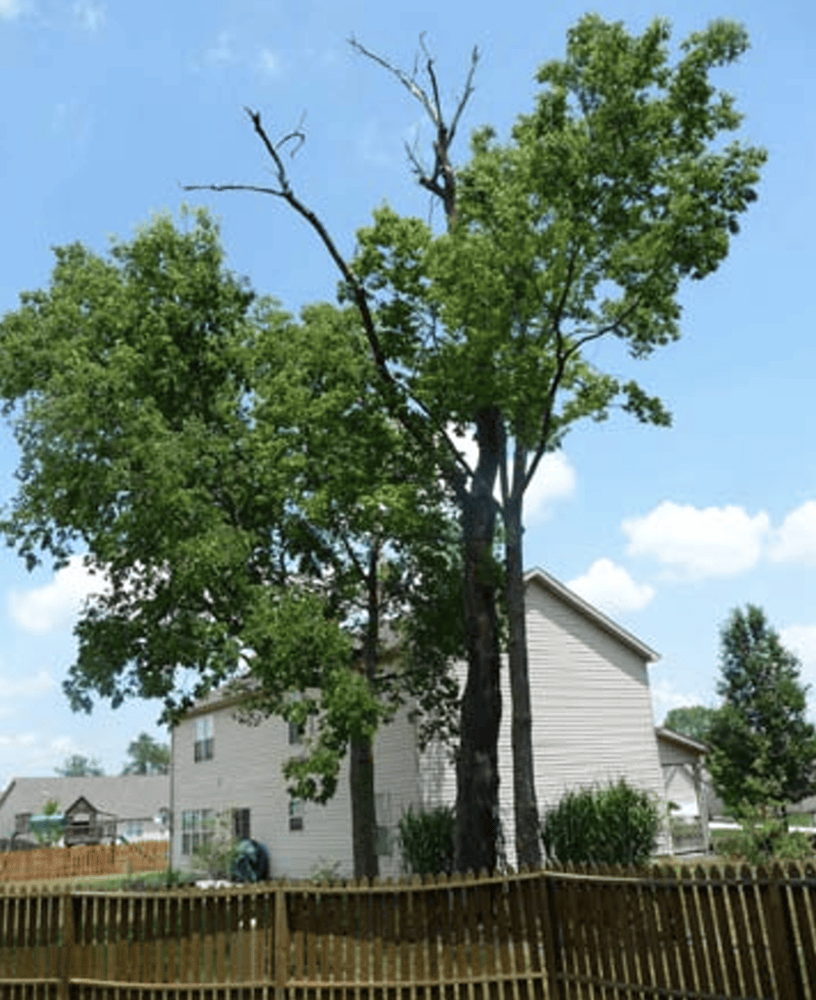
Unhealthy trees can fail, causing potential damage to nearby homes
Trees provide many benefits for our homes, businesses and properties. If a tree is defective, however, it may become a hazard. It is important to understand that tree owners have a duty to inspect and maintain their trees. All property owners should take reasonable steps to protect themselves by involving a qualified consultant or certified arborist.
The primary responsibilities of the arborist are to assess the potential for tree failure, advise owners of the consequences of failure and recommend the proper measures to prevent and abate failures. In assessing and managing trees it is important to create a balance between the inherent risk a tree poses and the benefits provided by the tree. Risk tree management begins with these basic steps:
Reduce tree liabilities: The property owner or manager has an obligation to periodically inspect trees for unsafe conditions. Since all trees have risk associated with them, regular inspection compels the owner or manager to evaluate the amount of risk they are willing to assume. Tree risk assessment is an important part of a program to determine if a tree is structurally sound or has the potential for failure. Inspections show that the tree owner is actively managing their trees and could reduce the owner’s liability if a failure occurs.
Inspect regularly: Trees should be assessed through inspections by a qualified arborist, preferably an International Society of Arboriculture Certified Arborist. Further inspections should be conducted after major weather events. At a minimum, trees should be inspected every five years or according to the owner’s risk tolerance.
Document and maintain records: Every inspection should be recorded and kept on file for future reference. These records are important for several reasons. Past evaluations can show how a tree has changed in its health and structure over the years. Also, written assessments are beneficial in liability claims and court cases. These written evaluations could minimize liability if a failure occurs and a claim is filed against the tree owner.
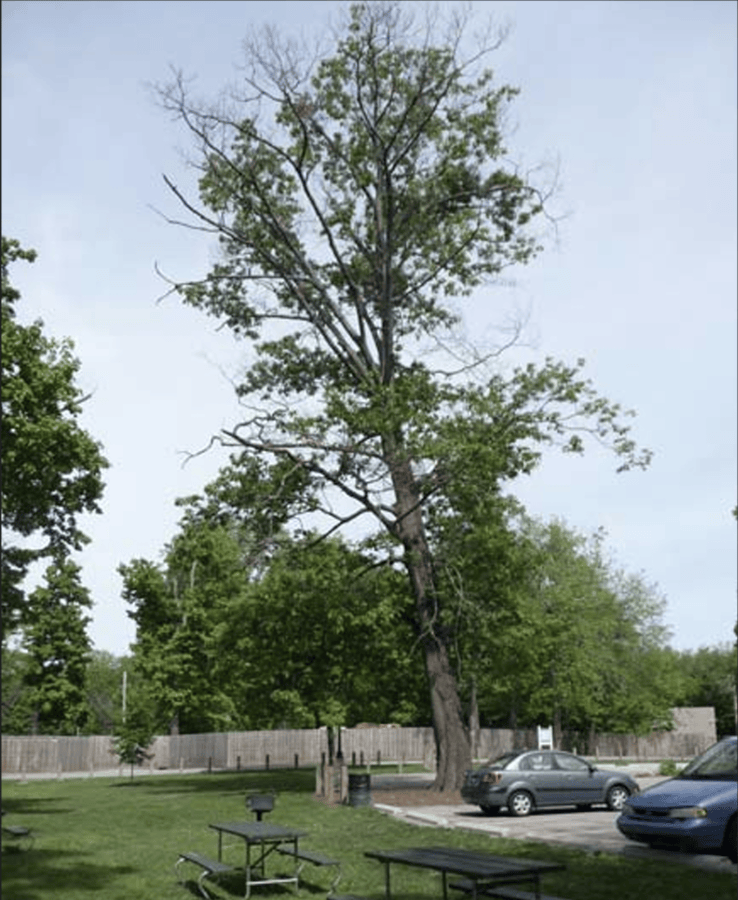
Inspect trees for health conditions and defects during the tree risk assessment.
Develop a site policy and care plan: Every property manager should create and implement a policy for tree risk. This includes developing a standard of care, an inspection process and mitigation of property risk. Routine care and scheduled maintenance for all trees is essential.
Mitigate tree risk: Tree owners should make every effort to reduce risk with proper pruning and health care practices. Consider all options before deciding on removal. If possible, move or remove the “target” (see definition in “Tree Risk Assessment” section). Install structural support systems where feasible. Modify site conditions to improve the environment around the tree. Risk mitigation requires a process of logical options focusing on protecting the target and preserving the tree.
Schedule tree work: While evaluating trees for risk, the inspector should note any tree maintenance needs. The inspection can determine the timing and priority of work needed. The work should be prioritized first for safety and then for tree health. Consider potential risk, activities around the tree, level of acceptable risk and the needs of the client.
Create good tree planting strategies: Identify planting needs and locations that become available as trees are removed or destroyed. Improving the health and safety of the landscape requires an understanding of management principles, such as species selection and diversity. Also consider the impact of site infrastructure, including utilities, streets and sidewalks, and choose the right tree for the right place. Select trees known to thrive under local conditions and sustainable as long-term investments in the property
Tree Risk Assessment
For a tree to be considered hazardous it must be defective either in some part or as a whole, with risk for failure and a target that is threatened. Trees are declared hazards if assessments have been completed and mitigation is required to prevent a failure from causing damage affecting the target. To understand the implications of this concept, tree owners need to know some common terms of tree risk management.
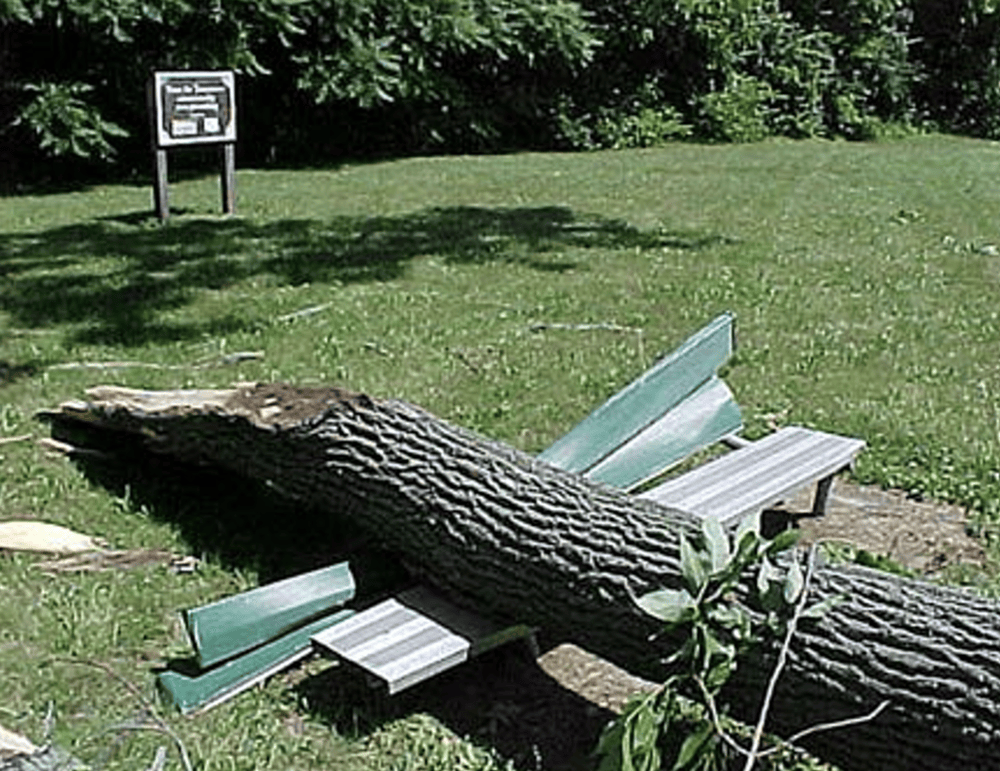
Identify potential targets for tree failure.
A target is people, property or activities that could be injured, damaged or disrupted by a tree failure. Tree owners must carefully assess the area around homes, playgrounds, sidewalks and parking areas. Is the target static, moveable or mobile? Consider whether people can be kept away or separated from the target area. Also, assess the target’s value and potential. Review the target zone, which is the area where the tree or a branch is likely to strike when it falls, to determine consequences of the tree’s failure. The target zone should include the areas inside a circle around the tree, which is at least as wide as the total tree height.
Risk is the combination of the likelihood of a tree failure event and the severity of the possible consequences of that event. Every tree has the potential to fail; however, only a small number of failures actually cause injury or damage. It is impossible to maintain trees free of risk. Some level of risk must be accepted by the owner.
Hazard is a likely source of harm and is identified as the tree part or parts which will affect the target zone. For example, an entire tree or a single branch could be determined as a hazard. Hazards are identified during tree assessments, and tree owners are required to take steps to minimize the risk of damage from failure.
Individual tree characteristics must be considered when conducting evaluations for defects and failure potential. Evaluations should take a systematic approach, assessing the potential for tree failure, understanding the impact of such failures and outlining a plan of action to prevent and mitigate these failures. Tree owners should fully understand the site factors and characteristics of the tree species. There are several contingencies that influence tree failure potential and risk. These include soil type and saturation, wind exposure, pest damage, poor growing conditions and poor pruning practices such as topping.
Among the characteristics to consider when conducting tree risk evaluations are:
- Defects — severity and location. Decay, cankers, cracks and other positive indicators of weakness in the roots, stems and branches may need immediate attention if a target is present.
- Species characteristics. Some tree species possess weaker wood, a susceptibility to decay, poor growth habits and potential for pests. They could be more likely to fail after wounding because of poor ability to wall off internal decay or health issues.
- Canopy size, shape and weight distribution. This is especially true in situations where a tree is exposed to windy conditions, is leaning or has a poor stem-to-canopy ratio.
- Crown architecture. Poor branching and similar characteristics can create high-risk situations in strong winds and other weather conditions.
- Plant health and vigor. This determines how a tree can overcome wounding or pest infestations.
- The overall size of the defective part. A predetermined rating system, which outlines critical thresholds, should be considered and incorporated into the tree’s risk management plan.
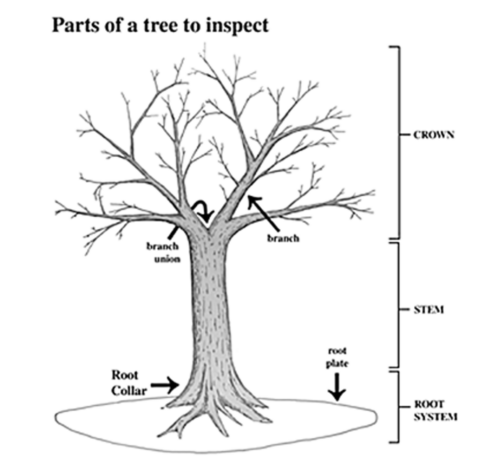 Tree Inspections
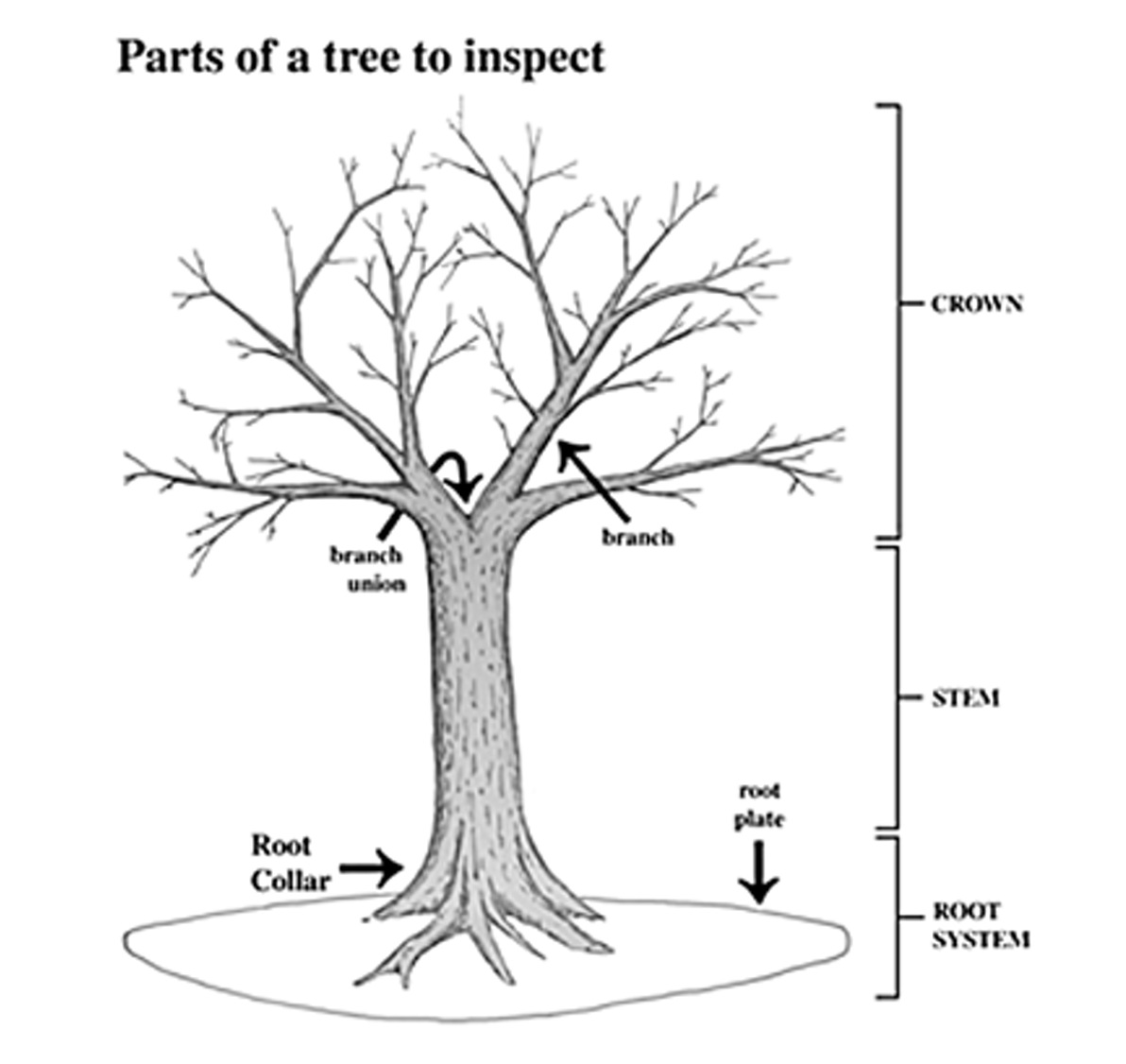
Assessments should include a thorough examination of each section of the tree. A systematic approach using standardized evaluation methods aids the process. Review the canopy (crown), branches and root zone to check for signs of failure. These include:
- Dead, diseased, dying or broken branches.
- Thinning or poor canopy health.
- An unstable branching pattern, overextended or weakly attached branches, or cracks in the stems.
- Cracks or decayed areas in the main trunk.
- Exposed or decayed roots, heaving of the soil, fungus growth or cracks in the soil around the root plate.
Recurrent inspections to determine tree health and condition are critical for successful risk management programs. Trees in active-use areas should be inspected annually for defects and conditions leading to failure. Inspections are necessary after storms to ensure excessive loads have not exceeded the strength of the tree and its parts. Also, be sure to note trees with a history of failures or those with problematic structure, for more frequent monitoring and inspection. A good database and archive of tree evaluations is a critical strategy in the overall risk management plan.
Resources:
Planting Your Tree Part 1: Choosing Your Tree, Purdue Extension YouTube Channel
Tree Pruning Essentials Video, Purdue Extension YouTube Channel
Tree Defect Identification, The Education Store, Purdue Education’s resource center
Why Is My Tree Dying?, Got Nature? Blog, Purdue Extension – Forestry and Natural Resources (FNR)
Tree Wound and Healing, Got Nature? Blog, Purdue Extension – FNR
Surface Root Syndrome, The Education Store
Find an Arborist video, Trees are Good-International Society of Arboriculture (ISA)
Trees and Storms: Understanding Damage, Risk and Recovery – Got Nature? Blog, Purdue Extension – FNR
Report INvasive, Purdue Extension
Indiana Invasive Species Council
ID That Tree, Playlist, Purdue Extension – FNR YouTube Channel (Invasive White Mulberry, Siberian Elm, Tree of Heaven)
Fifty Common Trees of Indiana
Native Trees of the Midwest, Purdue University Press
Subscribe – Purdue Extension-FNR YouTube Channel
Lindsey Purcell, Executive Director
Indiana Arborist Association
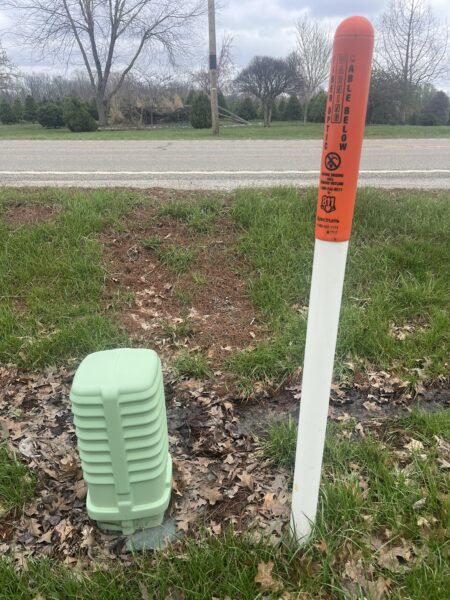
Figure 1. Runoff from roads surfaces into trenches can quickly form gullies from soil erosion if not quickly repaired following utility work (Purdue Landscape Report)
Purdue Landscape Report: Each of us utilize mobile devices and daily consume services that require fiber and other utility infrastructure. Necessary utility work along roadways often leaves sunken trenches, compacted soil for lawns that are uneven or stripped of vegetation. If damage is significant, check with the utility provider, as many companies have restoration policies or reimbursement options for affected homeowners. However, subcontractors and varying degrees of action by utilities can make this a frustrating process.
But a few timely steps can speed recovery and simplify the process rather than dealing with later weed overgrowth or washing overtime. Begin by removing rocks, excess gravel, and construction debris. Loosen the sides of ruts or where excess soil remains beside a trench with a rake or shovel to level out and improve water infiltration and root development. If the area has settled or ruts are present after a period of time, regrade to match the surrounding lawn and ensure proper drainage away from the roadway and sidewalks. Use extra caution when these areas are collocated with drainage or susceptible to water over wash as your work can be whisked away. In some cases, ignored sunken trenches and ruts can be back filled with highly deteriorated mulch to help bring back life to the soil if one has patience to let time continue to run its course and seed later into the mellowed, high organic matter soil.
Next, incorporate quality topsoil or compost to rebuild soil structure and fertility.
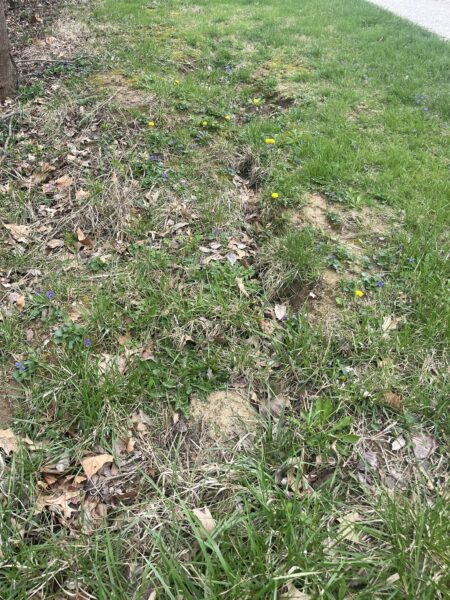
Figure 2. Sunken trenches from utility work that have been overgrown with grass/weeds can be a hazard for one walking or when mowing. Often the easiest fix if one is willing to be patient is to add composted mulch into the trench which will help fill to help soil and have less disturbance. Mulch is also much easier to shovel than top soil.
Choose a grass seed mix appropriate for your region and light conditions and apply it evenly over the prepared area. Lightly rake the seed into the soil and cover with straw mulch to reduce erosion and conserve moisture. Keep the area consistently moist with light, frequent watering until seedlings are well established, typically 2–3 weeks depending on weather. If the season is not fit for seeding grass (i.e. July) try seeding a temporary cover crop like buckwheat that will attract pollinators and give short term cover while choking out weeds.
For larger or highly visible areas, sod can provide an instant fix, though it is both expensive and requires careful watering to root successfully. Once new grass reaches 3–4 inches, begin mowing and apply a light fertilizer application to encourage growth.
In summary, it depends on the time frame and the urgency you have to fix a recently created problem based on its location. For problem areas that have existed over time where weed growth has already occurred, using composted mulch to fill sunken trenches or ruts may be the easiest, while using mowing to manage weeds during summer and seed after lighly working surface more towards late summer or early fall.
View the original article on the Purdue Landscape Report website: Roadside Rehab: Rebuilding Soil and Cover After Utility Damage.
Subscribe and receive the newsletter: Purdue Landscape Report Newsletter.
Resources:
Find an Arborist video, Trees are Good-International Society of Arboriculture (ISA)
Trees and Storms: Understanding Damage, Risk and Recovery – Got Nature? Blog, Purdue Extension – FNR
Caring for storm-damaged trees/How to Acidify Soil in the Yard – In the Grow, Purdue Extension
Why Is My Tree Dying? – Got Nature? Blog, Purdue Extension – Forestry and Natural Resources (FNR)
Tree Risk Management – Got Nature? Blog, Purdue Extension – FNR
Mechanical Damage to Trees: Mowing and Maintenance Equipment – Got Nature? Blog, Purdue Extension – FNR
Trees and Electric Lines – The Education Store
Tree Defect Identification, The Education Store
Planting Your Tree Part 1: Choosing Your Tree, video, Purdue Extension – FNR YouTube Channel
Tree Installation, The Education Store
Tree Wound and Healing, Got Nature? Blog, Purdue Extension – FNR
Ask an Expert: Tree Selection and Planting, Purdue Extension – FNR YouTube Channel
Tree Pruning Essentials, Purdue Extension – FNR YouTube Channel
Subscribe – Purdue Extension-FNR YouTube Channel
Mark Evans, Extension Educator/Plant & Soil Science, Elkhart County
Purdue Extension – Agriculture & Natural Resources (ANR)
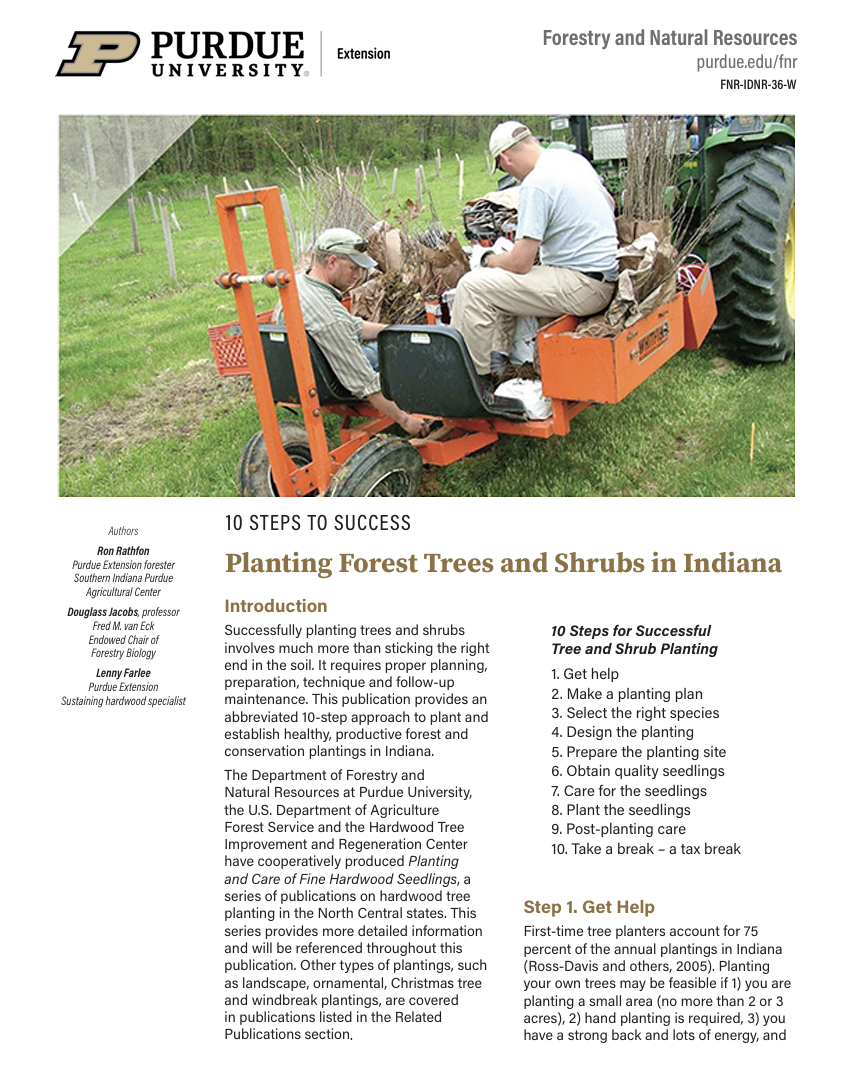 Discover the essential guide for anyone looking to plant forest trees or shrubs in Indiana. Whether you’re a first‑time landowner or an experienced conservationist, Planting Forest Trees and Shrubs in Indiana walks you through the 10 proven steps for establishing healthy, resilient plantings that thrive for generations. From choosing the right species to preparing your site, planting with confidence and ensuring long‑term success, this publication distills expert forestry knowledge into clear, practical advice. Ready to transform your landscape and leave a lasting legacy?
This publication provides an abbreviated 10-step approach to plant and establish healthy, productive forest and conservation plantings in Indiana. Successfully planting trees and shrubs involves much more than sticking the right end in the soil.
To receive the free download, visit the Purdue Extension’s resource center: The Education Store – Planting Forest Trees and Shrubs in Indiana.
Resources:
Control Management of Poison Hemlock, Got Nature? Blog, Purdue Extension – Forestry & Natural Resources (FNR)
Publication: Invasive Plant Series-Tree of Heaven, Got Nature? Blog, Purdue Extension – FNR
Publication – Invasive Plant Series: Swallow-worts, Got Nature? Blog, Purdue Extension – FNR
Question: What is the best management process with cut invasive brush tops?, Got Nature? Blog, Purdue Extension – FNR
Planting Your Tree Part 1: Choosing Your Tree, Purdue Extension YouTube Channel
Tree Pruning Essentials, The Education Store
Tree Pruning Essentials Video, Purdue Extension YouTube Channel
Surface Root Syndrome, The Education Store
District Forester, Indiana Department of Natural Resources, 10+ acres
Directory of Professional Foresters, Indiana Forestry & Woodland Owners Association (IFWOA)
Find an Arborist video, Trees are Good-International Society of Arboriculture (ISA)
Indiana Invasive Species Council
ID That Tree, Playlist, Purdue Extension – FNR YouTube Channel (Invasive White Mulberry, Siberian Elm, Tree of Heaven)
Fifty Common Trees of Indiana
An Introduction to Trees of Indiana
Native Trees of the Midwest, The Education Store
Subscribe – Purdue Extension-FNR YouTube Channel
Ron Rathfon, Regional Extension Forester, Southern Indiana Purdue Agriculture Center (SIPAC)
Purdue Forestry and Natural Resources
In this edition of ID That Tree, Purdue Extension Forester Lenny Farlee introduces us to Virgin’s Bower clematis, a native vining plant found in Indiana that’s especially noticeable when it blooms later in the growing season. Often seen climbing over nearby vegetation or spreading across open spaces, this species adds both beauty and ecological value to the landscape. Learn where Virgin’s Bower is typically found, how to recognize it and how it compares to a similar invasive look-alike. Whether you’re a student, landowner or simply curious about native vines, this video offers a quick introduction to this attractive and useful Indiana species.
If you have any questions regarding wildlife, trees, forest management, wood products, natural resource planning or other natural resource topics, feel free to contact us by using our Ask an Expert web page.
Resources:
ID That Tree – Video Playlist, Purdue Extension – Forestry and Natural Resources (FNR) YouTube Channel
Purdue Arboretum Explorer
Conservation Tree Planting: Steps to Success, Purdue Extension – FNR YouTube Channel
A Woodland Management Moment, Playlist, Purdue Extension – FNR YouTube Channel
Woodland Stewardship for Landowners, Playlist, Purdue Extension – FNR YouTube Channel
Fifty Common Trees of Indiana, Purdue Extension – FNR
Indiana Invasive Species Council
Cooperative Invasive Species Management Area (CISMA)
Report Invasive, Purdue Extension
Habitat University, Episode 12 – Exploring the challenges of Invasive Species, Habitat University-Natural Resource University
Shrubs and Woody Vines of Indiana and the Midwest, Purdue University Press
Native Trees of the Midwest, Purdue University Press
Professional Forester, Indiana Forestry Woodland Owners Association
District Forester, Indiana Department of Natural Resources, 10+ acres
Find an Arborist, International Society of Arboriculture
Forest Improvement Handbook, The Education Store
Lenny Farlee, Extension Forester
Hardwood Tree Improvement and Regeneration Center
Purdue Department of Forestry & Natural Resources
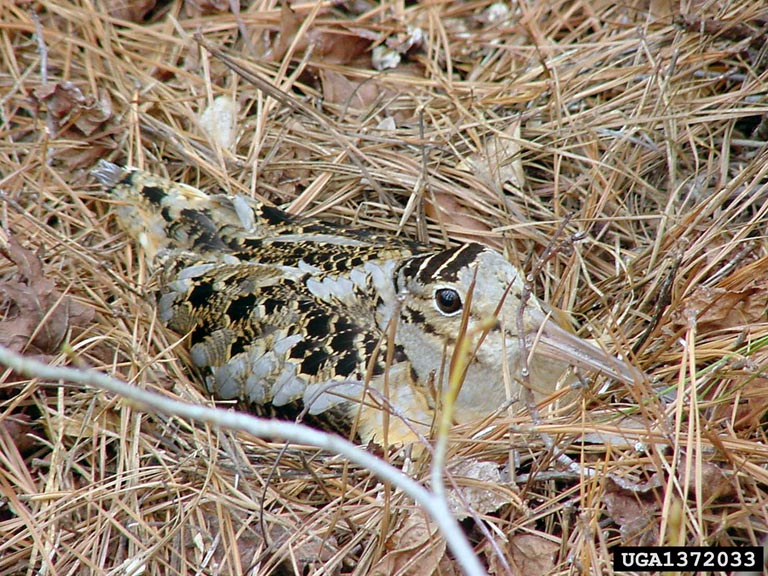
American Woodcock. Photo credit: Ricky Layson Photography, Bugwood.org.
You know Spring is around the corner when the days get longer and the temperatures rise. While the weather has pleasantly been warm this year so far, perhaps my favorite harbinger of Spring is the annual arrival of the American Woodcock, also known as the Timberdoodle. Their unique “peents” and the spectacular aerial flights of males looking to attract mates can be very entertaining.
Woodcock are migratory and spend their winters in the southern U.S. They arrive in Indiana in the early spring. Male woodcock typically set up their singing grounds in open fields and forest openings and recently logged areas. However, they can often be seen in urban areas including parks and even residential communities. The best time to observe them is at dusk. Woodcock will spend time on the ground “peenting” for a while, then fly high into the air to perform their “dance” only to return to the ground where they will repeat the process. This will go on until it gets dark. You can sometimes hear them peent in the morning before sunrise.
If you’re outside around dusk in early spring, keep an ear out — you just might hear the peent of a timberdoodle nearby.
Resources:
American Woodcock, Indiana Department of Natural Resources, Department of Fish & Wildlife
Americna Woodock – Listen to Woodcock call, Purdue Ross Biological Reserve
The Birders’ Dozen Profile 2: American Woodcock, Indiana Woodland Steward
Learn how forests are used by birds new videos, Got Nature? Blog
Managing Woodlands for Birds, The Education Store-Purdue Extension resource center
Managing Woodlands for Birds Video, Purdue Extension-Forestry and Natural Resources (FNR) YouTube Channel
Birds and Residential Window Strikes: Tips for Prevention, The Education Store, Purdue Extension resource center
Breeding Birds and Forest Management: The Hardwood Ecosystem Experiment and the Central Hardwoods Region, The Education Store
No Room at the Inn: Suburban Backyards and Migratory Birds, The Education Store
The Birders’ Dozen, Profile: Baltimore Oriole, Indiana Woodland Steward
Ask An Expert, Playlist, Purdue Extension – FNR YouTube Channel
It’s For the Birds, Indiana Yard and Garden-Purdue Consumer Horticulture
National Audubon Society
The Cornell Lab of Ornithology
Subscribe, Purdue Extension – FNR YouTube Channel
Brian MacGowan, Extension Wildlife Specialist
Purdue University, Department of Forestry and Natural Resources
Purdue Landscape Report: When talking about invasive species, specialists are most commonly talking about some kind of plant or insect that is making an impact on landscape plants, soil, or hardwood. Most of these species are relatively easy to understand, with a biology that typically resembles that of a native counterpart. Wood-boring insects, vining plants, and fast-growing shrubs all have similar native species that landowners deal with on a regular basis. And then, some invasive species are just plain weird, like the invasive hammerhead worm!
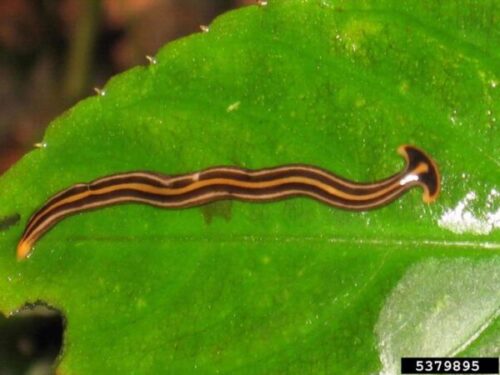
Hammerhead worm (photo from Arun T P, Bugwood.org)
Hammerhead worms, sometimes called shovel-headed garden worms, are a type of land planarian, or flatworm. Flatworms are worm-like organisms that lack the segmentation of earthworms and have the ability to regenerate from parts and pieces. Hammerhead worms belong to a subset of planarians, the genus Bipalium; while there are a few native species of Bipalium, most are from tropical regions. It is believed that hammerhead worms have been present in North America for long time, preferring environments that stay warm and moist through most of the year. Hammerhead worms are named for their spade-shaped head and typically have bright colors with dark lines running the length of their bodies. They are often found in indoor spaces and greenhouses that are temperature controlled and maintain humid conditions. Hammerhead worms can also be found living under rocks, fallen trees, or anywhere that can maintain a high enough relative humidity. While some flatworms are able to live in drier conditions, Bipalium need moisture in order to survive.
Members of Bipalium are predatory, consuming invertebrates like earthworms, snails, slugs, and some soft-bodied insects. Once they capture a prey item, they envelop it in a mouth-like organ located on the underside of their bodies. The primary issue with hammerhead worms is the potential damage they can do by preying on beneficial organisms that maintain soil and plant health. Hammerhead worms, and all other planarians, lack a closed body plan that uses a one-way digest system. Once they eat something, it is digested and waste is excreted through that same mouth-like opening. Some members of Bipalium can also use a toxin called tetrodotoxin to subdue their prey; however, they only produce a small amount and lack a way to use it on a larger organism. While they are often confused for more dangerous species, the Bipalium in North America do not represent a human health concern. Just keep any pets or children away from them, and if found, and use gloves if you’re forced to handle them.
As mentioned above, one of the more unique traits of Bipalium, and planarians in general, is their capacity to regenerate new individuals from parts and pieces. A piece as small as 1/279th of the whole can regenerate into a new individual. Do not attempt to chop up or crush hammerhead worms, or you may be dealing with several dozen when new worms develop in two weeks. However, even though it seems like hammerhead worms could reproduce very quickly, it’s still fairly uncommon to see one. If found, place it in a bag or bucket with either salt, alcohol, or vinegar until the worm is dead. As long as you do not cut or chop up the worms, it is very unlikely you’ll have to deal with more than one at any given time. Just keep your eyes open and remember to report any sightings to 1-866-NOEXOTICS!
View the original article on the Purdue Landscape Report website: Keep an eye out for hammerhead worms!.
Subscribe and receive the newsletter: Purdue Landscape Report Newsletter.
Resources:
Gardeners Asked to be Vigilant This Spring for Invasive Jumping Worm, Purdue Extension – FNR Got Nature? Blog
Fall webworms: Should you manage them?, Purdue Landscape Report
Mimosa Webworm, The Education Store, Purdue Extension resource center
Sod Webworms, Turf Science at Purdue University
Bagworm caterpillars are out feeding, be ready to spray your trees, Purdue Extension Forestry & Natural Resources (FNR) Got Nature? Blog
Landscape & Ornamentals: Bagworms, The Education Store
Purdue Plant Doctor, Purdue Extension-Entomology
Find an Arborist website, Trees are Good, International Society of Arboriculture (ISA)
ID That Tree – Video Playlist, Purdue Extension – Forestry and Natural Resources (FNR) YouTube Channel
Fifty Common Trees of Indiana, Purdue FNR web page list
Indiana Department of Natural Resources: Invasive Species
Indiana Invasive Species Council
Cooperative Invasive Species Management Area (CISMA)
Report Invasive, Purdue Extension
Native Trees of the Midwest, Purdue University Press
Report INvasive Facebook
Subscribe – Purdue Extension – FNR YouTube Channel
Bob Bruner, Exotic Forest Pest Educator
Purdue Entomology
Hummingbirds are a popular attraction in any backyard and we receive questions on when they will be coming to Indiana and how to attract them to your backyard. Our Purdue professor emeritus of wildlife ecology Barny Dunning in this interview for CBS4 Indianapolis titled “How to attract hummingbirds during peak migration,” shares how planting a variety of plants that bloom will help draw them in along with a simple hummingbird mixture.
The ruby-throated hummingbird is the only species of hummingbird that nests in the Hoosier state. These colorful visitors are migratory and arrive from their wintering grounds around mid-April.
Dr. Brian MacGowan has a publication titled Attracting Hummingbirds to Your Yard that is a great resource to share along with this video showing how to prepare your hummingbird feeders and how to find out when they will be migrating to your area. Hummingbird Central also tracks spring and fall migrations. Anyone can submit sightings on their website and view up-to-date sightings.
Resources:
Attracting Hummingbirds to Your Yard publication, The Education Store-Purdue Extension resource center
Virtual Tour Brings Forest Management for Birds to Life, Got Nature? Blog, Purdue Extension FNR
Birding Through the Seasons, Indiana Forestry & Woodland owners Association (IFWOA)
Behold! The Atlas of Breeding Birds of Indiana, MyDNR, Indiana Department of Natural Resources, Got Nature? Blog, Purdue Extension FNR
Breeding Birds and Forest Management: the Hardwood Ecosystem Experiment and the Central Hardwoods Region, The Education Store, Purdue Extension – Forestry and Natural Resources
Forest Birds, The Education Store
Managing Woodlands for Birds, The Education Store
Managing Woodlands for Birds Video, Purdue Extension-Forestry and Natural Resources (FNR) YouTube Channel
The Birders’ Dozen, Profile: Baltimore Oriole, Indiana Woodland Steward
Birds and Residential Window Strikes: Tips for Prevention, The Education Store, Purdue Extension resource center
No Room at the Inn: Suburban Backyards and Migratory Birds, Education Store
Question: Is there any risk of becoming infected with avian influenza virus by feeding backyard birds?, Got Nature? Blog, Purdue Extension FNR
Preventing Wildlife Damage – Do You Need a Permit?, The Education Store
How to Construct a Scent Station video, The Education Store
Subscribe – Purdue Extension-FNR YouTube Channel
Brian MacGowan, Wildlife Extension Specialist
Purdue Forestry and Natural Resources
Purdue Extension – Forestry and Natural Resources’ ID That Tree video series was recently highlighted in the National Woodland Owners Association’s (NWOA) Woodland Word Newsletter, recognizing the value of this Purdue FNR extension resource for woodland owners nationwide.

Hosted by Purdue Extension – Forestry and Natural Resources Forester Lenny Farlee, ID That Tree is a video series created to help viewers identify forest trees, shrubs and invasive plants through short, easy-to-follow lessons. With more than 150 videos in the playlist, the series offers a practical resource for woodland owners, land managers, outdoor enthusiasts and natural resource professionals interested in learning more about the plants and trees in their woodlands and surrounding landscapes. The ID That Tree playlist can be viewed on the Purdue Extension Forestry and Natural Resources YouTube channel.
In the March 25, 2026 issue of Woodland Word, NWOA featured the playlist in its “Knowledge, Inspiration, and Humor” section, describing it as a helpful tool for woodland owners seeking tree identification assistance.
Connecting National Resources to Indiana Woodland Owners
The National Woodland Owners Association (NWOA) is a nonprofit organization supporting woodland owners through education, advocacy, and stewardship resources across the U.S. To learn more about the opportunities and resources available view Join NWOA.
Here in Indiana, that national mission is carried forward locally through the Indiana Forestry & Woodland Owners Association (IFWOA), an official affiliate of NWOA.
IFWOA provides Indiana woodland owners with:
- Local networking and peer learning
- Educational programs and field tours
- Connections to Purdue Extension resources
- A voice for woodland owners at the state level
Resources:
Purdue Arboretum Explorer
Conservation Tree Planting: Steps to Success, Purdue Extension – FNR YouTube Channel
A Woodland Management Moment, Playlist, Purdue Extension – FNR YouTube Channel
Woodland Stewardship for Landowners, Playlist, Purdue Extension – FNR YouTube Channel
Fifty Common Trees of Indiana, Purdue Extension – FNR
Episode 11 – Exploring the challenges of Invasive Species, Habitat University-Natural Resource University
Shrubs and Woody Vines of Indiana and the Midwest, The Education Store
Native Trees of the Midwest, The Education Store
Professional Forester, Indiana Forestry Woodland Owners Association
Forest Improvement Handbook, The Education Store
Professional Forester, Indiana Forestry Woodland Owners Association (IFWOA)
District Forester, Indiana Department of Natural Resources, 10+ acres
Find an Arborist, International Society of Arboriculture
Indiana Invasive Species Council
Cooperative Invasive Species Management Area (CISMA)
Indiana Department of Natural Resources: Invasive Species
Report Invasive, Purdue Extension
Diana Evans, Extension & Web Communications Specialist
Purdue University Department of Forestry and Natural Resources

Recent Posts
- Purdue Extension’s Regional Teams Are Here: Connecting Communities with Expertise and Opportunity
Posted: October 14, 2026 in Community Development, Forestry, Forests and Street Trees, Gardening, How To, Timber Marketing, Urban Forestry, Wildlife, Woodlands - Deer and Turkey Archery Seasons Opening Soon, MyDNR
Posted: October 13, 2026 in Alert, Safety, Wildlife - Distinguishing Dogwoods
Posted: in Forestry, Urban Forestry, Wildlife, Woodlands - Can I Plant Trees in the Fall?
Posted: October 12, 2026 in Forestry, How To, Land Use, Plants, Urban Forestry, Wildlife - Publication Helps Midwest Fish Producers “Catch a Following” with Consumers
Posted: in Aquaculture/Fish, Aquatic/Aquaculture Resources, Wildlife - Minecraft Meets the Hellbender
Posted: September 22, 2026 in Aquaculture/Fish, Aquatic/Aquaculture Resources, Wildlife - What You Plant Matters to Wildlife
Posted: September 16, 2026 in Plants, Urban Forestry, Wildlife - Woodland Flowers of Late Summer
Posted: September 14, 2026 in Forestry, Gardening, Wildlife, Woodlands - Heavy August Rains Bring More Mosquitoes to Indiana
Posted: September 9, 2026 in How To, Invasive Insects, Safety, Wildlife - New Indiana Woodland Steward Newsletter
Posted: August 12, 2026 in Forestry, Urban Forestry, Wildlife, Woodlands
Archives
Categories
- Alert
- Aquaculture/Fish
- Aquatic/Aquaculture Resources
- Ask the Expert
- Christmas Trees
- Community Development
- Disease
- Drought
- Forestry
- Forests and Street Trees
- Gardening
- Got Nature for Kids
- Great Lakes
- How To
- Invasive Animal Species
- Invasive Insects
- Invasive Plant Species
- Land Use
- Natural Resource Planning
- Nature of Teaching
- Plants
- Podcasts
- Ponds
- Publication
- Safety
- Spiders
- Timber Marketing
- Urban Forestry
- Webinar
- Wildlife
- Wood Products/Manufacturing
- Woodland Management Moment
- Woodlands