 Purdue University - Extension - Forestry and Natural Resources
Got Nature? Blog
Purdue Landscape Report: Pollarding is a tree pruning method in which the upper branches of a tree are cut back to the same points on a regular schedule, creating a framework of knobby growth points from which new shoots emerge. The practice has been used for centuries and is especially common in landscapes where trees must be kept at a controlled height or width. Pollarding is not the same as topping, which is generally considered harmful because it removes branches without a long-term management plan. Instead, pollarding is a deliberate, repeated technique that can shape a tree into a compact, manageable form.
One of the main advantages of pollarding is size control. In urban areas, along streets, and near buildings or utility lines, trees often need to fit within tight spaces. Pollarding can reduce conflicts with overhead wires, streetlights, sidewalks, and traffic while still allowing a tree to remain in place. It can also reduce shade, which may be useful in courtyards, parking areas, and other sites where too much canopy cover is a problem. Some trees also respond by producing dense, attractive new growth, which can give them a distinctive architectural look.
Pollarding may also extend the usable life of certain trees when it is started early and maintained properly. Because the tree is kept smaller and more compact, it may be less likely to fail under wind or storm stress than a large tree with heavy limbs. In some settings, the regular cutting of new shoots can even provide a source of small-diameter wood or fodder, which helps explain why pollarding developed historically as a practical land-management method.
That said, pollarding has real drawbacks. It must be done correctly and consistently; if a tree is pollarded at the wrong age, on the wrong species, or after long neglect, the result can be stress, decay, weak regrowth, or structural problems. Not all trees tolerate the practice well, and some may decline if pollarded too aggressively. Pollarding also creates a very artificial appearance, which some people dislike. A freshly pollarded tree can look bare or severe for a time, and the repeated cuts require ongoing maintenance.
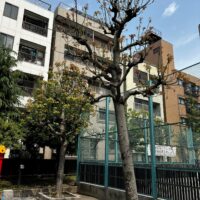
Figure 1: New growth on pollarded tree. Photo credit: Ben McCallister
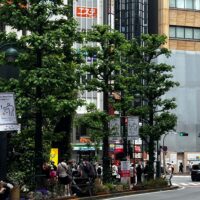
Figure 2: Pollarded street trees in Shibuya, Tokyo. Photo credit: Ben McCallister
Pollarding is most strongly associated with Europe, especially Britain, France, the Netherlands, Italy, and parts of Spain, where it has a long history in both rural and urban landscapes. Today, it is still widely seen in European cities and towns, particularly on street trees and in managed public spaces. It also appears in some parts of North America, but it remains much more culturally visible and historically rooted in Europe. In many places, it is valued both for its practical function and for the distinctive form it creates over time.
Used thoughtfully, pollarding is a useful tool rather than a universal solution. It works best when matched to the right species, the right site, and a long-term maintenance plan. For the right tree in the right place, it can be both functional and visually striking.
Resources:
Tree Pruning Essentials Video, Purdue Extension YouTube Channel
Surface Root Syndrome, The Education Store, Purdue Education’s resource center
Find an Arborist video, Trees are Good-International Society of Arboriculture (ISA)
Report INvasive, Purdue Extension
Indiana Invasive Species Council
ID That Tree, Playlist, Purdue Extension – Forestry and Natural Resources (FNR) YouTube Channel (Invasive White Mulberry, Siberian Elm, Tree of Heaven)
Planting Your Tree Part 1: Choosing Your Tree, Purdue Extension YouTube Channel
Tree Planting Part 2: Planting a Tree, Purdue Extension YouTube Channel
Tree Selection for the “Un-natural” Environment, The Education Store
Tree Installation: Process and Practices, The Education Store
Tree Defect Identification, The Education Store
Why Is My Tree Dying?, Got Nature? Blog, Purdue Extension – FNR
Tree Wound and Healing, Got Nature? Blog, Purdue Extension – FNR
Fifty Common Trees of Indiana
Native Trees of the Midwest, Purdue University Press
Subscribe – Purdue Extension-FNR YouTube Channel
Ben McAllister, Urban Forestry Specialist
Forestry & Natural Resources

Danielle Howard stands in front of a field on fire from a prescribed burn.
Danielle Howard has been hired as an Extension prescribed fire specialist housed with the Department of Forestry and Natural Resources at Purdue.
The prescribed fire specialist position, funded by the Sam Shine Foundation, aims to increase prescribed fire capacity in Indiana by coordinating, conducting, and leading prescribed fires and prescribed fire training and outreach statewide.
In this role, Howard also will support the formation of prescribed burn associations (PBAs) and the Indiana Prescribed Fire Council (INPFC). She will work closely with Indiana conservation partners to develop prescribed fire training and outreach that builds capacity and support for prescribed fire on public and private land in Indiana.
“Prescribed fire is key to maintaining healthy ecosystems in Indiana, and I’m very excited to be at the forefront of increasing its use across the state,” Howard said.
Co-PIs on the supporting grant titled “Building Capacity for Prescribed Fire in Indiana” are Extension wildlife specialists Jarred Brooke and Brian MacGowan, Extension forester Lenny Farlee, natural resources training specialist Jessica Outcalt and Dr. Zhao Ma.
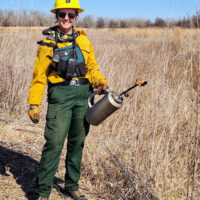
Danielle Howard holds a drip torch while starting a prescribed burn.
Howard, who previously worked in FNR as the field coordinator for the Hardwood Ecosystem Experiment from 2020 to 2023, comes to her new role after spending the last three years as the central region ecologist for the Indiana Department of Natural Resources Division of Fish, Wildlife and Nature Preserves. In that role, she managed 71 state-dedicated nature preserves and multiple privately-owned conservation easements across 26 counties in central Indiana. She also planned, prepared and implemented prescribed fire, invasive species control measures, native plantings, forest stand management and other restoration activities. She also established and sampled research plots for post-fire vegetation monitoring in Brown County State Park.
Howard also has taught Applied Ecology as an adjunct professor at Indiana University since January 2025.
In her previous stint in FNR as part of the HEE project, Howard coordinated forest management research activities, including bird surveys, overstory plots, small mammal trapping and more, conducted by various universities and partners at sites in Morgan-Monroe and Yellowwood State Forests.
Previously, she acted as an intermittent bird biologist for the Indiana DNR, the whooping crane outreach program assistant in Indiana for the International Crane Foundation and as a farm bill wildlife biologist for Pheasants Forever/Quail Forever.
Howard is a type II certified wildland firefighter and has certifications in prescribed fire for managers, wildlife fire chainsaws (S-212), wildlife fire pumps (S-211) and a pesticide applicator’s license for core and forests.
Howard began her new role on May 18. She will be based remotely in Bloomington, Indiana.
To view this article along with other news and stories posted on the Purdue Forestry and Natural Resources website view: Danielle Howard Hired as FNR Extension Prescribed Fire Specialist.
Resources:
Wildlife Habitat Hint: Prescribed Fire Techniques – Backing Fire, Video, Purdue Extension – Forestry and Natural Resources YouTube channel
Wildlife Habitat Hint: Prescribed Fire Techniques – Flanking Fire, Purdue Extension – FNR Video
Wildlife Habitat Hint: Late Growing Season Prescribed Fire, Purdue Extension – FNR Video
FNR Ask The Expert: Prescribed Fire with Jarred Brooke and Mike Saunders, Purdue Extension – FNR Video
Prescribed fire: 6 things to consider before you ignite, Got Nature? Blog, Purdue Extension – FNR
Indiana Prescribed Fire Council (IPFC)
Hardwood Ecosystem Experiment (HEE)
Finding help from a professional forester, Indiana Forestry & Woodland Owners Association (IFWOA)
Wildlife Management & Grassland Management, Pond and Wildlife Management, Purdue Extension
Forest Improvement Handbook, The Education Store, Purdue Extension resource center
Woodland Stewardship for Landowners YouTube Playlist, Purdue Extension – FNR
Woodland Management Moment YouTube Playlist, Purdue Extension – FNR
Subscribe – Purdue Extension-FNR YouTube Channel, find natural resources, forestry, wildlife, urban forestry and much more.
Wendy Mayer, FNR Communications Coordinator
Purdue University Department of Forestry and Natural Resources
Explore the latest newsletter updates on the Indiana Woodland Steward website. Stay up-to-date with forestry news and receive their free e-newsletter by subscribing at IWS Subscribe.
Highlights from the new Newsletter include:
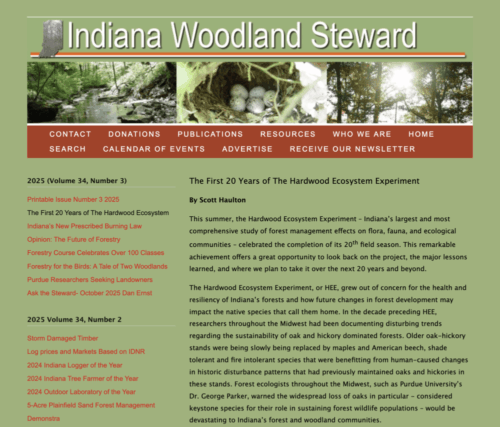 The First 20 Years of The Hardwood Ecosystem Experiment
By Scott Haulton
“This summer, the Hardwood Ecosystem Experiment – Indiana’s largest and most comprehensive study of forest management effects…”- Information on Indiana’s New Prescribed Burning Law
By Rob McCrea
“On July 1st, 2025, Indiana’s newly enacted law on prescribed burning took effect. This law does not.. - Opinion: The Future of Forestry
By Liz Jackson
“For decades the approach to forestry in Indiana has been one of restoration and recovery from the years of overcutting and abandonment…” - Purdue Extension Forestry Course Celebrates Over 100 Classes
“Forest Management for the Private Woodland Owner Course,” sometimes referred to as the Purdue Forestry short course…” - Forestry for the Birds: A Tale of Two Woodlands
By Dr. Jessica Outcalt
“Once upon a time, a few centuries ago, a woodland grew in a river valley of central Indiana. The people who managed this grove…” - Purdue Researchers Seeking Landowners
“In natural resource management, there is a need to understand the densities of wildlife species to determine hunting quotas, issue take permits, and predict…” - Ask the Steward
by Dan Ernst
“Question: Why does my glyphosate foliar treatment sometimes seem ineffective?”
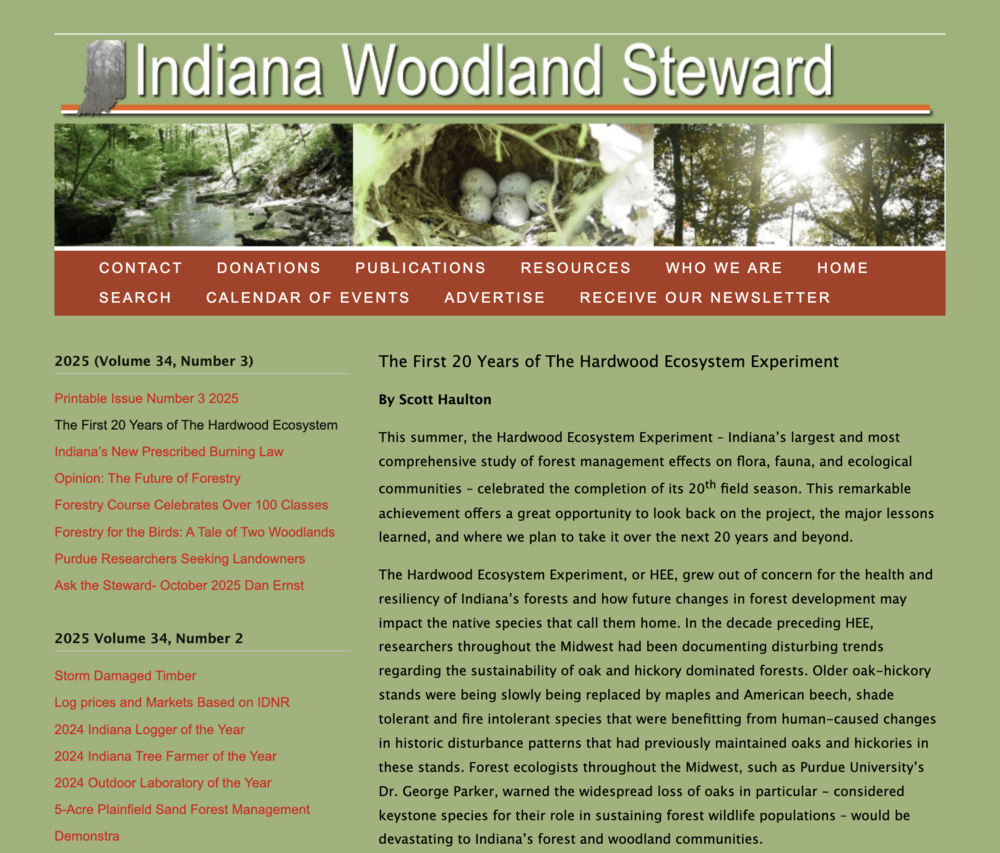
The Indiana Woodland Steward Newsletter is a resource offering a wealth of valuable information for foresters, woodland owners, timber marketing specialists, woodland and wildlife enthusiasts. The Indiana Woodland Steward Institute (IWS) is an entity made from 11 organizations within the state including Purdue University, Indiana Department of Natural Resources (DNR), and Indiana Hardwood Lumbermen’s Association (IHLA), that works to promote best usage practices of Indiana’s woodland resources through their Woodland Steward publication.
Resources
Hardwood Ecosystem Experiment (HEE) website
Hardwood Ecosystem Experiment – Wildlife Responses to Timber Harvesting, Purdue Extension
Forest Improvement Handbook, The Education Store
Invasive plants: impact on environment and people, The Education Store
Managing Your Woods for White-Tailed Deer, The Education Store
Shrubs and Woody Vines of Indiana and the Midwest, Purdue University Press
Virtual Tour Brings Forest Management for Birds to Life, Got Nature? Blog Post, Purdue Extension – Forestry and Natural Resources (FNR)
Breeding Birds and Forest Management: the Hardwood Ecosystem Experiment and the Central Hardwoods Region, The Education Store
Deer Impact Toolbox, Purdue Extension
Grassland Management Series, Purdue Extension Pond and Wildlife Management
Birdfeeder tips, The National Audubon Society
Explore the Rich World of Oaks with Purdue FNR Extension & Partners, Purdue Extension – FNR
Managing Woodlands for Birds Video, Purdue Extension-Forestry and Natural Resources YouTube Channel
Subscribe: Deer, Forest Management, ID That Tree, Woodland Management Moment, Invasive Species and many other topic video playlists Purdue Extension-Forestry and Natural Resources YouTube Channel
Dan McGuckin, President
Indiana Woodland Steward
Dr. Brian MacGowan, Extension Wildlife Specialist
Department of Forestry & Natural Resources, Purdue University
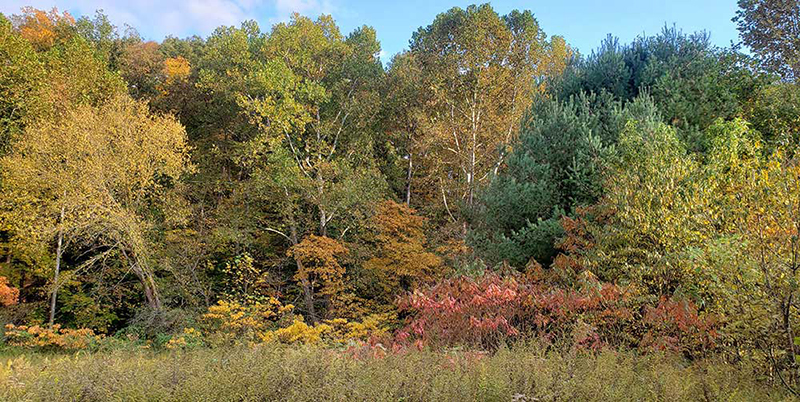 The Indiana Natural Resources Conservation Service (NRCS) is offering an opportunity for landowners to apply for cost assistance with conservation practices like tree planting, forest stand improvement, invasive species control, wildlife habitat improvement and many others.
U.S. Department of Agriculture, Natural Resources Conservation Service News Release, Indianapolis, IN, October 11, 2023 – Farm Bill program application dates have been set for Indiana’s agricultural producers who want to improve natural resources and address concerns on their land. Curtis Knueven, USDA-Natural Resources Conservation Service (NRCS) Acting State Conservationist, announced that December 8 will be the application deadline for the Environmental Quality Incentives Program (EQIP) and Conservation Stewardship Program (CSP) in Indiana. This year’s funding levels are a historic high for Indiana NRCS, bringing $42 million in EQIP and $22 million in CSP for Indiana landowners.
EQIP is a voluntary conservation program available for agricultural producers. Through EQIP, NRCS provides financial and technical assistance to install conservation practices that reduce soil erosion and sedimentation, improve soil health, improve water and air quality and create wildlife habitat. Also included in this sign up are several state and national initiatives. A full list of initiatives can be found by visiting www.nrcs.usda.gov/programs-initiatives/eqip-environmental-quality-incentives/indiana/environmental-quality-incentives.
“EQIP helps agricultural producers in a manner that promotes agricultural production and environmental quality as compatible goals,” said Knueven. “Farmers can receive assistance to implement structural and management conservation practices that optimize environmental benefits on their working agricultural land while helping to increase their yields.”
CSP is an important Farm Bill conservation program that helps producers who are already practicing good stewardship to take their natural resource management to the next level. The program helps to improve both their agricultural production and provide valuable conservation benefits such as cleaner and more abundant water, as well as healthier soils and better wildlife habitat.
“Whether you are looking to improve grazing conditions, increase crop resiliency, or develop wildlife habitat, we can custom design a CSP plan to help you meet those goals,” Knueven said. “We can help you identify natural resource problems in your operation and provide technical and financial assistance to solve those problems or attain higher stewardship levels in an environmentally beneficial and cost-effective manner.”
While applications are accepted year-round, interested producers should work with their local NRCS staff and apply by December 8 to be considered for the current funding period. Applications received after December 8 will automatically be considered during the next funding cycle.
For more information about Farm Bill programs and other technical and financial assistance available through Indiana NRCS conservation programs, visit www.nrcs.usda.gov/indiana or contact your district conservationist www.farmers.gov/working-with-us/service-center-locator.
Resources:
Woodland Stewardship for Landowners: EQUP, video, Purdue Extension-Forestry and Natural Resources (FNR) YouTube Channel
Woodland Stewardship for Landowners: Single Tree and Patch-Cut Harvesting, Purdue Extension – FNR Video
Woodland Stewardship for Landowners YouTube Playlist, Purdue Extension – FNR
Woodland Management Moment: Invasive Species Control Process, Purdue Extension – FNR Video
Woodland Management Moment YouTube Playlist, Purdue Extension – FNR
Invasive Species YouTube Playlist, Purdue Extension – FNR
What are invasive species and why should I care?, Got Nature? Blog, Purdue Extension – Forestry and Natural Resources
Report Invasive Species, Purdue Invasive Species
The GLEDN Phone App – Great Lakes Early Detection Network
EDDMaps – Early Detection and Distribution Mapping System
Hardwood Ecosystem Experiment: Uneven-aged Management, Purdue Extension – FNR Video
Hardwood Ecosystem Experiment: Even-aged Management, Purdue Extension – FNR Video
Finding help from a professional forester, Indiana Forestry & Woodland Owners Association
Forest Improvement Handbook, The Education Store, Purdue Extension resource center
Natural Resources Conservation Service
U.S. Department of Agriculture
Lenny Farlee, Extension Forester
Hardwood Tree Improvement & Regeneration Center (HTIRC)
Purdue University Department of Forestry and Natural Resources
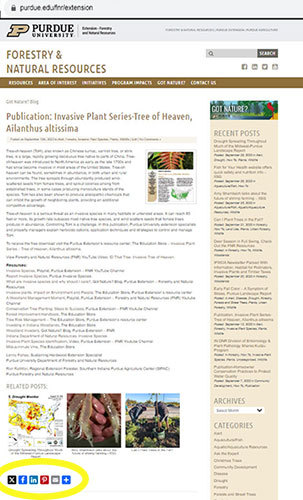 The Purdue Extension – Forestry & Natural Resources (FNR) team would like to take this time to thank our followers for their requests and comments. We received requests to improve our Purdue Extension – FNR’s Got Nature? Blog social media buttons and we would like to announce they are ready for you to share our articles. You can easily share the blog articles to X-Twitter, Facebook, LinkedIn, and Pinterest, along with an Email option.
The Got Nature? Blog was started 11 years ago to allow the FNR Extension team to share aquatic, forestry, natural resources, wildlife, urban forestry and wood products hot topics along with answering any questions regarding these areas. The blog producer Diana Evans, Web and Extension Specialist, has been with the blog from the start. The Got Nature? blog has had over 166,000 web visits in the past three years.
If you have a natural resource topic you would like to hear from our experts about, fill out our quick and easy Contact Us form.
Subscribe to our Got Nature? e-newsletter and receive our resources and updates. All email addresses are secure and only used for the Purdue Extension – Forestry and Natural Resources’ Got Nature? newsletter mailing.
What is Purdue Extension-Forestry and Natural Resources (FNR)?
Purdue Extension – FNR is a part of a larger group, the Cooperative Extension Service (CES), one of the nation’s largest and best-researched providers of science-based information and education. Purdue Extension delivers practical, research-based information and provides high-impact educational programs that enhance lives and livelihoods.
Resources:
Subscribe to Purdue Extension-FNR YouTube Channel
ID That Tree, Purdue Extension-Forestry & Natural Resources (FNR) YouTube playlist
Woodland Management Moment, Purdue Extension-FNR YouTube playlist
Ask An Expert Playlist, Purdue Extension – Forestry and Natural Resources (FNR) YouTube Channel
Wildlife Habitat Hint Playlist, Purdue Extension – FNR YouTube Channel
Subscribe to the Purdue Extension – Forestry and Natural Resources YouTube Channel
Diana Evans, Extension & Web Communications Specialist
Purdue University Department of Forestry and Natural Resources
Illinois-Indiana Sea Grant (IISG) Newsroom: At the recent Great Lakes Sea Grant Network meeting in Evanston, Illinois, Amy Shambach, Illinois-Indiana Sea Grant aquaculture marketing outreach associate, was presented with the 2023 Great Lakes Sea Grant Network Early Career Award.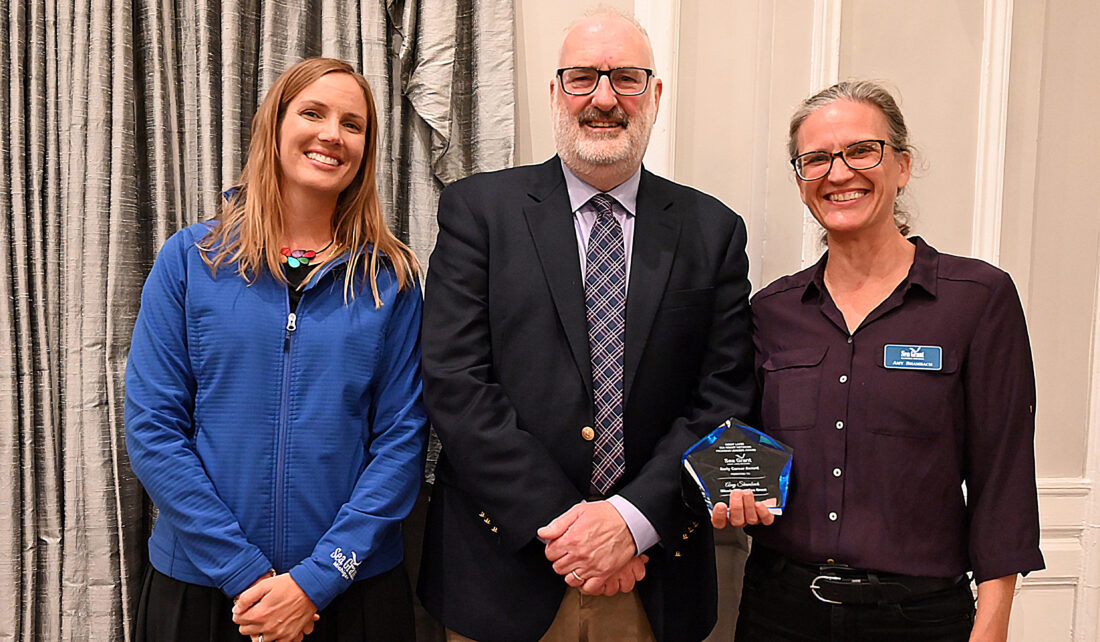
Shambach has been in her role with IISG since 2019. Since then, she has developed numerous outreach products, including videos, factsheets, and websites. She has organized and led webinars and workshops in the two states and helped lead Great Lakes-wide projects.
Throughout her four years with the program, Shambach has worked closely with fish farmers—she has been someone they can turn to for guidance and information. As a result, she was able to help some farmers successfully secure federal support during COVID and then when an ice storm hit southern Illinois.
“It is unusual for someone to launch so many high-output, high-impact programs so early in their Sea Grant career, especially when they begin the job with little outreach experience,” said Stuart Carlton, IISG assistant director. “However, Amy is not usual, she is special, and is well deserving of recognition for her work.”
To see full article, please visit: Illinois-Indiana Sea Grant recognized for outstanding outreach efforts.
Amy provides outreach and extension services to producers, potential producers, and consumers, which is also shared through IISG partner Purdue Extension.
To view Amy’s publications and products, please visit Illinois-Indiana Sea Grant’s Resources Page.
For free downloads of the publications, view The Education Store, Purdue Extension’s resource center, and place “Amy Shambach” in the search field.
Resources:
Freshwater Prawn Farmed Fish Fact Sheet, The Education Store, Purdue Extension’s resource center
Largemouth Bass Farmed Fish Fact Sheet, The Education Store
Atlantic Salmon Farmed Fish Fact Sheet, The Education Store
A Guide to Small-Scale Fish Processing Using Local Kitchen Facilities, The Education Store
Walleye Farmed Fish Fact Sheet: A Guide for Seafood Consumers, The Education Store
Sustainable Aquaculture: What does it mean to you?, The Education Store
Center For Great Lakes Literacy (CGLL), Website
Scientists bring the Great Lakes to students learning from home, Got Nature? Blog
Aquaculture Industry in Indiana Growing, Purdue Today
Largemouth Bass Market Trends, Purdue Extension – Forestry and Natural Resources (FNR) YouTube Channel
Ask An Expert: Hot and Cold, Video, Purdue Extension – FNR YouTube Channel
Video: Cage Culture and Aquaponics, FNR Youtube Channel
Eat Midwest Fish, Illinois-Indiana Sea Grant online resource hub
Illinois-Indiana Sea Grant (IISG)
Purdue Extension Showcase, Purdue Extension Annual Report highlights Purdue Extension-Forestry and Natural Resources Hardwood University program: Indiana ranks fourth in the U.S. in hardwood industry production. According to Indiana’s Department of Natural Resources, the hardwood industry contributes $17 billion in value-added to the Indiana economy. However, lack of skilled hardwood employees is the No. 1 impediment to industry success and growth. The number of job openings in wood products manufacturing exceeds the number of qualified applicants by a factor of 3:1 to 10:1. Hardwood industries employees require specialized training to produce lumber and hardwood products, and to maintain sustainable productivity of forest resources.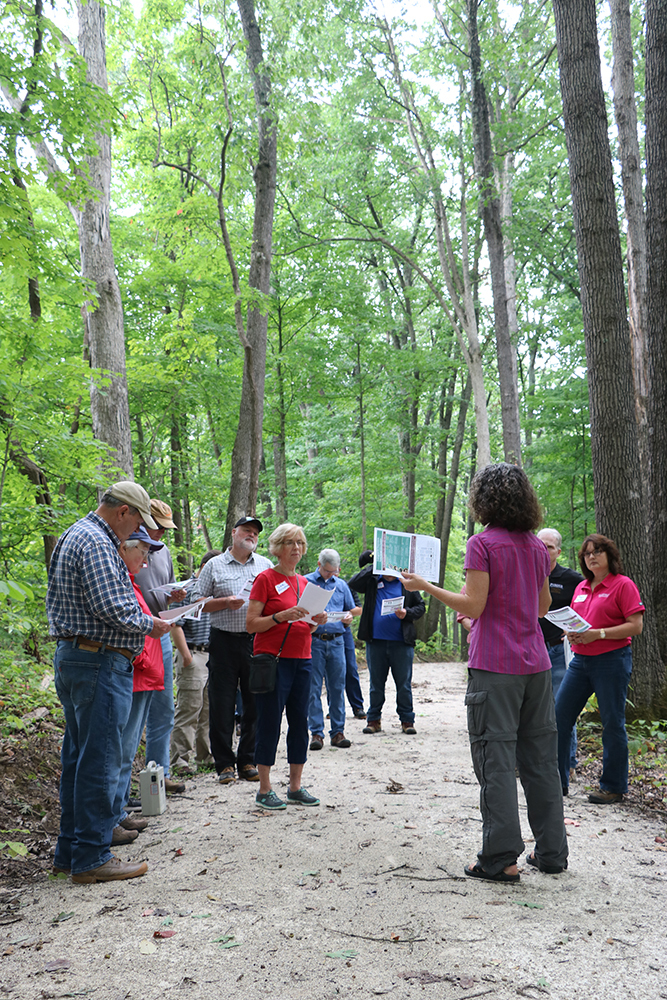
Purdue Extension annually offers a program, Hardwood University, to provide expertise, technical assistance, and education to industrial stakeholders engaged in wood products manufacturing to solve issues related to raw material quality, processing technologies, and manufacturing efficiency. Participants are business owners, chief executive and operations officers, production managers, supervisors, engineers, designers, equipment operators and industry associations in both primary hardwood products manufacturing for lumber and veneer, and secondary wood products manufacturing of furniture, cabinets, millwork, flooring and others. Nine monthly sessions during the academic year provide over 50 hours of instruction. Each session is a minimum of six hours and held at forestry or manufacturing worksites across Indiana. Hardwood industry professionals learned about sustainability of material supply, best management practices, procurement and marketing, tree, log and lumber quality and measurement, step-by-step processing techniques, equipment, and decision-making.
Participants may choose to focus on one of three tracks: 1) primary industry for log buyers, sawmill, stave mill, veneer mill, and lumber drying operators, 2) secondary industry for furniture, cabinet, millwork and other manufacturers of wood products, and 3) training a la carte for companies and individuals that would like to organize in-house training on a selected topic. Participants who finish all nine sessions in a chosen track within two years receive a program completion recognition from external partner Indiana Hardwood Lumbermen’s Association. In addition, sessions qualify for continuing education credits for certified foresters (Society of American Foresters), and consulting foresters (Association of Consulting Foresters). In one year of the program, 168 employees attended the sessions. Participants were employees new to the hardwood industry and employees preparing for advancement or cross-training.
On post-surveys, participants indicated they learned something new, increased awareness, and learned new skills. Participants indicated practices from the sessions that they plan to implement in the next 12 months. Most comments addressed lumber drying, including adjust kiln drying schedule, build/buy lumber dry kiln, change kiln startup procedure, change yard locations for drying particular species, eliminate standing water in yard, improve air flow in yard, and establish lumber drying operation. Also mentioned were: setting up lumber grading for company and training employees to grade lumber, conducting saw maintenance and changing sawing procedures, focusing on management – getting more education, implementing plan, or pursuing professional assistance, and identifying and sorting lumber by quality. Purdue Extension’s training for employees working in the hardwoods industry helps produce skilled workers for company success and to ensure sustainable management of woodlands across Indiana.
To read full article and others, check out Purdue Extension Showcase 2023.
Resources:
Hardwood Tree Improvement & Regeneration Center (HTIRC)
Tropical HTIRC
An Introduction to Trees of Indiana, The Education Store, Purdue Extension resource center
Native Trees of the Midwest, The Education Store
Shrubs and Woody Vines of Indiana and the Midwest, The Education Store
ID That Tree, Playlist, Subscribe to Purdue Extension – Forestry and Natural Resources YouTube Channel
A Woodland Management Moment, Playlist, Purdue Extension – FNR YouTube Channel
Investing in Indiana Woodlands, The Education Store
Forest Improvement Handbook, The Education Store
Finding help from a professional forester, Indiana Forestry & Woodland Owners Association
District Foresters for 10 plus acres, Indiana Department of Natural Resources
Sustainable Biomaterials, FNR Concentration
Wood is Best Video, Woodisbest.org
Rado Gazo, Professor of Wood Processing and Industrial Engineering
Purdue University Department of Forestry and Natural Resources
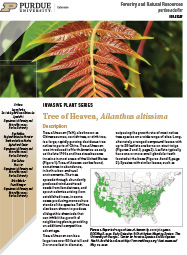 Tree-of-heaven (ToH), also known as Chinese sumac, varnish tree, or stink tree, is a large, rapidly growing deciduous tree native to parts of China. Tree-of-heaven was introduced to North America as early as the late 1700s and has since become invasive in most areas of the United States. Tree-of-heaven can be found, sometimes in abundance, in both urban and rural environments. The tree spreads through abundantly produced wind-scattered seeds from female trees, and sprout colonies arising from established trees, in some cases producing monoculture stands of the species. ToH has also been shown to produce allelopathic chemicals that can inhibit the growth of neighboring plants, providing an additional competitive advantage.
Tree-of-heaven is a serious threat as an invasive species in many habitats or untended areas. It can reach 80 feet or more, its growth rate outpaces most native tree species, and wind scatters seeds that female trees produce in abundance. Controlling ToH is a challenge. In this publication, Purdue University extension specialists and property managers explain herbicide options, application techniques and strategies to control and manage ToH.
To receive the free download visit the Purdue Extension’s resource center: The Education Store – Invasive Plant Series – Tree of Heaven, Ailanthus altissima.
View Forestry and Natural Resources (FNR) YouTube Video: ID That Tree: Invasive Tree of Heaven.
Resources:
Invasive Species, Playlist, Purdue Extension – FNR YouTube Channel
Report Invasive Species, Purdue Invasive Species
What are invasive species and why should I care?, Got Nature? Blog, Purdue Extension – Forestry and Natural Resources
Invasive plants: Impact on Environment and People, The Education Store, Purdue Extension’s resource center
A Woodland Management Moment, Playlist, Purdue Extension – Forestry and Natural Resources (FNR) Youtube Channel
Conservation Tree Planting: Steps to Success, Purdue Extension – FNR Youtube Channel
Forest Improvement Handbook, The Education Store
Tree Risk Management – Got Nature? Blog, Purdue Extension – FNR
Investing in Indiana Woodlands, The Education Store
Woodland Invaders, Got Nature? Blog, Purdue Extension – FNR
Indiana Department of Natural Resources: Invasive Species
Invasive Plant Species Identification, Video, Purdue Extension – FNR Youtube Channel
Mile-a-minute Vine, The Education Store
Lenny Farlee, Extension Forester
Hardwood Tree Improvement & Regeneration Center (HTIRC) & Purdue University Department of Forestry and Natural Resources
Ron Rathfon, Regional Extension Forester, Southern Indiana Purdue Agriculture Center (SIPAC)
Purdue Forestry and Natural Resources
We all want clean water but sometimes it is hard to know how one individual or family can make a difference. People who have a home with a yard have the opportunity to make decisions that can protect and improve water quality.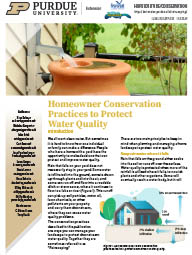
Rain that falls on your yard does not necessarily stay in your yard. Some water is infiltrated into the ground, some is drawn up through plants and into the air, and some can run off and flow into a roadside ditch or storm sewer, where it continues to flow to a lake or river. This runoff can pick up soil particles, motor oil, lawn chemicals, or other pollutants on your property and carry them downstream, where they can cause water quality problems.
Anyone who has a home with a yard can help protect and improve water quality. This publication offers practical advice about reducing impervious surfaces, select proper landscape plants, effective management of lawns, installing rain barrels and rain gardens, and proper care of septic systems.
To receive the free download visit the Purdue Extension’s resource center: The Education Store – Homeowner Conservation Practices to Protect Water Quality.
Resources:
Improving Water Quality by Protecting Sinkholes on Your Property, The Education Store, Purdue Extension’s resource center
A Landowner’s Guide to Sustainable Forestry: Part 5: Forests and Water, The Education Store
Improving Water Quality Around Your Farm, The Education Store, YouTube
Animal Agriculture’s Effect on Water Quality: Pastures and Feedlots, The Education Store
Improving Water Quality At Your Livestock Operation, The Education Store, YouTube
The Nature of Teaching: Discovering the Watershed, Purdue Extension-The Nature of Teaching
Rainscaping Education Program, Purdue Extension
Community Planning, Purdue Extension
Kara Salazar, Assistant Program Leader and Extension Specialist for Sustainable Communities
Purdue Department of Forestry and Natural Resources
Nick Burgmeier, Research Biologist and Wildlife Extension Specialist
Purdue Department of Forestry and Natural Resources
Laura Esman, Water Quality Program Coordinator
Purdue Department of Forestry and Natural Resources
Drones can be used to assess crop health, monitor livestock, disperse cover crop seed, optimize natural resources, for public safety, and much more. Purdue Extension’s UAV pilots are flying fields, forests, and urban areas through Indiana to help farmers, land and business owners, and government officials turn images into insights. Purdue Extension’s personnel are learning how to help farmers and agricultural professionals more easily analyze and apply data from UAVs or drones.
This publication titled Unmanned Aerial Vehicles: Checklist for Drones Flying in Indiana by Purdue Extension educators explains the steps required to legally fly a UAV or UAS in Indiana.
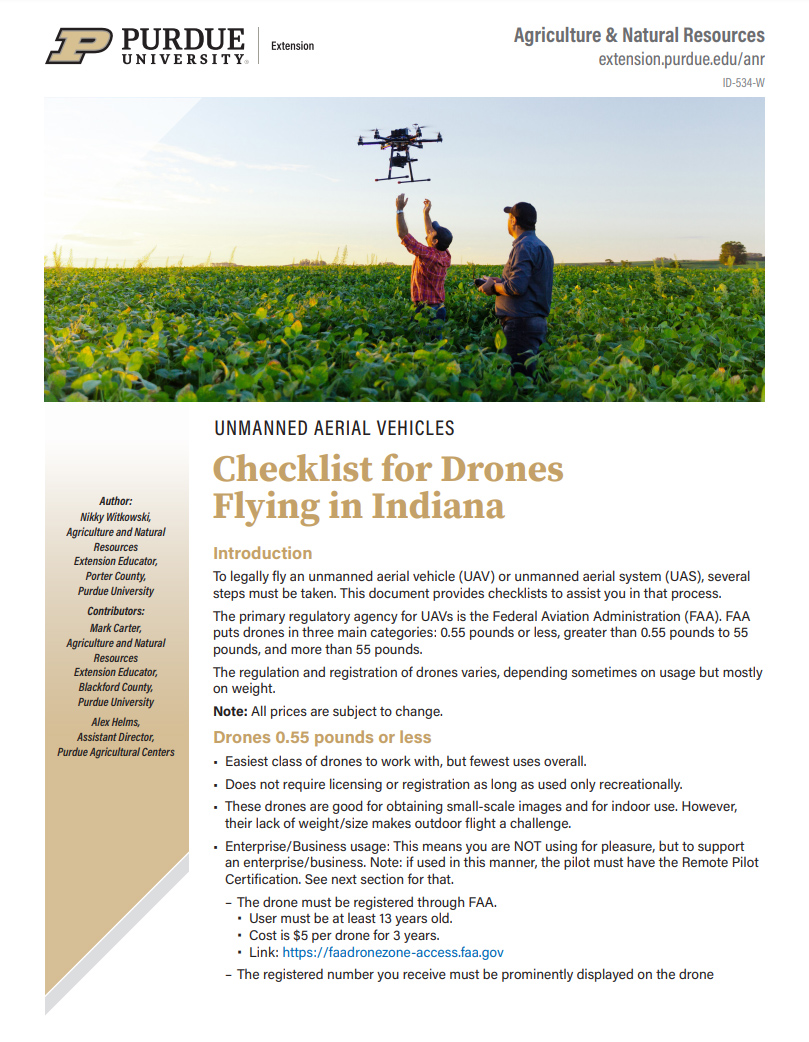
To legally fly an unmanned aerial vehicle (UAV) or unmanned aerial system (UAS), several steps must be taken. This document provides checklists to assist you in that process. The primary regulatory agency for UAVs is the Federal Aviation Administration (FAA). FAA puts drones in three main categories: 0.55 pounds or less, greater than 0.55 pounds to 55 pounds, and more than 55 pounds. The regulation and registration of drones varies, depending sometimes on usage but mostly on weight.
To receive the free download visit the Purdue Extension’s resource center: The Education Store – Unmanned Aerial Vehicles: Checklist for Drones Flying in Indiana.
For more information regarding Purdue Extension and Purdue Agriculture’s outreach through the agricultural use of unmanned aerial vehicles (UAVs) view Purdue Extension-UAV.
Resources:
Integrated Digital Forestry Initiative (iDiF)
Creating a Wildlife Habitat Management Plan for Landowners, The Education Store
Purdue Extension Pond and Wildlife Management Website, Purdue Extension
Timber Harvesting and Logging Practices for Private Woodlands, The Education Store, Purdue Extension’s resource center
Investing in Indiana Woodlands, The Education Store
Woodland Wildlife Management, The Education Store
ID That Tree, Playlist, Purdue Extension – Forestry & Natural Resources (FNR) YouTube Channel
Woodland Stewardship for Landowners Video Series, Playlist, Purdue Extension – FNR YouTube Channel
Frost Seeding Native Grasses and Forbs with a Drone (UAV): Lessons Learned, Purdue Extension Forestry & Natural Resources
A New Drone Supports Pollinator Efforts, Purdue Extension Forestry & Natural Resources
Nikky Witkowski, Agriculture and Natural Resources
Extension Educator, Purdue University
Mark Carter, Agriculture and Natural Resources
Extension Educator, Purdue University
Alex Helms, Assistant Director,
Purdue Agricultural Centers

Recent Posts
- Celebrate Pollinator Week With Flowers of June Tour
Posted: June 15, 2026 in Forestry, Gardening, How To, Wildlife - Pruning Highlight-Pollarding Trees: A Traditional Pruning Practice with Modern Uses
Posted: June 11, 2026 in Forestry, Forests and Street Trees, Urban Forestry, Wildlife, Woodlands - Danielle Howard Hired as FNR Extension Prescribed Fire Specialist
Posted: June 10, 2026 in Forestry, Wildlife, Woodlands - Flat-Faced Longhorn Beetle Found in Hardwood Logs – IDNR Division of Entomology
Posted: June 8, 2026 in Alert, Forestry, Forests and Street Trees, Invasive Insects, Urban Forestry, Wildlife, Woodlands - Connecting Research to Practice: Natural Resources & Land Use Spring Training
Posted: June 5, 2026 in Forestry, Forests and Street Trees, How To, Invasive Animal Species, Invasive Plant Species, Land Use, Natural Resource Planning, Urban Forestry, Wildlife, Woodlands - Indiana Monarch and Pollinator Conservation
Posted: June 1, 2026 in Forestry, Forests and Street Trees, Gardening, How To, Natural Resource Planning, Plants, Urban Forestry, Wildlife - Box Tree Moth Range is Expanding
Posted: May 27, 2026 in Forestry, Invasive Animal Species, Invasive Insects, Wildlife - Spotted Lanternfly Feeds on Over 70 Plus Plant Species
Posted: May 20, 2026 in Alert, Forestry, Forests and Street Trees, Gardening, Invasive Insects, Urban Forestry, Wildlife - Painted Hickory Borer, Purdue Landscape Report
Posted: May 14, 2026 in Forestry, Invasive Insects, Wildlife - Saving Giants of the Blue River: Purdue Team Earns Statewide Recognition
Posted: in Aquaculture/Fish, Aquatic/Aquaculture Resources, Wildlife
Archives
Categories
- Alert
- Aquaculture/Fish
- Aquatic/Aquaculture Resources
- Ask the Expert
- Christmas Trees
- Community Development
- Disease
- Drought
- Forestry
- Forests and Street Trees
- Gardening
- Got Nature for Kids
- Great Lakes
- How To
- Invasive Animal Species
- Invasive Insects
- Invasive Plant Species
- Land Use
- Natural Resource Planning
- Nature of Teaching
- Plants
- Podcasts
- Ponds
- Publication
- Safety
- Spiders
- Timber Marketing
- Urban Forestry
- Webinar
- Wildlife
- Wood Products/Manufacturing
- Woodland Management Moment
- Woodlands