 Purdue University - Extension - Forestry and Natural Resources
Got Nature? Blog
Once the leaves have fallen and the landscape is dominated by shades of brown and gray, bright colors like red catch our attention. There are several red fruits that we may encounter in the late fall and winter here in Indiana that add some color to the landscape. These fruits are retained on trees and shrubs for a variety of reasons. Some are not as palatable to wildlife, so they are eaten later in the season. Some are more resistant to freeze damage and thus cling to branches longer than delicate fruits. There may also be an advantage to their appearance. Many of these plants have seeds dispersed by wildlife like birds, which eat the seeds and excrete them later, providing an opportunity to produce new plants away from the parent. Many birds can see much of the same color spectrum we do, plus enhanced vision in the ultra-violet bands. Brightly-colored seeds with waxy skins may reflect more ultra-violet light and be more noticeable to the birds.
What are some of those red fruits?
One family of plants accounts for several red fruit we can see in late fall and winter, the rose family. This family includes apples, plums, cherries, hawthorns, pears and others as well as the roses. In Indiana we have several hawthorns (Crataegus species) that produce a fruit resembling a tiny apple. These vary in size by species but are typically ¼ to ½ inch diameter and often held in clusters. Hawthorns are typically small trees and may have long thin thorns on the twigs.

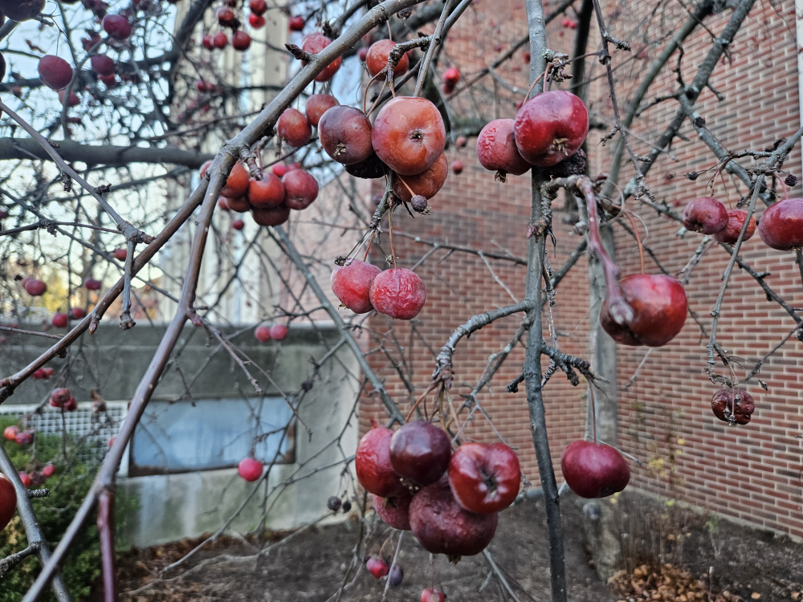
Another rose family member are the apples and crabapples with some small native trees like sweet crabapple, Malus coronaria, and several varieties of fruit-bearing apples and ornamental crabapples planted but sometimes escaping to natural areas. While our native crabapples are usually about 1-2 inches diameter and green to yellow, the domesticated apples and crabapples often have red fruit in various sizes from large apples to ½ inch diameter crabapples.

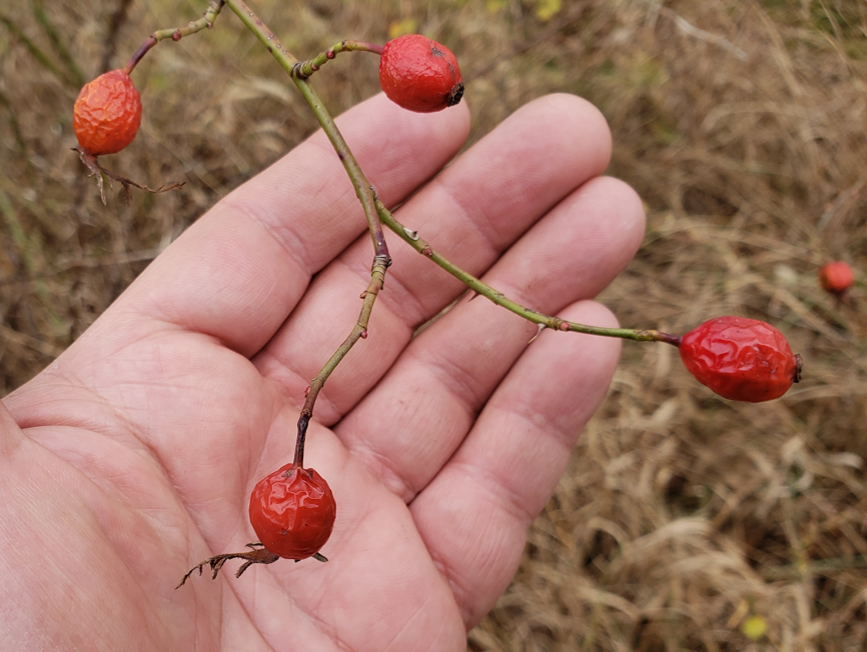
We also have several beautiful native roses in Indiana, and a particularly problematic exotic invasive rose in multiflora rose. Unfortunately, you are more likely to encounter multiflora rose with small ¼ inch clusters of red fruit. Our native roses typically have larger fruit and fewer fruit per cluster.

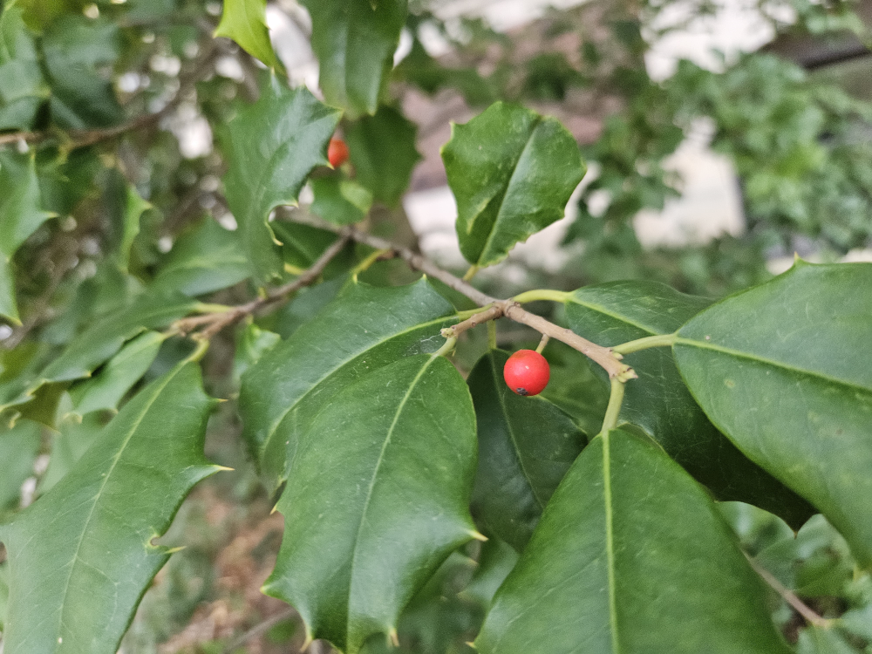
Holly is also noted for red fruit and some being evergreen as well. Our native Indiana hollies are all deciduous, losing their leaves in the fall but often retaining the red fruit on the female plants into winter. The most widespread species is winterberry, Ilex verticillate, a shrub which is seeing more use ornamentally due to its striking red fruit held past Christmas most years. American holly, an evergreen broadleaved tree, is well-known for its glossy, spiny foliage and red fruit on the female trees. Although not native to Indiana, it is spreading from plantings into natural areas. Several evergreen hollies from Europe and Asia are also common in ornamental plantings and may escape into natural areas.
Not only are these late-season showy fruit attractive, but they also provide some important nourishment for wildlife when the many other fruits are long-gone.
Resources:
Ask An Expert: Holidays in the Wild, Purdue Extension – Forestry and Natural Resources (FNR) YouTube Channel
Selecting a Real Christmas Tree, Got Nature? Blog Post, Purdue Extension – FNR
Tips on How You Can Recycle Your Christmas Tree, Got Nature? Blog Post, Purdue Extension – FNR
ID That Tree, Playlist, Purdue Extension – FNR YouTube Channel
ID That Tree: Prickly Ash, Purdue Extension – FNR YouTube Channel
A Woodland Management Moment, Playlist, Purdue Extension – FNR YouTube Channel
Shrubs and Woody Vines of Indiana and the Midwest, The Education Store, Purdue Extension Resource Center
Native Trees of the Midwest, The Education Store
Investing in Indiana Woodlands, The Education Store
Forest Improvement Handbook, The Education Store
Tree Installation: Process and Practices, The Education Store
Tree Planting Part 1: Choosing a Tree, video, The Education Store
Lenny Farlee, Extension Forester
Hardwood Tree Improvement and Regeneration Center
Purdue Department of Forestry & Natural Resources
Purdue Landscape Report: Spring is finally here! Everywhere you look, one can find some spring color around. Some of the first plants to peek out of the ground are spring-flowering bulbs like crocus, daffodil and tulip. But there are some beautiful spring time shrubs that are Indiana native plants you can add to your yard to be the first in the neighborhood with spring interest. Below, you’ll find a top 10 list of spring-flowering shrubs (in order of flower appearance).
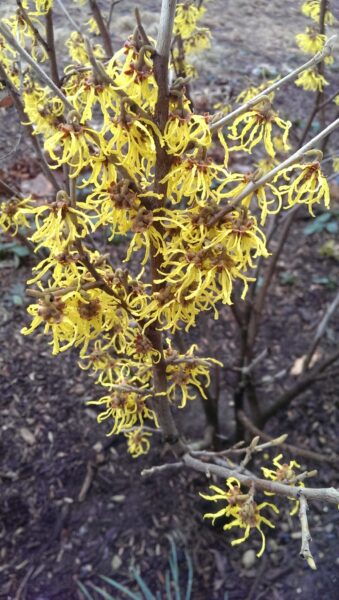
Figure 1. Witch-hazel is one of the first shrubs to bloom in the spring. Though similar to forsythia, it typically flowers a couple of weeks earlier.
Witch-hazel (Hamamelis x intermedia) Perhaps even earlier-flowering than Forsythia, is ‘Arnold Promise’ witch-hazel. This shrub can flower starting in late winter (unless we have unusually cold winter weather like polar vortices) and keep going all the way into spring. Bright flowers are yellow with red tinges, though there are red-flowering cultivars available. Witch-hazel can be grown as a shrub or a small tree and offers some yellow/orange/red fall color. It’s native!
Forsythia (Forsythia x intermedia) Forsythia is the traditional first-flowering plant in the spring. Hardy plants, their bright yellow blooms can catch your eye anywhere. There are new cultivars out.
Quince (Chaenomeles speciosa) In mid spring, you’ll find these shrubs covered with flowers. There are several cultivars and you may see white-flowering plants (‘Jet Trails’), red-flowering plants (‘Texas Scarlet’) or even large, double, fluffy, peach-pink flowers (‘Cameo’). After the show, this plant tends to fade into the background, but it’s a great native addition.
Korean Spice Viburnum (Viburnum carlesii) Korean spice viburnum blooms in late April with blooms that are pink/red while they are still in buds, opening to white flowers that are each a half inch wide. The flowers are presented on dense 2-3 inch groupings called cymes (semi-snowball) and very pleasantly fragrant. And luck of all luck, they have nice, clean leaves in the summer and great fall color. Can’t beat that in a multi-season shrub.
Flowering Almond (Prunus glandulosa) Here’s a small plant that grows well in full sun and its lovely. Flowering almond, particularly the cultivar ‘Rosea Plena’ has tons of pink flowers (double—lots of petals). Some cultivars have white flowers, and all present in mid to late spring.
Shadblow Serviceberry (Amelanchier canadensis) A multi-season-interest plant, serviceberry offers white flowers on 2-3 inch long inflorescences in April, which leads to sweet, juicy black fruit in the summer. Some plants can also have decent fall color (yellow with hints of orange and red). Serviceberry grows by suckering so it’s perhaps not a great choice for a small yard.

Figure 2. Lilac is most commonly a beautiful shade of purple.
Lilac (Syringa vulgaris). The beautiful purple flowers (many, many colors are available, but purple is most common) are wonderfully fragrant in most of spring. They may only bloom for 2 weeks, but man those 2 weeks are worth having a lilac in your garden! Takes me straight back to my childhood.
Black Chokeberry (Aronia melanocarpa) An adaptable species, this plant is known for long-lasting black fruit in the fall and wine-red fall color. Spring flowers are white, presented in groups of 9-20 resulting in 1 to 1.5 inch groupings covering the plant in May. This species can spread and colonize large areas, which makes for a striking mass effect in the spring. Small plant (under 5 feet) thrives in part shade to full sun.
Mock Orange (Philadelphus coronarius) Fans of mock orange are serious about their use in the landscape. These plants can take care of themselves and they’ll reward you every May/June with white, fragrant flowers that are 1 to 1.5 inches wide.
Siberian Peashrub (Caragana arborescens) Granted, this is a great shrub for harsh sites (poor soils, drought, alkaline soil, cold, wind), but it’s unusual and doesn’t take much care. Leaves are pea-green and emerge with the yellow flowers in May. Later in the summer the fruit of the flowers, a narrow pod, makes a popping sound when it opens.
Remember, plants with more than one season of interest are like hitting the landscape jackpot. So, if you’ve chosen one of these plants because you love the flowers in the spring, just be aware that it may need to fade into the background for the rest of the year. Having said that, plants that usher in the new season are anticipated, loved and enjoyed. Make sure you’ve got some of these in your neighborhood for a dose of early spring joy.
This was adapted from Horticulture Newsletter – Cheryl Boyer – Kansas Extension. All plants listed in this article are native species of Indiana.
Read the original article posted in the Purdue Landscape Report April 2025 Newsletter: Top 10 Spring Flowering Shrubs.
Subscribe and receive the newsletter: Purdue Landscape Report Newsletter.
Resources:
Spring Tree Preparations, Purdue Extension Forestry and Natural Resources (FNR) Got Nature? Blog
Celebrate Pollinator Week with Flowers of June Tour, Got Nature? Blog, Purdue Extension – FNR
Tracking the Bloom, Got Nature? Blog, Purdue Extension – FNR
Indiana’s Native Orchids, Indiana Forestry & Woodlands Association (IFWOA) Webinar
Wildflowers and Ferns of Indiana Forests: A Field Guide, Google Books
ID That Tree Spring Bloom Edition: Bladdernut, Got Nature? Blog, Purdue Extension – FNR
ID That Tree, Purdue Extension-FNR YouTube playlist
Alternative Options for Invasive Landscape Plants (pdf), Purdue Extension – Purdue Horticulture and Landscape Architecture
Landscape Uses of Native Plants, Indiana Native Plant Society
Find an Arborist video, Trees are Good-International Society of Arboriculture (ISA)
Tree Installation: Process and Practices, The Education Store, Purdue Extension resource center
Tree Planting Part 1: Choosing a Tree video, Purdue Extension
Tree Wound and Healing, Got Nature? Blog, Purdue Extension – FNR
Shrubs and Woody Vines of Indiana and the Midwest, Purdue University Press
Ask an Expert: Tree Selection and Planting, Purdue Extension-FNR YouTube playlist
Recommended Indiana-native Plants for Attracting Pollinators (pdf), Purdue Extension – Entomology
Gardening for Pollinators, Purdue Garden Articles
Subscribe Purdue Extension-FNR YouTube Channel
Amanda Bailey, Extension Educator – Ag and Natural Resources
Purdue Extension – Warrick County
A rain garden is a green infrastructure project that can improve the quality of stormwater, minimize pollution, and enhance biodiversity and pollinator habitat. Purdue, Iowa State and Illinois-Indiana Sea Grant researchers explain how to site, size, design, install and maintain a rain garden, and provide advice on plant selection, too.
When stormwater runs off streets, driveways, roofs, and other impervious surfaces, it can move pollutants such as oil, fertilizers, heat, and chemicals to storm drains and eventually to natural bodies of water, such as lakes, streams, and rivers. These natural water sources are valuable resources for recreation, irrigation, and drinking water. Green infrastructure projects, such as rain gardens, can improve the quality of stormwater, reduce flooding, minimize pollution, enhance biodiversity and pollinator habitat, and create educational and recreational opportunities.

Green infrastructure includes a range of practices that allows stormwater to infiltrate into the soil or be stored for later use, thereby reducing flows to sewer systems and surface waters (U.S. EPA, 2022). A rain garden is one such practice. It is a small-scale landscape feature planted with native shrubs, perennial plants, or flowers in a shallow depression. It captures and stores runoff, allowing it to slowly infiltrate into the soil. At the property scale and when properly located, rain gardens lessen erosion in steeply sloped areas, reduce the potential for water to flow into basements, and minimize ponding in areas with poor drainage. The net effect of multiple green infrastructure practices can reduce streambank erosion and downstream flooding as stream flows decrease. Water quality is also affected as plants and microbes in the soil filter nutrients and some heavy metals as the stormwater soaks into the soil.
To receive the free download for the Introduction to Rain Garden Design please visit The Education Store.
Resources:
Community Development, Purdue Extension Program
Environmental Planning in Community Plans, The Education Store, Purdue Extension’s resource center
Enhancing the Value of Public Spaces: Creating Healthy Communities, The Education Store
Conservation through Community Leadership, The Education Store
Tree Installation: Process and Practices, The Education Store
Planting Forest Trees and Shrubs in Indiana, The Education Store
Planting Your Tree Part 1: Choosing Your Tree, Video, Purdue Extension – Forestry and Natural Resources YouTube Channel
Subscribe – Purdue Extension – Forestry and Natural Resources YouTube Channel
Purdue Extension-Forestry and Natural Resources Calendar, workshops and Conferences
Kara A Salazar, Sustainable Communities
Purdue Community Development Extension Specialist
Sara Winnike McMillan, Associate Professor
Purdue University
Payton Ginestra, Natural Resources and Environmental Science
Purdue University
Laura Esman, Water Quality Program Coordinator
Purdue University
John Orick, Purdue Extension Master Gardener State Coordinator
Purdue University
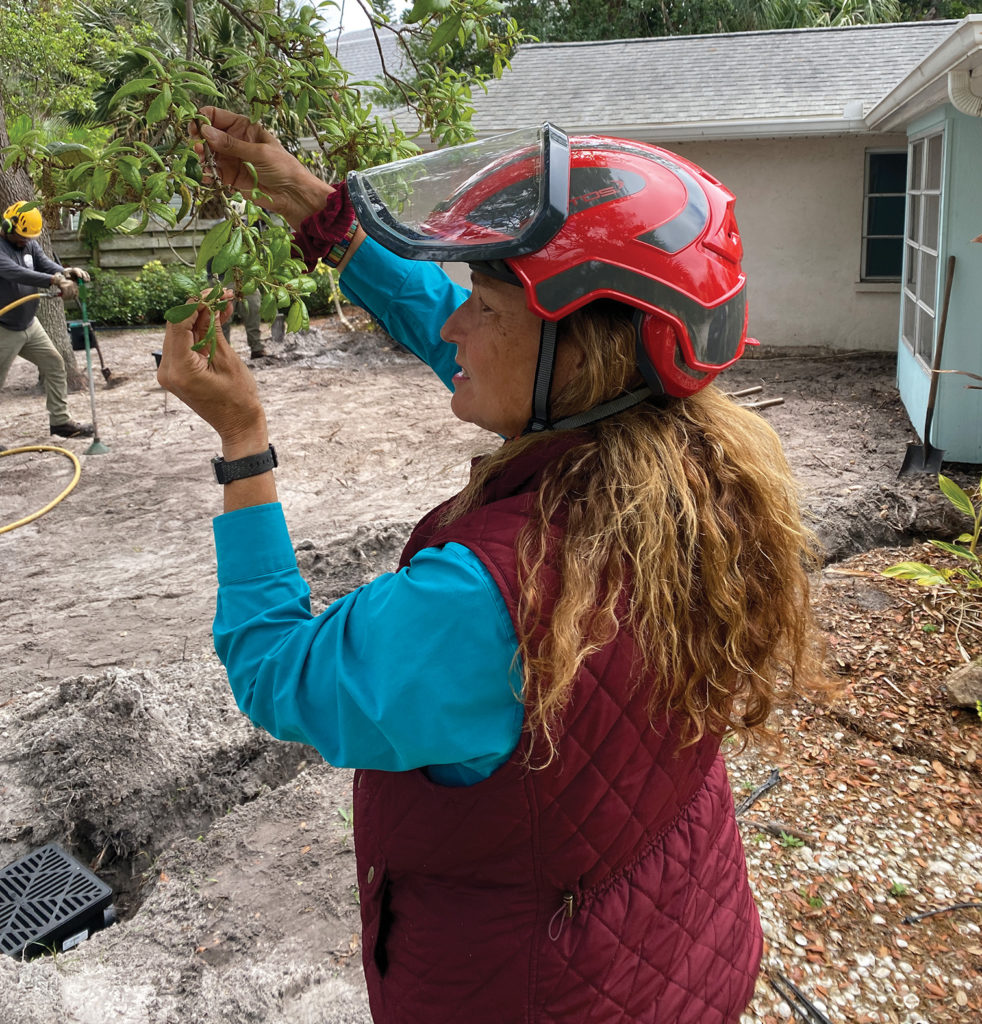
Scouting is the essential first step of an IPM program. Shown here is Tammy Kovar, owner of Biological Tree Services, a nine-year TCIA member company based in Sarasota, Florida. All photos and graphics courtesy of the author.
Tree Care Industry (TCI) Magazine: Plant health care (PHC) is the science and practice of understanding and overcoming the succession of biotic and abiotic factors limiting plants from achieving their full genetic potential in our landscapes and urban forests. Plant health care has been practiced as long as modern arboriculture itself and, as a science-based concept, is an important component in overall integrated pest management (IPM).
Pest management in our urban forests is a moving target and sometimes is overwhelming, especially for those early-career professionals. I remember from my early days in the field the overwhelming thought of needing to know every pest for every tree! I literally had a truckload (back seat of a king cab) of university publications, bulletins and articles ripped out of magazines for reference in the event I couldn’t figure it out quickly and on site. Just that fear of not knowing was often very stressful. Well, that has changed significantly.
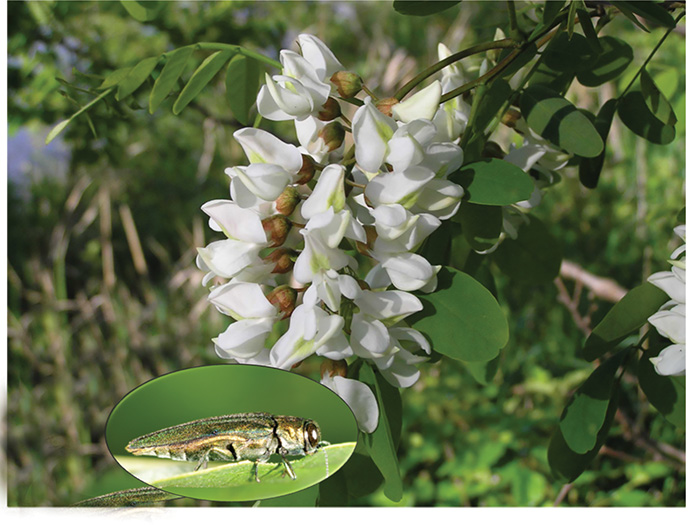
Adult emerald ash borers typically take flight about the same time that black locust trees bloom, indicating a good time for treatment.
The point is that first, you don’t have to know everything, and second, resources now are easily and readily available. Today, the smartphone and computing opportunities available on mobile platforms, apps such as the Purdue Tree Doctor and other web-based apps have improved diagnostics significantly, making it simpler for the technician to get a better idea of their pest issue and easier to find a control strategy.
One of the basic and most important keys when starting a PHC program is just learning to recognize the concerns for common trees already in your care. Tree identification is critically important to determine whether the tree is even a host for any given disease or insect. As a technician, you don’t need to know every tree in North America; just focus on those that are commonly found and that you are called upon to investigate for pest issues with your clients and customers. Few things are as awkward as misidentification of a tree and the corresponding application. Recommendations for treating emerald ash borer on a European mountain ash (Sorbus aucuparia), which is not susceptible to EAB infestation, could be fairly damaging to your credibility and your company!
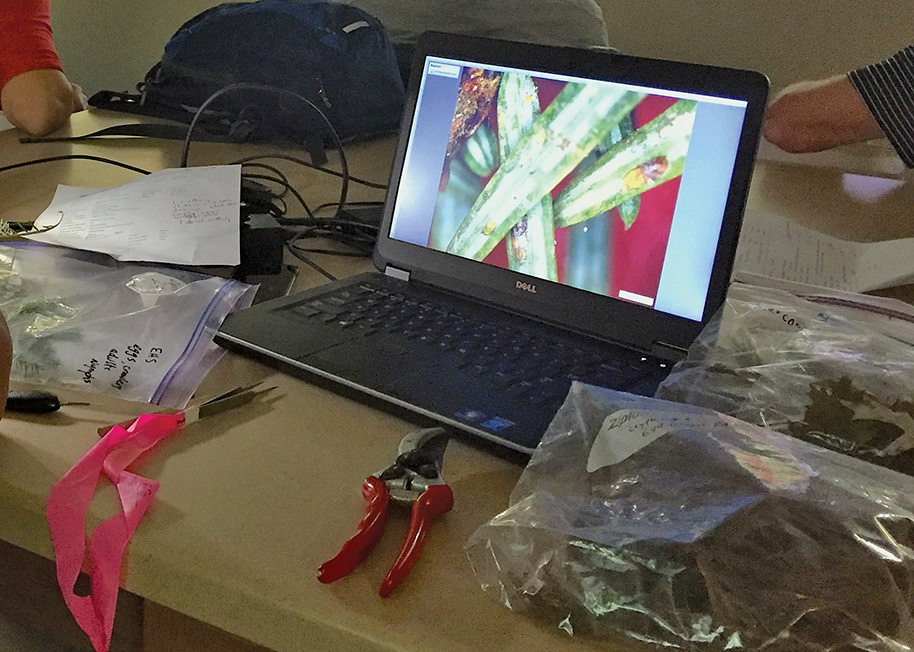
Each state has a land-grant college with resources to assist PHC technicians.
Get some help
All there is to know and what you need to know can be mind-boggling; however, it is more manageable when we are able to discover the resources available. Often overlooked, local extension services from state land-grant colleges provide a tremendous collection of experts trained and educated in pest management. They often have plant and pest diagnostic laboratories assisting with identification of those challenging diseases or insects, usually at a very economical cost, along with the appropriate management strategy to apply for control.
Resources:
Planting Your Tree Part 1: Choosing Your Tree, Purdue Extension YouTube Channel
Tree Installation: Process and Practices, The Extension Store, Purdue Extension resource center
Ask an Expert: Tree Selection and Planting, Purdue FNR Extension YouTube Channel
Webinar: How to Identify Trees in Indiana, Got Nature? Post, Purdue Extension – Forestry and Natural Resources
Shrubs and Woody Vines of Indiana and the Midwest, Purdue University Press
Native Trees of the Midwest, Purdue University Press
ID That Tree, Purdue Extension – Forestry and Natural Resources YouTube Playlist
Purdue Plant and Pest Diagnostic Lab
Emerald Ash Borer Information from Purdue
Lindsey Purcell, Urban Forestry Specialist
Purdue Department of Forestry and Natural Resources
Image 1. Cicada damage is typically restricted to the small, outer twigs. Trees may be completely covered by cicadas or have a few isolated dead twigs. All trees in these images are expected to suffer no serious long term effects from this damage. Images by Clifford Sadof of Purdue University and Pennsylvania Department of Conservation and Natural Resources – Forestry.
Purdue Landscape Report: Dead leaves covering trees (image 1) or on the ground beneath them (image 2) in July would normally be a worrying sign for tree health, but this year much of the damage can be blamed on 17-year cicadas. This damage is unlikely to cause serious trouble for healthy, large trees and management is relatively simple. The choice to prune or not to prune comes down to cost, aesthetics, and concern for the next generation of cicadas.
How Cicadas Damage Plants
Cicada damage is similar to a light pruning and should not be an issue for healthy, mature trees. Cicadas damage trees when they lay their eggs in small twigs (3/16 to 1/2 inch in diameter) on deciduous trees and shrubs. They have a long, thin body part called an ovipositor that resembles a sewing needle that they stab into plants to lay their eggs. This action creates small holes and cracks in the bark (image 3). If enough cicadas lay their eggs in a twig, it can damage the bark enough to kill the twig (image 1).

Image 2. The dead twigs killed by cicada egg laying may break off the tree and litter the ground underneath. Image by Pennsylvania Department of Conservation and Natural Resources – Forestry.
Recognizing Cicada Damage
The degree of cicada damage depends on insect density and the number of trees in the area. To determine if a tree or bush has been damaged by cicadas, ask the following questions:
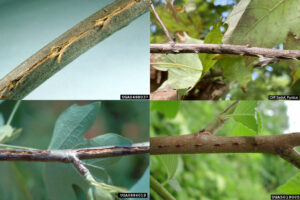
Image 3. Cicada egg laying damage varies between tree species, but is consistently in a straight, length-wise line along the branch. Note that all four examples also have signs of either puncture marks, cracks in the bark, or some combination of the two. Images by John Ghent, Clifford Sadof of Purdue University, Tim Tigner of Virginia Department of Forestry, and Pennsylvania Department of Conservation and Natural Resources – Forestry.
1. Were there 17-year cicadas within 50 meters (~164 ft) of the tree this year? Cicadas do not travel very far. If there weren’t noticeable numbers of 17-year cicadas nearby the damage was likely caused by something else.
2. Is the damage on a deciduous tree or bush? Cicadas rarely lay their eggs on evergreen trees and herbaceous plants. Damage on these types of plants is likely caused by something other than the cicadas.
3. What size of branches and twigs are damaged? Cicadas show a strong preference for small twigs (3/16 to 1/2 inch in diameter). As a result, damaged trees may appear as though their outer layer of leaves is dead while the inner leaves remain healthy (image 2). If larger branches are dead, the damage was probably not caused by cicadas.
4. Does the bark have typical egg laying damage? If you can reach the damaged twigs, look for a row of puncture wounds often connected by cracks length-wise along the branch. Their appearance may vary between tree species (image 3), but they will almost always be length-wise.
Resources:
17 Ways to Make the Most of the 17-year Cicada Emergence, Purdue College of Agriculture
Ask an Expert: Cicada Emergence Video, Got Nature? Blog, Purdue Extension-FNR
Periodical Cicada in Indiana, The Education Store, Purdue Extension resource center
Cicada Killers, The Education Store
Cicada, Youth and Entomology, Purdue Extension
Purdue Cicada Tracker, Purdue Extension-Master Gardener Program
Purdue Landscape Report
Elizabeth Barnes, Exotic Forest Pest Educator
Purdue University Department of Entomology
Purdue Landscape Report: Pruning is an important maintenance practice on trees that is discussed a great deal. An essential part of making the pruning cut properly is the ability to identify the parts of a branch. Identification of the branch bark ridge and branch collar are vital to severing the branch in a place that facilitates fast and effective wound closure, reducing decay in the location of the cut.
Branches on trees arise from lateral buds present in leaf axils. Initially, lateral shoots (branches) grow in length and diameter at approximately the same rate as the parent stem. As branches become shaded naturally by crown expansion, photosynthesis is reduced in that location and growth slows to a lesser rate than the parent or main stem. A swollen area or collar develops at the junction of branch and stem because of their differential growth rates and by the intermingling of vascular tissues from both the branch and the stem or trunk.
This swollen area is commonly referred to as a branch collar and often present in many branches on the underside of the branch. This specialized location on the branch is composed of trunk (parent stem) wood. The branch collar contains a protective chemical zone that inhibits the movement of decay organisms from dead or dying branches into healthy tissues of the parent stem. As branches begin to die from shading, pests or storm damage, for examples, they usually are walled off (compartmentalized) by tissues in the branch collar which prevents movement of decay organisms into the parent stem.
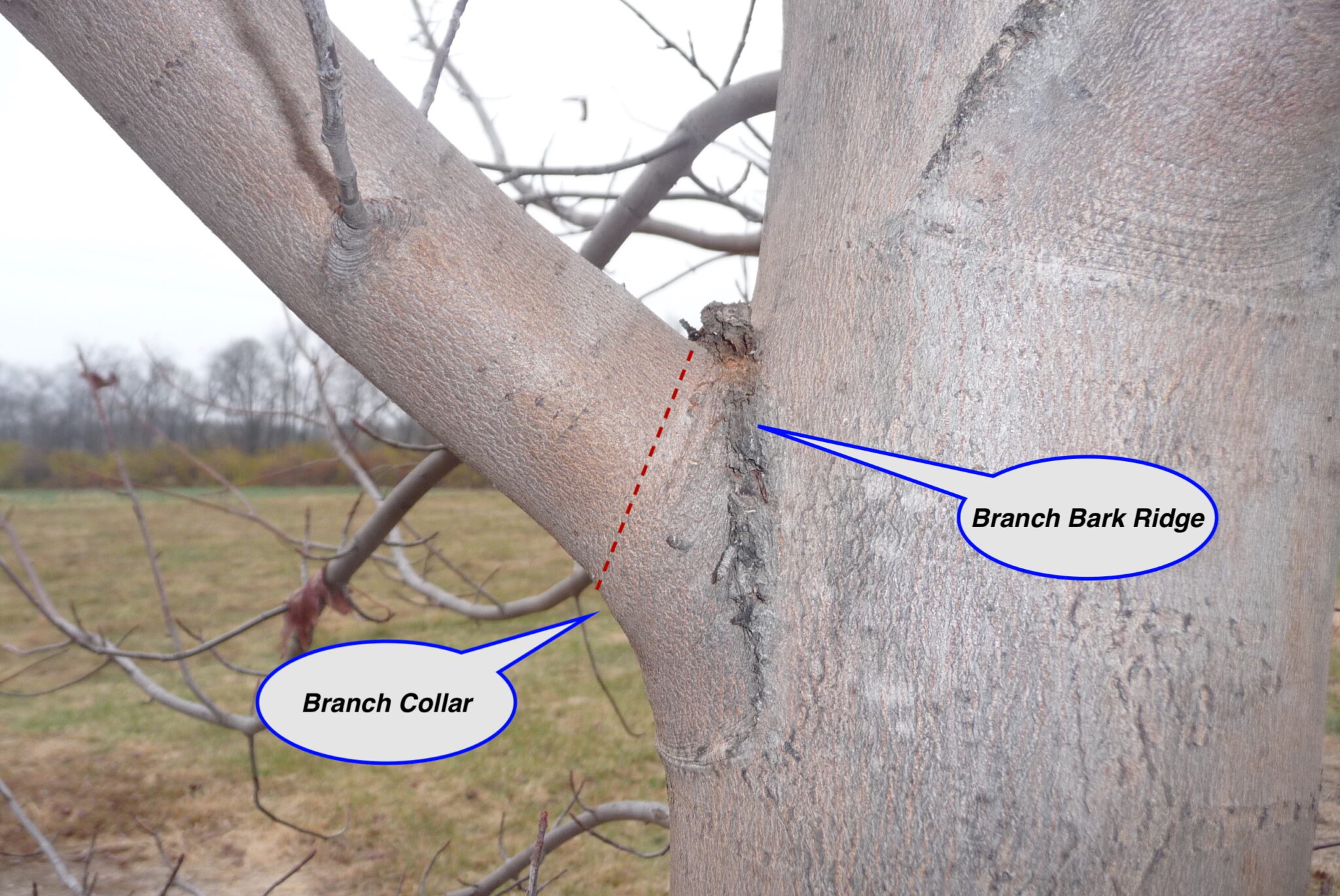
Identify the branch collar and branch bark ridge to perform a good cut, which is just outside the line.
Another important branch component to identify in tree branches is the branch bark ridge. This part of the attachment is composed of rough, usually darkened, raised bark formed at the union where the branch meets the parent stem. The ridge extends from the top of the branch down both sides of the branch union. Together with the branch collar, the portion of the ridge pushed up in the union provides our target for the pruning cut. The BBR is present on every branch union and is an important identifying feature for determining tool placement.
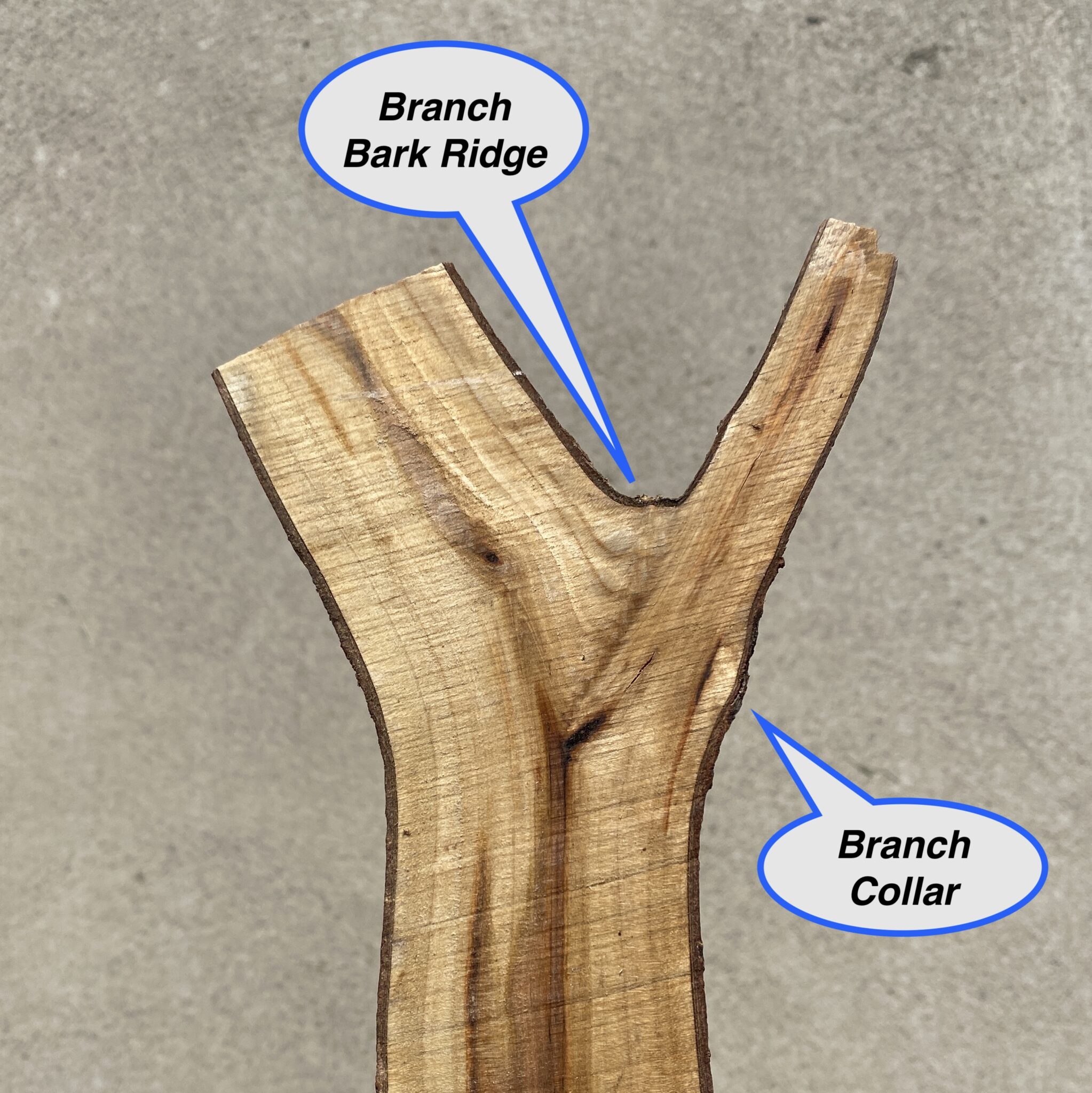
An internal view of the branch collar and branch bark ridge revealing the intermingled stem and branch wood fiber.
The combination of the branch collar, branch bark ridge, and the overlap between the branch and stem are the branch components that form what is called the branch protection zone. This zone contains specialized chemical compounds that help resist the spread of disease in the tree and facilitate wound-sealing. Always avoid damaging the area within the branch collar and branch bark ridge to help the tree recover from the pruning cut as quickly as possible.
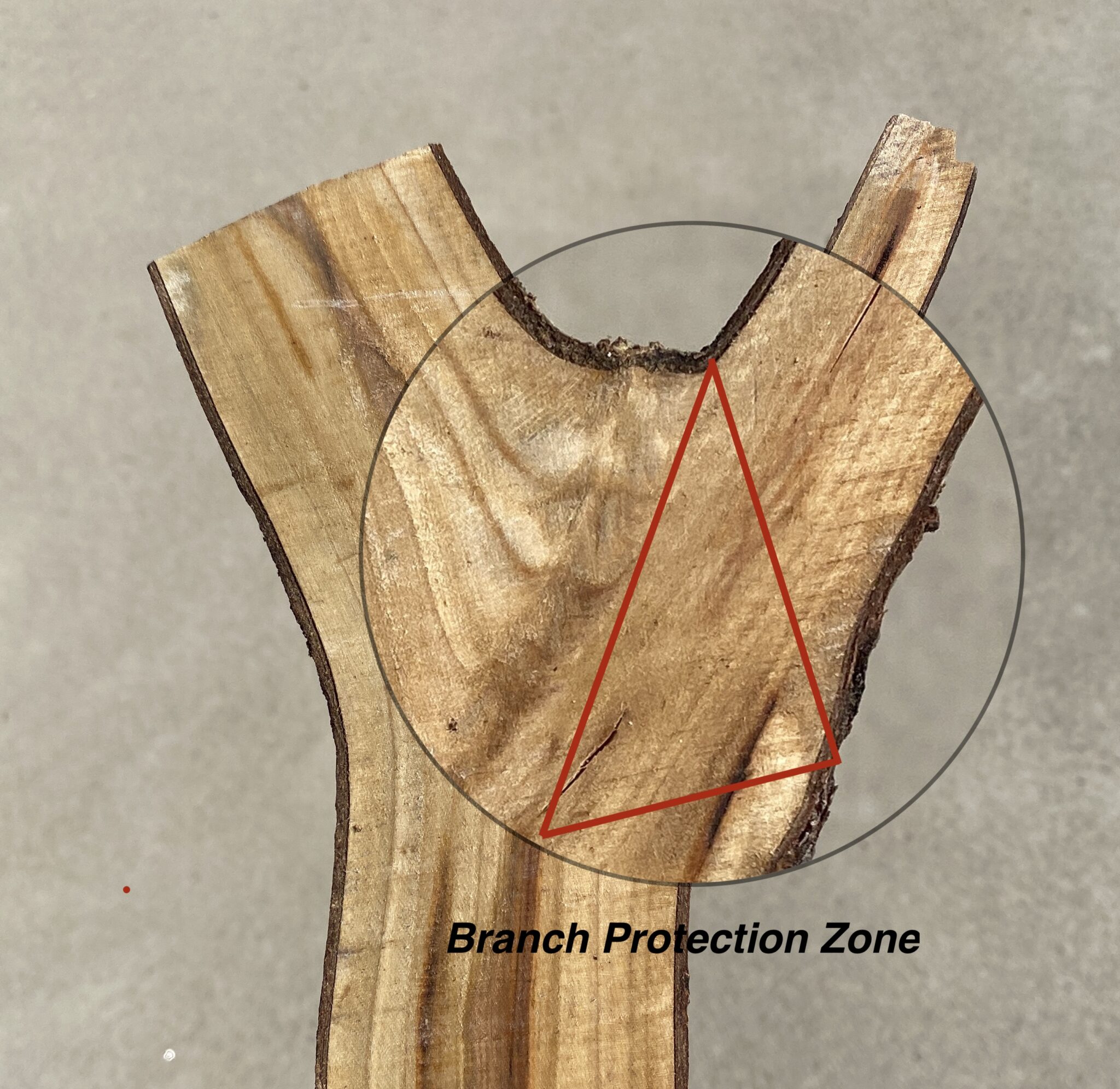
The Branch Protection Zone is an area that contains specialized chemicals to assist with the healing process after pruning.
For the best advice on tree maintenance and care, seek out a tree care professional with the experience and expertise to care for your trees. Search for a tree care provider in your area. Also, consider hiring an ISA Certified Arborist which can be found here.
Resources:
Planting Your Tree Part 1: Choosing Your Tree, Purdue Extension YouTube Channel
Tree Planting Part 2: Planting a Tree, Purdue Extension YouTube Channel
Tree Selection for the “Un-natural” Environment, The Education Store, Purdue Extension resource center
Tree Installation: Process and Practices, The Education Store
Tree Pruning Essentials Video, Purdue Extension YouTube Channel
Purdue Landscape Report
Lindsey Purcell, Urban Forestry Specialist
Purdue Department of Forestry and Natural Resources
Purdue Landscape Report: While fungi are responsible for many of our foliar disease problems, different fungal pathogens present as problems throughout the country, depending upon the host plant grown and the environmental conditions. This is a brief overview of several common types of fungal leaf diseases that occur in Indiana and throughout North America (and Europe). Recognizing the symptoms and signs is an important first step to diagnose a disease problem, followed by how to manage these diseases by combining cultural and chemical controls.
Common fungal leaf diseases of deciduous trees and shrubs
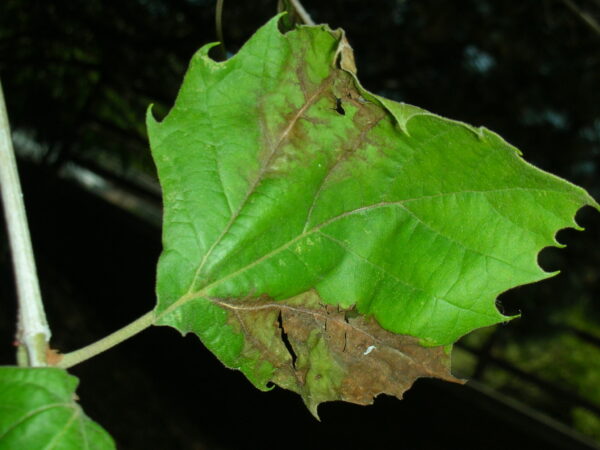
Figure 1. Anthracnose is a yearly problem on sycamore in the Midwest. Photo by Janna Beckerman.
Anthracnose. Anthracnose diseases probably are the best-known foliar fungal diseases of deciduous trees. They affect many ornamental trees including major shade-tree genera such as sycamore (Platanus spp.), oak (Quercus spp.), maple (Acer spp.), elm (Ulmus spp.) and ash (Fraxinus spp.) (Fig. 1). Anthracnose actually is a general term describing symptoms such as dead irregular areas that form along and between the main vein of the leaf. The leaves may also become curled and distorted and twigs may die back. The fungus overwinters in infected twigs and the petioles of fallen leaves, and the spores disseminate in the spring by wind and splashing rain. The disease, while unsightly, rarely results in the tree’s death. Sycamores and other trees often withstand many years of partial defoliation. However, one anthracnose disease is more serious. Dogwood anthracnose (Discula destructiva) is a devastating problem on the Eastern seaboard, but has not been a significant issue here in Indiana.
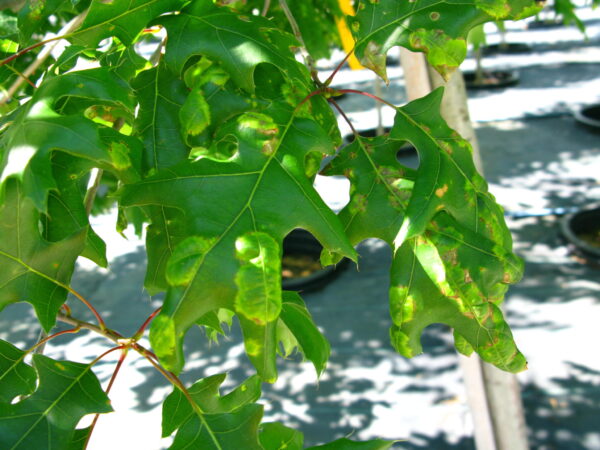
Figure 2. Leaf blister on oak. Photo by Janna Beckerman
Leaf blisters result in the blistering, curling and puckering of leaf tissue. Oak leaf blister (Taphrina caerulescens) is a common blister disease of oaks (Fig. 2)., particularly the red oak subgenus, which includes Northern red oak (Q. rubra) and pin oak (Q. palustris) among others. The symptoms begin as a slight yellowing of the infected leaf followed by round, raised blisters. These turn brown, and the infected leaves fall prematurely. This fungus overwinters as spores on the buds.
Leaf spot is a general symptom caused by a multitude of pathogens and infect all deciduous trees and shrubs, and include dead spots with a defined boundary between living and dead tissue. The dead tissue often separates from the surrounding living tissue creating a “shot-hole” appearance on the infected leaves. Common hosts include dogwood, maples, hydrangea, rose, holly, and Indian-hawthorn.
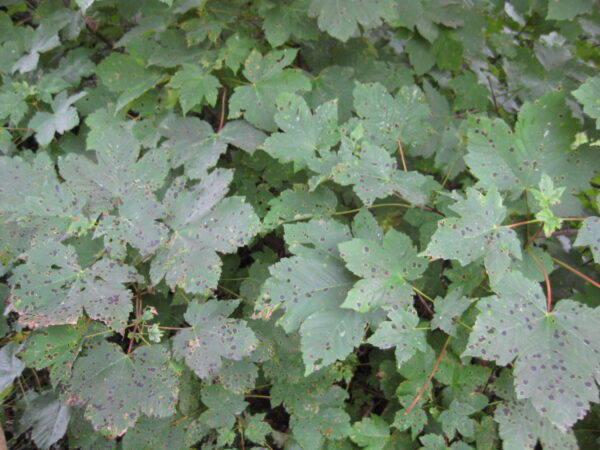
Figure 3. Tar spot is increasing in incidence and severity in Indiana. Photo by Janna Beckerman.
Tar spot (Rhytisma spp.) is a leaf disease with initial symptoms similar to leaf spot. The disease is most common on red (Acer rubrum) and silver maple (A. saccharinum) (Fig.3), but it can occur on a wide range of maple species from sugar (A. saccharum) and Norway (A. platanoides) to bigleaf maple (A. macrophyllum). The symptoms begin in the spring as small greenish-yellow spots on the upper leaf surface that, by mid-summer, progress to black tar-like spots about 0.5 inch in size. The disease is not fatal to the tree, but the appearance of the tar spots alarms some tree owners. A major outbreak in New York about 10 years ago left many maples completely defoliated by mid-August.
Resources:
Diplodia Tip Blight of Two-Needle Pines, The Education Store, Purdue Extension resource center
Boxwood Blight, The Education Store
Disease of Landscape Plants: Cedar Apple and Related Rusts on Landscape Plants, The Education Store
Planting Your Tree Part 1: Choosing Your Tree, Purdue Extension – Forestry & Natural Resources (FNR) YouTube Channel
Tree Planting Part 2: Planting a Tree, Purdue Extension – FNR YouTube Channel
Find a Certified Arborist, Trees are Good-International Society of Arboriculture (ISA)
Video: Step by Step to Find an Arborist, Trees are Good-International Society of Arboriculture (ISA)
Professional Forester, Indiana Forestry Woodland Owners Association
District Forester, Indiana Department of Natural Resources, 10+ acres
Trees and Storms: Understanding Damage, Risk and Recovery – Got Nature? Blog, Purdue Extension – FNR
Why Is My Tree Dying? – Got Nature? Blog, Purdue Extension – Forestry and Natural Resources
Tree Risk Management – Got Nature? Blog, Purdue Extension – FNR
Tree Pruning Essentials, Publication & Video, The Education Store
Tree Wound and Healing, Got Nature? Blog, Purdue Extension – FNR
What are Invasives Species and Why Should I Care?, Got Nature? Blog, Purdue Extension – FNR
Subscribe – Purdue Extension-FNR YouTube Channel
Janna Beckerman, Professor of Plant Pathology
Purdue Department of Botany and Plant Pathology
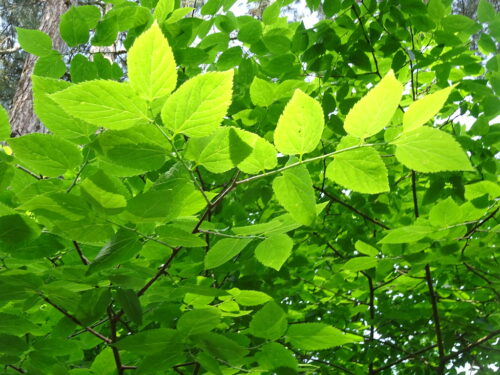 Question: My hackberry trees are dropping leaves for no apparent reason. The leaves look fine, no bugs or mold spots or discoloration of any kind. Do you have any idea what might be causing the leaf drop?
Answer: The loss of leaves on hackberries in spring is an occasional phenomenon in the Midwest. The exact cause has never been determined. In past years, no association was found between the leaf drop and insects or diseases. The most popular theory is that cold spring temperatures may have damaged the leaf buds or newly developing leaves, causing the leaf drop. Remember that blast of winter in April!? It’s likely the loss of leaves in spring is temporary. In past years, affected hackberries quickly developed new leaves and recovered completely. Just be patient and wait for the reflush of growth.
Leaves may be falling from your maple trees right now. This is a common spring issue caused by the maple petiole borer. Look closely at the fallen leaves for abnormally short petioles and examine the tree canopy for broken petioles that have remained attached. Although sugar maples are generally preferred, other maples may occasionally be infested. Fortunately, while the leaf drop may appear dramatic, the actual impact on the overall health of affected trees is minimal, so controls are not necessary. Also, a re-flush of leaves may be expected.
Resources:
Will My Tree Recover After Losing Their Leaves, Purdue Landscape Report
Planting Your Tree Part 1: Choosing Your Tree, Purdue Extension YouTube Channel
Planting Your Tree Part 2: Planting A Tree, Purdue Extension YouTube Channel
Tree Installation: Process and Practices, The Extension Store, Purdue Extension resource center
Ask an Expert: Tree Selection and Planting, Purdue FNR Extension YouTube Channel
Find a Certified Arborist, International Society of Arboriculture (ISA)-Trees Are Good
Lindsey Purcell, Urban Forestry Specialist
Purdue Department of Forestry and Natural Resources
United States Department of Agriculture Animal and Plant Health Inspection Service Bulletin: USDA declares August Tree Check Month and urges public to look for Asian longhorned beetle.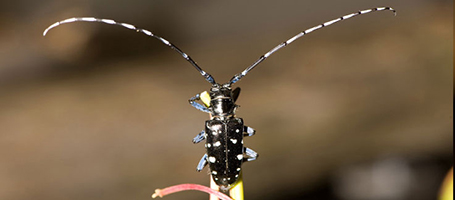
WASHINGTON, July 23, 2019 — August is the height of summer, and it is also the best time to spot the Asian longhorned beetle (ALB) as it starts to emerge from trees. The U.S. Department of Agriculture (USDA) is asking the public to take five minutes to step outside and report any signs of this invasive pest. Checking trees for the beetle will help residents protect their own trees and better direct USDA’s efforts to eradicate this beetle from the United States.
“It’s important to look for signs of the beetle now, because it’s slow to spread during the early stages of an infestation,” said Josie Ryan, APHIS’ National Operations Manager for the ALB Eradication Program. “With the public’s help, we can target new areas where it has spread and provide a better chance of quickly containing it.”
The Asian longhorned beetle feeds on a wide variety of popular hardwood trees, including maple, birch, elm, willow, ash and poplar. It has already led to the loss of more than 180,000 trees. Active infestations are being fought in three areas of the country: Worcester County, MA, Long Island, NY (Nassau and Suffolk Counties), and Clermont County, Ohio.
“Homeowners need to know that infested trees do not recover and will eventually die, becoming safety hazards,” warned Ryan. “USDA removes infested trees as soon as possible because they can drop branches and even fall, especially during storms, and this keeps the pest from spreading to nearby healthy trees.”
The Asian longhorned beetle has distinctive markings that are easy to recognize:
- Antennae that are longer than the insect’s body with black and white bands.
- A shiny, jet-black body with white spots, about 1” to 1 ½” long.
- Six legs and feet, possibly bluish-colored.
Signs of infestation include: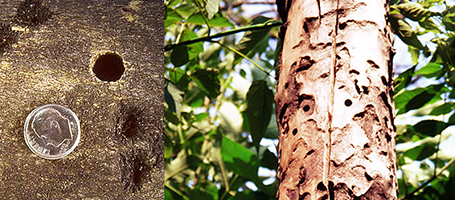
- Round exit holes in tree trunks and branches about the size of a dime or smaller.
- Shallow oval or round scars in the bark where the adult beetle chewed an egg site.
- Sawdust-like material called frass, laying on the ground around the tree or in the branches.
- Dead branches or limbs falling from an otherwise healthy-looking tree.
After seeing signs of the beetle:
- Make note of what was found and where. Take a photo, if possible.
- Try to capture the insect, place in a container, and freeze it. This will preserve it for easier identification.
- Report findings by calling 1-866-702-9938 or completing an online form at USDA Animal and Plant Health Inspection Service.
It is possible to eliminate this pest and USDA has been successfully doing so in several areas. Most recently, the agency declared Stonelick and Batavia Townships in Ohio to be free of the Asian longhorned beetle. We also eradicated the beetle from Illinois, New Jersey, Boston, MA, and parts of New York. The New York City boroughs of Brooklyn and Queens are in the final stages of eradication.
For more information about the Asian longhorned beetle, other ways to keep it from spreading—such as not moving firewood—and eradication program activities, visit USDA Animal and Plant Health Inspection Service. For local inquiries or to speak to your State Plant Health Director, call 1-866-702-9938.
Other Resources:
Report Invasive Species, Purdue Agriculture & Indiana Invasive Species Council
Great Lakes Early Detection Network, Bugwood Apps
New Hope for Fighting Ash Borer, Got Nature? Blog
Mile-a-Minute Invasive Vine Found Indiana, Got Nature? Blog
Sericea Lespedeza: Plague on the Prairie, Got Nature? Blog
Invasive Plants: Impact on Environment and People, The Education Store, Purdue Extension
Invasive Plant Species in Hardwood Tree Plantations, The Education Store
Invasive Plant Species: Callery Pear, Purdue Extension The Education Store
United States Department of Agriculture Animal and Plant Health Inspection Service
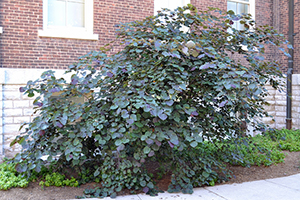
Photo credit: Purdue Arboretum
In July’s column of Purdue Yard & Garden News, Purdue Extension Consumer Horticulturist B. Rosie Lerner discusses several types of purple plants that could spice up your landscape, from small shrubs like Weigela and Ninebark to larger trees like Purple-leaf European Beech and Redbud Forest Pansy.
Resources
The Purple Landscape, Purdue Yard & Garden News
News Archive, Purdue Yard & Garden News
Purdue Master Gardener Program, Purdue Horticulture
B. Rosie Lerner
Extension Consumer Horticulturist, Purdue Extension

Recent Posts
- Spotted Lanternfly Feeds on Over 70 Plus Plant Species
Posted: May 20, 2026 in Alert, Forestry, Forests and Street Trees, Gardening, Invasive Insects, Urban Forestry, Wildlife - Painted Hickory Borer, Purdue Landscape Report
Posted: May 14, 2026 in Forestry, Invasive Insects, Wildlife - Saving Giants of the Blue River: Purdue Team Earns Statewide Recognition
Posted: in Aquaculture/Fish, Aquatic/Aquaculture Resources, Wildlife - Restoring Roots to Save the Salamanders, USDA – Natural Resources Conservation Service
Posted: May 6, 2026 in Aquaculture/Fish, Forestry, Wildlife - Spring Storms Are Coming: How to Reduce Tree Damage and Risk
Posted: May 1, 2026 in How To, Urban Forestry, Wildlife, Woodlands - Cryptocline Leaf Spot (Anthracnose) of Elm, Purdue Landscape Report
Posted: April 30, 2026 in Disease, Forestry, Woodlands - Mechanical Damage to Trees: Mowing and Maintenance Equipment
Posted: April 24, 2026 in Forestry, Forests and Street Trees, Urban Forestry - A Woodland Management Moment: Growing Quality Black Walnut in Openings
Posted: April 20, 2026 in Urban Forestry, Woodland Management Moment, Woodlands - Spring Into Bloom With ID That Tree
Posted: in Forests and Street Trees, Urban Forestry, Woodlands - Question: Have Whippoorwill Birds Declined in Numbers?
Posted: in Ask the Expert, Wildlife
Archives
Categories
- Alert
- Aquaculture/Fish
- Aquatic/Aquaculture Resources
- Ask the Expert
- Christmas Trees
- Community Development
- Disease
- Drought
- Forestry
- Forests and Street Trees
- Gardening
- Got Nature for Kids
- Great Lakes
- How To
- Invasive Animal Species
- Invasive Insects
- Invasive Plant Species
- Land Use
- Natural Resource Planning
- Nature of Teaching
- Plants
- Podcasts
- Ponds
- Publication
- Safety
- Spiders
- Timber Marketing
- Urban Forestry
- Webinar
- Wildlife
- Wood Products/Manufacturing
- Woodland Management Moment
- Woodlands