 Purdue University - Extension - Forestry and Natural Resources
Got Nature? Blog
In this webinar hosted by Indiana Forestry & Woodland Owners Association, author Doug Tallamy discusses his book “The Nature of Oaks” and how Oaks sustain a complex and fascinating web of wildlife. Doug has also written Bringing Nature Home: How Native Plants Sustain Wildlife in Our Gardens which was awarded the silver metal in 2008 by the Garden Writers Association, Living Landscape, and Nature’s Best Hope. Tallamy has also founded Homegrown National Parks, a grassroots call-to-action to regenerate biodiversity and ecosystem function by planting native plants and creating new ecological networks.
Join IFWOA for their upcoming webinar that will be recorded and placed on their YouTube Channel:
- April 12, 2023 – Magnificent Trees of Indiana
Check out their Indiana Forestry & Woodland Association YouTube Channel for videos including: What is IFWOA?; A New Carbon Program for Hardwood Landowners Webinar, 202 Charles Deam Forest Stewardship Award and much more.
The Indiana Forestry & Woodland Owners Association (IFWOA) was founded in 1977 and is a non-profit organization dedicated to conservation and sustainable management of woodlands in Indiana. IFWOA advocates for scientific best practices for management to achieve objectives of clean water, wildlife habitat, soil protection, native species diversity, timber production, recreation, carbon sequestration and many others.
IFWOA is an affiliate of the National Woodland Owners Association. IFWOA is a partner, collaborator or is represented on leading National and State organizations. These memberships or collaborations are selected to advance Indiana Woodland owner’s interests. IFWOA monitors and influences legislation and economic trends impacting Indiana woodlands and landowners for our members. Membership in IFWOA provides a valuable network linkage to information and resources at the leading edge of science, industry and politics impacting Indiana woodlands.
Resources:
Find an Indiana Professional Forester, Indiana Forestry & Woodland Owners Association (IFWOA)
Purdue Arboretum Explorer
Native Trees of the Midwest, The Education Store
Shrubs and Woody Vines of Indiana and the Midwest, The Education Store
Investing in Indiana Woodlands, The Education Store
Forest Improvement Handbook, The Education Store
ID That Tree, Purdue Extension-Forestry & Natural Resources (FNR) YouTube playlist
Woodland Management Moment , Purdue Extension-FNR YouTube playlist
Diana Evans, Extension and Web Communication Specialist
Purdue University Department of Forestry and Natural Resources
Liz Jackson, Engagement Lead
Indiana Forestry & Woodland Association
The Help the Hellbender Project is a joint project involving partners from across the country. The conservation outreach continues as the team shares how important it is that our household and farm management practices are aiming to help keep our rivers and streams clean.
 The Help the Hellbender conservation efforts will continue expanding as the U.S. Department of Agriculture (USDA) announced it is awarding $197 million for 41 locally led conservation projects through the Regional Conservation Partnership Program (RCPP). RCPP is a partner-driven program that leverages partner resources to advance innovative projects that address climate change, enhance water quality, and address other critical challenges on agricultural land. The “Farmers Helping Hellbenders” project, led by Dr. Rod Williams and Purdue Extension wildlife specialist/Help the Hellbender project coordinator Nick Burgmeier, is among the projects set to receive funding through the RCCP Classic fund, which uses NRCS contracts and easements with producers, landowners and communities in collaboration with project partners. To view article and the fourteen contributing partners in the article USDA Awards Farmers Helping Hellbenders Project $2.7 Million in Funding.
Help the Hellbender Recent Team Awards
- The team was honored by the Hoosier Outdoor Writers group with its 2022 Bayou Bill Conservation Award. The annual conservation award is given in memory of the legendary Crothersville, Indiana, outdoor writer Bayou Bill Scifres, who was a founding member of HOW in 1969, and had his outdoors column published in The Indianapolis Star newspaper for 50 years. View full article on the Purdue Forestry and Natural Resources’ News: Help the Hellbender Program Receives Hoosier Outdoor Writers Conservation Award.
- The team recently received the Budd Denneman Partners in Conservation Excellence Award, Indiana Department of Natural Resources, Division of Fish & Wildlife
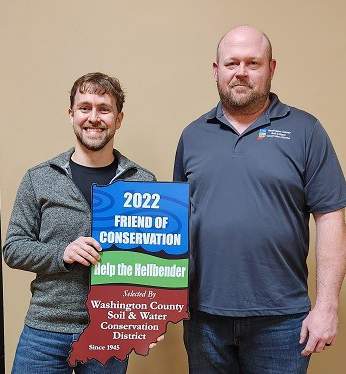
- Awarded the Friends of Conservation Award from the Washington County Soil and Water
The Help the Hellbender website is full of resources, activities, photos, posters, coloring pages and publications for homeowners, farmers, teachers and kids.
Resources:
Help the Hellbender Facebook page
Ask the Expert: Learn All About Hellbenders and Take a Tour, Subscribe Purdue Extension – Forestry & Natural Resources (FNR) YouTube Channel
Ask the Expert video: Help the Hellbender – Dr. Stephen Spear of The Wilds, Purdue Extension – FNR YouTube Channel
Ask the Expert video: Live with Mesker Park Zoo and Botanical Gardens – Hellbenders, Purdue Extension – FNR YouTube Channel
A Moment in the Wild video: Hellbender Hide, Purdue Extension – FNR YouTube Channel
A Moment in the Wild video: Release Moment of Hellbenders,
How Anglers and Paddlers Can Help the Hellbender video, Purdue Extension – FNR YouTube Channel
Eastern Hellbender ID Video, Purdue Extension – FNR YouTube Channel
Hellbenders Rock!, The Education Store, Purdue Extension’s resource center
Help the Hellbender, North America’s Giant Salamander, The Education Store
How Our Zoos Help Hellbenders, The Education Store
The Nature of Teaching: Adaptations for Aquatic Amphibians, The Education Store
Healthy Water, Happy Home – Lesson Plan, The Education Store
Purdue Expert: Hellbender Salamander, Purdue University News YouTube Channel
FNR Assists in First Natural Breeding of Eastern Hellbender in Captivity, Purdue FNR News & Stories
Helping the Hellbender: Mesker Park Zoo Begins Captive Breeding Efforts, Purdue Agriculture News
Diana Evans, Extension and Web Communication Specialist
Purdue University Department of Forestry and Natural Resources
The Help the Hellbender team, led by Dr. Rod Williams, professor of wildlife science, has been honored by the Hoosier Outdoor Writers group with its 2022 Bayou Bill Conservation Award.
The annual conservation award is given in memory of the legendary Crothersville, Indiana, outdoor writer Bayou Bill Scifres, who was a founding member of HOW in 1969, and had his outdoors column published in The Indianapolis Star newspaper for 50 years.
“The Hoosier Outdoor Writers group was introduced to Dr. Rod Williams in 2019 when he came to our annual conference and talked to us about his work with hellbenders and the Help the Hellbenders program,” Tom Berg, Executive Director of HOW, explained. “Our members were very interested in learning more about hellbender conservation and restoration, and also about his involvement with captive breeding and propagation efforts across the state. It was interesting to us to hear that Purdue University, the Indiana Department of Natural Resources and other groups were working together on management plans to re-introduce and re-populate hellbenders throughout much of their historical range. This is exactly the type of conservation story that our members like to hear and relate to their audiences. It also aligns very well with our strong belief in the conservation of Indiana’s natural resources, so choosing Dr. Williams and the “Help the Hellbenders” program for this award was an easy task.”
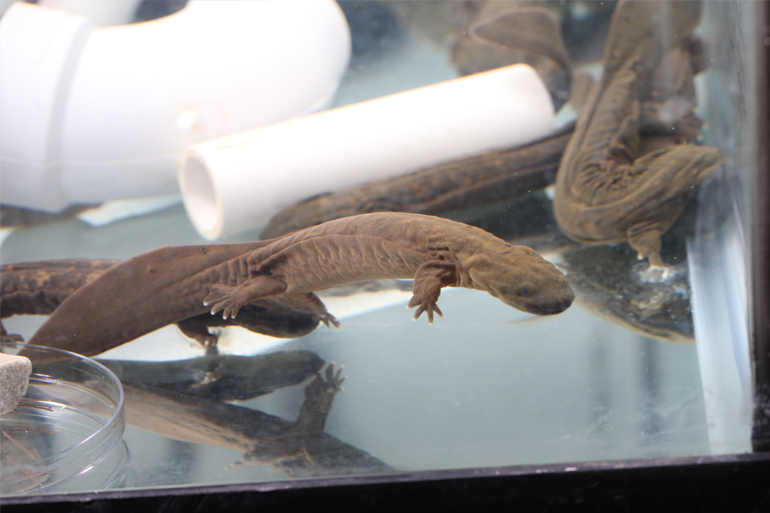 For much of the last 16 years, Williams and his team have been researching eastern hellbenders, spearheading regional conservation efforts and advancing hellbender captive propagation, or the rearing of this ancient animal in captivity and their eventual return to the wild.
After five years of breeding efforts, Williams’ partners at the Mesker Park Zoo in Evansville, Indiana, successfully bred eastern hellbenders naturally in captivity in October 2020, signifying the culmination of a long and collaborative effort to breed the species and restore this endangered species to its native environment.
Williams’ hellbender lab is actively collaborating with the Indiana Department of Natural Resources, Indiana Division of Fish and Wildlife and The Nature Conservancy as well as several other partners across 13 states on a number of conservation projects and educational opportunities for teachers and children, farmers and more.
For full article with additional photos view: Help the Hellbender Program Receives Hoosier Outdoor Writers Conservation Award.
Resources
Help the Hellbender website
Help the Hellbender Facebook page
Ask the Expert: Learn All About Hellbenders and Take a Tour, Subscribe Purdue Extension – Forestry & Natural Resources (FNR) YouTube Channel
Ask the Expert video: Help the Hellbender – Dr. Stephen Spear of The Wilds, Purdue Extension – FNR YouTube Channel
Ask the Expert video: Live with Mesker Park Zoo and Botanical Gardens – Hellbenders, Purdue Extension – FNR YouTube Channel
A Moment in the Wild video: Hellbender Hide, Purdue Extension – FNR YouTube Channel
A Moment in the Wild video: Release Moment of Hellbenders,
How Anglers and Paddlers Can Help the Hellbender video, Purdue Extension – FNR YouTube Channel
Eastern Hellbender ID Video, Purdue Extension – FNR YouTube Channel
Hellbenders Rock!, The Education Store, Purdue Extension’s resource center
Help the Hellbender, North America’s Giant Salamander, The Education Store
How Our Zoos Help Hellbenders, The Education Store
The Nature of Teaching: Adaptations for Aquatic Amphibians, The Education Store
Healthy Water, Happy Home – Lesson Plan, The Education Store
FNR Assists in First Natural Breeding of Eastern Hellbender in Captivity, Purdue FNR News & Stories
Wendy Mayer, FNR Communications Coordinator
Purdue University Department of Forestry and Natural Resources
Channel catfish, commonly known as catfish, are freshwater finfish in the Ictaluridae family. Their native range extends from southern Canada and the Central US to Mexico. They are popular to catch and eat and have been introduced throughout the US and the world for food and recreation. This fact sheet publication shares how to identify the catfish, where they can be found, where you can find catfish products and if they are safe to eat. You will also enjoy the recipe found on this fact sheet.
The Channel Catfish publication is the seventh in a series of consumer guides that describe fish and shellfish farmed in the Midwest region of the United States. (See FNR-608-W, Walleye Farmed Fish Fact Sheet, FNR-618-W, Yellow Perch Farmed Fish Fact Sheet, FNR-621-W, Tilapia Farmed Fish Fact Sheet, FNR-622-W, Rainbow Trout Farmed Fish Fact Sheet, FNR-623-W, Pacific White Shrimp Farmer Fish Fact Sheet and FNR-625-W, American Paddlefish Farmed Fish Fact Sheet). The fact sheet also includes culinary characteristics, cooking tips and a recipe for Classic Fried Catfish.
This publication is a collaborative project of Illinois-Indiana Sea Grant, the North Central Regional Aquaculture Center, University of Illinois Extension, and Purdue University’s Department of Forestry and Natural Resources.
About the Author
Amy Shambach is Illinois-Indiana Sea Grant’s (IISG) aquaculture marketing outreach associate who works with the aquaculture industry in the USDA’s North Central Regional Aquaculture Center. Her work focuses on the demand side of domestic farm raised seafood products. She provides outreach and extension services to producers, potential producers, and consumers. Along with Dr. Kwamena Quagrainie, producers, aquaculture associations, and consumers, she works to determine the needs of stakeholders.
To receive the free download for the Channel Catfish please visit The Education Store.
Resources:
Walleye Farmed Fish Fact Sheet, The Education Store, Purdue Extension’s resource center
Pacific White Shrimp Farmed Fact Sheet, The Education Store
Yellow Perch Farmed Fish Fact Sheet, The Education Store
Tilapia Farmed Fish Fact Sheet, The Education Store
Rainbow Trout Farmed Fish Fact Sheet, The Education Store
American Paddlefish, The Education Store
A Guide to Small-Scale Fish Processing Using Local Kitchen Facilities, The Education Store
Aquaculture Family Coloring Book Development, The Education Store
Eat Midwest Fish, Illinois-Indiana Sea Grant online resource hub
Aquatics & Fisheries Videos, Purdue Extension-Forestry and Natural Resources YouTube Channel Playlist
Amy Shambach, Aquaculture Marketing Outreach Associate
Purdue Department of Forestry and Natural Resources/Illinois Indiana Sea Grant Program
The classic and trusted book “Fifty Common Trees of Indiana” by T.E. Shaw was published in 1956 as a user-friendly guide to local species. Nearly 70 years later, the publication has been updated through a joint effort by the Purdue Department of Forestry and Natural Resources, Indiana 4-H, and the Indiana Department of Natural Resources, and reintroduced as “An Introduction to Trees of Indiana.”
The full publication is available for download for $7 in the Purdue Extension Education Store. The field guide helps identify common Indiana woodlot trees.
Each week, the Intro to Trees of Indiana web series will offer a sneak peek at one species from the book, paired with an ID That Tree video from Purdue Extension forester Lenny Farlee to help visualize each species as it stands in the woods. Threats to species health as well as also insight into the wood provided by the species, will be provided through additional resources as well as the Hardwoods of the Central Midwest exhibit of the Purdue Arboretum, if available. 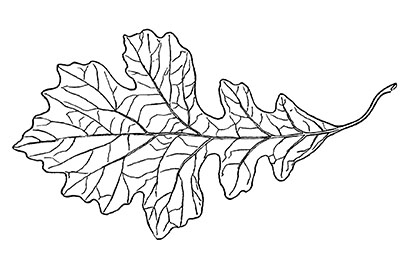
This week, we take a look at the second of our oak varieties in Indiana, the Bur Oak or Quercus macrocarpa.
The bur oak has rounded lobes on the end of the leaves, which have deep sinuses and are very broad across the top. Leaves are typically dark green that turn yellow or brown in the fall.
The bark on bur oak is medium to dark gray in color with heavy ridges and plates, often so thick that it is often fire resistant and resistant to damage from burning. Bur oak may have terminal buds that include small hairs and resemble bear claws.
The fruit of the bur oak is an acorn with a large cap that features a hairy fringe forming a burr along the outside edge. The acorns vary in size, but average one inch in length, and the cap covers half to two thirds of the acorn.
Bur oaks, which grow to 70-80 feet tall and up to five feet wide, are common in both bottomlands and prairie regions, and can tolerate many different sites. Bur oaks can be found in nearly any county and any habitat type in Indiana. The natural range of bur oak is the eastern Great Plains from the Dakotas to Ohio to the eastern Appalachians, except through the southeastern United States. The range also extends into southern Canada.
Lumber from the white oak group, which includes bur oak, is among the heaviest next to hickory, weighing in at 45 pounds per cubic foot. It is very resistant to decay and is one of the best woods for steam bending. Bur oak, however, is somewhat weaker than other species in the white oak group.
For full article with additional photos view: Intro to Trees of Indiana: Bur Oak
If you have any questions regarding wildlife, trees, forest management, wood products, natural resource planning or other natural resource topics, feel free to contact us by using our Ask an Expert web page.
Other Resources:
ID That Tree: Bur Oak
ID That Tree: White Oak Group
ID That Tree: Alternate Leaf Arrangement – Honey Locust/Bur Oak
Hardwood Lumber and Veneer Series: White Oak Group
Morton Arboretum: Bur Oak
Fifty Common Trees of Indiana
An Introduction to Trees of Indiana
Native Trees of the Midwest, The Education Store
Shrubs and Woody Vines of Indiana and the Midwest, The Education Store
Investing in Indiana Woodlands, The Education Store
Forest Improvement Handbook, The Education Store
ID That Tree, Purdue Extension-Forestry & Natural Resources (FNR) YouTube playlist
Woodland Management Moment , Purdue Extension-FNR YouTube playlist
Bur Oak, Native Trees of Indiana River Walk, Purdue-Fort Wayne
Wendy Mayer, FNR Communications Coordinator
Purdue University Department of Forestry and Natural Resources
Lenny Farlee, Sustaining Hardwood Extension Specialist
Purdue University Department of Forestry and Natural Resources
The new USDA-Natural Resources Conservation Service (NRCS) website is designed for farmers, ranchers and forest landowners who use NRCS conservation programs, and our partners who help us deliver the conservation mission.
You will find information that includes:
- Conservation Basics: find soil health, soil science, water, air, plants, animals, land, energy, climate, wildlife habitat and invasive species and pests
- Getting Assistance: find your local service center
- Programs & Initiatives
- Resources
- News & Events
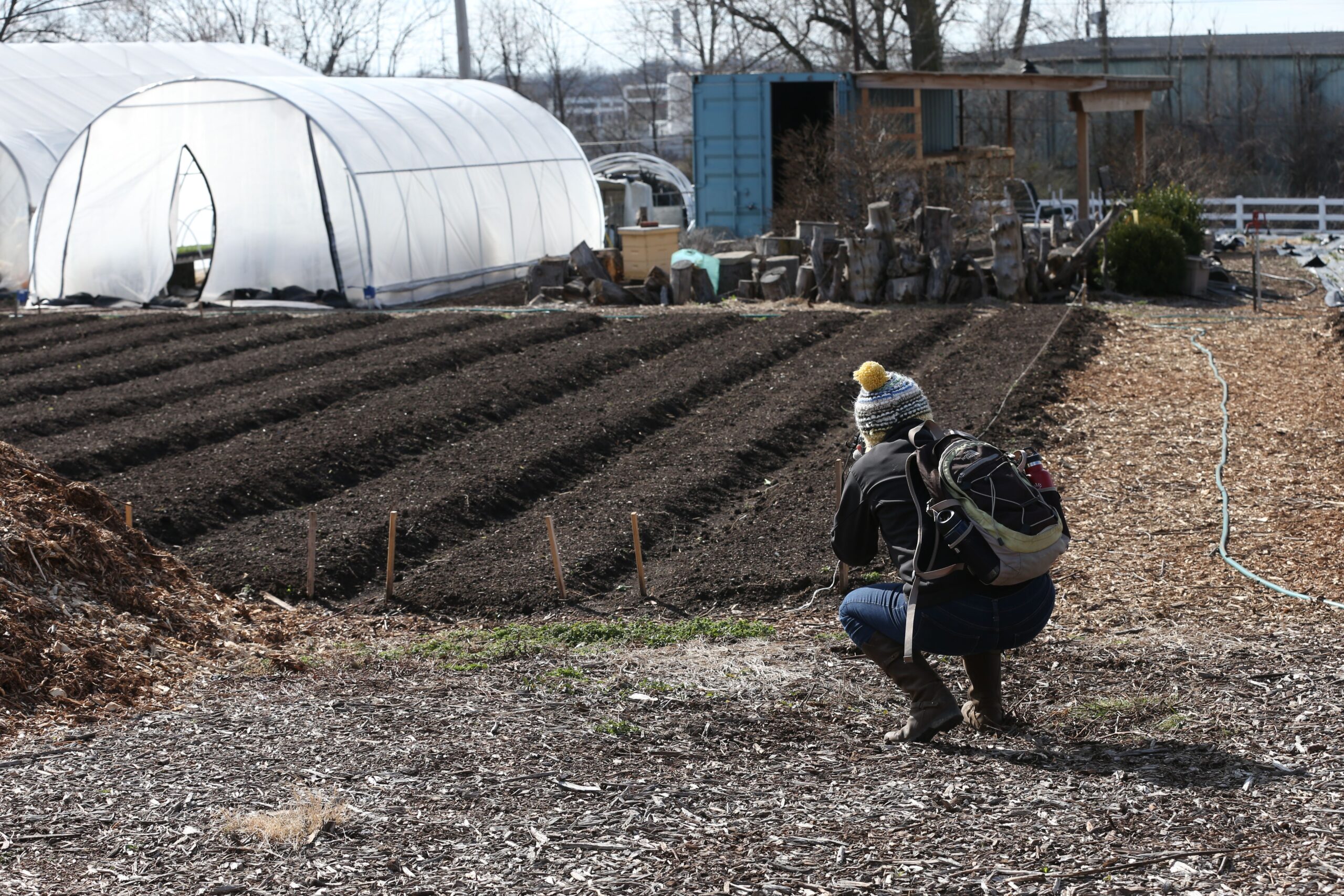
For more than 80 years, NRCS has helped people make investments in their operations and local communities to keep working lands working, boost rural economies, increase the competitiveness of American agriculture, and improve the quality of our air, water, soil, and habitat.
As the USDA’s primary private lands conservation agency, NRCS generates, manages, shares data, technology and standards that enable partners and policymakers to make decisions informed by objective, reliable science.
Resources:
Consumer Horticulture: Collecting Soil Samples for Testing, The Education Store , Purdue Extension resource center
Soil Sampling Guidelines, The Education Store
Soil Testing for Lawns, The Education Store
Certified Soil Testing Laboratories, Purdue Extension – Master Gardener Program
Lawn to Lake Midwest, Illinois-Indiana Sea Grant Program
Forest Improvement Handbook, The Education Store
Frost Seeding Native Grasses and Forbs with a Drone (UAV), Purdue Extension-Forestry & Natural Resources (FNR)
Hardwood Ecosystem Experiment – Wildlife Responses to Timber Harvesting, The Education Store
Invasive Plants: Impact on Environment and People, The Education Store
Urban Forestry, Playlist, Purdue Extension – FNR YouTube Channel
USDA-Natural Resources Conservation Service (NRCS)
The classic and trusted book “Fifty Common Trees of Indiana” by T.E. Shaw was published in 1956 as a user-friendly guide to local species. Nearly 70 years later, the publication has been updated through a joint effort by the Purdue Department of Forestry and Natural Resources, Indiana 4-H, and the Indiana Department of Natural Resources, and reintroduced as “An Introduction to Trees of Indiana.”
The full publication is available for download for $7 in the Purdue Extension Education Store. The field guide helps identify common Indiana woodlot trees.
Each week, the Intro to Trees of Indiana web series will offer a sneak peek at one species from the book, paired with an ID That Tree video from Purdue Extension forester Lenny Farlee to help visualize each species as it stands in the woods. Threats to species health as well as also insight into the wood provided by the species, will be provided through additional resources as well as the Hardwoods of the Central Midwest exhibit of the Purdue Arboretum, if available.
This week, we introduce the red mulberry or Morus rubra.
Red mulberry has variable leaves, which can come without lobes (entire) or with two (mitten), three or even five lobes. Regardless of shape, the leaves have serrated margins and pointed tips and are arranged alternately on the twigs. The topside of the dark green leaves is sandpapery to the touch and has a matte or flat finish. The dark green leaves turn a golden yellow in the fall.
Basswood has leaves similar to the unlobed variety of red mulberry, but those leaves are smooth to the touch and have finely toothed margins. White mulberry, which is not native to Indiana, also has similar leaves to its cousin red mulberry, but those leaves are typically bright green and smooth, have more rounded teeth on the margins and feature a shinier upper leaf surface.
The bark of red mulberry is gray or brown in color with long flaky ridges, but may show some orange or tan peeking through the fissures in the bark.
The fruit of red mulberry, which hangs individually only the twig, resembles a small blackberry, with a dark purple or almost black color when ripe, that is favored by both birds and humans. Mulberry fruit is typically produced from mid-June to July.
Red mulberry, which is often found under the canopy of other hardwood trees in moist areas such as river bottoms as well as along wooded slopes, wood’s edges and shady roadways, are typically small understory trees, but can grow between 40 and 60 feet tall. Red mulberries are becoming less common on the landscape than the invasive white mulberry, but can be found growing throughout the eastern United States.
The Morton Arboretum warns that red mulberry is susceptible to a variety of pests, including leaf spots, witches brooms, canker diseases, powdery mildew, spider mites and scale insects.
For full article with additional photos view: Intro to Trees of Indiana: Red Mulberry
If you have any questions regarding wildlife, trees, forest management, wood products, natural resource planning or other natural resource topics, feel free to contact us by using our Ask an Expert web page.
Other Resources:
FNR Know Your Tree Series: Red and White Mulberry in Indiana
Morton Arboretum: Red Mulberry
Red Mulberry, Native Trees of Indiana River Walk, Purdue Fort Wayne
Fifty Common Trees of Indiana
An Introduction to Trees of Indiana
Native Trees of the Midwest, The Education Store
Shrubs and Woody Vines of Indiana and the Midwest, The Education Store
Investing in Indiana Woodlands, The Education Store
Forest Improvement Handbook, The Education Store
ID That Tree, Purdue Extension-Forestry & Natural Resources (FNR) YouTube playlist
Woodland Management Moment , Purdue Extension-FNR YouTube playlist
Wendy Mayer, FNR Communications Coordinator
Purdue University Department of Forestry and Natural Resources
Lenny Farlee, Sustaining Hardwood Extension Specialist
Purdue University Department of Forestry and Natural Resources
The classic and trusted book “Fifty Common Trees of Indiana” by T.E. Shaw was published in 1956 as a user-friendly guide to local species. Nearly 70 years later, the publication has been updated through a joint effort by the Purdue Department of Forestry and Natural Resources, Indiana 4-H, and the Indiana Department of Natural Resources, and reintroduced as “An Introduction to Trees of Indiana.”
The full publication is available for download for $7 in the Purdue Extension Education Store. The field guide helps identify common Indiana woodlot trees.
Each week, the Intro to Trees of Indiana web series will offer a sneak peek at one species from the book, paired with an ID That Tree video from Purdue Extension forester Lenny Farlee to help visualize each species as it stands in the woods. Threats to species health as well as also insight into the wood provided by the species, will be provided through additional resources as well as the Hardwoods of the Central Midwest exhibit of the Purdue Arboretum, if available.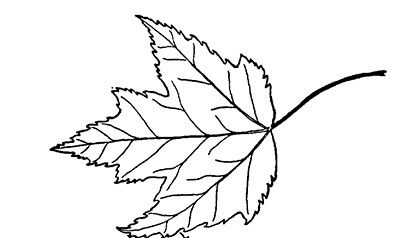
This week, we introduce the red maple or Acer rubrum.
Red maple has simple three to five-lobed leaves with relatively shallow, v-shaped divisions between the lobes. The oppositely held leaves may resemble sugar maple but the V shaped shallow divisions stand in contrast to sugar maple’s deep u-shaped sinuses. In the early spring, it is one of the earliest native trees to flower, producing clusters of reddish flowers as well as reddish colored pairs of winged seeds/fruit. In the fall, foliage typically turns a bright red to maroon color.
The bark is gray and smooth in young trees and may become flaky in older trees.
Red maple, which is a popular ornamental and street tree selection, is one of Indiana’s soft maples alongside silver maple. It also can be found in Indiana woodlands in both moist and dry sites and in bottomlands and uplands.
Red maple, grow 50 to 80 feet tall and are found growing throughout the eastern United States including the coastal regions.
The Morton Arboretum warns that red maple was display chlorosis symptoms of pale green leaves with dark green veins in high pH soil and drought conditions. The species also does not tolerate heavy pollution.
For full article with additional photos view: Intro to Trees of Indiana: Red Maple
If you have any questions regarding wildlife, trees, forest management, wood products, natural resource planning or other natural resource topics, feel free to contact us by using our Ask an Expert web page.
Other Resources:
Hardwoods of the Central Midwest: Soft Maple
Hardwood Lumber and Veneer Series, The Education Store: Soft Maple
Morton Arboretum: Red Maple
Red Maple, Native Trees of Indiana River Walk, Purdue Fort Wayne
Fifty Common Trees of Indiana
An Introduction to Trees of Indiana
Native Trees of the Midwest, The Education Store
Shrubs and Woody Vines of Indiana and the Midwest, The Education Store
Investing in Indiana Woodlands, The Education Store
Forest Improvement Handbook, The Education Store
ID That Tree, Purdue Extension-Forestry & Natural Resources (FNR) YouTube playlist
Woodland Management Moment , Purdue Extension-FNR YouTube playlist
Wendy Mayer, FNR Communications Coordinator
Purdue University Department of Forestry and Natural Resources
Lenny Farlee, Sustaining Hardwood Extension Specialist
Purdue University Department of Forestry and Natural Resources
The classic and trusted book “Fifty Common Trees of Indiana” by T.E. Shaw was published in 1956 as a user-friendly guide to local species. Nearly 70 years later, the publication has been updated through a joint effort by the Purdue Department of Forestry and Natural Resources, Indiana 4-H, and the Indiana Department of Natural Resources, and reintroduced as “An Introduction to Trees of Indiana.”
The full publication is available for download for $7 in the Purdue Extension Education Store. The field guide helps identify common Indiana woodlot trees.
Each week, the Intro to Trees of Indiana web series will offer a sneak peek at one species from the book, paired with an ID That Tree video from Purdue Extension forester Lenny Farlee to help visualize each species as it stands in the woods. Threats to species health as well as also insight into the wood provided by the species, will be provided through additional resources as well as the Hardwoods of the Central Midwest exhibit of the Purdue Arboretum, if available.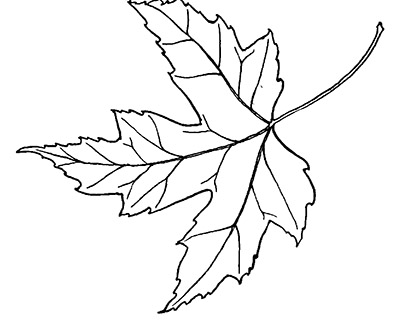
This week, we introduce the silver maple or Acer saccharinum.
Silver maple has simple, typically five-lobed leaves with deeply cut divisions, or sinuses, between the lobes, with narrow lobes at the base. The leaves, which are silvery on the underside, are held oppositely on long leaf stems coming off the twigs. The bark on young trees is smooth and light gray, and darker and scaly on older trees.
Silver maple, which is commonly found in swamps and overflow bottomlands, is one of Indiana’s soft maples alongside red maple. It flowers early and sheds its large winged seed in the spring, typically by late May.
Silver maples, which prefer moist or well-drained soil, grow 50 to 80 feet tall and are found growing from the Great Plains eastward, excluding the Gulf and Atlantic coastal region. Most silver maple lumber is produced in the Mississippi Delta and central states region.
The Morton Arboretum warns that without proper and frequent pruning, high winds and ice can cause limbs to break on silver maple trees due to its weak wood and branch structure. These species is also drought sensitive, so be careful to provide supplemental water during dry periods.
For full article with additional photos view: Intro to Trees of Indiana: Sugar Maple
If you have any questions regarding wildlife, trees, forest management, wood products, natural resource planning or other natural resource topics, feel free to contact us by using our Ask an Expert web page.
Other Resources:
Hardwoods of the Central Midwest: Silver Maple
Hardwood Lumber and Veneer Series, The Education Store: Soft Maple
Morton Arboretum: Silver Maple
Fifty Common Trees of Indiana
An Introduction to Trees of Indiana
Native Trees of the Midwest, The Education Store
Shrubs and Woody Vines of Indiana and the Midwest, The Education Store
Investing in Indiana Woodlands, The Education Store
Forest Improvement Handbook, The Education Store
ID That Tree, Purdue Extension-Forestry & Natural Resources (FNR) YouTube playlist
Woodland Management Moment , Purdue Extension-FNR YouTube playlist
Wendy Mayer, FNR Communications Coordinator
Purdue University Department of Forestry and Natural Resources
Lenny Farlee, Sustaining Hardwood Extension Specialist
Purdue University Department of Forestry and Natural Resources
The classic and trusted book “Fifty Common Trees of Indiana” by T.E. Shaw was published in 1956 as a user-friendly guide to local species. Nearly 70 years later, the publication has been updated through a joint effort by the Purdue Department of Forestry and Natural Resources, Indiana 4-H, and the Indiana Department of Natural Resources, and reintroduced as “An Introduction to Trees of Indiana.”
The full publication is available for download for $7 in the Purdue Extension Education Store. The field guide helps identify common Indiana woodlot trees.
Each week, the Intro to Trees of Indiana web series will offer a sneak peek at one species from the book, paired with an ID That Tree video from Purdue Extension forester Lenny Farlee to help visualize each species as it stands in the woods. Threats to species health as well as also insight into the wood provided by the species, will be provided through additional resources as well as the Hardwoods of the Central Midwest exhibit of the Purdue Arboretum, if available.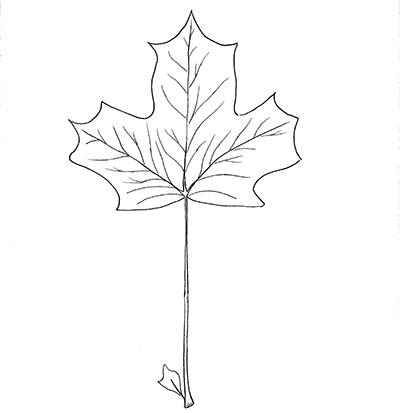
This week, we introduce the black maple or Acer nigrum.
Black maple is easily confused with its cousin, the sugar maple, but there are a few key identifying characteristics to tell them apart. Black maple commonly has stipules, or miniature leaves, at the base of the leaf stem. This species features mottled gray stems and black pointed buds oppositely arranged on the stems. The lobed leaves are darker green and tend to droop down at the edges as the summer goes on.
The bark is lighter gray and smooth in young trees and features flakes or plates in older trees.
The seed or fruit of black maple is a winged seed which occurs in pairs and turns from green to brown when mature, similar to sugar maple.
Black maples, frequently found on moist or bottomland sites, grow 60 to 75 feet tall and can be 40 to 50 feet wide, providing excellent shade with their full foliage.
The Morton Arboretum warns again pruning maps in the spring as they are ‘bleeders’ and will lose large amounts of sap. This species also is susceptible to leaf scorch, verticillium wilt, tar spot and anthracnose and can be affected by borers and cottony maple scale. Black maple suffers from salt, drought and air pollution.
“Don’t be confused by the similarities. Use the tiny stipule (leaf) at the base of the stem, the drooping edges of the dark leaf and its dark buds on gray mottled stems to tell this native apart from its cousin sugar maple. Can you ID this native tree? Meet black maple or Acer nigrum.”
For full article with additional photos view: Intro to Trees of Indiana: Sugar Maple
If you have any questions regarding wildlife, trees, forest management, wood products, natural resource planning or other natural resource topics, feel free to contact us by using our Ask an Expert web page.
Other Resources:
Morton Arboretum: Black Maple
Fifty Common Trees of Indiana
An Introduction to Trees of Indiana
Native Trees of the Midwest, The Education Store
Shrubs and Woody Vines of Indiana and the Midwest, The Education Store
Investing in Indiana Woodlands, The Education Store
Forest Improvement Handbook, The Education Store
ID That Tree, Purdue Extension-Forestry & Natural Resources (FNR) YouTube playlist
Woodland Management Moment , Purdue Extension-FNR YouTube playlist
Black Maple, Native Trees of Indiana River Walk, Fort Wayne, Purdue University
Wendy Mayer, FNR Communications Coordinator
Purdue University Department of Forestry and Natural Resources
Lenny Farlee, Sustaining Hardwood Extension Specialist
Purdue University Department of Forestry and Natural Resources

Recent Posts
- Celebrate Pollinator Week With Flowers of June Tour
Posted: June 15, 2026 in Forestry, Gardening, How To, Wildlife - Pruning Highlight-Pollarding Trees: A Traditional Pruning Practice with Modern Uses
Posted: June 11, 2026 in Forestry, Forests and Street Trees, Urban Forestry, Wildlife, Woodlands - Danielle Howard Hired as FNR Extension Prescribed Fire Specialist
Posted: June 10, 2026 in Forestry, Wildlife, Woodlands - Flat-Faced Longhorn Beetle Found in Hardwood Logs – IDNR Division of Entomology
Posted: June 8, 2026 in Alert, Forestry, Forests and Street Trees, Invasive Insects, Urban Forestry, Wildlife, Woodlands - Connecting Research to Practice: Natural Resources & Land Use Spring Training
Posted: June 5, 2026 in Forestry, Forests and Street Trees, How To, Invasive Animal Species, Invasive Plant Species, Land Use, Natural Resource Planning, Urban Forestry, Wildlife, Woodlands - Indiana Monarch and Pollinator Conservation
Posted: June 1, 2026 in Forestry, Forests and Street Trees, Gardening, How To, Natural Resource Planning, Plants, Urban Forestry, Wildlife - Box Tree Moth Range is Expanding
Posted: May 27, 2026 in Forestry, Invasive Animal Species, Invasive Insects, Wildlife - Spotted Lanternfly Feeds on Over 70 Plus Plant Species
Posted: May 20, 2026 in Alert, Forestry, Forests and Street Trees, Gardening, Invasive Insects, Urban Forestry, Wildlife - Painted Hickory Borer, Purdue Landscape Report
Posted: May 14, 2026 in Forestry, Invasive Insects, Wildlife - Saving Giants of the Blue River: Purdue Team Earns Statewide Recognition
Posted: in Aquaculture/Fish, Aquatic/Aquaculture Resources, Wildlife
Archives
Categories
- Alert
- Aquaculture/Fish
- Aquatic/Aquaculture Resources
- Ask the Expert
- Christmas Trees
- Community Development
- Disease
- Drought
- Forestry
- Forests and Street Trees
- Gardening
- Got Nature for Kids
- Great Lakes
- How To
- Invasive Animal Species
- Invasive Insects
- Invasive Plant Species
- Land Use
- Natural Resource Planning
- Nature of Teaching
- Plants
- Podcasts
- Ponds
- Publication
- Safety
- Spiders
- Timber Marketing
- Urban Forestry
- Webinar
- Wildlife
- Wood Products/Manufacturing
- Woodland Management Moment
- Woodlands