 Purdue University - Extension - Forestry and Natural Resources
Got Nature? Blog
Entomology Weekly Review: Purdue Forestry & Natural Resources (FNR) Extension would like to share a timely update from the Indiana Department of Natural Resources – Division of Entomology newsletter regarding a wood-boring insect that may be encountered in hardwood logs across the state. Will Drews, Entomology staff member located in south-central Indiana (Bloomington area), recently reported activity from one of the more common round-headed borer pests found in hardwood logs: the flat-faced longhorn beetle, Graphisurus fasciatus. Will shares in the Entomology Weekly Review how to identify the borer, their habitat and if we need to be concerned.
What to Look For
On the wing recently is one of the more common round-headed borer pests I find in hardwood logs, and that is the flat-faced longhorn beetle without a common name: Graphisurus fasciatus (Photos 2 – 5). This longhorn beetle (in the family Cerambycidae) is quite large as far as longhorn beetles go, reaching up to 0.6 inches in length, and features two long antennae (aka “horns”) characteristic of most of its family (Photo 3).
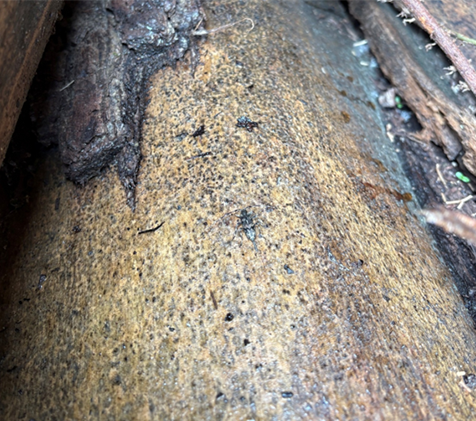
Photo 2 – Flat-faced longhorn beetle (Graphisurus fasciatus) adult found on a black walnut (Juglans nigra) log during a recent phytosanitary inspection.
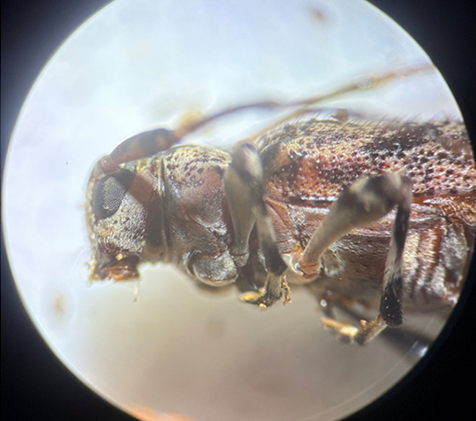
Photo 3 – Flat-faced longhorn beetle (Graphisurus fasciatus) adult female lateral view at 10X magnification. Note the long “horns” or antennae which are a little longer than the main body.
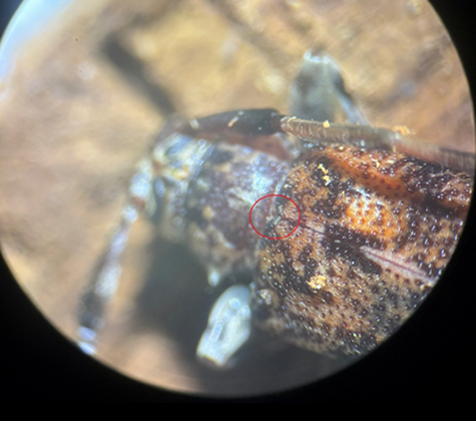
Photo 4 – Flat-faced longhorn beetle (Graphisurus fasciatus) adult female dorsal view at 10X magnification.
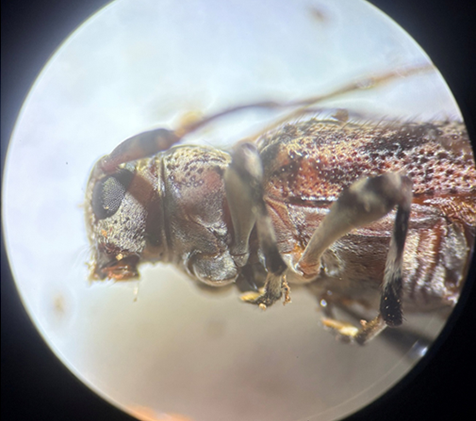
Photo 5 – Flat-faced longhorn beetle (Graphisurus fasciatus) adult female lateral view at 20x magnification. G. Fasciatus is parte of the flat-faced longhorn beetle subfamily (Lamiinae), which its membes are characterized by a long, usually flat face, shown here.
Host Trees and Habitat
As a larva, Graphisurus fasciatus feeds on a variety of hardwoods and is reported to feed on pine trees as well. I generally find G. fasciatus larvae feeding between
the bark and sapwood of black walnut (Juglans nigra), white oak (Quercus alba ) and red oak (Quercus rubra) logs (Photo 6).
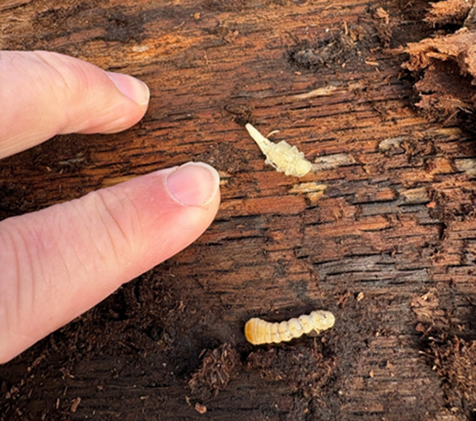
Photo 6 – Flat-faced longhorn beetle (Graphisurus fasciatus) larva (below) and pupa (above) with signs of larval mines on a red oak (Queracus rubra) log.
Identification Tips
There are several ways to differentiate this species from the less common but closely related Graphisurus despectus, but one of the surest ways is to examine the scutellum (aka the small shield-like plate at the top/between the elytra [wing covers]). In G. fasciatus, the scutellum has two small whitish patches of hair, not present on G. despectus (Photo 7). Another diagnostic characteristic of G. fasciatus is that it has elytra with emarginate (or notched) tips (Photo 8).
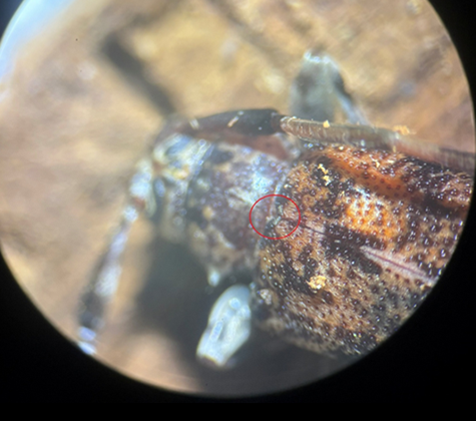
Photo 7 – Flat-faced longhorn beetle (Graphisurus fasciatus) adult female dorsal view at 20X magnification showing scutellum (cirecled in red). Note the two light/whitish patches of hair on the scutellum. This is one of the best ways to distinguish G. fasciatus from G. despectus.
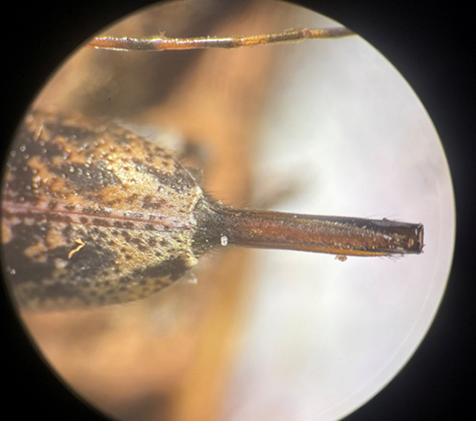
Photo 8 – Flat-faced longhorn beetle (Graphisurus fasciatus) adult female dorsal view at 20X magnification showing its elongated ovipositor. the ovipositor of G. fasciatus is quite unusual and proturberant for a longhorn beetle species and makes the females closer to 0/75 inches in length counting it. Also present in this image is the emarginate (or notched) tips of the elytra. This is another distinguishing characteristic of G. fasciaturs.
Should You Be Concerned?
This species can be alarming by its noticeable size and relative abundance but is not necessarily a major pest of concern as it does not usually bore into the sapwood and cause defects to the wood.
Stay Informed
FNR Extension encourages landowners and natural resource professionals to remain observant when working with hardwood logs and report unusual insect activity when found.
To stay up to date on forest health and insect alerts, consider subscribing to the Indiana Department of Natural Resources – Entomology Weekly Review for regular updates on insects affecting Indiana’s forests and natural areas.
Will Drews, Nursery Inspector & Compliance Officer
Indiana Department of Natural Resources
Division of Entomology & Plant Pathology
Resources:
Spotted Lanternfly, Indiana Department of Natural Resources Entomology
Box Tree Moth Range is Expanding, Purdue Landscape Report
Beetle that attacks Tree-of-Heaven found in Indiana, Purdue Landscape Report, Got Nature? Blog, Purdue Extension – FNR
Sawflies: Caterpillar Pests but not Caterpillars – PLR, Got Nature? Blog, Purdue Extension – FNR
Prepared for Insects Waking Up? – PLR, Got Nature? Blog, Purdue Extension – FNR
Case Study: Maple Tree Pests – PLR, Got Nature? Blog, Purdue Extension – FNR
Invasive Species, Purdue Extension – FNR YouTube Playlist (Asian Bush Honeysuckle, Burning Bush, Callery Pear, Multiflora rose)
What are invasive species and why should I care?, Got Nature? Blog, Purdue Extension – FNR
Finding help from a professional forester, Indiana Forestry & Woodland Owners Association
Find an Arborist video, Trees are Good, International Society of Arboriculture (ISA)

Recent Posts
- Disease May Cause Wilting and Eventual Death of Certain Trees and Shrubs, Purdue Landscape Report
Posted: October 5, 2026 in Disease, Forestry, Plants - October Is Firewood Month: Protect Indiana’s Forests by Making Smart Choices
Posted: October 1, 2026 in Forestry, Forests and Street Trees, How To, Invasive Insects, Urban Forestry - Minecraft Meets the Hellbender
Posted: September 22, 2026 in Aquaculture/Fish, Aquatic/Aquaculture Resources, Wildlife - Is It Too Early to Think About Christmas Tree Pests?
Posted: in Christmas Trees, Invasive Insects, Safety - What You Plant Matters to Wildlife
Posted: September 16, 2026 in Plants, Urban Forestry, Wildlife - Woodland Flowers of Late Summer
Posted: September 14, 2026 in Forestry, Gardening, Wildlife, Woodlands - Heavy August Rains Bring More Mosquitoes to Indiana
Posted: September 9, 2026 in How To, Invasive Insects, Safety, Wildlife - Question: Why Did the Shagbark Hickories Survive the Tornado?
Posted: August 27, 2026 in Forests and Street Trees, How To, Urban Forestry - New Indiana Woodland Steward Newsletter
Posted: August 12, 2026 in Forestry, Urban Forestry, Wildlife, Woodlands - Indiana Fall Hunting Licenses on Sale and New Mobile App Available
Posted: in Forestry, How To, Wildlife
Archives
Categories
- Alert
- Aquaculture/Fish
- Aquatic/Aquaculture Resources
- Ask the Expert
- Christmas Trees
- Community Development
- Disease
- Drought
- Forestry
- Forests and Street Trees
- Gardening
- Got Nature for Kids
- Great Lakes
- How To
- Invasive Animal Species
- Invasive Insects
- Invasive Plant Species
- Land Use
- Natural Resource Planning
- Nature of Teaching
- Plants
- Podcasts
- Ponds
- Publication
- Safety
- Spiders
- Timber Marketing
- Urban Forestry
- Webinar
- Wildlife
- Wood Products/Manufacturing
- Woodland Management Moment
- Woodlands