 Purdue University - Extension - Forestry and Natural Resources
Got Nature? Blog
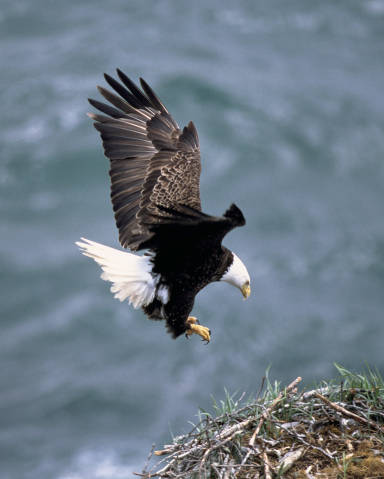
Photo Credit: Dave Menke/USFWS
While most of us think of spring as the bird breeding season, several species get a jump start during the winter. Bald Eagles are one of those species. Winter is a time when Bald Eagles build nests in large trees or snags near sources of food – rivers, streams and lakes. The nests they construct are very large (4-6 feet in diameter) and can weigh more than 1,000 pounds. They also construct alternate nests within their territory and will usually return to the same nesting territory year after year.
Bald Eagles were once listed under the Endangered Species Act. However, their populations recovered to a level where they were delisted. Even so, Bald Eagles are still offered some level of protection under the Bald and Golden Eagle Protection Act and Migratory Bird Treaty Act. Almost all birds in Indiana and the U.S. are protected under the MBTA. In fact, under the MBTA, it is unlawful to “take, possess, transport, sell, purchase, barter or offer for sale any migratory bird or the parts, nests or eggs of such bird.” The MBTA also protects nests from destruction while they have eggs or dependent young (i.e., prior to fledging).
For Bald Eagles, I think most people know you can’t directly harm them. But I do receive questions about what activities can be done around Bald Eagles and especially their nests – Bald Eagles are quick to abandon a nest in the presence of disturbance. The MBTA provides protection from harming an eagle or a nest with eggs or young. The Bald and Golden Eagle Protection Act provides additional protection during the breeding season as well as the nest.
According to the Bald and Golden Eagle Protection Act, it is unlawful to disturb eagles during the breeding season. In this case,
“Disturb means to agitate or bother a bald or golden eagle to a degree that causes, or is likely to cause, based on the best scientific information available 1) injury to an eagle, 2) a decrease in its productivity by substantially interfering with normal breeding, feeding or sheltering behavior or 3) nest abandonment by substantially interfering with normal breeding, feeding or sheltering behavior.”
To minimize the risk of disturbing eagles, the guidelines suggest a buffer between a nest and the activity, but it depends on the category activity, according to the guidelines. For example, Timber Operations and Forestry Practices list a distance of 330 feet from the nest at any time. They suggest avoiding harvesting operations within 660 feet of the nest during the breeding season.
The management guidelines are downloadable from the link provided below in the Resources. If you have questions about Bald Eagles and their protection, contact the U.S. Fish and Wildlife Service at their Bloomington Field Office.
Resources:
National Bald Eagle Management Guidelines (2007), U.S. Fish and Wildlife Service/South Dakota
Indiana Eagle Watch Events, Indiana Department of Natural Resources (INDNR)
Have You Seen a Soaring Eagle Lately, Morning AgClips, Purdue Extension – Forestry & Natural Resources (FNR) Got Nature? Blog
Indiana Department of Natural Resources Shares Bald Eagle Successfully Recovered, MyDNR, Indiana’s Outdoor News
Bald Eagle, Indiana Department of Natural Resources (IN DNR)
Forestry for the Birds Virtual Tour, Purdue Extension – Pond and Wildlife
Breeding Birds and Forest Management: the Hardwood Ecosystem Experiment and the Central Hardwoods Region, The Education Store, Purdue Extension resource center
Forest Birds, The Education Store
Managing Woodlands for Birds, The Education Store
Managing Woodlands for Birds Video, Purdue Extension – FNR YouTube Channel
Breeding Birds and Forest Management: the Hardwood Ecosystem Experiment and the Central Hardwoods Region, The Education Store
The Birders’ Dozen, Profile: Baltimore Oriole, Indiana Woodland Steward
Ask An Expert: Birdwatching, Playlist, Purdue Extension – FNR YouTube channel
Birds and Residential Window Strikes: Tips for Prevention, The Education Store
No Room at the Inn: Suburban Backyards and Migratory Birds, The Education Store
Dr. Brian MacGowan, Extension Wildlife Specialist
Department of Forestry & Natural Resources, Purdue University
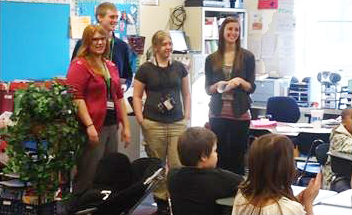 FNR is pleased to announce a new program that will provide undergraduate extension internship opportunities for qualified students this summer. This is an exciting program with the potential to build on an already strong set of FNR extension programs while providing valuable experience and training for undergraduates.
Purdue University’s Department of Forestry and Natural Resources seeks candidates for extension internship positions. The department extension program has a broad environmental scope including fisheries, forest management, invasive species, urban forestry, sustainability, wildlife and wood products. Student interns can enhance their career potential through practical, hands-on experience. Our extension internship program can help you:
- Develop leadership and decision-making skills in handling creative challenges
- Gain experience developing extension products including publications, online videos, presentations and/or more
- Participate in professional development opportunities
- Build professional references and contacts
- Clarify career goals
- Learn from a diverse and experienced group of natural resources professionals
Internships are open to non-Purdue students. Requirements for the position(s) include status as a junior or senior level college student in natural resources or related discipline, minimum 3.0 GPA, evidence of initiative, independence and commitment to conservation of natural resources. Internships are available for summer term (up to 40 hours/wk., up to 8 weeks) with pay at a rate of $12 per hour. Internship start dates and work hours are flexible depending on the applicant’s availability.
Resources
FNR Extension Internship Information, Purdue Forestry and Natural Resources (FNR)
Brian MacGowan, Extension Wildlife Specialist
Department of Forestry and Natural Resources, Purdue University
 Trees in Rice Cemetery in Elkhart, IN, were cut down due to verticillium wilt, a disease causing discoloration and wilt of branches. The fungus causing this disease spreads through roots. Many trees in the cemetery have been marked with a red dot and will be removed. If all goes well, new younger trees will take their place in the fall. If you have witnessed verticillium wilt, please notify the Indiana Department of Natural Resources.
Resources
Rice Cemetery Trees Cut Down Due to Verticillium Wilt as Elkhart Forestry Workers Fight to Save Those Left, The Elkhart Truth
Verticillium Wilt of Shade Trees, The Education Store, Purdue Extension’s resource center
Diseases in Hardwood Tree Plantings, The Education Store
Forest Health Informer, Indiana Department of Natural Resources
How to Check for Verticillium Wilt, July “In The Grow” (Q&A), Indiana Yard and Garden – Purdue Consumer Horticulture
What are Invasive Species and Why Should I Care?, (What to do if you see any disease) Purdue Extension-Forestry & Natural Resources Got Nature? Blog
Diana Evans, Extension and Web Communication Specialist
Purdue University Department of Forestry and Natural Resources
 Effects of Root Competition on Development of Chestnut and Oak Regeneration Following Midstory Removal was featured in the Oxford Journals, Forestry: An International Journal of Forest Research. The Department of Forestry and Natural Resources has continued to work for the regeneration of the American chestnut and red oak.
Abstract: “Partial canopy cover promotes regeneration of many ecologically and/or economically favored tree species in temperate mesic forests. However, the specific effects of belowground resource competition from different canopy strata in these systems are poorly understood. This is particularly…” Read more.
Resources
Indiana American Chestnut Foundation
The American Chestnut Foundation
Natural Oak Regeneration Following Clearcutting on the Hoosier National Forest, The Education Store
Hardwood Tree Improvement and Regeneration Center
Caleb E. Brown, M.S. graduate student
Brian G. Bailey, graduate student
Michael R. Saunders, Associate Professor of Ecology and Natural Resources
Douglass F. Jacobs, Fred M. van Eck Professor of Forest Biology
Department of Forestry and Natural Resources
 Soundscape ecology is a new field of research that investigates how sound in the environment can be used to assess ecosystem health as well as human connection to nature and the environment in general. With this app, you can help capture and preserve sounds of the Earth and highlight their bellwether role in alerting scientists to environmental habitat changes by species. This app was originally launched to encourage the general public’s citizen researchers to capture natural sound recordings and upload them for preservation during Earth Day 2014. However, we are continuing to preserve sounds that you capture using this app.
Resources
Center for Global Soundscapes
Conserving Biodiversity in Agricultural Landscapes, Purdue University Press
Managing Forest & Wildlife Resources: An Integrated Approach, The Education Store
Bryan Pijanowski, Professor of Human-Environment Modeling and Analysis Laboratory
Department of Forestry and Natural Resources
 Randy Creaser, a graduate student working with Liz Flaherty, Assistant Professor of Wildlife Ecology and Habitat Management, is collaborating with Polar Bears International (PBI). This research consists of developing noninvasive methods to monitor the Western Hudson Bay polar bear population using photography. These methods will allow scientists to document trends in the population along with providing estimates of body condition. The ultimate goal of this project is to further develop a citizen science project that will allow the public to submit and measure their bear and wildlife photos using our methods. Watch the video to learn more about the program. You can learn what other graduate students are doing by visiting their profile pages or attending their events on campus.
Resources
Polar Bears International
Graduate Studies, Purdue FNR
Graduate Spotlight, Purdue Agriculture
Got Nature?
Department of Forestry and Natural Resources
Purdue University
 Communities in developing countries have limited budgets for education. Even though they may provide a school building, they often don’t have money to buy furniture to equip it. However, low-cost, durable, attractive school chairs can be produced in essentially any region of the world from locally available wood, wood residues or semi-processed woody materials. These chairs could fill a need for economical, functional school furniture in developing countries. This six-page publication describes the process for producing these kinds of chairs.
How to Build a Simple Chair for Schools or Homes in Disadvantaged Areas of the World Using Local Resources and Low-End Technology is available in The Education Store today!
Resources
Joint Design Manual for Furniture Frames Constructed of Plywood and Oriented Strand Board, The Education Store
The Shrinking and Swelling of Wood and Its Effect on Furniture, The Education Store
Performance Test Method for Intensive Use Chairs – FNEW 83-269: A Description of the Test Method with Drawings, The Education Store
How Baby Bear’s Chair Was Made, The Education Store
Eva Haviarova, Associate Professor of Wood Products
Carl A. Eckelman, Professor of Wood Products
Department of Forestry and Natural Resources, Purdue University
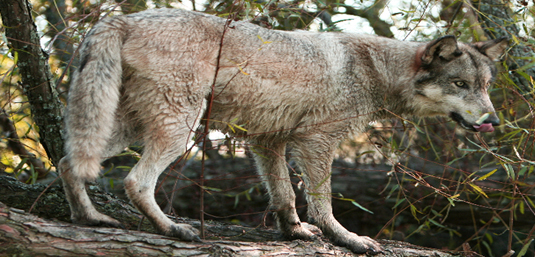 An Obama administration decision sought to remove gray wolves in the Great Lakes region from the endangered species list. However, a federal judge gave a 111-page opinion and ruled to keep the wolves on the list, resulting in a ban to trap and hunt wolves in the surrounding states. Michigan, Minnesota and Wisconsin were mainly affected by the ruling because they have allowed hunting and trapping of the wolves for one season already. There have been arguments on both side of the fence for these wolves. The Elkhart Truth reports, “Animal protection advocates repeatedly have sued over federal efforts to drop federal protections in both regions, arguing that the wolf’s situation remains precarious. Meanwhile, ranchers and farmers complain of heavy financial losses from wolf attacks on livestock.” As of today, it is only legal to shoot wolves if they are threatening human life. It is illegal to kill the wolves even if they are preying on livestock or pets.
Resources
Some Gray Wolves to be Returned to Endangered List, AP News
Gray Wolves in the Northern Rocky Mountains, U.S. Fish and Wildlife Service
Hunting and Trapping Guide, Indiana Department of Natural Resources
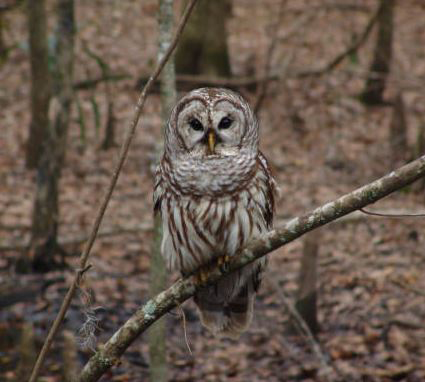
Photo Credit: U.S. Fish and Wildlife Service.
It’s me, the crazy wildlife student again. This time, I’m running around in the dark playing owl calls in the middle of the woods.
What was I doing? Owl surveys, and I was helping provide data for the Hardwood Ecosystem Experiment (or HEE). Basically what we’re trying to figure out is if barred owls and eastern screech owls prefer managed or unmanaged forests. Do they like pristine, untouched areas? Or do they desire a changing atmosphere where timber harvests are opening up new areas and there’s more variation in the age of trees? The data may tell. However, the process to get it is interesting. We drive between different checkpoints with about 90 for barred owls and 100 for eastern screech owls. At each of these, we blare owl noises out of a truck and wait for anything to respond.
How is this fun? Well first, I got to travel with Jeff Riegel, Field Supervisor of the HEE. He helped me understand what we were doing and told me all about the HEE as we bumped along logging roads just wide enough for his truck. “Be prepared for anything,” he told me as he took out a blowtorch to unfreeze lock after lock. He also had a chainsaw in case of fallen trees among various other tools I’m sure have been put to good use.
It was pretty cold outside, just hovering under 20 degrees Fahrenheit, and it was dropping as snow began to quilt the forest. It was also very quiet. One of the only disturbances was when we spooked an eastern screech owl; it flew away in its unique way, wings flapping rapidly but its body perfectly still in flight. As we repeated the process of the survey again and again (pop in the CD, roll down the windows, open both back doors and stand in front of the truck with the lights off), I scanned the trees for the silhouettes of owls as snow filtered down through the scarce frozen leaves. Jeff talked about how some owls would perch at the same branch every year and respond to the calls. He also talked about the volunteers that kept up the data flow, how some did it to enjoy the quiet night atmosphere, while others did it just to get the chance to hear the eerie but beautiful sounds of the owls. Even better was the chance to see dark wings among the trees.
The surveys are conducted in the winter to avoid messing with the owls’ nesting season. An owl’s eggs can freeze quickly if left unattended, and the birds will come to investigate the calls to make sure their territory is not being encroached upon, leaving the eggs. The timing has to be careful.
They’re mysterious creatures, but their calls remind us that the forest is alive in the darkness.
Learn more about the Hardwood Ecosystem Experiment.
Morgan Sussman, Freshman
Department of Forestry and Natural Resources, Purdue Univeristy
 Ever wondered why people go into wildlife? I mean, we’re expected to have low salaries. Why are we spending so much money to get a degree where we’ll go out to observe animals for a living or manage them? Can’t we do that as an everyday person with pets?
I can’t answer this question for everyone, but I’ll give it a shot. We are fascinated by the world around us. We love it and want to understand it, along with our role in it. It’s that simple.
There’s so much to be learned as a student in wildlife, even though we’ve been living alongside the concepts we’re learning about all our lives. Every time I walk into my Introduction to Environmental Conservation class, I walk out and gain an entirely new viewpoint. Recycling has taken on a whole new meaning when put into the dimensions of its actual effects. All my bathroom products give me a deep sense of suspicion because there are simply so many different chemicals and plastics being used with them. I have developed a rational hatred for ginkgo trees while on Purdue’s campus; not only do they stink, they’re also not even native. I worry about the squirrel population because that many squirrels in 10 yards of grass cannot be healthy. I’m all for wooden buildings, so long as it’s sustainable, thanks to carbon sequestration. Did you know wood is made up of 50 percent carbon? So when it’s built into buildings, it’s not actually harming the environment because it’s still holding in all that carbon dioxide that would have gone into the atmosphere had the tree been burned or decomposed. All this to say, I just pay a lot more attention to the environment around me.
Those are just some of the concepts we’ve learned so far, and it’s a blast. On top of this, I feel like we’re actually doing something good for humanity. Not many people want to do the dirty work or have months of research credited with one line in a scientific paper. However, we get to better see how it’s all interconnected. The world is more entwined than anyone knows. If everyone took just one day to be a wildlife student, it would be an incredible transformation in the world, even if each person only took one aspect away from the lesson learned.
Resources
FNR Majors and Minors, Purdue FNR
Prospective Students, Purdue FNR
We Know Nature! FNR This is Your Class Project Video
Morgan Sussman, Freshman
Department of Forestry and Natural Resources, Purdue University

Recent Posts
- 2026 Winter Bat Survey In Progress, MyDNR
Posted: March 27, 2026 in Wildlife - Fast-Growing Trees for the Landscape, Purdue Landscape Report
Posted: March 26, 2026 in Forestry, Urban Forestry, Woodlands - Urban Tree Spotlight: Planting Deciduous Shade Trees, Purdue Landscape Report
Posted: March 25, 2026 in Forests and Street Trees, Urban Forestry, Woodlands - Beetle that attacks Tree-of-Heaven found in Indiana, Purdue Landscape Report
Posted: March 20, 2026 in Invasive Insects, Wildlife, Woodlands - ID That Tree: Dwarf Chinkapin Oak
Posted: in Forestry, Urban Forestry, Wildlife, Woodlands - IN-PREPared: Essential Resources for Indiana’s Severe Weather Season
Posted: March 11, 2026 in How To, Safety - DNR Hiring for Indiana Conservation Officer Positions, MyDNR
Posted: March 9, 2026 in Urban Forestry, Wildlife, Woodlands - ID That Tree: Shumard Oak
Posted: in Plants, Urban Forestry, Wildlife, Woodlands - A Woodland Management Moment: Windbreak Around Walnut Plantings
Posted: March 3, 2026 in Forestry, Urban Forestry, Woodland Management Moment - Getting Certified as an Indiana Certified Prescribed Burn Manager
Posted: March 2, 2026 in How To, Urban Forestry, Woodlands
Archives
Categories
- Alert
- Aquaculture/Fish
- Aquatic/Aquaculture Resources
- Ask the Expert
- Christmas Trees
- Community Development
- Disease
- Drought
- Forestry
- Forests and Street Trees
- Gardening
- Got Nature for Kids
- Great Lakes
- How To
- Invasive Animal Species
- Invasive Insects
- Invasive Plant Species
- Land Use
- Natural Resource Planning
- Nature of Teaching
- Plants
- Podcasts
- Ponds
- Publication
- Safety
- Spiders
- Timber Marketing
- Uncategorized
- Urban Forestry
- Webinar
- Wildlife
- Wood Products/Manufacturing
- Woodland Management Moment
- Woodlands