Purdue Landscape Report: Besides nursery inspections, our division assists with phytosanitary inspections in partnership with the USDA’s APHIS Plant Protection and Quarantine staff. In my area, I assist mainly with log inspections and ensure the commodities are relatively pest-free before leaving the country or, if not, that they will be treated beforehand.
Figure 1: Painted hickory borer (Megacyllene caryae) emerging from a hickory (Carya spp.) log.
Figure 2: Painted hickory borer (Megacyllene caryae) on a hickory (Carya spp.) log with finger for size reference. Note the distinct “w” marking on elytra.
Recently I found an interesting pest on a hickory (Carya spp.) log. I occasionally find round-headed borers infesting logs, which are fairly common pests that often mine in or between the bark and sapwood of logs. Round-headed borers are the larval form of longhorned beetles (a.k.a. cerambycids [or beetles in the Cerambycidae family]). I normally just find the larvae during inspections, not the future life cycle stages like pupae or adults. However, I recently was able to spot painted hickory borer (Megacyllene caryae) adults emerging from a hickory log I inspected.
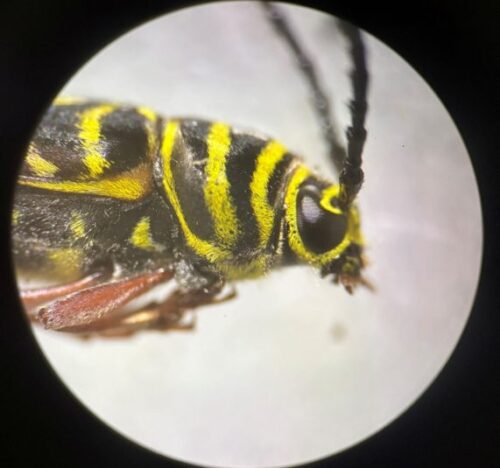
Painted hickory borers are colorful distinct longhorn beetles in the Cerambycidae family that can be distinguished by their yellow bands on an otherwise black body, including a “w” shaped band on the elytra (or wing coverings). They are important decomposers which help break down fallen logs for hickory trees as well as other hardwood species. However, because they bore into logs and firewood, they are considered pests for those commodities and are a species we look for when we perform inspections.
Painted hickory borers can be confused with their very similar relative, the locust borer (Megacyllene robiniae), but there are some easy ways to distinguish these longhorned beetle species. First, the host is important to note since locust borers only infest black locust (Robinia pseudoacacia) trees. Also, painted hickory borer adults are active in spring, while locust borer adults are active in late summer/fall.
Figure 3: Painted hickory borer (Megacyllene caryae) lateral view under 20x magnification. Note the dense hairs, which also are what give the beetle its distinct coloration.
Painted hickory borers do not often warrant management as they generally feed only on dead and decaying wood and do not affect living trees. Larvae generally feed on the inner bark of dead logs initially but can bore into the sapwood and heartwood as they develop. The biggest impact this has is on the lumber production since scarring to the wood can occur. Very few management activities will be successful once the borers are inside the logs, except for fumigation activities from a state-approved facility. The best method of control is preventative such as not leaving logs lying around for long periods of time before processing or treating susceptible logs with an insecticide like bifenthrin to create an insecticidal barrier and prevent infestation. Otherwise, painted hickory borers are harmless, colorful longhorned beetles to be admired as they emerge in spring.
This article appeared in the Indiana Department of Natural Resources-Department of Entomology’s Weekly Review. You can find past reports and subscribe to their newsletter by visiting IN DNR – Entomology Weekly Review.
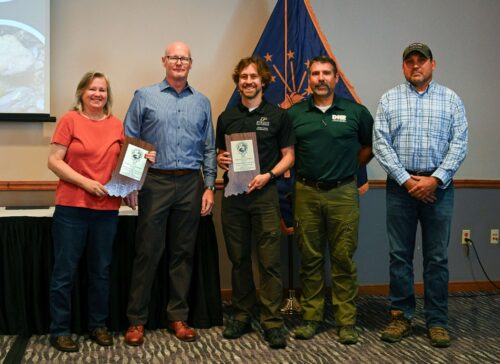
Pictured left to right: Leslie Grow, assistant manager O’Bannon Woods SP, Brandt Baughman, State Parks Director, Nick Burgmeier, Purdue Research Biologist and Wildlife Extension Specialist, Jarrett Manek, Interpretive Naturalist O’Bannon Woods SP, Stanley Baelz, property manager O’Bannon Woods SP.
Indiana State Parks Facebook, Indiana Department of Natural Resources: The Purdue Hellbender Research Team and O’Bannon Woods State Park were recognized for their excellence in resource management at this year’s State Parks division meeting.
Since 2007, the Purdue University Hellbender Research Team has been an invaluable partner at O’Bannon Woods State Park, spearheading the successful recovery of the endangered Eastern hellbender in the Blue River. Their work reintroduced more than 800 individuals with a 75% survival rate, and provided critical educational support through programs and the 5k Hellbender Hustle. Their statewide work has expanded and includes habitat protection efforts, and they provide unique public opportunities at the O’Bannon Woods Nature Center for visitors to enjoy and learn while visiting the Park.
The Natural Resources Conservation Service (NRCS) highlights a powerful example of how conservation practices on working lands can support both farm productivity and wildlife habitat in their recent story, Restoring Roots to Save the Salamanders.
Image from U.S. Department of Agriculture – Natural Resources Conservation Service
On a stretch of farmland in southern Indiana, deep ruts once cut through fields so severely that, as landowner Ben Shireman recalls, “we had ditches in the field that you could park pickup trucks in.” Years of continuous row cropping by a previous owner had taken a toll on the land, leaving behind eroded hillsides, depleted soils and a system that was no longer sustainable both economically and environmentally. What followed for the Shireman family was not a quick fix. It was a transformation rooted in conservation, partnership and a willingness to rethink how their land could work for them and the environment around them.
Today, that same farm is a small but vital part of a growing effort to improve water quality and restore habitat for one of Indiana’s most unique aquatic species called the Eastern Hellbender.
Read how one southern Indiana farm transformed degraded soils and severe erosion into a more resilient system through conservation practices and partnerships here: Restoring Roots to Save the Salamanders.
At the center of this effort is the Farmers Helping Hellbenders initiative, a Regional Conservation Partnership Program (RCPP) focused on improving water quality in the Blue River watershed while supporting habitat for the Eastern Hellbender, one of Indiana’s most unique aquatic species. By implementing practices like rotational grazing, cover crops and nutrient management, farmers can improve soil health and contribute to cleaner waterways that benefit both agriculture and wildlife.
This story highlights how targeted conservation programs and local collaboration can create lasting impacts, helping farms remain productive while protecting natural resources for future generations. It also emphasizes the importance of outreach, technical assistance and farmer-led innovation in building more sustainable systems across Indiana landscapes.
With storm season just around the corner, one topic of concern on many minds is damage to and from trees. Depending on the intensity of the storms and the condition of the trees, damage from high winds, heavy rainfall, and lightning can be quite severe. Cracked or broken branches, stem failure, and root failure are some of the main concerns, but also the risk and liability of damage to people and property.
If your tree is damaged, there are some steps to deal with the situation. First and foremost, consider the safety of yourself and others around you. Inspect the tree from a distance first looking for the following:
Heaving of the ground indicating potential root failure
Damage to limbs and/or the trunk of the tree
Hanging branches can fall to the ground resulting in injury or death
Be aware of utility and power lines. Trees can become charged by coming in contact with live wires. All utility lines should be considered energized and dangerous.
If you find your trees damaged from a storm hiring an International Society of Arboriculture (ISA) Certified Arborist to perform a risk assessment will help guide your decision of how to manage your tree. To find an arborist near you and verify credentials use the link at Find an Arborist, Trees are Good, International Society of Arboriculture (ISA). For more information, you can also view Trees and Storms: Understanding Damage, Risk and Recovery, an informational Got Nature? Blog article from Purdue Extension.
Purdue Landscape Report: Many of the leaf spot diseases we observe can cause premature leaf drop in affected plants, which can reduce plant vigor if the disease is severe enough and a large proportion of the canopy falls in one season. Elm trees are susceptible to a number of different anthracnose fungi, including Ophiognomoniaintermedia, Gloeosporium betulae, Cryptocline betularum, and Cylindrosporium sp. Cryptocline is the fungus that we encounter the most frequently on samples submitted to the lab for diagnosis.
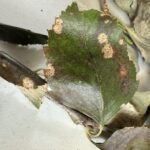
Figure 1: Cryptocline leaf spot on Elm (photo by Paul Bachi, University of Kentucky Research and Education Center)
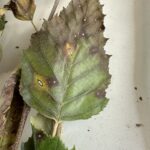
Figure 2: Cryptocline leaf spot on a young elm shrub. As the density of leaf spots increases, the leaf blade turns more yellow. (Photo from Purdue Landscape Report)
Figure 3: Mature Cryptocline lesions which are tan in color and have black fungal structures within (photo from Purdue Plant & Pest Diagnostic Laboratory)
Symptoms
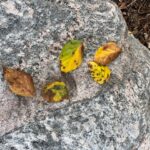
Leaf spots may start as small, round chlorotic lesions that slowly expand over time (Figures 1 & 2). Eventually, a necrotic spot with a purple/black border and tan or white center will form (Figure 3). Lesions may begin to develop on a leaf vein and instead of being circular will follow the vein a little, creating a thin necrotic lesion (Figure 4). With increased leaf spot development, large areas of the leaf blade will turn yellow and eventually necrotic, before it falls from the tree (Figure 5). Leaf drop will typically occur in the lower canopy, areas where there is less air movement and higher humidity; however, epidemics occur during periods of we weather that can cause significant leaf drop. Leaf loss typically occurs in the summer (late July to mid-August).
Figure 4: Lesions of Cryptocline located on leaf veins, creating elongate necrotic lesions instead of the typical round lesions located elsewhere on the leaf. (Photo from Purdue Plant & Pest Diagnostic Laboratory)
Figure 5: Elm leaves which have turned yellow or necrotic and fallen prematurely from the tree. (Photo from Plant & Pest Diagnostic Laboratory)
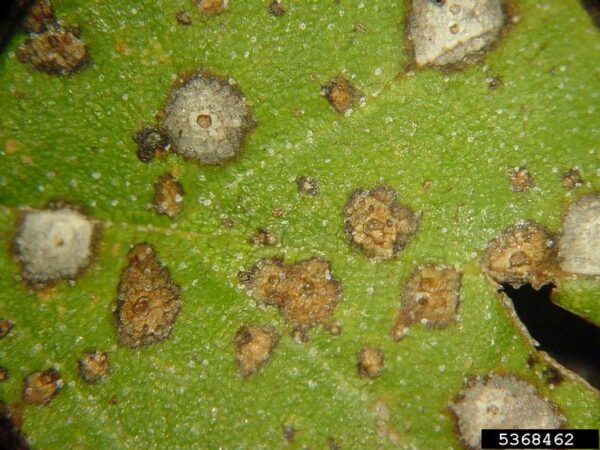
Figure 6: Close up image of Cryptocline leaf spots with acervuli. (Photo by Paul Bachi, University of Kentucky Research and Education Center)
Life Cycle Cryptocline is only known to colonize the leaves, so it overwinters in fallen leaf tissue. In the spring, the fungus will produce ascospores which are carried in the wind to infect young elm leaves. Once initial lesions progress, black fungal structures (acervuli) will form in the necrotic tissue and being producing asexual spores (conidia) in a sticky substance, which can be spread via rain (Figure 6). The conidia act as a secondary infection cycle where it will infect foliage and create new leaf spots continuously throughout the growing season as long as the environmental conditions are conducive.
Management
Like other leaf spot pathogens that do not infect stems, removal of the foliage in the fall can reduce inoculum for the following year (though won’t eliminate the disease). Providing fertilizer (where needed) and water (hot and dry periods) will help mitigate some tree stress, as stress can predispose plants to increased disease severity. Fungicides are not normally recommended for mature trees as it is impractical to get coverage across the entire canopy, but could be practical in a nursery setting if symptoms are observed and leading to leaf drop. It is still early in the season, but the next few weeks are important to monitor for some disease issues that may explode later in the season.
For other information on management of foliar disease problems, please see the following link: Foliar Fungal Disease Management.
Damage to the cambium layer can cause serious health issues for the tree.
One of the most dangerous pests of trees is humans, especially humans with equipment. Lawn mowers and weed trimmers can cause injuries that create a hazard when an injury leads to tree disease or death. This publication explains why the damage is so dangerous and suggests ways to protect your trees.
Defended by Bark
The site of injury is usually the root flare: the area where the tree meets the turf and gets in the path of the mower or trimmer. The root flare, like the rest of the trunk, is protected by bark, which guards a very important plant transport system just behind the woody bark layer. Specialized tubes move nutrients and water between the roots and leaves to keep the tree alive. Any damage to this transport system can affect tree health and the tree could die.
Old damage from mowing can create a serious risk in the landscape
The bark layer can vary in thickness on different tree species. It can be more than an inch in thickness or less than 1/16 of an inch on young, smooth-barked trees such as maples and birches. This isn’t much protection against string trimmers and mowing equipment, especially on young, newly planted trees.
Damage Done
Any damage to or removal of the bark and the transport system can cause problems for a tree. Even when a tree tries to recover from a wound, leaves and branches often decline and die back, because food and water pathways were destroyed. Although a large wound is generally more serious than a smaller one, repetitive wounding adds up to greater trouble for the tree. If the damage extends completely around the base of the tree (a situation called girdling), the tree ultimately dies.
Recent damage from mowing equipment leads to decay and dieback in the tree
All tree wounds are serious when it comes to tree health. No matter what size the wound is, the damage done is irreversible. The tree must devote a great deal of energy and many resources into trying to seal off the damaged area to prevent further complications. The wounded area is an opening for wood-rotting organisms and decay fungi to enter and cause further damage. These microorganisms often attack the injured bark and invade adjacent healthy tissue, greatly enlarging the wound and extending the damage. Trees can be completely girdled from pathogen attack following injuries.
Fungi that are active on the wound surface can also deteriorate the structure of the woody tissues beneath, decaying and weakening the tree. This weakened, structurally unsound tree may eventually die and become a hazard to people around it.
Preventing Problems
Newly planted, young trees need our help to become established in the landscape. They are the trees most commonly and seriously affected by maintenance equipment.
Mulch rings can provide a healthier environment as well as a visual cue to keep equipment away.
However, injury to these trees can be avoided easily and at very low cost if you follow one or more of these suggestions.
Physically remove turf or prevent grass and weeds from growing at the base of the tree. This lowtech solution can eliminate a potentially serious problem.
Spray herbicides to eliminate vegetation around the base of the tree to decrease mowing maintenance costs. Be sure to use care when applying herbicides around trees. Carefully follow label directions.
Add a mulch ring, when possible, to help reduce the competition for water and nutrients. Mulch or other ground coverings reduce mowing requirements in the landscape.
Add a 2˝ to 3˝ layer of mulch on the root zone of the tree to provide an attractive and healthy environment for the tree to grow. This also provides a visual cue to keep equipment away from the tree.
Add trunk guards or similar devices to give the tree additional protection. White, expanding tree guards can help help trees withstand equipment contact and also can help to reduce winter injury.
Trees are a valuable asset to your property and are important to our environment. Every tree contributes to the urban forest and improves air and water quality in your neighborhood. Protect and preserve these growing assets by keeping mowing and weed-trimming equipment away from tree trunks. The damage lasts and it cannot be undone. Don’t create a hazard!
Join Purdue Extension forester Lenny Farlee in this episode of “A Woodland Management Moment” as he explores the considerations for growing high timber-quality black walnut on purpose. Learn about what black walnut requires to grow well, its visual characteristics and the timeline of this plant in openings. Watch the video to discover some of the management strategies you can use gradually develop these black walnut stems for timber markets.
If you have any questions regarding trees, forests, wildlife, wood products, or other natural resource topics, feel free to contact us by using our Ask an Expert web page.
Rooted in Research, USDA Forest Service: Non-native species are increasingly shaping forests across the eastern United States. While many introduced species coexist without major disruption, some become invasive: damaging ecosystems, reducing biodiversity and impacting the economic value forests provide. Over the past decade, the extent of forest land affected by invasive species has continued to grow, making management more complex and costly.
Hemlock woolly adelgid egg sacs on a hemlock branch. Photo from Rooted in Research newsletter.
To address these challenges, the USDA Forest Service Research and Development team is hosting a six-part webinar series focused on invasive species in eastern forests. This series brings together leading scientists to share research-backed management strategies and explore the ecological and economic impacts of invasive species across the region.
These are virtual webinars that will be held on select Tuesdays and Thursdays in May. Each webinar will be ~60 minutes and start at 2:00 PM Eastern time. All events are open to anyone interested in forest health, conservation and management!
Forests play a critical role in supporting biodiversity, protecting water resources, and contributing to local and regional economies. As invasive species continue to spread, understanding how to manage and mitigate their impacts is more important than ever. This webinar series provides an opportunity to learn directly from experts working at the forefront of forest research.
Question: “Have whippoorwill birds disappeared in our area?” We recently received this question from a bird enthusiast in southern Indiana who has noticed the absence of Eastern Whip-poor-wills in his area. He shared that when he was younger, Whip-poor-wills were common and their calls were regularly heard in the evenings. However, over time, sightings and calls have become rare or have seemingly disappeared altogether.
Photo: Matt Williams Nature Photography.
Resource Request: “As a landowner with access to a significant amount of family-owned property, I am interested in learning whether any programs exist in Indiana that focus on raising and releasing Eastern Whip-poor-wills or otherwise supporting their return to suitable habitats. I would also like to know if there are opportunities for private landowners to participate in conservation or habitat management efforts that could benefit this species in southern Indiana.”
Answer: Your observation of the decline is accurate. Breeding bird surveys have documented a population decline in the U.S. over the past 40-50 years. The primary reasons for this is loss of forest habitat, loss of young forests, and declines in old-fields (many converted to other cover types – crops, pastures, houses). There is no raise and release programs for whip-poor-wills. In fact, these are rarely done and only in very unusual circumstances when a species faces extinction. It’s very expensive, logistically challenging or impossible, and it doesn’t work. This is true even if we have appropriate habitat available, which we do not in many parts of its range.
The good news is that more groups and agencies are starting to pay attention and work to improve habitat for this charismatic and unique bird. I provided a couple resources below that you may find of interest.
Check out these resources to learn more along with resources listed below:
Spring is one of the best times to identify trees and shrubs in Indiana. As buds break and flowers emerge, many species reveal distinctive traits that make identification easier and more enjoyable. In this collection of ID That Tree videos, Purdue Extension Forester Lenny Farlee highlights a variety of native trees and shrubs from eye-catching flowering species to lesser-known woodland plants. Whether you’re a student, landowner or simply enjoy exploring the outdoors, these videos offer a quick and accessible way to build your tree identification skills this spring.
Explore the Spring Bloom Edition videos, starting with Umbrella Magnolia:
Continue building your identification skills with these additional ID That Tree: Spring Bloom Edition videos:
If you have any questions regarding wildlife, trees, forest management, wood products, natural resource planning or other natural resource topics, Purdue Extension – FNR is here to help. Visit our Ask an Expert webpage to connect with a Purdue Extension specialist.