 Purdue University - Extension - Forestry and Natural Resources
Got Nature? Blog
Purdue Landscape Report: Espalier is a pruning and training technique that shapes a tree or shrub to grow in a flat, usually two-dimensional form, often against a wall, fence, or trellis. Rather than allowing branches to grow in every direction, espalier uses careful cutting and tying to guide stems into a planned pattern. The result can be both practical and beautiful, turning a fruit tree or ornamental plant into a living architectural feature.
This method has been used for centuries, especially in places where gardeners wanted to maximize growing space or use walls to create a
warmer microclimate. Espalier is especially popular with fruit trees such as apples, pears, and sometimes figs or stone fruits, because the open structure can improve light penetration and make harvesting easier. It is also valued in formal gardens and small urban spaces where a full-sized tree would be too large or unruly.
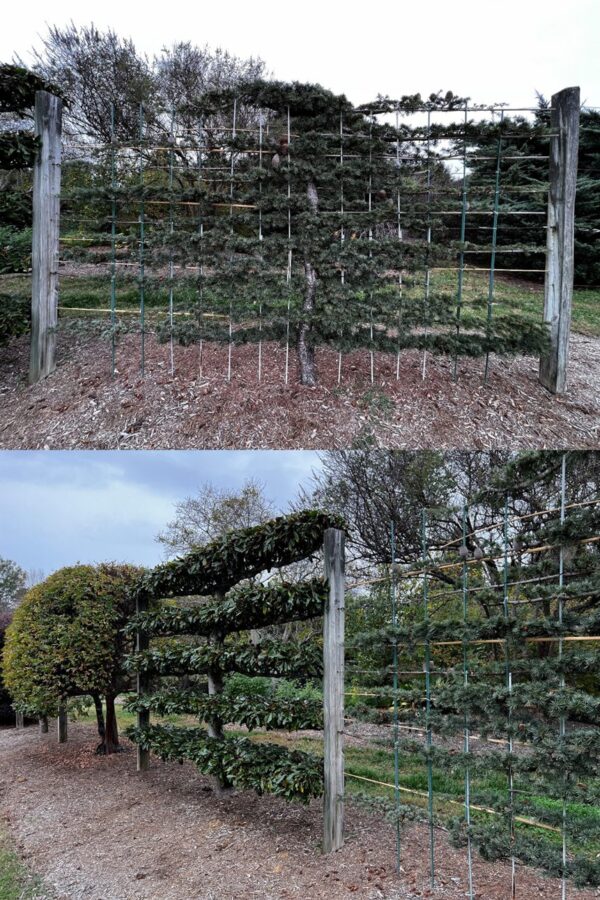
Figure 1: Examples of espalier from the Bartlett Tree Research Lab. Photo Credit: Ben McCallister
One of the biggest advantages of espalier is efficient use of space. A tree trained flat can fit into narrow courtyards, along property lines, or against sunny walls where space is limited. It can also make maintenance easier, since pruning, spraying, thinning, and harvesting are often more accessible than in a dense, free-growing tree. In fruit production, better sunlight and air circulation can improve fruit quality and reduce some disease problems. For many gardeners, espalier is also appealing because it adds a strong visual design element to the landscape.
Espalier does have challenges. It requires patience, regular attention, and a willingness to prune frequently during the training phase. The technique is not ideal for every species, and success depends on choosing a plant that responds well to bending and cutting. If neglected, an espaliered tree can lose its shape quickly and become difficult to correct. It also demands a level of planning that is greater than ordinary pruning, since the final form must be imagined and maintained over time.
The technique is most commonly associated with Europe, especially France, Italy, and England, where it has long been used in formal gardens, orchards, and along estate walls. Today it is also popular in North America among home gardeners, landscape designers, and urban fruit growers who want to combine productivity with ornament. While espalier is less about a single geographic region than pollarding, it remains especially visible in European garden traditions and in places where intensive use of limited space matters.
Espalier is both practical and artistic. It can help gardeners grow more in less space while creating a distinctive look that feels deliberate and refined. For the right plant and the right site, it is a pruning style that blends horticulture with design.
Resources:
Tree Pruning Essentials Video, Purdue Extension YouTube Channel
ID That Tree, Playlist, Purdue Extension – Forestry and Natural Resources (FNR) YouTube Channel
Planting Your Tree Part 1: Choosing Your Tree, Purdue Extension YouTube Channel
Tree Selection for the “Un-natural” Environment, The Education Store, Purdue Education’s resource center
Tree Installation: Process and Practices, The Education Store
Why Is My Tree Dying?, Got Nature? Blog, Purdue Extension – FNR
Tree Risk Management, Got Nature? Blog, Purdue Extension – FNR
Tree Wound and Healing, Got Nature? Blog, Purdue Extension – FNR
Pruning Highlight-Pollarding Trees, Got Nature? Blog, Purdue Extension – FNR
Urban Tree Spotlight: Planting Deciduous Shade Trees, Got Nature? Blog, Purdue Extension – FNR
Southwest Damage, Scalding or Frost Cracking, Got Nature? Blog, Purdue Extension – FNR
Fifty Common Trees of Indiana
Native Trees of the Midwest, Purdue University Press
Surface Root Syndrome, The Education Store
Find an Arborist video, Trees are Good-International Society of Arboriculture (ISA)
Report INvasive, Purdue Extension
Indiana Invasive Species Council
Subscribe – Purdue Extension-FNR YouTube Channel
Ben McAllister, Urban Forestry Specialist
Forestry & Natural Resources
Purdue Landscape Report: Some of the questions that I get asked quite frequently are “Are my trees ok?”, “Do I need to have an arborist come work on my trees?”, and “Is there anything I can do to help my trees without hurting my savings?”. Just like many questions, the answers are dependent on the situation. There are a multitude of cases where it is in the best interest of both you and the tree to hire a professional. From removals and storm damage, to pruning at height and/or around utilities, and other dangerous situations, you really should invest in the cost of a certified arborist. But there are instances where you can save some money and feel the pride of caring for your trees yourself by doing some of your own pruning work.
You might not think too much about pruning. Maybe you feel like “Hey! Anyone can cut off a branch”, and you’re right but also not. There is a right and wrong way to pruning and cleaning out dead wood. Depending on where you cut and how much you remove, you might end up doing more damage to your tree and end up requiring the assistance of an arborist earlier than needed. For the pruning layperson, there are several topics that can help you prune like a pro: safety, equipment, and proper pruning cuts.
First and foremost is safety. From this time of the year onward it’s only going to get hotter, but it’s important to protect your body from accidents with your tools, from the elements, and even from the plants you’re pruning by wearing the proper personal protective equipment (PPE). From the toes up, skilled professionals have their work boots (closed toed shoes), pants (not shorts), at the very least a t-shirt, gloves and safety glasses, and hearing and head protection depending on the equipment and scale of work. And if you’re using power equipment like chainsaws make sure you’ve got protective chaps for that added level of safety.
The standard equipment available for pruning includes hand pruners, loppers, and hand and pole saws (I’ll touch on chainsaws more in a later article). The two main types of pruners and loppers are called bypass and anvil styles. Bypass pruners have two blades that “bypass” each other like scissors, leaving clean cuts on your trees and shrubs. Anvil pruners have a single blade that shuts against a flat surface, the “anvil”, and can leave bruised or crushed plant material after cuts. Use your hand pruners for smaller cuts (up to 3/4” in diameter depending on the quality of your blade) and your loppers for larger diameters that might not require a hand saw.
When choosing a hand or pole saw, it is best to have one specifically designed for pruning. Pruning saws come in different configurations. They can be straight or curved, have fixed or folding blades, and come in different lengths and teeth sizes. A good rule of thumb is shorter blades or blades with smaller teeth for finer pruning cuts and longer blades with larger teeth for bigger diameter limbs (pole saws will usually have larger blades attached to single or extendable poles). You’ll also want a blade that isn’t so thin that it buckles on the first cut. For pruning at home, I recommend a 10-12” saw with medium sized teeth. That coupled with a hand pruner and some loppers should cover most of your pruning projects.
Now that you have your PPE and your pruning equipment you’ll want to begin cutting, but there are some considerations along with dos and don’ts for pruning. First, you want to decide what your goals are (raising the canopy off the ground or a building, thinning the crown to increase light and/or wind, or reducing the canopy by shortening limbs) and how much you need to remove from your tree (Fig. 1). In most cases, less is more. Whenever you remove plant material you are doing two things:
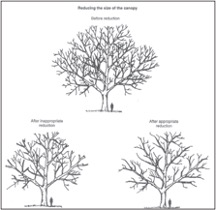
Figure 1a: Examples of canopy reduction, thinning, and raising (FNR-506-W).

Figure 1b: Examples of canopy reduction, thinning, and raising (FNR-506-W).
1) you are injuring the tree, exposing open cuts to pests, diseases, and the elements
2) you are removing plant material that could continue to create energy for the tree if left on.
Both will stress your tree and it will need time to adapt and heal. You can always remove more later, but once you make your cuts you cannot put them back. If your tree needs a heavier prune, it’s time to bring in an arborist.
Next you need to consider what are you cutting? Are you removing whole limbs back to the trunk or are you shortening limbs? If you are removing limbs you want to avoid flush cuts, cutting back even to the trunk. Flush cuts (Fig. 2) are usually oval and have a larger surface area exposing more of the tree to pests, diseases, and the elements. Instead, you want to cut up to the branch bark ridge, a raised portion of bark on the top of the limb where it meets the trunk, and the branch collar, usually a swollen area on the bottom side of the limb where it begins to flare out from the trunk (Fig. 3). This is a proper removal cut that has the smallest surface area exposed and is usually more circular than oval.
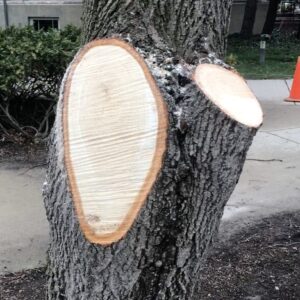
Figure 2: Examples of a flush cut (left) and a proper removal cut (right).
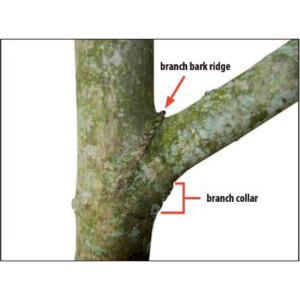
Figure 3: Identifying the branch bark ridge and the branch collar for proper removal cuts (FNR-506-W).
If you are shortening limbs you want to perform a reduction cut, which is removing a larger stem by cutting back to a lateral branch that is at least 1/3 the diameter of the portion you are removing (Fig. 4). This provides sufficient energy production the keep the remaining limb alive. In this situation, you want to avoid heading cuts, which are length reductions without regard to the position or diameter of the lateral branch you are cutting back too. Cutting too far away from the lateral will lead to dead stubs that increase exposure and the time needed to heal over wounds. Cutting to laterals that are too small won’t allow the limb to produce enough energy to survive.
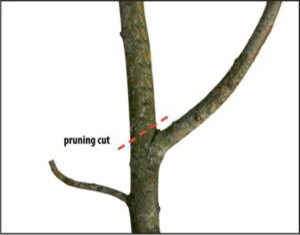
Figure 4: Correct placement of a reduction cut to an properly sized lateral branch (FNR-506-W).
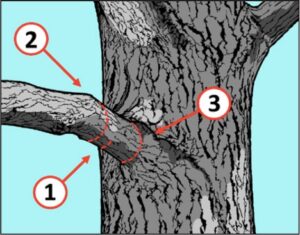
Figure 5: The 3-cut method for safe removal of limbs (FNR-506-W).
Last, whether you are applying removal or reduction cuts, you want to utilize what is called the ternary or 3-Cut Method (Fig. 5). The purpose of this method to stop damage from splitting and tear-outs in larger limbs that can’t be controlled by hand. The first cut is the undercut, about 1/3 the diameter of the limb and usually 6-12 inches from your final cut. The second cut is the top cut just outside the undercut. This cut continues down until it meets the same plane as the undercut where gravity will take hold as the branch snaps and falls. The final cut is to the branch collar, or the chosen lateral as noted above.
Proper pruning can be a daunting task at first. With time, the correct materials, and practice you can better care for your trees, your landscape, and yourself. If you are still worried about your trees, there are plenty of resources at Purdue Extension and The Education Store or you can always find an ISA Certified Arborist nearby using the Trees Are Good website. They will be able to help assess any other issues and provide excellent professional help.
Resources:
Tree Pruning Essentials, Video & Document
Tree Pruning for the Landscape Webinar, Purdue Extension – Forestry and Natural Resources (FNR) Youtube Channel
Tree Appraisal and the Value of Trees, The Education Store, Purdue Extension resource center
Tree Pruning: What Do Trees Think?, The Education Store
Mechanical Damage to Trees: Mowing and Maintenance Equipment, The Education Store
Tree Installation Process and Practices, The Education Store
Tree Planting Part 1: Choosing a Tree, The Education Store
Tree Planting Part 2: Planting Your Tree, The Education Store
Planting Problems: Planting Too Deep, Video, Purdue Extension – FNR Youtube Channel
Ben McCallister, Urban Forestry Specialist
Purdue Forestry and Natural Resources
Purdue Landscape Report: Pruning is an important maintenance practice on trees that is discussed a great deal. An essential part of making the pruning cut properly is the ability to identify the parts of a branch. Identification of the branch bark ridge and branch collar are vital to severing the branch in a place that facilitates fast and effective wound closure, reducing decay in the location of the cut.
Branches on trees arise from lateral buds present in leaf axils. Initially, lateral shoots (branches) grow in length and diameter at approximately the same rate as the parent stem. As branches become shaded naturally by crown expansion, photosynthesis is reduced in that location and growth slows to a lesser rate than the parent or main stem. A swollen area or collar develops at the junction of branch and stem because of their differential growth rates and by the intermingling of vascular tissues from both the branch and the stem or trunk.
This swollen area is commonly referred to as a branch collar and often present in many branches on the underside of the branch. This specialized location on the branch is composed of trunk (parent stem) wood. The branch collar contains a protective chemical zone that inhibits the movement of decay organisms from dead or dying branches into healthy tissues of the parent stem. As branches begin to die from shading, pests or storm damage, for examples, they usually are walled off (compartmentalized) by tissues in the branch collar which prevents movement of decay organisms into the parent stem.
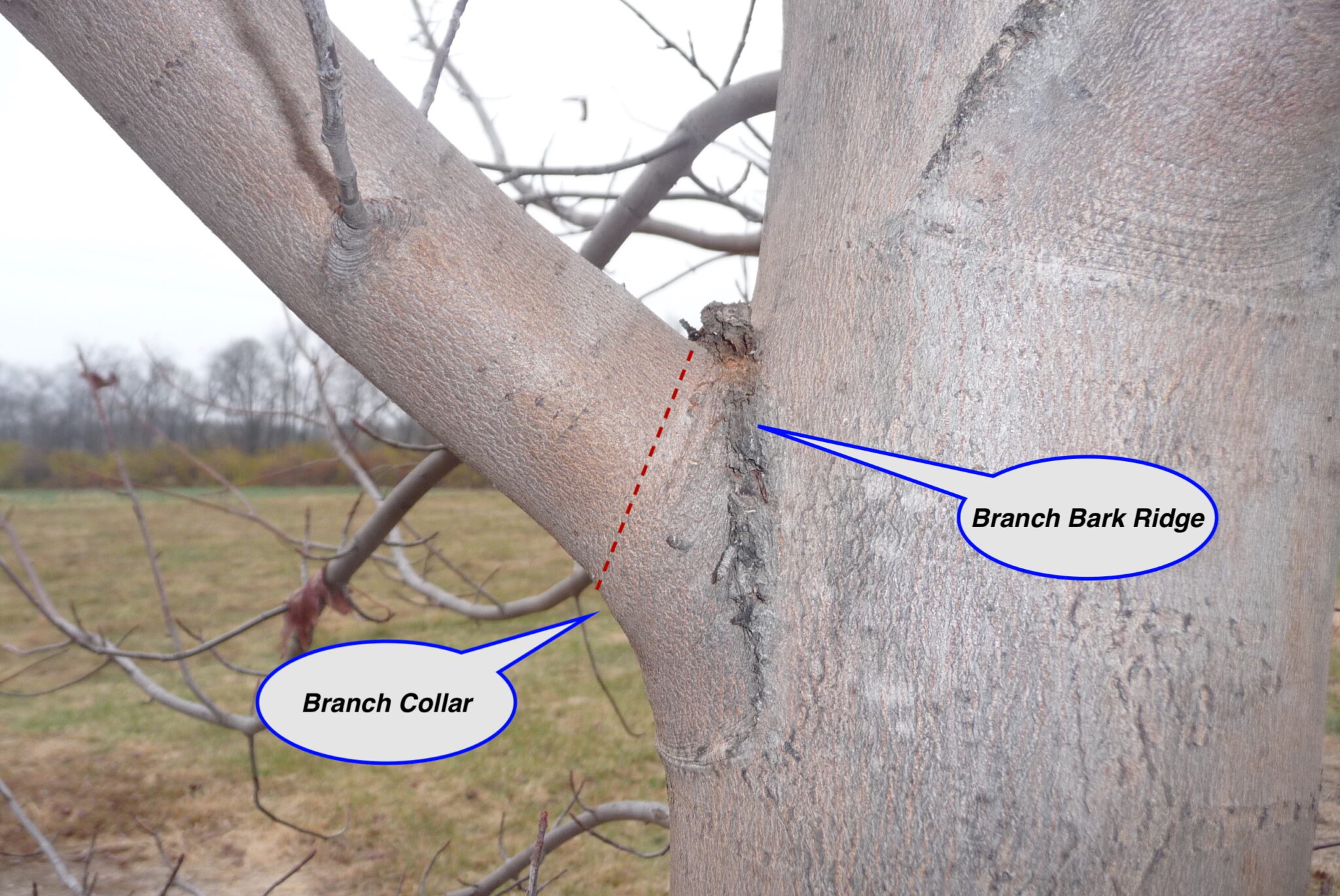
Identify the branch collar and branch bark ridge to perform a good cut, which is just outside the line.
Another important branch component to identify in tree branches is the branch bark ridge. This part of the attachment is composed of rough, usually darkened, raised bark formed at the union where the branch meets the parent stem. The ridge extends from the top of the branch down both sides of the branch union. Together with the branch collar, the portion of the ridge pushed up in the union provides our target for the pruning cut. The BBR is present on every branch union and is an important identifying feature for determining tool placement.
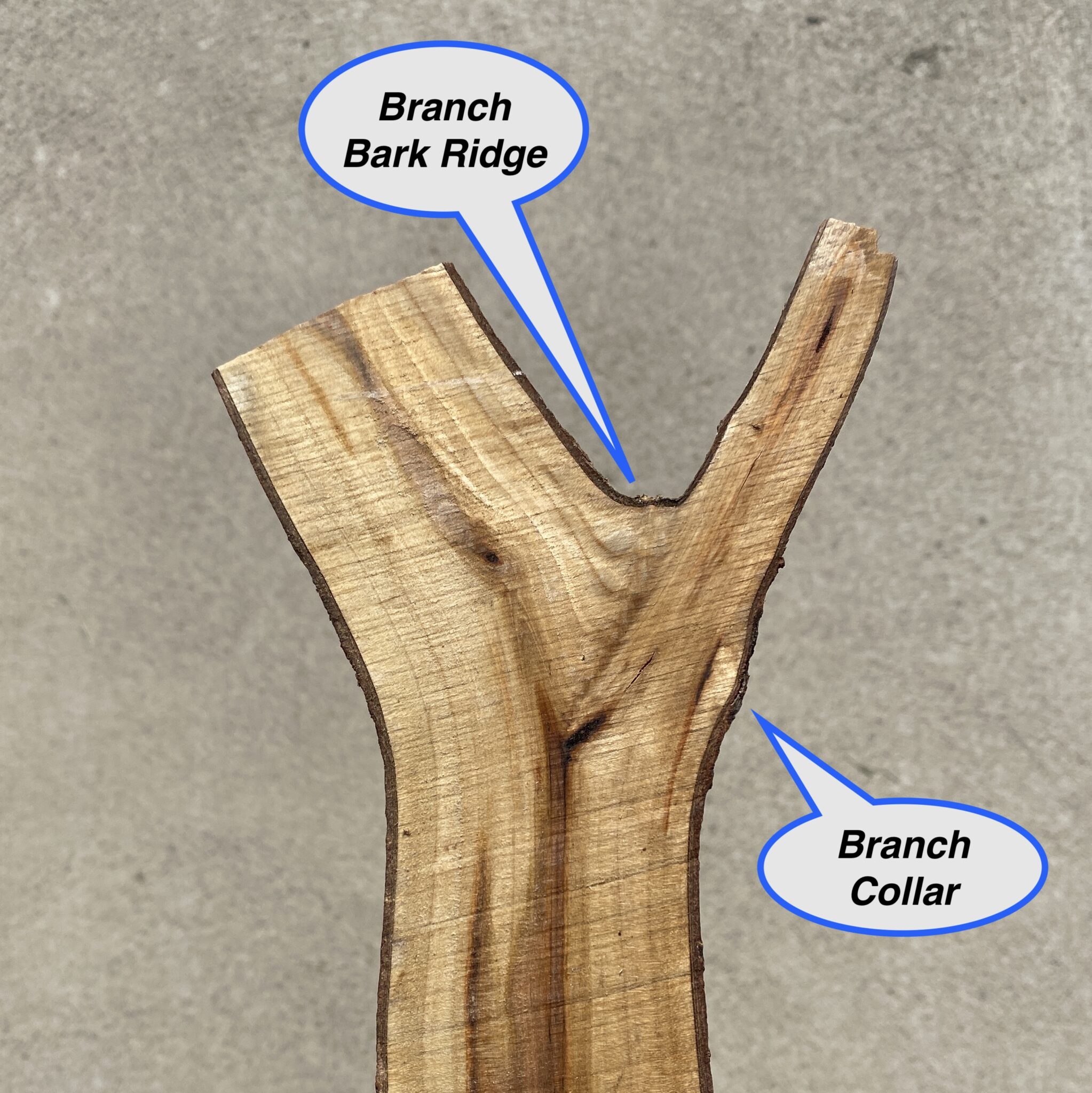
An internal view of the branch collar and branch bark ridge revealing the intermingled stem and branch wood fiber.
The combination of the branch collar, branch bark ridge, and the overlap between the branch and stem are the branch components that form what is called the branch protection zone. This zone contains specialized chemical compounds that help resist the spread of disease in the tree and facilitate wound-sealing. Always avoid damaging the area within the branch collar and branch bark ridge to help the tree recover from the pruning cut as quickly as possible.
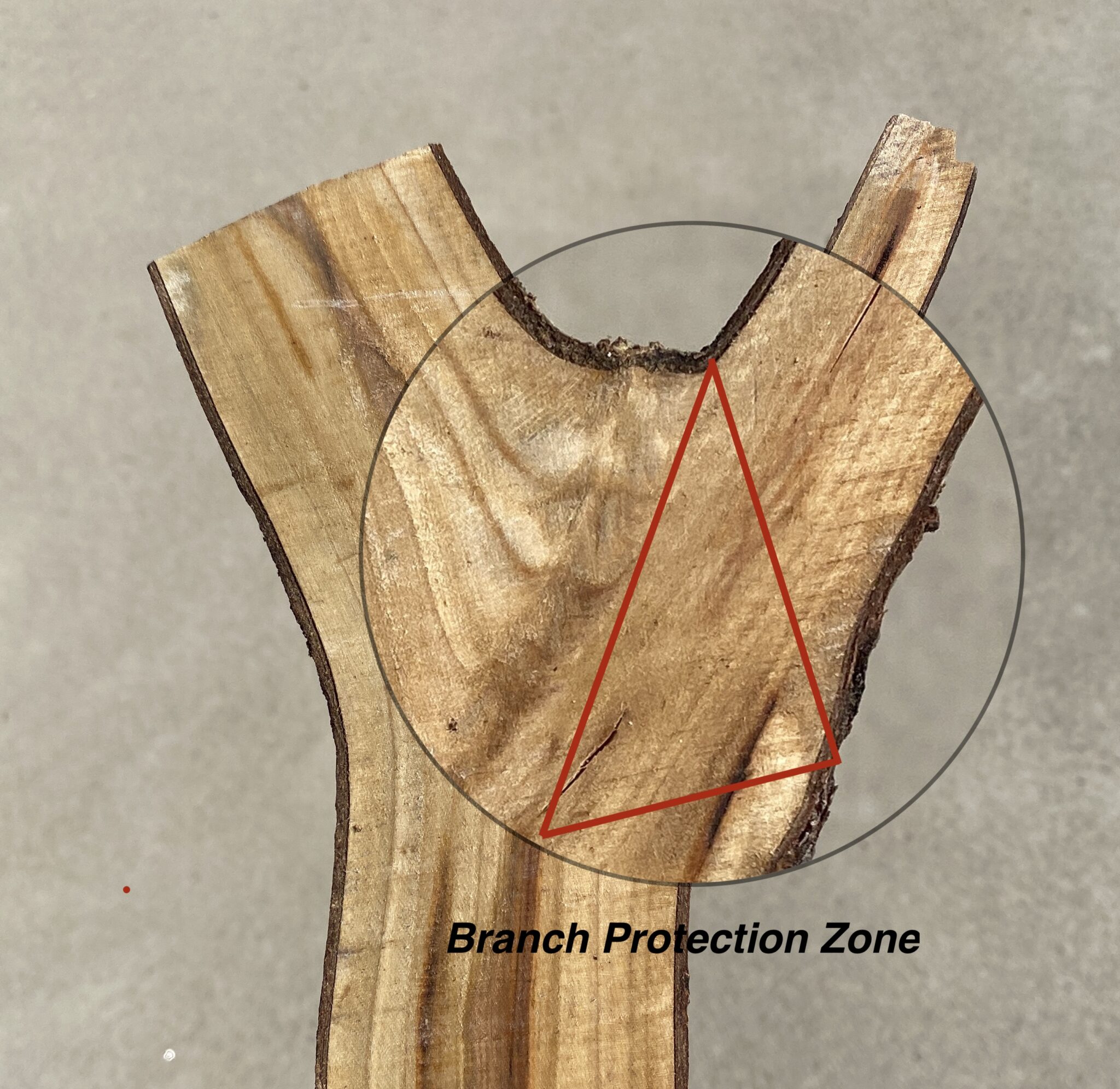
The Branch Protection Zone is an area that contains specialized chemicals to assist with the healing process after pruning.
For the best advice on tree maintenance and care, seek out a tree care professional with the experience and expertise to care for your trees. Search for a tree care provider in your area. Also, consider hiring an ISA Certified Arborist which can be found here.
Resources:
Planting Your Tree Part 1: Choosing Your Tree, Purdue Extension YouTube Channel
Tree Planting Part 2: Planting a Tree, Purdue Extension YouTube Channel
Tree Selection for the “Un-natural” Environment, The Education Store, Purdue Extension resource center
Tree Installation: Process and Practices, The Education Store
Tree Pruning Essentials Video, Purdue Extension YouTube Channel
Purdue Landscape Report
Lindsey Purcell, Urban Forestry Specialist
Purdue Department of Forestry and Natural Resources
Purdue Landscape Report: Trees are incredible survivors in spite of the challenges from pests of all kinds, including us! They are vulnerable to injuries such as mechanical wounds from lawn equipment, vehicles and ice. Pruning results in an intentional wound which is of importance to consider. Tree owners and managers need to prune trees to maintain aesthetic characteristics, remove infected limbs, reduce risk, or improve structural stability. Proper pruning practice and understanding tree wounds can minimize the impact of creating wounds on trees.
Wounds attract pests due to the phytochemicals dispersed from exposed tissue. When tree tissue is damaged or wounded, the newly uncovered tissue is exposed and that is when to expect an attack. Insect pests are drawn to trees in distress, feeding on the tissue and weakening the tree. Diseases affecting trees will introduce enzymes into the cells, digesting living tissue responsible for food and water translocation (phloem and xylem) or structural support resulting in unhealthy, unsightly, or unsafe trees.
Wound wood Formation
Trees attempt to close wounds by sealing or compartmentalizing the affected area, naturally.
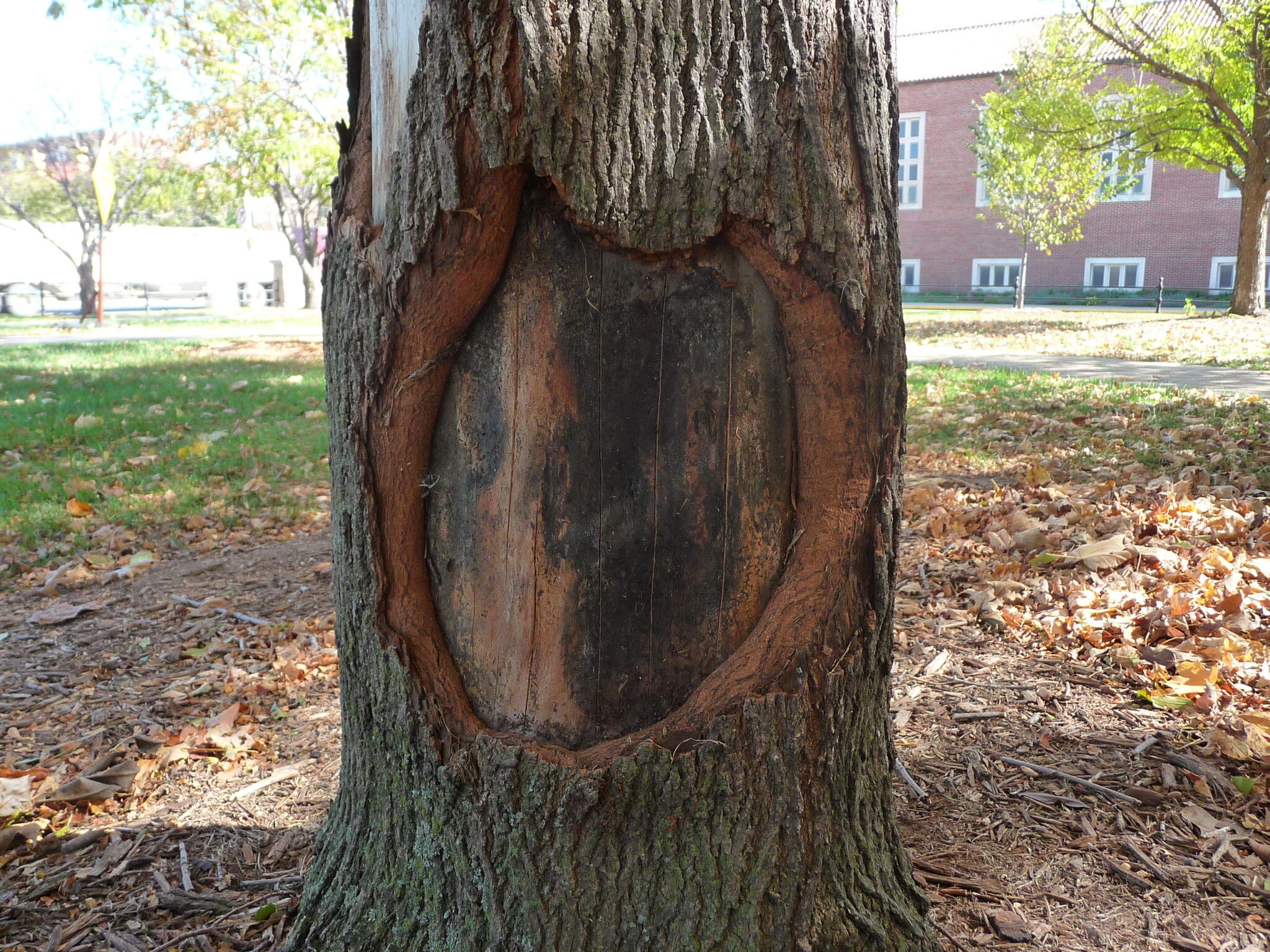
Tree trunk damaged by construction equipment developing wound wood around the edges to eventually seal the wound.
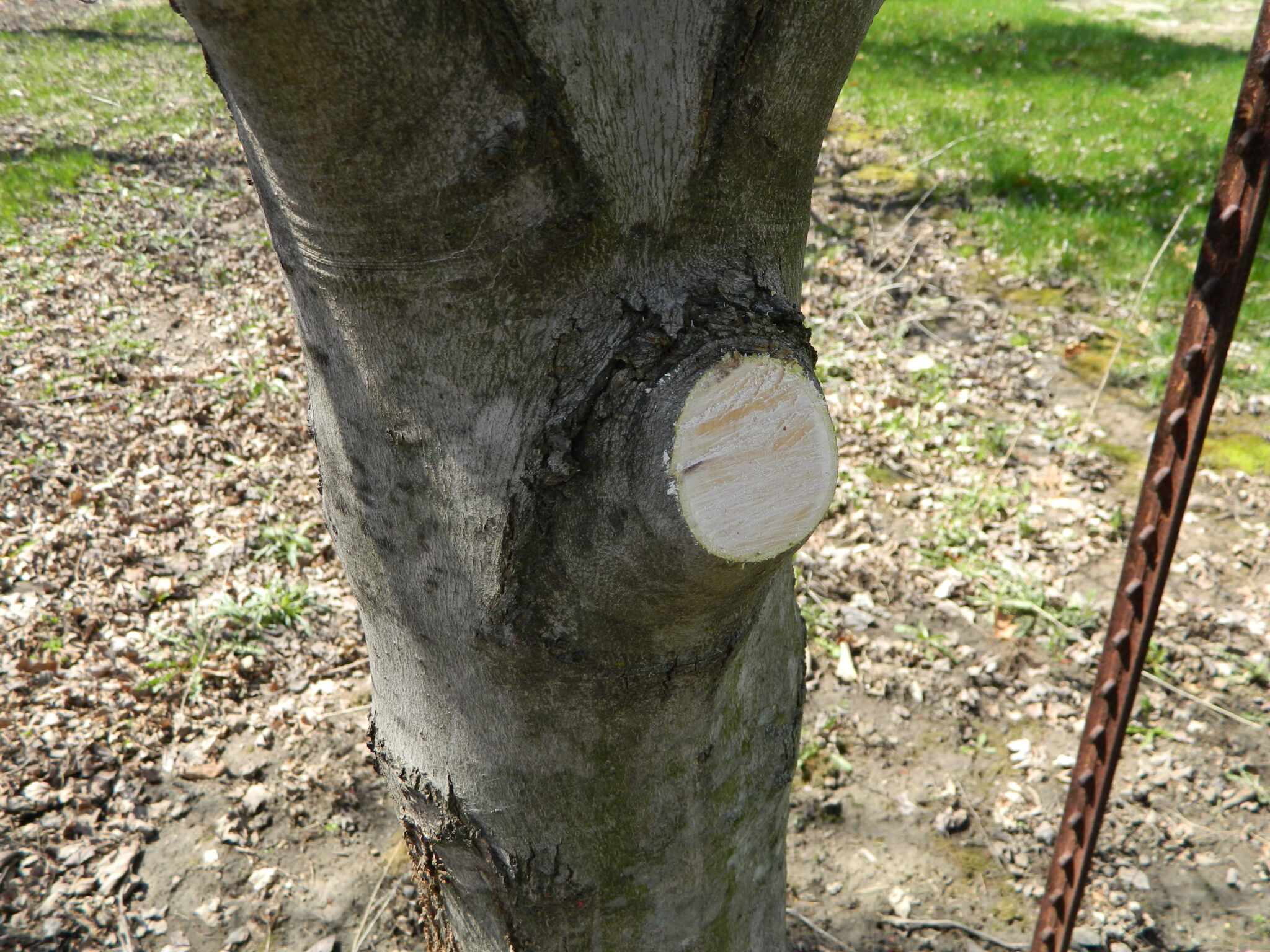
Pruning cuts will develop callus tissue on the exposed tissue giving rise to wound wood.
Wound recovery rates vary widely for different tree species. The speed of recuperation is greatly affected by developmental environmental conditions, vigor and health of the tree. Some trees may never completely close their wounds due to their genetic capacity or perhaps inadequate resources to keep the tree vigorous. However, numerous studies reveal that faster wound closure results in fewer health issues for the tree. Quick healing is always better!
A healthy tree will seal wounds faster and the same for younger trees as well. Trees that are planted in well-drained, quality soils, with good texture, structure, and containing adequate nutrition levels, grow in a way that favors the healing process. Thus, when planting trees, homeowners should be aware of the effects of site selection, soil quality, and other site factors that may impact tree growth.
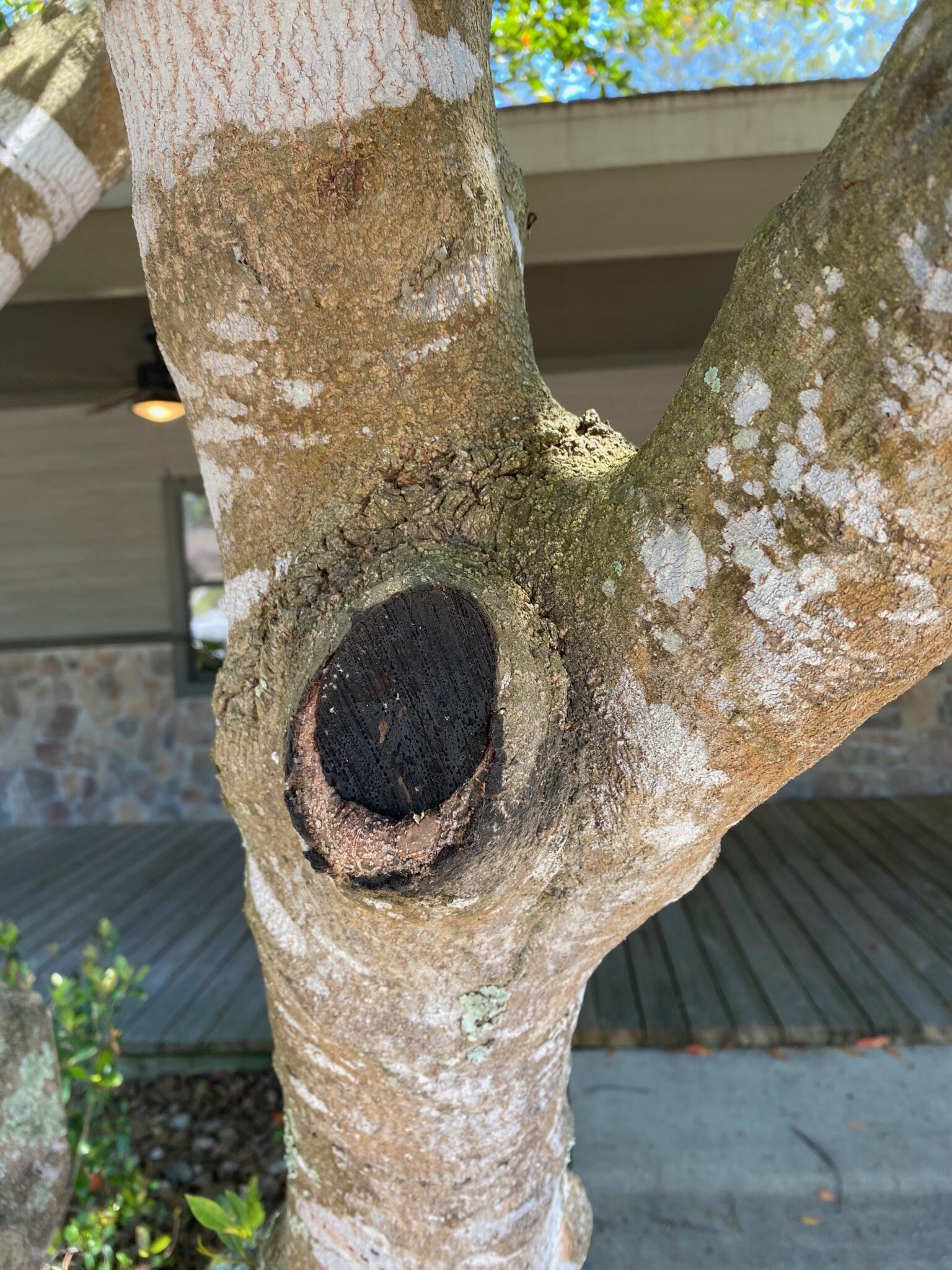
Wound dressings slow closure and can prevent healing.
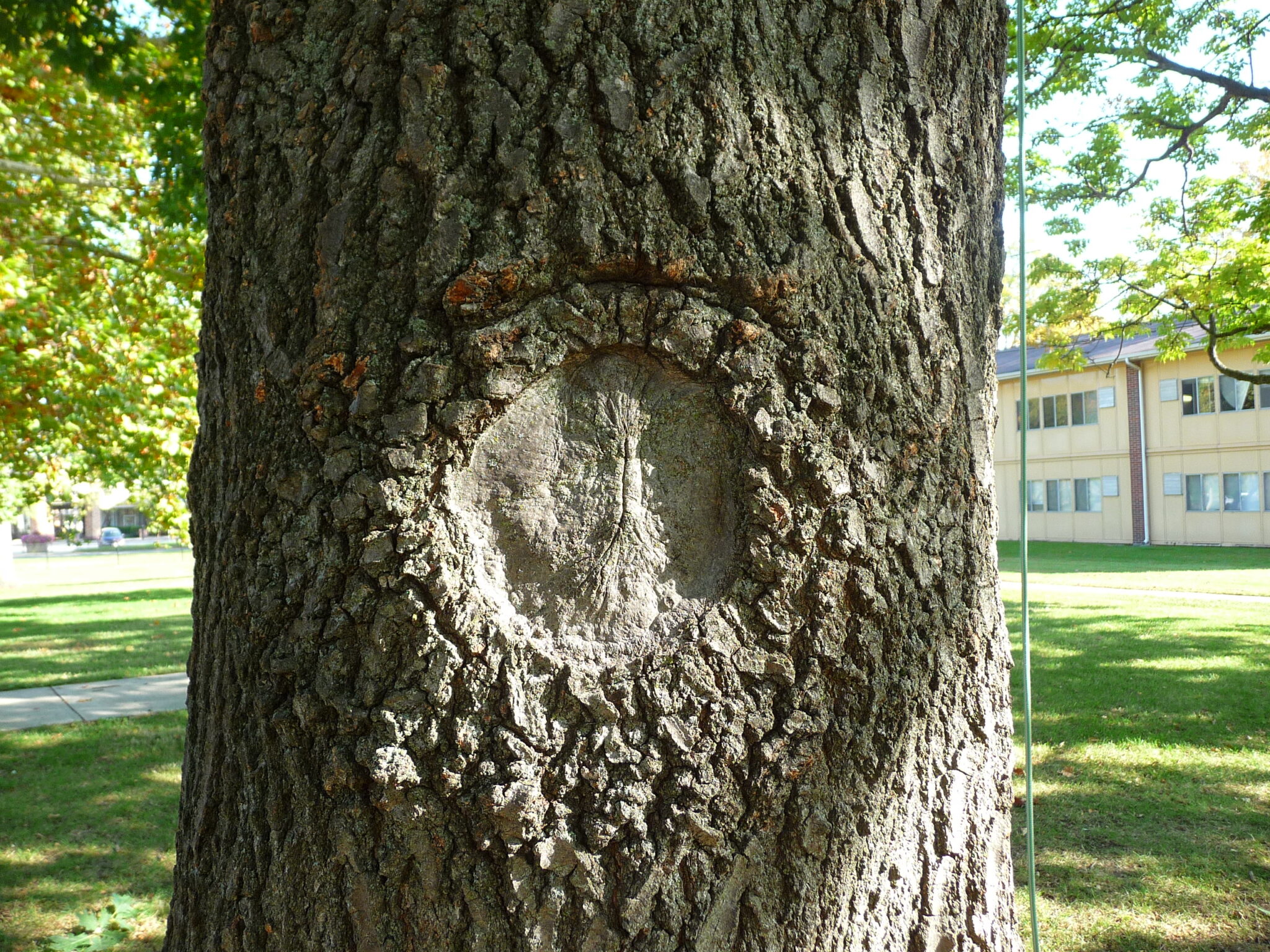
Complete wound closure improves tree health and slows decay.
There are few ways wound closure can be hastened, or at least not inhibited. First, it is essential to avoid limiting oxygen availability to the wounded tissues. Oxygen is necessary for proper recovery. For example, painting a wound with any kind of material that interferes or impedes oxygen will slow or even prevent wound closure by poor callus formation. Wound treatment with petroleum-based products is not recommended. In fact, research indicates any type of wound dressing can slow the healing process. There is one exception for treating wounds. This is in areas where oak wilt disease occurs, wound paints may be useful in preventing insect spread of the oak wilt fungal pathogen.
Basically, the best way to help insure proper wound closure and quick and effective sealing of the tissue is a proper pruning cut and preventing damage whenever possible.
Find a professional
Be sure to always hire an insured, tree care professional, preferably and ISA Certified Arborist with the experience, expertise, and equipment to provide proper tree care. Require proof of liability insurance to protect yourself as well.
Another easy way to find a tree care service provider in your area is to use the “Locate Your Local Tree Care Industry Association Member Companies” program. For more information refer to the publication Trees and Utilities at the Purdue Education Store.
Find an ISA Certified Arborist in your area by visiting the Trees Are Good website.
Resources
Tree Pruning Essentials, Publication & Video, The Education Store, Purdue Extension resource center
Tree Pruning: What Do Trees Think?, The Education Store
Mechanical Damage to Trees: Mowing and Maintenance Equipment, The Education Store
Tree Installation Process and Practices, The Education Store
Tree Pruning for the Landscape, Webinar, Purdue Extension – Forestry and Natural Resources Youtube channel
Lindsey Purcell, Chapter Executive Director
Indiana Arborist Association
Purdue Landscape Report: We all have heard about dormancy and the restful time of woody plants in our landscapes. That “chill-out” time is nearing the end and it’s time to think about tree maintenance. Trees and shrubs have actually been growing for quite some time, we just can’t see it… yet. Woody plants begin growth after the chilling requirements have been filled. These requirements are different for every plant. Chilling units are hours of time spent above freezing. The number of hours required for chilling varies for different plants from less than 500 to 1,500 hours or more. Many people think the plant is tracking hours below freezing, but in actuality, hours below freezing has no effect on chilling but does increase cold hardiness. Our mild winter and early spring arrival is playing a role in this process.
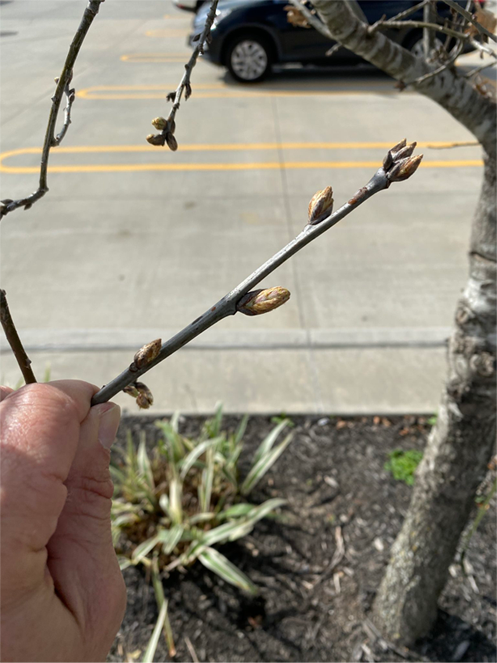
Figure 1. These oak tree buds may look dormant but have completed their chilling requirement and are ready to break. Source
An important maintenance task is supplemental fertilization during early spring weather, especially if there wasn’t any type of fall fertilization. Let’s take a look at how a tree uses and gains energy during the year to understand why and when trees need good nutrition. After the leaves have fallen there is no way to generate food because without leaves, there is no photosynthesis. There are huge demands on the carbohydrate reserves due to increased metabolic functions to support new leaves, flowers and fruit. Supplemental nutrition can help if storage levels are low or depleted until the new photosynthates are available. That’s a huge demand on its reserves! The tree must rely on stored carbohydrate reserves in its woody parts such as stems and branches to grow. Hopefully, the tree was healthy and developing those reserves going into fall or supplemental nutrition was offered with fall fertilization. If not, then the tree exhausts much of its energy and is in need of new resources. In some situations, it may be considered safer for the tree to apply fertilizer in the spring. Fall applications, if applied too early in the fall season, can create the risk of forcing the plant into becoming metabolically active right when cold weather hits, creating growth susceptible to freeze damage.
Many woody plants begin the new year’s growth with stored food from the year before. An application of fertilizer in the spring gives an additional boost to this new growth. It is important to note that not all trees and shrubs need fertilization, however, most can benefit from this application, especially the younger actively growing trees. In forests, soils have an abundance of nutrients, but in our landscapes and urban forest areas, that’s not often the case. As we sweep away leaves, twigs and fallen bark, we’re removing potential recycling of nutrients for the soil. Additionally, the grass around our trees is unnatural and often outcompetes trees for available nutrients and water. That’s why we need to fertilize our trees, spring or fall. Look for signs that your tree is lacking nutrients in the soil. If you see these signs, fertilization may be necessary.

Figure 2. The graph shows the starch loss or energy used during various growing stages for the tree during the year. Most energy is depleted after leaf emergence and then regained as leaves begin photosynthesizing new resources. Source
- Shorter than normal annual twig growth
- Undersized leaves that are fewer in number
- Dead branches and branch tips
- Leaf veins darker than leaf margins
- Leaves any other color than dark green, such as yellow or red
However, never fertilize without getting a soil test. If your trees are experiencing any of the above symptoms, have your local arborist inspect the tree to determine the best treatment. Also, Review Consumer Horticulture: Fertilizing Woody Plants (pdf) for more details on fertilizer application techniques and rates.
Now for just a little about tree pruning. All of that new tree growth is going to prompt the pruning activities… be patient! Once trees start budding and blooming in the spring hold off until after the flush. Pruning in the spring can limit bloom potential and remove newly expanding leaves that will be needed to produce new food products for energy.
Generally, the best time to prune is several weeks after the spring flush or during the summer months. Early spring pruning should focus primarily on pruning for safety to remove any dead, dying or decayed branches. Aesthetic or structural pruning can be completed much later and when the tree is better prepared to seal those pruning wounds with energy reserves. For more information refer to the publication Tree Pruning Essentials from the Education Store on pruning topics.
Resources
Consumer Horticulture: Fertilizing Woody Plants, The Education Store, Purdue University
Tree Planting Part 1: Choosing a Tree, Video, The Education Store
Tree Installation: Process and Practices, The Education Store
Tree Pruning Essentials, Video
Corrective Pruning for Deciduous Trees, The Education Store
Tree Pruning: What Do Trees Think?, The Education Store
Lindsey Purcell, Urban Forestry Specialist
Purdue University, Department of Forestry and Natural Resources
One of the most dangerous pests to trees is a human, especially with equipment. 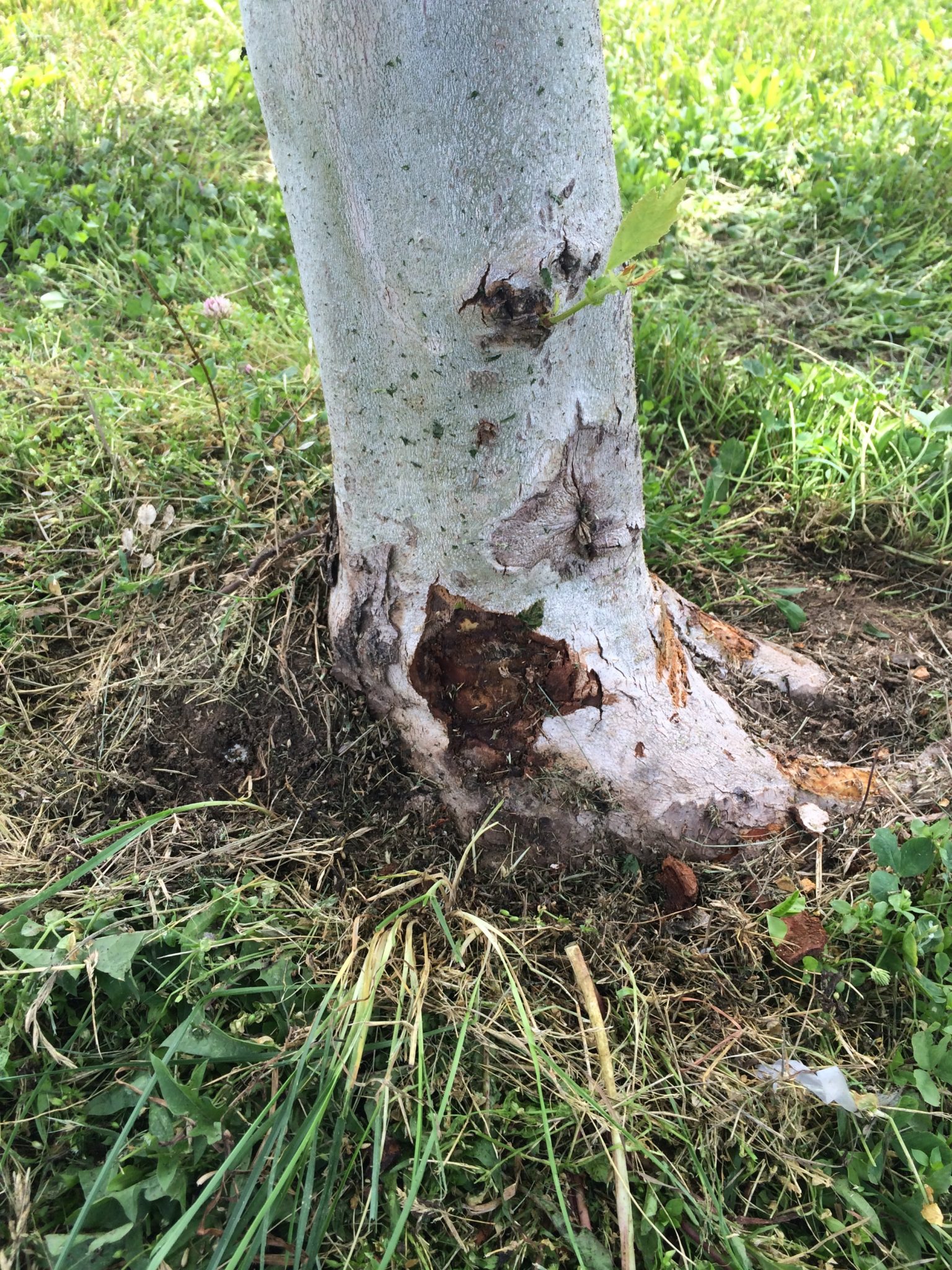 Injuries to trees caused by a lawn mower or weed trimmer can seriously threaten a tree’s health.
Additionally, damage to the bark layer of trees causes a long-term liability by creating a wound which leads to a defect, becoming an unsafe tree.
The site of injury is usually the root flare area, where the tree meets the turf and gets in the path of the mower or trimmer. The bark on a tree acts to protect a very important transport system called the cambium layer.
This is where specialized tubes are located which move nutrients and water between the roots and the leaves. Bark layers can vary in thickness on different tree species. It can be more than an inch in thickness or less than 1/16 of an inch on young, smooth-barked trees such as maples and birch trees. This isn’t much protection against string trimmers and mowing equipment, especially the young trees.
Any type of damage or removal of the bark and the transport system can result in long-term damage. Damage, which extends completely around the base of the tree called girdling, will result in ultimate death in a short time.
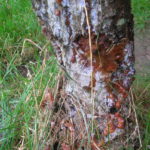
Tree wounds are serious when it comes to tree health. The wounded area is an opportunity for other insects and diseases to enter the tree that causes further damage. Trees can be completely killed from an attack following injuries. Fungi becomes active on the wound surface, causing structural defects from the decay. This weakens the tree or it eventually dies, creating a risk tree to people around it.
Newly planted, young trees need all the help we can provide to become established in the landscape and these trees are often the most commonly and seriously affected by maintenance equipment. However, injury can be avoided easily and at very low cost with these suggestions.
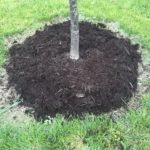 The removal of turf or prevention of grass and weeds from growing at the base of the tree are low-tech solutions to eliminate a serious problem. Spraying herbicides to eliminate vegetation around the base of the tree can decrease mowing maintenance costs. Be sure to use care when applying herbicides around trees.
- A 2-3” layer of mulch on the root zone of the tree provides an attractive and healthy environment for the tree to grow. Additionally, it provides a visual cue to keep equipment away from the tree.
- Also, trunk guards and similar devices can add an additional measure of protection for the tree. Using white, expanding tree guards can help improve the trees ability to withstand equipment contact, but also help to reduce winter injury.

Trees are a major asset to your property and important to our environment. Protect our trees and preserve these valuable assets by staying away from tree trunks with any mowing or weed trimming equipment. The damage lasts and it cannot be repaired and often results in losing your tree.
Purdue University Landscape Report Article
Resources
Corrective Pruning for Deciduous Trees, The Education Store – Purdue Extension resource center
What plants can I landscape with in areas that floods with hard rain?, Purdue Got Nature? Blog
Tree support systems, The Education Store
Tree Installation: Process and Practices, The Education Store
Lindsey Purcell, Urban Forest Specialist
Forestry and Natural Resources
How do I remedy poor branching? Is my tree at risk of splitting, and how can pruning prevent that? Corrective pruning has many implications for tree structure, health, and longevity. Developing a strong, central branch structure in a deciduous tree is critical for preventing structural failure caused by storms, wind, and ice. This 8-page publication explains the problems resulting from a co-dominant stem structure and addresses pruning strategies for correcting poor structure.
To view this full publication please go to Corrective Pruning for Deciduous Trees located in The Education Store, Purdue Extension’s resource center.
Resources
Preparations to Prevent Southwest Tree Injury, Got Nature? Blog
When do you stake a tree?, Got Nature? Blog
Top 5 List for Tree Selection and Planting, Got Nature? Blog
Tree Selection for the “Un-natural” Environment, The Education Store, Purdue Extension
Tree Support Systems, The Education Store, Purdue Extension
Tree Installation: Process and Practices, The Education Store, Purdue Extension
Planting Your Tree Part 1: Choosing Your Tree, video, The Education Store, Purdue Extension
Lindsey Purcell, Urban Forestry Specialist
Purdue Forestry and Natural Resources
 Due to reasons such as pruning, location of growth and species characteristics, trees can grow in ways that don’t endorse long-term health and safety. To counter trees growing in unsafe ways, cabling, bracing, guying, or props can be utilized to prevent branch or whole-tree failure. These tree support systems reinforce critical areas of the tree by limiting the movement of branches or leaders. In the publication titled Large Tree Cabling and Bracing, FNR-550-W, common structural deficiencies in trees and the tree support devices used to prevent problems caused by those deficiencies are described and covered.
Resources:
Tree Support Systems, The Education Store, Purdue Extension
Tree Planting Part 1: Choosing a Tree, The Education Store, Purdue Extension
Tree Pruning: What Do Trees Think?, The Education Store, Purdue Extension
Forest Improvement Handbook, The Education Store, Purdue Extension
Got Nature?, Purdue Extension, Forestry and Natural Resources
Lindsey Purcell, Urban Forestry Specialist
Purdue University, Department of Forestry and Natural Resources
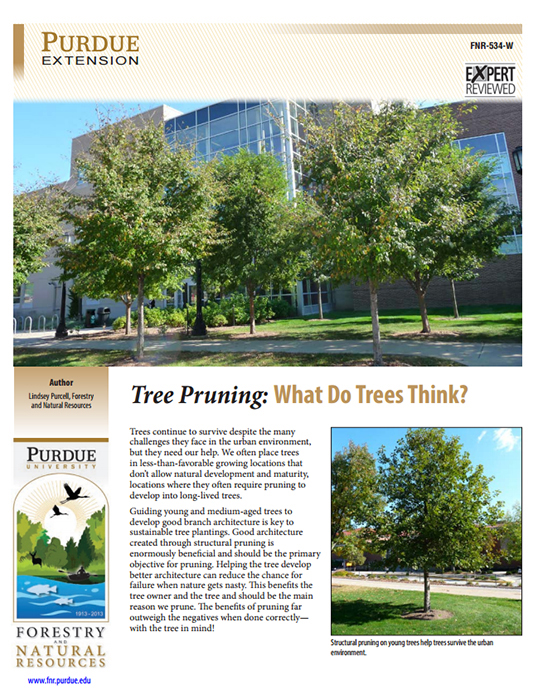 The Tree Pruning: What Do Trees Think publication explains the physiological and physical changes that happen within trees as a response to pruning. Guiding young and medium-aged trees to develop good branch architecture is key to sustainable tree plantings. Good architecture created through structural pruning is enormously beneficial and should be the primary objective for pruning. Helping the tree develop better architecture can reduce the chance for failure when nature gets nasty. The benefits of pruning far outweigh the negatives when done correctly–with the tree in mind!
Resources:
Tree Pruning Essentials – publication, The Education Store, Purdue Extension Resource Center
Tree Pruning Essentials – video, The Education Store
Trees and Storms, Got Nature?
Tree Risk Management – Got Nature? Blog, Purdue Extension – FNR
Lindsey Purcell, Urban Forestry Specialist
Purdue University, Department of Forestry and Natural Resources
Pruning has been called “one of the best, worst maintenance practices,” especially when performed on urban trees. The process creates wounds, which have a major impact on plant processes. Improper cutting on a tree causes severe damage or even death. Be sure to watch this before pruning trees! Tree Pruning Essentials video.
View publication for more details: Tree Pruning Essentials – FNR-506-W at the Education Store.
Resources
Tree Pruning Essentials – publication, Purdue Extension
Trees and Storms: Understanding Damage, Risk and Recovery – Got Nature? Blog, Purdue Extension – FNR
Tree Risk Management – Got Nature? Blog, Purdue Extension – FNR
Lindsey Purcell, Urban Forestry Specialist
Purdue University, Department of Forestry and Natural Resources

Recent Posts
- Minecraft Meets the Hellbender
Posted: September 22, 2026 in Aquaculture/Fish, Aquatic/Aquaculture Resources, Wildlife - Is It Too Early to Think About Christmas Tree Pests?
Posted: in Christmas Trees, Invasive Insects, Safety - What You Plant Matters to Wildlife
Posted: September 16, 2026 in Plants, Urban Forestry, Wildlife - Woodland Flowers of Late Summer
Posted: September 14, 2026 in Forestry, Gardening, Wildlife, Woodlands - Heavy August Rains Bring More Mosquitoes to Indiana
Posted: September 9, 2026 in How To, Invasive Insects, Safety, Wildlife - Question: Why Did the Shagbark Hickories Survive the Tornado?
Posted: August 27, 2026 in Forests and Street Trees, How To, Urban Forestry - New Indiana Woodland Steward Newsletter
Posted: August 12, 2026 in Forestry, Urban Forestry, Wildlife, Woodlands - Indiana Fall Hunting Licenses on Sale and New Mobile App Available
Posted: in Forestry, How To, Wildlife - Trees and Storms: Understanding Damage, Risk and Recovery
Posted: in How To, Urban Forestry - Lighting a Spark: Prescribed Burn Associations
Posted: August 6, 2026 in Community Development, Forestry, Safety, Wildlife
Archives
Categories
- Alert
- Aquaculture/Fish
- Aquatic/Aquaculture Resources
- Ask the Expert
- Christmas Trees
- Community Development
- Disease
- Drought
- Forestry
- Forests and Street Trees
- Gardening
- Got Nature for Kids
- Great Lakes
- How To
- Invasive Animal Species
- Invasive Insects
- Invasive Plant Species
- Land Use
- Natural Resource Planning
- Nature of Teaching
- Plants
- Podcasts
- Ponds
- Publication
- Safety
- Spiders
- Timber Marketing
- Urban Forestry
- Webinar
- Wildlife
- Wood Products/Manufacturing
- Woodland Management Moment
- Woodlands