 Purdue University - Extension - Forestry and Natural Resources
Got Nature? Blog
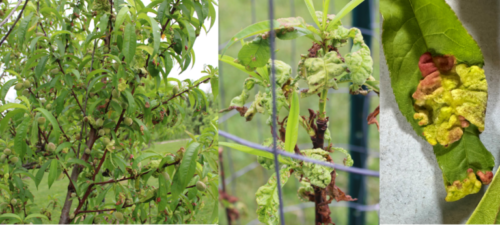
Figure 1: Peach trees showing symptoms of peach leaf curl caused by Taphrina
Purdue Landscape Report: The past two months have been relatively wet and cool to warm. This prolonged period of overcast conditions, high humidity, and light to moderate rainfall is perfect for some of our foliar disease issues.
“April flowers bring May Leaf spots” doesn’t have the right ring to it, but we are seeing quite a bit of leaf curl and leaf blister. These are two disease issues caused by Taphrina spp. fungi. Like the common names of their diseases, the symptoms caused by a Taphrina infection include leaf deformation.

Figure 2: Oak leaf blister symptoms ranging from light green early infections, changing to yellow and then becoming necrotic as the season progresses.
In the case of Peach, the leaves turn light yellow, bright pink, or red where tissue puckers and twists leading to curled leaves. In oak, leaves develop localized blisters that are light green early in the season and are easy to miss since the color is not very different from healthy tissue.
However, the blisters will turn brown later in the season which makes them more noticeable. Maples also get a disease caused by Taphrina, but it does not cause as much distortion as it does on oak or peach. Severe maple leaf blister can lead to leaves becoming slightly contorted, but the primary symptom is brown necrotic lesions.
With cool wet weather over an extended period of time, we have been seeing more foliar disease issues than in the last few years.

Figure 3: Symptoms of leaf blister on maple trees.
Since disease problems can take time to develop, Taphrina is likely just the harbinger for some other disease issues we may see in early summer if moderate conditions continue. If the weather dries out as it heats up, it will halt many of these foliar problems in their tracks.
Original article posted: Purdue Landscape Report
Subscribe and receive the newsletter: Purdue Landscape Report Newsletter.
Resources:
Learn How to Support Oak-Hickory Ecosystems, Purdue Extension – Forestry and Natural Resources (FNR) Got Nature? Post
“The Nature of Oaks” Webinar, Indiana forestry & Woodland Owners Association
How to Find an Arborist Near You!, Purdue Extension – FNR Got Nature? Post
Diplodia Tip Blight of Two-Needle Pines, The Education Store, Purdue Extension resource center
Boxwood Blight, The Education Store
Disease of Landscape Plants: Cedar Apple and Related Rusts on Landscape Plants, The Education Store
Planting Your Tree Part 1: Choosing Your Tree, Purdue Extension YouTube Channel
Indiana Department of Natural Resources: Invasive Species
Indiana Invasive Species Council
Cooperative Invasive Species Management Area (CISMA)
Report Invasive, Purdue Extension
Aquatic Invasive Species, Illinois-Indiana Sea Grant (IISG)
Episode 11 – Exploring the challenges of Invasive Species, Habitat University-Natural Resource University
What are invasive species and why should I care?, Got Nature? Blog, Purdue Extension – FNR
Shrubs and Woody Vines of Indiana and the Midwest, The Education Store, Purdue Extension Resource Center
Native Trees of the Midwest, The Education Store
John Bonkowski, Lead Extension Administrator
Purdue Department of Botany and Plant Pathology
Purdue Landscape Report: While fungi are responsible for many of our foliar disease problems, different fungal pathogens present as problems throughout the country, depending upon the host plant grown and the environmental conditions. This is a brief overview of several common types of fungal leaf diseases that occur in Indiana and throughout North America (and Europe). Recognizing the symptoms and signs is an important first step to diagnose a disease problem, followed by how to manage these diseases by combining cultural and chemical controls.
Common fungal leaf diseases of deciduous trees and shrubs
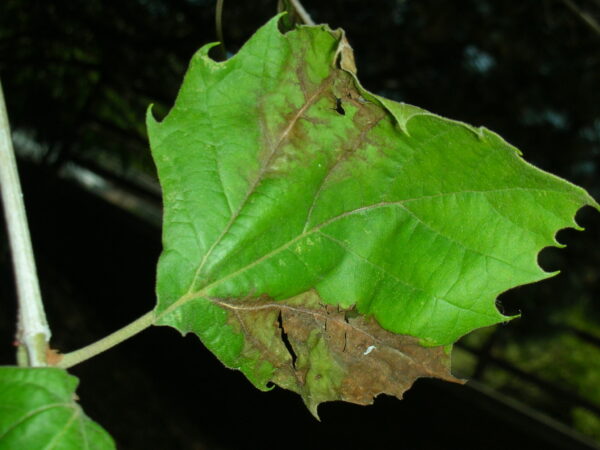
Figure 1. Anthracnose is a yearly problem on sycamore in the Midwest. Photo by Janna Beckerman.
Anthracnose. Anthracnose diseases probably are the best-known foliar fungal diseases of deciduous trees. They affect many ornamental trees including major shade-tree genera such as sycamore (Platanus spp.), oak (Quercus spp.), maple (Acer spp.), elm (Ulmus spp.) and ash (Fraxinus spp.) (Fig. 1). Anthracnose actually is a general term describing symptoms such as dead irregular areas that form along and between the main vein of the leaf. The leaves may also become curled and distorted and twigs may die back. The fungus overwinters in infected twigs and the petioles of fallen leaves, and the spores disseminate in the spring by wind and splashing rain. The disease, while unsightly, rarely results in the tree’s death. Sycamores and other trees often withstand many years of partial defoliation. However, one anthracnose disease is more serious. Dogwood anthracnose (Discula destructiva) is a devastating problem on the Eastern seaboard, but has not been a significant issue here in Indiana.
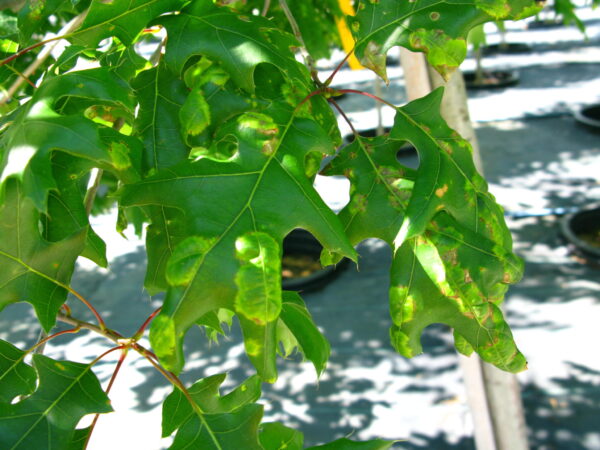
Figure 2. Leaf blister on oak. Photo by Janna Beckerman
Leaf blisters result in the blistering, curling and puckering of leaf tissue. Oak leaf blister (Taphrina caerulescens) is a common blister disease of oaks (Fig. 2)., particularly the red oak subgenus, which includes Northern red oak (Q. rubra) and pin oak (Q. palustris) among others. The symptoms begin as a slight yellowing of the infected leaf followed by round, raised blisters. These turn brown, and the infected leaves fall prematurely. This fungus overwinters as spores on the buds.
Leaf spot is a general symptom caused by a multitude of pathogens and infect all deciduous trees and shrubs, and include dead spots with a defined boundary between living and dead tissue. The dead tissue often separates from the surrounding living tissue creating a “shot-hole” appearance on the infected leaves. Common hosts include dogwood, maples, hydrangea, rose, holly, and Indian-hawthorn.
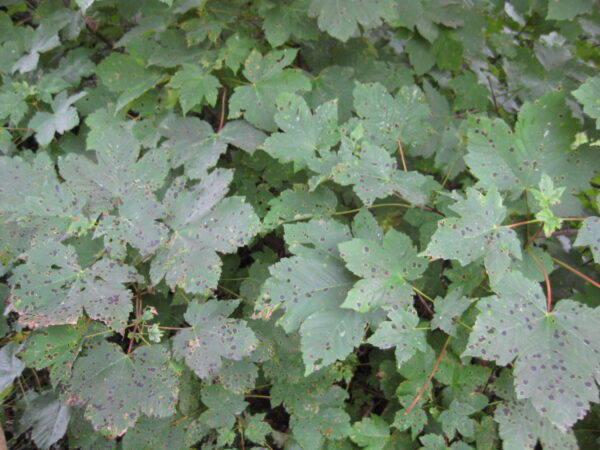
Figure 3. Tar spot is increasing in incidence and severity in Indiana. Photo by Janna Beckerman.
Tar spot (Rhytisma spp.) is a leaf disease with initial symptoms similar to leaf spot. The disease is most common on red (Acer rubrum) and silver maple (A. saccharinum) (Fig.3), but it can occur on a wide range of maple species from sugar (A. saccharum) and Norway (A. platanoides) to bigleaf maple (A. macrophyllum). The symptoms begin in the spring as small greenish-yellow spots on the upper leaf surface that, by mid-summer, progress to black tar-like spots about 0.5 inch in size. The disease is not fatal to the tree, but the appearance of the tar spots alarms some tree owners. A major outbreak in New York about 10 years ago left many maples completely defoliated by mid-August.
Resources:
Diplodia Tip Blight of Two-Needle Pines, The Education Store, Purdue Extension resource center
Boxwood Blight, The Education Store
Disease of Landscape Plants: Cedar Apple and Related Rusts on Landscape Plants, The Education Store
Planting Your Tree Part 1: Choosing Your Tree, Purdue Extension – Forestry & Natural Resources (FNR) YouTube Channel
Tree Planting Part 2: Planting a Tree, Purdue Extension – FNR YouTube Channel
Find a Certified Arborist, Trees are Good-International Society of Arboriculture (ISA)
Video: Step by Step to Find an Arborist, Trees are Good-International Society of Arboriculture (ISA)
Professional Forester, Indiana Forestry Woodland Owners Association
District Forester, Indiana Department of Natural Resources, 10+ acres
Trees and Storms: Understanding Damage, Risk and Recovery – Got Nature? Blog, Purdue Extension – FNR
Why Is My Tree Dying? – Got Nature? Blog, Purdue Extension – Forestry and Natural Resources
Tree Risk Management – Got Nature? Blog, Purdue Extension – FNR
Tree Pruning Essentials, Publication & Video, The Education Store
Tree Wound and Healing, Got Nature? Blog, Purdue Extension – FNR
What are Invasives Species and Why Should I Care?, Got Nature? Blog, Purdue Extension – FNR
Subscribe – Purdue Extension-FNR YouTube Channel
Janna Beckerman, Professor of Plant Pathology
Purdue Department of Botany and Plant Pathology

Recent Posts
- Spring Storms Are Coming: How to Reduce Tree Damage and Risk
Posted: May 1, 2026 in How To, Urban Forestry, Wildlife, Woodlands - Cryptocline Leaf Spot (Anthracnose) of Elm, Purdue Landscape Report
Posted: April 30, 2026 in Disease, Forestry, Woodlands - Mechanical Damage to Trees: Mowing and Maintenance Equipment
Posted: April 24, 2026 in Forestry, Forests and Street Trees, Urban Forestry - Spring Into Bloom With ID That Tree
Posted: April 20, 2026 in Forests and Street Trees, Urban Forestry, Woodlands - Question: Have Whippoorwill Birds Declined in Numbers?
Posted: in Ask the Expert, Wildlife - Invasive Species in Eastern Forests, Webinar Series
Posted: in Invasive Insects, Invasive Plant Species, Urban Forestry, Wildlife - Tree Risk Management: What Every Property Owner Needs to Know
Posted: April 17, 2026 in Forests and Street Trees, Wildlife, Woodlands - As the spring wildflowers emerge, so do the woodland invaders
Posted: April 16, 2026 in Forestry, Forests and Street Trees, Invasive Plant Species - Roadside Rehab: Rebuilding Soil and Cover After Utility Damage, Purdue Landscape Report
Posted: April 15, 2026 in Alert, Forests and Street Trees, Urban Forestry, Wildlife, Woodlands - Ash Trees have Disappeared. What is Taking Their Place?
Posted: in Forestry, Urban Forestry, Woodlands
Archives
Categories
- Alert
- Aquaculture/Fish
- Aquatic/Aquaculture Resources
- Ask the Expert
- Christmas Trees
- Community Development
- Disease
- Drought
- Forestry
- Forests and Street Trees
- Gardening
- Got Nature for Kids
- Great Lakes
- How To
- Invasive Animal Species
- Invasive Insects
- Invasive Plant Species
- Land Use
- Natural Resource Planning
- Nature of Teaching
- Plants
- Podcasts
- Ponds
- Publication
- Safety
- Spiders
- Timber Marketing
- Urban Forestry
- Webinar
- Wildlife
- Wood Products/Manufacturing
- Woodland Management Moment
- Woodlands