 Purdue University - Extension - Forestry and Natural Resources
Got Nature? Blog
The Invasive Terrestrial Plant Rule was signed by Governor Holcomb and published on March 18, 2019. the rule goes into effect 30 days after publishing, so it will be effective in April.
The Rule States that a person must not: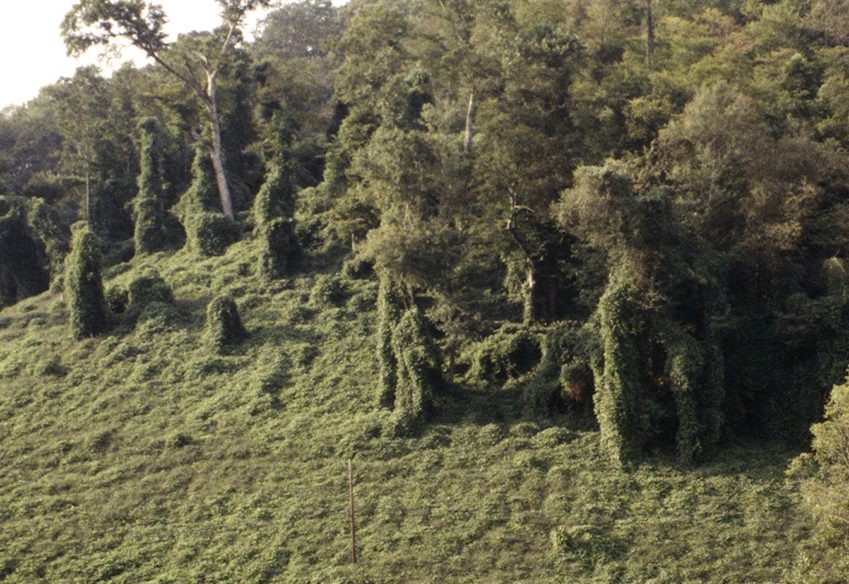
- sell, offer or grow for sale, gift, barter, exchange, or distribute a species;
- transport or transfer a species;
- introduce a species
with respect to the 44 invasive plant species (see full list in the Landscape Report).
Note: Selling, offering, distributing and transporting doesn’t go into effect until April of 2020, so nurseries will have some time to sell down their stock. This is an important component of the rule to minimize economic loss to nurseries that grow and/or sell the few commercially available species that are on the list. Currently there is no mandate to eradicate existing plantings in nurseries, landscapes, or forested areas
To learn more about what an invasive species is, what damage they do, what Indiana is doing, and more please read the Landscape Report, Terrestrial Invasive Species Rule Signed by Indiana Governor.
Resources
Mile-a-Minute Invasive Vine Found Indiana, Got Nature? Blog
Invasive plants: impact on environment and people, Purdue Extension The Education Store
Invasive Plant Species in Hardwood Tree Plantations, The Education Store
Invasive Plant Species: Callery Pear, Purdue Extension The Education Store
Invasive Plant Species: Wintercreeper, Purdue Extension The Education Store
Invasive Plant Species Oriental Bittersweet, Purdue Extension The Education Store
Report Invasive Species, Purdue Invasive Species
The GLEDN Phone App – Great Lakes Early Detection Network
EDDMaps – Early Detection and Distribution Mapping System (Report Invasives)
Cooperative Invasive Species Management Area (CISMA)
Indiana Department of Natural Resources: Invasive Species
Indiana Invasive Species Council
Indiana Department of Natural Resources (IDNR)
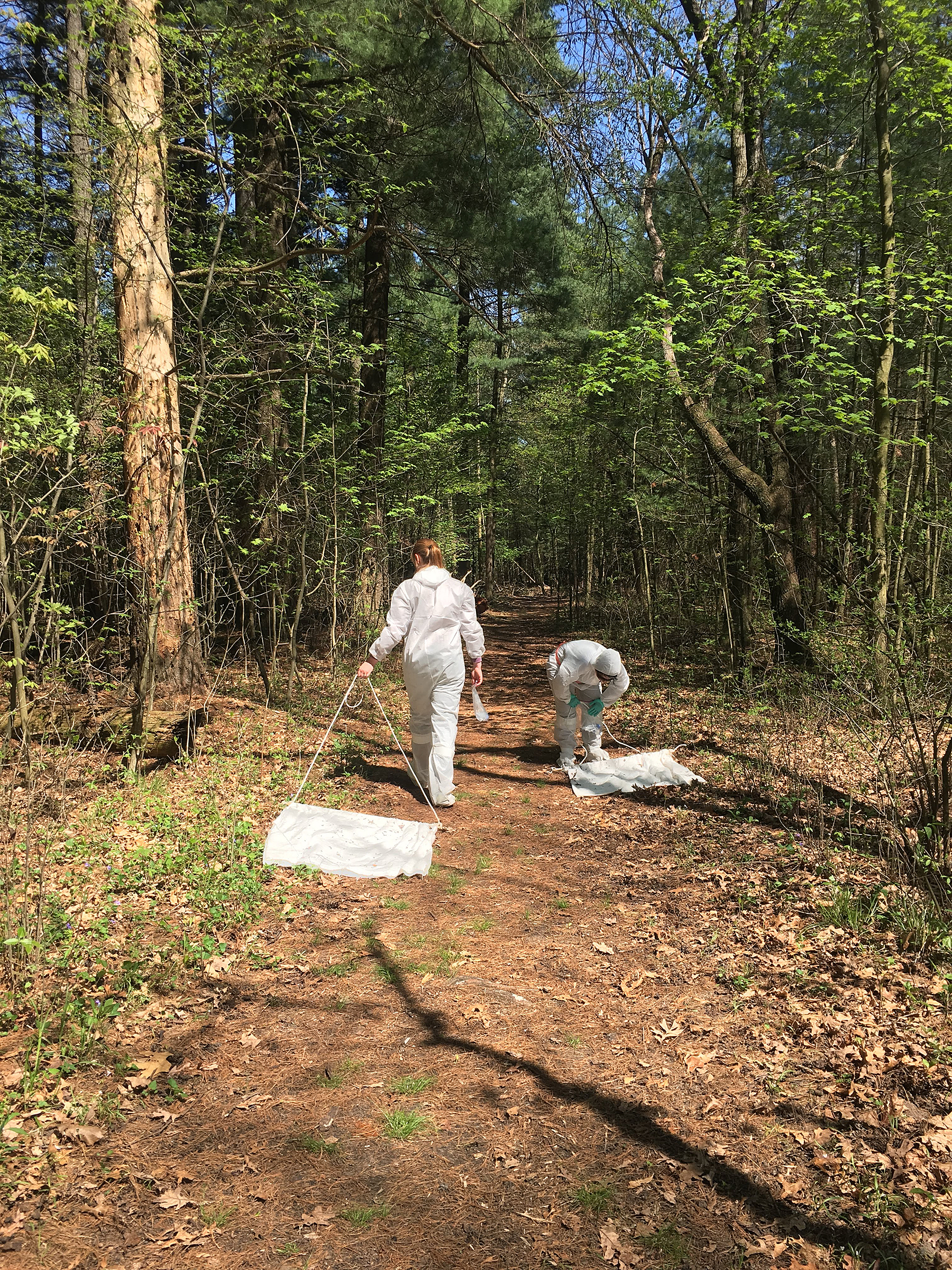
Scientists from Purdue’s Tick INsiders program, Lauren Hagen (left) and Maria Muriga (right), drag and check tick cloths at Tippecanoe River State Park in 2018. The program is looking for high school students and citizen scientists interested in helping with tick collections this year. (Tick INsiders photo)
Purdue University’s Tick INsiders program is looking for Indiana high school students and other Indiana residents willing to roll down their sleeves to get involved in a citizen science project.
Cate Hill, a Purdue professor of entomology, leads this effort to analyze the bacteria and viruses in Indiana’s ticks to build an understanding of what they are carrying and how that might impact human health. To do that, she needs volunteers to collect ticks from all over the state.
This year the Tick INsiders program will provide training for up to 50 students. Citizen scientists are also now welcome to collect and send ticks to Hill’s lab.
“It’s really important work. The Centers for Disease Control and Prevention reports that human cases of tick-borne diseases doubled from 2004 to 2016. If we’re going to get a handle on that and develop strategies for reducing tick bites and treating patients, we need to know where our ticks are and what our ticks are carrying around inside them,” Hill said. “That means we need a lot of ticks, and we need help collecting them.”
Three species of ticks – the blacklegged or deer tick, the lone star tick and the American dog tick – are found in Indiana. These ticks can transmit multiple pathogens, nine of which are known to cause human illnesses, though not all have been identified in Indiana. The Indiana State Department of Health reports more than 100 cases of Lyme disease each year and dozens of cases of Ehrlichiosis, anaplasmosis and Rocky Mountain spotted fever.
Research suggests that ticks can carry a cocktail of microbes – bacteria and viruses – that can sicken bite victims and may work in concert to affect the severity of an illness and human immune response.
“Not all tick bites are the same. We don’t know what is passed from a tick to a human each time someone is bitten, which means that health care professionals may need to consider multiple tick-borne pathogens in a person who has been bitten by a tick,” Hill said. “This program improves our knowledge so that we can improve our outcomes.”
Indiana residents interested in participating can collect ticks and send them to Hill’s lab for analysis. Videos on safe and proper collection techniques, as well as how to send ticks will be at Tick INsiders.
For full article, see Purdue Agriculture News.
Resources
Ticks 101: A Quick Start Guide to Indiana Tick Vectors, The Education Store – Extension Resource
The Biology and Medical Importance of Ticks in Indiana, The Education Store
Mosquitoes, Purdue Extension Entomology
One Small Bite: One Large Problem, Got Nature?, Purdue Extension-Forestry and Natural Resources
Mosquitoes and ticks – little pests carry big risks, Got Nature?
Catherine A Hill, Professor of Entomology/Vector Biology
Purdue University Department of Entomology

Empty cage trap with door open. Image taken by Doug Beckers and courtesy of flickr.com.
Having raccoon, groundhog, or other bothersome wildlife problems? Thinking about setting traps to catch these animals? There is much to consider when using traps. Take a look at the latest publication for best results.
Wildlife specialists Brian MacGowan and Rick Shadel have collaborated to bring you this new publication: Considerations for Trapping Nuisance Wildlife with Box Traps.
Homeowners commonly set traps to capture and remove wildlife from their home or yard. Setting a box trap improperly can decrease their effectiveness and even lead to safety risks to both people and wildlife. The purpose of this publication is to 1) outline the legal and ethical factors homeowners should consider before setting a trap, 2) review the basic procedure for effectively trapping wildlife, and 3) help you to determine the fate of the captured animal.
If you have a serious, dangerous, or a nuisance wildlife issue, you may want to consider hiring a professional. Consider reading this publication before deciding whether or not you need to hire a professional: Selecting a Nuisance Wildlife Control Professional.
Resources
Preventing Wildlife Damage – Do You Need a Permit? – The Education Store, Purdue Extension resource center
Selecting a Nuisance Wildlife Control Professional, The Education Store
How to Construct a Scent Station, The Education Store
Question: How do I properly relocate raccoons from my attic?, Got Nature? Blog, Purdue Extension FNR
Nuisance Wildlife – Indiana Department of Natural Resources
Brian MacGowan, Wildlife Extensions Specialist
Purdue Forestry and Natural Resources
Kristol from Tippecanoe County, IN, sent in question to the Purdue Extension-Forestry and Natural Resources experts (Ask an Expert ) asking what resources are available to help with landscaping for a front yard and sidewalk area that accumulates water after a hard rain. She also asked for resources to improve drainage.
Purdue Extension has several articles and resources to help with this type of situation.
The resources in our Rainscaping and Master Gardeners Program shares several neat options:
Rain Gardens Go with the Flow, Indiana Yard and Garden, Purdue Horticulture
Rainscaping Program
Master Gardeners Program
Don’t miss the publications located in the Purdue Extension resource center, The Education Store, relating to the topic:
Tree Installation: Process and Practices
Planting Forest Trees and Shrubs in Indiana
Climate Change: How will you manage stormwater runoff?
For Midwest Landscapes, have a look at the Purdue Landscape Report:
Purdue Landscape Report
Check out upcoming workshops available for land and woodland owners, to talk with an expert:
Purdue Extension-Forestry and Natural Resources Calendar
Check out our Got Nature? posts as well, as this is always a great resource for new information:
Got Nature?, Forestry and Natural Resources-Purdue Extension
These resources give you lots of options that match what your looking for along with experts in the field to contact if needed.
We always appreciate the questions coming in, so keep them coming. Our experts will respond quickly and give you the guidance you need for your next steps.
Diana Evans, Extension Information Coordinator
Purdue Forestry and Natural Resources
This looks to be shaping up as a tough winter for us and our trees. Lots of snow and ice are predicted for the Hoosier state and this can be a challenge for our trees and shrubs.
After a heavy snowfall, protect your trees and property with these simple tips:
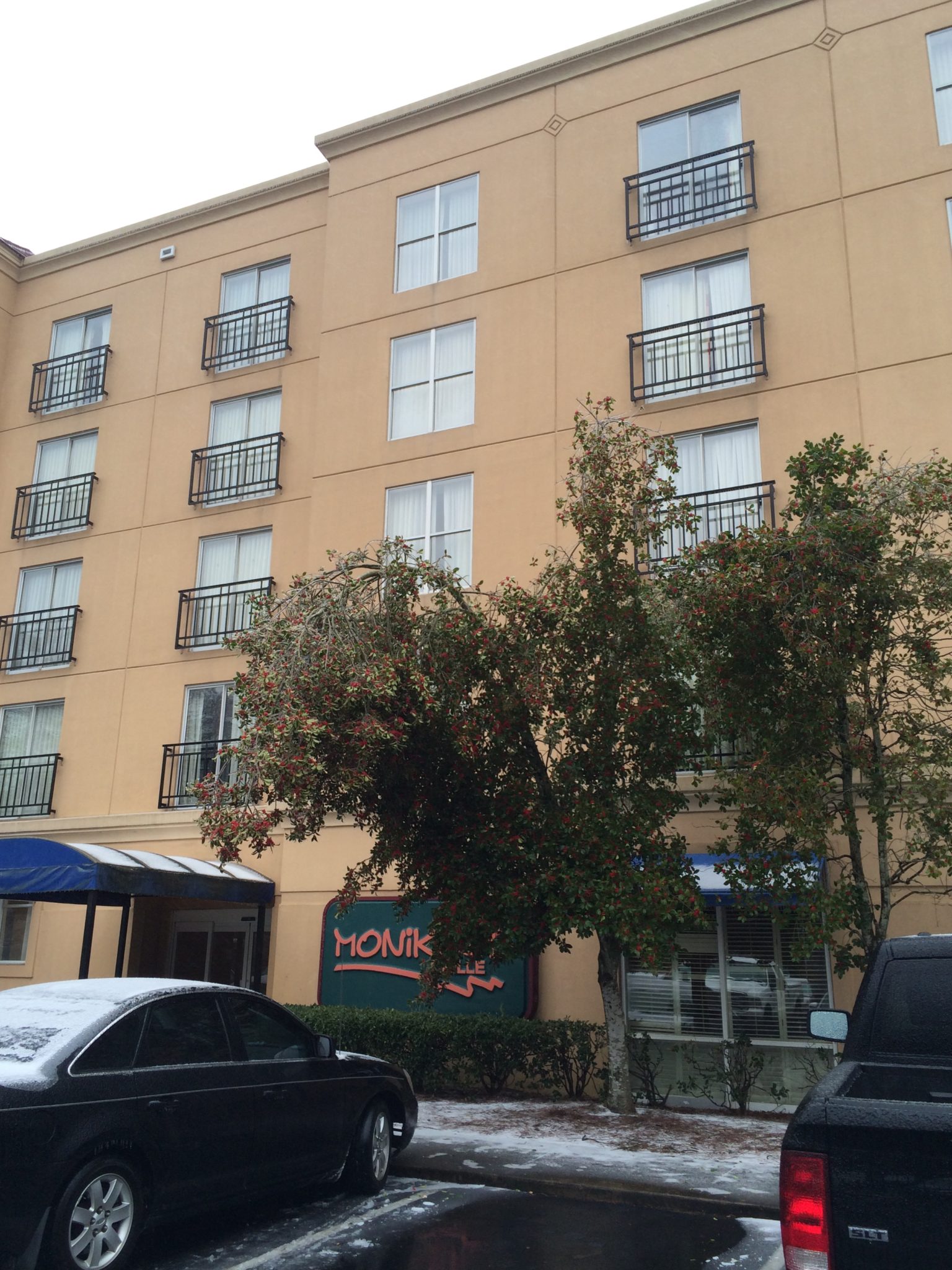
Limbs bending from ice loading.
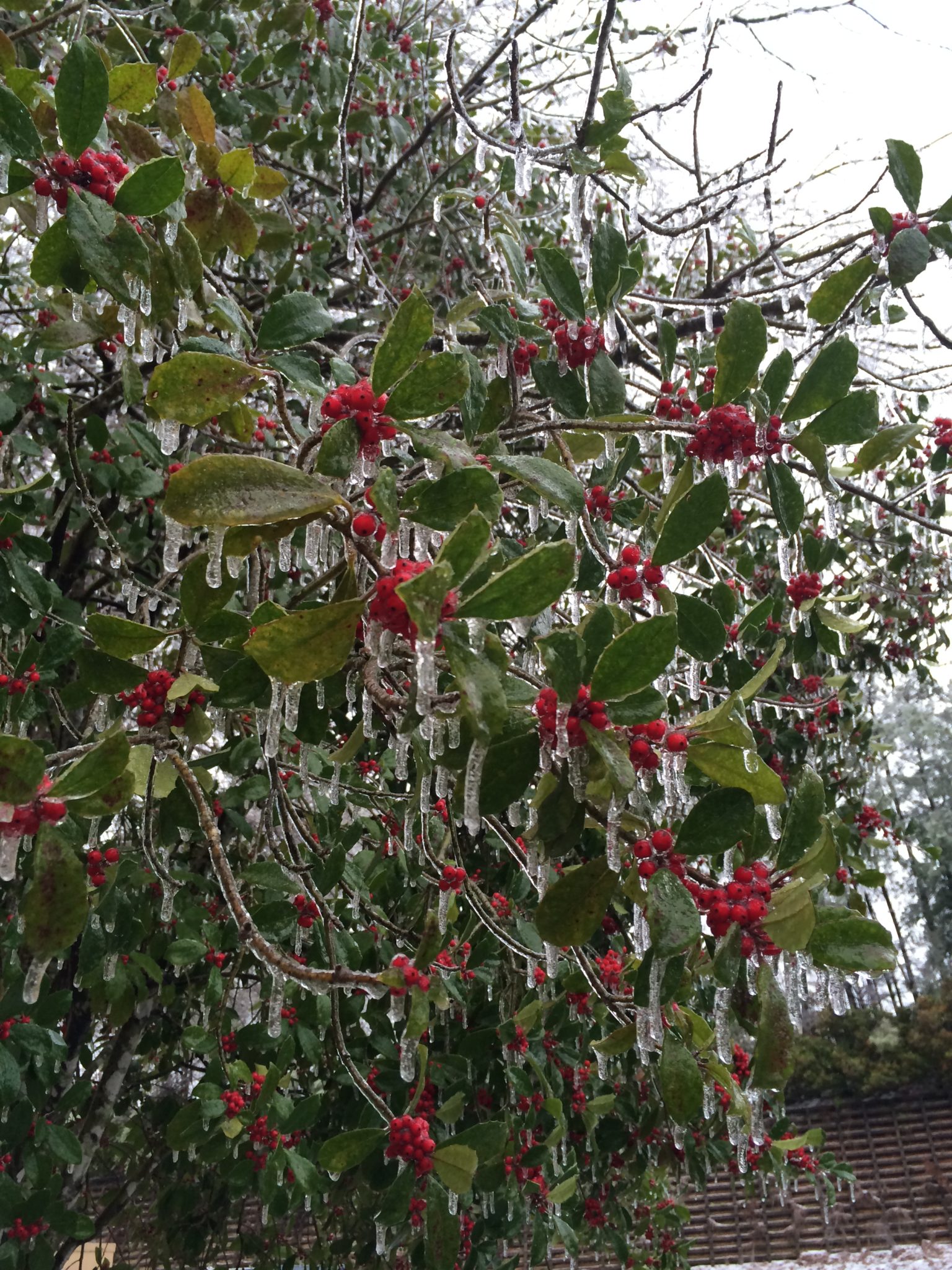
Ice accretion on hawthorn branches.
Do not shake limbs to try to remove snow or ice.
When you find your trees are bending or drooping as a result of ice or snow accumulation, your first instinct is probably to shake the branches or knock the weight off with a broom or something similar. This may cause worse damage or actually cause the branch to snap off. Stop right there! Healthy tree branches are flexible, so knocking off the accumulation of snow or ice accretion may cause them to “snap” back, potentially damaging their food and water transport system. The results of the damage may not be evident until next spring.
Trees that tend to suffer the worst damage as a result of snow and ice are upright evergreens, like arborvitae and juniper, and clump trees, like birch. And, when it comes to ice, age does not make a tree stronger; younger trees are better at actually overcoming damage in ice storms.
Hire a Professional.
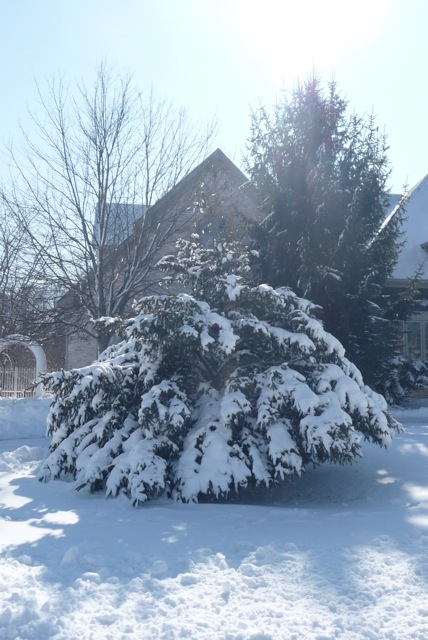
Snow weighing down spruce branches.
Safely remove broken limbs.
Broken and hanging branches can be a threat to people and property. If a limb breaks off from the weight of ice or snow and remains in the tree canopy, have it removed and the remaining stub properly pruned to the branch collar as soon as weather allows. The tree will recover better when properly pruned. For undamaged limbs bending under the weight of ice or snow, don’t prune as a means of correcting the situation. Be patient. It takes time for wood fibers in the limbs to return to its natural position.
Always be mindful of walking or parking under branches loaded down by snow or ice as they may snap and fall, causing injury or damage. If a limb breaks and becomes entangled in power lines, notify your utility company immediately. Never approach a downed power line or a branch touching a utility line.
If there is substantial damage to your tree, have an arborist examine damaged branches and limbs for signs of weakness and injury for reparations. It is best to always hire an ISA Certified Arborist. To find an arborist in your area, visit the website, www.treesaregood.org
How can you help prevent ice damage to trees? Proper pruning is one way. Particularly important is the removal of poor branch attachments and weak branch structure in the tree, prior to winter. For more information on pruning, download the publication, Tree Pruning Essentials.
Full article published in the Purdue Landscape Report.
Resources
Avoid Deadly Risk of Dying Ash Trees with Timely Tree Removal, Got Nature? Purdue Extension-FNR
New Hope for Fighting Ash Borer, Got Nature? Purdue Extension-FNR
Invasive Pest Species: Tools for Staging and Managing EAB in the Urban Forest, Got Nature?
Emerald Ash Borer, Purdue Extension-Entomology
Emerald Ash Borer Tools & Resources – Purdue Extension Entomology
Corrective Pruning for Deciduous Trees, The Education Store, Extension Publications
Lindsey Purcell, Chapter Executive Director
Indiana Arborist Association
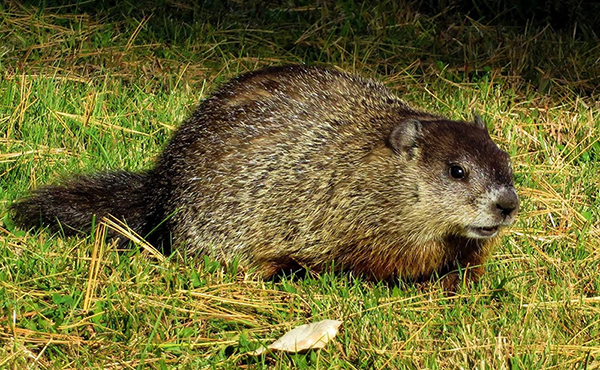 Groundhogs are good at many things, said Brian MacGowan, Purdue University Extension wildlife specialist and Forestry and Natural Resources Extension coordinator, but predicting the weather definitely isn’t one of them.
The lore surrounding Groundhog Day originated in Germany where people used the reactions of badgers and hedgehogs to gauge weather patterns. When the tradition eventually migrated to America, Jarred Brooke, Extension wildlife specialist, said hedgehogs, which can be found throughout the United States, became the mammalian forecaster of choice.
“They’re crafty little critters,” McGowan explains, “which is why they’re found in so many different places. They’re habitat generalists and can live in open woodlands, grasslands, what have you.”
While MacGowan and Brooke agreed groundhogs don’t have a great track-record of weather prediction, other facts make groundhogs one of the more interesting members of the squirrel-family.
For full article see: Groundhogs can’t predict the weather but they do poop underground.
Resources:
Selecting a Nuisance Wildlife Control Professional – The Education Store, Purdue Extension Resource Center
Preventing Wildlife Damage – Do You Need a Permit? – The Education Store
The Basics of Managing Wildlife on Agricultural Lands – The Education Store
Nuisance Wildlife – Indiana Department of Natural Resources
Dealing with nuisance geese this spring – Got Nature?
Animal Damage Management: Woodchucks, The Education Store
Brian MacGowan, Wildlife Extension Specialist
Purdue University, Forestry and Natural Resources
Jarred Brooke, Wildlife Extension Specialist
Purdue University, Forestry and Natural Resources
Emerald ash borer (EAB), the most destructive forest pest to enter North America has left hundreds of millions of dead ash trees in its wake. Although this pest has been found throughout our state, many of Indiana’s ash trees are still alive, or dead and still standing. Ash trees killed by emerald ash borer, become extremely brittle and break easily as they decline. Branches can fall on people and property in snowstorms, with a light breeze, or even on a calm clear day. Danger could be hanging over your head in the street, in the forest, and even in your backyard.
Why does emerald ash borer make ash trees so brittle?
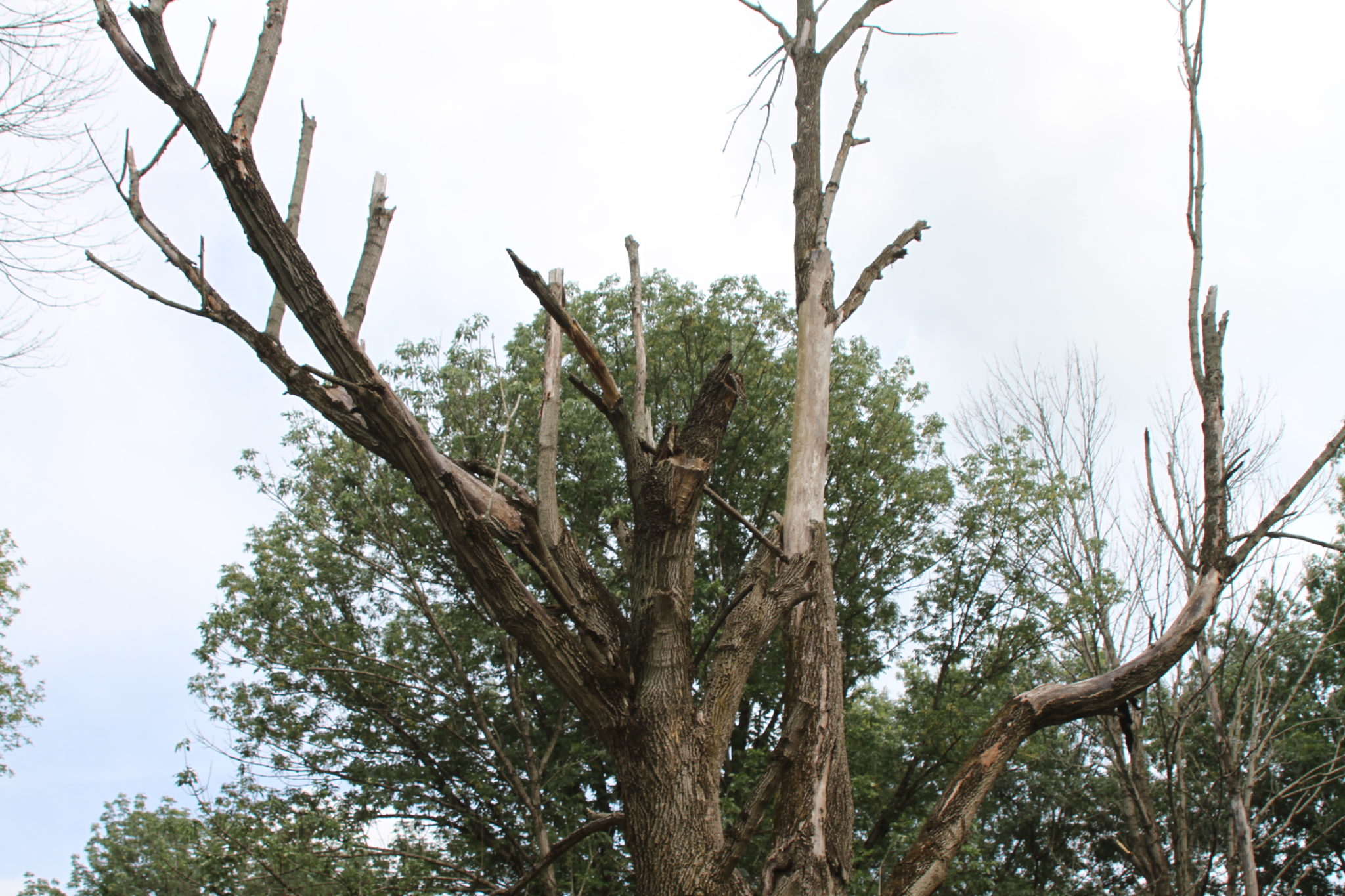
Large ash limbs that have broken off in the upper canopy.
Unlike elms, oaks, and maples, ash trees use a thin ring of conducting tissue to supply water from the roots to the entire tree. Emerald ash borer grubs will damage these functional water pipes as they chew just beneath the bark inside trunks and branches. This causes the tree to dry quickly and the structural wood to become prone to cracking. Internal breaks in the structural wood that bear the weight of the tree are often hidden from view by tree bark. As such, limbs can break and fall at any point along the branch at any time. It is not uncommon to have sizable limbs snap 30 feet off the ground on a calm day.
The threat of falling limbs is not limited to just dead ash. A comparative study of ash trees conducted in Ohio shows that structural integrity of ash trees can begin to decline even when trees are mostly green and have two thirds of the canopy still intact.
What should I do to protect myself from falling ash trees and limbs?

If your tree has lost less than 30% of its canopy hire a professional to protect the tree.
If the tree has lost more than 30% of the canopy, make plans to remove it. Delaying removal allows the tree to become more brittle and the problem more dangerous. Remember, EAB causes progressively more injury to ash trees as time goes on. The dead parts never come back to life.
If you have been treating your tree continue to do so.
How should I remove the tree?
To minimize risk of harm, hire a trained professional who has experience removing emerald ash borer damaged trees. The International Society of Arboriculture maintains a directory of Certified Arborists and their credentials. They can help find an arborist near you. Always get bids from more than one contractor. Be sure your contractor is insured and bonded in case of an accident. Professionals are happy to share this information.
Some homeowners might be hesitant to remove dead ash trees because they provide valuable habitat for a range of woodland animals and mushrooms. However, we do not recommend keeping them standing unless you can guarantee that no people, domesticated animals, or property will ever be in their path if they fall. If you have a dead tree that can’t be felled right away or ever, stay away from it until after it has fallen.
Article courtesy of the Landscape Report.
Resources:
New Hope for Fighting Ash Borer, Got Nature? Purdue Extension-FNR
Emerald Ash Borer, Purdue Extension-Entomology
Emerald Ash Borer Cost Calculator – Purdue Extension Entomology
Lindsey Purcell, Urban Forestry Specialist
Purdue Forestry and Natural Resources
Elizabeth Barnes, Exotic Forest Pest Educator
Purdue Entomology
Cliff Sadof, Professor, Ornamental, Pest Management
Purdue Entomology Extension Coordinator
 This unit highlights the resources required to produce food and the food wasted along each step of the food production system. It contains two lessons: Producers, Consumers, and Natural Resources; and Food Waste from Farm to Fork, along with all necessary overviews, notes, and resources.
For more details and free downloadable PDF see FNR-558-W publication at The Education Store: Food Waste and Natural Resources Lesson Plans.
Resources
What a Waste of Food!, lesson plans, The Education Store, Purdue Extension’s resource center
Food Waste Lesson Plans, Nature of Teaching
Rebecca Busse, Nature of Teaching Program Coordinator
Purdue Department of Forestry and Natural Resources
Rod N Williams, Engagement Faculty Fellow & Associate Professor of Wildlife Science
Purdue University Department of Forestry and Natural Resources
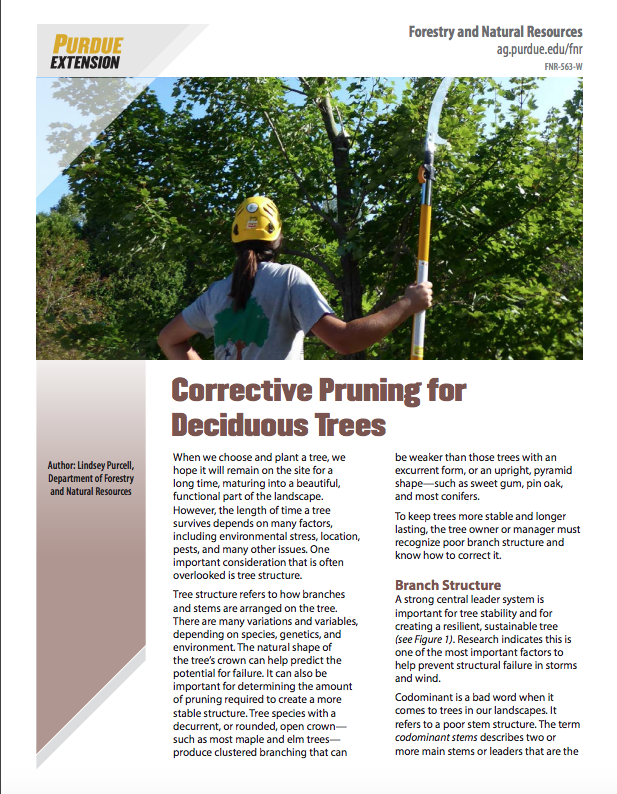
How do I remedy poor branching? Is my tree at risk of splitting, and how can pruning prevent that? Corrective pruning has many implications for tree structure, health, and longevity. Developing a strong, central branch structure in a deciduous tree is critical for preventing structural failure caused by storms, wind, and ice. This 8-page publication explains the problems resulting from a co-dominant stem structure and addresses pruning strategies for correcting poor structure.
To view this full publication please go to Corrective Pruning for Deciduous Trees located in The Education Store, Purdue Extension’s resource center.
Resources
Preparations to Prevent Southwest Tree Injury, Got Nature? Blog
When do you stake a tree?, Got Nature? Blog
Top 5 List for Tree Selection and Planting, Got Nature? Blog
Tree Selection for the “Un-natural” Environment, The Education Store, Purdue Extension
Tree Support Systems, The Education Store, Purdue Extension
Tree Installation: Process and Practices, The Education Store, Purdue Extension
Planting Your Tree Part 1: Choosing Your Tree, video, The Education Store, Purdue Extension
Lindsey Purcell, Urban Forestry Specialist
Purdue Forestry and Natural Resources

A large flock of birds flying over a field. Photo: Indiana DNR
The latest Wildlife Bulletin, provided by the Indiana Department of Natural Resources-Division of Fish and Wildlife, has all the Indiana hunting information you need to know along with upcoming events and resources. Topics include: Get your deer licenses now; Deer hunting checklist; Deer processing videos on YouTube; Hunting seasons dates; Four options to check in game; Sandhill crane migration at Jasper-Pulaski; and much more.
The Wild Bulletin is a free email newsletter offering information about Indiana’s fish and wildlife resources and recreation opportunities. Subjects covered include profiles, information about hunting and fishing season dates, regulation updates, wildlife and fisheries research status reports, tips on wildlife watching and reminders about important dates for Hoosier outdoor enthusiasts.
To subscribe to this free e-newsletter visit Wild Bulletin, Indiana Department of Natural Resources.
Other resources:
State Parks, Indiana Department of Natural Resources (IN DNR)
Outdoor Indiana, Indiana Department of Natural Resources (IN DNR)
Indiana Department of Natural Resources

Recent Posts
- ID That Tree: Nannyberry Viburnum
Posted: July 22, 2026 in Forestry, Plants, Wildlife, Woodlands - ID That Tree: Eastern Swamp Privet
Posted: in Forestry, Plants, Wildlife, Woodlands - Jarred Brooke Receives Early Career Award for Prescribed Fire Work
Posted: July 20, 2026 in Forestry, Forests and Street Trees, Natural Resource Planning, Safety - Bovine Tuberculosis in Wild White-tailed Deer: Background and Frequently Asked Questions
Posted: in Disease, Natural Resource Planning, Wildlife - ID That Tree: Carolina Buckthorn
Posted: July 15, 2026 in Forestry, Wildlife, Woodlands - Bat Roost Reporting Tool
Posted: July 8, 2026 in Alert, Community Development, Invasive Animal Species, Wildlife - Pruning Highlight; Espalier Pruning: Training Trees into Living Patterns
Posted: in Forestry, Forests and Street Trees, Gardening - Thank You, Turkey Trackers! Your Brood Counts Make a Difference – MyDNR
Posted: in Alert, Community Development, Wildlife - Identifying Evergreens
Posted: June 24, 2026 in Forestry, Wildlife, Woodlands - Celebrate Pollinator Week With Flowers of June Tour
Posted: June 15, 2026 in Forestry, Gardening, How To, Wildlife
Archives
Categories
- Alert
- Aquaculture/Fish
- Aquatic/Aquaculture Resources
- Ask the Expert
- Christmas Trees
- Community Development
- Disease
- Drought
- Forestry
- Forests and Street Trees
- Gardening
- Got Nature for Kids
- Great Lakes
- How To
- Invasive Animal Species
- Invasive Insects
- Invasive Plant Species
- Land Use
- Natural Resource Planning
- Nature of Teaching
- Plants
- Podcasts
- Ponds
- Publication
- Safety
- Spiders
- Timber Marketing
- Urban Forestry
- Webinar
- Wildlife
- Wood Products/Manufacturing
- Woodland Management Moment
- Woodlands