 Purdue University - Extension - Forestry and Natural Resources
Got Nature? Blog
Purdue Landscape Report: Aspen, cottonwood, and poplar are all names for the fast-growing Populus tree species. Used widely for building materials, these trees are often located around ponds, riverbanks, and sloping areas toward water bodies (especially cottonwood). Cottonwood flowers produce little white tufted seeds that float through the air which a lot of people love (my kids included), unless it lands in their mouth. These beautiful trees are susceptible to a fungus that can cause significant damage under the right conditions: Marssonina (newer name is Drepanopeziza).
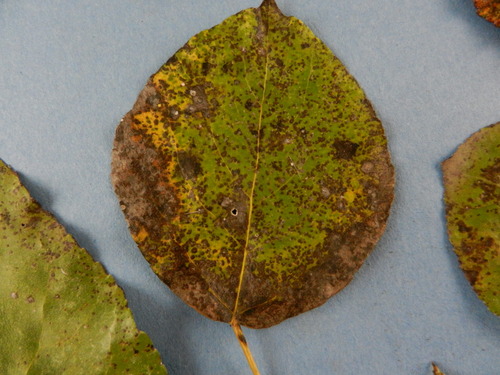
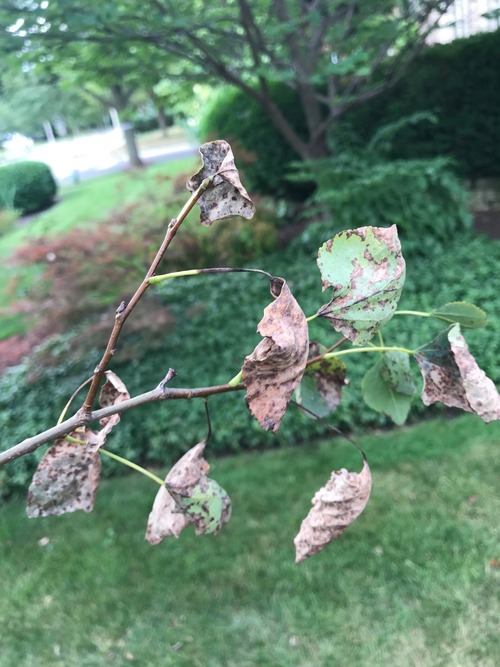
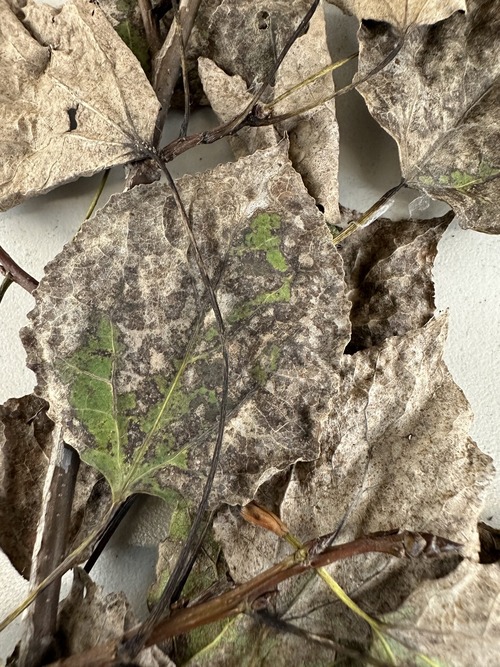
There are three species of Marssonina that can infect Populus – different tree species may only be susceptible to one of the Marssonina species. The fungi cause the same kind of disease and develop similarly on the host. Marssonina can infect the leaves, stems and seeds of Populus, which can lead to large amounts of leaf loss during wet weather, girdled stems and dieback, and aborted seeds. Since seeds can carry the fungus, the seed will take it with it to where it lands and can become infected immediately after germinating. It is common to see high disease severity in the canopy, but unless there is significant leaf loss (up to 70% defoliation) it may not reduce plant vigor. Leaf lesions typically develop as small black to brown dots or flecks which expand in size as time goes one. As the disease progresses, large areas of the leaf will become necrotic, creating odd dead blotches, potentially killing the majority of the leaf blade.
The fungus produces asexual spores in a small black pustule on the upper surface of the leaf which will eventually burst and release the spores during humid weather early in the spring. Marssonina will continue to produce spores and cause disease the whole season, creating repeat infections on the same tree. Symptoms tend to start lower in the canopy and ascend up the tree as the season progresses. The spores are spread by water splash, so rainfall will help spread this fungus in the landscape.
For trees planted in native landscapes, this disease will likely be inevitable and may make the foliage look less than stellar. That being said, removing leaves that drop or at the end of fall will reduce total inoculum for future seasons and can reduce total disease long-term. Similarly, trees that are stressed will typically develop increased disease severity, so if you are seeing large amounts of leaf spots or leaf loss, I would recommend employing stress mitigation strategies to keep the tree happy and healthy (fertilizer, mulch, irrigation as needed, etc.). If a tree appears to develop significant disease every year and has reduced limb growth, you may consider removing the tree if you are concerned it may die early and replace with a resistant clone, as disease susceptibility can vary greatly between clones of the same species.


View the original article on the Purdue Landscape Report website: Marssonina leaf spot and blotch of Poplar.
Subscribe and receive the newsletter: Purdue Landscape Report Newsletter.
Resources:
ID That Tree, Playlist, Purdue Extension – FNR YouTube Channel (Invasive White Mulberry, Siberian Elm, Tree of Heaven)
Eastern Cottonwood, Article, Purdue Fort Wayne
Find a Certified Arborist, Trees are Good-International Society of Arboriculture (ISA)
Video: Step by Step to Find an Arborist, Trees are Good-International Society of Arboriculture (ISA)
Professional Forester, Indiana Forestry Woodland Owners Association
District Forester, Indiana Department of Natural Resources, 10+ acres
Trees and Storms – The Education Store, Purdue Education’s resource center
Why Is My Tree Dying? – The Education Store
Tree Risk Management – The Education Store
Tree Pruning Essentials, Publication & Video, The Education Store
Tree Defect Identification, The Education Store
Planting Your Tree, video, Purdue Extension
Tree Installation, The Education Store
A Woodland Management Moment, Playlist, Purdue Extension – FNR YouTube Channel (Against Invasives, Garlic Mustard, Autumn Olive)
Woodland Stewardship for Landowners, Playlist, Purdue Extension – FNR YouTube Channel (Common Buckthorn, Japanese Barberry)
Indiana Invasive Species Council
Indiana Department of Natural Resources: Invasive Species
Subscribe – Purdue Extension-FNR YouTube Channel
John Bonkowski, Lead Extension Administrator
Purdue Department of Botany and Plant Pathology
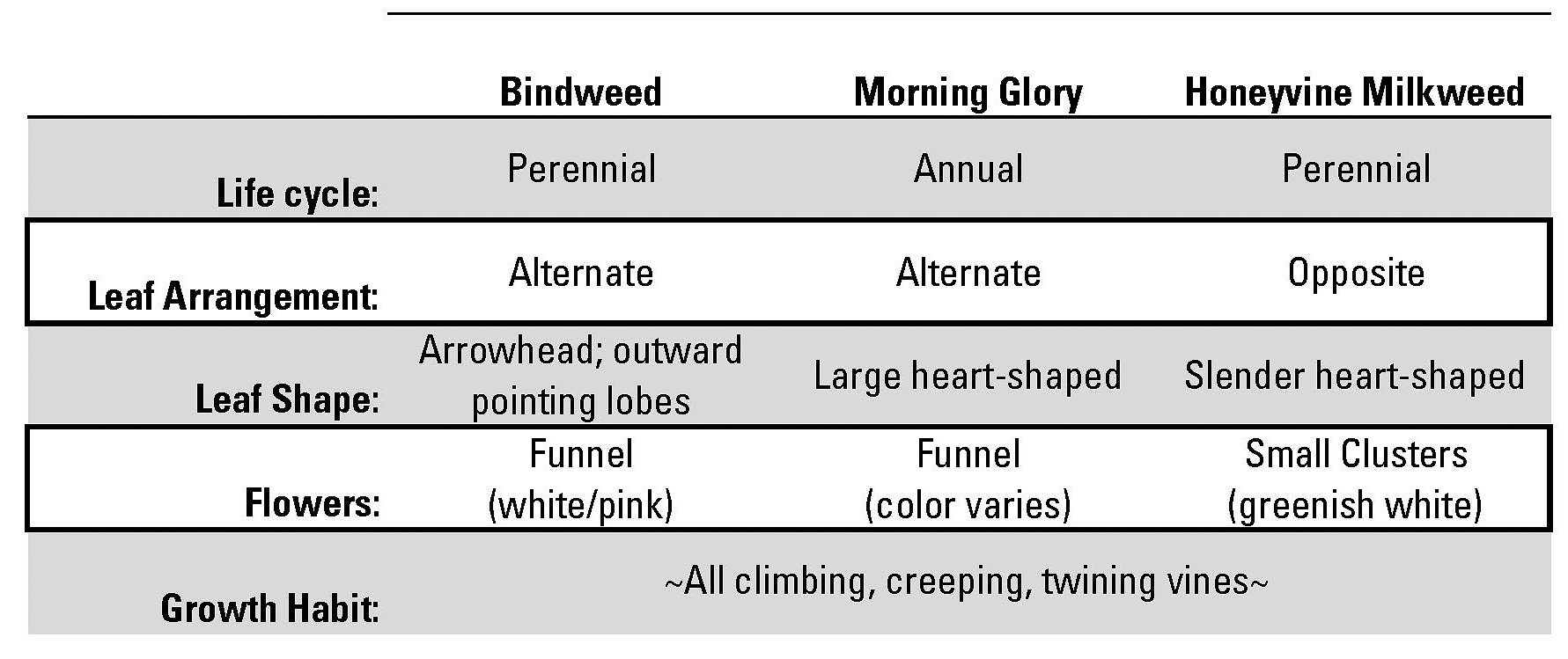
Figure 1. Chart comparing plant traits of bindweed, morning glory, and honeyvine milkweed. Credit: K. Mitchell
Purdue Landscape Report: Few garden problems cause as much frustration as untangling vines. Sometimes the vines are beautiful climbers planted with intention. Other times, they creep in uninvited and smother everything in their path. Among the most common, and the most confusing, vines in Indiana are bindweed, morning glory, and honeyvine milkweed. To the untrained eye, they look similar: all are fast-growing vines with heart-shaped leaves. However, there are noticeable differences in their physiological traits (Fig. 1) and ecological value. Recognizing the distinctions can improve management and help strike a balance between aesthetics, control, and ecological benefits.
Bindweed (Hedge bindweed: Calystegia sepium; Field bindweed: Convolvulus arvensis)
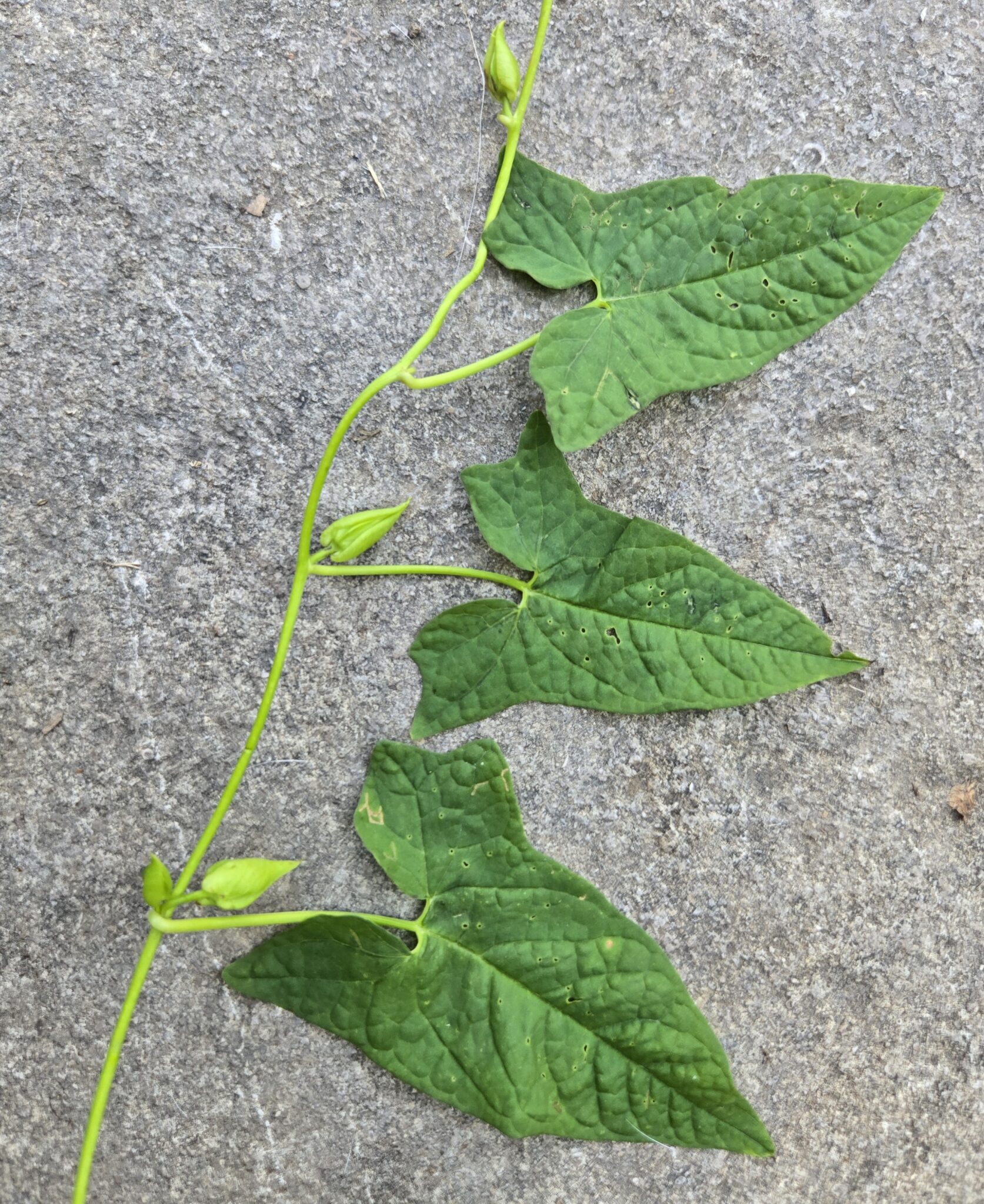
Bindweed is an aggressive vine with alternate, arrowhead-shaped leaves (Fig. 2) and small white or pink funnel-shaped flowers (Fig. 3). This perennial spreads readily from rhizomes (underground stems), forming vegetative colonies that become increasingly difficult to control. Hedge bindweed and field bindweed differ slightly in appearance, but both are aggressive invaders; in fact, field bindweed is listed as a prohibited noxious weed in Indiana. Cultural control methods, such as cultivation or light exclusion, can take 3 to 5 years to achieve eradication. The best results often come from combining these approaches with carefully timed herbicide applications.

Morning Glory (Ipomoea spp.)
Morning glories are a familiar vine often planted intentionally for their large, colorful flowers. Unlike bindweed, morning glory is an annual and dies off in winter. However, its abundant seed production allows it to return year after year. A single vigorous vine can produce hundreds of colorful, funnel-shaped flowers (Fig. 4) resulting in over a thousand seeds which may remain viable in the soil for decades. Morning glory will become weedy if left unmanaged. Thoughtful containment and regular deadheading can help to keep it under control.


Two types are most often seen (Fig. 5):
- Common morning glory (Ipomoea purpurea) has large, heart-shaped leaves and showy, funnel-shaped flowers in a wide variety of colors.
- Ivy-leaf morning glory (Ipomoea hederacea) has leaves with three distinct lobes that resemble ivy, and its smaller flowers are typically light blue or purple with white.
Honeyvine Milkweed (Cynanchum laeve)
Honeyvine milkweed has slender heart-shaped leaves like bindweed, but unlike bindweed, this native vine provides ecological value as a food source for monarch caterpillars. It’s easily distinguished from morning glory and bindweed by its opposite leaf arrangement (Fig. 6), small clusters of greenish-white flowers (Fig. 7), and long seed pods, typical of the milkweed family, that release hundreds of windblown seeds. While beneficial to pollinators, honeyvine can overwhelm a home landscape and should be contained to naturalized areas or pollinator gardens.


Correct identification is the first step toward effective management. Though bindweed, morning glory, and honeyvine milkweed are all fast-growing vines, they have key differences in their physiological traits and ecological value. Proper identification determines whether you are eradicating noxious weeds, containing ornamentals, or conserving natives where appropriate.
Quick Tips for Identification
- Leaf arrangement:
- Alternating leaves (only one leaf per node) – bindweed or morning glory
- Opposite leaves (two leaves per node) – honeyvine milkweed
- Flowers:
- White or pink funnel-shaped (~1 to 3 in) – bindweed
- Colorful funnel-shaped (2 to 4 in) – morning glory
- Small, greenish white clusters – honeyvine milkweed
- Seed pods:
- Tiny capsules – bindweed or morning glory
- Long pods with silky seeds – honeyvine milkweed
View the original article on the Purdue Landscape Report website: Untangling the Vines: Identifying Bindweed, Morning Glory, and Honeyvine Milkweed.
Subscribe and receive the newsletter: Purdue Landscape Report Newsletter.
Resources:
ReportINvasive, Purdue College of Agriculture
What are Invasive Species and Why Should I Care?, Got Nature? Blog, Purdue Extension – Forestry and Natural Resources
Large Spots on Maple Leaves that Look Like Tar, Purdue Extension News
Find an Arborist, International Society of Arboriculture
Fifty Common Trees of Indiana
An Introduction to Trees of Indiana
Native Trees of the Midwest, The Education Store
Shrubs and Woody Vines of Indiana and the Midwest, The Education Store
Tree Installation: Process and Practices, The Education Store
Planting Your Tree Part 1: Choosing Your Tree, Video, Purdue Extension – Forestry & Natural Resource (FNR) YouTube Channel
Investing in Indiana Woodlands, The Education Store
Forest Improvement Handbook, The Education Store
ID That Tree, Purdue Extension-FNR YouTube playlist
Purdue Plant and Pest Diagnostic Laboratory
Karen Mitchell, Consumer Horticulture Extension Specialist
Purdue Horticulture & Landscape Architecture
Purdue Extension was recently honored as the 2025 National Runner-up for the Innovation & Creativity: Team Award by the National Association of Community Development Extension Professionals (NACDEP) for its work in leading Wind Energy End-of-Service Listening Sessions.

Winning Team: Kara Salazar, Marty Huseman, Jon Charlesworth, and Tamara Ogle
Kara Salazar, assistant program leader for Community Development and Sustainable Communities extension specialist, and her team members, Tamara Ogle, Purdue extension community development regional educator, Jon Charlesworth, senior extension educator, and Marty Huseman, Purdue extension educator, partnered with the National Renewable Energy Laboratory (NREL) to organize and host listening sessions across the Midwest region, focused on wind turbine decommissioning and end-of-service considerations. These sessions created forums where community members and landowners could learn, ask questions and share their perspectives about what should happen when wind turbines reach the end of their life cycle. What roles different stakeholders should play, what responsibilities exist and how transitions can be managed fairly and transparently.
The goal of this work has been twofold. First, to ensure that public education about wind turbine decommissioning is accessible and tailored to local concerns. Second, to gather real on-the-ground insights from those most affected by end-of-service processes. Feedback from these listening sessions will directly inform NREL’s future research and resource development, helping ensure that when wind energy infrastructure transitions occur, communities are supported with the tools, knowledge and policies needed to navigate those changes.
This work also connects to Purdue Extension’s Wind Energy Resources, a collection of research, tools and outreach materials designed to help communities, landowners and local leaders understand the opportunities and challenges of wind development. These resources cover topics ranging from economic impacts and land use planning to community engagement and end-of-service issues, equipping Indiana residents and decision-makers with the information needed to make informed choices.
Other Resources:
Environmental Planning in Community Plans, The Education Store, Purdue Extension’s resource center
Enhancing the Value of Public Spaces: Creating Healthy Communities, The Education Store
Conservation through Community Leadership, The Education Store
Tree Installation: Process and Practices, The Education Store
Planting Forest Trees and Shrubs in Indiana, The Education Store
Planting Your Tree Part 1: Choosing Your Tree, Video, Purdue Extension – Forestry and Natural Resources YouTube Channel
Subscribe – Purdue Extension – Forestry and Natural Resources YouTube Channel
Purdue Extension-Forestry and Natural Resources Calendar, workshops and Conferences
Diana Evans, Extension and Web Communication Specialist
Purdue University Department of Forestry and Natural Resources
 We are thrilled to announce the launch of the Explore Oak Resources webpage — a dynamic new hub created by Purdue Forestry and Natural Resources Extension to celebrate and support one of Indiana’s most iconic tree groups: the oaks.
Whether you’re a landowner, educator, natural resource professional or simply an oak enthusiast, this comprehensive collection of science-based resources is designed to deepen your understanding and enhance your stewardship of oak ecosystems.
What You’ll Find
The new oak resource page is packed with tools and insights, including:
- Expert-reviewed publications on forest stewardship, oak regeneration, and habitat management
- Engaging videos like the ID That Tree series, featuring 17 oak species native to Indiana
- Webinars and podcasts exploring topics from oak woodland restoration to wildlife-friendly forestry
- Practical guides on threats like oak wilt and invasive beetles
- Seedling purchasing info for select white and red oak varieties developed at Purdue
Why Oaks Matter
Oaks are more than just majestic trees — they’re keystone species that support biodiversity, provide critical wildlife habitat and contribute to Indiana’s ecological and cultural heritage. With challenges like invasive pests and regeneration difficulties, informed management is more important than ever.
Start Exploring
Ready to dive in? Visit the new Explore Oak Resources page and discover how you can help steward Indiana’s oak landscapes for generations to come.
Other Resources of Interest:
Purdue Extension – Forestry and Natural Resources (FNR) YouTube Channel:
A Woodland Management Moment, Playlist
Conservation Tree Planting: Steps to Success
ID That Tree, Playlist
Ask an Expert: Tree Selection and Planting
Woodland Stewardship for Landowners Video Series, Playlist
The Education Store – Purdue Agriculture’s resource center:
Investing in Indiana Woodlands
Forest Improvement Handbook
Purdue University Press:
Shrubs and Woody Vines of Indiana and the Midwest
Native Trees of the Midwest
Purdue Extension – FNR Got Nature? Blog:
Learn How to Support Oak-Hickory Ecosystems
Inonotus Dryadeus, Butt and Root Rot of Oaks
Hardwood Tree Improvement & Regeneration Center (HTIRC):
Predicting the Height Growth of Oak Species Reproduction Over a 23-year Period Following Clearcutting,
Indiana Forestry & Woodland Owners Association (IFWOA):
Find an Indiana Professional Forester
District Foresters, Indiana Department of Natural Resources
Diana Evans, Extension & Web Communications Specialist
Purdue University Department of Forestry and Natural Resources
 IN-PREPared: As harvest 2025 continues across Indiana, unusually dry conditions have increased the risk of combine and field fires. Farmers and landowners are urged to take extra precautions: perform regular equipment maintenance, clean combines frequently to remove crop residue and keep fully charged fire extinguishers accessible at all times.
This season brings plenty of opportunities to enjoy campfires, cookouts and hayrides – but please enjoy these activities safely. Be mindful of fire safety, especially in dry areas, and always check for local burn bans before lighting any recreational fires.
Combine fires are a much too common sight throughout Indiana and the Midwestern corn belt during the fall harvest season. Sometimes these equipment fires spread to the surrounding fields and cause property damage and threaten or even take lives. Dry weather makes harvest-related fires even more likely. This site offers ready-to-use materials to help Extension staff, media outlets, emergency managers and agricultural organizations raise awareness about preventing combine and field fires — and responding safely if one occurs.
Click on the website to view more resources and information: Combine & Field Fires.
Resources:
FNR Ask The Expert: Prescribed Fire, Purdue Extension Forestry & Natural Resources
Wildlife Habitat Hints: Prescribed Fire Techniques, view – Point Source Fire, Ring Fire, Flanking Fire, Strip Head Fires, Backing Fire and Late Growing Season Prescribed Fire, Purdue Extension Forestry & Natural Resources YouTube Channel
October Is Firewood Month: Protect Indiana’s Forests by Making Smart Choices, Purdue Extension – FNR Got Nature? Blog
100 Year Project Shares New Video, Prescribed Fire, Purdue Extension – FNR Got Nature? Blog
Brooke’s Prescribed Fire Videos Utilized in Global USFS Efforts, Purdue Extension – FNR Got Nature? Blog
Renovating Native Warm-Season Grass Stands for Wildlife: A Land Manager’s Guide, The Education Store, Purdue Extension resource center
Prescribed fire: 6 things to consider before you ignite, Got Nature? Blog, Purdue Extension – 4Forestry and Natural Resources
An Introduction to Trees of Indiana, Purdue University Press
Native Trees of the Midwest, Purdue University Press
ID That Tree, Playlist, Subscribe to Purdue Extension – Forestry and Natural Resources YouTube Channel
A Woodland Management Moment, Playlist, Purdue Extension – FNR YouTube Channel
Forest Improvement Handbook, The Education Store
Finding help from a professional forester, Indiana Forestry & Woodland Owners Association
District Foresters for 10 plus acres, Indiana Department of Natural Resources
Ed Sheldon, Farm/Veteran Job Coach and Engagement Coordinator
Department of Agriculture & Biological Engineering, Purdue University
Purdue Landscape Report: The last week has caused many to struggle with whether to turn the heat on inside. Mornings have been quite chilly, and I am guessing several readers may have also struggled with the decision to wear a jacket as they started their workday. These are tough decisions, no doubt. Several data sources have suggested we have had at least 2 weeks of consecutive below-average daily mean temperatures. While not a record, this is certainly noticeable! Perhaps we are hoping those tomato plants will produce just a few more tomatoes. Is it mum season, already? The good news – for those not quite ready to say goodbye to warm days, not needing coats, and garden delights – is warm temperatures are expected to return. Daily high temperatures are already in the 80s and Indiana is likely to see temperatures in the mid-90s by next week. There is significant confidence that this warmer-than-normal temperature trend is likely to continue through most of September. Average high temperatures typically range from 75°F – 85°F in mid-September and 70°F – 75°F in late September, so keep in mind climate outlooks are all relative. Indiana is not likely to experience triple-digit heat waves over the next few weeks, but nighttime low temperatures are likely to fight for temperatures warranting a sweater or jacket.


There’s been a noticeable lack of precipitation with Indiana receiving well below-normal precipitation throughout the state over the past 30 days except for the northwestern counties. This has led to expansion of both Abnormally Dry (D0) and Moderate Drought (D1) areas across the state (Figure 1). Unfortunately, both forecasts and climate outlooks suggest this below-normal precipitation pattern is likely to continue for a while. Over the next 7 days, very little precipitation is expected across much of Indiana (Figure 2). This below-normal precipitation pattern is likely to continue through most of next week. After that, climate outlooks are favoring near-normal precipitation through September 24th.

Figure 3. Average date of the first fall frost where temperature first reach or drop below 28°F. (Purdue Landscape Report)
Regarding first frost or even hard frost, we are still too early in the calendar year to worry about this being an extensive risk. Very localized, low-lying areas may be susceptible, but the climatological average date of the first hard freeze (28°F) is often not until mid-to-late October (Figure 3). With temperatures expected to warm again, widespread hard frost is not anticipated prior to October.
Explore the latest Indiana climate and drought maps, including first freeze and frost probabilities, view the Purdue Indiana State Climate Office.
View the original article on the Purdue Landscape Report website: A False Sense of Autumn.
Subscribe and receive the newsletter: Purdue Landscape Report Newsletter.
Resources:
Alert – Water Your Trees, Watch Video, Purdue Extension – Forestry and Natural Resources Got Nature? Blog
Find an Arborist video, Trees are Good-International Society of Arboriculture (ISA)
ID That Tree, Playlist, Purdue Extension – FNR YouTube Channel
Summer Tree Care, Purdue Landscape Report
Drought? Don’t Forget the Trees!, The Education Store, Purdue Extension resource center
Extreme Heat Including Fact Sheets, Purdue Extension – IN-PREPared
Extreme Heat – Resources, Extension Disaster Education Network (EDEN)
Drought Information, Indiana Department of Natural Resources
Planting Your Tree Part 1: Choosing Your Tree, Purdue Extension YouTube Channel
Tree Defect Identification, The Education Store
Surface Root Syndrome, The Education Store
Submit Sample, Purdue Plant & Pest Diagnostic Lab
What Are Invasive Species and Why Should I Care?, Purdue Extension-FNR Got Nature? Blog
Invasive Species Playlist, Playlist, Purdue Extension – FNR YouTube Channel
Subscribe Purdue Extension-Forestry and Natural Resources YouTube Channel
Beth Hall, Indiana State Climate Office Director
Purdue University Department of Agronomy
It is natural to think of spring as the season of flowers in our woodlands, but summer can also provide some outstanding displays of native bloom. In addition, these flowers are often attracting some of our largest and showiest butterflies and bumblebees. Here are a few of the late summer flowers you may encounter in local woodlands. (Click on photos to enlarge.)
 Wood Nettle is a look-but-don’t-touch type of plant. While I find the foamy white flowers attractive, the stinging hairs along the stems and under the leaves feel like instant poison ivy. This is one of the reasons Foresters don’t wear short pants in the woods! It is a good indicator of moist and fertile soils.

Wingstem is a large plant with thin ridges along the stems providing the name. These head-high and taller plants of edges, thin woodlands and fertile soils put on a great display. It seems to be a common plant in black walnut plantations as both the good soils and light shade favor its growth.
 Tall Bellflower catches the eye as blues seem to stick out in the green and yellow dominated foliage. I see this attractive star-shaped flower on tall stalks at the edge of woodlands and in areas where more sunlight enters the forest understory.

Pale or Yellow Jewelweed is in the same genus as the impatiens found in the garden stores. The tube flowers turn into spring-loaded seed pods that pop with the least amount of pressure applied by a finger and thumb. It is hard not to be startled even if you have experienced this mini-explosion before. Spotted Jewelweed is very similar, but has orange flowers with dark dots.
 White Snakeroot can be quite common in forest understories. The white flowers may be the dominant bloom in some woodlands, partly because of the toxic nature of the plant. It is toxic to both livestock and humans and is the source of the milk sickness that killed Abraham Lincolns mother. Cows grazing in woodlands would eat the white snakeroot, which tainted the milk consumed by the pioneer families.

Jack-in-the-Pulpit flowers in the spring, but the cluster of red berries which ripen in the late summer and fall are large and bright, so they draw attention. While toxic to humans some birds and other wildlife will consume the seeds. The less common, but related Green Dragon plant has similar berry clusters.
 Great Blue Lobelia has a name that matches its visual impact. The tall spikes of brilliant blue flowers are excellent for pollinators and put on a great show. This is a plant of woodland edges and moist soils, but can get to be 4 feet tall, with large numbers of flowers, so it is hard to miss when present.
Resources:
Celebrate Pollinator Week with Flowers of June Tour, Got Nature? Blog, Purdue Extension – FNR
Pollinator Conservation Education, Purdue Extension – Entomology
What’s buzzing in your backyard? Learn about protecting pollinators, beekeeping with Purdue Extension, Purdue Extension News
Indiana Monarch and Pollinator Conservation website
Protecting Pollinators: Protecting Pollinators in Home Lawns and Landscapes, publication, The Education Store, Purdue Extension’s resource center
Consider Pollinators When Planning Your Garden, Got Nature? Blog, Purdue Extension – FNR
Attract Hummingbirds to Your Yard video, Purdue Extension – FNR YouTube Channel
Tracking the Bloom, Got Nature? Blog, Purdue Extension – FNR
Indiana’s Native Orchids, Indiana Forestry & Woodlands Association (IFWOA) Webinar
Landscape Uses of Native Plants, Indiana Native Plant Society
Find an Arborist video, Trees are Good-International Society of Arboriculture (ISA)
Tree Installation: Process and Practices, The Education Store, Purdue Extension resource center
Tree Planting Part 1: Choosing a Tree video, Purdue Extension
Wildflowers and Ferns of Indiana Forests: A Field Guide, Google Books
Intro to Trees of Indiana: Flowering Dogwood, Got Nature? Blog, Purdue Extension – FNR
ID That Tree Spring Bloom Edition: Bladdernut, Got Nature? Blog, Purdue Extension – FNR
ID That Tree, Purdue Extension-FNR YouTube playlist
Lenny Farlee, Extension Forester
Hardwood Tree Improvement and Regeneration Center
Purdue Department of Forestry & Natural Resources
 This new publication Fish Muscle Hydrolysate introduces a novel method for producing high-quality protein for larval fish diets, targeting feed and ingredient manufacturers. It outlines the challenges of indoor fish rearing using recirculating aquaculture systems (RAS), particularly the difficulty larvae have digesting traditional dry feeds. The proposed solution uses protein hydrolysates—pre-digested proteins made more accessible through hydrolysis with species-specific digestive enzymes. This approach improves nutrient absorption and growth performance. Notably, the method uses invasive fish species as a sustainable protein source and applies enzymes from the target species for precise, efficient hydrolysis.
This fact sheet is intended for feed ingredient and feed manufacturers interested in producing a species-specific protein source for starter feeds. The early growth and survival of many fish species depend on several factors, including food availability, ingredient digestibility, and environmental conditions.
To receive the free download, visit the Purdue Extension’s resource center: The Education Store – Fish Muscle Hydrolysate.
Resources:
Profitability of Hybrid Striped Bass Cage Aquaculture in the Midwest, The Education Store, Purdue Extension resource center
A Guide to Marketing for Small-Scale Aquaculture Producers, The Education Store
A Guide to Small-Scale Fish Processing Using Local Kitchen Facilities, The Education Store
Marine Shrimp Biofloc Systems: Basic Management Practices, The Education Store
Handbook on Processing Fish for Small-Scale Fish Farmers, The Education Store
Aquaculture Industry in Indiana Growing, Purdue Today
Tilapia Farmed Fish Fact Sheet, The Education Store
Rainbow Trout Farmed Fish Fact Sheet, The Education Store
Pacific White Shrimp Farmed Fish Fact Sheet, The Education Store
Walleye Farmed Fish Fact Sheet: A Guide for Seafood Consumers, The Education Store
Sustainable Aquaculture: What does it mean to you?, The Education Store
The Benefits of Seafood Consumption The Education Store
Walleye Farmed Fish Fact Sheet: A Guide for Seafood Consumers, The Education Store
Pond and Wildlife Management website, Purdue Extension
Fish Cleaning with Purdue Extension County Extension Director, Got Nature? Blog, Purdue Extension – Forestry and Natural Resources
Aquaponics: What to consider before starting your business, YouTube, Purdue Ag Economics
Aquatics & Fisheries, Playlist, YouTube, Purdue Extension – Forestry and Natural Resources
Eat Midwest Fish, Illinois-Indiana Sea Grant online resource hub
Amy Shambach, Aquaculture Marketing Outreach Associate
Purdue Department of Forestry and Natural Resources/Illinois Indiana Sea Grant Program
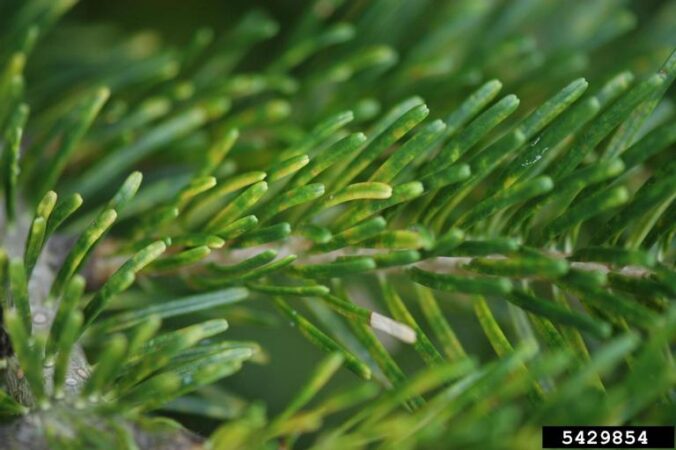
Fig. 1. Yellowing mottling damage due to scale feeding. Image: Brian Kunkel, University of Delaware.
Purdue Landscape Report: Christmas tree growers have been struggling with an invasive scale pest called Cryptomeria scale (Aspidiotus cryptomeriae), which is a serious pest of conifers. The scales infest the undersides of the needles and extract plant juices with their piercing-sucking mouthparts. Economic losses are due to the unsightly yellow discoloration and needle drop that occurs from the insect feeding (Fig. 1).
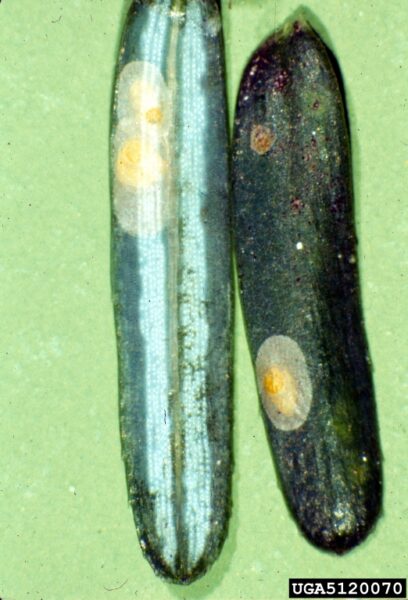
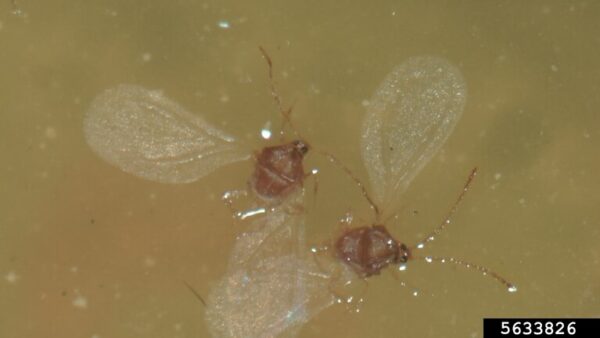
Life cycle: Cryptomeria scale has two generations per year. It overwinters as second-instar nymphs on the undersides of the needles, and in spring (March-April) the nymphs begin feeding again and continue development. They reach maturity by late spring. The adult females are flightless and remain stationary. They have a “fried egg” appearance of a white oval shape with a yellow center (Fig. 2). The adult males are alate, meaning they have wings (Fig. 3). Males fly in the summer, typically in July. They will mate with the females and die shortly after. The females lay eggs in the weeks following the mating flight. Egg hatch occurs around late August. These newly-hatched nymphs are called “crawlers”, because they are mobile and will disperse across the plant to find a new spot to settle and feed. Cryptomeria scale nymphs may not move very far from the female; many settle close to the female. The crawler stage is over by early September, when most have established a feeding site. They will develop through the fall into second-instars and overwinter until the following spring.
Management: Scout for the scale in the late winter when the scales are overwintering and prune infested branches, or remove the entire tree if heavily infested. Lady beetles and parasitic wasps will feed on Cryptomeria scale, so use biorational insecticides to maintain populations of beneficial insects which help control Cryptomeria scale and other pests.
Since Cryptomeria scales are armored scales, horticultural oils are recommended instead of insecticidal soaps for effective management (Quesada et al. 2017). Apply oils before bud break to target overwintering scales. Make sure to saturate the needles fully, especially the undersides of the needles, to smother the scales. For a more aggressive solution, dinotefuran can be applied for control of Cryptomeria scale. Basal bark applications of dinotefuran applied just after bud break were shown to significantly reduce scale populations and actually improved the rate of parasitism from parasitic wasps (Cowles 2010).
Not sure if you Cryptomeria scale or something else? Reach out to the Plant Pest and Diagnostics Lab for identification services!
View the original article on the Purdue Landscape Report website: Cryptomeria scale on Christmas trees.
Subscribe and receive the newsletter: Purdue Landscape Report Newsletter.
A Choose-and-Cut Pine and Fir Christmas Tree Case Study, The Education Store, Purdue Extension’s resource center
Living Christmas Trees For The Holidays and Beyond, The Education Store
Tips for First-Time Buyers of Real Christmas Trees, The Education Store
Growing Christmas Trees, The Education Store
Selecting an Indiana-Grown Christmas Tree, The Education Store
Winterize Your Trees, The Education Store
Tree Installation: Process and Practices, The Education Store
What do Treed Do in the Winter?, Got Nature? Blog, Purdue Extension – Forestry and Natural Resources (FNR)
Forest/Timber Playlist, subscribe to Purdue Extension – Forestry and Natural Resources (FNR) YouTube Channel
Ask the Expert: Holidays in the Wild, Purdue Extension – FNR YouTube Channel
ID That Tree: Balsam Fir, Purdue Extension – FNR YouTube Channel
ID That Tree: Scotch Pine, Purdue Extension – FNR YouTube Channel
To identify other pine trees view ID That Tree, Purdue Extension – FNR YouTube Channel
Report Invasive, Purdue Extension
Purdue Plant Doctor, Purdue Extension
Purdue Extension – Entomology
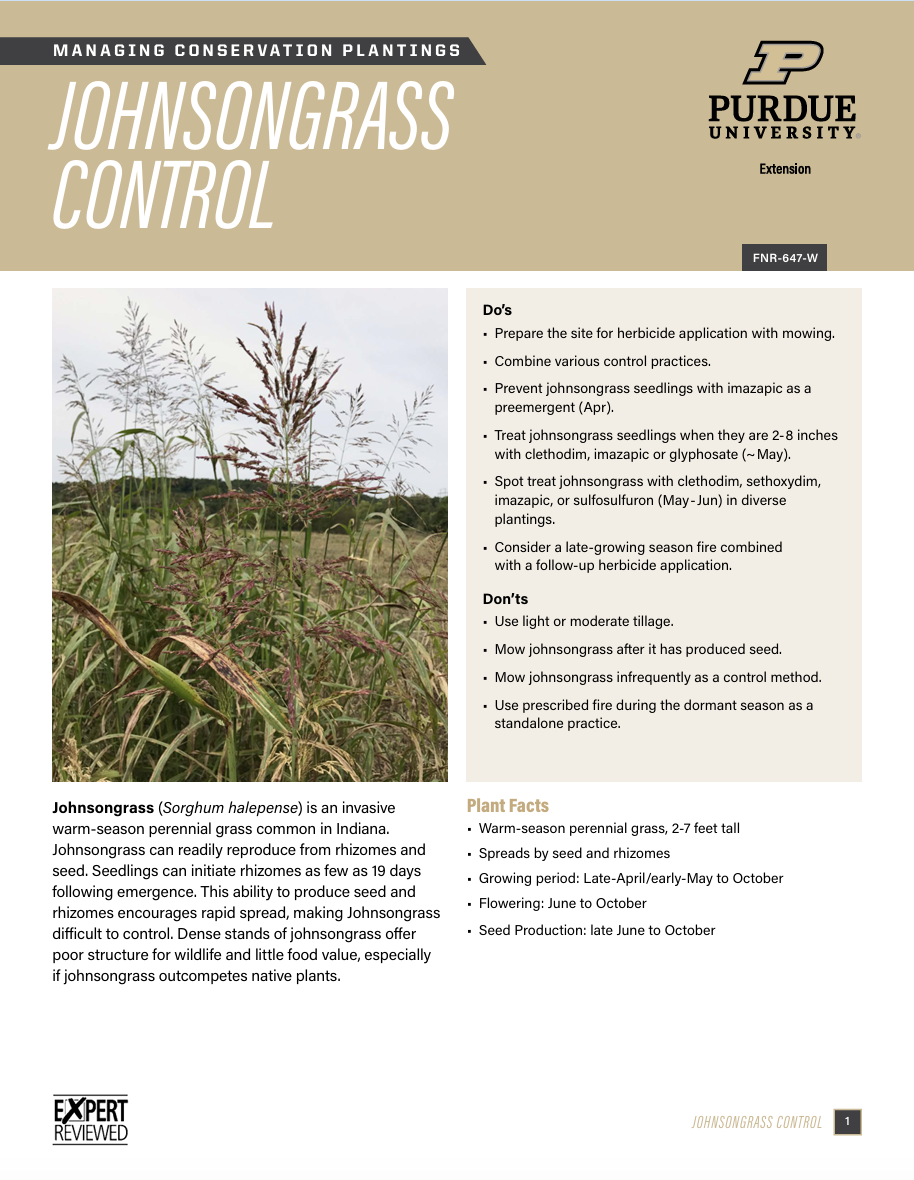 Discover effective strategies for controlling Johnsongrass, an invasive warm-season grass prevalent in Indiana. This guide explains several control options for johnsongrass issues in native conservation plantings. Essential reading for land managers and conservationists committed to maintaining healthy grassland ecosystems: Johnsongrass Control.
Check out the Managing Conservation Plantings Series which include details on how to control invasive species and other problematic plants in Conservation Reserve Program (CRP) plantings and native warm-season grass and wildflower conservation plantings.
Publications in this series include:
- Golden Rod Control
- Thinning Native Warm-Season Grasses
- Sericea Lespedeza Control
- Woody Encroachment and Woody Invasives
- Johnsongrass Control
- Reed Canarygrass Control
- Teasel Control (Common and Cut Leaved)
- Controlling Introduced Cool-season Grasses
- Crownvetch, Sweetclover and Birdsfoot Trefoil Control
Resources:
Deer Impact Toolbox & Grassland Management, Purdue Extension Pond and Wildlife Management
Pond and Wildlife Management, Purdue Extension
Forestry for the Birds Virtual Tour and Pocket Guide, Got Nature? Blog, Purdue Extension – FNR
Frost Seeding to Establish Wildlife Food Plots and Native Grass and Forb Plantings – Purdue Extension – FNR YouTube channel
Wildlife Habitat Hint: Tips for Evaluating a First Year Native Grass and Forb Plantings, Purdue Extension – FNR YouTube Channel
Drone Seeding Native Grasses and Forbs: Project Overview & Drone Setup, Purdue Extension – FNR YouTube channel
Ask an Expert: Wildlife Food Plots, video, Purdue Extension – FNR YouTube Channel
Handling Harvested Game: Episode 1, Field Dressing, video, Purdue Extension – FNR YouTube Channel
Managing Your Woods for White-Tailed Deer, The Education Store
Forest Improvement Handbook, The Education Store
Forest Management for Reptiles and Amphibians: A Technical Guide for the Midwest, The Education Store
A Template for Your Wildlife Habitat Management Plan, The Education Store
Woodland Stewardship for Landowners, Playlist, Purdue Extension – FNR YouTube channel
Nature of Teaching Unit 1: Animal Diversity and Tracking, The Education Store
Nature of Teaching, Purdue College of Agriculture
Invasive Species Playlist, Playlist, Purdue Extension – FNR YouTube Channel
Report Invasive, Purdue Extension
Subscribe Purdue Extension – Forestry and Natural Resources YouTube Channel
Jarred Brooke, Wildlife Extension Specialist
Purdue Department of Forestry and Natural Resources

Recent Posts
- Beetle that attacks Tree-of-Heaven found in Indiana, Purdue Landscape Report
Posted: March 20, 2026 in Invasive Insects, Wildlife, Woodlands - ID That Tree: Dwarf Chinkapin Oak
Posted: in Forestry, Urban Forestry, Wildlife, Woodlands - IN-PREPared: Essential Resources for Indiana’s Severe Weather Season
Posted: March 11, 2026 in How To, Safety - DNR Hiring for Indiana Conservation Officer Positions, MyDNR
Posted: March 9, 2026 in Urban Forestry, Wildlife, Woodlands - ID That Tree: Shumard Oak
Posted: in Plants, Urban Forestry, Wildlife, Woodlands - A Woodland Management Moment: Windbreak Around Walnut Plantings
Posted: March 3, 2026 in Forestry, Urban Forestry, Woodland Management Moment - Getting Certified as an Indiana Certified Prescribed Burn Manager
Posted: March 2, 2026 in How To, Urban Forestry, Woodlands - Uniting Indiana Residents Against Invasive Species
Posted: February 27, 2026 in Community Development, Invasive Insects, Wildlife - Have You Seen a Soaring Eagle Lately? Morning Ag Clips
Posted: February 25, 2026 in Urban Forestry, Wildlife - Register for Natural Resources Teacher Institute’s Class of 2026
Posted: February 19, 2026 in Forestry, Wildlife, Woodlands
Archives
Categories
- Alert
- Aquaculture/Fish
- Aquatic/Aquaculture Resources
- Ask the Expert
- Christmas Trees
- Community Development
- Disease
- Drought
- Forestry
- Forests and Street Trees
- Gardening
- Got Nature for Kids
- Great Lakes
- How To
- Invasive Animal Species
- Invasive Insects
- Invasive Plant Species
- Land Use
- Natural Resource Planning
- Nature of Teaching
- Plants
- Podcasts
- Ponds
- Publication
- Safety
- Spiders
- Timber Marketing
- Uncategorized
- Urban Forestry
- Webinar
- Wildlife
- Wood Products/Manufacturing
- Woodland Management Moment
- Woodlands