 Purdue University - Extension - Forestry and Natural Resources
Got Nature? Blog
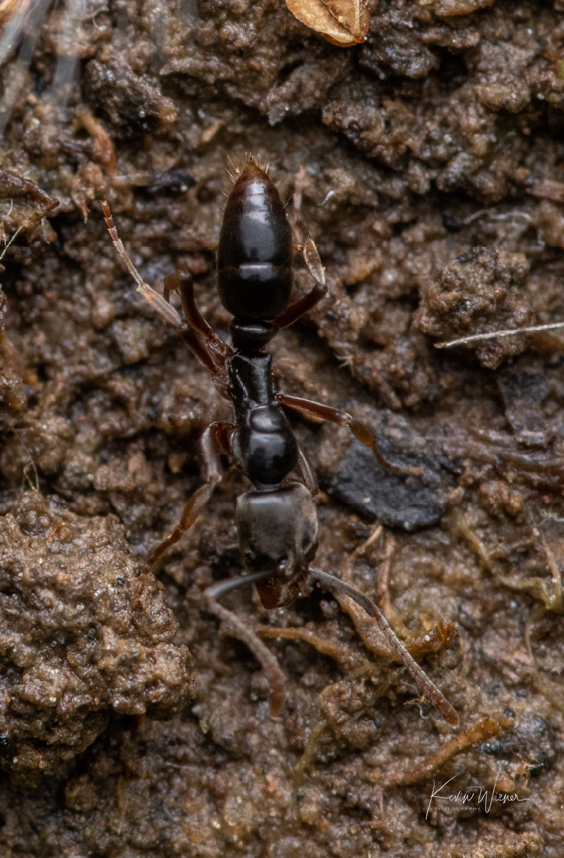
Asian needle ant in
natural setting. Photo by Kevin Weiner, Evansville, IN.
It is official. The Asian needle ant is our newest invasive insect pest and has now become a permanent resident, stinging ant. Two ant specimens taken from a wooded area in southern Indiana by an astute amateur entomologist, who observed their appearance and behavior as ‘out of the ordinary’, was submitted to the Indiana Department of Natural Resources and to the Purdue University Plant and Pest Diagnostic Laboratory for species identification in February, 2022. Both were confirmed to be Formicidae: Brachyponera chinensis, commonly known as the Asian needle ant, not previously recorded from Indiana.
Asian needle ants (ANAs), originally from Eastern Asia (China, Japan, and Korea), were first discovered in the United States in the early 1930s, but only recognized as a pest since 2006. They have been officially established in several states in the U.S. including North Carolina, South Carolina, Alabama and Georgia and, have been anecdotally reported as far north and west as New York, Tennessee and Kentucky.
Note that stings to humans will be moderately painful (potentially causing severe allergic reactions to susceptible individuals) much like fire ant or bee stings, but fortunately because these ants are much less aggressive in protecting their nests, the number of stings per encounter will be less.
The First Report of the Invasive Asian Needle Ant in Indiana pdf provides more details on their identification and biology.
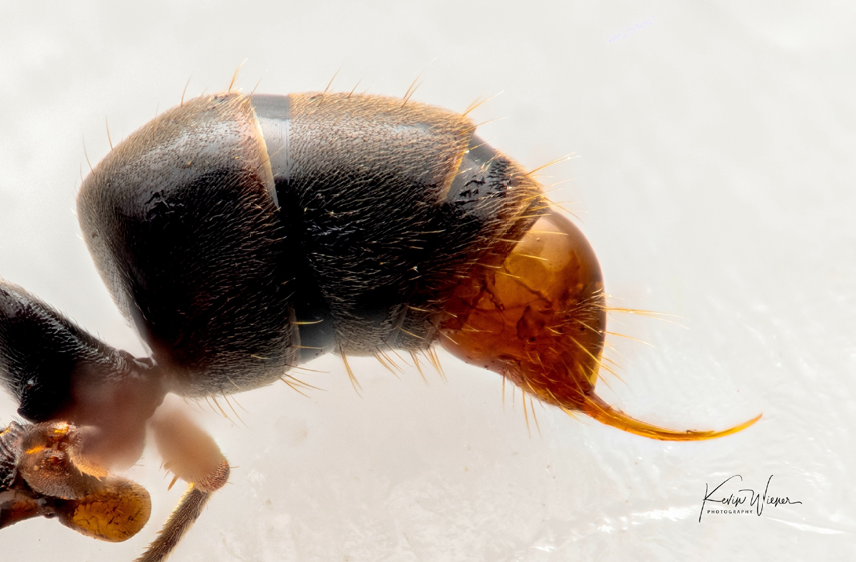
Asian needle ant stinger extended. Photo by Kevin Weiner, Evansville, IN.
If you want to confirm a sighting of the Asian needle ant please contact the Purdue University Plant and Pest Diagnostic Laboratory at this time. More information will be presented as experts monitor the spread.
Resources:
Thousand Cankers Disease, Indiana Department of Natural Resources
Thousand Cankers Disease: Indiana Walnut Trees Threatened, The Education Store, Purdue Extension’s resource center
Indiana Walnut Council
Spotted lanternfly: Everything You Need to Know in 30 Minutes, Video, Emerald Ash Borer University
Emerald Ash Borer, EAB Information Network
Report Invasive Species, Purdue Invasive Species
The GLEDN Phone App – Great Lakes Early Detection Network
EDDMaps – Early Detection and Distribution Mapping System
Indiana Department of Natural Resources: Invasive Species
Indiana Invasive Species Council
Cooperative Invasive Species Management Area (CISMA)
Invasive plants: impact on environment and people, The Education Store
Woodland Management Moment: Invasive Species Control Process, Video, Purdue Extension – Forestry and Natural Resources (FNR) YouTube Channel
Invasive Species, Playlist, Purdue Extension – FNR YouTube Channel
What are invasive species and why should I care?, Got Nature? Blog, Purdue Extension – Forestry and Natural Resources
Report Invasive
Indiana Department of Entomology and Plant Pathology
Tim Gibb, Insect Diagnostician and Extension Specialist
Purdue Department of Entomology
The classic and trusted book “Fifty Common Trees of Indiana” by T.E. Shaw was published in 1956 as a user-friendly guide to local species. Nearly 70 years later, the publication has been updated through a joint effort by the Purdue Department of Forestry and Natural Resources, Indiana 4-H, and the Indiana Department of Natural Resources, and reintroduced as “An Introduction to Trees of Indiana.”
 The full publication is available for download for $7 in the Purdue Extension Education Store. The field guide helps identify common Indiana woodlot trees.
Each week, the Intro to Trees of Indiana web series will offer a sneak peek at one species from the book, paired with an ID That Tree video from Purdue Extension forester Lenny Farlee to help visualize each species as it stands in the woods. Threats to species health as well as also insight into the wood provided by the species, will be provided through additional resources as well as the Hardwoods of the Central Midwest exhibit of the Purdue Arboretum, if available.
This week, we introduce the Blue Beech or Carpinus caroliniana.
The blue beech, also known as the American hornbeam, musclewood or the water beech, is an understory tree that stands out due to its gray bark and striations that resemble muscles and sinews as well as its doubly toothed leaves.
The small tree, which typically grows to a height of 20 to 35 feet, has oblong leaves with doubly toothed leaf margins, arranged alternately on very fine twigs. Lower leaf veins are seldom forked. The fruit is in clusters, consisting of small, seed-like nuts on small, three-lobed leaves. It’s bark and fruit help differentiate blue beech from its close relative, the ironwood.
Blue beech’s natural range is the majority of the midwestern and eastern United States, reaching as far south as Texas.
For full article and photos view Purdue Forestry and Natural Resources News: Trees of Indiana: Blue Beech.
Other Resources:
Beech – Hardwood Lumber and Veneer Series
Fifty Common Trees of Indiana
An Introduction to Trees of Indiana
Native Trees of the Midwest, The Education Store, Purdue Extension’s resource center
Shrubs and Woody Vines of Indiana and the Midwest
ID That Tree YouTube playlist
Woodland Management Moment YouTube playlist
Investing in Indiana Woodlands, The Education Store
Forest Improvement Handbook The Education Store
Wendy Mayer, FNR Communications Coordinator
Purdue University Department of Forestry and Natural Resources
Lenny Farlee, Sustaining Hardwood Extension Specialist
Purdue University Department of Forestry and Natural Resources
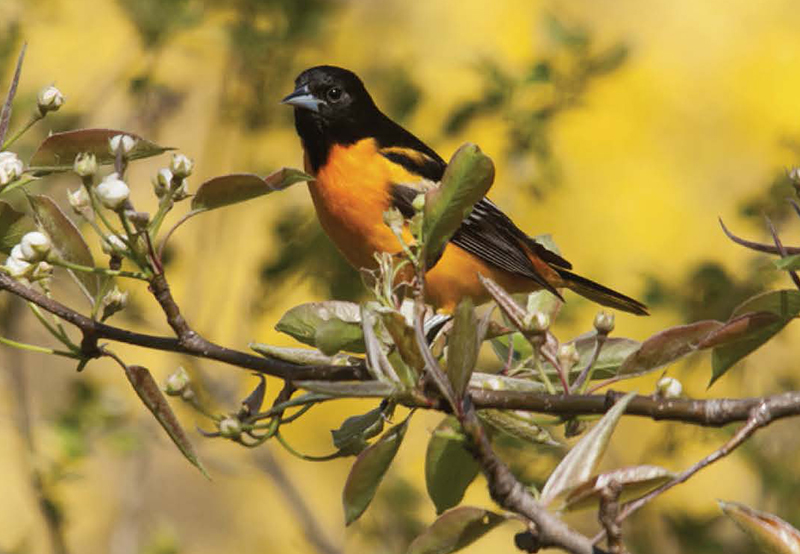 Question: Is there any risk of becoming infected with highly pathogenic avian influenza virus by feeding backyard birds or cleaning a bird feeder?
Answer: There is currently no evidence that suggests you could become infected with highly pathogenic avian influenza virus by feeding backyard birds. Generally, songbirds, or perching birds, (Passeriformes) are the primary type of birds at feeders, and they are usually not affected by HPAI. Most wild birds traditionally associated with avian influenza viruses are waterfowl, shorebirds and scavengers. It is unlikely that bird feeders will contribute to an outbreak among songbirds, but if someone also has backyard poultry, then we recommend removing bird feeders during the outbreak. Songbirds are susceptible to other avian diseases. Therefore, we recommend that people without backyard poultry who feed birds routinely, clean their feeders and bird baths, and anyone who comes in direct contact with bird droppings should thoroughly wash their hands with soap and water.
Additional information:
Indiana Department of Natural Resources (IN DNR) – Fish and Wildlife, Avian Flu: What is the risk to people? Very few types of AI can infect humans. The Centers for Disease Control and Prevention (CDC) considers the risk to people from AI viruses to be low. To date, no human AI infections have been detected in the United States. The U.S. has a strong AIV surveillance program that has been in place for many years.
Cornell Bird Lab: Avian Influenza Outbreak: Should You Take Down Your Bird Feeders?
Utah Division of Wildlife Resources: Is there any risk of becoming infected with highly pathogenic avian influenza virus by feeding backyard birds or cleaning a bird feeder?
Resources:
The National Audubon Society
Birds and Residential Window Strikes: Tips for Prevention, The Education Store, Purdue Extension resource center
Breeding Birds and Forest Management: the Hardwood Ecosystem Experiment and the Central Hardwoods Region, The Education Store
Putting a Little Wildlife in Your Backyard This Spring, The Education Store
It’s For the Birds, Indiana Yard and Garden-Purdue Consumer Horticulture
Managing Woodlands for Birds Video, Purdue Extension-Forestry and Natural Resources YouTube Channel
Brian MacGowan, Wildlife Extension Specialist
Purdue Forestry and Natural Resources

This print-your-own coloring book provides a fun and active way for children and adults to learn about the many kinds of aquatic animals raised on farms for aquaculture. Each spread highlights one species, pairing a beautifully illustrated coloring page with accompanying text for advanced and beginning readers with information about fisheries, recreational fishing, and cooking tips.
This publication is a collaborative project of Illinois-Indiana Sea Grant, the North Central Regional Aquaculture Center, University of Illinois Extension, and Purdue University’s Department of Forestry and Natural Resources.
To receive the free download for the Aquaculture Family Coloring Book visit The Education Store.
About the Author
Amy Shambach is Illinois-Indiana Sea Grant’s (IISG) aquaculture marketing outreach associate who works with the aquaculture industry in the USDA’s North Central Regional Aquaculture Center. Her work focuses on the demand side of domestic farm raised seafood products. She provides outreach and extension services to producers, potential producers, and consumers. Along with Dr. Kwamena Quagrainie, producers, aquaculture associations, and consumers, she works to determine the needs of stakeholders. View the Aquaculture Family Coloring Book Development Team with the free download of the book.
Resources:
Walleye Farmed Fish Fact Sheet, The Education Store
Pacific White Shrimp Farmed Fact Sheet, The Education Store
Yellow Perch Farmed Fish Fact Sheet, The Education Store
Tilapia Farmed Fish Fact Sheet, The Education Store
Rainbow Trout Farmed Fish Fact Sheet, The Education Store
American Paddlefish, The Education Store
Eat Midwest Fish, Illinois-Indiana Sea Grant online resource hub
Illinois-Indiana Sea Grant (IISG), Illinois-Indiana Sea Grant
Amy Shambach, Aquaculture Marketing Outreach Associate
Purdue Department of Forestry and Natural Resources/Illinois Indiana Sea Grant Program
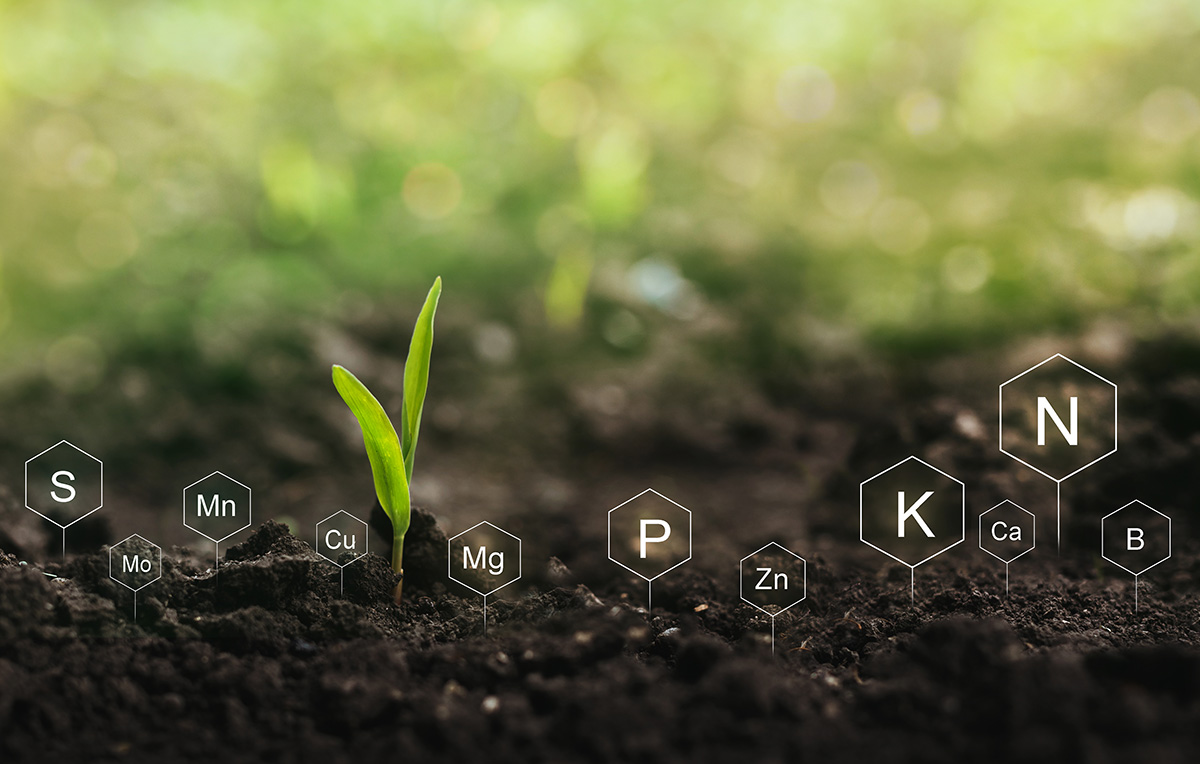
Photo credit: Adobe Stock
Lawn to Lake Midwest is a great resource as the experts share each month care tips on how to have a healthy lawn all year long while using natural lawn care practices. For the month of May check out the things to watch out for and why testing your soil is important.
You will also find resources for more options for a sustainable lawn:
- Take the Natural Lawn Care Quiz and see where you are at with your lawn care practices.
- Take a look at some simply ways to incorporate more natural lawn care practices.
- If you’re ready, jump into the weeds to explore even more sustainable lawn management practices.
- Find answers to commonly asked lawn care questions.
Resources:
Forest Improvement Handbook, The Education Store
Turfgrass Science, Department of Horticulture & Landscape Architecture
Turfgrass Insect Management, The Education Store
Tree Planting Part 1: Choosing a Tree, Video, The Education Store
Purdue Turf Doctor app for Apple iOS, Apple App Store
Illinois-Indiana Sea Grant (IISG)
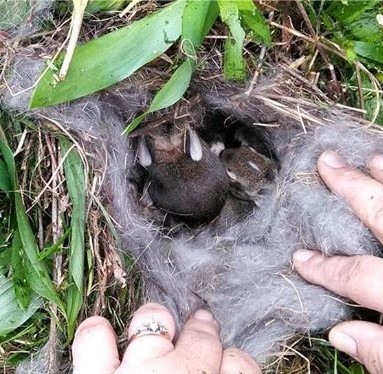
Wild Bulletin, Indiana Department of Natural Resources: The emergence of spring means young wildlife will begin appearing throughout Indiana, from our state’s forests to your own backyard. If you encounter a young wild animal that appears to have been left alone, keep calm. Adult wild animals rarely abandon their young and will likely return after gathering food for the family.
Check back periodically on the young animal and look for signs that an adult has been attending to them, but don’t hover.
If the animal you find is injured or in distress (bleeding, weak, covered in flies, has broken bones), contact a wildlife rehabilitator instead of trying to care for the animal yourself. Wild animals require different care than domesticated pets. Wildlife rehabilitators are trained and permitted to care for many different wild species. They will be equipped to care for the animal while allowing it to retain its natural fear of humans so it can return to and survive in the wild.
For more contacts and information on when and why to call a rehabilitator, go check out Indian Department of forestry and Natural Resources: Orphaned & Injured animals.
Subscribe and receive this newsletter: Wild Bulletin.
Resources:
Injured Wildlife and What to Do, Got Nature? Blog, Purdue Extension – FNR
Resourceful Animal Relationships, The Education Store, Purdue Extension resource center
No Room at the Inn: Suburban Backyards and Migratory Birds, The Education Store
Wildlife Curriculum, Nature of Teaching, Purdue Extension
Wildlife, Playlist, Purdue Extension – FNR YouTube channel
Indiana Department of Natural Resources
The classic and trusted book “Fifty Common Trees of Indiana” by T.E. Shaw was published in 1956 as a user-friendly guide to local species. Nearly 70 years later, the publication has been updated through a joint effort by the Purdue Department of Forestry and Natural Resources, Indiana 4-H, and the Indiana Department of Natural Resources, and reintroduced as “An Introduction to Trees of Indiana.”
The full publication is available for download for $7 in the Purdue Extension Education Store. The field guide helps identify common Indiana woodlot trees.
Each week, the Intro to Trees of Indiana web series will offer a sneak peek at one species from the book, paired with an ID That Tree video from Purdue Extension forester Lenny Farlee to help visualize each species as it stands in the woods. Threats to species health as well as also insight into the wood provided by the species, will be provided through additional resources as well as the Hardwoods of the Central Midwest exhibit of the Purdue Arboretum, if available. 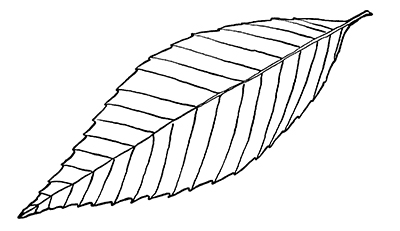
This week, we introduce the beech, or Fagus grandifolia.
The Beech is easily identified by its smooth gray bark and its simple leaves, which feature straight-line veins from the midrib to the small teeth on the margin. Beeches produce a 3/4-inch long fruit covered in spines, which typically holds two triangular-shaped nuts.
American beech is a shade tolerant species found in the understory often on moist but well-drained soils, that also reaches up into the forest canopy at around 70 to 80 feet tall. Beech is found throughout the Great Lakes region as well as the central and southeastern United States.
Beech is used to make items varying from wooden clothes pins to brush banks, handles and woodenware. Due to its strength and ease of turning, it is also used for chair production. Flooring, railroad ties, pallets and container veneer are other uses for this species.
For full article and photos view Purdue Forestry and Natural Resources: Trees of Indiana: Beech.
 View the Purdue Online Tour: Hardwoods of the Central Midwest and find out beech species workability, strength, if it can be steam bent, drying details and much more.
Resources:
Beech – Hardwood Lumber and Veneer Series
Fifty Common Trees of Indiana
An Introduction to Trees of Indiana
Native Trees of the Midwest, The Education Store, Purdue Extension’s resource center
Shrubs and Woody Vines of Indiana and the Midwest, The Education Store, Purdue Extension’s resource center
ID That Tree, YouTube playlist
Woodland Management Moment, YouTube playlist
Investing in Indiana Woodlands, The Education Store, Purdue Extension’s resource center
Forest Improvement Handbook, The Education Store, Purdue Extension’s resource center
Wendy Mayer, FNR Communications Coordinator
Purdue University Department of Forestry and Natural Resources
Lenny Farlee, Sustaining Hardwood Extension Specialist
Purdue University Department of Forestry and Natural Resources
 MyDNR Newsletter, Indiana Department of Forestry and Natural Resources: Gov. Eric J. Holcomb and DNR Director Dan Bortner recently announced 38 communities and non-profit organizations will receive a combined $65 million for 77 miles of new trail development.
“Trails connect communities together in such a personal way and are perfect pathways to good mental and physical well-being,” Gov. Holcomb said.
A $150 million grant program, Next Level Trails is the largest infusion of trails funding in state history. In rounds one and two, a total of $55 million was awarded to 35 communities. To date, $120 million has been awarded to build 190 miles of trails throughout Indiana. Ninety-four percent of Hoosiers live within five miles of a trail.
The grants awarded in the third round include 17 regional projects and 21 local projects. The list of awards, project descriptions, and a map are posted at on.IN.gov/NLT-round-3.
To read other news articles visit Indiana Department of forestry and Natural Resources website.
Resources:
Enhancing The Value of Public Spaces, Purdue Extension Forestry and Natural Resources
Enhancing The Value of Public Spaces: Creating Healthy Communities, The Education Store, Purdue Extension’s resource center
Fun Trail Event Days, Indiana Department of Natural Resources
Healthy and Wellness Videos, The Nature of Teaching YouTube Channel
Benefits of Connecting with Nature, The Education Store
Indiana Department of Natural Resources
 The classic and trusted book “Fifty Common Trees of Indiana” by T.E. Shaw was published in 1956 as a user-friendly guide to local species. Nearly 70 years later, the publication has been updated through a joint effort by the Purdue Department of Forestry and Natural Resources, Indiana 4-H, and the Indiana Department of Natural Resources, and reintroduced as “An Introduction to Trees of Indiana.”
The full publication is available for download for $7 in the Purdue Extension Education Store. The field guide helps identify common Indiana woodlot trees.
Each week, the Intro to Trees of Indiana web series will offer a sneak peek at one species from the book, paired with an ID That Tree video from Purdue Extension forester Lenny Farlee to help visualize each species as it stands in the woods. Threats to species health as well as also insight into the wood provided by the species, will be provided through additional resources as well as the Hardwoods of the Central Midwest exhibit of the Purdue Arboretum, if available.
This week, we introduce the basswood or Tilia Americana.
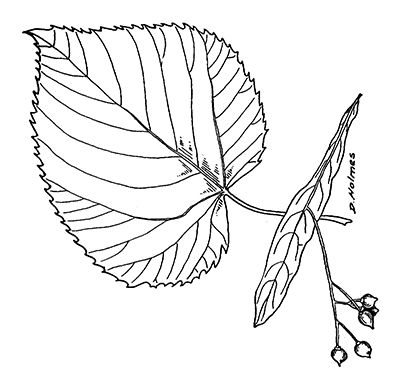
The American basswood, which is also called linden, is commonly identified by its simple heart-shaped leaves with finely toothed margins, flat bark with long running lines up and down the trees, and possibly a ring of sprouts originating from the base of the tree. The clusters of small, nutlike seeds (⅓-inch in diameter)
are attached by a stem to a leaflike wing. 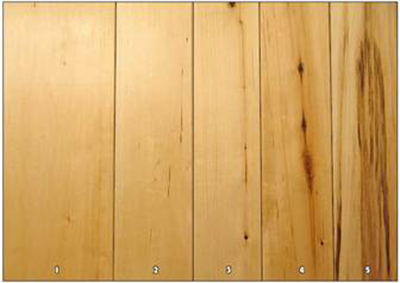
This species is often found on moist sites, deep, loamy soils, with its range stretching from the Great Plains east and from southern Canada through northern Arkansas, Kentucky and the mountains of North Carolina and Tennessee.
With heights reaching 70 to 80 feet tall, basswood can offer good shade. It also offers good flowering for bees. This species has a light colored, fine-grained wood varying from a white color to a very light brown or flesh color.
Due to its weight and stability, basswood has historically been used to make Venetian blinds and key stock in pianos. It also is a preferred species for carving, including items like hunting decoys, etc.
Full article also can be viewed with Purdue Forestry and Natural Resources News: Trees of Indiana: American Basswood.
Other Resources
Basswood – Hardwood Lumber and Veneer Series
Hardwoods of Central Indiana: American Basswood
Fifty Common Trees of Indiana
An Introduction to Trees of Indiana
Native Trees of the Midwest
Shrubs and Woody Vines of Indiana and the Midwest
ID That Tree YouTube playlist
Woodland Management Moment YouTube playlist
Investing in Indiana Woodlands
Forest Improvement Handbook
Wendy Mayer, FNR Communications Coordinator
Purdue University Department of Forestry and Natural Resources
Lenny Farlee, Sustaining Hardwood Extension Specialist
Purdue University Department of Forestry and Natural Resources
Spring is in full bloom and trees are beginning to look green again. Learning how to identify trees in yards, neighborhoods and local parks provides insight into the diversity and relationships found in nature. Lenny Farlee, Purdue Extension Forester, shares how to identify trees native to Indiana.
Leaf Arrangement
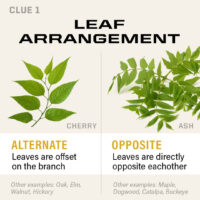 Leaf arrangement is one of the first characteristics to check for on deciduous (trees that lose their leaves annually) broadleaved trees that make up the majority of our native species. The two arrangements we commonly find are alternate and opposite.
Opposite arrangement means the leaves are held on the twig directly opposite of one another. Alternate leaf arrangement means the leaves are arranged on the twig in an offset manner. We have one leaf, then another in a zig-zag or spiral fashion.
There are only a few native tree families with opposite leaf arrangements: Maple, Ash, Dogwood, Catalpa, Buckeye. You can remember these from the anacronym MAD Cat Buck – Maple, Ash, Dogwood, Catalpa, Buckeye. Almost all other native trees have alternate leaf arrangements.
Leaf Types
The next characteristic to check is if the tree has simple or compound leaves. To do this, we need to understand the difference between a leaf and a leaflet. A leaf has a bud at the base of the stem. The entire structure after the bud is the leaf.
A simple leaf is singular and never divided into smaller leaflets. A compound leaf consists of several or many leaflets joined to a single stem after the bud.
Resources:
ID That Tree, Playlist, Purdue Extension – Forestry and Natural Resources YouTube Channel
A Woodland Management Moment, Playlist, Purdue Extension – FNR YouTube Channel
Purdue Extension, website
Shrubs and Woody Vines of Indiana and the Midwest, The Education Store, Purdue Extension Resource Center
Native Trees of the Midwest, The Education Store
Investing in Indiana Woodlands, The Education Store
Forest Improvement Handbook, The Education Store
Purdue College of Agriculture News
Lenny Farlee, Sustaining Hardwood Extension Specialist
Purdue University Department of Forestry and Natural Resources

Recent Posts
- Beetle that attacks Tree-of-Heaven found in Indiana, Purdue Landscape Report
Posted: March 20, 2026 in Invasive Insects, Wildlife, Woodlands - ID That Tree: Dwarf Chinkapin Oak
Posted: in Forestry, Urban Forestry, Wildlife, Woodlands - IN-PREPared: Essential Resources for Indiana’s Severe Weather Season
Posted: March 11, 2026 in How To, Safety - DNR Hiring for Indiana Conservation Officer Positions, MyDNR
Posted: March 9, 2026 in Urban Forestry, Wildlife, Woodlands - ID That Tree: Shumard Oak
Posted: in Plants, Urban Forestry, Wildlife, Woodlands - A Woodland Management Moment: Windbreak Around Walnut Plantings
Posted: March 3, 2026 in Forestry, Urban Forestry, Woodland Management Moment - Getting Certified as an Indiana Certified Prescribed Burn Manager
Posted: March 2, 2026 in How To, Urban Forestry, Woodlands - Uniting Indiana Residents Against Invasive Species
Posted: February 27, 2026 in Community Development, Invasive Insects, Wildlife - Have You Seen a Soaring Eagle Lately? Morning Ag Clips
Posted: February 25, 2026 in Urban Forestry, Wildlife - Register for Natural Resources Teacher Institute’s Class of 2026
Posted: February 19, 2026 in Forestry, Wildlife, Woodlands
Archives
Categories
- Alert
- Aquaculture/Fish
- Aquatic/Aquaculture Resources
- Ask the Expert
- Christmas Trees
- Community Development
- Disease
- Drought
- Forestry
- Forests and Street Trees
- Gardening
- Got Nature for Kids
- Great Lakes
- How To
- Invasive Animal Species
- Invasive Insects
- Invasive Plant Species
- Land Use
- Natural Resource Planning
- Nature of Teaching
- Plants
- Podcasts
- Ponds
- Publication
- Safety
- Spiders
- Timber Marketing
- Uncategorized
- Urban Forestry
- Webinar
- Wildlife
- Wood Products/Manufacturing
- Woodland Management Moment
- Woodlands