 Purdue University - Extension - Forestry and Natural Resources
Got Nature? Blog
Documenting an occurrence of a new wildlife species for a region is usually good news. Unfortunately, with the number of non-native species that seemingly pop up, this is not always the case. Extension Specialists across the U.S. often receive inquiries about identifying pictures of wildlife. We were recently contacted by an individual to identify the “white frog” pictured below. It was clearly not a native species from Indiana but rather a Cuban treefrog.
The Cuban treefrog (Osteopilus septentrionalis) is native to Cuba, the Cayman Islands and the Bahamas. These treefrogs were accidentally brought to Florida in the 1920s, probably as hitchhikers in cargo containers on ships. Cuban treefrogs are considered invasive in Florida (and elsewhere outside their native range) because they are likely to harm our native ecosystems and cause a lot of problems for humans. They are voracious predators and have likely caused declines of native treefrogs in many suburban areas of peninsular Florida. They get into people’s homes and sometimes end up in toilets. And they are even known to invade electrical equipment and have caused power outages in Florida.
Cuban treefrogs are much larger than Indiana’s native treefrogs with adults typically reaching lengths of 2 to 3 inches and large females may grow to about 5 inches. Body color is highly variable, ranging from whitish to gray, green, or brown, and may be marked with irregular, dark stripes or blotches that fade when the frog changes color. Their skin is warty (some warts quite prominent) and have large “bug eyes.”. The armpits and groin may be washed with yellow.
Native gray treefrogs, which occur throughout Indiana, look a lot like Cuban treefrogs. However, gray treefrogs have granular skin and normally do not have individual warts that stand out from the rest of the bumpy skin on their back. Gray treefrogs also have a light-colored blotch directly below each eye.
How did the Cuban treefrog get to Indiana? That remains unclear, and this a very rare event for the Hoosier State. We only know of two other times Cuban treefrogs have shown up here. Both were discovered in ornamental plants shipped to Indiana from Florida. Cuban treefrogs spread by hitchhiking on ornamental plants, motorized vehicles, boats, etc. and it is also possible that this frog was someone’s pet that was either intentionally or accidently released. Cuban treefrogs are adapted to warm environments and it gets too cold in Indiana for this invasive frog to live here.
What can you do to help?
It is import to document the locations of Cuban treefrogs outside of Florida in the US and Canada. If you see a Cuban treefrog, or suspect you have seen one, outside of peninsular Florida please email Dr. Steve A. Johnson at tadpole@ufl.edu. Include your name, date you saw the frog, where you saw it (state, county, city, street address), and also attach a digital image so Dr. Johnson can positively identify the frog. It is also important to report Cuban treefrog sightings at EDDMapS, the online mapping system for invasive species in the US. Visit https://www.eddmaps.org/ and click the “Report Sightings” tab. Thank you for being a community scientist!
Cuban Treefrog Pictures (Non-native species)
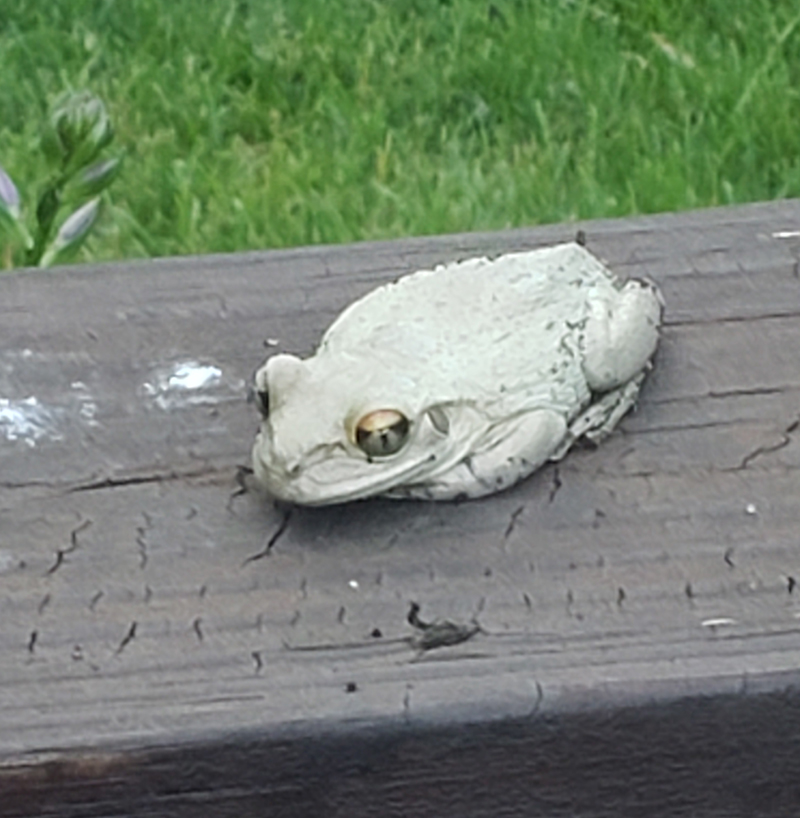
Photo credit: E. Ferguson
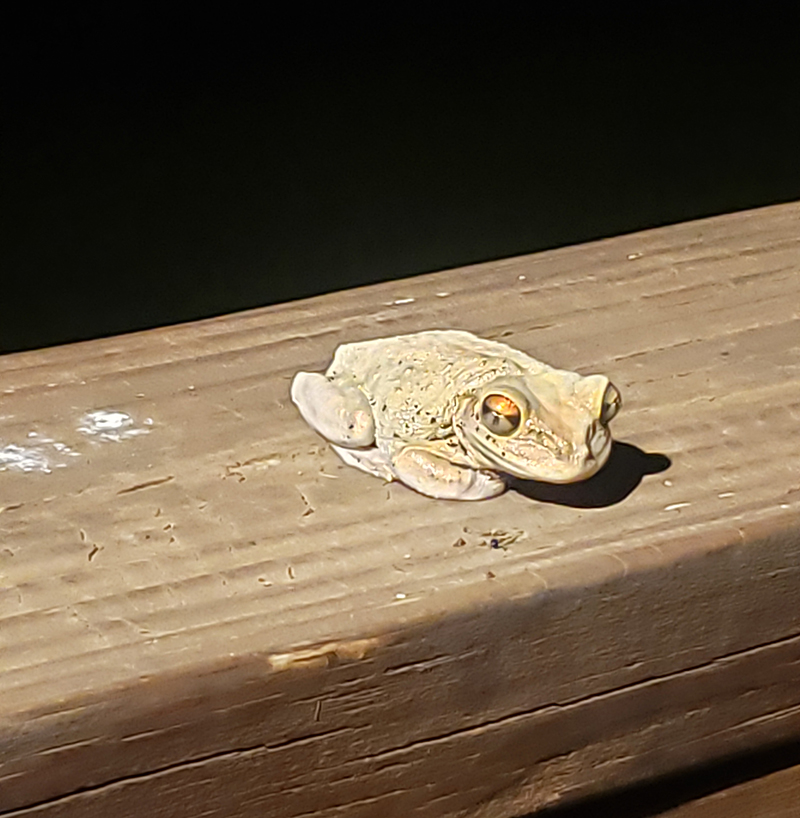
Photo credit: E. Ferguson
Gray Treefrog Pictures (native species)
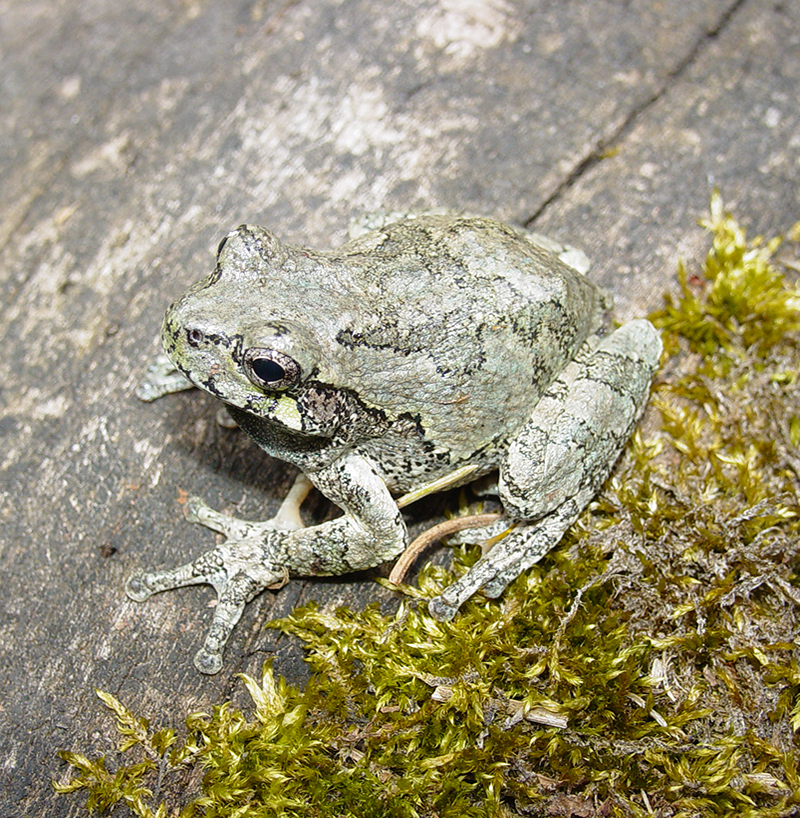
Photo credit: B. MacGowan
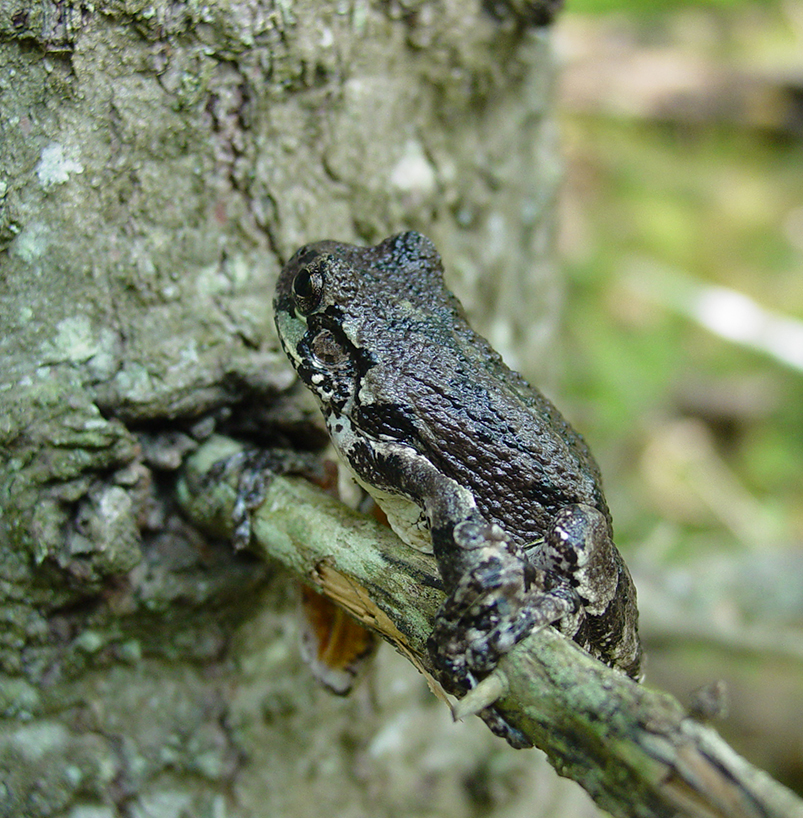
Photo credit: B. MacGowan
Resources
The Cuban Treefrog (Osteopilus septentrionalis), University of Florida- Institute of Food and Ag Sciences (IFAS) Extension
Invasive Cuban Treefrogs, Department of Wildlife Ecology & Conversation, University of Florida
Sounds of Frogs and Toads of Indiana, Purdue Extension – Forestry and Natural Resources
Ask An Expert: Anurans (Frogs and Toads), Got Nature? Blog, Purdue Extension – Forestry and Natural Resources
Frogs and Toads of Indiana, The Education Store, Purdue Extension resource center
A Moment in the Wild, Playlist, Purdue Extension – Forestry and Natural Resources
Forestry Management for Reptiles and Amphibians: A Technical Guide for the Midwest, The Education Store
Appreciating Reptiles and Amphibians in Nature, The Education Store
Nature of Teaching website and YouTube Playlist, Purdue Extension
Steve Johnson, Associate Professor
Dept. of Wildlife Ecology & Conservation, University of Florida
Brian MacGowan, Extension Wildlife Specialist
Department of Forestry and Natural Resources, Purdue University
Starting trees from seed requires knowing the germination requirements for the species you wish to grow. Most native tree seeds require treatments to break seed dormancy before the seed will germinate. These are done naturally by weather cycles, moisture, sunlight and wildlife in the forest environment. When we collect seeds, we will have to simulate these natural events to germinate the seeds successfully.
The Woody Plant Seed Manual, a U.S. Forest Service publication, gives detailed germination and nursery culture instructions by genus and species of trees. With over 450 seeds of woody plants in the United States, this manual continues to be popular both in this country and beyond. Seed data includes approximately 800 species, varieties, and sub-species in 188 genera, considerable more than the 420 species and 140 genera in this edition.
View this general germination guide for some common tree species.
Resources:
Frost Seeding to Establish Wildlife Food Plots & Native Grass and Forb Plantings – YouTube Video
Planting Hardwood Seedlings – The Education Store
Ordering Seedlings from the State Forest Nursery System, Got Nature? – Purdue Extension-FNR
Instructions for Ordering Tree Seedlings – Indiana DNR Division of Forestry
Importance of Hardwood Tree Planting – The Education Store, Purdue Extension Resource Center
Forest Improvement Handbook – The Education Store
Designing Hardwood Tree Plantings for Wildlife – The Education Store
National Nursery and Seed Directory – USDA Forest Service
Web Soil Survey – USDA Natural Resources Conservation Service
ID That Tree – YouTube Playlist
Diana Evans, Extension and Web Communication Specialist
Purdue University Department of Forestry and Natural Resources
Lenny Farlee, Sustaining Hardwood Extension Specialist
Purdue University Department of Forestry and Natural Resources
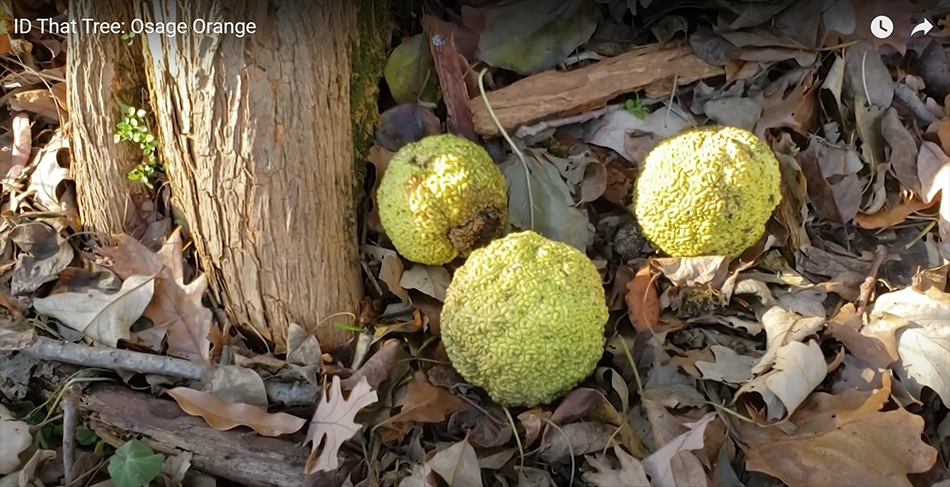 Question: I am building a hedge row and am contemplating working with Osage-orange seedlings and planting them. Is this a good choice?
Answer: Osage-orange, (Maclura pomifera) aka hedge, hedge-apple, bodark, bois d’arc and several other common names, is a tree native to parts of Arkansas, Oklahoma, and Texas, but has been planted in every one of the lower 48 states. The reason for that extensive planting was Osage-orange was promoted as the best tree for “living fences”, which were hedgerows planted to enclose or exclude livestock before the use of barbed wire. Osage-orange was also widely panted as a hedge-row and windbreak by the conservation programs of the FDR administration in the 1930’s. You can still encounter some of those old hedgerows on the landscape. It made a good hedgerow because the stems have stout thorns at the base of the leaves and will produce large and dense sprout colonies when cut back or pruned. It produced a living fence described as “horse-high, bull-strong, and pig-tight”.
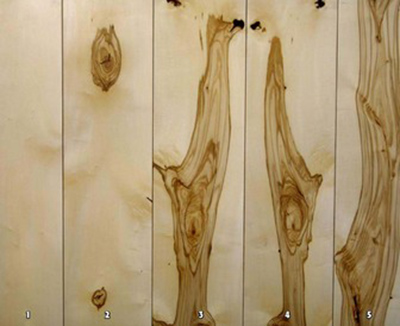
The wood of Osage-orange was also used for wagon wheel parts, tool handles and fence posts due to its strength and rot-resistance. I have met a few landowners who showed me Osage gate or fence posts they had helped set as a child that were still in good condition 60 or more years later. It is also an excellent firewood, with one of the highest BTU yields of any native tree. Native peoples used straight-grained Osage-orange wood for outstanding bows, thus the French name bois d’arc and the English derivation bodark. Some crafters still seek Osage wood for making traditional bows or for turnings and other decorative items. The wood becomes so hard and dense with drying that it is recommended in most cases to work it green. The yellow-orange fresh wood color gradually ages to a deep reddish brown.
Osage-orange may have had more favorable treatment as a wood for many uses were it not for the tendency of the tree to fork, bend and twist, making straight, long stems uncommon.
The fruit of Osage-orange is where this and the hedge-apple name comes from. Osage-orange is neither a citrus tree nor an apple, but the large, round, green to yellow fruit suggest each to some extent. The interlacing bumps and crevices and the round shape suggest a brain to many, including myself. The closest relatives of Osage-orange are actually the mulberries. The size of this fruit and the limited number of current animals that will use it have prompted some to suggest it was originally eaten and propagated by large, and now extinct, ice-age animals such as the giant ground sloth, mammoth, and mastodon.
Osage-orange has many interesting and sometimes useful characteristics, but it can also become weedy in some situations. It can spread by seed or sprouts into disturbed areas like abandoned fields, farmlands, or grazed areas and out-compete native vegetation. For these reasons, planting new areas to Osage-orange is usually discouraged.
Resources:
You Say Hedge-Apple, I Say Osage Orange!, Indiana Yard and Garden – Purdue Consumer Horticulture.
Osage Orange, The Wood Database
ID That Tree: Osage-Orange, Purdue Extension-FNR’s YouTube playlist
ID That Tree, Purdue Extension-FNR’s YouTube playlist
Windbreaks – Agroforestry for Any Property, Caring for your Woodland, University of Wisconsin-Madison, Extension
The Woody Plant Seed Manual, U.S. Forest Service
Native Trees of the Midwest, The Education Store, Purdue Extension’s resource center
Shrubs and Woody Vines of Indiana and the Midwest, The Education Store
Woodland Management Moment , Purdue Extension-FNR’s YouTube playlist
Investing in Indiana Woodlands, The Education Store
Forest Improvement Handbook, The Education Store
Lenny Farlee, Sustaining Hardwood Extension Specialist
Purdue University Department of Forestry and Natural Resources
 The classic and trusted book “Fifty Common Trees of Indiana” by T.E. Shaw was published in 1956 as a user-friendly guide to local species. Nearly 70 years later, the publication has been updated through a joint effort by the Purdue Department of Forestry and Natural Resources, Indiana 4-H, and the Indiana Department of Natural Resources, and reintroduced as “An Introduction to Trees of Indiana.”
The full publication is available for download for $7 in the Purdue Extension Education Store. The field guide helps identify common Indiana woodlot trees.
Each week, the Intro to Trees of Indiana web series will offer a sneak peek at one species from the book, paired with an ID That Tree video from Purdue Extension forester Lenny Farlee to help visualize each species as it stands in the woods. Threats to species health as well as also insight into the wood provided by the species, will be provided through additional resources as well as the Hardwoods of the Central Midwest exhibit of the Purdue Arboretum, if available.
This week, we introduce Ohio Buckeye or Aesculus glabra.
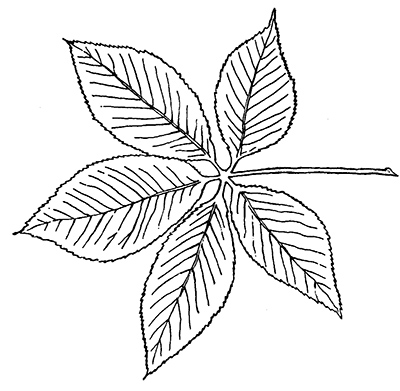
This understory tree is easily identifiable by its oppositely arranged compound leaves with five leaflets, placed like the fingers on your hand, that originate from one location on the long leaf stems. Ohio Buckeye features clusters of tubular yellow/green flowers borne on the end of the stems in the spring. In the winter, twigs show large white leaf scars where leaves were present the season prior. This tree produces round, shiny dark brown nuts, which are contained in a spiny shell.
 Ohio Buckeye is one of the first trees to leaf out in the spring, while its smooth buds also form early in the season. It is also one of the first trees to lose its leaves, typically at the end of the summer.
Ohio Buckeyes are found mostly in the understory, in the shade of other trees, on moist sites. They grow to be anywhere from 20 to 40 feet tall. According to the Morton Arboretum, Ohio Buckeyes are native from western Pennsylvania to Iowa and south to Alabama and Arkansas.
Ohio Buckeye is susceptible to a variety of pests and diseases from leaf blotch and powdery mildew to infestation by scale and Japanese beetles.
According to the Hardwoods of the Central Midwest exhibit, the sapwood is white to grayish with a darker irregular heartwood. The wood has uniformly distributed pores and its growth rings are slightly visible. With a 12 percent moisture content, buckeye weighs about 25 pounds per cubic foot, making it one of Indiana’s lightest weight woods.
The wood from Ohio Buckeye is very desirable for carving. In the past, it was used for artificial limbs. When the material is processed today, it is used for low-strength pallets and crates. It can also be used for paint grade molding.
For full article with photos view: Intro to Trees of Indiana: Ohio Buckeye
Resources:
Ohio Buckeye – Purdue Arboretum
ID That Tree Winter Edition: Opposite Leaf Arrangement – Ohio buckeye, Red maple, Purdue Extension-Forestry and Natural Resources’ YouTube playlist
Fifty Common Trees of Indiana
An Introduction to Trees of Indiana
Native Trees of the Midwest, The Education Store, Purdue Extension’s resource center
Shrubs and Woody Vines of Indiana and the Midwest, The Education Store
ID That Tree, Purdue Extension-FNR’s YouTube playlist
Woodland Management Moment , Purdue Extension-FNR’s YouTube playlist
Investing in Indiana Woodlands, The Education Store
Forest Improvement Handbook, The Education Store
Wendy Mayer, FNR Communications Coordinator
Purdue University Department of Forestry and Natural Resources
Lenny Farlee, Sustaining Hardwood Extension Specialist
Purdue University Department of Forestry and Natural Resources
MyDNR, Indiana’s Outdoor Newsletter, 2022-23 Migratory Bird Hunting Seasons: Indiana’s migratory bird hunting seasons for 2022-2023 have been submitted to the US Fish and Wildlife Service. These seasons include those for mourning doves, waterfowl (ducks, coots, mergansers, and geese), woodcock, snipe, and sora rails.
The seasons are listed in the image below with mourning dove hunting listed first with dates of Sept. 1 – Oct. 16 and then Nov. 1 – 27. If you need more information you can contact Adam Phelps, 812-929-0355, aphelps@dnr.IN.gov.
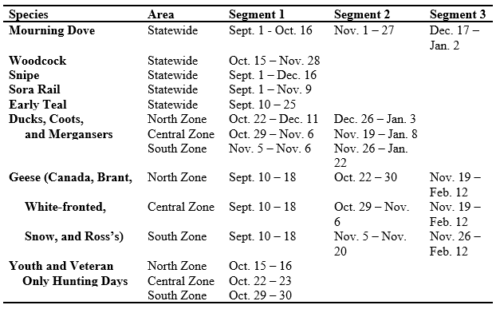
For the daily limits view 2022-23 Migratory Bird Hunting Seasons, Indiana Department of Natural Resources calendar post.
Resources:
Birds and Residential Window Strikes: Tips for Prevention, The Education Store, Purdue Extension resource center
Breeding Birds and Forest Management: the Hardwood Ecosystem Experiment and the Central Hardwoods Region, The Education Store
It’s For the Birds, Indiana Yard and Garden-Purdue Consumer Horticulture
Managing Woodlands for Birds Video, Purdue Extension-Forestry and Natural Resources (FNR) YouTube Channel
Ask An Expert, Playlist, Purdue Extension – FNR YouTube channel
No Room at the Inn: Suburban Backyards and Migratory Birds, Education Store, Purdue Extension resource center
Hardwood Ecosystem Experiment – Wildlife Responses to Timber Harvesting, The Education Store
Subscribe, Purdue Extension – FNR YouTube Channel
Division of Fish & Wildlife
Indiana Department of Natural Resources
In this episode of A Moment in the Wild, extension wildlife specialist Zach Truelock introduces the American toad. He explains where you might find this species, how to identify it and differentiate it from Fowler’s toads and also its mating and metamorphosis process.
If you have any questions regarding wildlife, trees, forest management, wood products, natural resource planning, or other natural resource topics, feel free to contact us by using our Ask an Expert web page.
Resources
A Moment in the Wild, Playlist, Purdue Extension – Forestry and Natural Resources
Sounds of Frogs and Toads of Indiana, Purdue Extension – Forestry and Natural Resources
Ask An Expert: Anurans (Frogs and Toads), Got Nature? Blog, Purdue Extension – Forestry and Natural Resources
Frogs and Toads of Indiana, The Education Store, Purdue Extension resource center
Forestry Management for Reptiles and Amphibians: A Technical Guide for the Midwest, The Education Store
Appreciating Reptiles and Amphibians in Nature, The Education Store
The Nature of Teaching: Adaptations for Aquatic Amphibians, The Education Store, Purdue Extension resource center
Amphibians: Frogs, Toads, and Salamanders, Purdue Nature of Teaching
Nature of Teaching website and YouTube Playlist, Purdue Extension
Help the Hellbender, Playlist & Website
Help the Hellbender, North America’s Giant Salamander, The Education Store
Zach Truelock, Hellbender Technician
Purdue Forestry and Natural Resources
Rod Williams, Assistant Provost for Engagement/Professor of Wildlife Science
Purdue University Department of Forestry and Natural Resources
The classic and trusted book “Fifty Common Trees of Indiana” by T.E. Shaw was published in 1956 as a user-friendly guide to local species. Nearly 70 years later, the publication has been updated through a joint effort by the Purdue Department of Forestry and Natural Resources, Indiana 4-H, and the Indiana Department of Natural Resources, and reintroduced as “An Introduction to Trees of Indiana.”
The full publication is available for download for $7 in the Purdue Extension Education Store. The field guide helps identify common Indiana woodlot trees.
book, paired with an ID That Tree video from Purdue Extension forester Lenny Farlee to help visualize each species as it stands in the woods. Threats to species health as well as also insight into the wood provided by the species, will be provided through additional resources as well as the Hardwoods of the Central Midwest exhibit of the Purdue Arboretum, if available.
Each week, the Intro to Trees of Indiana web series will offer a sneak peek at one species from the
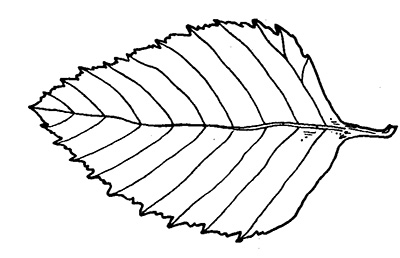
This week, we introduce River Birch or Betula nigra, which is also known as red birch.
As its name implies, it is found frequently in wet situations. It is often found need waterways and in moist soil areas across the state.
Full article also can be viewed with Purdue Forestry and Natural Resources News: Intro to Trees of Indiana: River Birch
Other Resources:
Birch – Hardwood Lumber and Veneer Series
Fifty Common Trees of Indiana
An Introduction to Trees of Indiana
Native Trees of the Midwest-The Education Store, Purdue Extension’s resource center
Shrubs and Woody Vines of Indiana and the Midwest– The Education Store
ID That Tree– YouTube playlist
Woodland Management Moment-YouTube playlist
Investing in Indiana Woodlands– The Education Store
Forest Improvement Handbook– The Education Store
Wendy Mayer, FNR Communications Coordinator
Purdue University Department of Forestry and Natural Resources
Lenny Farlee, Sustaining Hardwood Extension Specialist
Purdue University Department of Forestry and Natural Resources
Healthy trees can improve our quality of life by providing food, cleaner air and water, regulating temperatures, supporting pollination and providing recreational, health and spiritual benefits.
Here are some easy ways in which urban trees and woodlots contribute to making cities more environmentally sustainable and livable:
- Trees can contribute to the increase of local food and nutrition security, providing food such as fruits and nuts for wildlife and human consumption.
- Trees play an important role in increasing urban biodiversity, providing plants and animals with a proper habitat, food and protection.
- A mature tree can absorb up to 350 lbs. of CO2 per year. As a result, trees play an important role in climate change mitigation. In cities with high levels of pollution, trees can improve air quality making cities healthier places to live in.
- Strategic placement of trees in cities can help to cool the air between 30-40o F, thus reducing the urban “heat island” effect, helping reduce extreme heat conditions in summer weather.
- Large trees are great biological filters for urban pollutants and particulate pollution. They absorb pollutant gases (such as carbon monoxide, nitrogen oxides, ozone and Sulphur oxides) and filter fine particulates such as dust, dirt, or smoke out of the air by trapping them on leaves and bark.
- Research shows that living in close proximity of urban green spaces and having access to them, can improve physical and mental health, for example by decreasing high blood pressure and stress. Also, research indicates greatly improved neo-natal health as well. This, in turn, contributes to the well-being of urban communities.
- Mature trees regulate water flow and play a key role in preventing floods and reducing the risk of sewer overflow. Stormwater management is a crucial city infrastructure issue and trees help. A mature tree, for instance, can intercept more than 5,000 gallons of water per year and without trees, every rain would contribute floods.
- Trees also help to reduce carbon emissions by helping to conserve energy. For example, the correct placement of trees around buildings can reduce the need for air conditioning by 30 percent and reduce winter heating bills by 20-50 percent.
- Planning urban landscapes with trees can increase property value, by up to 15 percent, and attract tourism and business.
Planting trees is important, but their maintenance is equally as important. A way for homeowners to ensure their trees stay healthy is by hiring an arborist. Professional, trained arborists know how to properly maintain trees for the safety of the public and the health of the tree.
This brief tutorial shows how to use the Trees Are Good website to find an arborist near you, verify credentials and where to find more information on trees.
View the Indiana Arborist Association website for more certification resources along with planting, maintenance and preservation resources.
Resources:
Find an Arborist website, Trees are Good, International Society of Arboriculture (ISA)
Caring for storm-damaged trees/How to Acidify Soil in the Yard – In the Grow, Purdue Extension
Moist soil and rotten roots makes it easy for trees to come crashing down – Fox 59 News
Tree Risk Management – Got Nature? Blog, Purdue Extension – FNR
Mechanical Damage to Trees: Mowing and Maintenance Equipment – The Education Store
Trees and Electric Lines – The Education Store
Tree Support Systems, The Education Store
Corrective Pruning for Deciduous Trees, The Education Store
Tree Installation: Process and Practices, The Education Store
Lindsey Purcell, Chapter Executive Director
Indiana Arborist Association
Diana Evans, Extension & Web Communications Specialist
Purdue University Department of Forestry and Natural Resources
In this episode of A Moment in the Wild, wildlife technician Zach Truelock introduces a species of mole salamander that only comes above ground to breed. Meet the Tiger Salamander. This species is brown with yellow modeling or spots but can be differentiated from the spotted salamanders due to the irregular pattern of markings and the fact that markings bleed onto the underbelly of the tiger salamander.
If you have any questions regarding wildlife, trees, forest management, wood products, natural resource planning, or other natural resource topics, feel free to contact us by using our Ask an Expert web page.
Resources
I found this in my barn. Is it a Hellbender?, Purdue Extension
Question: Which salamander is this?, Got Nature? Blog, Purdue Extension – Forestry and Natural Resources
Is it a Hellbender or a Mudpuppy?, Got Nature? Blog
Amphibians: Frogs, Toads, and Salamanders, Purdue Nature of Teaching
A Moment in the Wild, Playlist, Purdue Extension – Forestry and Natural Resources
Help the Hellbender, Playlist & Website
The Nature of Teaching: Adaptations for Aquatic Amphibians, The Education Store, Purdue Extension resource center
Hellbenders Rock!, The Education Store
Help the Hellbender, North America’s Giant Salamander, The Education Store
Zach Truelock, Hellbender Technician
Purdue Forestry and Natural Resources
Rod Williams, Assistant Provost for Engagement/Professor of Wildlife Science
Purdue University Department of Forestry and Natural Resources
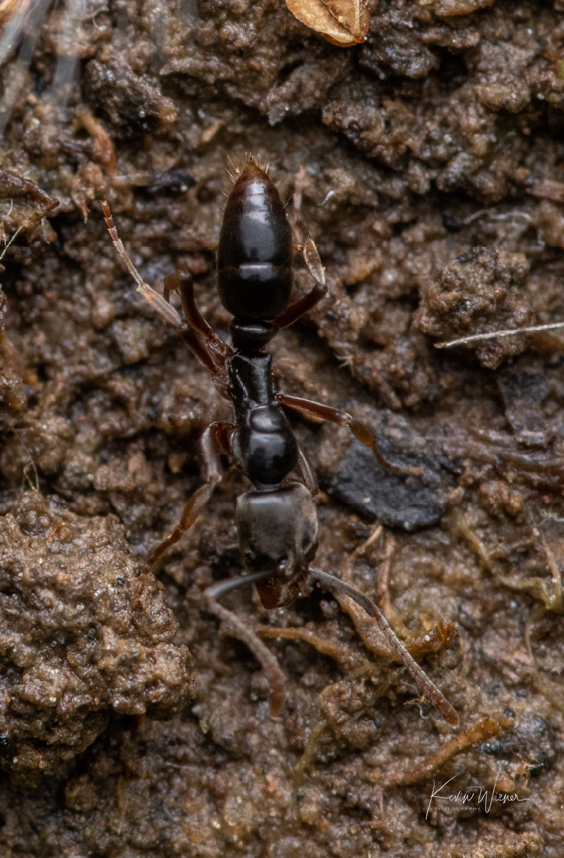
Asian needle ant in
natural setting. Photo by Kevin Weiner, Evansville, IN.
It is official. The Asian needle ant is our newest invasive insect pest and has now become a permanent resident, stinging ant. Two ant specimens taken from a wooded area in southern Indiana by an astute amateur entomologist, who observed their appearance and behavior as ‘out of the ordinary’, was submitted to the Indiana Department of Natural Resources and to the Purdue University Plant and Pest Diagnostic Laboratory for species identification in February, 2022. Both were confirmed to be Formicidae: Brachyponera chinensis, commonly known as the Asian needle ant, not previously recorded from Indiana.
Asian needle ants (ANAs), originally from Eastern Asia (China, Japan, and Korea), were first discovered in the United States in the early 1930s, but only recognized as a pest since 2006. They have been officially established in several states in the U.S. including North Carolina, South Carolina, Alabama and Georgia and, have been anecdotally reported as far north and west as New York, Tennessee and Kentucky.
Note that stings to humans will be moderately painful (potentially causing severe allergic reactions to susceptible individuals) much like fire ant or bee stings, but fortunately because these ants are much less aggressive in protecting their nests, the number of stings per encounter will be less.
The First Report of the Invasive Asian Needle Ant in Indiana pdf provides more details on their identification and biology.
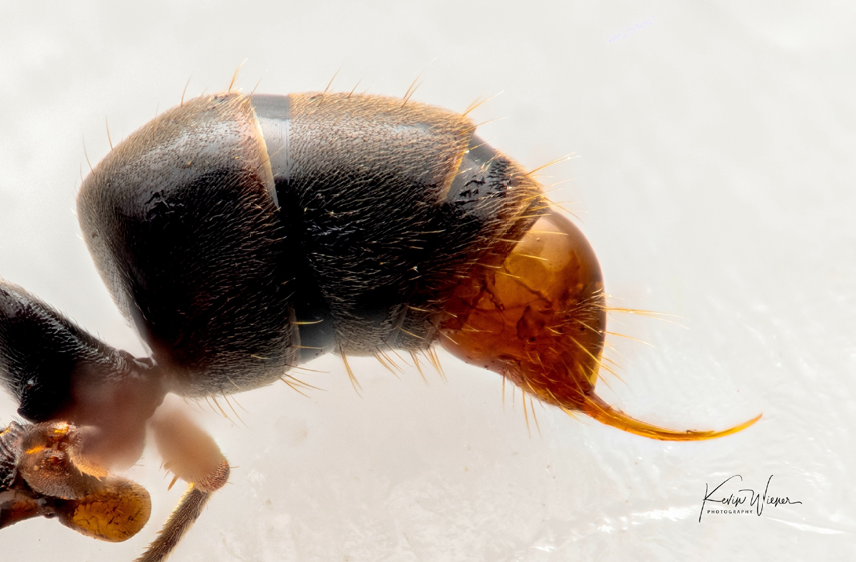
Asian needle ant stinger extended. Photo by Kevin Weiner, Evansville, IN.
If you want to confirm a sighting of the Asian needle ant please contact the Purdue University Plant and Pest Diagnostic Laboratory at this time. More information will be presented as experts monitor the spread.
Resources:
Thousand Cankers Disease, Indiana Department of Natural Resources
Thousand Cankers Disease: Indiana Walnut Trees Threatened, The Education Store, Purdue Extension’s resource center
Indiana Walnut Council
Spotted lanternfly: Everything You Need to Know in 30 Minutes, Video, Emerald Ash Borer University
Emerald Ash Borer, EAB Information Network
Report Invasive Species, Purdue Invasive Species
The GLEDN Phone App – Great Lakes Early Detection Network
EDDMaps – Early Detection and Distribution Mapping System
Indiana Department of Natural Resources: Invasive Species
Indiana Invasive Species Council
Cooperative Invasive Species Management Area (CISMA)
Invasive plants: impact on environment and people, The Education Store
Woodland Management Moment: Invasive Species Control Process, Video, Purdue Extension – Forestry and Natural Resources (FNR) YouTube Channel
Invasive Species, Playlist, Purdue Extension – FNR YouTube Channel
What are invasive species and why should I care?, Got Nature? Blog, Purdue Extension – Forestry and Natural Resources
Report Invasive
Indiana Department of Entomology and Plant Pathology
Tim Gibb, Insect Diagnostician and Extension Specialist
Purdue Department of Entomology

Recent Posts
- Question: Why Did the Shagbark Hickories Survive the Tornado?
Posted: August 27, 2026 in Forests and Street Trees, How To, Urban Forestry - New Indiana Woodland Steward Newsletter
Posted: August 12, 2026 in Forestry, Urban Forestry, Wildlife, Woodlands - Indiana Fall Hunting Licenses on Sale and New Mobile App Available
Posted: in Forestry, How To, Wildlife - Trees and Storms: Understanding Damage, Risk and Recovery
Posted: in How To, Urban Forestry - Lighting a Spark: Prescribed Burn Associations
Posted: August 6, 2026 in Community Development, Forestry, Safety, Wildlife - ID That Tree: Nannyberry Viburnum
Posted: July 22, 2026 in Forestry, Plants, Wildlife, Woodlands - ID That Tree: Eastern Swamp Privet
Posted: in Forestry, Plants, Wildlife, Woodlands - Jarred Brooke Receives Early Career Award for Prescribed Fire Work
Posted: July 20, 2026 in Forestry, Forests and Street Trees, Natural Resource Planning, Safety - Bovine Tuberculosis in Wild White-tailed Deer: Background and Frequently Asked Questions
Posted: in Disease, Natural Resource Planning, Wildlife - ID That Tree: Carolina Buckthorn
Posted: July 15, 2026 in Forestry, Wildlife, Woodlands
Archives
Categories
- Alert
- Aquaculture/Fish
- Aquatic/Aquaculture Resources
- Ask the Expert
- Christmas Trees
- Community Development
- Disease
- Drought
- Forestry
- Forests and Street Trees
- Gardening
- Got Nature for Kids
- Great Lakes
- How To
- Invasive Animal Species
- Invasive Insects
- Invasive Plant Species
- Land Use
- Natural Resource Planning
- Nature of Teaching
- Plants
- Podcasts
- Ponds
- Publication
- Safety
- Spiders
- Timber Marketing
- Urban Forestry
- Webinar
- Wildlife
- Wood Products/Manufacturing
- Woodland Management Moment
- Woodlands