 Purdue University - Extension - Forestry and Natural Resources
Got Nature? Blog
Planting food plots is a popular activity for landowners interested in attracting wildlife for viewing or hunting. The following are answers to questions we commonly receive regarding food plots, providing basic information to consider when planning for food plots as part of a comprehensive wildlife management plan for your property.
What is a food plot, and how important are food plots for wildlife in general?
A food plot is simply an agricultural crop or forage planted to attract wildlife for observation or hunting. While food plots are readily used by wildlife, they are not necessarily needed by wildlife. When we manage wildlife habitat, we break the habitat down into four basic components. Those components are food, water, cover and space. When we assess a habitat for the needs of a particular wildlife species, we want to determine which of those basic habitat components are most limiting or in need of the most work. Food is rarely the most limiting factor for wildlife. The most limiting factors are usually cover and space. Therefore, food is usually not the first habitat component needing to be addressed on the landscape. The primary purpose of planting food plots is to meet human desires to attract wildlife, rather than a necessity for wildlife. That said, food plots can still be incorporated and managed as part of a comprehensive management plan for any property in which wildlife viewing or hunting is an objective.
What are the different types of food plots?
What plants you provide in a food plot is largely determined by what species of wildlife you are interested in attracting. If you are interested in attracting white-tailed deer, which is quite often the wildlife species for which most food plots are planted, plants that provide green browse throughout most of the year would be recommended. The most popular green browse plants are typically forage plants and include clovers and wheat. Other green browse options might include soybeans, alfalfa, brassicas, turnips, kale, rye, oats and triticale, among others.
Wild turkeys will also use green browse plots, especially during the spring. Due to the short growth stature of green browse plots in the spring, male turkeys will often use these areas for strutting. Hen turkeys will bring broods to food plots of clover or other legumes for “bugging.” These areas are often high in insect biomass, providing an abundant and easily accessible food source for growing turkey chicks.
Agricultural grains are often planted for small game wildlife, including northern bobwhites, ring-necked pheasant and eastern cottontails. Grains like milo (or sorghum), sunflowers and corn are popular for small game food plots. Eastern cottontails will also readily use green browse plots if there is dense shrubby cover close by to escape predation. Sunflowers are usually planted specifically for hunting mourning doves. Grain food plots will also attract many nongame wildlife, especially songbirds. A mature sunflower field will often be full of American goldfinches, indigo buntings, chipping sparrows and song sparrows.
When should food plots be planted?
When food plots should be planted depends on what plants you will be planting. Most of the agricultural grains should be planted in the spring. Typically April and May are best for spring planted grains. Exact timing for spring planting is not as critical for food plots as it is for agricultural production. For example, soybeans can be planted in late June or even early July as a food plot. Soybeans planted for food plots are usually to provide green browse through the summer rather than bean production for harvest. Although late planted soybeans may not grow as optimal as earlier planted beans, they can still enhance the nutritional quality of summer forage for deer. Green browse plots for winter forage, including wheat and clovers, are usually planted in late summer through early fall. Clovers can also be planted in late winter or early spring.
Are food plots expensive?
Food plots vary in their expense to establish. Much of the expense depends on what you plant, equipment costs, herbicides and soil amendments. The expense really boils down to how much effort you want to put in the food plot and how successful you want it to be.
Seed costs vary considerably. Some conservation organizations, like Quail Forever and Pheasants Forever, offer free seed for its members to plant grain food plots. You might check with a local agricultural seed dealer or Ag co-op for availability of old seed. Older seed is not usually sold for agricultural production, and seed dealers may be willing to make a deal to get it out of their storage facilities. Some seed suppliers can provide additional services such as mixing your seed order for a small fee to save you time in the field. Of course, there are also the name brand seed varieties available through many sporting goods stores; however, they are usually much more expensive.
Equipment can be a considerable expense for planting food plots. Small tractors and utility vehicles can be quite expensive alone. Then you will need the implements to do the job, such as discs, planters, sprayers and possibly tillers or cultivators. If you lease part of your land for farming, you might be able to negotiate food plot work as part of the contract. Some Soil and Water Conservation Districts have implements, especially grain drills, available for loan at a small fee or deposit. Some equipment can be rented from rental supply companies. There are also individuals who specialize in food plot establishment and other habitat management projects available for hire.
Expenses associated with food plot preparation should be considered during the planning process. You will likely need to control undesirable vegetation with herbicides. Fertilizer may be necessary, and fertilizer costs fluctuate yearly. You may even have to consider exclusion of wildlife during the establishment phase, especially where deer are extremely abundant. Fencing for exclusion can be a considerable cost.
What are the basic steps in establishing a food plot?
The first step in food plot planning is to consider your objectives for having a food plot. Are you a hunter wanting to attract game to increase your hunting success? Are you interested in bringing wildlife closer to you and your family for viewing and enjoying?
Once you have determined your objectives, you need to determine the location(s). If you are planting for viewing only, where do you intend to view from? A back deck or perhaps from your living room or kitchen with large windows? You will need to consider the movement patterns of wildlife through the landscape, especially if hunting is your objective. Wildlife are more likely to utilize food plots when they are planted in areas through which they are already moving. It can be difficult to attract wildlife to an area they do not otherwise occupy unless you intend to address other habitat needs, especially cover requirements. If you are hunting, you will also want to consider wind patterns that will impact your movement into and out of the food plot during hunting. Providing multiple food plots increases hunting opportunities.
Site preparation is determined by several factors, including the amount of undesirable vegetation you will have to treat with herbicides, soil tests and planting method. If the site you have selected contains a large amount of herbaceous vegetation, you will want to consider using herbicide to kill as much of the competing vegetation as possible. Which herbicide needed depends on the nature of the plants you will control. A general herbicide most people use is glyphosate. If you have mostly grass to control, then a grass-specific herbicide can be used. If you need to control mostly broad-leaved plants, then a broad-leaf specific herbicide can be used. It is critical that before you use any herbicide, you read and follow all label directions.
A soil fertility test should be conducted for each food plot in order to determine if any of the essential soil elements are lacking and in need of amendment. The basic test will provide information on soil pH, plus the amounts of nitrogen, phosphorus, potassium and lime (calcium) that should be added. The folks at your county Extension or Soil and Water Conservation offices will provide you with the information you need for soil sampling and submission for testing. After you receive the test results, it is up to you on whether you want to amend the soil as per the test recommendations. Factors to consider are cost of the amendments and the desired vigor of the crop you plant. The more vigorous the crop, the more nutritional value it will have.
The planting method you choose will dictate how much soil work will be necessary. If you will be using a no-till drill, then you will be able to drill your seed directly into the soil through vegetation without disking it first. If you are using a conventional drill or broadcasting the seed, you will need to disk the soil prior to planting. If broadcasting, you will want to make another pass over the field with a cultipacker, harrow or other drag to lightly cover the broadcasted seed.
Annual plants, such as agricultural grains, will need to be planted every year. You could lightly disk a field of annual grains following seed set and perhaps get a second growing season from the seed production, assuming all the seeds have not been consumed. You could also leave the field fallow the next year, which means do nothing with it and let it go without disking or spraying. Either way will result in some germination of the previous year’s seed production along with annual weeds. The annual weeds are likely to be of good value for wildlife. Invasive weeds, such as Canada thistle, should be controlled with herbicide. Keep in mind that ragweeds and foxtail, while agricultural weeds, are highly valued by wildlife who consume seeds.
Other food plot plants, such as many clovers, are short-lived perennial plants and do not usually need to be planted every year. Once established, many clovers can be mowed periodically to maintain a vigorous growth. It would be beneficial to allow the perennials to produce seed to help maintain the field. Reseeding perennial plants may be necessary where browse pressure by deer is excessive.
Are there negatives associated with food plots?
There are not many negative impacts of food plots on wildlife. Two that could potentially impact wildlife are disease and predation. Any time you concentrate animals, you increase the risk of communicable disease transmission and predation. These negatives can be reduced through vigilant observation of your plots and habitat management. If you do notice a disease problem, then you may want to take the plot out of production for a year or two to reduce the concentration of animals. Disease transmission associated with food plots is rare.
Anytime you concentrate a food resource, you attract animals that eat that food, and this logic follows on up the food chain. If you plant milo, you will attract northern bobwhites and other birds. This, in turn, will attract predators of those birds. You can reduce predation by providing adequate escape cover in close proximity to the food plot.
What resources are available to help with food plots?
One of the best resources available for wildlife habitat management, including food plots, is your local District Wildlife Biologist from the Indiana Department of Natural Resources. The District Wildlife Biologist will be able to assist you in meeting your land management objective, especially as it relates to wildlife habitat. They will also be able to determine if your wildlife management objectives qualify for any cost share opportunities. If you are not in Indiana, your state’s natural resource management agency will also have a team of wildlife biologists dedicated to assisting landowners.
Another source of information is the Cooperative Extension Service. All states have Extension Wildlife Specialists housed within a Land Grant university that can provide you with information on managing wildlife habitat. Your county Extension Educator/Agent will also be able to provide you with information. The University of Tennessee Extension Service has several food plot resources available that are applicable throughout the eastern United States, including the book, A Guide to Successful Wildlife Food Plots: Blending Science with Common Sense (8MB pdf). For more resources, view Food Plots from The University of Tennessee Extension.
There are many books about food plots available from online bookstores. You can also get information about food plots from non-profit conservation organizations such as Whitetail’s Unlimited, Quality Deer Management Association, Pheasants Forever, Quail Forever, Duck’s Unlimited, etc. If you use the Internet for information, look for information from organizations previously listed, from government natural resource agencies and the Cooperative Extension Service.
Don’t forget to ask neighbors, friends, hunters and others with similar interests from your area. They may be experienced with planting food plots and, from my experience, enjoy talking about their experiences. They can be a wealth of knowledge, especially in regard to what will grow and what will not in your area. They may also be willing to help you with the planting of your plots!
If you have any questions, please feel free to contact Jarred Brooke, extension wildlife specialist, at jmbrooke@purdue.edu.
Resources
Food Plots, The University of Tennessee Extension
A Guide to Successful Wildlife Food Plots: Blending Science with Common Sense, The University of Tennessee Extension
Indiana’s District Wildlife Biologist, Indiana Department of Natural Resources
Food Plots for White-Tailed Deer, The Education Store
The Basics of Managing Wildlife on Agricultural Lands, The Education Store
How to Score Your White-tailed Deer, video, The Education Store, Purdue Extension Resource Center
White-Tailed Deer Post Harvest Collection, video, The Education Store
Jarred Brooke, Wildlife Specialist
Department of Forestry and Natural Resources, Purdue University
 The National Association of State Foresters (NASF) posts an Purdue Agriculture research article titled “Hunting Gives Deer-Damaged Forests in Indiana State Parks a Shot at Recovery.” The Purdue research team led by Michael Jenkins, associate professor of forest ecology, shares that a 17-year-long Indiana Department of Natural Resources policy of organizing hunts in state parks has successfully spurred the regrowth of native tree seedlings, herbs and wildflowers rendered scarce by browsing deer.
“We can’t put nature in a glass dome and think it’s going to regulate itself,” Jenkins said. “Because our actions have made the natural world the way it is, we have an obligation to practice stewardship to maintain ecological balance.”
Resources
Electric Fences for Preventing Browse Damage by White-Tailed Deer, The Education Store, Purdue Extension
Emerging Issues in White-Tailed Deer Management and Conservation, The Education Store, Purdue Extension
Corn and Soybean Crop Depredation by Wildlife, Purdue Extension
As hellbenders continue to decline, Dr. Rod Williams and his research team have been sharing awareness of how important it is that these salamanders continue to thrive in the current ecosystem.
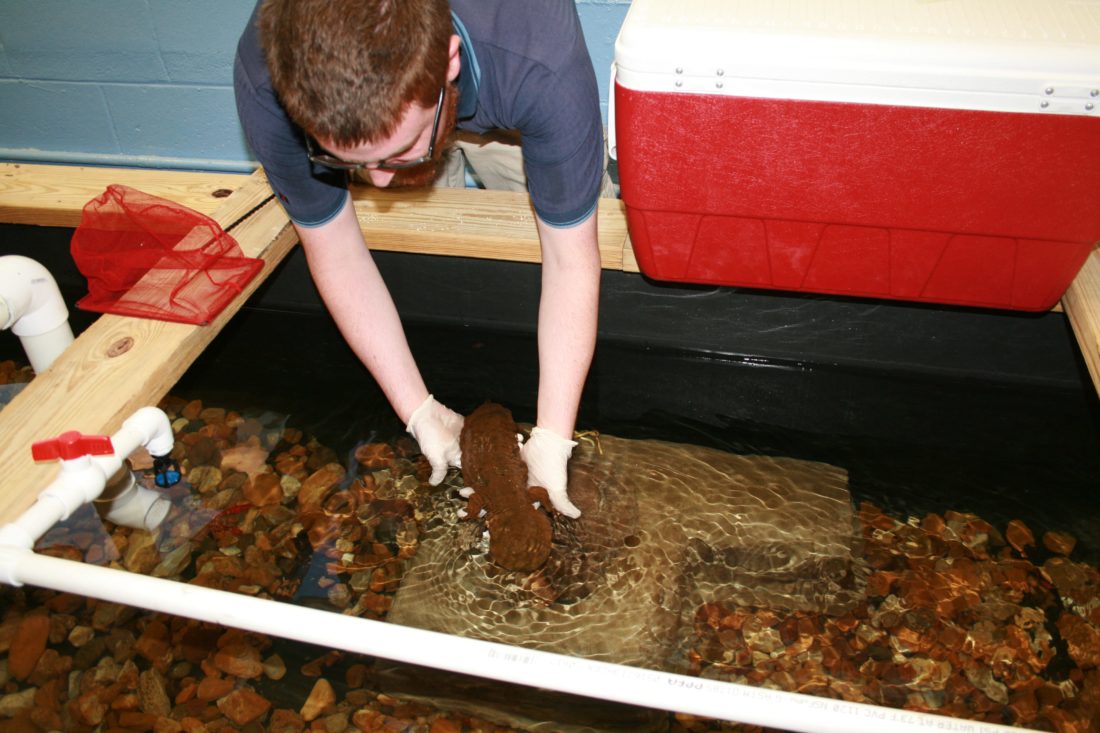
Eastern hellbenders are the largest salamander in North America. Adults can reach 29 inches in length, though most individuals are typically 11-24 inches long. Clean water is important for Hellbenders because they obtain most of their oxygen from the water by “breathing” through their skin. When breathing, their fleshy folds expand in surface area, enabling them to absorb more oxygen from the water.
Hellbender populations are declining across their range, from Missouri to New York. This decline, which affects the hellbender population in Indiana’s Blue River, is likely caused by human influences such as habitat degradation and destruction. The stream-bottom habitat of hellbenders can be degraded by sediment from eroded banks and fields and destroyed when streams are dammed or dredged. Hellbenders are also captured inadvertently by anglers or purposefully for illegal sale in the pet trade. Finally, emerging diseases may be impacting some populations of hellbenders.
Many states are developing conservation programs to help the hellbender. For more information and to learn more on conservation efforts, view Help the Hellbender.
Dr. Rod Williams and his hellbender research team have recently made national news:
CBS News
Trying To Save The Hellbender, America’s Largest Salamander
July 10, 2014
Resources:
Help the Hellbender Facebook page
Ask the Expert: Learn All About Hellbenders and Take a Tour, Subscribe Purdue Extension – Forestry & Natural Resources (FNR) YouTube Channel
Ask the Expert video: Help the Hellbender – Dr. Stephen Spear of The Wilds, Purdue Extension – FNR YouTube Channel
Ask the Expert video: Live with Mesker Park Zoo and Botanical Gardens – Hellbenders, Purdue Extension – FNR YouTube Channel
A Moment in the Wild video: Hellbender Hide, Purdue Extension – FNR YouTube Channel
A Moment in the Wild video: Release Moment of Hellbenders,
How Anglers and Paddlers Can Help the Hellbender video, Purdue Extension – FNR YouTube Channel
Eastern Hellbender ID Video, Purdue Extension – FNR YouTube Channel
Hellbenders Rock!, The Education Store, Purdue Extension’s resource center
Help the Hellbender, North America’s Giant Salamander, The Education Store
How Our Zoos Help Hellbenders, The Education Store
The Nature of Teaching: Adaptations for Aquatic Amphibians, The Education Store
Healthy Water, Happy Home – Lesson Plan, The Education Store
Purdue Expert: Hellbender Salamander, Purdue University News YouTube Channel
FNR Assists in First Natural Breeding of Eastern Hellbender in Captivity, Purdue FNR News & Stories
Helping the Hellbender: Mesker Park Zoo Begins Captive Breeding Efforts, Purdue Agriculture News
Rod Williams, Professor of Wildlife science and Assistant Provost for Engagement at Purdue University
Department of Forestry and Natural Resources, Purdue University
Diana Evans, Extension Information Coordinator
Department of Forestry and Natural Resources, Purdue University
Indiana Department of Natural Resources (INDNR) recently received inquiries asking what to do with an abandoned animal. The INDNR web resource titled Orphaned and Injured Animals has steps to follow as you decide if the animal is truly abandoned.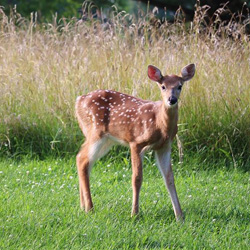
Resources
Got Nature? Orphaned Animals, author Brian MacGowan, extension wildlife specialist, Purdue University:
In most cases, the young animal is simply “spreading its wings” and exploring, or mom simply left it to get something to eat. Fawn deer are programmed to hide and remain motionless while mom is away. The fact is wildlife rarely abandons their young. They may leave briefly only to return.
Remember that you should never handle wild animals unless absolutely necessary. Any animal can bite you, and many harbor diseases and pests that can be transmitted to people.
In Indiana, wildlife rehabilitators have necessary state and federal permits to house and care for sick or injured wild animals. If you think you have found a sick or injured animal, you can find a list of licensed Wild Animal Rehabilitators in your area on the DNR Division of Fish and Wildlife’s website.
Mammals of Indiana, J.O. Whitker and R.E. Mumford
Common Indiana Mammals, R.N. Chapman and R.N. Williams, publication number FNR-413-W
Orphaned and Injured Animals, Indiana DNR
The Education Store (Search keywords to find the resources you need)
As foresters, woodland owners and tree and wildlife enthusiasts, we hear the word safety and immediately think about making sure our hard hat is packed, our gas tank is full, our cell phone is charged and we have a buddy to call in case of an emergency. How many of us think about diseases? Who thinks about West Nile Virus (WNV) or Eastern Equine Encephalitis (EEE)? For those of us that take our pets into the field, WNV and EEE are very real threats. West Nile Virus originated in Africa but spread quickly throughout the United States after an outbreak in New York in 1999. By 2003, 46 states had been infected, and nearly 10,000 people had fallen ill.
Although not contagious by contact with an infected person or animal, a protective layer is recommended when handling potential infected subjects. Most infected humans show no symptoms while a minority exhibit fevers, headaches, skin rashes, meningitis or encephalitis. Very few people die from WNV (< 1:1,000), but precautions should always be taken to prevent exposure. A total of 156 cases of WNV have been reported in Indiana this year with one sample being human. Other cases have been found in bordering states with 741 cases (mosquito) in Illinois, two mosquito and four human cases in Michigan, 64 mosquito cases in Ohio and zero cases of any kind in Kentucky as of August 20, 2013.
Eastern Equine Encephalitis is a rare viral disease that can be transmitted from host mosquitoes to a number of other animal species. Historical accounts of the disease show that in Midwestern states, EEE is most often found in southwestern Michigan; however, infected horses in Indiana have been found. EEE infects nearly all game birds, amphibians and reptiles, and last year in Michigan, an 8-week-old puppy.
Humans are not immune to EEE. Nearly 30% of people that develop the disease die, and approximately 50% of survivors have permanent neurological complications. Symptoms of infection may or may not occur and will often take between three and 10 days to be realized. EEE symptoms in humans range from fever, headache and nausea to abdominal pain, paralysis, seizures and fainting. An elderly woman in New England died on August 21, 2013, and was the first human casualty of the disease this year. A vaccine has been developed to prevent EEE in horses; however, no vaccine or treatment is available to protect humans or other animals from EEE or WNV. Elimination of standing water is our only defense against potential EEE and WNV threats.
As the summer is in full swing and more and more of us head out to the field, please do not forget to protect yourself and your pets from potential exposure to mosquitoes.
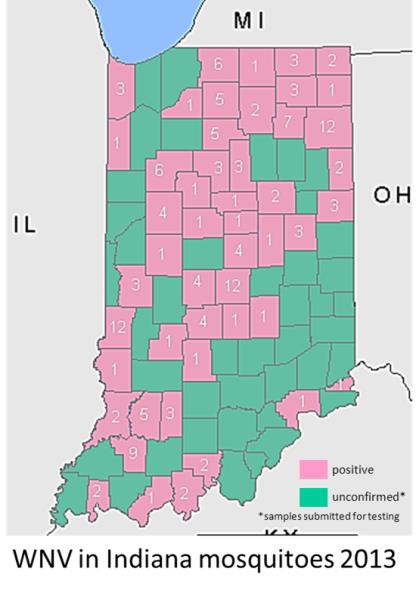
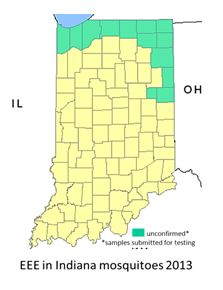
Sourced Information:
Beasley, D.W.C. et al. (2013) Resurgence of West Nile neurologic disease in the United States in 2012: What happened? What needs to be done? Antiviral Research 99:1–5.
Wendell, L.C. et al. (2013) Successful Management of Severe Neuroinvasive Eastern Equine Encephalitis. Neurocritical Care 19:111–115.
USGS Disease Maps
Van Buren County Horse Dies of Eastern Equine Encephalitis, Horse Owners Urged to Vaccinate Animals, MLIVE Media Group
Weymouth Officials Urge Caution After EEE Death, The Patriot Ledger
Resources
Mosquitoes, Purdue Extension Entomology
Shaneka Lawson, Plant Physiologist
Hardwood Tree Improvement and Regeneration Center (HTIRC)
Department of Forestry and Natural Resources, Purdue University
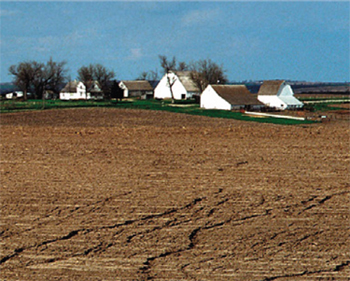 Because agriculture dominates the midwestern landscape, it has a huge impact on environmental quality. Agricultural producers are often advised to adopt practices that help to reduce the impact of agriculture on the environment. However, like all humans, they are often reluctant to change, which makes the work of conservation professionals extremely challenging. In this publication, we explore the myths and realities around what motivates farmers to adopt conservation practices. We draw on the authors’ combined research and applied practitioner experience with farmer adoption of conservation practices. Most evidence is based on studies and observations of traditional row-crop farmers in the midwestern United States.
Adoption of Agricultural Conservation Practices
The Education Store
Purdue Extension
Spring time brings a cacophony of frog calls around ponds and wetlands, but as spring slowly transitions into summer, the warmer temperatures signal the breeding season for many of our native reptiles. One of the oldest and most primitive reptile groups are the turtles. These ancient reptiles have remained relatively unchanged for 225 million years. There are currently ~300 species of turtles worldwide, and 18 species are found in Indiana. Most turtles in Indiana are associated with water, particularly waters that provide a variety of food items, basking sites and adjacent upland habitats. While Indiana is home to a diversity of turtle species, many are declining in number across their range. There are many factors contributing to these declines, but one that is particularly important this time of year is road mortality.
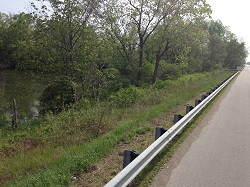
Figure 1: Small pond containing semi-aquatic turtles with a major road intersecting adjacent breeding habitat.
Why do you see so many turtles crossing the road in late spring and early summer (May-June)? This is the time of year when most of our turtles are searching for adequate nesting sites. Unlike amphibians that generally lay their eggs directly in the water, female turtles search for nesting spots in open, unshaded areas where the soil is not muddy or subject to flooding. Nests are often located on the nearest spot of land providing these conditions, but females of some species may travel 1-2 kilometers in search of a suitable net site.
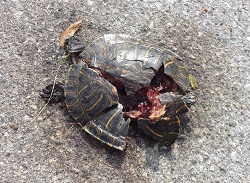
Figure 2: Female Red-eared Slider killed while attempting to cross the road to lay eggs at nearby upland nesting site.
Unfortunately, many of the upland sites are separated from ponds, lakes and streams by roads (Figure 1). As the females leave the ponds to lay eggs, they are forced to cross busy roads and may suffer incredibly high mortality rates (Figure 2). Females are more prone to road mortality than males (which are not required to leave the water to lay eggs), resulting in some populations consisting of nearly all male turtles. Increased female mortality lowers population growth rates (once the female is killed, so are the eggs she was carrying). To further complicate matters, turtles are long-lived species (up to 100 years), and females may not reach sexual maturity for 8-25 years.
What can you do to help? Increase vigilance and slow down when driving, especially in areas where roads intersect ponds and adjacent uplands. If you encounter an injured turtle that needs medical attention, call the Indiana DNR at 800-893-4116 or 317-232-4080 during business hours, 765-473-9722 (northern half of Indiana) or 812-837-9536 (southern half of Indiana) after hours or visit wildlifehotline.info.
For more information on turtles:
The Turtles of Indiana
The Education Store (Search keywords for more information)
Rod Williams, Associate Professor of Wildlife Science
Department of Forestry and Natural Resources, Purdue University
The month of May is not only known for producing flowers but the start of the white-tailed deer fawning season. In fact, nearly 90% of all white-tailed deer fawns are born between mid-May and mid-June. This time of year coincides with many of the outdoor activities that we all enjoy (hiking, mushroom hunting and shed hunting) and may sometimes bring us into contact with deer fawns.
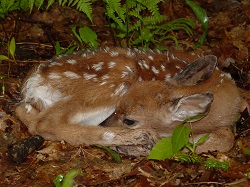
Figure 1. White-tailed deer fawn hiding in cover while the mother is off feeding.
When out enjoying nature, it is not uncommon to come upon a fawn tucked away under brushy cover, alone (Figure 1). At first glance, it may appear that the fawn has been abandoned by its mother, but this is rarely the case. This is actually part of the doe’s strategy to keep her fawn alive. Caching fawns in heavy cover serves to keep the fawn out of sight and away from would-be predators. A fawn will instinctively stay bedded down, remain motionless and silent until its mother returns from feeding. However, if harassed, the fawn may eventually leave the safety of cover and bleat in distress which results in the doe returning immediately to her fawn.
If you happen upon a fawn in the wild, you should not handle or harass it. Handling young fawns can distress not only the fawn, but the mother that is likely close by. If you happen to find a fawn cached in the woods, admire its hiding spot, spotted camouflage pattern and perhaps snap a photo. Take pride in knowing that the young fawn is not an abandoned orphan and will soon grow into the largest wild mammal in Indiana.
Under no circumstance should you remove a fawn from its hiding place. Removing wildlife from the environment is illegal without a proper handling permit from the Department of Natural Resources. If you find a sick or injured animal, you should contact your DNR law enforcement district or regional headquarters. The DNR does not care for injured animals but can connect you to licensed wildlife rehabilitators with the appropriate permits to care for injured wildlife.
Sources
Mammals of Indiana, J.O. Whitker and R.E. Mumford
Common Indiana Mammals, R.N. Chapman and R.N. Williams, FNR-413-W
Indiana DNR Orphaned and Injured Animals
Rod Williams, Associate Professor of Wildlife Science
Department of Forestry and Natural Resources, Purdue University
One of the best parts of spring is seeing all of the wildlife seemingly come to life around us. Unfortunately, that activity can also bring new challenges to homeowners. One of the most common and widespread problems is lawn damage caused by moles.
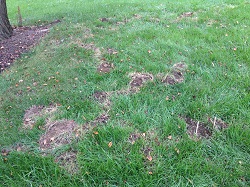
In Indiana, eastern moles cause significant lawn damage. Characteristic signs of damage are the raised surface tunnels (these make your lawn uneven and feel “spongy” when you walk across it) and the dirt mounds created when moles dig deeper tunnels. A single mole can dig many feet of tunnels; one study found a single mole constructed 31 m of surface tunnels in a day.
Biologists actually know very little about moles compared to many species. It is assumed they are territorial and solitary (except during the breeding season), but that has yet to be determined. The only home range study of eastern moles was published in 1976. That study found that the average home range size of male moles was just over 2.5 acres; females had an average home range size of two-thirds of an acre. In reality, there is likely much variation across habitat types and season. Clearly, small yards in urban areas are capable of sustaining many moles.
One of the most effective ways to control moles in the yard is by trapping. It just so happens that the best time to trap them is right now. In May, moles are actively looking for food (mostly earthworms and insects) in the top layer of the soil profile; however, they have not yet had their litter of up to four young. Thus, a little trapping effort now can save you more effort, and less damage, later.
There are a lot of different kinds of mole traps on the market. Which do you choose? Regardless of the type of trap, it should be in good working order. Poorly kept traps that are rusty with loose or broken parts are not worth setting out. In terms of the specific type of trap that you use, it’s really up to you. With types of traps, I use the analogy of computer programs. There are advantages and limitations to most computer programs, but they all get the job done they were intended to do. Different people seem to find different programs easier to work with than others. Perhaps most often, we simply use the first program we learned to use, and as long as it works, there’s not much point in learning another. I think the same is true of traps. We tend to have success with the ones that we first learned or have some experience with using.
The main point is to start trapping now – don’t wait for the damage to get worse. Select relatively straight surface tunnels for trap locations. If you only have one trap at your disposal, you may want to also mark a couple other potential trapping locations. Collapse these locations by stepping on them and marking them with a pin flag. If you aren’t having success catching a mole in your initial location, you can try moving to one of these if the tunnels are repaired. It may be that you initially chose a tunnel that was not a primary tunnel. However, it also may mean that your trap was not set properly.
Finally, you may come across some references that will direct you to check the traps frequently. While this is absolutely critical for live traps, it is not for mole traps since they are kill traps. There is no requirement to check them regularly other than to see if you have a mole. However, a trap with a dead mole won’t catch anything else. This is one reason why setting several traps is better if you have access to them. If you don’t catch a mole within two days, then you should consider moving locations or resetting the trap. When you catch a mole, keep setting traps until you don’t catch them. Most homeowners have problems with several moles and not simply one mole.
For more detailed information about controlling moles, see Wildlife Conflict Management – Moles, Purdue Department of Entomology.
Resources:
Moles, The Education Store, Purdue Extension resource center
Dealing With Mole Damage in Your Yard, Video, Purdue-Extension Forestry and Natural Resources (FNR) YouTube Channel
Adjuvants and the Power of the Spray Droplet: Improving the Performance of Pesticide Applications, The Education Store
Preventing Wildlife Damage – Do You Need a Permit?, The Education Store
Attract Hummingbirds to Your Yard, Video, Purdue Extension – FNR YouTube Channel
How to Stop Woodland Animals from Digging in Your Flower Pots, Video, Purdue Extension – FNR YouTube Channel
Brian MacGowan, Extension Wildlife Specialist
Department of Forestry and Natural Resources, Purdue University
Box turtles are so-called because unlike most turtles, they can completely close up their shell, much like a box. They have a hinged belly that can close so tightly that even an ant couldn’t get inside. They have probably evolved this capability in order to be safe from predators such as raccoons and opossums. There is a wonderful British Broadcasting Corporation (BBC) video called Eastern Box Turtle.
We have two box turtle species in Indiana, the ornate box turtle and the eastern box turtle. Both are protected by law from disturbance of any kind with the single exception of moving them out of danger, such as helping one cross a road (place it on the side it was headed; it will cross again if you return it to the original side). 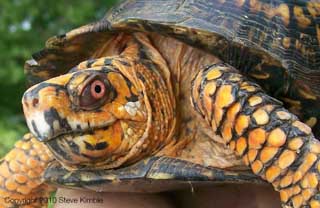 Both box turtles in Indiana are state protected because their numbers are declining, probably due to habitat loss and road deaths. What can you do to help? Slow down when driving, especially on rainy spring, summer or fall mornings. If you wish to have a box turtle as a pet, make sure that it was captive-reared, not wild-caught, though both are illegal in Indiana. If you encounter an injured box turtle that needs medical attention, call the Indiana DNR at 800-893-4116 or 317-232-4080 during business hours, 765-473-9722 (northern half of Indiana) or 812-837-9536 (southern half of Indiana).
To learn more about box turtles and other turtle species in Indiana, visit The Education Store for Turtles of Indiana.
Steve Kimble, Post Doctoral Research Associate
Department of Forestry and Natural Resources, Purdue
Rod Williams, Associate Professor of Wildlife Science
Department of Forestry and Natural Resources, Purdue

Recent Posts
- Beetle that attacks Tree-of-Heaven found in Indiana, Purdue Landscape Report
Posted: March 20, 2026 in Invasive Insects, Wildlife, Woodlands - ID That Tree: Dwarf Chinkapin Oak
Posted: in Forestry, Urban Forestry, Wildlife, Woodlands - DNR Hiring for Indiana Conservation Officer Positions, MyDNR
Posted: March 9, 2026 in Urban Forestry, Wildlife, Woodlands - ID That Tree: Shumard Oak
Posted: in Plants, Urban Forestry, Wildlife, Woodlands - Uniting Indiana Residents Against Invasive Species
Posted: February 27, 2026 in Community Development, Invasive Insects, Wildlife - Have You Seen a Soaring Eagle Lately? Morning Ag Clips
Posted: February 25, 2026 in Urban Forestry, Wildlife - Register for Natural Resources Teacher Institute’s Class of 2026
Posted: February 19, 2026 in Forestry, Wildlife, Woodlands - ID That Tree: Fragrant Sumac
Posted: February 4, 2026 in Plants, Urban Forestry, Wildlife - Woodsy Owl Edition for Educational Learning, USDA – U.S. Forest Service
Posted: January 21, 2026 in Forestry, Forests and Street Trees, Got Nature for Kids, Urban Forestry, Wildlife - Opt-in to the Deer Management Survey, MyDNR
Posted: January 12, 2026 in Forestry, Wildlife
Archives
Categories
- Alert
- Aquaculture/Fish
- Aquatic/Aquaculture Resources
- Ask the Expert
- Christmas Trees
- Community Development
- Disease
- Drought
- Forestry
- Forests and Street Trees
- Gardening
- Got Nature for Kids
- Great Lakes
- How To
- Invasive Animal Species
- Invasive Insects
- Invasive Plant Species
- Land Use
- Natural Resource Planning
- Nature of Teaching
- Plants
- Podcasts
- Ponds
- Publication
- Safety
- Spiders
- Timber Marketing
- Uncategorized
- Urban Forestry
- Webinar
- Wildlife
- Wood Products/Manufacturing
- Woodland Management Moment
- Woodlands