 Purdue University - Extension - Forestry and Natural Resources
Got Nature? Blog
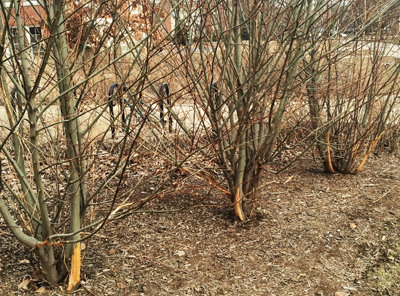 Cold winter winds, alternating extreme temperatures, ice and snow can be damaging to trees and shrubs. However, this spring, we are seeing additional damage due to the harsh winter conditions that is of the furry kind: rabbits and rodents. Mice and rabbits often damage young trees in the winter by feeding on the juicy, green cambium layer just under the bark and girdling the tree. Damage from these furry creatures occurs most commonly in winters when there is prolonged, heavy snow cover and food is scarce. Sound familiar? Rabbits feed on the bark above the snow while mice tunnel under the snow and feed near the ground level. Mouse damage is usually more severe when the trees are surrounded by heavy grass, weed cover or heavy mulch.
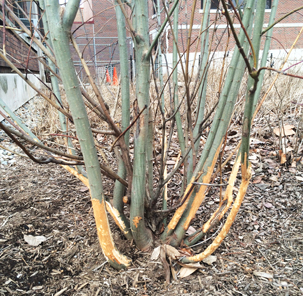 On young trees and multi-stemmed ornamental trees, rabbits remove the bark completely around the trunks and stems, effectively girdling them. All growth above the girdled areas will eventually decline and die, and for most situations, replacing the girdled trees is the best course of action. There are no applications that will mitigate the effects of rabbit damage or save severely damaged trees. Wound dressings, pruning paints, latex paints, wrappings and other alleged protective barriers do not help.
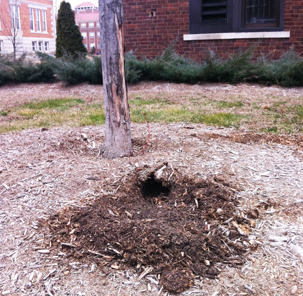 Many deciduous shrubs have the ability to produce new shoots or suckers at their base. Because of this ability, many severely damaged deciduous shrubs can recover. However, patience is required as several years may be required for some shrubs to fully recover. In early spring as the greening begins, prune off girdled stems just below the damaged areas. This will help rejuvenate the plant in most circumstances and replace the damage growth.
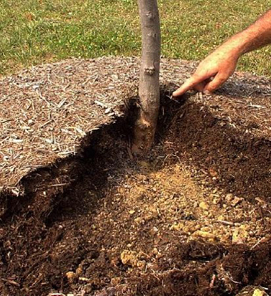 The most effective deterrent to girdling by mice or rabbits is to wrap the trunk and low branches of young trees with screen wire or hardware cloth. Be certain the wire wrap is buried below the ground line and extends high enough above the possible snow line to prevent rabbits from reaching to the trunk or branches. To help control mouse damage, maintain an area free of grass or weeds for a 1- to 2-foot radius around the base of the tree. Additionally, maintain proper mulch levels, never more than 2-3”, to eliminate the habitat for mice. Various chemicals are available to repel mice and rabbits, but these do not afford the reliability of a well-made barrier.
Resources
Preventing Wildlife Damage, The Education Store, Purdue Extension
Vole Damage in Pumpkins (and other crops), Purdue Extension – Forestry and Natural Resources (FNR) Got Nature? Blog
Moles, The Education Store, Purdue Extension resource center
Adjuvants and the Power of the Spray Droplet: Improving the Performance of Pesticide Applications, The Education Store
Preventing Wildlife Damage – Do You Need a Permit?, The Education Store
Attract Hummingbirds to Your Yard, Video, Purdue Extension Youtube Channel
How to Stop Woodland Animals from Digging in Your Flower Pots, Video, Purdue Extension Youtube Channel
Purdue Extension – Forestry and Natural Resources
Winter can be a difficult time of year for wildlife. Cold temperatures, deep snow and an ever-reducing supply of food impact the daily activities and survival ability for many wildlife. In general, wildlife have three strategies for surviving winter: migration, dormancy or toughing it out. Many species of birds migrate to warmer climates in the fall and return in the spring. Migrations can be as little as a few hundred miles to many thousands of miles. Many species of small mammals and most species of reptiles and amphibians handle winter by going through a period of dormancy, which includes torpor and hibernation. These animals reduce their metabolism by lowering oxygen consumption rates and body temperatures. Most mammals and many birds, however, will stick around and tough the winter out.
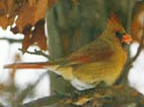 Toughing out a winter hasn’t been so bad in recent years, but the arctic weather pattern we have experienced recently will certainly force some changes in how those who tough it out spend the day. There are a myriad of adaptions for toughing out a winter. A heavier coat of fur or downy feathers increases insulation. Fatty deposits accumulated within the body are metabolized during lean food periods. Daily movements are often reduced to conserve energy. Food preferences change based on what types of food are available. How wildlife digest food in the winter can change. For example, the digestive enzymes in white-tailed deer change in order to cope with a change in diet during deep snow and severe cold as their diet shifts to more woody stems and buds. Many species look for shelter from the bitter cold and wind in thickets, dense shrubs and briar patches. Other species use underground dens to escape the cold. Some species of rodents, like southern flying squirrels, will share a den with many individuals, huddling together to conserve body heat. Others may burrow in the snow as it provides an effective barrier to sub-zero temperatures.
There are many things you can do on your property or around your home to help wildlife tough out the winter. Plantings of both deciduous and coniferous shrubs and trees can supply areas to escape cold winds as well as provide a food source. Coniferous shrubs and trees that provide excellent thermal protection include eastern red cedar, eastern white pine, northern white cedar, eastern hemlock, balsam fir, white spruce and American yew. When planting deciduous shrubs, select those whose twigs and branches overlap and lace together, forming a dense canopy. Recommended deciduous shrubs for thermal cover include American plum, the shrub dogwoods (gray, silky, red-osier and rough-leaved), hazelnut and ninebark. Also consider planting sumacs (Rhus spp.), deciduous hollies (Ilex spp.), viburnums (Viburnum spp.) and coralberry. While these species do not provide much winter thermal cover, they do produce abundant fruits that persist through winter, making them important emergency food sources. Dense patches of blackberry and raspberry can provide excellent thermal and escape cover, especially when located near food and water sources. These shrub and tree species can be planted in groups around your property or used as ornamental plantings around your home and out buildings. Most of these tree and shrub species are available commercially through the state nursery, native plant nurseries and some landscaping nurseries. Just make sure you are selecting species native to your area and stay away from invasive species!
Other habitat management practices that can increase winter habitat include cutting undesirable trees, constructing brushpiles and planting food plots. Cutting undesirable trees and allowing grape and greenbrier vines to cover the branches can create good thermal cover as can building brushpiles. Brushpiles should be no bigger than a small pickup truck. Heavier limbs and branches should be placed on the bottom with lighter branches stacked on top. Planting food plots and leaving a few unharvested rows of grain can provide food during extreme winter weather. When planning a food plot to serve as emergency winter food, I generally recommend milo, or sorghum. Milo is high in energy and can produce prolific seed heads with seeds that persist through winter. The stalks and leaves also provide good thermal cover in many cases. Be sure to include plantings of dense shrubs adjacent to food plots to serve as additional thermal and escape cover. Putting out extra bird feeders will be welcome by birds, especially when filled with oily seeds like sunflower and nyjer, or suet. Be sure to clear any deep snow from under the feeders to make seed more available and consider scattering seed on the ground near shrubs and other dense vegetation. Peanut butter and seed pine cones will be relished by many bird species and a fun activity for kids to make.
Let’s not forget about water. Open water can be just as difficult, or more difficult, to find during arctic cold snaps than food. If you have bird baths, try to keep ice free water available on a daily basis. If the air is so cold that bird bath water freezes quickly, then consider purchasing a few heated bird baths. My heated bird bath remained ice free, even during the -15 degree temperatures we just had. Sections of ponds can be kept relatively ice free by agitating the water. Special water agitators can be purchased, and water fountains will also work in some instances.
Resources
Winter Bird Feeding Tips, Minnesota Department of Natural Resources (photo above provided by MDNR)
Everything Wildlife, Purdue University
For information on natural resources management, visit the Extension webpage of Purdue University’s Department of Forestry and Natural Resources/Extension.
Rob Chapman, Extension Wildlife Specialist
Department of Forestry and Natural Resources, Purdue University
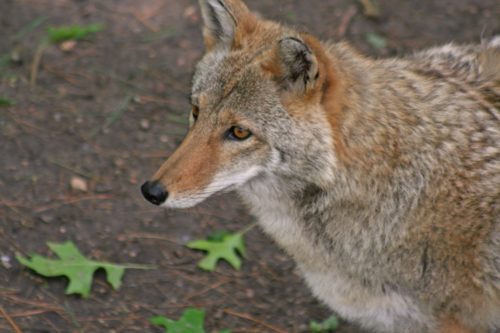 As you can imagine, there is no simple solution for this problem. There is no way to direct their movements. They will go where there is ample cover and food; yards and urban areas often have plenty of both. Also coyotes are territorial, so that plays an important role in their spatial ecology. What researchers are finding is that suburban and urban coyotes (and other wildlife for that matter) do not behave the same as their rural counterparts. Oftentimes, they need less space because resources are plentiful and close together.
Most biologists would agree that trapping and removing coyotes in general is not an appropriate management strategy. If you move them out, more will simply come in. However, trapping of specific problem coyotes can be part of a comprehension management approach. The best approach is to avoid problems, and this starts with preventing coyotes from getting comfortable around people. Never feed coyotes. Many problems in urban areas are the result of people feeding coyotes. If you see coyotes around your home or yard, scare them off by yelling, clapping your hands or with other loud noises.
Resources
Coyotes, IN DNR
Coyotes (PDF), Wildlife Conflicts, Department of Entomology, Purdue University
Should I Be Worried About Coyotes in My Yard?, Purdue Extension – Forestry & Natural Resources (FNR) Got Nature? Blog
Coexisting With Coyotes, Wild Bulletin, Indiana Department of Natural Resources, Division of Fish and Wildlife
Ask the Expert: Coexisting with Coyotes , Purdue Extension – FNR Got Nature? Blog
Urban Coyotes – Should You Be Concerned?, Purdue Extension – FNR Got Nature? Blog
Pets Disappearing? The Cause May Be Coyotes, Purdue Extension – FNR Got Nature? Blog
Question: Which is the correct species of coyotes I have on my land here in Indiana, coyote or coywolf?, Purdue Extension – FNR Got Nature? Blog
Permitted Wildlife Rehabilitators, Indiana Department of Natural Resources
How do you eliminate a nuisance animal on your property?, Indiana Department of Natural Resources (IN DNR)-Fish and Wildlife
Urban Coyote Research Center, Urban Coyote Ecology & Management, Cook County, Illinois
Brian MacGowan, Wildlife Extension specialist
Department of Forestry and Natural Resources, Purdue University
Determining what causes holes in lawn and landscaping can be a challenging endeavor for any homeowner. The size of the hole, the presence of excavated dirt and the timing of activity are all good clues to consider. Recently, I had several holes along my driveway and sidewalk that perplexed me. I’m no stranger to holes in my yard. I’ve been combating moles in my yard (we will save that for another post) and had recently observed dead mice and shrews in my driveway. I also have many chipmunks and gray squirrels around the yard.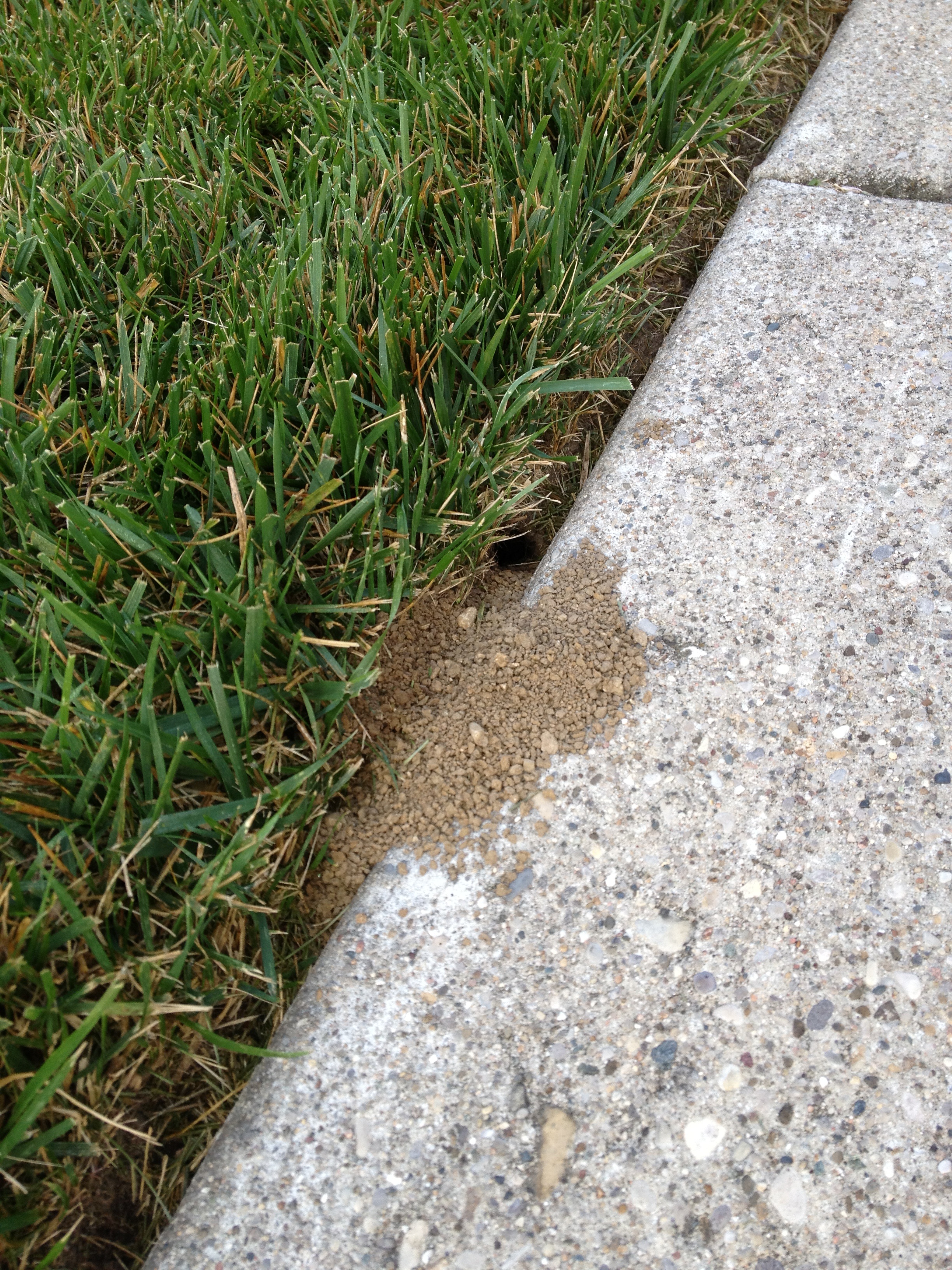 All of these can make holes of one type or another. However, these new holes looked different. They were clearly a tunnel/burrow with an entrance of 1.5 inches. Squirrels dig holes to bury/dig nuts or to feed on small plants. Chipmunks make 1.5 inch holes, but they carry the cast soil away in their mouths which results in a less conspicuous hole. Shrews and voles will excavate holes and tunnels, but these looked different. Voles usually are found in areas with overhead cover such as densely planted landscaping beds, areas with ground ivy or similar plants and beds with think mulch. These holes were exposed far from cover. So what were they?
It just so happens I was at a colleague’s house recently, and he mentioned all the cicada killers he has around the house. He literally had dozens of holes in areas with exposed soil just like the ones I observed at home. To my delight, I finally had the answer to my question.
Cicada killers are large wasps but unlikely to sting. Purdue’s Department of Entomology has more on cicada killers free downloadable pdf, Household and Structural, Cicada Killers.
Other resources:
Cicada killers: a nuisance or a danger?, Turfgrass Science at Purdue University
Cicada Killers, Plant & Pest Diagnostic Lab
Great Lakes Early Detection Network App (GLEDN) – The Center for Invasive Species & Ecosystem Health
EDDMaps – Early Detection and Distribution Mapping System
Report Invasives, College of Agriculture
Subscribe Purdue Extension – Forestry and Natural Resources YouTube Channel, Playlists include wildlife, Nature of Teaching, Moments in the Wild and much more.
Brian MacGowan, Wildlife Extension Specialist
Department of Forestry and Natural Resources
Purdue University
Wildlife identification guides are useful tools that help you figure out what kind of animal you may be looking at. However, they don’t always tell the complete story. Some animals such as garter snakes can have varied appearances which makes identification difficult. Some mammals have varied pelage such as striped skunks with some being almost completely black, white or some combination in between. A very small percentage of animals within a species may look dramatically different due to differences in pigment.
 Albinos lack the ability to produce color pigment in their skin, hair, feathers, scales or eyes. Animals with this condition have a white appearance with red or pink eyes. The latter is the result of tiny blood vessels that are now visible. They are typically hidden by the colored iris which is transparent in albinos.
In wildlife, albinism is a rare occurrence at birth caused by a recessive gene. The rate in wildlife is estimated from 1 in 20,000 to 1 in 1 million. Their solid white coat of fur makes them more susceptible to predation, or conversely, would make it difficult for an albino predator to stalk its prey. Albinos also have poor vision or may even be blind. The combination of these factors results in low survival of albinos, further decreasing their proportion in the population.
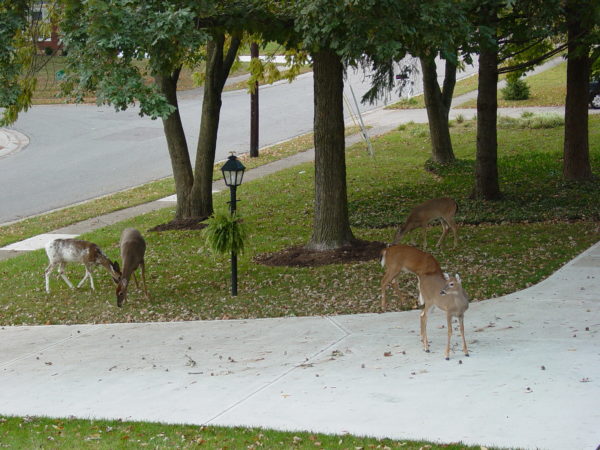
Partial albinism occurs in some animals and is much more common than true albinism. In white-tailed deer, this is sometimes referred to as ‘piebald’ where their fur has a blotchy, white appearance, but they lack the pink eyes found in albinos. Piebald deer occur at a frequency of less than 1 percent in hunted populations. A greater incidence of physical deformities have been reported for piebald deer.
*View in photo the piebald deer on the far left side.
Resources:
Ask an Expert: Wildlife Food Plots, video, Purdue Extension – FNR YouTube Channel
Handling Harvested Game: Episode 1, Field Dressing, video, Purdue Extension – FNR YouTube Channel
Deer Harvest Data Collection, Got Nature? Blog, Purdue Extension – FNR
How to Score Your White-tailed Deer, video, The Education Store, Purdue Extension Resource Center
Age Determination in White-tailed Deer, video, The Education Store
Handling Harvested Deer Ask an Expert? video, Purdue Extension – FNR YouTube Channel
Woodland Stewardship for Landowners: Managing Deer Damage to Young Trees, video, Purdue Extension – FNR YouTube Channel
Managing Your Woods for White-Tailed Deer, The Education Store
Deer Impact Toolbox, Pond and Wildlife Management, Purdue Extension
Snakes and Lizards of Indiana, The Education Store
Subscribe Purdue Extension – Forestry and Natural Resources YouTube Channel, Playlists include wildlife, Nature of Teaching, Moments in the Wild and much more.
Brian MacGowan, Extension Wildlife Specialist
Department of Forestry and Natural Resources, Purdue University
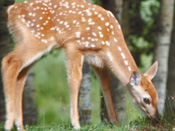 This time of year, sightings of white-tailed deer fawns, fledgling birds and other young critters becomes common. In most cases, the young animal is simply “spreading its wings” and exploring, or mom simply left it to get something to eat. Fawn deer are programmed to hide and remain motionless while mom is away. The fact is wildlife rarely abandons their young. They may leave briefly only to return.
Remember that you should never handle wild animals unless absolutely necessary. Any animal can bite you, and many harbor diseases and pests that can be transmitted to people.
In Indiana, wildlife rehabilitators have necessary state and federal permits to house and care for sick or injured wild animals. If you think you have found a sick or injured animal, you can find a list of licensed Wild Animal Rehabilitators in your area on the DNR Division of Fish and Wildlife’s website.
Resources
Mammals of Indiana, J.O. Whitker and R.E. Mumford
Common Indiana Mammals, R.N. Chapman and R.N. Williams, publication number FNR-413-W
Indiana DNR Orphaned and Injured Animals
Wildlife Habitat Hint: Tips for Evaluating a First Year Native Grass and Forb Plantings, Purdue Extension – FNR YouTube Channel
Drone Seeding Native Grasses and Forbs: Project Overview & Drone Setup, Purdue Extension – FNR YouTube channel
Designing Hardwood Tree Plantings for Wildlife – The Education Store
Forest Management for Reptiles and Amphibians: A Technical Guide for the Midwest, The Education Store
A Template for Your Wildlife Habitat Management Plan, The Education Store
Managing Your Woods for White-Tailed Deer, The Education Store
Woodland Stewardship for Landowners, Playlist, Purdue Extension – FNR YouTube channel
Nature of Teaching Unit 1: Animal Diversity and Tracking, The Education Store
Subscribe Purdue Extension – Forestry and Natural Resources YouTube Channel, Playlists include wildlife, Nature of Teaching, Moments in the Wild and much more.
Brian MacGowan, Extension Wildlife Specialist
Department of Forestry and Natural Resources, Purdue University
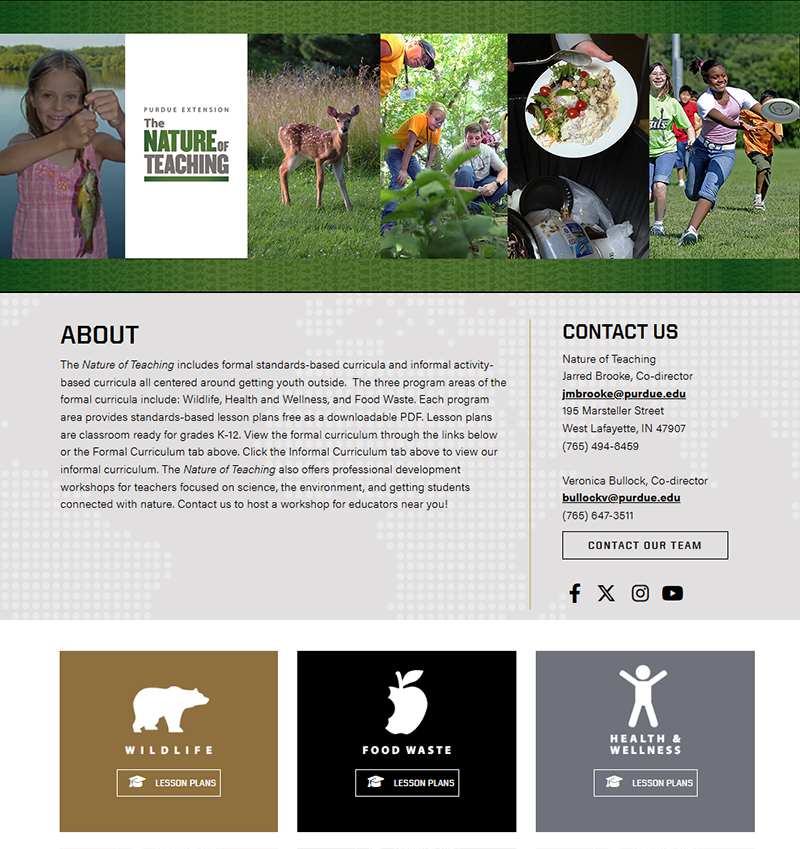 As teachers prepare their lessons for the fall, The Nature of Teaching is a great website to visit for science-based resources. Teachers can find free lesson plans, printable, posters, a photo library, information on upcoming workshops and more. You will find on the website tabs titled “Formal Curriculum” and “Informal Curriculum.” The Nature of Teaching also offers professional development workshops for teachers focused on science, the environment, and getting students connected with nature.
These organized lesson plans meet several K-5 Science and Math Academic Standards along with three 9-12 Natural Resource Management Academic Standards.
Wildlife curriculum include:
- Animal Diversity and Tracking
- Discovering the Watershed: Effects on Water Quality
- Common Indiana Mammals: Natural History and Identification
- Invasive Plants: Impact on Environment and People
- Hellbenders Rock! Natural History and Conservation of the Eastern Hellbender
Food Waste curriculum include:
- Food Waste and Natural Resources
- What a Waste of Food!
- Food Waste and The Environment
- Food Waste Solutions
- Transporting Food Waste
Health & Wellness curriculum include:
- Unit 1 Benefits of Connecting with Nature
- Unit 2 Gardening Station
- Unit 3 Tree Talk Station
Other resources:
- Help the Hellbender, Purdue Extension
- Indiana Department of Natural Resources (INDNR): For Kids
- 4-H, Purdue Extension
- National FFA Organization
- Indiana FFA
- Flying Wild, Association of Fish & Wildlife Agencies
- Project Learning Tree, Indiana Department of Natural Resources
- Project Wet
- Project Wild
- Indiana Wildlife Habitat Evaluation Program (WHEP)
Contact The Nature of Teaching team if you have any questions regarding workshops, certifications and curriculum.
The Nature of Teaching, Purdue Extension
 Several myths have surfaced and resurfaced over many years. Indiana’s state forests have been managed by the Division of Forestry since the first state forest was established in 1903. Questions arise including acreage, management, level of harvest, the forestry profession and a number of other issues. The maintenance of ecosystem processes is inherently more important than a given stage of development that must be preserved.
Check out the Forest Management and Wildlife Habitat Myths and Truths of Indiana State Forests (pdf).
Resources:
Frost Seeding to Establish Wildlife Food Plots and Native Grass and Forb Plantings – Purdue Extension YouTube
Wildlife Habitat Hint: Tips for Evaluating a First Year Native Grass and Forb Plantings, Purdue Extension – FNR YouTube Channel
Drone Seeding Native Grasses and Forbs: Project Overview & Drone Setup, Purdue Extension – FNR YouTube channel
Forest Improvement Handbook, The Education Store
Ordering Seedlings from the State Forest Nursery System, Got Nature? – Purdue Extension-Forestry & Natural Resources (FNR)
Designing Hardwood Tree Plantings for Wildlife – The Education Store
ID That Tree – YouTube Playlist
Forest Management for Reptiles and Amphibians: A Technical Guide for the Midwest, The Education Store
Ask the Expert: Hardwood Ecosystem Experiment – Birds and Salamander Research, Purdue Extension – FNR
A Template for Your Wildlife Habitat Management Plan, The Education Store
Managing Your Woods for White-Tailed Deer, The Education Store
Woodland Stewardship for Landowners, Playlist, Purdue Extension – FNR YouTube channel
Nature of Teaching Unit 1: Animal Diversity and Tracking, The Education Store
Subscribe Purdue Extension – Forestry and Natural Resources YouTube Channel, Playlists include wildlife, Nature of Teaching, Moments in the Wild and much more.
Indiana Department of Natural Resources
Division of Fish and Wildlife
As an Extension Wildlife Specialist, this is one of the most common questions I receive. The answer to this seemingly simple question can actually be quite complicated. It depends in part on what wildlife species you desire and what objectives you have for wildlife and other land uses for your property. There is no one plant that will do it. Food habit studies show that deer, turkey and many other wildlife species can consume hundreds of plant species throughout the year. With that in mind, focusing on one or two “miracle” plants would not yield great results (also remember that the presence of wildlife on your property depends on the surrounding properties).
If you have a particular species of wildlife you are interested in, you can compare their habitat 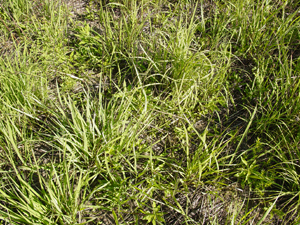 to what you have available to determine what is missing or limiting. You may also use a more general approach, looking at what major plant types are limiting such as hard mast trees, soft mast trees, shrubs, vines, annual forbs and perennial forbs. You will also want to evaluate water, cavities, downed woody debris or snags.
For questions about what to plant, it is easier to answer specific situations. Recently, a blog reader wrote that they just dredged their pond and spread it on a large open pasture about 50 yards from the pond. The reader wanted to know what to plant to attract quail and pheasant while also benefiting deer and turkey populations. Being in Monroe County, quail is more likely, so I will focus on that.
In the fall and winter, quail feed heavily on plant seeds, especially ragweed, pigweed, foxtail and agricultural crop residue. Spring and summer foods include tender green vegetation and soft fruits. Invertebrates are consumed when available and are essential for the development of chicks.
Cover is equally important in deciding what to plant. A mixture of herbaceous (grass, wildflowers) cover with bare ground interspersed with some woody shrubs or open woodland edges will generally benefit quail. With these in mind and using what the “typical” Indiana landscape looks like, the owner may want to consider the following:
Native Warm Season Grass mix – This provides quality brood and nesting cover. Rates are listed in pounds (lbs.) PLS (Pure Live Seed) per acre. A typical mix for quail recommended by the USDA Natural Resources Conservation Service is listed below. The general idea behind this and other mixes for quail is the bunch grass provides overhead cover above and bare ground and space below. This allows free access to seeds on the ground from the wildflowers along with invertebrates on the ground and vegetation. Quail are small and can’t scratch their way to seeds like turkey and other larger birds.
|
Species
|
Rate (PLS)
|
|
Grasses
|
|
|
Big Bluestem
|
0.25 lbs.
|
|
Sideoats grama
|
2.00 lbs.
|
|
Canada Wildrye
|
1.25 lbs.
|
|
Little Bluestem
|
0.50 lbs.
|
|
Wildflowers
|
|
|
Partridge Pea
|
4 oz.
|
|
Illinois Bundleflower
|
1 oz.
|
|
Purple Prairie Clover
|
3 oz.
|
|
Purple Coneflower
|
2 oz.
|
|
Black-eyed Susan
|
1 oz.
|
|
Wild Bergamot
|
1 oz.
|
|
Showy Tick Trefoil
|
1 oz.
|
|
Butterfly Milkweed
|
2 oz.
|
|
Lead Plant
|
2 oz.
|
|
Round-headed Lespedeza
|
2 oz.
|
Plant a mixture of shrubs – Shrubs provide good resting cover and winter cover for quail. Bare root seedlings planted in the spring should be planted 6 ft. x 6 ft. spacing in clumps “about the size of a large pickup truck.” Species that provide good structure for quail include gray or silky dogwood. American plum and serviceberry will also benefit wild turkey and white-tailed deer.
IMPORTANT: Plant species and mixes recommended above may not be suitable for the site moisture or soil conditions. Improper site preparation and methods will lead to planting failures. Contact your county extension office for proper methods and species that are appropriate for your area. It is always best to have a resource professional visit your site to provide you specific advice that considers your current habitat condition and the equipment and resources available to you, along with what you want to accomplish. In addition to your county extension office, you may want to contact your DNR district wildlife biologist. Finally, planting is only a start. Providing habitat for wildlife, and especially for early successional species such as bobwhite quail, requires continually habitat management that may include invasive species control, prescribed burning, disking or more.
Resources:
Natural Resources Conservation Service Indiana
Pheasant Forever
Quail Forever
Pure Live Seed: Calculations and Considerations for Wildlife Food Plots, Purdue Extension – Forestry and Natural Resources (FNR)
Seed Fillers and Carriers for Planting Native Warm-season Grasses and Forbs, Purdue Extension – FNR
Calibrating a No-Till Drill for Conservation Plantings and Wildlife Food Plots, The Education Store, Purdue Extension resource center
Subscribe: Purdue Extension – Forestry and Natural Resources YouTube Channel
Habitat Help LIVE Q&A – Native Grasses and Forbs for Wildlife, Purdue Extension-FNR Got Nature? Blog/Video
Frost Seeding Native Grasses and Forbs with a Drone (UAV): Lessons Learned, Purdue Extension-FNR Got Nature? Blog/Videos
Creating a Wildlife Habitat Management Plan for Landowners, Purdue Extension-FNR Got Nature? Blog
A Template for Your Wildlife Habitat Management Plan, The Education Store, Purdue Extension resource center
Managing Your Woods for White-Tailed Deer, The Education Store
Dr. Brian MacGowan, Wildlife Extension Specialist
Department of Forestry & Natural Resources, Purdue University
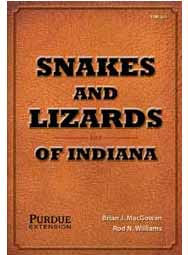 There are 36 species of snakes and lizards in Indiana and about 8,000 species worldwide. Lizards are the most taxonomically diverse and speciose group of reptiles with approximately 5,000 species. Serpentes represents the second most diverse and successful group of reptiles with approximately 3,000 species. Assistant Professor Rod Williams and Extension Wildlife Specialist Brian MacGowan of Purdue Forestry and Natural Resources have authored a book that provides information on the identification, ecology and behavior of snakes and lizards. This colorful resource with maps and photos expands upon their food habits, reproduction and conservation.
For more information about Indiana snakes and lizards, view The Education Store’s Snakes and Lizards of Indiana.
Resources:
Turtles of Indiana, The Education Store
Appreciating Reptiles and Amphibians in Nature, The Education Store
Forestry Management for Reptiles and Amphibians: A Technical Guide for the Midwest, The Education Store
The Nature of Teaching, Unit 3: Reptiles, Amphibians, and the Scientific Method, The Education Store
Snakes of Indiana, The Education Store
IDNR list of Endangered, Threatened & Rare Species
Indiana Herp Atlas
Partners in Amphibian and Reptile Conservation (PARC)
A Moment in the Wild: Black Racer, Video, Purdue Extension – Forestry and Natural Resources YouTube channel
A Moment in the Wild: Eastern Kingsnake, Purdue Extension – FNR Video
A Moment in the Wild: Eastern Hognose, Purdue Extension – FNR Video
Ask An Expert: Turtles and Snakes, Purdue Extension – FNR Video
Ask An Expert, Purdue Extension – FNR Playlist
Brian MacGowan, Wildlife Extension Specialist
Department of Forestry and Natural Resources, Purdue University

Recent Posts
- ID That Tree: Nannyberry Viburnum
Posted: July 22, 2026 in Forestry, Plants, Wildlife, Woodlands - ID That Tree: Eastern Swamp Privet
Posted: in Forestry, Plants, Wildlife, Woodlands - Bovine Tuberculosis in Wild White-tailed Deer: Background and Frequently Asked Questions
Posted: July 20, 2026 in Disease, Natural Resource Planning, Wildlife - ID That Tree: Carolina Buckthorn
Posted: July 15, 2026 in Forestry, Wildlife, Woodlands - Bat Roost Reporting Tool
Posted: July 8, 2026 in Alert, Community Development, Invasive Animal Species, Wildlife - Thank You, Turkey Trackers! Your Brood Counts Make a Difference – MyDNR
Posted: in Alert, Community Development, Wildlife - Identifying Evergreens
Posted: June 24, 2026 in Forestry, Wildlife, Woodlands - Celebrate Pollinator Week With Flowers of June Tour
Posted: June 15, 2026 in Forestry, Gardening, How To, Wildlife - Pruning Highlight-Pollarding Trees: A Traditional Pruning Practice with Modern Uses
Posted: June 11, 2026 in Forestry, Forests and Street Trees, Urban Forestry, Wildlife, Woodlands - Danielle Howard Hired as FNR Extension Prescribed Fire Specialist
Posted: June 10, 2026 in Forestry, Wildlife, Woodlands
Archives
Categories
- Alert
- Aquaculture/Fish
- Aquatic/Aquaculture Resources
- Ask the Expert
- Christmas Trees
- Community Development
- Disease
- Drought
- Forestry
- Forests and Street Trees
- Gardening
- Got Nature for Kids
- Great Lakes
- How To
- Invasive Animal Species
- Invasive Insects
- Invasive Plant Species
- Land Use
- Natural Resource Planning
- Nature of Teaching
- Plants
- Podcasts
- Ponds
- Publication
- Safety
- Spiders
- Timber Marketing
- Urban Forestry
- Webinar
- Wildlife
- Wood Products/Manufacturing
- Woodland Management Moment
- Woodlands