 Purdue University - Extension - Forestry and Natural Resources
Got Nature? Blog
Many forest landowners own and manage their land for hunted wildlife species such as white-tailed deer, wild turkey, and a host of other game species. This presentation titled Managing Your Woods for Game Species by Jarred Brooke, Extension Wildlife Specialist for Purdue University, discusses how forest management can be tailored to enhance habitat for game species and how forest management focused on game species can provide habitat for a suite of non-game wildlife.
The Toms, Tines, and Tanagers is a webinar event hosted by the Illinois Extension, College of Agricultural, Consumer & Environmental Sciences.
Resources:
Hunting Guide for 2023-2024, Indiana Department of Natural Resources
How to Score Your White-tailed Deer, video, The Education Store, Purdue Extension Resource Center
White-Tailed Deer Post Harvest Collection, video, The Education Store
Age Determination in White-tailed Deer, video, The Education Store
How to Build a Plastic Mesh Deer Exclusion Fence, The Education Store
Managing Your Woods for White-Tailed Deer, The Education Store
Bovine Tuberculosis in Wild White-tailed Deer, The Education Store
Frost Seeding Native Grasses and Forbs with a Drone (UAV), Purdue Extension-FNR
Help With Wild Turkey Populations, Video, Purdue Extension – Forestry and Natural Resources YouTube Channel
Turkey Brood Reporting, Indiana Department of Natural Resources (IDNR)
Wild Turkey, Indiana Department of Natural Resources (IDNR)
Wild Turkey Hunting Biology and Management, Indian Department of Natural Resources (IDNR)
Subscribe to Purdue Extension-Forestry & Natural Resources YouTube Channel, Wildlife Playlist
Woodland Management Moment YouTube Playlist, Purdue Extension – FNR
Finding help from a professional forester, Indiana Forestry & Woodland Owners Association
Forest Improvement Handbook, The Education Store, Purdue Extension resource center
Jarred Brooke, Wildlife Extension Specialist
Purdue Department of Forestry and Natural Resources
Illinois Extension, College of Agricultural, Consumer & Environmental Sciences
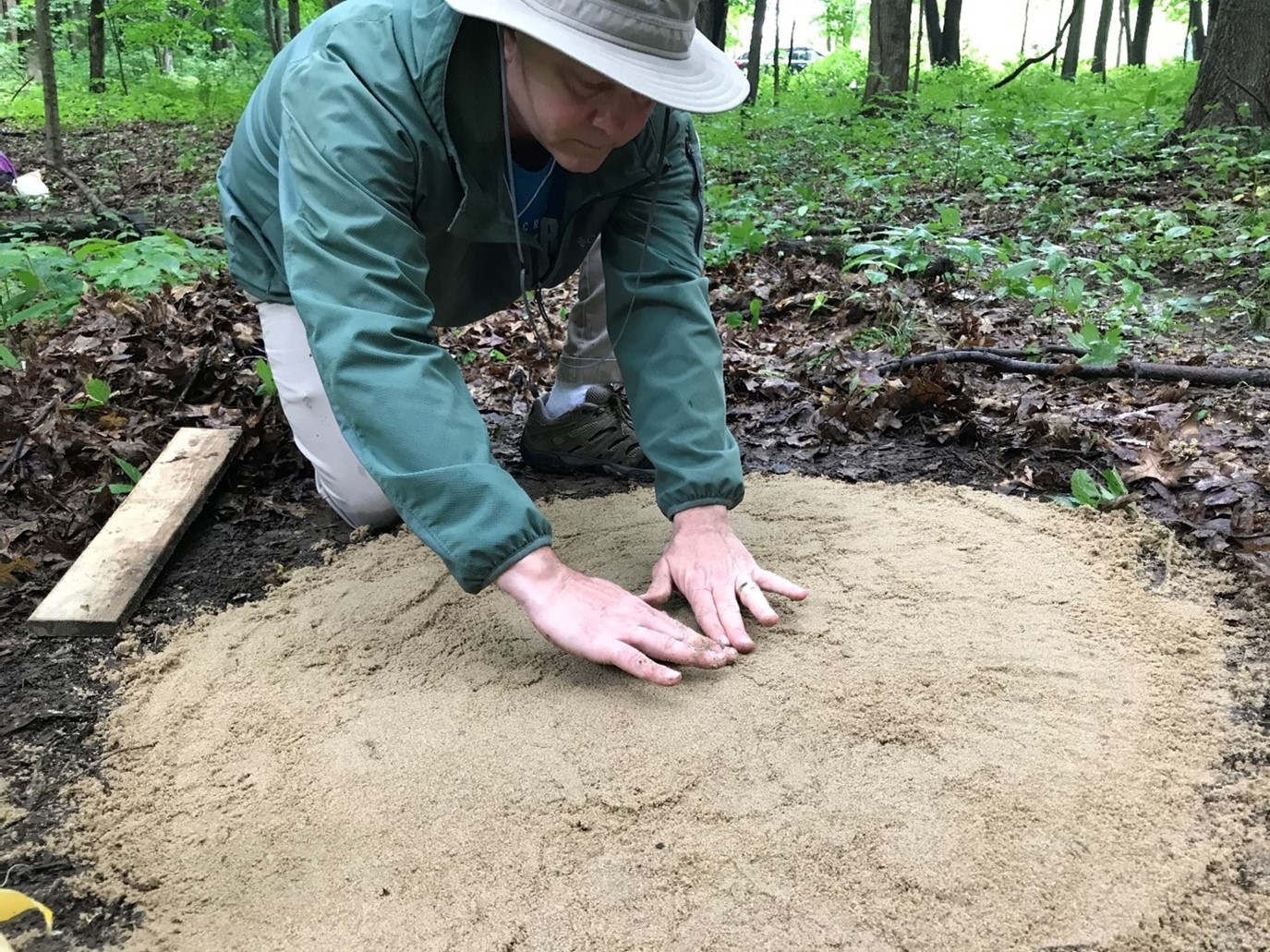
During K-12 Educator workshops, participants learn how to implement TNT curriculum such as building scent stations (pictured above). Photo by Jarred Brooke.
Agricultural & Natural Resources: Richard Louv’s words, “Time in nature is not leisure time, it’s an essential investment in our children’s health (and also, by the way, in our own),” underscores the critical role of nature in children’s well-being. Inspired by Louv’s concept of “nature deficit disorder,” The Nature of Teaching (TNT) was established in 2009 to connect youth to nature. The Nature of Teaching became an ANR signature program in 2019.
The primary focus of TNT is to engage K-12 youth with nature to foster environmental awareness and reap the positive health benefits of outdoor experiences. The program achieves this by integrating nature-based education into the school environment through standards-based curriculum. Through this, TNT not only connects students with nature but also provides lessons that align with Common Core and Next Generation Science standards.
The curriculum of The Nature of Teaching is divided into three key areas: Wildlife, Health and Wellness, and Food Waste. The Wildlife curriculum enhances students’ understanding of the natural world, while the Health and Wellness curriculum emphasizes the health benefits of connecting with nature. The Food Waste curriculum explores the environmental impact of food waste. Educators have access to more than 60 free standards-based lesson plans suitable for K-12 classrooms. In addition, TNT includes five informal curriculum units that are not standards-based and are more activity-focused. These informal lessons are great for field days and after-school type programs.

Veronica Bullock teaching a TNT lesson, Adaptations for Aquatic Amphibians, in a Union County classroom. Photo by Jennifer Logue.
Extension educators around the state have delivered TNT lessons to K-12 students since TNT became a signature program in 2019. In 2022 alone, 2,424 K-12 students benefited from TNT instruction, highlighting an impressive average knowledge increase of 16-31% in natural resources topics. The Nature of Teaching further supports K-12 educators through teacher workshops, with 17 teachers attending a workshop at Big Oaks National Wildlife Refuge in 2022. Attendees reported a significant boost in knowledge and confidence in connecting youth with nature.
As part of the signature program, Extension educators deliver three educational sessions using TNT formal curriculum to at least 15 students. Educators are also asked to provide students with pre- and post-tests to better understand student learning outcomes. Most educators deliver TNT in their local school system over several weeks. However, others deliver TNT through school clubs, after-school programs, or other avenues. The signature program requirements for Nature of Teaching are on the ANR Intranet. Educators are encouraged to work across program areas to deliver TNT.
Starting this year, The Nature of Teaching will be co-led by Jarred Brooke, Extension wildlife specialist, and Veronica Bullock, ANR educator, Franklin County. Jarred and Veronica have a long history with the TNT program and are excited to lead TNT into the future.
For educators who are interested in TNT, we will host a webinar on April 2 at 10 a.m. EDT to discuss future changes to the Nature of Teaching Signature program.
To see this article and others, please visit ANR Newsletter-February 2024.
Visit Nature of Teaching to learn more and explore the different lessons.
Resources:
Virtual Workshops, Nature of Teaching
Nature of Teaching, Website, Purdue College of Agriculture
The Nature of Teaching, YouTube channel
Transporting Food Waste, The Education Store, Purdue Extension resource center
Benefits of Connecting with Nature, The Education Store
Nature of Teaching: Common Mammals of Indiana, The Education Store
The Nature of Teaching: Food Waste Solutions, The Education Store
The Nature of Teaching: Food Waste and the Environment, The Education Store
The Nature of Teaching: Trees of the Midwest, The Education Store
The Nature of Teaching: Adaptations for Aquatic Amphibians, The Education Store
Trees of the Midwest Webinar, Nature of Teaching YouTube channel
Adaptations For Aquatic Amphibians Webinar, Nature of Teaching YouTube channel
Agriculture & Natural Resources (ANR)
Jarred Brooke, Wildlife Extension Specialist
Purdue Department of Forestry and Natural Resources
Veronica Bullock, ANR Extension Educator
Purdue Extension Franklin County
Wild Bulletin, Indiana Department of Natural Resources (DNR) Fish and Wildlife: Looking to build habitat that benefits wildlife species near you? February is a great time to complete winter habitat improvement projects, such as frost seeding native forbs, edge feathering forest boundaries, prescribe-burning warm-season grass, and removing invasive species.
DNR’s wildlife habitat fact sheets can teach you the best techniques for your desired management practices. Need more information for your unique property? Contact your district’s Wildlife Biologist, who can meet with you to provide suggestions on wildlife habitat improvements based on your specific goals.
To learn more please visit DNR: Wildlife Habitat Fact Sheets.
Resources:
Frost Seeding to Establish Wildlife Food Plots and Native Grass and Forb Plantings – The Education Store, Purdue Extension’s resource center
Tips for Evaluating a First Year Native Grass and Forb Planting, Got Nature? – Purdue Extension-Forestry & Natural Resources (FNR)
Wildlife Habitat Hint: Tips for Evaluating a First Year Native Grass and Forb Plantings, Purdue Extension – FNR YouTube Channel
Calibrating a No-Till Drill for Conservation Plantings and Wildlife Food Plots – The Education Store
Drone Seeding Native Grasses and Forbs: Project Overview & Drone Setup, Purdue Extension – FNR YouTube channel
Drone Seeding Native Grasses and Forbs: Seed Mixing, Loading the Hopper, Programming the Route, Purdue Extension – FNR YouTube channel
Drone Seeding Native Grasses and Forbs: Recapping the Project, Purdue Extension – FNR YouTube channel
Renovating Native Warm-season Grass Stands for Wildlife, The Education Store
Forest Improvement Handbook, The Education Store
Ordering Seedlings from the State Forest Nursery System, Got Nature? – Purdue Extension-Forestry & Natural Resources (FNR)
Designing Hardwood Tree Plantings for Wildlife – The Education Store
ID That Tree – YouTube Playlist
Forest Management for Reptiles and Amphibians: A Technical Guide for the Midwest, The Education Store
Ask the Expert: Hardwood Ecosystem Experiment – Birds and Salamander Research, Purdue Extension – FNR
A Template for Your Wildlife Habitat Management Plan, The Education Store
Managing Your Woods for White-Tailed Deer, The Education Store
Woodland Stewardship for Landowners, Playlist, Purdue Extension – FNR YouTube channel
Winter Weather Tree Tips, Got Nature? Blog, Purdue Extension – FNR
Indiana Department of Natural Resources
In 2023, our FNR Extension website featured stories on topics ranging from wildlife identification, concerns in forestry, urban forestry issues and aquaculture how-to guides. Here are the top stories our FNR Extension readers were interested in last year from archival favorites to new publications on our Got Nature! blog.
FROM THE ARCHIVES – ARTICLES ORIGINALLY POSTED PRIOR TO 2023
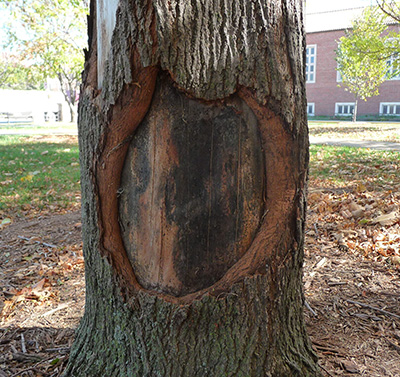
1 – Tree Wounds and Healing — Trees are incredible survivors in spite of the challenges from pests of all kinds, including us! They are vulnerable to injuries such as mechanical wounds from lawn equipment, vehicles and ice. Pruning results in an intentional wound which is of importance to consider. Tree owners and managers need to prune trees to maintain aesthetic characteristics, remove infected limbs, reduce risk, or improve structural stability. Proper pruning practice and understanding tree wounds can minimize the impact of creating wounds on trees.
2 – Question: Can Tree Roots Cause Damage to a Home’s Foundation? — A reader asked this question regarding a pin oak tree that is within 10 feet of their house after receiving A certified arborist took a look at it and said that he would like to use an Air Knife to expose the roots near the foundation (a walkout basement) to determine if the roots are causing damage and/or need to be pruned, or whether the tree needs to be removed since it is situated too close to the house.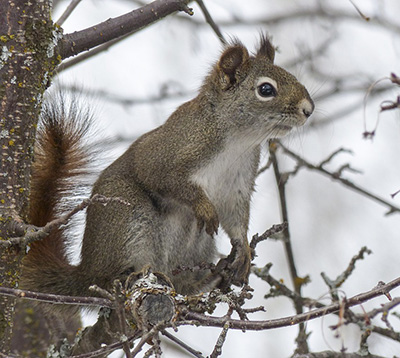
3 – Question: I Saw A Squirrel with No Fur on Its Neck, Both Backside and Underneath. What Is This? — People can be taken aback by the sight of squirrels missing hair. Sightings of partially furred squirrels is not unusual with warmer temperatures experienced through the winter. Like many wildlife issues, the cause of hair loss in squirrels is not easy to answer and often results in more questions than answers. In most situations, hair loss does not impact populations of squirrels.
4 – Be on the Watch for EHD in Deer — In August 2019, residents were warned to be on the watch for Epizootic Hemorrhagic Diseases (EHD) in deer after a white-tailed deer in Clarke County, Indiana tested positive for Epizootic Hemorrhagic Disease (EHD), and potential EHD cases had been reported in 26 other Indiana counties. Here are a few things you should know about how EHD, how to spot it, and how to report it.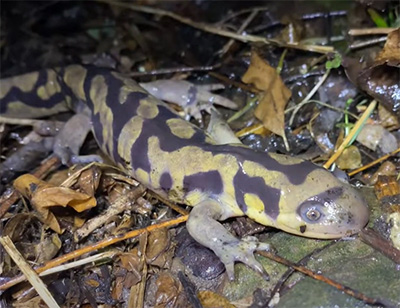
5 – Question: Are Carpenter Ants Harmful to My Tree? — Carpenter ants are very common inside trees, especially on larger, mature trees that are hollow with cavities. They nest in rotted, decayed wood, although some nests may extend into sound heartwood in the center of the tree. Carpenter ant presence is an indication of rotting wood, and infested trees should be checked to determine whether the rot has weakened the tree enough that it has become a risk of failure.
6 – Question: Why Are There So Many Acorns This Year? — If you have ever noticed acorns so numerous that you could not take a step without crushing several, you may be asking the question, “why are there so many acorns?” Some answers to this question can be found in the physiology and ecology of trees and their relationship to wildlife.
7 – It Is A Salamander. No, It Is a Lizard. Are They Different? — Salamanders are often mistaken for lizards, but the two groups are very different. Learn the differences between lizards and salamanders, how to identify each and more.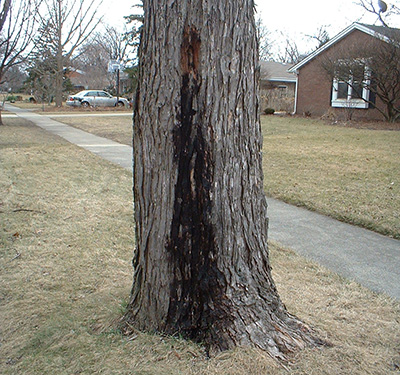
8 – Question: Blue Spruce is Dying, What Can I Do? — A reader sent in a question asking about a 40-year old spruce which is dying in the middle. There was a concern about Rhizosphaera needle cast as well as questions about fungus control sprays or alternative fungicide treatments.
9 – Slime Flux of Trees — Slime flux (also known as wet wood) is a dark, foul-smelling and unsightly seepage of sap from tree trunks. The disease is not usually a serious problem but the appearance can be alarming. Learn about the symptoms of slime flux, diagnosis and prevention measure.
10 – What Do Trees Do In the Winter? — Do they freeze up like unprotected water pipes? Or burst when it gets below freezing? Yes, the below-ground parts of a tree are kept insulated by mulch, soil and a layer of snow, and that is important to survival, but the exposed parts of a tree are not protected.
To see the full article, please visit FNR News & Stories.
Resources
Tree Pruning: What Do Trees Think?, The Education Store
Mechanical Damage to Trees: Mowing and Maintenance Equipment, The Education Store
Surface Root Syndrome, The Education Store, Purdue Extension resource center
The Nature of Teaching: Trees of the Midwest, The Education Store
Diseases in Hardwood Tree Plantings , The Education Store, Purdue Extension’s resource center
Iron Chlorosis of Trees and Shrubs, The Education Store
Purdue Landscape Report, Website
Winterize Your Trees, The Education Store, Purdue Extension resource center
Tree Defect Identification, The Education Store
Forest/Timber, Playlist, Purdue Extension – Forestry and Natural Resources YouTube channel
Urban Forestry, Purdue Extension – FNR playlist
Wendy Mayer, FNR Communications Coordinator
Purdue University Department of Forestry and Natural Resources
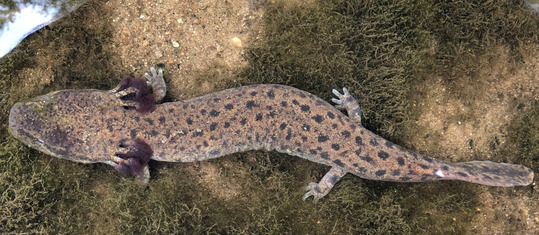
Photo by: Indiana DNR
Wild Bulletin, Indiana Department of Natural Resources (DNR) Fish and Wildlife: The Division of Fish & Wildlife asks anglers to report sightings of the mudpuppy (Necturus maculosus) to help biologists track their populations across the state. A Species of Special Concern in Indiana, this salamander inhabits the state’s lakes and streams.
Mudpuppies, like fish, live their entire lives in water, but they are more secretive and difficult to locate. During winter, mudpuppies move into shallow water and are more frequently caught by anglers. They may also be viewed from shore using a flashlight at night, while they walk along the lake bottom. Mudpuppies are not dangerous or poisonous. They can be identified by the red, fluffy gills on the back of their head, but the gills tend to lay flat against their body when they are out of the water.
If you catch a mudpuppy while fishing, please photograph it, cut your fishing line, and release the mudpuppy back into the water. Report your observation to the DNR herpetologist at HerpSurveys@dnr.IN.gov and include a clear photograph of it, the date, and the location where it was found. The DNR appreciates your help tracking this unique salamander.
To learn more please visit DNR: Amphibians and Reptiles.
Resources:
Researchers Discover Young Hellbender in Blue River, Purdue Forestry and Natural Resources News & Stories
Help the Hellbender, North America’s Giant Salamander, The Education Store
Help the Hellbender, Purdue College of Agriculture
Question: Which salamander is this?, Got Nature? Blog, Purdue Extension – Forestry and Natural Resources
Is it a Hellbender or a Mudpuppy?, Got Nature? Blog
Amphibians: Frogs, Toads, and Salamanders, Purdue Nature of Teaching
A Moment in the Wild, Playlist, Purdue Extension – Forestry and Natural Resources
Help the Hellbender, Playlist & Website
The Nature of Teaching: Adaptations for Aquatic Amphibians, The Education Store, Purdue Extension resource center
Hellbenders Rock!, The Education Store
Indiana Department of Natural Resources
Videos on the Purdue Forestry and Natural Resources Extension YouTube channel received more than 213,000 views in 2023. The Top 50 videos included 47 editions of ID That Tree, an informational series by Purdue Extension forester Lenny Farlee, as well as a webinar by Farlee on How to Identify Trees in Indiana. The remaining two videos in the Top 50 were an instructional video about a common urban tree planting problem by former Purdue Extension urban forester Lindsey Purcell, and a video about the use of prescribed fire on the Hardwood Ecosystem Experiment.
Below we will count down the 10 most viewed Purdue FNR Extension videos of 2023 with a few bonus videos sure to shoot up the list in future years.
Our most viewed video in 2023 was ID That Tree: Black Walnut with a whopping 18,156 views. This video has been seen more than 28,000 times since its debut in September of 2020.
1 – ID That Tree: Black Walnut — Learn the identifying characteristics of the black walnut tree, also known as the American black walnut or eastern black walnut, including pairs of leaflets running down each stem, long running ridges on the bark, and round nuts that have a very strong exterior. This sun-loving tree also needs high quality soil.
Our second most viewed video is ID That Tree: American Elm. This video, which debuted in June 2020, was watched 16,779 times in 2023, and has been viewed 33,456 times overall.
2 – ID That Tree: American Elm — In this tree identification series you will see how American elm leaves have jagged edges with a large tooth and then smaller teeth like edges on top of it. Find out why these trees are not as easy to find as they used to be.
Number three on our most viewed list is ID That Tree: Black Oak. This video, which debuted in March 2021, was seen 5,773 times in 2023.
3 – ID That Tree: Black Oak — In this episode of ID That Tree, we continue to get to know the oak groups, this time focusing on the black oak species. Deep sinuses on the leaves and shinier coat, a dark blocky bark and acorns with loose shingle-like plates on the cap are some key identifiers to separate it from the red oak and others.
Number four on the most viewed videos list was ID That Tree: Invasive White Mulberry. This video, which debuted in September 2021, was seen 5,197 times in 2023.
4 – ID That Tree: Invasive White Mulberry — On this episode of ID That Tree, Purdue Extension forester Lenny Farlee introduces you to a non-native invasive tree that is widespread across the state, white mulberry. Key identifying characteristics to separate it from its native cousin red mulberry are shiny variable leaves and where the species grows, near fence rows, hedgerows and other waste areas. The red mulberry has larger leaves that are duller in color with a sandpapery texture, and the species is often found in the forest understory.
Fifth on our countdown of top videos of 2023 is ID That Tree: Pignut Hickory. This video, which debuted in March 2022, was seen 4,569 times in 2023.
5 – ID That Tree: Pignut Hickory — In this edition of ID That Tree, meet another member of the hickory family that can found in upland areas, the pignut hickory. This species is identifiable by its five-leaflet compound leaves, its smooth round nut and partially open husk.
Number six on our list of top videos for the year is ID That Tree: Northern Catalpa. This video, which debuted in August 2021, was watched 4,489 times in 2023.
6 – ID That Tree: Northern Catalpa – On this episode of ID That Tree, meet the Northern Catalpa, native to southern Indiana along the Ohio River bottoms. This species, which provides rot resistant wood great for outdoor usage, features beautiful flower clusters in early summer, huge heart shaped leaves in whirled formation, and long bean-like fruit pods.
Number seven on our Purdue FNR Extension most viewed list is ID That Tree: Sassafras. This video, which debuted in July 2020, was seen 4,481 times in 2023. Graduate student Olivia Bingham is researching sassafras wilt in Indiana and needs your help with possible sightings across the state.
7 – ID That Tree: Sassafras — Join Purdue Extension forester Lenny Farlee as he introduces you to the Sassafras in this edition of ID That Tree. The Sassafras is well known for the tea made from its bark and also for having a variety of shaped leaves from zero to three lobes.
Eighth on our 2023 most watched videos list is ID That Tree: Red Pine. This video, which debuted in February 2022, was seen 4,470 times in 2023.
8 – ID That Tree: Red Pine — This week on ID That Tree, Purdue Extension forester Lenny Farlee introduces you to a non-native conifer that can be found throughout the state, the Red Pine. This species, which enjoys sandy soil, is identifiable by its small, egg-shaped cones, as well as tufts of needle pairs, which can be quite brittle, and orange/reddish bark.
Number nine on our most watched list is ID That Tree: Pin Oak. This video, which debuted in December 2021, was viewed 4,100 times in 2023.
9 – ID That Tree: Pin Oak — On this edition of ID That Tree, meet a species of native Indiana oak from the broad red/black oak family, which is found in bottomlands and areas with imperfectly drained soil, the Pin Oak. This species is recognizable by round acorns with flat scales, bristle-tipped leaves with deep 90-degree angled lobes, and lower branches that angle downward.
Number 10 on our most watched list is ID That Tree: Honey Locust. This video, which debuted in October 2021, was seen 3,510 times in 2023.
10 – ID That Tree: Honey Locust — This native tree comes with its own defense system in very large thorns on the stems and trunk. Meet the honey locust. Purdue Extension forester Lenny Farlee explains that large, long yellow seed pods that resemble bean pods, the option of single or doubly compound leaves on the same tree and smooth gray bark also help identify this species.
To see the full article, please visit FNR News & Stories.
Resources:
ID That Tree, Playlist, Purdue Extension – Forestry and Natural Resources (FNR) YouTube Channel (Invasive White Mulberry, Siberian Elm, Tree of Heaven)
Invasive Species Playlist, Playlist, Purdue Extension – FNR YouTube Channel (Asian Bush Honeysuckle, Burning Bush, Callery Pear, Multiflora rose)
A Woodland Management Moment, Playlist, Purdue Extension – FNR YouTube Channel (Against Invasives, Garlic Mustard, Autumn Olive)
Woodland Stewardship for Landowners, Playlist, Purdue Extension – FNR YouTube Channel (Common Buckthorn, Japanese Barberry)
Indiana Department of Natural Resources: Invasive Species
Indiana Invasive Species Council
Cooperative Invasive Species Management Area (CISMA)
Report Invasive, Purdue Extension
Aquatic Invasive Species, Illinois-Indiana Sea Grant (IISG)
Episode 11 – Exploring the challenges of Invasive Species, Habitat University-Natural Resource University
What are invasive species and why should I care?, Got Nature? Blog, Purdue Extension – FNR
Shrubs and Woody Vines of Indiana and the Midwest, The Education Store, Purdue Extension Resource Center
Native Trees of the Midwest, The Education Store
Investing in Indiana Woodlands, The Education Store
Forest Improvement Handbook, The Education Store
Wendy Mayer, FNR Communications Coordinator
Purdue University Department of Forestry and Natural Resources
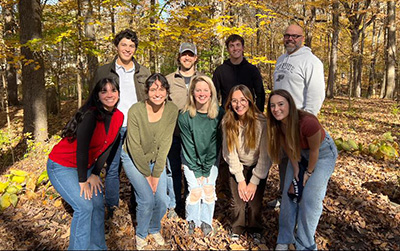 Dr. Rod Williams, extension wildlife specialist Nick Burgmeier and the Help the Hellbender team were honored for their collaboration with partners, outreach to the community and awareness education with the 2023 Indiana Friend of Conservation Award on January 9 in Indianapolis. The award, sponsored by Brownfield Ag News and presented by the Indiana Association of Soil and Water Conservation Districts (IASWCD) at its annual Conservation Awards Luncheon, recognizes individuals of entities who have made an outstanding contribution to soil and water conservation in Indiana. State level honorees are named in the corporate, individual and nonprofit/government categories.
Burgmeier and Eliza Hudson, the Farmers Helping Hellbenders Project Coordinator for the Regional Conservation Partnership Program, accepted the award on the Help the Hellbender team’s behalf.
The team was nominated for the state level award in the nonprofit/government category by virtue of receiving the Washington County Soil & Water Conservation District’s Friend of Conservation Award in February.
The eastern hellbender (Cryptobranchus alleganiensis alleganiensis) is a large, fully aquatic salamander, nicknamed the snot otter, water dog, devil dog, Allegheny alligator and water eel among other things. Their decline statewide has been documented as far back as the early-to-mid 1900s as a result of habitat loss and poor water quality. Hellbenders play an important role in aquatic ecosystems and are indicators of clean water.

For much of the last 17 years, Williams and his team have been researching eastern hellbenders, spearheading regional conservation efforts and advancing hellbender captive propagation, or the rearing of this ancient animal in captivity and their eventual return to the wild. The partnership had a major breakthrough over the summer with the documentation of a young hellbender salamander in the Blue River while conducting routine surveys. This discovery is significant because over the past three to four decades, only adult hellbenders have been documented in the Blue River. The presence of a young salamander suggests that conservation efforts and rearing programs are accomplishing their goals for the recovery of this endangered species.
The Help the Hellbender lab is actively collaborating with the Indiana Department of Natural Resources, Indiana Division of Fish and Wildlife and The Nature Conservancy as well as several other partners across 13 states on a number of conservation projects and educational opportunities for teachers and children, farmers and more.
To see the full article please visit the FNR News & Stories page.
Resources:
Help the Hellbender website
Help the Hellbender Facebook page
Ask the Expert: Learn All About Hellbenders and Take a Tour, Subscribe Purdue Extension – Forestry & Natural Resources (FNR) YouTube Channel
Ask the Expert video: Help the Hellbender – Dr. Stephen Spear of The Wilds, Purdue Extension – FNR YouTube Channel
Ask the Expert video: Live with Mesker Park Zoo and Botanical Gardens – Hellbenders, Purdue Extension – FNR YouTube Channel
A Moment in the Wild video: Hellbender Hide, Purdue Extension – FNR YouTube Channel
A Moment in the Wild video: Release Moment of Hellbenders,
How Anglers and Paddlers Can Help the Hellbender video, Purdue Extension – FNR YouTube Channel
Eastern Hellbender ID Video, Purdue Extension – FNR YouTube Channel
Hellbenders Rock!, The Education Store, Purdue Extension’s resource center
Help the Hellbender, North America’s Giant Salamander, The Education Store
How Our Zoos Help Hellbenders, The Education Store
The Nature of Teaching: Adaptations for Aquatic Amphibians, The Education Store
Healthy Water, Happy Home – Lesson Plan, The Education Store
Purdue Expert: Hellbender Salamander, Purdue University News YouTube Channel
FNR Assists in First Natural Breeding of Eastern Hellbender in Captivity, Purdue FNR News & Stories
Helping the Hellbender: Mesker Park Zoo Begins Captive Breeding Efforts, Purdue Agriculture News
Wendy Mayer, FNR Communications Coordinator
Purdue University Department of Forestry and Natural Resources
Indiana Association of Soil and Water Conservation Districts (IASWCD)
Are you curious about eastern hellbender salamanders? Learn about their biology, ecology and the work that is being done in Indiana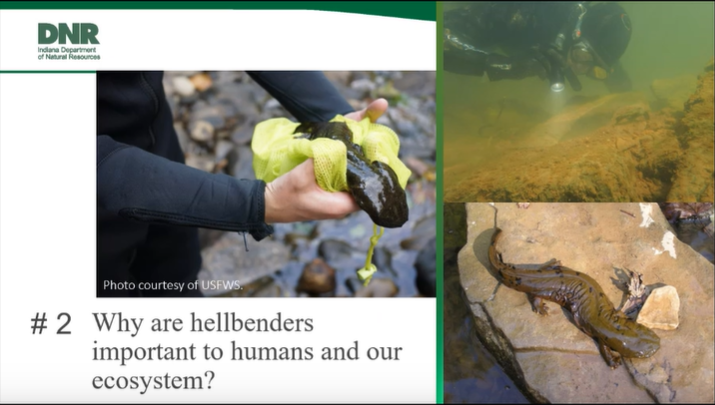 and beyond to restore the populations of this endangered species in a newly released webinar from the Indiana Department of Natural Resources.
The “Conservation of the Hellbender: Experts Unite” webinar, which originally took place on Nov. 14, 2023, features a panel discussion between FNR Extension wildlife specialist Nick Burgmeier, Nate Engbrecht, Indiana state herpetologist, and Leigh Ramon, animal curator at Mesker Park Zoo and Botanic Gardens).
The webinar is now available on the Indiana Department of Natural Resources’ YouTube channel.
For much of the last 17 years, Dr. Rod Williams and his team have been researching eastern hellbenders, spearheading regional conservation efforts and advancing hellbender captive propagation, or the rearing of this ancient animal in captivity and their eventual return to the wild. Beginning January 2024, Dr. Jason Hoverman will act as lead investigator for the Help the Hellbender lab’s work at Purdue.
Purdue’s hellbender lab is actively collaborating with the Indiana Department of Natural Resources, Indiana Division of Fish and Wildlife and The Nature Conservancy as well as several other partners across 13 states on a number of conservation projects and educational opportunities for teachers and children, farmers and more.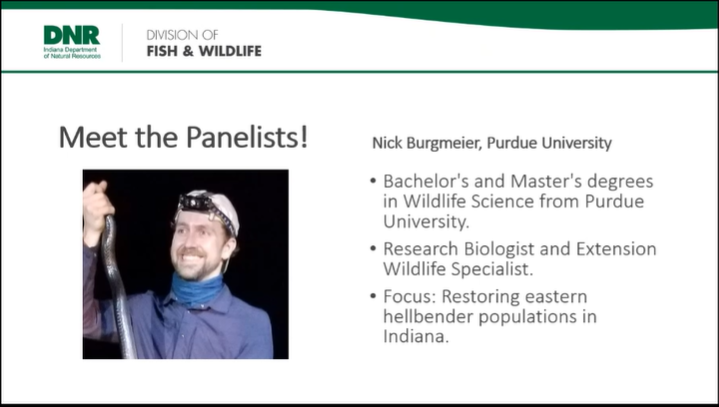
The “Farmers Helping Hellbenders” project, led by Williams and Purdue Extension wildlife specialist/Help the Hellbender project coordinator Nick Burgmeier, was selected in August 2022 to receive $2.7 million in funding through the RCCP Classic fund. The project aims to improve hellbender habitat in a four-county region in south central Indiana, the only remaining habitat for hellbenders in the state, by expanding the use of agricultural conservation practices that lead to decreased sedimentation in local rivers systems. Williams talks more about hellbenders and the project in this YouTube video.
The Indiana Hellbender Partnership is a collaboration between the Indiana DNR and Purdue University with funding support from the Indiana DNR Nongame Wildlife Fund, U.S. Fish & Wildlife Service, and partners in local governments, universities, non-governmental organizations, and zoos that are working to recover the state-endangered hellbender. Developed over 15 years, the Indiana Hellbender Partnership is the largest and most comprehensive group working to recover an imperiled amphibian in Indiana.
Resources:
Help the Hellbender website
Help the Hellbender Facebook page
Ask the Expert: Learn All About Hellbenders and Take a Tour, Subscribe Purdue Extension – Forestry & Natural Resources (FNR) YouTube Channel
Ask the Expert video: Help the Hellbender – Dr. Stephen Spear of The Wilds, Purdue Extension – FNR YouTube Channel
Ask the Expert video: Live with Mesker Park Zoo and Botanical Gardens – Hellbenders, Purdue Extension – FNR YouTube Channel
A Moment in the Wild video: Hellbender Hide, Purdue Extension – FNR YouTube Channel
A Moment in the Wild video: Release Moment of Hellbenders, Purdue Extension – FNR YouTube Channel
How Anglers and Paddlers Can Help the Hellbender video, Purdue Extension – FNR YouTube Channel
Eastern Hellbender ID Video, Purdue Extension – FNR YouTube Channel
Hellbenders Rock!, The Education Store, Purdue Extension’s resource center
Help the Hellbender, North America’s Giant Salamander, The Education Store
How Our Zoos Help Hellbenders, The Education Store
The Nature of Teaching: Adaptations for Aquatic Amphibians, The Education Store
Healthy Water, Happy Home – Lesson Plan, The Education Store
Wendy Mayer, FNR Communications Coordinator
Purdue University Department of Forestry and Natural Resources
Indiana Department of Natural Resources (IN DNR)
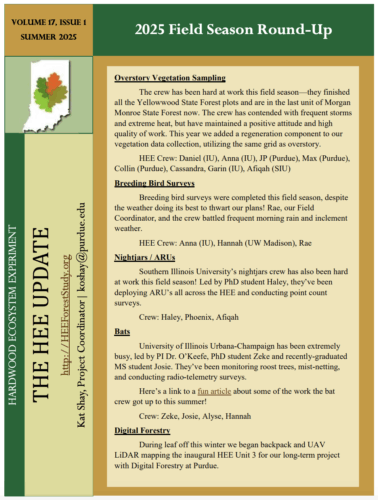 The Hardwood Ecosystem Experiment (HEE) just updated their newsletter for the fall/winter season. The Hardwood Ecosystem Experiment (HEE) was developed to study the effectiveness of different forest management methods in promoting successful oak and hickory regeneration and the effects of these management practices on plant and animal species. With nine partnering universities and agencies conducting research on the ecological and social impacts of long-term forest management, HEE has been an integral part of completed research for over 30 plus M.S. and Ph.D. level graduate students. The project has also employed more than 250 undergraduate and post-graduate students to conduct summer field work.
Newsletter topics include:
Squirrel & Small Mammal Crew
- Sarah Baker (PhD Candidate, Purdue) and three Wildlife Technicians conducted squirrel point count surveys. Camera trapping for squirrels and small mammals was also conducted.
Cerulean Warbler Crew
- Julian Grudens (MS Candidate, BSU) and Brit Nahorney (MS Candidate, BSU) worked with two Technicians to conduct aural surveys, nest searching, and mist netting.
They also collected caterpillar droppings to investigate the dietary preferences of Ceruleans.
Bat Crew
- Josie Hoppenworth (MS Candidate, UIUC) and Reed Crawford (PhD Candidate, UIUC) worked with two Technicians to conduct mist netting and find and catalogue roost trees.
Additional Work
- Longhorn beetle trapping was conducted (Purdue).
- Moth samples were collected (Drake University).
Introducing New HEE Staff
Rae Garrett – Field Coordinator
Rae began as the Field Coordinator in May 2023. Recently she graduated from Purdue University with a BS in Wildlife Biology with a minor in Insect Biology. Since then, she has worked in various temporary positions gaining experience in field work and outreach. She looks forward to assisting HEE Researchers with continuing data collection and working with Kat to reach new goals in outreach.
Kat Shay – Project Coordinator
Kat began as the Project Coordinator in September 2023. She has an MS in Environmental Science and an MPA from Indiana University, where she worked in Dr. Kim Novick’s lab on various phenology, carbon flux, oak leaf-miner, and cicada projects in Morgan Monroe and Yellowwood. She holds a BS in Environmental Science from the University of Alabama, where she worked in the Spatial Ecology Lab. She previously worked for NOAA at the Beaufort Lab in NC, conducting research on carbon flux and storage in salt marshes. Most recently she worked in the San Bernardino National Forest in southern California, managing conservation, recreation, and restoration projects. She has lived in Scotland, Germany, and all over the US and loves reading, traveling, and sports (especially soccer and rugby). She’s excited Hardwood Ecosystem Experiment Fall/Winter 2023 to join the HEE team and continue working in the forests she loves.
To view the full newsletter visit: HEE Newsletter.
If you would like to receive the HEE e-newsletter send your name, email, address and your interests to Kat Shay, forest project coordinator, at koshay@purdue.edu.
Resources:
Hardwood Ecosystem Experiment – Wildlife Responses to Timber Harvesting, The Education Store, Purdue Extension’s resource center
The Hardwood Ecosystem Experiment: Indiana Forestry and Wildlife, The Education Store
Breeding Birds and Forest Management: the Hardwood Ecosystem Experiment and the Central Hardwoods Region, The Education Store
The Hardwood Ecosystem Experiment: 2006-2016, The Education Store
Shrubs and Woody Vines of Indiana and the Midwest, The Education Store
Hardwood Ecosystem Experiment Playlist, Subscribe to Purdue Extension – Forestry and Natural Resources (FNR) YouTube Channel
Hardwood Ecosystem Experiment – Prescribed Fire, Purdue Extension – FNR YouTube
A Woodland Management Moment, Playlist, Purdue Extension – FNR YouTube Channel
Investing in Indiana Woodlands, The Education Store
Forest Improvement Handbook, The Education Store
Finding help from a professional forester, Indiana Forestry & Woodland Owners Association
Kat Shay, Forest Project Coordinator
Hardwood Ecosystem Experiment (HEE)
Purdue Forestry & Natural Resources

Three foresters with exemplary careers, including two Purdue Forestry and Natural Resources alumni, were recognized with the John F. Datena Distinguished Forester Award at the recent Indiana Forestry & Woodland Owners Association annual conference.
Jack Nelson of Lizton, Lenny Farlee of Lafayette and Bob Koenig (posthumously) from Greencastle were recognized for their leadership in forestry and support for Indiana woodland owners.
The Datena Award, named after former state forester John F. Datena to honor his commitment to Indiana forestry, recognizes professional foresters who have been highly influential in promoting the forestry profession in a manner that rises above their peers. Honorees have spent their careers making significant and sustained contributions to the betterment of forestry and are recognized by their peers to be leaders.
Jack Nelson retired after 34 years working for the Indiana Department of Natural Resources Division of Forestry and followed that long career with a private consulting forestry business. He has been practicing forestry for 53 years. In his role with the DNR he assisted private landowners and administered the Indiana Timber Buyers Licensing and Indiana Classified Forest programs. He owned a Christmas tree farm for 30 years and is active in many conservation organizations.
After a 20-year career with the IDNR Division of Forestry, Lenny Farlee pivoted to an Extension Forester role at Purdue University, where he provides science-based information on sustainable forest management to woodland owners and natural resource professionals across the Central Hardwoods region. Lenny is especially known for the “Forest Management for the Private Woodland Owner” short course he annually teaches and his series of 120+ videos on tree identification.
“This award has special significance to me as my fellow awardees this year were both pivotal supervisors and mentors in my early career,” Farlee said. “It also represents a very humbling acknowledgement of contributions over a career to the profession and practice of forestry in Indiana, something that has been my joy and pleasure to participate in with so many others. I recognize that significant accomplishments are always done in conjunction with others, and I am grateful for the support and assistance I have received from the Indiana forestry community over these many years.”
Farlee earned his bachelor’s degree in Forestry and Natural Resources from Purdue in 1985 and his master’s degree in 1991. He then worked as a nursery forester with the Indiana Division of Forestry at Vallonia State Tree Nursery from 1988 to 1991 and as a district forester from 1991 to 2006. In January 2007, Farlee joined Purdue FNR as an extension forester for the Hardwood Tree Improvement and Regeneration Center.
Farlee received the Friend of Conservation Award from the Tippecanoe County Soil and Water Conservation District in 2015 and was named as a recipient of the Indiana Hardwood Lumbermen’s Association’s President’s Award in 2015 and 2017. He also was part of the multidisciplinary group that received the PUCESA Team Award in 2021 for its outreach work on the cicada emergence.
To see the full article, please visit the FNR News and Stories page.
Resources:
Forest Management for the Private Woodland Owner Course – Got Nature? Blog, Purdue Extension – Forestry and Natural Resources
Virtual Forest Management for the Private Woodland Owner Course, Purdue Extension-FNR Events
Forestry Management for the Private Woodland Owner Course – Jackson County, Purdue Extension-FNR Events
Cost Assistance for Landowners Planning Conservation Practices, Purdue Extension-FNR Got Nature? Blog
Woodland Stewardship for Landowners: EQUP, video, Purdue Extension-Forestry and Natural Resources (FNR) YouTube Channel
Woodland Stewardship for Landowners YouTube Playlist, Purdue Extension – FNR
Woodland Management Moment: Invasive Species Control Process, Purdue Extension – FNR Video
Woodland Management Moment YouTube Playlist, Purdue Extension – FNR
Invasive Species YouTube Playlist, Purdue Extension – FNR
What are invasive species and why should I care?, Got Nature? Blog, Purdue Extension – Forestry and Natural Resources
Report Invasive Species, Purdue Invasive Species
The GLEDN Phone App – Great Lakes Early Detection Network
EDDMaps – Early Detection and Distribution Mapping System
Hardwood Ecosystem Experiment: Uneven-aged Management, Purdue Extension – FNR Video
Finding help from a professional forester, Indiana Forestry & Woodland Owners Association
Forest Improvement Handbook, The Education Store, Purdue Extension resource center
Lenny Farlee, Extension Forester
Hardwood Tree Improvement & Regeneration Center (HTIRC)
Purdue University Department of Forestry and Natural Resources

Recent Posts
- Purdue Extension’s Regional Teams Are Here: Connecting Communities with Expertise and Opportunity
Posted: October 14, 2026 in Community Development, Forestry, Forests and Street Trees, Gardening, How To, Timber Marketing, Urban Forestry, Wildlife, Woodlands - Deer and Turkey Archery Seasons Opening Soon, MyDNR
Posted: October 13, 2026 in Alert, Safety, Wildlife - Distinguishing Dogwoods
Posted: in Forestry, Urban Forestry, Wildlife, Woodlands - Can I Plant Trees in the Fall?
Posted: October 12, 2026 in Forestry, How To, Land Use, Plants, Urban Forestry, Wildlife - Publication Helps Midwest Fish Producers “Catch a Following” with Consumers
Posted: in Aquaculture/Fish, Aquatic/Aquaculture Resources, Wildlife - Minecraft Meets the Hellbender
Posted: September 22, 2026 in Aquaculture/Fish, Aquatic/Aquaculture Resources, Wildlife - What You Plant Matters to Wildlife
Posted: September 16, 2026 in Plants, Urban Forestry, Wildlife - Woodland Flowers of Late Summer
Posted: September 14, 2026 in Forestry, Gardening, Wildlife, Woodlands - Heavy August Rains Bring More Mosquitoes to Indiana
Posted: September 9, 2026 in How To, Invasive Insects, Safety, Wildlife - New Indiana Woodland Steward Newsletter
Posted: August 12, 2026 in Forestry, Urban Forestry, Wildlife, Woodlands
Archives
Categories
- Alert
- Aquaculture/Fish
- Aquatic/Aquaculture Resources
- Ask the Expert
- Christmas Trees
- Community Development
- Disease
- Drought
- Forestry
- Forests and Street Trees
- Gardening
- Got Nature for Kids
- Great Lakes
- How To
- Invasive Animal Species
- Invasive Insects
- Invasive Plant Species
- Land Use
- Natural Resource Planning
- Nature of Teaching
- Plants
- Podcasts
- Ponds
- Publication
- Safety
- Spiders
- Timber Marketing
- Urban Forestry
- Webinar
- Wildlife
- Wood Products/Manufacturing
- Woodland Management Moment
- Woodlands