 Purdue University - Extension - Forestry and Natural Resources
Got Nature? Blog
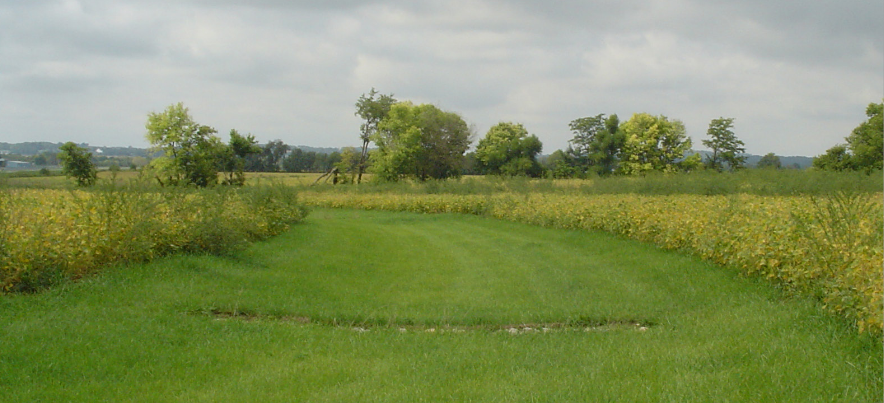 Agricultural Best Management Practices (BMPs) are intended to protect or improve water quality without significantly impacting production. This resource titled Tipping Point Planner Stormwater Definitions, Agricultural Best Management Practices, helps communities plan for a sustainable future. Authored by Ben Wegleitner, social science outreach associate, Daniel Walker, community planning extension specialist, Kara A Salazar, assistant program leader and extension specialist for sustainable communities, and Lydia Utley, data analyst, you will find references and get an overview of how the Tipping Point Planner program guides you through best management practices.
In this Long-Term Hydrologic Impact Assessment (L-THIA) model and the Tipping Point Planner program you will find the following BMPs: no-till practices, buffer strips, grassed waterway, nutrient management, grade stabilization structure and blind inlet.
With help from trained facilitators, the Tipping Point Planner program enables professional and citizen participation in the land use planning and management process.
Resources
Urban Best Management & Low Impact Development Practices, The Education Store, Purdue Extension resource center
Bioindicators of Water Quality: Quick Reference Guide, The Education Store
Improving Water Quality by Protecting Sinkholes on Your Property, video, The Education Store
Improving Water Quality At Your Livestock Operation, video, The Education Store
Improving Water Quality Around Your Farm, video, The Education Store
Healthy Water, Happy Home – Lesson Plan, The Education Store
Kara A Salazar, Assistant Program Leader and Extension Specialist for Sustainable Communities
Purdue University Department of Forestry and Natural Resources
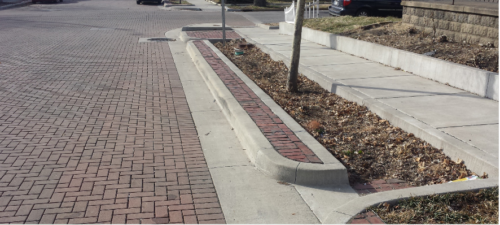 Urban best management practices (BMPs) and low-impact development practices are forms of green infrastructure designed to protect water quality and quantity by reducing stormwater runoff or by storing and treating stormwater before it reaches surface waters. Low-impact development practices are intended to mimic natural infiltration processes.
This publication titled Tipping Point Planner Stormwater Definitions: Urban Best Management Practices (BMPs) and Low Impact Development Practices is written by Ben Wegleitner, social science outreach associate, Daniel Walker, community planning extension specialist, Kara A Salazar, assistant program leader and extension specialist for sustainable communities, and Lydia Utley, data analyst. It discusses the benefits of several urban best management practices for protecting or improving water quality. These BMPs include: permeable pavement, rain barrels, bioretention system, grass strip (or buffer strip), grassed swale, retention ponds, wetland basin and detention basin. The following practices are used in the Long-Term Hydrologic Impact Assessment (L-THIA) model and the Tipping Point Planner. Through Tipping Point Planner, Great Lakes communities can plan sustainable futures by directly linking data to their local decision-making processes.
Resources
Tipping Point Planner Stormwater Definitions: Agricultural Best Management Practices, The Education Store, Purdue Extension resource center
Improving Water Quality by Protecting Sinkholes on Your Property, video, The Education Store
Improving Water Quality At Your Livestock Operation, video, The Education Store
Improving Water Quality Around Your Farm, video, The Education Store
Healthy Water, Happy Home – Lesson Plan, The Education Store
Kara A Salazar, Assistant Program Leader and Extension Specialist for Sustainable Communities
Purdue University Department of Forestry and Natural Resources
Cities and towns in the U.S. contain more than 130 million acres of forests. These forests vary extensively in size and locale. An urban forest can describe an urban park such as Central Park in New York City, NY, street trees, nature preserves, extensive gardens, or any trees collectively growing within a suburb, city, or town. Urban forestry is the name given to the care and maintenance of those ecosystem areas that remain after urbanization. Data from the 2010 census indicated more than 80% of Americans live in urban centers with a population increase greater than 12%. The population of Indiana represents only 2.1% of the nation. In the last 8 years, IN has had an influx of 200,000 people which represents a population increase of 3.0%!
Urban forests, which help filter air and water, control storm water runoff, help conserve energy and provide shade and animal habitat must be maintained. As our nation becomes more urbanized, appreciate those urban foresters working to ensure we have save urban forest spaces to enjoy. These precious resources add more than curb appeal and economic value, they improve our quality of life.
What does an urban forester do? Here’s a quick answer:
References:
Purdue Urban Forestry & Arboriculture, Purdue Forestry and Natural Resources
USDA Forest Service Urban Forests, United States Department of Agriculture
US Census Bureau, United States Census Bureau
Interested in Purdue Urban Forestry? Contact:
Lindsey Purcell, Chapter Executive Director
Indiana Arborist Association
Ben McCallister, Urban Forestry Specialist
Forestry and Natural Resources
Resources:
Tree Support Systems, The Education Store, Purdue Extension Resource Center
Corrective Pruning for Deciduous Trees, The Education Store
Tree Installation: Process and Practices, The Education Store
What plants can I landscape with in area that floods with hard rain?, Got Nature? Blog, Purdue University Forestry and Natural Resources Extension
 This unit highlights the resources required to produce food and the food wasted along each step of the food production system. It contains two lessons: Producers, Consumers, and Natural Resources; and Food Waste from Farm to Fork, along with all necessary overviews, notes, and resources.
For more details and free downloadable PDF see FNR-558-W publication at The Education Store: Food Waste and Natural Resources Lesson Plans.
Resources
What a Waste of Food!, lesson plans, The Education Store, Purdue Extension’s resource center
Food Waste Lesson Plans, Nature of Teaching
Rebecca Busse, Nature of Teaching Program Coordinator
Purdue Department of Forestry and Natural Resources
Rod N Williams, Engagement Faculty Fellow & Associate Professor of Wildlife Science
Purdue University Department of Forestry and Natural Resources
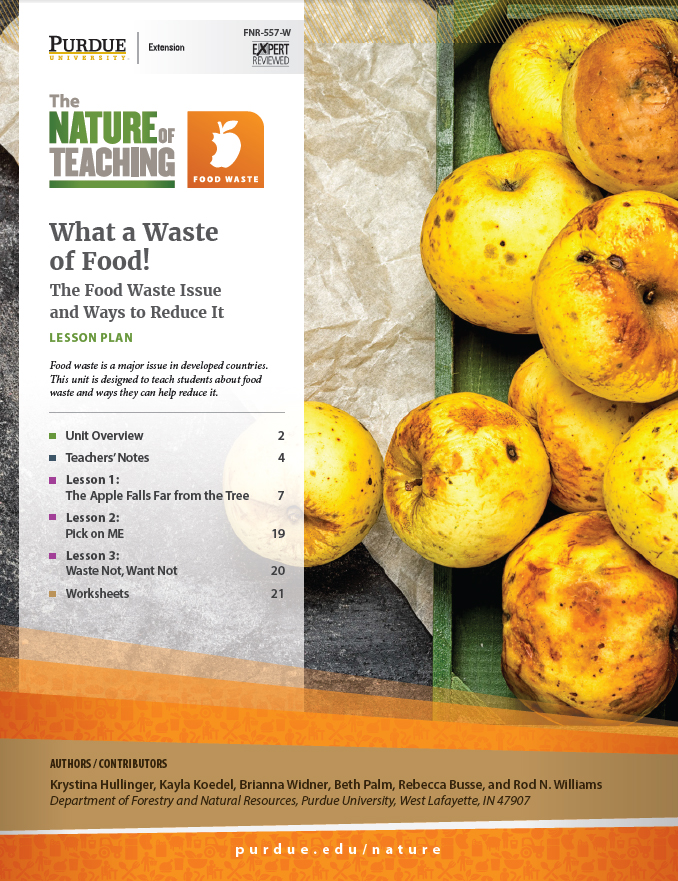 Food waste is a major issue in developed countries. This unit is designed to teach students about food waste and ways they can help reduce it. This section contains one unit with three lesson plans that will teach students how to reduce food waste by learning more about proper food storage, best-by dates, and ugly foods. It also contains a stand-alone lesson on food packaging and composting.
To view this free complete unit see: What a Waste of Food! Lesson Plans and PowerPoint, The Education Store, Purdue Extension.
Resources:
Food Preservation Methods, Purdue Extension
Washing Fresh Vegetables to Enhance Food Safety, Purdue Extension
Food Waste Lesson Plans, Nature of Teaching
Rebecca L Busse, Graduate Research Assistant
Purdue University Department of Forestry and Natural Resources
Rod N Williams, Engagement Faculty Fellow & Associate Professor of Wildlife Science
Purdue University Department of Forestry and Natural Resources
Prescribed fire is a great tool to improve the food and cover for a variety of wildlife species on your property. One of the most important aspects of using prescribed fire is making sure the fire is conducted safely. This point cannot be overstated, safe use of prescribed fire is paramount. Beyond taking the appropriate training courses or seeking help from a professional, one the most important aspects of safely conducting a prescribed fire is ensuring you have adequate firebreaks.
Firebreaks can serve multiple purposes related to the safe use of prescribed fire and can provide additional food and cover for wildlife. The main purpose of firebreaks is to stop the fire from escaping the burn unit, but they also can provide quick and easy movement around the burn unit, help reduce the amount of people required for the burn and can make igniting the fire safer. Here are a few examples of different types of firebreaks.
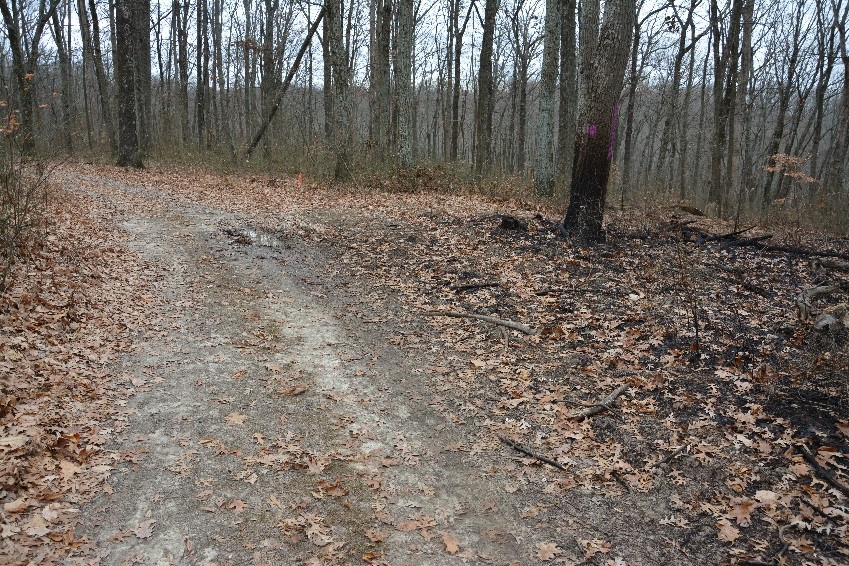
This logging road is a good example of an existing road that can be used as a firebreak.
Existing roads
Existing roads, whether they are paved, gravel, dirt, or logging roads, can serve as outstanding firebreaks, plus they require very little work to prepare prior to a burn. These are also one of the cheapest options for firebreaks. If you are using gravel, dirt, or logging roads as firebreaks, you need to make sure there is not excessive vegetation or leaf litter in the road. Too much vegetation
on the firebreak could lead to an escape.
Streams, creeks, or other bodies of water
Another cheap and easy option for firebreaks is to use existing streams, river, or bodies of water. If you are using water features as a firebreak, here are some things to consider: is the stream or river wide enough to stop the fire from escaping and can people helping with the fire move easily around, across, or through the stream or river to access various part of the burn unit or to stop an escaped fire?
Crop fields
Crop fields with cool-season grains (wheat, oats, rye) or cover crops can serve as a great firebreak. Crop fields with only soybean or corn stubble should be used with caution, as fire may creep through a field with excessive stubble. For fields with crop stubble, planting the edge of the field in a cool-season crop (wheat, clover, oats, etc.), disking the edge of the field, or wetting the crop stubble are all steps that can used to improve the field as a firebreak.
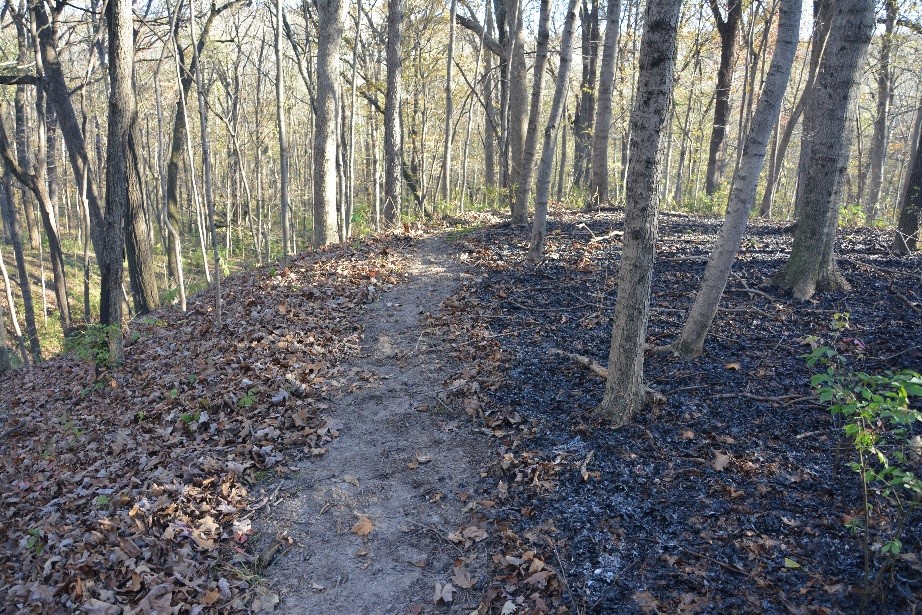
This leaf-blown firebreak was only 3-4 feet wide, but it easily stopped the fire in this situation.
Leaf-blown firebreaks
If you are burning in the woods, using a leaf blower to remove leaf litter and expose bare mineral soil is a quick and easy way to create a firebreak. These firebreaks do not need to be as wide as those in an old field or native grass stand because the flame length when burning in the woods is typically much shorter than burning in a field.
Disked firebreaks for multiple purposes
Disking or tilling to expose bare mineral soil is an extremely effective method of creating a firebreak. These breaks can also provide food and/or cover for various wildlife species if managed correctly. Disking the firebreak and then letting the firebreak remain fallow during the growing season creates outstanding cover for brooding turkeys, pheasants, and quail.
You can also plant the firebreaks after disking to create a food plot for various wildlife species. If you disk the firebreaks in the fall and plan to burn in the spring, you can plant the firebreaks with a mix of wheat and crimson clover or a mix of perennial clovers to create a great food plot for deer and turkey. You can also plant the firebreaks with millet, grain sorghum, or sunflowers after you have burned the field in the spring.

If you use mowed firebreaks you run the risk of fire creeping across the firebreak and escaping, especially if there is too much thatch in the firebreak.
My absolute favorite multiple purpose firebreak is one that is disked in Aug-Sep, planted to winter wheat (40-60 lbs/ac), and then left to remain fallow after the wheat has produced seed. This firebreak effectively stops fire, provide green browse from the fall through the spring, provides seed during the early summer, and provides excellent brood cover throughout the summer and early fall. This is truly an all-in-one firebreak.
Mowed grass firebreak
Mowed grass firebreaks are not ideal, but they can be used in certain situations. If mowed firebreaks are used, you must be sure that there is not excessive thatch built up in the break. Too much thatch will allow the fire to creep across the break and potentially escape. Even on firebreaks without excessive thatch, using water to create a “wet” firebreak is recommended.
No matter which type of firebreak you choose to use, taking the time to make sure the firebreak is adequately installed and is sufficient to stop the fire from escaping will help make the burn safer and will create less headaches for you when conducting the burn.
Additional Resources:
Firebreaks for Prescribed Burning, Oklahoma State University Extension
Prescribed fire: 6 things to consider before you ignite, Got Nature?, Purdue Extension-FNR,
On-line Basic Prescribed Fire Training, USDA, U.S. Forest Service
Publications Focus on Plan, Safety of Prescribed Burns, Iowa State Extension,
eFIRE, North Carolina State Extension
Renovating native warm-season grass stands for wildlife: A Land Manager’s Guide, The Education Store, Purdue Extension resource center
Calibrating a No-Till Drill for Conservation Plantings and Wildlife Food Plots, The Education Store
Jarred Brooke, Wildlife Extension Specialist
Purdue Department of Forestry and Natural Resources
Planting at the proper seeding rate is an important step to ensure a successful native warm-season grass and forb planting or a wildlife food plot. This video will discuss how to properly calibrate the seeding rate for a Truax No-Till Seed Drill. The video will also discuss a calibration method that can be used with multiple different types of seed drills.
Check out these detailed resources that are referenced in the video:
Seed Fillers and Carriers for Planting Native Warm-Season Grasses and Forbs
Pure Live Seed: Calculations and Considerations for Wildlife Food Plots
Resources:
Renovating Native Warm-Season Grass Stands for Wildlife: A Land Manager’s Guide, The Education Store, Purdue Extension resource center
Food Plots, Got Nature?, Purdue Extension-FNR
Food Plots for White-Tailed Deer, The Education Store
Jarred Brooke, Extension Wildlife Specialist
Purdue Department of Forestry and Natural Resources
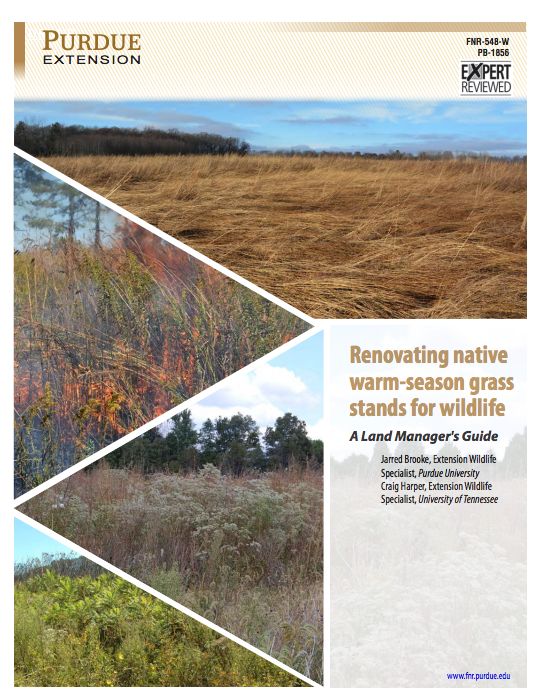 A new extension publication co-authored by Purdue Extension Wildlife Specialist, Jarred Brooke, and University of Tennessee Extension Wildlife Specialist, Dr. Craig Harper, provides landowners and land managers with practical recommendations to assist in the management and renovation of existing native-warm season grass stands for wildlife. The publication provides information on how to use various habitat management tools to fix common issues in planted native grass stands. The publication was produced in partnership with University of Tennessee Extension, Indiana DNR Fish & Wildlife Division, and the Indiana State Chapter of the National Wild Turkey Federation.
The electronic copy of the publication is available to download for free from the Purdue Education Store. Printed copies are also available from the Education Store for $10.
Resources:
Sericea Lespedeza, Plague on the Prairie, Got Nature?, Purdue Extension-FNR
Prescribed fire: 6 things to consider before you ignite, Got Nature?, Purdue Extension-FNR
If Your Native Grasses Look Like This, It’s Time for Management, Got Nature?, Purdue Extension-FNR
Jarred Brooke, Extension Wildlife Specialist
Purdue Department of Forestry and Natural Resources
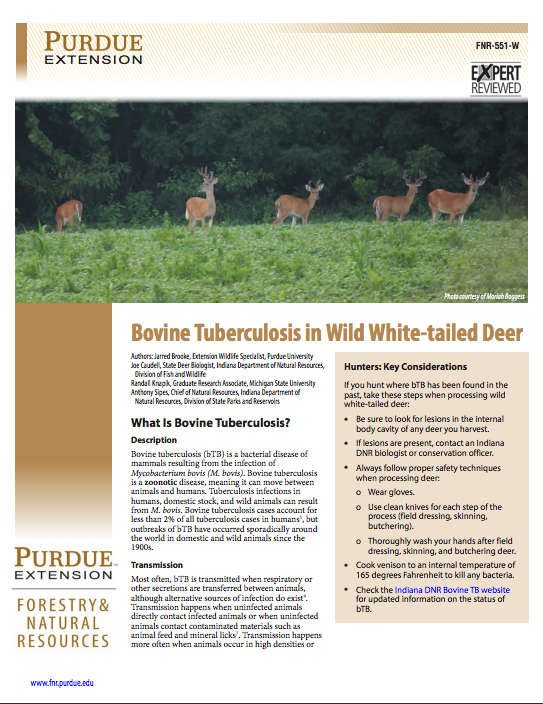 Outbreaks of bovine tuberculosis have occurred sporadically around the world since the 1900s. In Bovine Tuberculosis in Wild White-tailed Deer, Bovine tuberculosis transmission, hosts, current status in Indiana, clinical signs, effects on deer populations, effect on white-tailed deer meat, management, and monitoring is extensively covered. If you’re a hunter or cattle producer, the information provided within this free publication would greatly benefit you!
Resources:
Bovine Tuberculosis in wild white-tailed deer, Got Nature?, Purdue Extension-FNR
Jarred Brooke, Extension Wildlife Specialist
Purdue Department of Forestry and Natural Resources
A recent study in Costa Rica by scientists at Princeton University-Department of Ecology and Evolutionary Biology and the University of Pennsylvania-Ecology & Biodiversity showed how agricultural waste could help successfully remediate barren tropical forest sites.
A deal between an orange juice manufacturer and advisors for the Área de Conservación Guanacaste was struck that allowed 1,000 truckloads (12 metric tons) of orange peels and pulp to be unloaded on nutrient-poor soils dominated by invasive grass within one of Costa Rica’s national parks in the mid-1990s. The land was left to rest for sixteen years. Now, the forest has begun the lengthy process of regeneration and some secondary forest regeneration has been observed. The peels were spread over 3 ha (7 acres) and scientists measured an increase of 176% in aboveground biomass. The distinction between the orange-fertilized land and the unfertilized areas was pronounced. Orange-fertilized areas demonstrated more tree biomass and species diversity and richer soils than their counterparts.
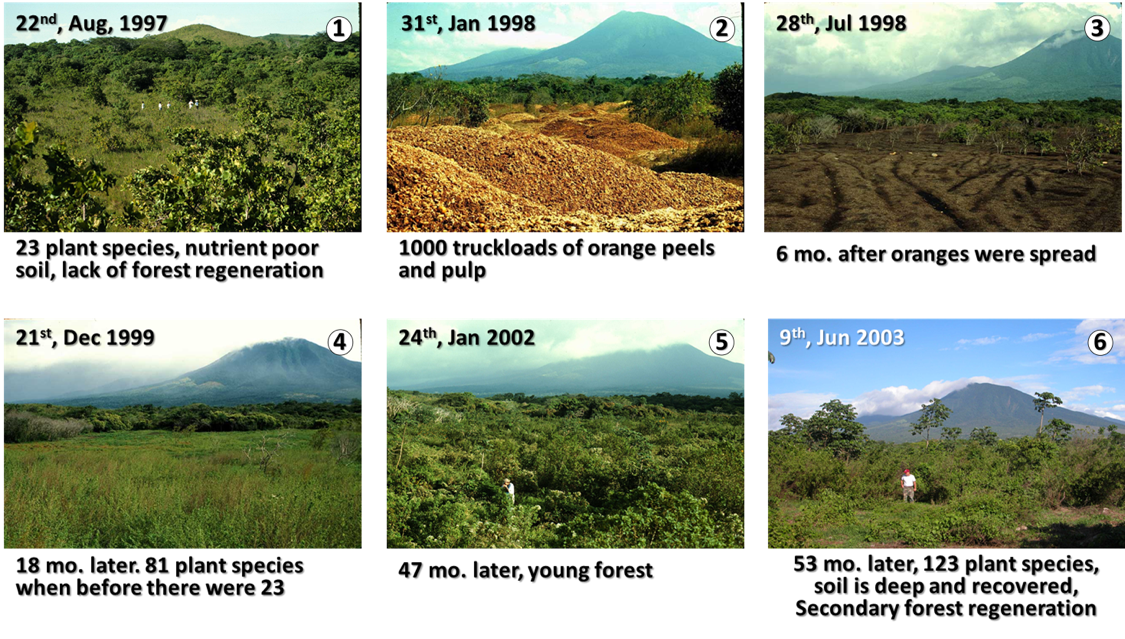
To enlarge photo click on image. Photo credits: Tim Treuer, Daniel Janzen, Winnie Hallwachs, & Leland Werden.
This research shows what could happen when the environmental community and industry find a medium where they can work together to come up with problem solutions. Perhaps, in future, similar uses can be found for agricultural excess here in the United States.
References:
Treuer TLH, Choi JJ, Janzen DH, Hallwachs W, Peréz-Aviles D, Dobson AP, Powers JS, Shanks LC, Werden LK, Wilcove DS. (2017) Low-cost agricultural waste accelerates tropical forest regeneration. Restoration Ecology, DOI: 10.1111/rec.12565
Resources:
Indiana Forestry & Woodland Owners Association
Purdue Extension-Forestry and Natural Resources workshops
Forest Improvement Handbook, The Education Store, Purdue Extension resource center
Shaneka Lawson, USDA Forest Service/HTIRC Research Plant Physiologist/Adjunct Assistant Professor
Purdue University Department of Forestry and Natural Resources

Recent Posts
- Purdue Extension: Empowering Indiana Through Innovation, Education and Community Impact
Posted: January 28, 2026 in Community Development, How To, Invasive Insects, Invasive Plant Species, Natural Resource Planning, Woodlands - Kara Salazar and Team Win National Runner-up for Innovation & Creativity Award
Posted: September 29, 2025 in Community Development, Land Use, Natural Resource Planning - Hardwood Tree Improvement Regeneration Center (HTIRC) Shares Fall Newsletter, Research and Outreach
Posted: December 13, 2024 in Forestry, Land Use, Natural Resource Planning, Woodlands - Purdue Extension’s Showcase, Impacting Indiana
Posted: November 8, 2024 in Community Development, Forestry, Forests and Street Trees, Gardening, Land Use, Natural Resource Planning, Timber Marketing, Urban Forestry, Wildlife, Wood Products/Manufacturing, Woodlands - IAA Receives $250,000 Grant for Arborist Apprenticeship
Posted: February 21, 2024 in Forestry, Forests and Street Trees, Natural Resource Planning, Urban Forestry, Wildlife, Woodlands - Build a Better Habitat for Wildlife This Winter – Wild Bulletin
Posted: February 1, 2024 in Forestry, How To, Land Use, Natural Resource Planning, Plants, Wildlife, Woodlands - Cost Assistance for Landowners Planning Conservation Practices
Posted: October 13, 2023 in Forestry, Invasive Plant Species, Natural Resource Planning, Woodlands - MyDNR: New multi-agency research partnership to benefit Indiana’s wildlife and wild places
Posted: September 7, 2023 in Aquaculture/Fish, Aquatic/Aquaculture Resources, Forestry, Natural Resource Planning, Plants, Wildlife, Woodlands - Purdue Extension to Connect Underserved Communities with Funding for Energy and Environmental Improvements
Posted: June 6, 2023 in Community Development, How To, Natural Resource Planning - Question: what resources do you have on wind energy, contracts?
Posted: April 11, 2023 in How To, Land Use, Natural Resource Planning
Archives
Categories
- Alert
- Aquaculture/Fish
- Aquatic/Aquaculture Resources
- Ask the Expert
- Christmas Trees
- Community Development
- Disease
- Drought
- Forestry
- Forests and Street Trees
- Gardening
- Got Nature for Kids
- Great Lakes
- How To
- Invasive Animal Species
- Invasive Insects
- Invasive Plant Species
- Land Use
- Natural Resource Planning
- Nature of Teaching
- Plants
- Podcasts
- Ponds
- Publication
- Safety
- Spiders
- Timber Marketing
- Uncategorized
- Urban Forestry
- Webinar
- Wildlife
- Wood Products/Manufacturing
- Woodland Management Moment
- Woodlands