 Purdue University - Extension - Forestry and Natural Resources
Got Nature? Blog
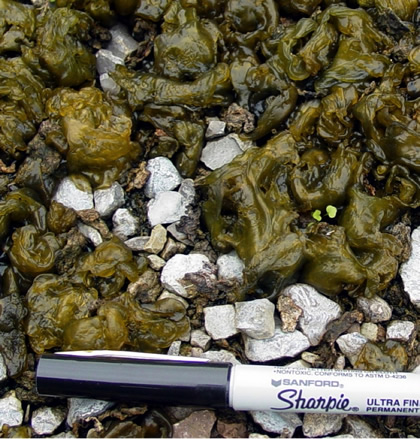
Photo credit: Purdue Plant and Pest Diagnostic Lab
In this month’s column of In the Grow, B. Rosie Lerner, Purdue Extension Consumer Horticulturist, addresses algae that can pop up on stone, concrete, gravel or even lawns this summer as we are getting large amounts of hot, rainy weather.
This terrestrial algae known as Nostoc can look unappealing and also be a slippery safety hazard, but unfortunately, there isn’t much to do about it. Raking the algae will just spread it to larger areas. Keeping the area aerated and dry as much as you are able can help a little with controlling this algae, and applying copper sulfate will also shrink it a little bit, but it will just reappear when warm, rainy weather conditions occur again.
Resources
News Columns & Podcasts, Purdue Agricultural Communication
Nostoc: A Green, Jelly-Like Substance Growing in Lawns, Michigan State University Extension
B. Rosie Lerner
Purdue Extension Consumer Horticulturist
This is the time of year that many homeowners start their annual battle with nuisance wildlife. While trapping animals is not always required or desirable, it may be necessary in some cases to alleviate damage. Homeowners will typically use a box-style or cage “live” trap. Before you take action, there are a few key points you should first consider.
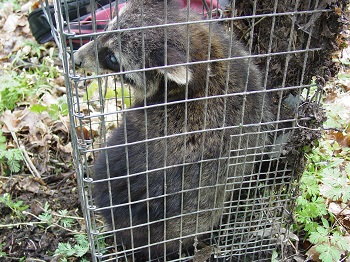
What permits, if any, are required?
Some animals require a permit prior to trapping. Raccoons, skunks, opossums, groundhogs, gray squirrels and fox squirrels are examples of mammals that do not require a permit in Indiana. Resident landowners or tenants can legally capture these species if the animal is causing damage to the property. However, you no longer have to report capture of wildlife to a conservation officer within 72 hours. Perhaps to the surprise of probably most people, rabbits do require a Nuisance Animal Control Permit prior to trapping. The Indiana DNR has a list of permitting requirements.
What do you do with wildlife you catch?
You have two choices of what to do with wildlife you capture: let it go or euthanize it (put to death humanely by injection). In either case, you may not possess an animal for more than 24 hours. If you relocate an animal, you must have permission of the landowner or property manager (even for public lands) AND you may only release that animal within the county of capture.
A common question I receive is, “What should I do?” There is no answer for which is best because circumstances differ. Most people probably prefer to let them go somewhere else because they find euthanizing animals unacceptable. They also may think that letting them go allows them to live out their lives, but this may not be the case. There has been some research on what happens to translocated raccoons and tree squirrels. In both cases, the animals don’t stay where they were let go. In the case of squirrels, a high number died within 88 days of release. Raccoons removed from structures tended to relocate in another structure.
Other things to consider
- Despite being cute and furry, wild animals are exactly that – wild animals. You should always use caution when handling traps that contain wildlife. Wear thick leather gloves and avoid sticking fingers inside the trap.
- If you transport an animal to be released (assuming you have gotten permission), do not place the trap inside your vehicle. Use a pickup truck to avoid contaminating your vehicle with animal waste and to minimize the spread of disease. Wildlife carry many pathogens and diseases that are transmittable to people.
- Animals can roll traps or pull in vegetation from the immediate vicinity. Be careful where you place the trap. Staking box traps is also a good idea.
- Be sure the trap is stable or “bedded” when you set it. Remove rocks and debris from under the trap. You may have to “work” the trap into the ground. Just be sure that debris doesn’t get caught under the treadle. If it does, the trap may not fire.
- You may want to cover your trap by wrapping it with cardboard and wire.
- Check your traps frequently. Indiana has a 24-hour trap check law. It is often a good idea to check them more frequently – perhaps 2 to 3 times a day. This is especially true if you are trapping during extremely hot or cold weather.
- Wildlife species have different times of activity, so you can be selective what time of day you trap. For example, tree squirrels and groundhogs are not active at night. Closing traps at night can avoid non-targets but would also require opening the trap at sunrise.
If you are interested in hiring a state licensed animal control professional, you can visit the Indiana DNR Nuisance Wildlife page and click on the link to “Nuisance Wildlife Control Operators.”
Additional Resources
Preventing Wildlife Damage – Do You Need a Permit?
Indiana Wildlife Conflicts Information
Indiana DNR Nuisance Wildlife
Brian MacGowan, Wildlife Extension Specialist
Department of Forestry and Natural Resources, Purdue University
 A 20+ extension team led by Kara Salazar, sustainable communities extension specialist, and Michael Wilcox, assistant program leader for extension community development, have produced a new publication and curriculum titled “Enhancing the Value of Public Spaces.” This must-have spiral bound notebook and curriculum zip file download is a great resource for decision makers and local leaders developing community public spaces including park boards, planning commission members, members of organizations, public officials and staff whose missions are related to providing services, programs or management of public spaces. This program serves as a “how-to” guide for creating high-quality action plans to achieve great public spaces.
A one day workshop starts the process with collaborative activities to identify best practices for improving public spaces with emphasis on forming partnerships to achieve desired community goals. Follow-on working group meetings provide the resources and technical support needed to plan and implement projects tailored to individual communities. The completed high quality public spaces action plan can be used as part of comprehensive planning efforts, parks and recreation master plans and fundraising initiatives.
Resources
Enhancing the Value of Public Spaces, The Education Store
Kara Salazar, Sustainable Communities Extension Specialist
Department of Forestry and Natural Resources
Illinois-Indiana Sea Grant
Michael Wilcox
Assistant Program Leader, Extension Community Development Program
Senior Associate, Purdue Center for Regional Development
Faculty and staff in the Department of Forestry and Natural Resources (FNR) are engaged in environmental planning around the state. Extension programs help managers and decision-makers improve Indiana’s natural resource management and environmental planning. We deliver programs to help communities consider how to plan for their unique and life-sustaining environmental resources and provide education and technical assistance to plan commissions. Programs are developed and delivered in collaboration with the Purdue Extension Community Development Program and Illinois-Indiana Sea Grant. Some of the programs FNR faculty and extension staff have developed in collaboration with our partners include:
American Citizen Planner – Indiana (ACP-IN)
American Citizen Planner – Indiana provides training to Indiana citizen planners who currently serve or plan to serve on area or advisory plan commissions. The program features 31 topics detailing core planning theories, practices, and processes. A comprehensive assessment and four virtual training events reinforce the content learned in the units. The program is hosted by a local Purdue Extension educator for either a county or a region.
Conservation Through Community Leadership (CCL)
Communities face many challenges, and many of these are their natural resources. The Conservation through Community Leadership program serves as a roadmap for communities tackling complex land use and natural resource management challenges. The program provides information, tools, and resources to help communities work with diverse stakeholders.
Enhancing the Value of Public Spaces (EVPS)
The Purdue University Extension program, Enhancing the Value of Public Spaces, addresses public spaces and their role in enhancing the quality of place by helping regions, communities and neighborhoods plan and prepare for a sustainable future. The Indiana-based curriculum is designed for use by decision makers and local leaders with oversight and management of community public spaces such as parks boards and planning commission members, public officials and their staff and members of organizations whose missions provide services related to programs or management of public spaces. The program provides a framework for collecting data on community assets and using that data to plan public spaces improvements.
Green Infrastructure and Hazard Mitigation
Communities face several challenges and complex decisions related to natural hazards, which are increasingly exacerbated by climate change. The program supports a collaborative community planning approach to evaluate the relevance and effectiveness of existing community policies and to identify goals, motivations, and barriers for hazard mitigation planning, focusing on water resources, flooding, and green infrastructure.
Land Use
The Purdue University Land Use Team provides research-based resources and educational programs for Extension professionals, government officials, citizen planners, and residents on land use issues impacting their communities. Land Use Team efforts are underpinned by a timely and rigorous professional development system that prepares Purdue Extension professionals to effectively serve on Plan Commissions.
Rainscaping Education Program
Rainscaping is a combination of sustainable landscape design and management practices that prevents polluted runoff from reaching water bodies — directing stormwater to be absorbed by plants and soils. The program provides training and resources on rainscaping practices that can be installed in residential settings or small-scale public spaces projects.
Renewable Energy
Renewable Energy for Community Planning brings resources for general renewable energy, solar and wind. This includes: community planning guidebooks for renewable energy, solar development, landowner leasing for solar, qualifications for a wind lease, wind farm impact statements and much more.
Sustainable Communities
Extension programs that support sustainable community development strategies are available to communities throughout Indiana. These support decision makers with evaluating, prioritizing, and implementing sustainability strategies for their communities.
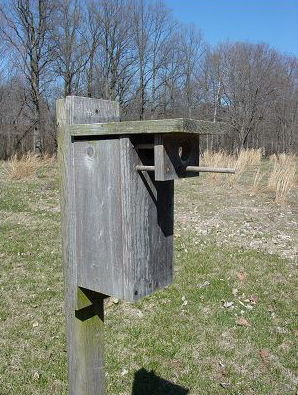
Remove perches from wildlife nest boxes like the bluebird box pictured here. Perches allow undesirable birds to harass native cavity nesters and take over a nest box.
Even though we have had some rough weather lately, this winter didn’t seem so bad to me. Now that the weather forecast is looking positive and the days are getting longer (this month, we gain about 75 minutes – I am embarrassed to admit that I check this frequently during the winter because it helps me get through the winter doldrums), it is a good time to think about wildlife habitat projects.
Many species of native birds and mammals will utilize nest boxes. When we put out a nest box, all we are doing is replicating what nature already provides with cavities in both live and dead trees. Woodpeckers are primary cavity users because they create their own. Other birds and mammals are secondary cavity users because they use what is already there – either those that occur in older, dying trees or those that are created by woodpeckers. Installing nest boxes in areas where cavities are likely scarce such as urban environments or young woods may be particularly beneficial.
Tips
- Use quality materials that are weather resistant. Exterior grade plywood and lumber are good choices. Cedar and other rot-resistant woods are best. Avoid using treated lumber and metal.
- Avoid painting or staining inside nest boxes. Painting the outside can prolong its life and may be attractive for some species (white for purple martins, for example).
- The roof should be sloped to allow water runoff and should hang over the sides.
- Drill at least four 3/8-inch drainage holes on the floor.
- The roof or one side should open to allow easy access for cleaning.
- Avoid perches. Natural cavities don’t have them and neither should your nest box. Perches also allow European starlings and English house sparrows, non-native invasive species, to harass native cavity nesters and take over a nest box.
- Near the top of each side, leave gaps or drill 5/8-inch holes (at least two per side).
More tips on design, such as nest box specifics by species (dimensions, hole size and placement, box placement and location), maintenance and problem species, can be found in our Nest Boxes for Wildlife publication.
Other resources available:
Attracting Hummingbirds to Your Yard, The Education Store
Birds of Benton County, Indiana, The Education Store
Brian MacGowan, Extension Wildlife Specialist
Department of Forestry and Natural Resources, Purdue University
 FNR is pleased to announce a new program that will provide undergraduate extension internship opportunities for qualified students this summer. This is an exciting program with the potential to build on an already strong set of FNR extension programs while providing valuable experience and training for undergraduates.
Purdue University’s Department of Forestry and Natural Resources seeks candidates for extension internship positions. The department extension program has a broad environmental scope including fisheries, forest management, invasive species, urban forestry, sustainability, wildlife and wood products. Student interns can enhance their career potential through practical, hands-on experience. Our extension internship program can help you:
- Develop leadership and decision-making skills in handling creative challenges
- Gain experience developing extension products including publications, online videos, presentations and/or more
- Participate in professional development opportunities
- Build professional references and contacts
- Clarify career goals
- Learn from a diverse and experienced group of natural resources professionals
Internships are open to non-Purdue students. Requirements for the position(s) include status as a junior or senior level college student in natural resources or related discipline, minimum 3.0 GPA, evidence of initiative, independence and commitment to conservation of natural resources. Internships are available for summer term (up to 40 hours/wk., up to 8 weeks) with pay at a rate of $12 per hour. Internship start dates and work hours are flexible depending on the applicant’s availability.
Resources
FNR Extension Internship Information, Purdue Forestry and Natural Resources (FNR)
Brian MacGowan, Extension Wildlife Specialist
Department of Forestry and Natural Resources, Purdue University
 Trees in Rice Cemetery in Elkhart, IN, were cut down due to verticillium wilt, a disease causing discoloration and wilt of branches. The fungus causing this disease spreads through roots. Many trees in the cemetery have been marked with a red dot and will be removed. If all goes well, new younger trees will take their place in the fall. If you have witnessed verticillium wilt, please notify the Indiana Department of Natural Resources.
Resources
Rice Cemetery Trees Cut Down Due to Verticillium Wilt as Elkhart Forestry Workers Fight to Save Those Left, The Elkhart Truth
Verticillium Wilt of Shade Trees, The Education Store, Purdue Extension’s resource center
Diseases in Hardwood Tree Plantings, The Education Store
Forest Health Informer, Indiana Department of Natural Resources
How to Check for Verticillium Wilt, July “In The Grow” (Q&A), Indiana Yard and Garden – Purdue Consumer Horticulture
What are Invasive Species and Why Should I Care?, (What to do if you see any disease) Purdue Extension-Forestry & Natural Resources Got Nature? Blog
Diana Evans, Extension and Web Communication Specialist
Purdue University Department of Forestry and Natural Resources
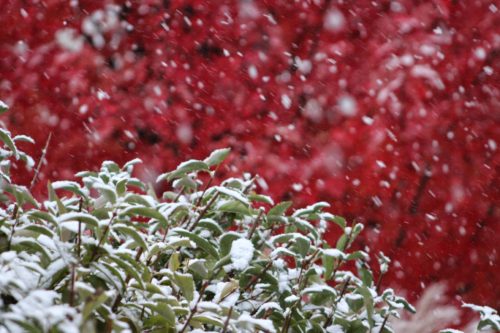 You may be considering giving a plant as a holiday gift this year. But before you buy your plant, there are precautions you need to take into consideration in order to keep it healthy. Purdue Yard and Garden News has some tips for you.
Your plant can get damaged due to cold, frigid air. Ensure that the salesperson wraps your purchase to protect it from the cold temperatures and wind as you walk back to your car. Also preheat your car to keep it out of the cold for the shortest time possible.
Keep plants away from drafts when you return home. Instead, put it in a place that is 60-70 degrees Fahrenheit during the day and provides plenty of bright light. Water your plant until some excess water comes through the drainage holes at the bottom.
View all of the tips on the Purdue Yard and Garden News page.
Resources
Effects of Cold Weather on Horticultural Plants in Indiana, The Education Store
Winter Injury of Ornamentals, Purdue e-Pubs
How To Care For Your Amaryllis, Purdue Yard and Garden News
Purdue Yard and Garden
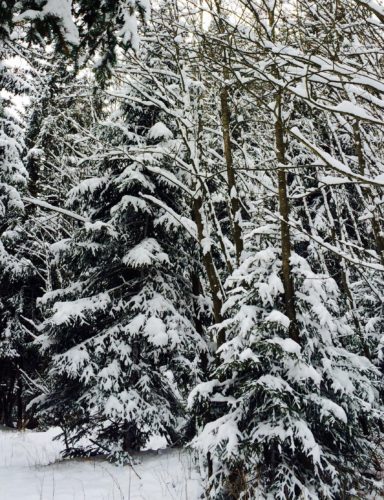 The Purdue Yard and Garden Calendar for January has provided some tips on how to care for your plants as a bitter cold winter sweeps upon us.
HOME
Keep plants near a bright window and hydrated. Increase humidity around houseplants by grouping plants together, placing them on a pebble-water tray or running a humidifier. Check stored produce and tender flower bulbs and roots for rot, shriveling or excess moisture. Remove and discard damaged material.
Repot houseplants as they outgrow current pots.
YARD
Check young trees for rodent injury on lower trunks. Prevent injury with hardware cloth or protective collars.
Keep road and sidewalk salt away from plants. Construct a screen of burlap, if necessary, to keep salt spray off plants.
GARDEN
Order seeds and plants as early as possible for best selection.
Wood ashes from the fireplace can be spread in the garden, but don’t overdo it. Wood ashes increase soil pH, and excess application can make some nutrients unavailable for plant uptake. Have soil tested to be certain of the pH before adding wood ash.
View all of the tips on the Purdue Yard and Garden Calendar page.
Resources
Winter Injury of Ornamentals, The Education Store
Steps To Ensure Your Plants Survive This Winter, Got Nature?
Winterize Your Trees, The Education Store
Purdue Yard and Garden Calendar
As winter comes swiftly upon us, there are precautions we need to take to ensure our plants, both indoor and outdoor, are well taken care of. Below are a few examples of how you can prevent certain problems that occur in the cold months ahead. View all of the steps you can take at the Purdue Extension Yard and Garden Calendar page.
HOME (Indoor plants and activities)
- Houseplants may not receive adequate light because days are short and gloomy. Move plants closer to windows, but avoid placing foliage against cold glass panes. Artificial lighting may be helpful.
- Because growth slows or stops in winter months, most plants will require less water and little, if any, fertilizer.
- Extend the lives of holiday plants such as poinsettias and Christmas cactus by placing them in a cool, brightly lit area that is free from warm or cold drafts.
YARD (Lawns, woody ornamentals and fruits)
- Prevent bark splitting of young and thin-barked trees, such as fruit and maple trees. Wrap trunks with tree wrap or paint them with white latex (not oil-based) paint, particularly on the south- and southwest-facing sides.
- Provide winter protection for roses by mounding soil approximately 12 inches high to insulate the graft union after plants are dormant and temperatures are cold. Additional organic mulch such as straw compost or chopped leaves can be placed on top.
GARDEN (Flowers, vegetables and small fruits)
- To protect newly planted or tender perennials and bulbs, mulch with straw, chopped leaves or other organic material after plants become dormant.
- Store leftover garden chemicals where they will stay dry, unfrozen and out of the reach of children, pets and unsuspecting adults.
- Once the plants are completely dormant and temperatures are consistently below freezing, apply winter mulch to protect strawberries and other tender perennials. In most cases, two to four inches of organic material such as straw, pine needles, hay or bark chips will provide adequate protection.
Resources
Winter Garden Calendar, The Education Store
Winter Storage of Geranium, Canna, Gladiolus, Caladium, and Begonia, The Education Store
Winterize Your Trees, The Education Store

Recent Posts
- Woodland Flowers of Late Summer
Posted: September 19, 2025 in Forestry, Gardening, Wildlife - Celebrate Pollinator Week With Flowers of June Tour
Posted: June 10, 2025 in Forestry, Gardening, How To, Wildlife - Top 10 Spring Flowering Shrubs, Purdue Landscape Report
Posted: April 28, 2025 in Gardening, Plants, Urban Forestry - Leaving Leaves Benefits Wildlife – Wild Bulletin
Posted: November 11, 2024 in Forestry, Forests and Street Trees, Gardening, Urban Forestry, Wildlife - Purdue Extension’s Showcase, Impacting Indiana
Posted: November 8, 2024 in Community Development, Forestry, Forests and Street Trees, Gardening, Land Use, Natural Resource Planning, Timber Marketing, Urban Forestry, Wildlife, Wood Products/Manufacturing, Woodlands - When Roundup Isn’t Roundup – Purdue Landscape Report
Posted: October 17, 2024 in Forestry, Gardening, Plants, Urban Forestry - Ask An Expert: What’s Buzzing or Not Buzzing About Pollinators, Webinar
Posted: July 4, 2023 in Forestry, Gardening, How To, Plants, Wildlife - Magnificent Trees of Indiana Webinar
Posted: May 12, 2023 in Forestry, Forests and Street Trees, Gardening, Got Nature for Kids, Urban Forestry, Webinar, Woodlands - Be Tick Aware: Lyme Disease & Prevention Strategies Webinar
Posted: May 11, 2023 in Alert, Forestry, Forests and Street Trees, Gardening, How To, Urban Forestry, Webinar, Wildlife, Woodlands - Illinois Groundwork provides a rich supply of green infrastructure resources – IISG
Posted: in Gardening, Land Use, Plants, Wildlife
Archives
Categories
- Alert
- Aquaculture/Fish
- Aquatic/Aquaculture Resources
- Ask the Expert
- Christmas Trees
- Community Development
- Disease
- Drought
- Forestry
- Forests and Street Trees
- Gardening
- Got Nature for Kids
- Great Lakes
- How To
- Invasive Animal Species
- Invasive Insects
- Invasive Plant Species
- Land Use
- Natural Resource Planning
- Nature of Teaching
- Plants
- Podcasts
- Ponds
- Publication
- Safety
- Spiders
- Timber Marketing
- Uncategorized
- Urban Forestry
- Webinar
- Wildlife
- Wood Products/Manufacturing
- Woodland Management Moment
- Woodlands