 Purdue University - Extension - Forestry and Natural Resources
Got Nature? Blog
Purdue Landscape Report: It’s that time of year when we remind everyone to watch for spotted lanternfly (SLF) infestations. Spotted lanternfly is an invasive insect first detected in Pennsylvania in 2014, and has since spread throughout the eastern USA. Its preferred host is the invasive Tree-of-Heaven, but it also feeds on a wide range of important plant species, including grapes, walnuts, maples, and willows.
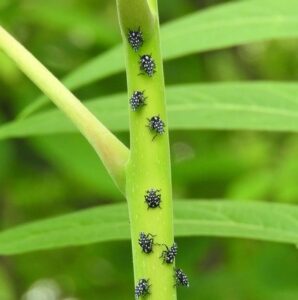
Early instar-Photo credit Richard Gardner, Bugwood.org
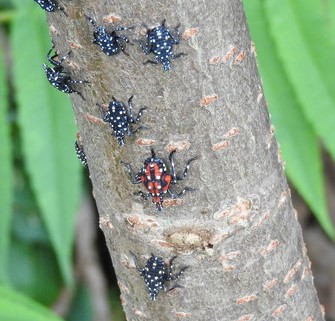
Late instar -Photo credit Richard Gardner, Bugwood.org
There are two known populations of SLF in Indiana. The first population was found in 2021 in Switzerland County, and the second population was found in Huntington County in 2022. The Indiana Department of Natural Resources (IDNR), Division of Entomology and Plant Pathology, has launched a delimiting survey throughout the two counties to delimit its range and monitor for activity.
Egg hatch was confirmed in Huntington County and Switzerland County in mid-May at the two known sites. A few adults have been caught about one mile south of the core infestation site in Huntington; however, there are not any new infestations reported as of July 2023. IDNR employees have completed several egg scraping events at the infestation sites, removing over 16,800 egg masses so far this year. That’s over 672,000 eggs!
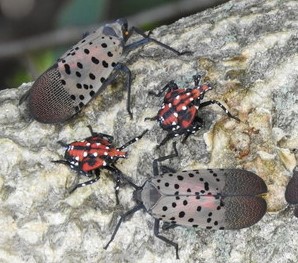
Adult-rest & late instar -Photo credit Richard Gardner, Bugwood.org

Adult Spotted lanternfly Photo credit-Rebekah D. Wallace, University of Georgia, Bugwood.org
Finding this invasive insect early is crucial to preventing its spread as long as possible. Currently, SLF nymphs are in their 1st-3rd instar, so watch for small, black, white-spotted bugs on Tree-of-Heaven. Later instars are black and red with white spots. The adults are about 1 inch long, with very brightly colored wings. The forewings are light brown with black spots, and the underwings are a striking red and black, with white band in between the red and black. When at rest, the adult SLFs appear light pinkish-grey.
Report any suspect findings at https://ag.purdue.edu/reportinvasive/
To view this full article and other Purdue Landscape Report articles, please visit Purdue Landscape Report.
Subscribe and receive the newsletter: Purdue Landscape Report Newsletter.
Resources:
The Purdue Landscape Report
Spotted Lanternfly, Indiana Department of Natural Resources Entomology
Spotted Lanternfly Found in Indiana, Purdue Landscape Report
Invasive plants: impact on environment and people, The Education Store, Purdue Extension’s resource center
Woodland Management Moment: Invasive Species Control Process, Video, Purdue Extension – Forestry and Natural Resources (FNR) YouTube Channel
Invasive Species, Playlist, Purdue Extension – FNR YouTube Channel
What are invasive species and why should I care?, Got Nature? Blog, Purdue Extension – FNR
Report Invasive, Purdue College of Agriculture – Entomology
Alicia Kelley, Cooperative Agricultural Pest Survey (CAPS) Coordinator
Purdue Extension – Entomology
Purdue Landscape Report: A new invasive insect of concern has been identified in the state of Georgia. In August of 2023, Georgia’s Department of Agriculture, along with the USDA, confirmed the presence of the yellow-legged hornet, Vespa velutina, outside of the city of Savannah. To date, this is the only confirmed identification of this insect in the United States; it has already established in Europe, the Middle East, and parts of Asia outside of its native range. V. velutina is a native of the subtropical and tropical regions of southeast Asia, and it is not yet clear how it arrived in North America. Much like the northern giant hornet, previously known as the Asian giant hornet or ‘murder hornet’, this insect will attack honeybee hives in search of food and represents a potential danger to the beekeeping industry.
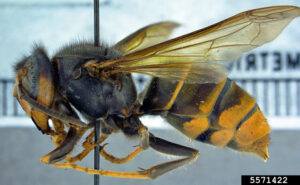
Figure 1. Yellow-Leg Hornet. Image Credit: Allan Smith-Pardo, Invasive Hornets, USDA APHIS PPQ, Bugwood.org
Yellow-legged hornets are predators and will regularly attack honeybees to provide food for their young, though it is possible they could attack other, similar species. Since honeybees concentrate their numbers in hives with a lot of in-and-out traffic, they provide an excellent opportunity for the hornets to hunt and provide food for their young. The hornets are effectively ambush predators, waiting in front of hive entrances and capturing workers with their legs as they leave the hive. The hornets then dismember the bees, returning to their young with only the thorax, which contains the largest amount of protein. However, it is believed that yellow-legged hornets only represent a lethal threat to weaker hives that are already experiencing problems; it is also too early to tell how already-existing honeybee issues, such as mite and disease issues, will interact with the presence of this insect.
The yellow-legged hornet, much like other members of Order Hymenoptera, is a social insect. They create oval or egg-shaped nests in trees that can house as many as 6,000 individuals. Colonies are composed of a foundress and her young, who become the workers within the colony. Female hornets will overwinter within tree hollows, leaf litter, or other environmentally stable locations, and once spring arrives, they start their own colony and give birth to new workers who care for young and hunt.
As with any new invasive species, it is critical to successful identify it and differentiate it from other species of wasps and hornets that we experience in the Midwest. At a glance, the yellow-legged hornet is barely discernable from European hornets, yellowjackets, and similar insects; they possess aerodynamic shapes with heavy yellow and black color patterns like many of their cousins. The most easily identified trait is their namesake: the legs of this insect tend to be black closer to the body, with the lower half of the leg bright yellow. The segments of the abdomen follow a similar pattern, with those segments closer to the center of the body being dominated by black, steadily becoming more yellow as you reach the tip of the abdomen. The yellow-legged hornet is also approximately an inch in length, with reproductive individuals sometimes reaching an inch and a half.
While remaining observant will be critical to reporting any invasive species, there are a few things to keep in mind about the yellow-legged hornet. This insect has only been found in one location in Georgia; no other states have any sightings or confirmed reports of this insect. There is also no evidence the insect has established a population in Georgia, there is only one confirmed sighting. The best course of action for now is to be vigilant and report any potential sightings by calling 1-866-NOEXOTIC, or you can contact our local Purdue Extension educator for assistance.
To view this full article and other Purdue Landscape Report articles, please visit Purdue Landscape Report.
Subscribe and receive the newsletter: Purdue Landscape Report Newsletter.
Resources:
Invasive Species, Playlist, Purdue Extension – FNR YouTube Channel
Report Invasive Species, Purdue Invasive Species
What are invasive species and why should I care?, Got Nature? Blog, Purdue Extension – Forestry and Natural Resources
Pest Management, The Education Store
Protecting Pollinators: Why Should We Care About Pollinators?, The Education Store, Purdue Extension resource center
Ask The Expert: What’s Buzzing or Not Buzzing About Pollinators , Purdue Extension – Forestry & Natural Resources (FNR) YouTube Channel
Purdue Pollinator Protection publication series, Purdue Extension Entomology
Subscribe Purdue Extension-Forestry and Natural Resources YouTube Channel
Bob Bruner, Exotic Forest Pest Educator
Purdue Entomology
Tom Creswell, Plant & Pest Diagnostic Laboratory Director
Purdue Botany and Plant Pathology
Cliff Sadof, Professor, Ornamental, Pest Management
Purdue Entomology Extension Coordinator
Purdue Landscape Report: The emerald ash borer (EAB), Agrilus planipennis, is still one of the most damaging insect pests ever to invade North American forests. Unlike most native boring insects, this beetle can attack and kill relatively healthy ash trees. In Indiana cities we found this insect capable of killing most of the unprotected ash trees within 6 to 10 years. Nearly 20 years after its first detection in Indiana (2004), trees still need to be protected to keep them alive. The benefits of these living ash trees easily justify the cost of monitoring them. We provide answers to common questions people have about the need for continued treatment.
- I have had a tree care specialist treat my ash trees for the last 10 years. What will happen to these trees if I stop this service? If your trees are still healthy, they were probably treated with injections of emamectin benzoate. Initially we recommended treating trees once every 2 years. This was especially helpful during the initial invasion when each newly infested tree was producing hundreds of beetles per year. Now that most of the untreated ash trees are dead in Indiana, there are fewer emerald ash borers to attack the surviving ash trees. Research clearly shows that treating trees once every 3 years is enough to keep ash trees alive. Increasing the time between treatments beyond 3 years will increase the risk of losing your trees.
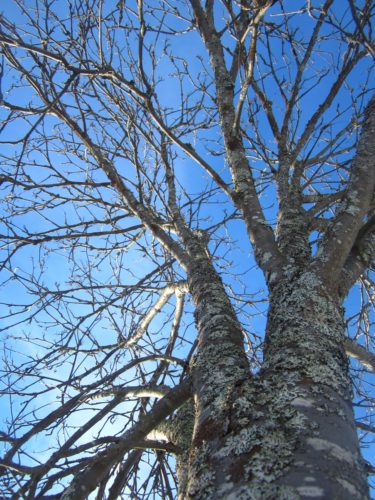
We recently completed a 10-year study in Indianapolis, where large ash trees were treated at 3-year intervals (2013 and 2016), Although they were well-protected through 2019, we saw a slight increase in damage 4 and 5 years after the last injection (2020 and 2021). By the 6th year trees after the last treatment (2022), trees declined to the point that they were a safety hazard. Overall, spring treatments were more effective than fall treatments.
- Is it worthwhile to continue treating my trees? The simple answer is YES, especially if you think about the costs of the alternatives over time. Consider the following choices:
- Homeowner tree removal vs treatment. Suppose you had ash tree that was whose trunk diameter was 30 inches. If you were to have that tree and its stump removed, the cost could easily be $1800. If an ash tree is near your house or other valuable structure special precautions need to be taken to keep limbs from causing damage. These protective measures add greatly to the labor costs and could easily double the removal costs ($3600). In contrast, to keep that tree alive, you would have to inject that tree once every three years at a cost of $300 (assuming the fee is $10/ diameter inch). In other words, the $1800 -3600 you pay to remove the trees would provide 18-36 years of enjoying your tree!
- Homeowner tree replacement vs treatment. Trees grow slowly. Most add a bit less than a half an inch per year of diameter to the trunk. So, if you add $500 on top of the removal costs to plant a new tree ($2300- $4100), the same money would provide 23 to 42 years of tree enjoyment. Moreover, the tree you planted would only be half the size of the original ash tree in 30 years.
For the full article please visit Purdue Landscape Report: Should ash trees still be protected from emerald ash borer?
Resources:
New Hope for Fighting Ash Borer, Got Nature? Purdue Extension-FNR
Invasive Pest Species: Tools for Staging and Managing EAB in the Urban Forest, Got Nature?
Emerald Ash Borer, Purdue Extension-Entomology
Emerald Ash Borer Tools & Resources – Purdue Extension Entomology
Planting Your Tree Part 1: Choosing Your Tree, Purdue Extension YouTube Channel
Tree Planting Part 2: Planting a Tree, Purdue Extension – Forestry and Natural Resources YouTube Channel
Indiana Invasive Plant List, Indiana Invasive Species Council, Purdue Entomology
Landscape Report Shares Importance of Soil Testing, Purdue FNR Extension
Find an Arborist website, Trees are Good, International Society of Arboriculture (ISA)
Tree Risk Management – The Education Store, Purdue Extension’s resource center
Bob Bruner, Exotic Forest Pest Educator
Purdue Entomology
Cliff Sadof, Professor, Ornamental, Pest Management
Purdue Entomology Extension Coordinator
While earthworms in the spring are a happy sight for gardeners, an invasive worm species is wreaking havoc for landowners and gardeners in southern Indiana.
Robert Bruner, Purdue Extension’s exotic forest pest specialist, describes jumping worms, an invasive species to North America in the genus Amynthas: “Traditionally, when we see earthworms, they are deep in the ground and a little slimy. The jumping worms are a little bit bigger, kind of dry and scaly, and tend to thrash around much like a snake does.”
While worms have a reputation as a helpful species found in the soil ecosystem, invasive jumping worms do not live up to that standard, Bruner explained. Jumping worms will consume all organic material from the top layer of soil, leaving behind a coffee ground-like waste with no nutrients for plants or seeds.
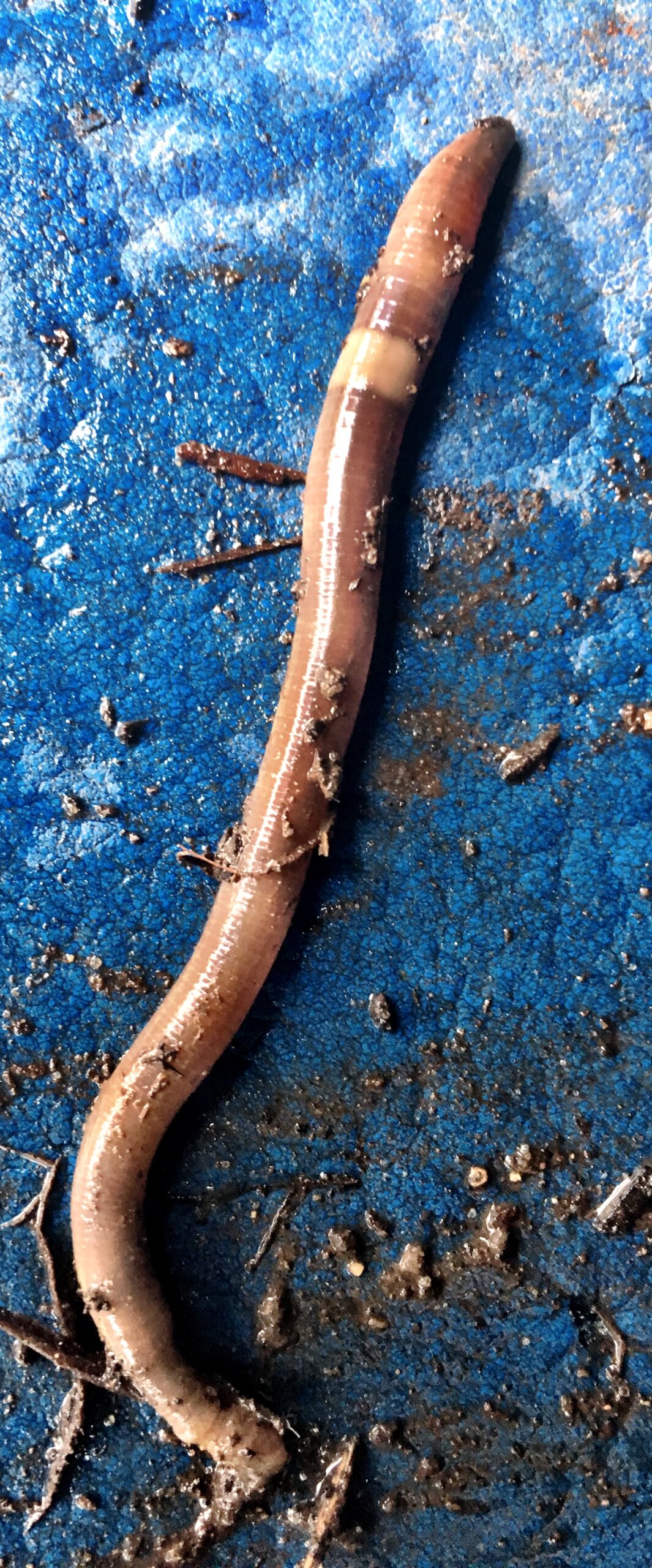
Since jumping worms stay within the first few inches of topsoil, they are not creating channels for water and air the way earthworms do, disrupting water flow to plant roots.
“So basically, they’re just very nasty pests that ruin the quality of our soil, and the only thing that can really grow in soil like that are essentially invasive plants, or species that are meant to survive really harsh conditions,” Bruner said.
Currently, the worms are being found in cities around southern Indiana, he said, particularly in Terre Haute. There is still much to learn about jumping worms, making eradication efforts difficult. One thing that is known, Bruner said, is they aren’t a migrating species.
“This is the kind of invasive pest that is moved almost entirely through human activity. They don’t crawl superfast,” he explained. “So, when they move, that means they’re moving because we’re transferring soil, say, from someone’s plants or someone’s compost and we’re bringing them to a new area.”
Any invasive species sightings should be reported to the Indiana Department of Natural Resources at depp@dnr.in.gov or by calling 1-866-663-9684.
For full article with additional photos view: Gardeners asked to be vigilant this spring for invasive jumping worms, Purdue College of Agriculture News.
Other Resources:
Fall webworms: Should you manage them?, Purdue Landscape Report
Mimosa Webworm, The Education Store, Purdue Extension resource center
Sod Webworms, Turf Science at Purdue University
Bagworm caterpillars are out feeding, be ready to spray your trees, Purdue Extension Forestry & Natural Resources (FNR) Got Nature? Blog
Purdue Plant Doctor App Suite, Purdue Extension-Entomology
Landscape & Ornamentals: Bagworms, The Education Store
What are invasive species and why should I care? (How to report invasives.), Purdue Extension – FNR Got Nature? Blog
Indiana Invasive Species Council
Report Invasive Species, Purdue Invasive Species
The GLEDN Phone App – Great Lakes Early Detection Network
EDDMaps – Early Detection and Distribution Mapping System
Indiana Department of Natural Resources: Invasive Species
Indiana Invasive Species Council
Cooperative Invasive Species Management Area (CISMA)
Ask An Expert, Purdue Extension-Forestry & Natural Resources
Jillian Ellison, Agricultural Communication
Purdue College of Agriculture
Bob Bruner, Exotic Forest Pest Educator
Purdue Department of Entomology
United States Department of Agriculture Animal and Plant Health Inspection Service Bulletin: USDA declares August Tree Check Month and urges public to look for Asian longhorned beetle.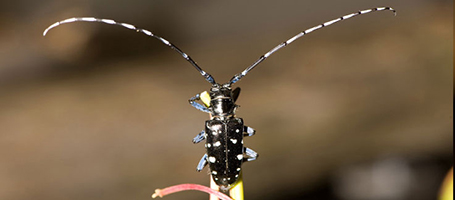
WASHINGTON, July 23, 2019 — August is the height of summer, and it is also the best time to spot the Asian longhorned beetle (ALB) as it starts to emerge from trees. The U.S. Department of Agriculture (USDA) is asking the public to take five minutes to step outside and report any signs of this invasive pest. Checking trees for the beetle will help residents protect their own trees and better direct USDA’s efforts to eradicate this beetle from the United States.
“It’s important to look for signs of the beetle now, because it’s slow to spread during the early stages of an infestation,” said Josie Ryan, APHIS’ National Operations Manager for the ALB Eradication Program. “With the public’s help, we can target new areas where it has spread and provide a better chance of quickly containing it.”
The Asian longhorned beetle feeds on a wide variety of popular hardwood trees, including maple, birch, elm, willow, ash and poplar. It has already led to the loss of more than 180,000 trees. Active infestations are being fought in three areas of the country: Worcester County, MA, Long Island, NY (Nassau and Suffolk Counties), and Clermont County, Ohio.
“Homeowners need to know that infested trees do not recover and will eventually die, becoming safety hazards,” warned Ryan. “USDA removes infested trees as soon as possible because they can drop branches and even fall, especially during storms, and this keeps the pest from spreading to nearby healthy trees.”
The Asian longhorned beetle has distinctive markings that are easy to recognize:
- Antennae that are longer than the insect’s body with black and white bands.
- A shiny, jet-black body with white spots, about 1” to 1 ½” long.
- Six legs and feet, possibly bluish-colored.
Signs of infestation include: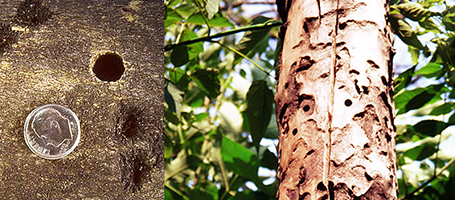
- Round exit holes in tree trunks and branches about the size of a dime or smaller.
- Shallow oval or round scars in the bark where the adult beetle chewed an egg site.
- Sawdust-like material called frass, laying on the ground around the tree or in the branches.
- Dead branches or limbs falling from an otherwise healthy-looking tree.
After seeing signs of the beetle:
- Make note of what was found and where. Take a photo, if possible.
- Try to capture the insect, place in a container, and freeze it. This will preserve it for easier identification.
- Report findings by calling 1-866-702-9938 or completing an online form at USDA Animal and Plant Health Inspection Service.
It is possible to eliminate this pest and USDA has been successfully doing so in several areas. Most recently, the agency declared Stonelick and Batavia Townships in Ohio to be free of the Asian longhorned beetle. We also eradicated the beetle from Illinois, New Jersey, Boston, MA, and parts of New York. The New York City boroughs of Brooklyn and Queens are in the final stages of eradication.
For more information about the Asian longhorned beetle, other ways to keep it from spreading—such as not moving firewood—and eradication program activities, visit USDA Animal and Plant Health Inspection Service. For local inquiries or to speak to your State Plant Health Director, call 1-866-702-9938.
Other Resources:
Report Invasive Species, Purdue Agriculture & Indiana Invasive Species Council
Great Lakes Early Detection Network, Bugwood Apps
New Hope for Fighting Ash Borer, Got Nature? Blog
Mile-a-Minute Invasive Vine Found Indiana, Got Nature? Blog
Sericea Lespedeza: Plague on the Prairie, Got Nature? Blog
Invasive Plants: Impact on Environment and People, The Education Store, Purdue Extension
Invasive Plant Species in Hardwood Tree Plantations, The Education Store
Invasive Plant Species: Callery Pear, Purdue Extension The Education Store
United States Department of Agriculture Animal and Plant Health Inspection Service
Cockroaches are serious threats to human health. They carry dozens of types of bacteria, such as E. coli and salmonella, that can sicken people. And the saliva, feces and body parts they leave behind may not only trigger allergies and asthma but could cause the condition in some children.
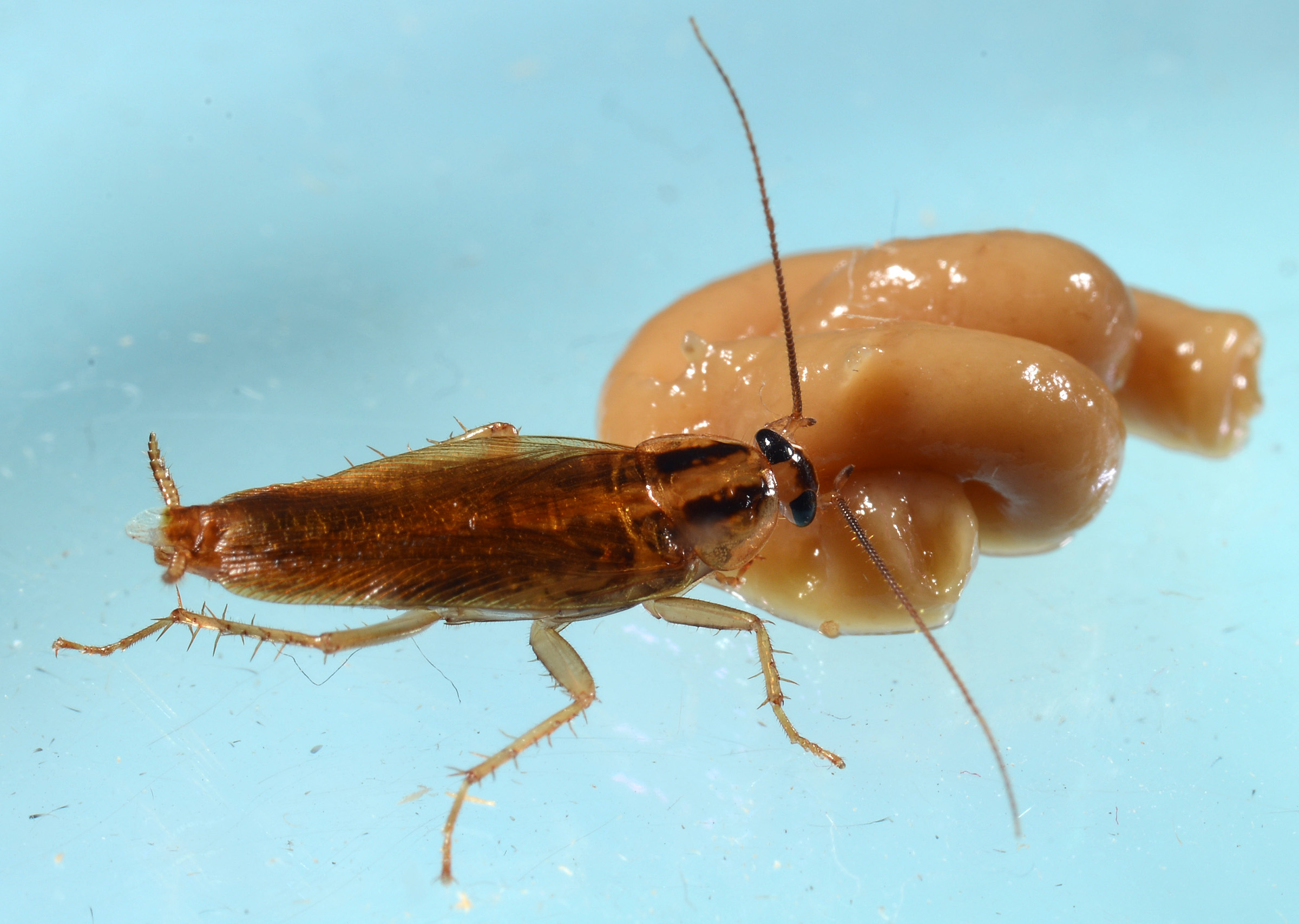
A German cockroach feeds on an insecticide in the laboratory portion of a Purdue University study that determined the insects are gaining cross-resistance to multiple insecticides at one time. (Photo by John Obermeyer/Purdue Entomology)
A Purdue University study led by Michael Scharf, professor and O.W. Rollins/Orkin Chair in the Department of Entomology, now finds evidence that German cockroaches (Blattella germanica L.) are becoming more difficult to eliminate as they develop cross-resistance to exterminators’ best insecticides. The problem is especially prevalent in urban areas and in low-income or federally subsidized housing where resources to effectively combat the pests aren’t as available.
“This is a previously unrealized challenge in cockroaches,” said Scharf, whose findings were published in the journal Scientific Reports. “Cockroaches developing resistance to multiple classes of insecticides at once will make controlling these pests almost impossible with chemicals alone.”
Each class of insecticide works in a different way to kill cockroaches. Exterminators will often use insecticides that are a mixture of multiple classes or change classes from treatment to treatment. The hope is that even if a small percentage of cockroaches is resistant to one class, insecticides from other classes will eliminate them.
Scharf and his study co-authors set out to test those methods at multi-unit buildings in Indiana and Illinois over six months. In one treatment, three insecticides from different classes were rotated into use each month for three months and then repeated. In the second, they used a mixture of two insecticides from different classes for six months. In the third, they chose an insecticide to which cockroaches had low-level starting resistance and used it the entire time.
In each location, cockroaches were captured before the study and lab-tested to determine the most effective insecticides for each treatment, setting up the scientists for the best possible outcomes.
“If you have the ability to test the roaches first and pick an insecticide that has low resistance, that ups the odds,” Scharf said. “But even then, we had trouble controlling populations.”
For full article: Rapid cross-resistance bringing cockroaches closer to invincibility.
Resources
Report Invasive Species, Purdue Agriculture & Indiana Invasive Species Council
Purdue experts encourage ‘citizen scientists’ to report invasive species, Purdue Agriculture News
New Hope for Fighting Ash Borer, Got Nature? Blog, Purdue Forestry and Natural Resources
Mile-a-Minute Invasive Vine Found Indiana, Got Nature? Blog
Sericea Lespedeza: Plague on the Prairie, Got Nature? Blog
Michael E. Scharf, Professor and O.W. Rollins/Orkin Chair
Purdue Department of Entomology
Brian J. Wallheimer, Science Writer
Purdue College of Agriculture
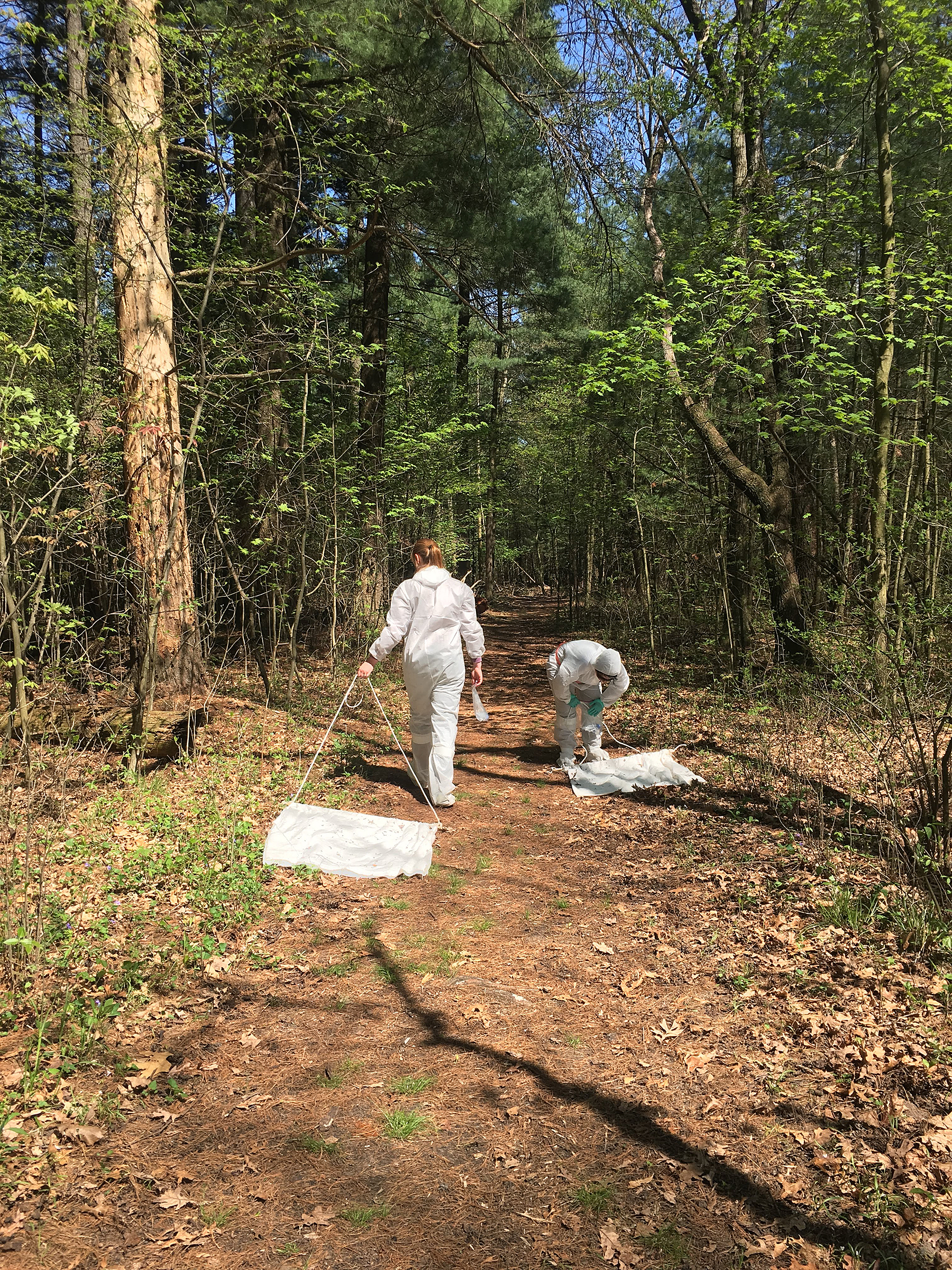
Scientists from Purdue’s Tick INsiders program, Lauren Hagen (left) and Maria Muriga (right), drag and check tick cloths at Tippecanoe River State Park in 2018. The program is looking for high school students and citizen scientists interested in helping with tick collections this year. (Tick INsiders photo)
Purdue University’s Tick INsiders program is looking for Indiana high school students and other Indiana residents willing to roll down their sleeves to get involved in a citizen science project.
Cate Hill, a Purdue professor of entomology, leads this effort to analyze the bacteria and viruses in Indiana’s ticks to build an understanding of what they are carrying and how that might impact human health. To do that, she needs volunteers to collect ticks from all over the state.
This year the Tick INsiders program will provide training for up to 50 students. Citizen scientists are also now welcome to collect and send ticks to Hill’s lab.
“It’s really important work. The Centers for Disease Control and Prevention reports that human cases of tick-borne diseases doubled from 2004 to 2016. If we’re going to get a handle on that and develop strategies for reducing tick bites and treating patients, we need to know where our ticks are and what our ticks are carrying around inside them,” Hill said. “That means we need a lot of ticks, and we need help collecting them.”
Three species of ticks – the blacklegged or deer tick, the lone star tick and the American dog tick – are found in Indiana. These ticks can transmit multiple pathogens, nine of which are known to cause human illnesses, though not all have been identified in Indiana. The Indiana State Department of Health reports more than 100 cases of Lyme disease each year and dozens of cases of Ehrlichiosis, anaplasmosis and Rocky Mountain spotted fever.
Research suggests that ticks can carry a cocktail of microbes – bacteria and viruses – that can sicken bite victims and may work in concert to affect the severity of an illness and human immune response.
“Not all tick bites are the same. We don’t know what is passed from a tick to a human each time someone is bitten, which means that health care professionals may need to consider multiple tick-borne pathogens in a person who has been bitten by a tick,” Hill said. “This program improves our knowledge so that we can improve our outcomes.”
Indiana residents interested in participating can collect ticks and send them to Hill’s lab for analysis. Videos on safe and proper collection techniques, as well as how to send ticks will be at Tick INsiders.
For full article, see Purdue Agriculture News.
Resources
Ticks 101: A Quick Start Guide to Indiana Tick Vectors, The Education Store – Extension Resource
The Biology and Medical Importance of Ticks in Indiana, The Education Store
Mosquitoes, Purdue Extension Entomology
One Small Bite: One Large Problem, Got Nature?, Purdue Extension-Forestry and Natural Resources
Mosquitoes and ticks – little pests carry big risks, Got Nature?
Catherine A Hill, Professor of Entomology/Vector Biology
Purdue University Department of Entomology
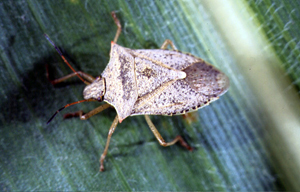
Photo credit: B. Christine
Every fall, a little pest called the brown marmorated stink bug returns to annoy and destroy. This invasive species from the far east has no local predators to control its numbers and does a great deal of damage to fruits, vegetables, and other plants. As the weather cools down, they also like to sneak into homes to stay warm, and will remain there throughout the winter unless dealt with. As the name suggests, these bugs’ defense mechanism is the release of a foul-smelling chemical, and dealing with them can be unpleasant.
Purdue Extension Entomologist Rick Foster answers several questions about stink bugs and what to do about them in a Q&A article for The Star Press. Check out “Stink bug Q&A with Purdue expert” and learn some more about these pesky invaders.
Resources:
Brown Marmorated Stink Bug In Homes – Purdue Extension Entomology
Stink bug Q&A with Purdue expert – The Star Press
Brown Stink Bug – Purdue University Field Crops IPM
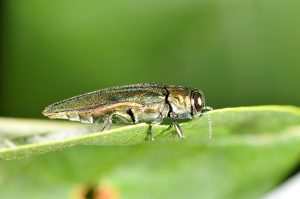
An adult emerald ash borer feeds off a leaf. (Purdue University Department of Entomology photo/John Obermeyer)
Article by Pat Munsey, taken from KokomoPerspective.com:
The ash borer beetle is a scourge that has spread across the Midwest for more than a decade, laying waste to trees as it burrows and feeds. Now it is in Howard County.
Ash trees in several areas of the community are showing signs of the inevitable death that comes with infestation, but citizens can stop the pest in its tracks.
According to the Indiana Department of Natural Resources (DNR), the beetles were first discovered in Indiana on April 21, 2004. Since that time, it has steadily spread across the state with heavy concentrations in the northeast. Evidence of the insects’ arrival locally began appearing two years ago, and according to Kristy McNeil, an associate at Salsbery Garden Center, it is vital that people take action now to prevent further damage.
Resources
Emerald Ash Borer, Indiana Department of Natural Resources (IDNR)
Emerald Ash Borer in Indiana, Purdue Extension
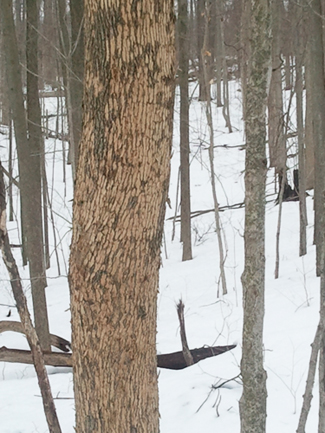 If you’re walking in the woods or maybe even traveling along a road this spring in Indiana, you may come across some trees that look like the one in the photos. Clearly, something unusual is going on here. What made the bark change color so quickly, and why are there holes in the bark?
The answer to both of those questions for ash trees around the state is Emerald Ash Borer and woodpeckers. As Emerald Ash Borer spreads across Indiana, the population of Emerald Ash Borer larvae overwintering under the bark of ash trees can quickly increase. These grubs provide a tasty treat and important winter and early spring nutrition to hungry woodpeckers.
 Woodpeckers of several species are experts at detecting and extracting these grubs by pounding holes in tree bark. Ash bark is generally gray on the surface, but the inner bark is a light corky tan color. Once the woodpeckers find the EAB larvae, their excavation activities flake off the outer bark to expose the lighter colored inner bark. This is actually one of the best indicators of the presence of Emerald Ash Borer in a tree. The woodpecker activity often starts in the upper main stem and branches of ash trees, but as the population of EAB larvae in the trees increase, the woodpecker activity spreads down the trunk of the tree. Trees with this much inner bark exposed indicate an advanced infestation of EAB and signal ash tree mortality in the next year or two.
If you would like to learn more about ash trees and the Emerald Ash Borer, visit the Purdue Emerald Ash Borer website.
Resources
Arrest That Pest! – Emerald Ash Borer in Indiana, Purdue Extension
Purdue Extension – Forestry & Natural Resources website with search bar, place “Invasive Insect”
Emerald Ash Borer, Indiana Department of Natural Resources (IDNR)
Emerald Ash Borer in Indiana, Purdue Extension
New Hope for Fighting Ash Borer, Purdue Extension – Forestry and Natural Resources Got Nature? blog
Lenny Farlee, Extension Forester
Purdue University Department of Forestry and Natural Resources

Recent Posts
- It’s Timberdoodle Time!
Posted: April 3, 2026 in Got Nature for Kids, How To, Wildlife - Keep An Eye Out for Hammerhead Worms, Purdue Landscape Report
Posted: April 2, 2026 in Invasive Animal Species, Wildlife, Woodlands - When is the Peak Migration For Hummingbirds and How Can You Attract Them?
Posted: in How To, Wildlife - ID That Tree Featured in National Woodland Owners Association Newsletter
Posted: April 1, 2026 in Urban Forestry, Wildlife, Woodlands - New 2026 Indiana Woodland Steward Newsletter
Posted: March 30, 2026 in Urban Forestry, Wildlife, Woodlands - A Woodland Management Moment: Why Aspect Matters
Posted: in Urban Forestry, Woodland Management Moment, Woodlands - 2026 Winter Bat Survey In Progress, MyDNR
Posted: March 27, 2026 in How To, Wildlife - Fast-Growing Trees for the Landscape, Purdue Landscape Report
Posted: March 26, 2026 in Forestry, Urban Forestry, Woodlands - Urban Tree Spotlight: Planting Deciduous Shade Trees, Purdue Landscape Report
Posted: March 25, 2026 in Forests and Street Trees, Urban Forestry, Woodlands - Beetle that attacks Tree-of-Heaven found in Indiana, Purdue Landscape Report
Posted: March 20, 2026 in Invasive Insects, Wildlife, Woodlands
Archives
Categories
- Alert
- Aquaculture/Fish
- Aquatic/Aquaculture Resources
- Ask the Expert
- Christmas Trees
- Community Development
- Disease
- Drought
- Forestry
- Forests and Street Trees
- Gardening
- Got Nature for Kids
- Great Lakes
- How To
- Invasive Animal Species
- Invasive Insects
- Invasive Plant Species
- Land Use
- Natural Resource Planning
- Nature of Teaching
- Plants
- Podcasts
- Ponds
- Publication
- Safety
- Spiders
- Timber Marketing
- Uncategorized
- Urban Forestry
- Webinar
- Wildlife
- Wood Products/Manufacturing
- Woodland Management Moment
- Woodlands