 Purdue University - Extension - Forestry and Natural Resources
Got Nature? Blog
Rooted in Research, USDA Forest Service: Non-native species are increasingly shaping forests across the eastern United States. While many introduced species coexist without major disruption, some become invasive: damaging ecosystems, reducing biodiversity and impacting the economic value forests provide. Over the past decade, the extent of forest land affected by invasive species has continued to grow, making management more complex and costly.

Hemlock woolly adelgid egg sacs on a hemlock branch. Photo from Rooted in Research newsletter.
To address these challenges, the USDA Forest Service Research and Development team is hosting a six-part webinar series focused on invasive species in eastern forests. This series brings together leading scientists to share research-backed management strategies and explore the ecological and economic impacts of invasive species across the region.
These are virtual webinars that will be held on select Tuesdays and Thursdays in May. Each webinar will be ~60 minutes and start at 2:00 PM Eastern time. All events are open to anyone interested in forest health, conservation and management!
Here is the schedule for the upcoming webinars:
- May 5 – Invasive Species in Eastern Forests: Extent, Impact, and Response
- May 7 – Managing Invasive Plants: Understanding Rapid Adaptation and Strategies for Control
- May 12 – Hemlock Woolly Adelgid: Protecting Hemlocks with Silviculture and Biocontrol
- May 14 – Management Solutions for Emerald Ash Borer
- May 19 – Tracking Spongy Moth Defoliations and the Economics of Slowing the Spread
- May 21 – Emerging Threats: Asian Needle Ant and Beech Leaf Disease
Participants must register for each webinar individually, visit to Research & Development Presents: Invasive Species in Eastern Forests learn more and sign up.
Forests play a critical role in supporting biodiversity, protecting water resources, and contributing to local and regional economies. As invasive species continue to spread, understanding how to manage and mitigate their impacts is more important than ever. This webinar series provides an opportunity to learn directly from experts working at the forefront of forest research.
To subscribe to the newsletter, visit Sign Up for Rooted in Research.
Learn and read more about the research done by the USDA Forest Service by exploring the Northern Research Station and Southern Research Station.
More Resources
ID That Tree, Playlist, Purdue Extension – FNR YouTube Channel
A Woodland Management Moment, Playlist, Purdue Extension – FNR YouTube Channel
Woodland Stewardship for Landowners, Playlist, Purdue Extension – FNR YouTube Channel
Native Trees of the Midwest, Purdue University Press
Investing in Indiana Woodlands, The Education Store
Forest Improvement Handbook, The Education Store
Invasive Species Playlist, Playlist, Purdue Extension – FNR YouTube Channel
Indiana Department of Natural Resources: Invasive Species
Indiana Invasive Species Council
Cooperative Invasive Species Management Area (CISMA)
Report Invasive, Purdue Extension
Episode 11 – Exploring the challenges of Invasive Species, Habitat University-Natural Resource University
What are invasive species and why should I care?, Got Nature? Blog, Purdue Extension – FNR
Invasive plants: impact on environment and people, The Education Store
New Hope for Fighting Ash Borer, Got Nature? Purdue Extension-FNR
Invasive Pest Species: Tools for Staging and Managing EAB in the Urban Forest, Got Nature?
Emerald Ash Borer, Purdue Extension-Entomology
Emerald Ash Borer Tools & Resources – Purdue Extension Entomology
U.S. Department of Agriculture (USDA) Forest Service, Research & Development
Walk through many forests in Indiana today, and you might not notice what is missing until you look up. Ash trees, once a common part of these woodlands, have rapidly disappeared due to the invasive emerald ash borer. Since its arrival in the early 2000’s, this small beetle has killed millions of ash trees across the state (Figure 1).

Figure 1: Dead ash tree killed by emerald ash borer
But what happens after ash trees are gone? Do new trees grow in their place, or do forests begin to change in unexpected ways?
To answer these questions, researchers revisited long-term forest monitoring plots across Indiana that were first established in the 1990s, before emerald ash borer was present. By comparing forest conditions before and after widespread ash mortality, we can begin to understand how these ecosystems are responding to one of the most destructive invasive forest pests in North America.
Even though young ash trees are still present in many forests, their numbers are dropping quickly (Figure 2). In some areas, ash seedlings have declined by more than 70 percent over the past decade. While a few saplings remain, very few are surviving long enough to replace the large trees that have been lost.
This suggests that ash is unlikely to return as a major component of Indiana forests anytime soon. As the remaining seeds in the soil are used up and fewer young trees survive, ash may become a much rarer species on the landscape.
As ash declines, other plant species are filling the gaps, but not always in the way we might expect.
Instead of fast-growing canopy trees taking over, many forests are becoming dominated by shade-tolerant species that thrive in low-light conditions. Native plants like spicebush and pawpaw are increasing in abundance, often forming dense layers in the understory. These species can make it difficult for other trees to establish and grow.
Sugar maple, another shade-tolerant species, remains common as seedlings but is not always successfully growing into larger trees. This creates a bottleneck where young trees are present, but few make it into the next stage of forest development.
At the same time, invasive plants are becoming more common in many forests following ash loss. Species such as bush honeysuckle and multiflora rose are increasing, especially in areas where ash trees have died.
These invasive plants can outcompete native vegetation, further limiting the ability of forests to regenerate diverse tree communities. Once established, they often persist and spread, creating additional challenges for forest management.
When large trees die, we might expect more sunlight to reach the forest floor, helping new trees grow. However, in many Indiana forests, the loss of ash is creating only small openings in the canopy rather than large gaps.

Figure 2: Ash regeneration in the understory.
These smaller gaps favor shade-tolerant plants rather than species that need full sunlight to thrive. As a result, forests are gradually shifting toward communities dominated by shrubs and slow-growing, shade-adapted trees.
Ecologists often refer to this process as mesophication, a transition toward cooler, shadier, and more moisture-loving forest conditions. Over time, this can lead to forests that are more uniform and less diverse.
The loss of ash is more than just the disappearance of a single group of trees: it is part of a broader pattern of change driven by invasive species, altered disturbance patterns, and shifting forest conditions.
Without intervention, many forests may continue to develop dense understories dominated by a small number of species, including invasive plants. This can reduce tree diversity, limit wildlife habitat, and alter how forests function over time.
While forests are resilient and will continue to grow and change, they may look very different from those of the past.
Landowners, land managers, and the public all play a role in supporting healthy forests. Monitoring for invasive species, promoting a diversity of native trees, and managing dense understory growth can help improve forest regeneration.
As research continues, understanding how forests respond to the loss of species like ash will be critical for guiding conservation and management efforts in the years ahead.
Resources:
Emerald Ash Borer, Purdue Extension-Entomology
Emerald Ash Borer, Animal and Plant Health Inspection Service (USDA)
Emerald Ash Borer Invasion of North America: History, Biology, Ecology, Impacts, and Management, Daniel A. Herms, Deborah G. McCullough, 2014, Annual Review Entomology.
New Hope for Fighting Ash Borer, Got Nature? Purdue Extension- Forestry and Natural Resources (FNR)
Emerald Ash Borer Tools & Resources – Purdue Extension Entomology
Invasive Pest Species: Tools for Staging and Managing EAB in the Urban Forest, Got Nature? Blog, Purdue Extension – FNR
Now is the Time to Control Non-Native Bush Honeysuckle, Got Nature? Blog, Purdue Extension – FNR
What are Invasives Species and Why Should I Care?, Got Nature? Blog, Purdue Extension – FNR
ID That Tree: Invasive Multiflora Rose, Purdue Extension – FNR YouTube Channel
Invasive Species, Purdue Extension – FNR YouTube Channel
Report INvasive, Purdue Extension
The GLEDN Phone App – Great Lakes Early Detection Network
EDDMapS, Early Detection and Distribution Mapping System
Cooperative Invasive Species Management Area (CISMA)
Find an Arborist, International Society of Arboriculture
Professional Forester, Indiana Forestry Woodland Owners Association (IFWOA)
District Forester, Indiana Department of Natural Resources, 10+ acres
Tree Planting Part 2: Planting a Tree, Purdue Extension – FNR YouTube Channel
Conservation Tree Planting: Steps to Success, Purdue Extension – FNR YouTube Channel
Hardwood Tree Improvement and Regeneration Center (HTIRC)
Tree Risk Management – Got Nature? Blog, Purdue Extension – FNR
Subscribe – Purdue Extension-FNR YouTube Channel
Thaddeus Swart, Graduate Research Assistant
Purdue Department of Forestry & Natural Resources
Faculty Advisors:
Dr. Mike Jenkins, Forestry & Natural Resources Professor
Purdue Department of Forestry & Natural Resources
Dr. Mike Suanders, Professor of Ecology and Natural Resources
Purdue Department of Forestry & Natural Resources
Purdue Landscape Report: Recently, there has been an uptick in questions related to one of Indiana’s most notorious invasive pests: the emerald ash borer. Homeowners, businesses, even professionals have asked if ash trees are still present in Indiana, and if the insect is still a threat to our ecosystem. Emerald ash borer wreaked significant havoc among Indiana’s hardwoods, and a person could be forgiven for believing that there are no ash trees at all in our state, but this is simply not true. Ash still survives in Indiana and can be found both as ornamental plantings and in untended woodlots; unfortunately, emerald ash borer is also still present and just as deadly to them as ever. The question of protecting ash versus removal them is complex, but entomologists and tree specialists have learned from this insect’s invasion.
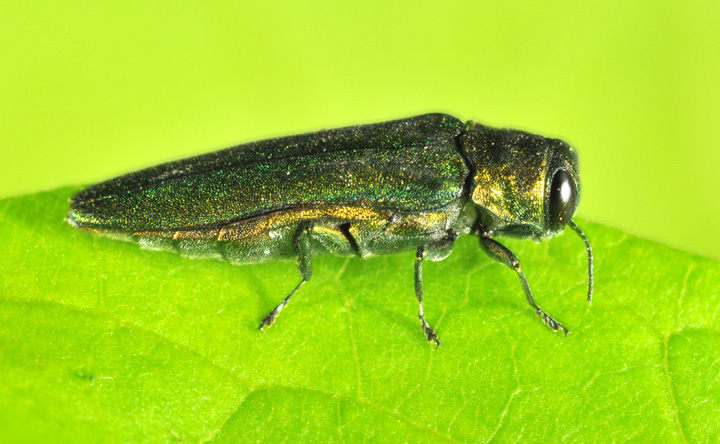
Figure 1. Side view of EAB, John Obermeyer
The emerald ash borer (Agrilus planipennis), a wood-boring insect native to Asia, is responsible for decimating ash (Fraxinus spp.) throughout the United States and elsewhere. In Indiana, this insect’s presence was confirmed in 2004, though it had probably been in the state for some time before then. Since its arrival, Hoosiers have been forced to watch as ash trees have rapidly declined and died due to the insect’s feeding and life cycle. The insect lays its eggs in crevices in the bark of an ash that is 8 to 10 years old, and after hatching, the new larvae begin to bore through the tree’s cambium tissue. The tree relies on its cambium tissue to transport water and nutrients and supply cells for new growth. Often, the only signs of the insect’s presence are a reduction in canopy coverage and D-shaped exit holes in the bark, indicating adult emergence. As time goes on, however, the tree will continue to lose canopy, experience limb death, and often have large chunks of bark detach. Unprotected trees will typically die within 2 to 5 years of infestation. Dead and dying ash trees represent a serious hazard to health and property as infestation will leave them extremely brittle. Brittle ash will often fall during weather events or even collapse over time as limbs fall off.
While emerald ash borer did significant damage to ash tree populations in Indiana, they did not destroy the population entirely. While virtually all untreated trees will eventually become infested, saplings with a trunk diameter of ½ to 1 inch will remain untouched, allowing annual replacement of trees to continue. Since the initial invasion killed so many trees, the borer’s populations have been proportionally reduced as well due to a lack of a food source. This combination of factors has created a cycle of growth and infestation that allows both populations to survive, but at significantly lower levels as compared to the period of the initial infestation. Unfortunately, this also means that emerald ash borer is now a permanent fixture in the hardwood ecosystem in Indiana.

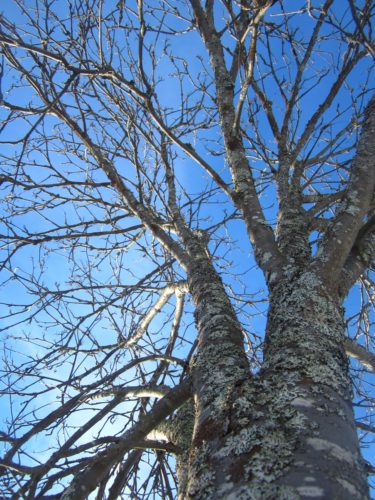
Figure 2. This photo illustration shows three ash trees in Bloomington, Indiana, with different levels of canopy lost to the emerald ash borer. (Purdue Tree Doctor app illustration/Cliff Sadof)
While many may believe ash trees are a total loss, there are still options to protect ash tree and even rescue ash that have already been infested. The first step in this process is to determine the extent of damage in a given tree. As the cambium tissue is consume by ash borer larvae, the tree will experience a steady loss of canopy and limb death. The proportion of lost canopy makes a great indicator for treatment viability. For example, a tree that has only lost 10% of its canopy will normally respond well to treatment. As more canopy is lost, recovery is more challenging, until the tree has lost %30 of canopy coverage. After that point, there is very little chance that a rescue treatment will be successful, and removal will most likely be necessary. It is also important to remember that limb death may occur; these limbs will not recover and will need to be removed to avoid any potential hazards.
There are several insecticides with varying ranges of efficacy that can be used to manage emerald ash borer. These include imidacloprid, dinotefuran, azadirachtin, and emamectin benzoate. Several studies have been conducted to find the best combination of chemical and application type, such as the difference between using a soil drench compared to a trunk injection. While all of the above chemicals can be effective against the insect, the combination of emamectin benzoate applied through a trunk injection offers the best, longest lasting protection from infestation. This combination has a durable effect lasting for two years under dense infestations. However, the reduction in emerald ash borer populations have spread the distribution of the insect thinner, and longer intervals between treatments are possible. A ten-year study conducted by Purdue University demonstrated that treating trees once every three years provided sufficient protection from the beetles, while also showing that 4 to 5 years after last treatment coincided with an increase in damage to the trees. This same study also found that by six years post-treatment, the trees would decline to the point of making removal a necessity. This research concluded that increasing time between intervals after three years increased the risk of catastrophic damage due to emerald ash borer activity, thus the recommendation for three-year intervals.
Ultimately, many will see this as a financial issue: the cost of treatment over time against the cost of removal to avoid potential damages. The above study estimated the cost of treating a single tree with an emamectin benzoate injection at $300 per treatment. Since treatment only needs to happen once every three years, the cost per year per tree would be $100, approximately. Tree removal was estimated between $1800 and $3600, depending on tree location and other factors. Also consider replacement costs if you wanted to continue to grow ash in that area, and how long the tree would need to grow to match the size of the tree you just replaced. Additionally, add in any treatment costs to make sure it survives infestation. When looked at from this angle, maintaining regular treatment on rescuable trees would appear to be the most cost-effective route for managing ash. Any treatment plan should be discussed with a professional, such as a certified arborist.
Read the original article posted in the Purdue Landscape Report April 2025 Newsletter: Revisiting Ash Tree Protection.
Subscribe and receive the newsletter: Purdue Landscape Report Newsletter.
Resources:
New Hope for Fighting Ash Borer, Got Nature? Purdue Extension-FNR
Invasive Pest Species: Tools for Staging and Managing EAB in the Urban Forest, Got Nature?
Emerald Ash Borer, Purdue Extension-Entomology
Emerald Ash Borer Tools & Resources – Purdue Extension Entomology
Planting Your Tree Part 1: Choosing Your Tree, Purdue Extension YouTube Channel
Tree Planting Part 2: Planting a Tree, Purdue Extension – Forestry and Natural Resources YouTube Channel
Indiana Invasive Plant List, Indiana Invasive Species Council, Purdue Entomology
Landscape Report Shares Importance of Soil Testing, Purdue FNR Extension
Find an Arborist website, Trees are Good, International Society of Arboriculture (ISA)
Tree Risk Management – Got Nature? Blog, Purdue Extension – FNR
ID That Tree – Video Playlist, Purdue Extension – Forestry and Natural Resources (FNR) YouTube Channel
Purdue Arboretum Explorer
Conservation Tree Planting: Steps to Success, Purdue Extension – FNR YouTube Channel
A Woodland Management Moment, Playlist, Purdue Extension – FNR YouTube Channel
Woodland Stewardship for Landowners, Playlist, Purdue Extension – FNR YouTube Channel
Indiana Department of Natural Resources: Invasive Species
Indiana Invasive Species Council
Cooperative Invasive Species Management Area (CISMA)
Report Invasive, Purdue Extension
Native Trees of the Midwest, Purdue University Press
Professional Forester, Indiana Forestry Woodland Owners Association
Forest Improvement Handbook, The Education Store
Bob Bruner, Exotic Forest Pest Educator
Purdue Entomology
Purdue Landscape Report: The emerald ash borer (EAB), Agrilus planipennis, is still one of the most damaging insect pests ever to invade North American forests. Unlike most native boring insects, this beetle can attack and kill relatively healthy ash trees. In Indiana cities we found this insect capable of killing most of the unprotected ash trees within 6 to 10 years. Nearly 20 years after its first detection in Indiana (2004), trees still need to be protected to keep them alive. The benefits of these living ash trees easily justify the cost of monitoring them. We provide answers to common questions people have about the need for continued treatment.
- I have had a tree care specialist treat my ash trees for the last 10 years. What will happen to these trees if I stop this service? If your trees are still healthy, they were probably treated with injections of emamectin benzoate. Initially we recommended treating trees once every 2 years. This was especially helpful during the initial invasion when each newly infested tree was producing hundreds of beetles per year. Now that most of the untreated ash trees are dead in Indiana, there are fewer emerald ash borers to attack the surviving ash trees. Research clearly shows that treating trees once every 3 years is enough to keep ash trees alive. Increasing the time between treatments beyond 3 years will increase the risk of losing your trees.
We recently completed a 10-year study in Indianapolis, where large ash trees were treated at 3-year intervals (2013 and 2016), Although they were well-protected through 2019, we saw a slight increase in damage 4 and 5 years after the last injection (2020 and 2021). By the 6th year trees after the last treatment (2022), trees declined to the point that they were a safety hazard. Overall, spring treatments were more effective than fall treatments.
- Is it worthwhile to continue treating my trees? The simple answer is YES, especially if you think about the costs of the alternatives over time. Consider the following choices:
- Homeowner tree removal vs treatment. Suppose you had ash tree that was whose trunk diameter was 30 inches. If you were to have that tree and its stump removed, the cost could easily be $1800. If an ash tree is near your house or other valuable structure special precautions need to be taken to keep limbs from causing damage. These protective measures add greatly to the labor costs and could easily double the removal costs ($3600). In contrast, to keep that tree alive, you would have to inject that tree once every three years at a cost of $300 (assuming the fee is $10/ diameter inch). In other words, the $1800 -3600 you pay to remove the trees would provide 18-36 years of enjoying your tree!
- Homeowner tree replacement vs treatment. Trees grow slowly. Most add a bit less than a half an inch per year of diameter to the trunk. So, if you add $500 on top of the removal costs to plant a new tree ($2300- $4100), the same money would provide 23 to 42 years of tree enjoyment. Moreover, the tree you planted would only be half the size of the original ash tree in 30 years.
For the full article please visit Purdue Landscape Report: Should ash trees still be protected from emerald ash borer?
Resources:
New Hope for Fighting Ash Borer, Got Nature? Purdue Extension-FNR
Invasive Pest Species: Tools for Staging and Managing EAB in the Urban Forest, Got Nature?
Emerald Ash Borer, Purdue Extension-Entomology
Emerald Ash Borer Tools & Resources – Purdue Extension Entomology
Planting Your Tree Part 1: Choosing Your Tree, Purdue Extension YouTube Channel
Tree Planting Part 2: Planting a Tree, Purdue Extension – Forestry and Natural Resources YouTube Channel
Indiana Invasive Plant List, Indiana Invasive Species Council, Purdue Entomology
Landscape Report Shares Importance of Soil Testing, Purdue FNR Extension
Find an Arborist website, Trees are Good, International Society of Arboriculture (ISA)
Tree Risk Management – The Education Store, Purdue Extension’s resource center
Bob Bruner, Exotic Forest Pest Educator
Purdue Entomology
Cliff Sadof, Professor, Ornamental, Pest Management
Purdue Entomology Extension Coordinator
Jennifer Koch, and other researchers with the U.S. Forest Service, has spent the last several years studying what are known as lingering ash – trees that have fared much better against the emerald ash borer. The invasive beetle, which came to North America from Asia about 20 years ago, has killed millions of ash trees around the Midwest.

An adult emerald ash borer feeds off a leaf. (Purdue University Department of Entomology photo/John Obermeyer)
But for reasons that researchers are learning more about, some trees have survived.
Koch says they’ve identified at least two reasons why. Lingering ash seem to attract fewer hungry adult ash borers, which means they’re less likely to become homes to eggs. And when eggs do hatch on lingering ash trees, they tend to be smaller and have a higher mortality rate.
Those are extremely valuable characteristic for modern ash trees, so Koch is making sure they get passed on through cloning. Not genetic modification, but rather clonal duplicates of lingering ash literally cut from part of the parent tree.
Maybe most importantly, Koch says the cloned trees appear to be even more resistant to the ash borer. With their cloned trees healthy and growing, researchers are waiting on the next generation of seeds to see if they’re even more resistant than their cloned parents.
Koch says they plan to add more lingering ash seedlings into their on-site orchard this year. Ash trees planted from seed typically take seven to 10 years to begin giving off seeds of their own, so it could be another decade before Koch knows just how successful their ash tree breeding program can be.
See full article: Attack Of The Clones: Ohio Researchers Find New Hope For Fighting Ash Borer, WOSU Public Media
Resources:
Question: What options do we have to treat our ash trees against the Emerald Ash Borer?, Got Nature?, Purdue Extension-FNR
Invasive Pest Species: Tools for Staging and Managing EAB in the Urban Forest, Got Nature?, Purdue Extension-FNR
Emerald Ash Borer, Purdue Extension-Entomology
Emerald Ash Borer Tools & Resources – Purdue Extension Entomology
WOSU Radio, Columbus, Ohio
This comprehensive written abstract titled Tools for Staging and Managing Emerald Ash Borer in the Urban Forest shares research gathered in an eight-year period with a variety of management strategies.
Advances in control can help municipal foresters save ash trees from emerald ash borer (EAB) [Agrilus planipennis (Fairmaire)]
in urban forests. Although ash trees of any size can be protected from this pest, cities often do not implement programs because they fail to recognize and act o incipient populations of EAB. In this study, researchers develop a model for predicting ash mortality over an eight-year period, and validated with data from the removal of >14,000 ash trees killed by EAB in Fort Wayne, Indiana, U.S. researchers then developed a sampling scheme to help foresters map their ash trees along the expected progression of ash decline. This model was then used to modify a web-based EAB cost calculator that compares discounted annual and cumulative costs of implementing a variety of management strategies. It was determined that strategies that most heavily relied on saving ash trees were less expensive and produced a larger forest than those strategies that mostly removed and replaced ash trees. Ratios of total discounted costs to discounted cumulative benefits of strategies that saved most ash trees were over two-thirds lower than strategies of proactive tree removal and replacement. Delaying implementation of an ash management program until damage would be visible and more obvious to the community (Year 5 of the model) decreased the cost–benefit ratio by <5%. Thus, delays that rely on the abundance of locally damaged trees to bolster community support do not necessarily diminish the utility of implementing a control strategy.
For full article: Tools for Staging and Managing Emerald Ash Borer
Resources:
Tree Doctor App, The App Store
Invasive Species – Indiana Department of Natural Resources (IDNR)
Ask an Expert – Purdue Extension-Forestry and Natural Resources
Indiana Invasive Species Council – Includes: IDNR, Purdue Department of Entomology and Professional Partners
Great Lakes Early Detection Network App (GLEDN) – The Center for Invasive Species & Ecosystem Health
National Invasive Species Awareness Week: February 27-March 3, 2017
Invasive Species Week a reminder to watch for destructive pests, Purdue entomologist says – Purdue Agriculture News
Cliff Sadof, Professor
Purdue University Department of Entomology
Matt Ginzel, Associate Professor
Purdue University Department of Forestry and Natural Resources & Department of Entomology
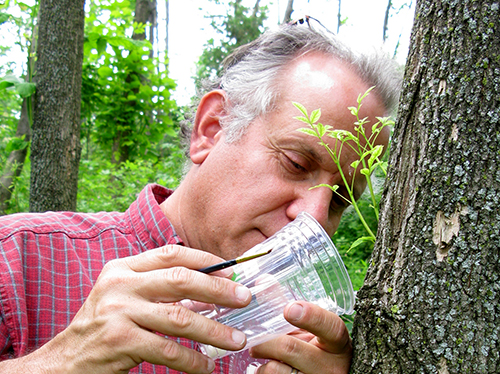 Cities and towns with “urban forests” such as parks and streets lined with trees could spend less money by taking steps to save emerald ash borer-infested trees early rather than wait until they can only replace them, Purdue University researchers concluded in a study.
Cliff Sadof, professor of Entomology and Matt Ginzel, associate professor in the Department of Entomology and Department of Forestry and Natural Resources, developed a model to help foresters predict the progression of ash decline over time. This model helps them use early reports of damaged trees to alert the community to the imminent threat posed by EAB. The percentage of damaged ash trees in a city typically doubles every year.
Owners of ash trees in Indiana, as well as all around the country, are encouraged to check out the full article provided by Purdue Agriculture News EAB research: Saving trees early less costly than replacing them. You will find several resources on what we can do to aid the ash trees.
Resources:
EAB research: Saving trees early less costly than replacing them – Purdue Agriculture News
Purdue Tree Doctor – Purdue Botany and Plant Pathology
Emerald Ash Borer in Indiana – Purdue Extension
Emerald Ash Borer Cost Calculator – Purdue Extension Entomology
Emerald Ash Borer – Purdue Extension Entomology
Cliff Sadof, Professor of Ornamental and Pest Management
Purdue University Department of Entomology
Matt Ginzel, Associate Professor
Department of Entomology and Department of Forestry & Natural Resources

Recent Posts
- Box Tree Moth Range is Expanding
Posted: May 27, 2026 in Forestry, Invasive Animal Species, Invasive Insects, Wildlife - Spotted Lanternfly Feeds on Over 70 Plus Plant Species
Posted: May 20, 2026 in Alert, Forestry, Forests and Street Trees, Gardening, Invasive Insects, Urban Forestry, Wildlife - Painted Hickory Borer, Purdue Landscape Report
Posted: May 14, 2026 in Forestry, Invasive Insects, Wildlife - Saving Giants of the Blue River: Purdue Team Earns Statewide Recognition
Posted: in Aquaculture/Fish, Aquatic/Aquaculture Resources, Wildlife - Restoring Roots to Save the Salamanders, USDA – Natural Resources Conservation Service
Posted: May 6, 2026 in Aquaculture/Fish, Forestry, Wildlife - Spring Storms Are Coming: How to Reduce Tree Damage and Risk
Posted: May 1, 2026 in How To, Urban Forestry, Wildlife, Woodlands - Cryptocline Leaf Spot (Anthracnose) of Elm, Purdue Landscape Report
Posted: April 30, 2026 in Disease, Forestry, Woodlands - Mechanical Damage to Trees: Mowing and Maintenance Equipment
Posted: April 24, 2026 in Forestry, Forests and Street Trees, Urban Forestry - A Woodland Management Moment: Growing Quality Black Walnut in Openings
Posted: April 20, 2026 in Urban Forestry, Woodland Management Moment, Woodlands - Spring Into Bloom With ID That Tree
Posted: in Forests and Street Trees, Urban Forestry, Woodlands
Archives
Categories
- Alert
- Aquaculture/Fish
- Aquatic/Aquaculture Resources
- Ask the Expert
- Christmas Trees
- Community Development
- Disease
- Drought
- Forestry
- Forests and Street Trees
- Gardening
- Got Nature for Kids
- Great Lakes
- How To
- Invasive Animal Species
- Invasive Insects
- Invasive Plant Species
- Land Use
- Natural Resource Planning
- Nature of Teaching
- Plants
- Podcasts
- Ponds
- Publication
- Safety
- Spiders
- Timber Marketing
- Urban Forestry
- Webinar
- Wildlife
- Wood Products/Manufacturing
- Woodland Management Moment
- Woodlands