 Purdue University - Extension - Forestry and Natural Resources
Got Nature? Blog
Purdue Landscape Report: Is it too early (and too hot outside) to think about Christmas trees? Maybe, but many of the pests that attack them are active at this time of year. In this week’s IDNR Entomology review, Jared Spokowsky shared damage he observed on pine from white pine weevil and Zimmerman pine moth, which got me thinking about Christmas tree season.
One of my favorite winter traditions is selecting a Christmas tree to bring home and decorate. Whether you are a Christmas tree grower or simply have conifers in your landscape, there are several pests to keep an eye out for as summer comes to an end. Here is a brief review of a few pests that threaten our Christmas (tree) spirit.
Zimmerman pine moth (ZPM)

Fig. 1. White ooze caused from ZPM feeding. Image by Cliff Sadof.
At this time of year, second-generation caterpillars of this moth are hatching from eggs laid in August. Their feeding creates white, oozing, gummy wounds along the trunk (Fig. 1). It is recommended to remove heavily infested trees to help reduce populations for the following spring. Insecticides are best applied in April.
Weevils
The Eastern pine weevil (Pissodes nemorensis, formerly Pissodes approximatus), also known as the deodar weevil, is a brownish-red snout beetle with orange and white spots (Fig. 2). These beetles are especially problematic where large numbers of stumps are present because stumps attract adults and provide an oviposition substrate. Adults feed on twigs and terminal ends, causing dieback. The larvae tunnel beneath the bark and can cause significant damage to newly planted trees. Typically, however, they are not a major issue in healthy trees.
The Pales weevil (Hylobius pales) has a similar biology to the Northern pine weevil. Pales weevils are larger than Northern pine weevils, but the adults are larger and lack the orange and white spots (Fig. 2).

Fig. 2. Adult Eastern pine weevil (right) next to a Pales weevil (left). Image by Gerald J. Lenhard, Louisiana State University Ag Center.
The white pine weevil (Pissodes strobi) feeds on a wide range of conifers, including pines, firs, and spruces. It looks similar to P. nemorensis shown above (Fig. 2), but the species can be distinguished by their different life cycles and biology. White pine weevil adults become active and mate in the treetops during the spring. Eggs are laid on the terminal ends of branches, and significant damage can occur when larvae tunnel into developing shoots (Fig. 3). The larvae develop throughout the summer. At this time of year, the new adults have emerged and may cause feeding damage on twigs (Fig. 4). Check out the Purdue Plant Doctor for management recommendations here.
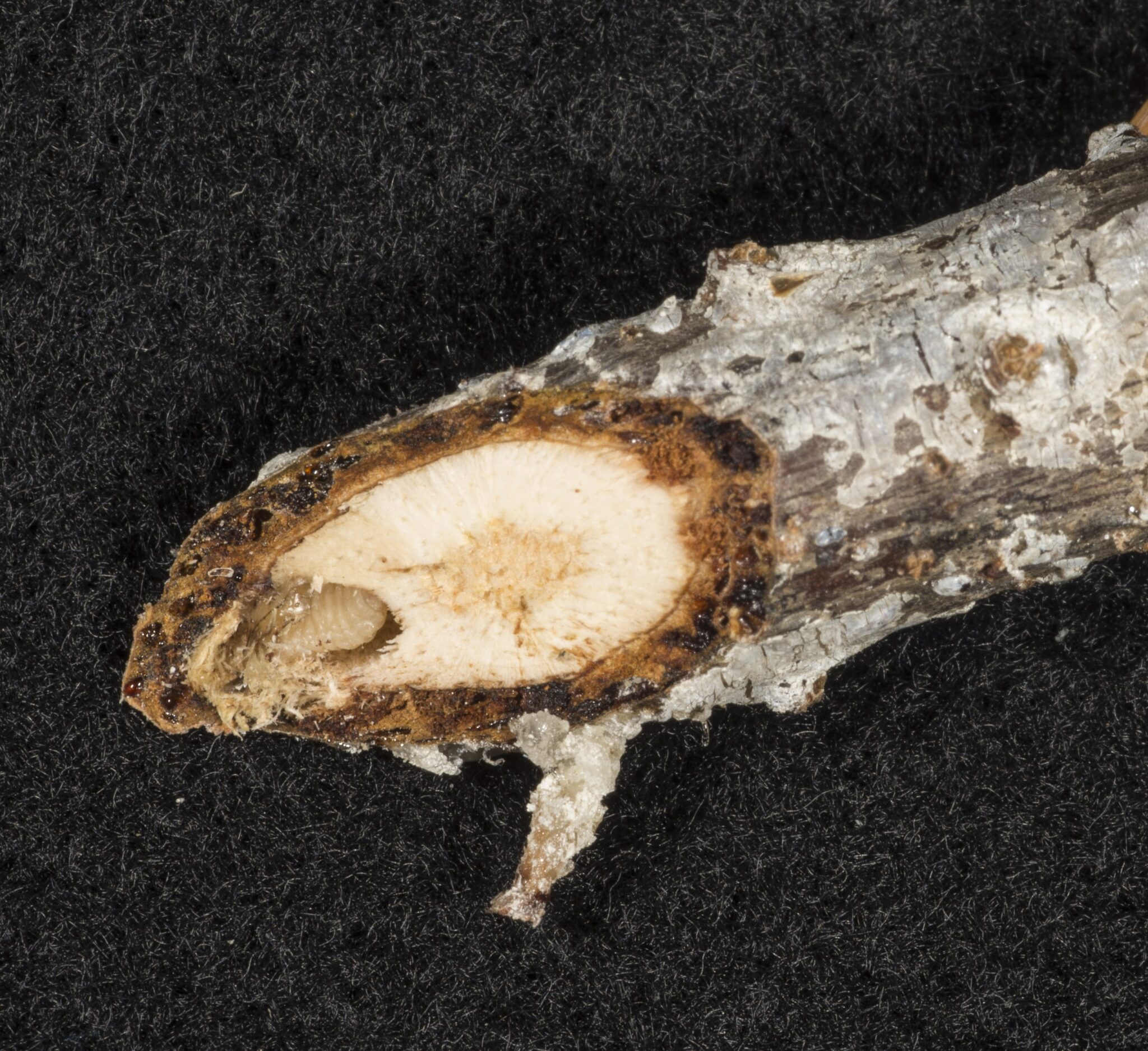
Fig. 3. Exposed White pine weevil larvae in a cut branch. Image by John Obermeyer
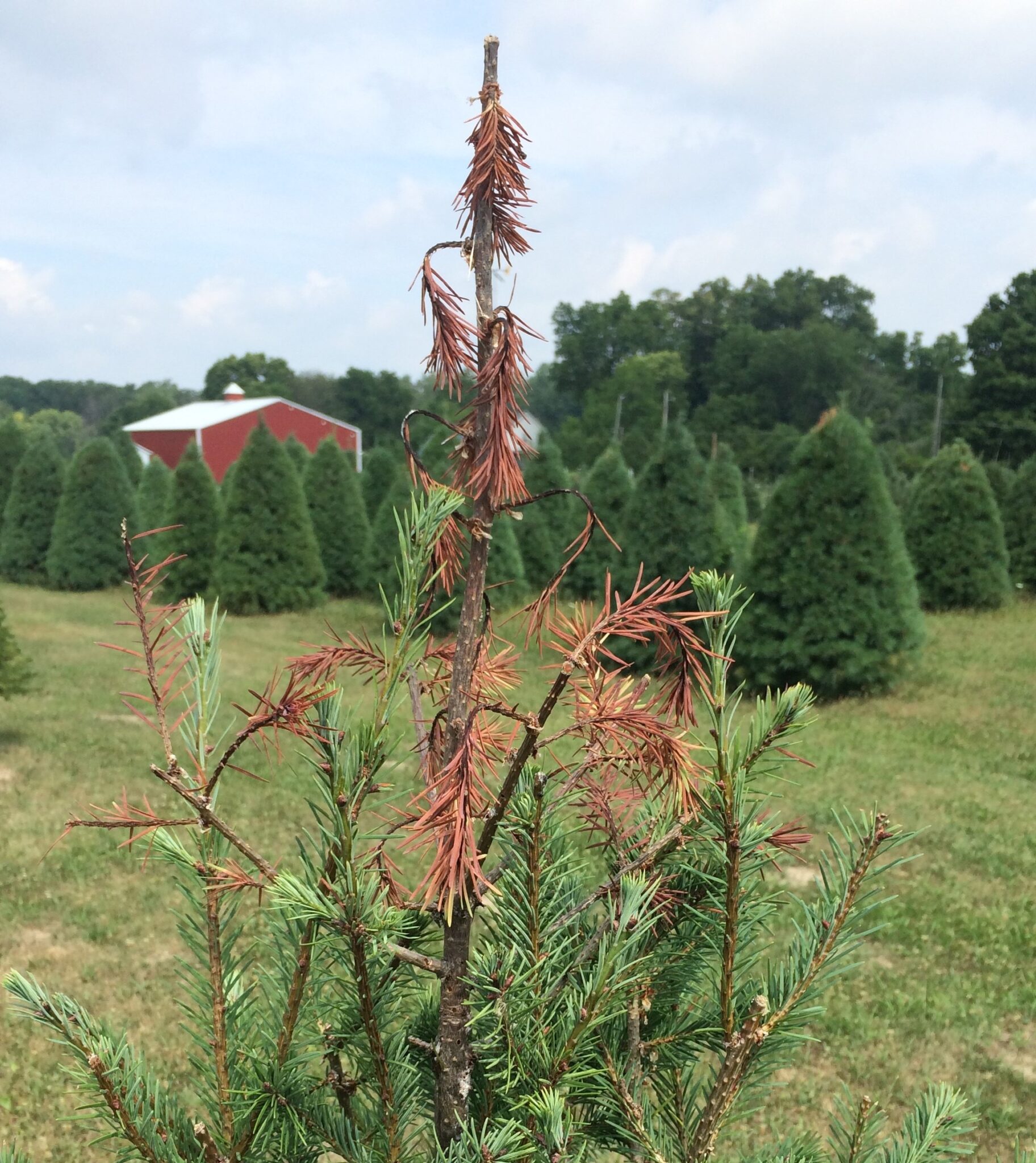
Fig. 4. White pine weevil damage. Note twig browning and curling. Image by Vince Burkle, IDNR.
Scales
Pine needle scales (Chionaspis pinifoliae and C. heterophyllae) are slender, white scales that look like small white flecks on needles (Fig. 5). In severe cases, infestations can cause needles to turn yellow and drop. Horticultural oils are best applied during the dormant season or when crawlers are active in the summer.
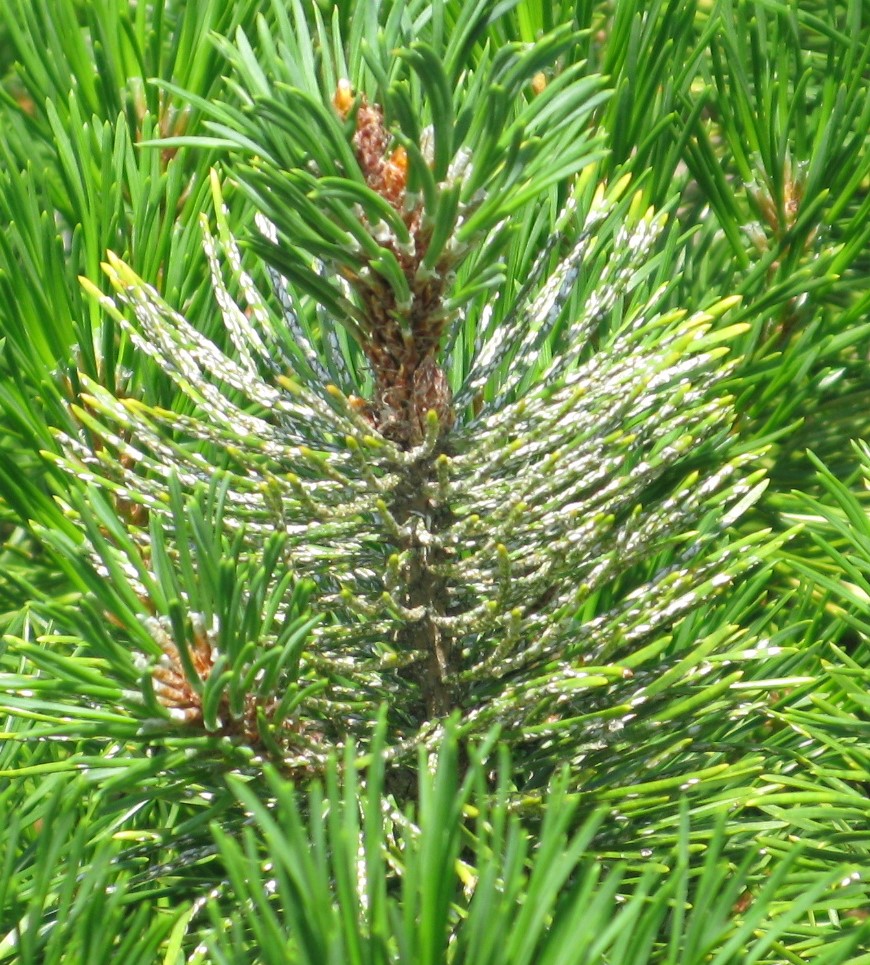
Fig. 5. Pine shoot infested with pine needle scale. Image by Cliff Sadof.
Cryptomeria scale (Aspidiotus cryptomeriae) is an invasive species that has become a problematic pest in recent years. It feeds on several conifers but especially favors firs and hemlocks. These scales have a distinctive “fried egg” appearance on the undersides of needles. Need a refresher on its biology and management? Check the previous article I wrote about this scale for a more thorough review.
Sawflies
Sawflies may superficially resemble caterpillars, but they are actually insects in the order Hymenoptera. Several species of sawfly attack pines and other conifers by feeding on needles and stripping branches. Repeated defoliation can eventually lead to tree death.
White pine sawfly (Neodiprion pinetum) adults lay eggs in the spring, and larval feeding occurs throughout the summer. Another generation occurs from late summer into fall, so you may see the second generation of white pine sawflies beginning to feed in the coming weeks. Now is a good time to scout for them, as insecticide applications are most effective when applied to small larvae soon after hatching. They feed on multiple pine species but especially prefer white pine. Monitor trees for pale yellow larvae with black heads and black spots extending toward the tail.
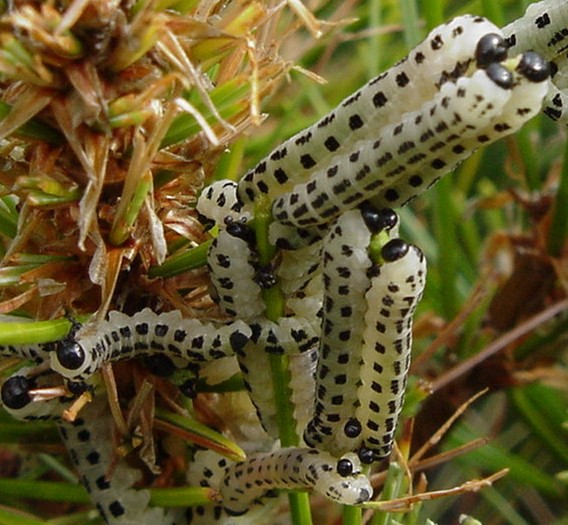
Fig. 6. White pine sawfly larvae. Image by Cliff Sadof.
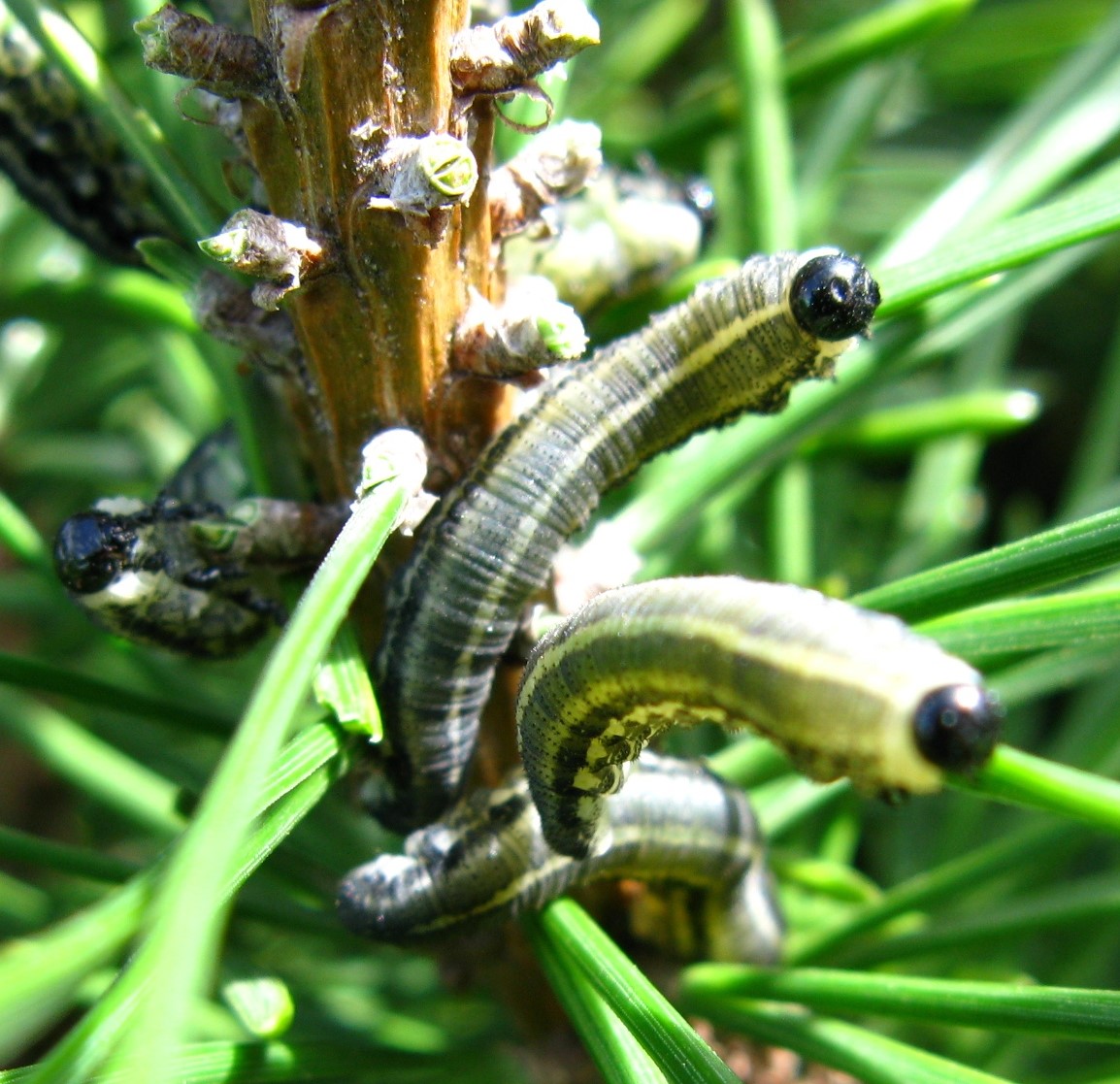
Fig. 7. European pine sawfly larvae. Image by Cliff Sadof.
European pine sawfly (Neodiprion sertifer) adults emerge in August and September to lay eggs. Females insert their eggs into the needles, where they appear as small yellow spots or bumps. The eggs overwinter in this stage and hatch the following spring. Monitor for larvae in the spring, as this is the best time to apply insecticides if management is needed. The larvae are greenish-gray with black heads and a stripe running down the center of their backs (Fig. 7).
Late summer and early fall are a good time to scout conifers for pests and identify potential problems before they become more serious. A little monitoring now can help keep those firs, pines, and spruces looking their best when Christmas tree season finally arrives.
Resources:
A Choose-and-Cut Pine and Fir Christmas Tree Case Study, The Education Store, Purdue Extension’s resource center
Living Christmas Trees For The Holidays and Beyond, IN Yard & Garden, Purdue Consumer Horticulture
Tips for First-Time Buyers of Real Christmas Trees, The Education Store, Purdue Extension’s resource center
Growing Christmas Trees, The Education Store
Selecting an Indiana-Grown Christmas Tree, The Education Store
Winterize Your Trees, The Education Store
Tree Installation: Process and Practices, The Education Store
What do Treed Do in the Winter?, Got Nature? Blog, Purdue Extension – Forestry and Natural Resources (FNR)
Forest/Timber Playlist, subscribe to Purdue Extension – FNR YouTube Channel
Ask the Expert: Holidays in the Wild, Purdue Extension – FNR YouTube Channel
ID That Tree: Balsam Fir, Purdue Extension – FNR YouTube Channel
ID That Tree: Scotch Pine, Purdue Extension – FNR YouTube Channel
Subscribe – Purdue Extension-FNR YouTube Channel
Alicia Kelley, Cooperative Agricultural Pest Survey (CAPS) State Survey Coordinator
Purdue Extension – Entomology
 Hoosier Ag Today – Your Farm Podcast: On the latest episode of the “Your Farm” podcast, C.J. Miller chats with Lenny Farlee from Purdue Forestry & Natural Resources, about the environmental and sustainability benefits of a having a real Christmas tree in your home this holiday season.
“It’s a great family experience and there is also some really significant environmental benefits to using live trees as your Christmas tree decorations.” — Lenny Farlee, Purdue FNR extension forester.
Looking for the perfect Christmas tree but feeling overwhelmed by all the options? Whether you’re debating between fir, pine, or cedar, this podcast has you covered! Join Lenny as he shares expert tips and the key questions every first-time buyer should ask to find the tree that fits your home and your holiday dreams.
Watch the YouTube video from the podcast episode 5 The Benefits of a Real Christmas Tree in Your Home!
The “Your Farm” Podcast is one of the many new podcasts available as Hoosier Ag Today presents YOUR Purdue Extension—a Podcast Network!
About Hoosier Ag Today
Hoosier Ag Today is Indiana’s leading agricultural news network, dedicated to providing timely, relevant and credible information for the state’s farming community. It delivers farm news, market updates, weather forecasts and analysis through the largest network of local radio stations in Indiana, as well as digital platforms like its website, podcasts, e-newsletter and mobile app. Founded in 2006, Hoosier Ag Today serves as a trusted source for farmers and agribusiness leaders to stay informed about state, national and international agricultural developments.
Resources:
A Choose-and-Cut Pine and Fir Christmas Tree Case Study, The Education Store, Purdue Extension’s resource center
Living Christmas Trees For The Holidays and Beyond, The Education Store
Tips for First-Time Buyers of Real Christmas Trees, The Education Store
Growing Christmas Trees, The Education Store
Selecting an Indiana-Grown Christmas Tree, The Education Store
Winterize Your Trees, The Education Store
Tree Installation: Process and Practices, The Education Store
What do Treed Do in the Winter?, Got Nature? Blog, Purdue Extension – Forestry and Natural Resources (FNR)
Forest/Timber Playlist, subscribe to Purdue Extension – Forestry and Natural Resources (FNR) YouTube Channel
Ask the Expert: Holidays in the Wild, Purdue Extension – FNR YouTube Channel
ID That Tree: Balsam Fir, Purdue Extension – FNR YouTube Channel
ID That Tree: Scotch Pine, Purdue Extension – FNR YouTube Channel
To identify other pine trees view ID That Tree, Purdue Extension – FNR YouTube Channel
Report Invasive, Purdue Extension
Purdue Plant Doctor, Purdue Extension
C.J. Miller, Assistant News Director
Hoosier Ag Today
Diana Evans, Extension & Web Communications Specialist
Purdue University Department of Forestry and Natural Resources
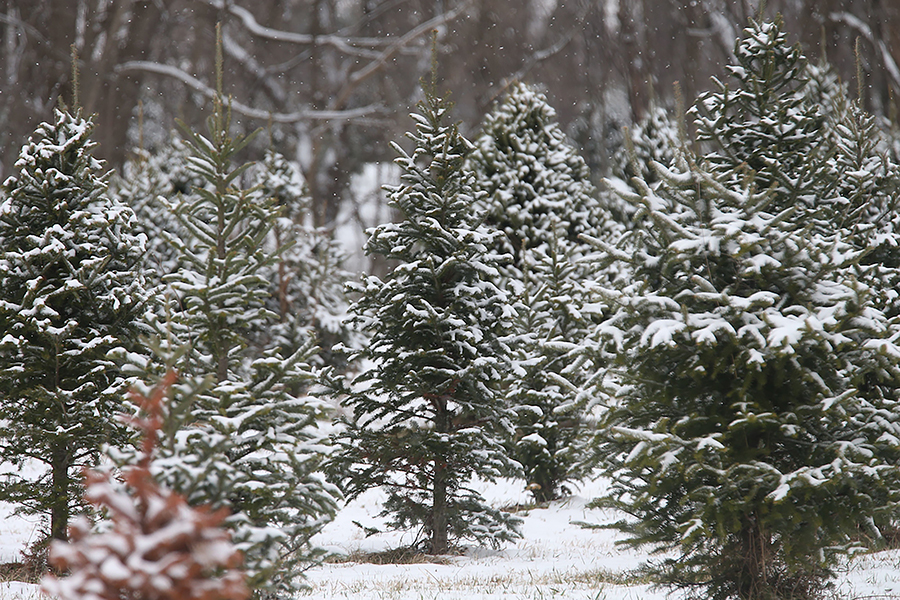 A real Christmas tree is an important part of a holiday celebration for many Hoosier households. Consumers have several choices for purchasing a real tree, including pre-cut trees at retail outlets or seasonal sales locations, choose-and-cut trees at Christmas tree farms, or even live trees that can be replanted after the holidays. Purdue Extension offers two publications that can help you select and care for your tree: Tips for First-Time Buyers of Christmas Trees provides advice and direction on how to set up and care for your tree to improve safety and enjoyment. Selecting an Indiana-Grown Christmas Tree provides details on the characteristics of different species of real Christmas trees available in Indiana, as well as care instructions for cut and live Christmas trees.
Pre-cut real Christmas trees are available at many retail outlets like garden centers, supermarkets, or seasonal sales locations. If you are looking for local choose-and-cut Christmas tree farms you can consult local media and advertising outlets or the Indiana Christmas Tree Growers Association. Some garden centers and Christmas tree farms may also offer live trees for sale.
If you are considering growing your own Christmas trees for personal use or sale, the Extension publications Growing Christmas Trees and A Choose-and-Cut Pine and Fir Christmas Tree Case Study outline economic and management considerations for growing Christmas trees.
Check out the Ask an Expert: Holidays in the Wild as the experts answer questions regarding Christmas trees along with wildlife you may see while you walk in the woods this winter. In this Ask an Expert video they share resources about picking a real Christmas tree and how to access real trees locally in Indiana as well as collecting decoration materials like cones, seed pods and nuts form the wild for crafting and decorating. They also discuss how you can provide habitat and supplemental food for wildlife using Christmas trees and wreaths before, during and after the holiday season.
Resources:
A Choose-and-Cut Pine and Fir Christmas Tree Case Study, The Education Store, Purdue Extension’s resource center
Living Christmas Trees For The Holidays and Beyond, IN Yard & Garden, Purdue Consumer Horticulture
Tips for First-Time Buyers of Real Christmas Trees, The Education Store
Growing Christmas Trees, The Education Store
Selecting an Indiana-Grown Christmas Tree, The Education Store
Winterize Your Trees, The Education Store
Tree Installation: Process and Practices, The Education Store
What do Treed Do in the Winter?, Got Nature? Blog, Purdue Extension – Forestry and Natural Resources (FNR)
Forest/Timber Playlist, subscribe to Purdue Extension – Forestry and Natural Resources (FNR) YouTube Channel
Ask the Expert: Holidays in the Wild, Purdue Extension – FNR YouTube Channel
ID That Tree: Balsam Fir, Purdue Extension – FNR YouTube Channel
ID That Tree: Scotch Pine, Purdue Extension – FNR YouTube Channel
To identify other pine trees view ID That Tree, Purdue Extension – FNR YouTube Channel
Lenny Farlee, Extension Forester
Hardwood Tree Improvement and Regeneration Center
Purdue Department of Forestry & Natural Resources
With the holidays over the needles are beginning to fall from your natural Christmas tree, continue to spread holiday cheer by returning your tree to nature.
Jarred Brooke, Extension wildlife specialist, shares a few creative ways you can repurpose and recycle your tree this year.
“Before you throw your used natural Christmas tree in the trash, think about recycling it on your property. Instead of taking up space in the landfill, your tree could decompose naturally while providing cover and food for fish, wildlife or insects,” said Brooke.
No matter how you choose to repurpose your tree, make sure it is free from ornaments and decorations. Do not recycle trees that have been sprayed with “fake” snow or treated with chemicals.
Create a habitat for fish
Throwing used Christmas trees in ponds is a great way to recycle the tree and provide a fish habitat to your pond. The small branches provide hiding spots for small fish to escape from larger predators.
If the pond is frozen with more than four inches of ice, you can drag your tree onto the ice. The tree will fall into place once the ice melts.
You should only add Christmas trees to your ponds or other private ponds with the permission of the pond owner. While they do provide great habitats for fish, they can be a nuisance for fishing as hooks and lines may get caught on branches. It is recommended that you keep trees away from popular fishing areas like docks.
Resources:
Selecting a Real Christmas Tree, Got Nature? Blog, Purdue Extension-Forestry and Natural Resources
A Choose-and-Cut Pine and Fir Christmas Tree Case Study, The Education Store, Purdue Extension’s resource center
Living Christmas Trees For The Holidays and Beyond, The Education Store
Growing Christmas Trees, The Education Store
Selecting an Indiana-Grown Christmas Tree, The Education Store
Forest/Timber Playlist, subscribe to Purdue Extension – Forestry and Natural Resources YouTube Channel
Aquatics & Fisheries, Playlist, Purdue Extension – Forestry and Natural Resources YouTube Channel
Ask an Expert: Pond Wildlife Management, Video, Purdue Extension – FNR YouTube Channel
Ask an Expert: Pond Management: What to Do in Winter, How to Plan for Spring, Video, Purdue Extension – FNR YouTube Channel
Aquatic Plant Management: Identifying and Managing Aquatic Vegetation, The Education Store
Pond and Wildlife Management, Purdue Extension-Forestry and Natural Resources
Jarred Brooke, Wildlife Extension Specialist
Purdue Forestry and Natural Resources
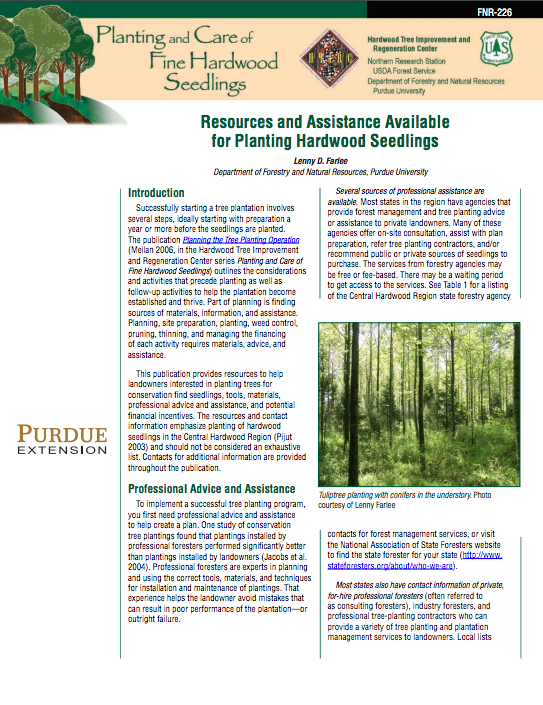 Successfully starting a tree plantation involves several steps, ideally starting with preparation a year or more before the seedlings are planted. This updated publication with current resources titled Resources and Assistance Available for Planting Hardwood Seedlings, landowners can find valuable information about planting trees for conservation, such as resources, contact information, tools, professional advice and assistance and financial incentives.
Resources:
Ordering Seedlings from the State Forest Nursery System, Got Nature?, Purdue Extension-FNR
Instructions for Ordering Tree Seedlings – Indiana DNR Division of Forestry
Importance of Hardwood Tree Planting – The Education Store, Purdue Extension Resource Center
Forest Improvement Handbook – The Education Store
Designing Hardwood Tree Plantings for Wildlife – The Education Store
Lenny D Farlee, Sustaining Hardwood Extension Specialist
Purdue University Department of Forestry and Natural Resources
It’s that time of year again. The desperate rush to find the ‘perfect’ tree for your annual year-end celebration is very real. Unfortunately, you chose a tree last year that died within a month and was disappointingly dull. This year, you are going to do your homework to find the best tree available.
Home preparations:
- Tree Location: Select an area out of direct sunlight and away from the heating vents in your house for the tree. Excessive sunlight and heat will cause your tree to fade and dry out more quickly.
- Ceiling height: Measure your ceiling heights and take into account the height of your tree stand and the tree topper or you’ll have to make excessive cuts in your tree to adjust for the differences. Write down these measurements.
- Tree shape: Visualize the shape of the tree that best fits the space you have available (tall and thin, short and broad) and keep that in mind. Certain tree types are more expensive therefore knowing your budget will help ensure you purchase the perfect tree for your household. Measure the width of the space and write down these measurements.
- Tree stand: Anticipate needing to support your tree stand and acquire a piece of plywood that you can bolt the stand to keep it level. Measure the inside diameter of the tree stand and write down the measurements.
Choosing a tree farm:
- Buy from a local farm if at all possible. These trees are bred to be hardy and to remain fresh longer.
Bring to the farm:
- List of required measurements for your perfect tree.
- A large unbreakable ornament to view branch spacing (ensures your ornaments will hang straight).
- Measuring tape to measure prospective trees before getting them home.
- Thick gloves for handling your tree as the needles may be sharp and the bark rough on your bare hands.
- An old blanket that can cover the truck bed or car roof to protect it from sap.
- Rope, twine, bungee cords, and twist ties to secure the tree to the car if these items are not provided by the tree farm.
Species selection:
- Each tree species is different so careful selection is important: Soft needle species (pines, firs) are best for homes with small children while hard needle species (spruce) are the adult choice.
- Firs often have shorter needles, strong stems, and well-spaced branches making it easier to hang lights and decorations.
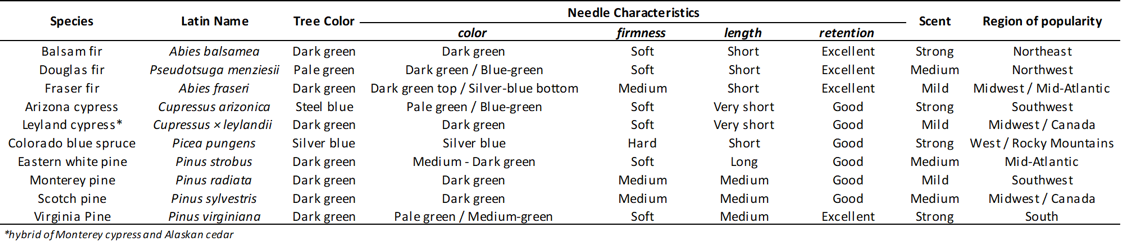 *click image to enlarge
At the tree farm:
- Check freshness: Bend a needle with your fingers (firs snap, pines ben).
- Gentle run your hand over the branch from inside to out or if possible, gently bounce the tree on the cut end. If a few interior needles come off, it is probably fresh; if many exterior needles fall off, choose a different tree.
- Remove and crush a few needles in your hand, if there is little scent choose another tree.
- The tree should have even coloration 360° around and needles should be fresh (shiny, green) and not old (dried out, brown).
When you and your tree get home:
- Protect Your Floor– Place a plastic or other waterproof covering on the floor where your tree will stand so you don’t ruin the carpet or get watermarks on hardwood flooring.
- Put down waterproof coverings or plastic sheeting under the tree skirt to prevent ruining the carpet or hardwood floor if water is spilled.
- Make a fresh cut at the base of the tree, take off ½” from the base so that tree can absorb more water (slows needle drop and helps maintain tree color) and immediately place the tree upright in the stand with lukewarm water.
- Trim any low-hanging branches that hit furniture or are too thin for ornaments parallel to the floor. Keep them in a bucket of water before using as decorations.
- Secure your tree to the wall or heavy furniture if you have pets and children that could knock it over or heavy ornaments that may sway the tree.
- Ensure that your tree stand always has water in it.
- Take a photo of your tree when set up and secured as a reminder for the following year.
After the holidays:
- Recycle your tree through your local waste management company.
- Trees can also be chipped for mulch. Never burn your tree because of the likelihood of starting a fire.
Examples of holiday tree types:
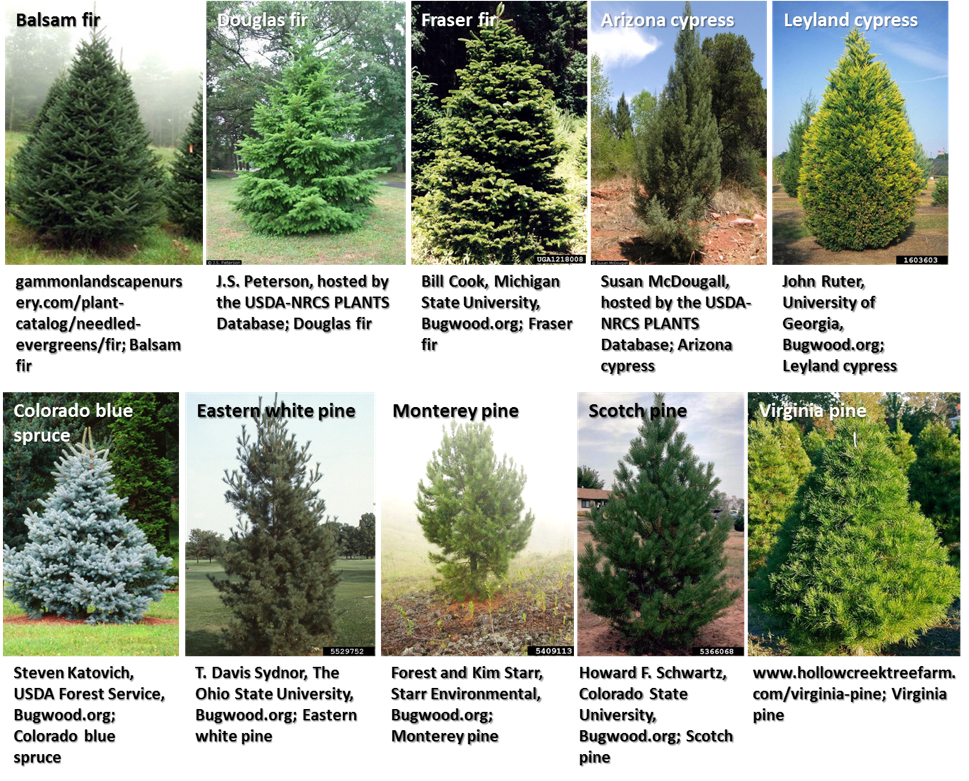 *click image to enlarge
Resources:
Which Real Indiana Christmas Tree Will You Select? – Got Nature?, Purdue FNR-Extension
Living Christmas Trees For The Holidays and Beyond, The Education Store
Tips for First-Time Buyers of Real Christmas Trees, The Education Store
Growing Christmas Trees, The Education Store
Shaneka Lawson, USDA Forest Service/HTIRC Research Plant Physiologist/Adjunct Assistant Professor
Purdue University Department of Forestry and Natural Resources
Your real tree, once cut, is like fresh fruit in regards to its useful life expectancy. Just like fruit, care needs to be exercised in the trees selection and subsequent care according to Daniel Cassens, Professor in the Department of Forestry and Natural Resources, Purdue University and member of the National Christmas Tree Association. Over half of the tree’s weight consists of water when first cut and it is important that the water content be maintained.
First, it is important to select a fresh tree. If you cut the tree at a choose-and-cut farm, it has to be fresh. If the tree is pre-cut, make sure the needles are flexible and firmly attached to the stem. Also, the tree should look “normal” and not crushed with broken branches and distorted or missing needles. Fresh looking trees indicate they have been well cared for.
Fresh cut trees should be kept out of the sun and wind to prevent accelerated dehydration. If the tree needs to be temporarily stored, place it in an unheated building or on the north side of a building where it will be less exposed. It will also help to place the tree in a bucket of water.
Just before setting up the tree, using an inexpensive bow or other saw trim about one-half inch from the base of the trunk. The cut should be perpendicular to the main stem. If the tree cannot be set up within 6 to 8 hours, make another cut. About 6 to 8 hours after the cut is made, the living cells begin to die and become blocked so the tree cannot take up water.
The tree should now be placed in a stand capable of supporting the tree mechanically. Make sure the stand has extended legs to prevent the tree from tipping. Do not whittle down the outside diameter of the tree base. The outer layers of wood are the most effective in taking up water. The stand should also be able to hold at least one quart of water for each inch of stem diameter. A typical 7 foot tree will require a stand with a water holding capacity of about two gallons. Check the water level each day and add cool water as needed. Make sure the butt end of the tree stem is always in water contact. Some stands do not allow the stem to reach the bottom of the water holding container. Trees tend to take large quantities of water each day for the first week or so and then slow down. Remember, if the tree runs out of water, the cells in the very butt or exposed end will become blocked and subsequent water uptake will be prevented.
Some tree lights can also produce excessive heat. Small lights or those that produce low heat will also help to reducing localized drying of the tree.
For more information about Christmas trees or to locate a choose-and-cut tree farm near you, please visit the National Christmas Tree Growers Association.
Resources:
A Choose-and-Cut Pine and Fir Christmas Tree Case Study, The Education Store, Purdue Extension’s resource center
Selecting an Indiana-Grown Christmas Tree, The Education Store
Tips for First-Time Buyers of Real Christmas Trees, The Education Store
Daniel Cassens, Professor Emeritus
Department of Forestry and Natural Resources
The debate over rather the use of a real tree or an artificial tree is better for the environment continues, especially as the Holiday season nears. Real tree growers point out that their product is renewable, each species has its own characteristic odor, consumes carbon dioxide and gives off oxygen, can be recycled, provides wildlife habitat and creates jobs in rural America. Artificial trees contain non biodegradable plastics and possible metal toxins such as lead. Most artificial trees are made in China and must be shipped long distances to the United States. On the other hand the artificial tree industry points out that their product can be reused and thus saves several real trees from being harvested. The industry goes on to claim that their trees do not need fertilizers or pesticides and do not create a mess or hassle. These are just examples of claims being made by two distinctly different industries. Considering the entire production cycle for real and artificial trees, it is difficult to determine which type of tree is best for the environment, based on scientific based data. Conducting a “Life Cycle Assessment” (LCA) for real and artificial trees would be one approach to answer this question.
Real Christmas trees, like all green plants, consume carbon dioxide and produce oxygen. The carbon dioxide is absorbed through the leaves or needles, combined with sunshine and water to make food and release oxygen. This process is called photosynthesis. The “carbon” is stored in the wood, needles, and leaves and constitutes about one-half of the dry weight. If the trees are burned or otherwise decomposed the “stored” or sequestered carbon is released back into the atmosphere. Other existing or planted trees absorb the carbon making trees carbon neutral. Some of the carbon is also stored in the soil. Growing trees also require some carbon dioxide back into the atmosphere.
Artificial trees use petroleum based products. Petroleum based products are ancient, stored sources of carbon dioxide and if burned as in the case of gasoline, release new carbon dioxide into the atmosphere. Transportation becomes a significant source of carbon release regardless of the tree being real or artificial.
Carbon dioxide is important because it traps heat from the earth’s surface. This is often referred to as the “greenhouse effect”. The amount of carbon dioxide in the atmosphere has been increasing since the late 1800’s and scientific data shows a particularly significant increase since the 1960’s. “Global warming” is the term being used to describe an increase in the world’s average surface temperature as a result of more heat being trapped.
“Cradle to Grave” or “Life Cycle Assessments” are used to summarize all of the positive and negative activities associated with developing a product and delivering it to the consumer. LCA’s become complicated, costly and the results are dependent on exactly which set or sets of circumstances are considered. Only one documented study on real and artificial trees is available. A Canadian Environmental consulting firm, Ellipsos has completed a LCA for both real and artificial trees. (Ellipsos/Strategists in Sustainable Development)
In this study, the carbon balance for an individual 7 foot high real Christmas tree was about +24 Kg (53 lbs) of CARBON DIOXIDE after all factors such as labor, use of machinery, transportation, and other inputs are considered. The tree was grown south of Montreal, Canada. It was assumed that the tree was grown in the nursery for four years and in the field for 11 years. In Indiana, two year old nursery stock and about 7 years in the field to produce a 7 foot tree are more typical and would probably result in less carbon being released. The “+” indicates that the overall process of growing a tree is carbon positive (i.e. carbon is released).
The carbon balance for a similar six foot artificial tree was about +48Kg (106 lbs) of CARBON DIOXIDE or twice that of the real tree. Most of the positive carbon release in this case is due to the manufacturing of the tree and transportation of the tree by boat from China to Vancouver and then by train to Montreal, Canada.
For comparison purposes, the average American car emits about 1.5 tons or 3000 pounds of carbon into the atmosphere on a yearly basis. (Green Car Congress)
The Ellipsos report assumed that the real tree would be burned for fuel at the end of the life cycle, thus releasing all of the stored carbon in the tree. If the real tree is recycled for mulch or fish habitat or other uses the carbon budget would be closer to zero at least until the tree finally decomposes. The study goes on to conclude that considering climate change impact along with environmental and public health impact, real trees appear to be a better choice for a responsible customer and that artificial trees must be displayed for more than 20 years in order for it to compare favorably with the real Christmas tree.
The assessment method used for the life cycle analysis groups problems into four damage oriented impacts areas on the environment. These are 1) climate change, 2) human health, 3) ecosystem quality, and 4) resource depletion. The results for the Ellipsos report are interesting. Considering climate change, the real tree has much less impact due to a smaller amount of carbon being released into the atmosphere as discussed above. The LCA also considers the products impact on human health, ecosystem quality and resource depletion. Considering human health, the artificial tree is a slightly better choice than the real tree. Considering ecosystem quality, the artificial tree is a better choice. This is likely due to the use of land for plantations and associated cultural practices (fertilizer, pesticide, irrigation) for real trees. In regards to both climate change (global warming) and resource depletion (use of non-renewable energy and mineral extraction), the real tree is a better choice than the artificial tree. The Ellipsos report titled “Comparative life Cycle Assessment (LCA) of Artificial vs Natural Christmas trees” can be viewed by Googling “Ellipsos report 1043-RF3-09.”
Both real and artificial trees have positive and negative attributes. Based on this study, the real tree has less effect on global warming than the artificial tree ie less carbon is released. The amount of carbon released by either the real or artificial tree is relatively small compared to that released by the average car over the course of the year. To reduce carbon production, consumers might be better advised to limit (plan ahead) the use of the car over the holiday season.
For more information about Christmas trees or to locate a choose-and-cut tree farm near you, please visit the National Christmas Tree Growers Association.
Other resources:
A Choose-and-Cut Pine and Fir Christmas Tree Case Study, The Education Store, Purdue Extension’s resource center
Selecting an Indiana-Grown Christmas Tree, The Education Store
Tips for First-Time Buyers of Real Christmas Trees, The Education Store
Daniel Cassens, Professor Emeritus
Department of Forestry and Natural Resources
 This question and answer were provided by Purdue Extension: In the Grow.
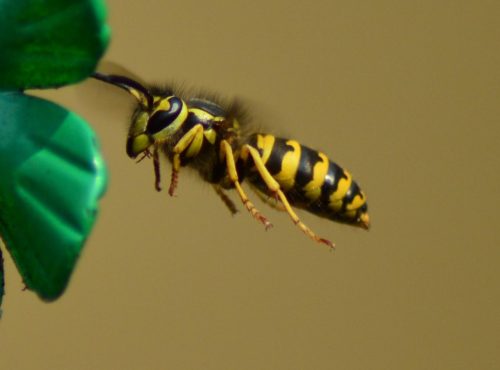
Question: I have small evergreen trees planted in my yard. They are the small, slow-growing type. They are around eight years old. Every fall, the yellow jackets start swarming around them, crawling in and out of the inside of the tree. They don’t seem to hurt it, but it looks like they are trying to find something, acting like a honey bee on a flower. But these have no flowers. They don’t bother us as long as we don’t get too close. Could you tell me why this is happening? – C.K., Shoals, Indiana
Answer: Our Purdue entomologists advise that yellow jackets commonly scavenge for food in the fall, and it is likely they are attracted to tree resin or sap that has some sugar content. Scavenging yellow jackets are less aggressive than those that are protecting a nest. And you are correct; they will not harm the trees and will generally not attack unless provoked. We commend you for aiming for a peaceful coexistence!
View the full post at Purdue Extension’s: In the Grow website.
Resources
Social Bees and Wasps, The Education Store
Indiana Beekeepers Swarm List, Indiana DNR
Department of Entomology, Purdue University
Purdue Extension: In the Grow

Recent Posts
- Deer and Turkey Archery Seasons Opening Soon, MyDNR
Posted: October 13, 2026 in Alert, Safety, Wildlife - Distinguishing Dogwoods
Posted: in Forestry, Urban Forestry, Wildlife, Woodlands - It’s Not Too Early To Start Planning For Spring Tree Planting
Posted: in Forestry, How To - Can I Plant Trees in the Fall?
Posted: October 12, 2026 in Forestry, How To, Land Use, Plants, Urban Forestry, Wildlife - Burning for Benefits: Why Fire Belongs in Indiana
Posted: in Forestry, Safety, Woodlands - Publication Helps Midwest Fish Producers “Catch a Following” with Consumers
Posted: in Aquaculture/Fish, Aquatic/Aquaculture Resources, Wildlife - Disease May Cause Wilting and Eventual Death of Certain Trees and Shrubs, Purdue Landscape Report
Posted: October 5, 2026 in Disease, Forestry, Plants - October Is Firewood Month: Protect Indiana’s Forests by Making Smart Choices
Posted: October 1, 2026 in Forestry, Forests and Street Trees, How To, Invasive Insects, Urban Forestry - Minecraft Meets the Hellbender
Posted: September 22, 2026 in Aquaculture/Fish, Aquatic/Aquaculture Resources, Wildlife - Is It Too Early to Think About Christmas Tree Pests?
Posted: in Christmas Trees, Invasive Insects, Safety
Archives
Categories
- Alert
- Aquaculture/Fish
- Aquatic/Aquaculture Resources
- Ask the Expert
- Christmas Trees
- Community Development
- Disease
- Drought
- Forestry
- Forests and Street Trees
- Gardening
- Got Nature for Kids
- Great Lakes
- How To
- Invasive Animal Species
- Invasive Insects
- Invasive Plant Species
- Land Use
- Natural Resource Planning
- Nature of Teaching
- Plants
- Podcasts
- Ponds
- Publication
- Safety
- Spiders
- Timber Marketing
- Urban Forestry
- Webinar
- Wildlife
- Wood Products/Manufacturing
- Woodland Management Moment
- Woodlands