 Purdue University - Extension - Forestry and Natural Resources
Got Nature? Blog
Welcome to “ID That Tree.” In this edition, Purdue Extension Forester Lenny Farlee introduces us to an autumn olive shrub found across Indiana. This dense shrub requires extensive control and management due to its effects on the habitat. Watch the video to learn about its aggressive growth, wildlife impact, leaf pattern, and other features!
If you have any questions regarding wildlife, trees, forest management, wood products, natural resource planning or other natural resource topics, feel free to contact us by using our Ask an Expert web page.
Resources:
ID That Tree – Video Playlist, Purdue Extension – Forestry and Natural Resources (FNR) YouTube Channel
Purdue Arboretum Explorer
Conservation Tree Planting: Steps to Success, Purdue Extension – FNR YouTube Channel
A Woodland Management Moment, Playlist, Purdue Extension – FNR YouTube Channel
Woodland Stewardship for Landowners, Playlist, Purdue Extension – FNR YouTube Channel
Indiana Department of Natural Resources: Invasive Species
Indiana Invasive Species Council
Cooperative Invasive Species Management Area (CISMA)
Report Invasive, Purdue Extension
Fifty Common Trees of Indiana, Purdue Extension – FNR
Episode 11 – Exploring the challenges of Invasive Species, Habitat University-Natural Resource University
Shrubs and Woody Vines of Indiana and the Midwest, The Education Store
Native Trees of the Midwest, The Education Store
Professional Forester, Indiana Forestry Woodland Owners Association
Forest Improvement Handbook, The Education Store
Find an Arborist, International Society of Arboriculture
Lenny Farlee, Extension Forester
Hardwood Tree Improvement and Regeneration Center
Purdue Department of Forestry & Natural Resources
In this episode of ID That Tree, Purdue Extension Forester Lenny Farlee explores the greenbriers—Indiana’s unique climbing vines. Though distantly related to lilies, these vines stand out with their distinctive oblong leaves, prominent veins, and alternate leaf arrangement. Watch the video to discover how to identify these fascinating vines and learn more about their characteristics!
If you have any questions regarding wildlife, trees, forest management, wood products, natural resource planning or other natural resource topics, feel free to contact us by using our Ask an Expert web page.
Resources:
ID That Tree: Firs and Spruces, Video Playlist, Purdue Extension – Forestry and Natural Resources (FNR) YouTube Channel
ID That Tree – Jack Pine, Scotch Pine, Red Pine, Virginia Pine, Eastern White Pine, Video Playlist, Purdue Extension – Forestry and Natural Resources (FNR) YouTube Channel
Beat Back Borers Attacking Pines and Other Cone Bearing Trees, Purdue Landscape Report
Tree Diseases: White Pine Decline in Indiana, The Education Store, Purdue Extension Resource Center
Purdue Arboretum Explorer
Conservation Tree Planting: Steps to Success, Purdue Extension – FNR YouTube Channel
A Woodland Management Moment, Playlist, Purdue Extension – FNR YouTube Channel
Woodland Stewardship for Landowners, Playlist, Purdue Extension – FNR YouTube Channel
Indiana Department of Natural Resources: Invasive Species
Indiana Invasive Species Council
Cooperative Invasive Species Management Area (CISMA)
Report Invasive, Purdue Extension
Episode 11 – Exploring the challenges of Invasive Species, Habitat University-Natural Resource University
Shrubs and Woody Vines of Indiana and the Midwest, Purdue University Press
Native Trees of the Midwest, Purdue University Press
Professional Forester, Indiana Forestry Woodland Owners Association
Forest Improvement Handbook, The Education Store
Find an Arborist, International Society of Arboriculture
Lenny Farlee, Extension Forester
Hardwood Tree Improvement and Regeneration Center
Purdue Department of Forestry & Natural Resources
Welcome to ID That Tree! In this video, Purdue forester Lenny Farlee examines one of Indiana’s most troublesome invasive shrubs: Amur honeysuckle. This aggressive species, along with other Asian honeysuckle varieties, is widespread across the state. It’s easily identified by its long, pointed leaves, smooth edges, and fine fuzz. Watch the video to learn more about its distinguishing features and the impact on Indiana’s ecosystems!
If you have any questions regarding wildlife, trees, forest management, wood products, natural resource planning or other natural resource topics, feel free to contact us by using our Ask an Expert web page.
Resources:
ID That Tree – Video Playlist, Purdue Extension – Forestry and Natural Resources (FNR) YouTube Channel
Purdue Arboretum Explorer
Conservation Tree Planting: Steps to Success, Purdue Extension – FNR YouTube Channel
A Woodland Management Moment, Playlist, Purdue Extension – FNR YouTube Channel
Woodland Stewardship for Landowners, Playlist, Purdue Extension – FNR YouTube Channel
Indiana Department of Natural Resources: Invasive Species
Indiana Invasive Species Council
Cooperative Invasive Species Management Area (CISMA)
Report Invasive, Purdue Extension
Fifty Common Trees of Indiana, Purdue Extension – FNR
Episode 11 – Exploring the challenges of Invasive Species, Habitat University-Natural Resource University
Shrubs and Woody Vines of Indiana and the Midwest, The Education Store
Native Trees of the Midwest, The Education Store
Professional Forester, Indiana Forestry Woodland Owners Association
Forest Improvement Handbook, The Education Store
Find an Arborist, International Society of Arboriculture
Lenny Farlee, Extension Forester
Hardwood Tree Improvement and Regeneration Center
Purdue Department of Forestry & Natural Resources
Welcome to this edition of “ID That Tree”. In this video Purdue Extension forester Lenny Farlee will introduce you to leatherwood, a charming Indiana shrub. Typically found in the understory of forest areas, this compact shrub is easy to identify by its oblong leaves with smooth margins and alternate leaf arrangement. Join us to learn more about leatherwood and its unique characteristics!
If you have any questions regarding wildlife, trees, forest management, wood products, natural resource planning or other natural resource topics, feel free to contact us by using our Ask an Expert web page.
Resources:
ID That Tree – Video Playlist, Purdue Extension – Forestry and Natural Resources (FNR) YouTube Channel
Purdue Arboretum Explorer
Conservation Tree Planting: Steps to Success, Purdue Extension – FNR YouTube Channel
A Woodland Management Moment, Playlist, Purdue Extension – FNR YouTube Channel
Woodland Stewardship for Landowners, Playlist, Purdue Extension – FNR YouTube Channel
Indiana Department of Natural Resources: Invasive Species
Indiana Invasive Species Council
Cooperative Invasive Species Management Area (CISMA)
Report Invasive, Purdue Extension
Fifty Common Trees of Indiana, Purdue Extension – FNR
Episode 11 – Exploring the challenges of Invasive Species, Habitat University-Natural Resource University
Shrubs and Woody Vines of Indiana and the Midwest, The Education Store
Native Trees of the Midwest, The Education Store
Professional Forester, Indiana Forestry Woodland Owners Association
Forest Improvement Handbook, The Education Store
Find an Arborist, International Society of Arboriculture
Lenny Farlee, Extension Forester
Hardwood Tree Improvement and Regeneration Center
Purdue Department of Forestry & Natural Resources
 Indiana Forestry & Woodland Owners Association (IFWOA) News: If you live in Indiana and own more than ten acres of woodlands, then you may want to enroll in the Classified Forest and Wildlands Program offered through the Indiana Department of Natural Resources (DNR), Division of Forestry. This program encourages timber production, watershed protection, and wildlife habitat management on private lands in Indiana. Program landowners receive a property tax reduction in return for following a professionally written management plan. In addition to the tax incentive, landowners receive free technical assistance from DNR foresters and wildlife biologists, priority for cost-share to offset the cost of doing management, and the ability to “green” certify their forests. The minimum requirement for program enrollment is 10 acres of forest, wetland, shrubland, and/or grassland.
“Once enrolled in our program, you get a reduced property tax assessment,” says Gretchen Herbaugh, District Forester with Indiana DNR serving southwestern Indiana.
“Property can be anything from forest ground to native grasses to pollinator habitats to wildlife food plots—we span a large range of habitat types and management styles,” Herbaugh says.
For full IFWOA article view: Indiana DNR Offers a Special Program for Woodland Owners.
To learn more about the program with more resources view the Hoosier Ag Today article, Indiana DNR Offering a Special Program for Woodland Owners.
Resources:
Subscribe, IFWOA YouTube Channel (includes The Nature of Oaks, Be Tick Aware, Population Ecology of Deer and more)
Find an Indiana Professional Forester, Indiana Forestry & Woodland Owners Association (IFWOA)
Purdue Arboretum Explorer
Native Trees of the Midwest, The Education Store
Shrubs and Woody Vines of Indiana and the Midwest, The Education Store
Investing in Indiana Woodlands, The Education Store
Forest Improvement Handbook, The Education Store
ID That Tree, Purdue Extension-Forestry & Natural Resources (FNR) YouTube playlist
Woodland Management Moment , Purdue Extension-FNR YouTube playlist
District Foresters for 10 plus acres, Indiana Department of Natural Resources
Financial and Tax Aspects of Tree Planting
Diana Evans, Extension and Web Communication Specialist
Purdue University Department of Forestry and Natural Resources
Liz Jackson, Engagement Lead
Indiana Forestry & Woodland Association (IFWOA)
In this edition of ID That Tree, Purdue Extension Forester Lenny Farlee showcases the unique features of prickly ash. The northeast member of the Citrus family (not the Ash family!) is a shrub with stout, paired thorns, reddish-brown buds and also has other traits shared in the video that makes it easy to spot out in the wild. This video contains nice close-up shots so you can identify this plant, which is native to Indiana and an important part of the habitat.
If you have any questions regarding wildlife, trees, forest management, wood products, natural resource planning or other natural resource topics, feel free to contact us by using our Ask an Expert web page.
Resources:
ID That Tree: Firs and Spruces, Video Playlist, Purdue Extension – Forestry and Natural Resources (FNR) YouTube Channel
ID That Tree – Jack Pine, Scotch Pine, Red Pine, Virginia Pine, Eastern White Pine, Video Playlist, Purdue Extension – Forestry and Natural Resources (FNR) YouTube Channel
Beat Back Borers Attacking Pines and Other Cone Bearing Trees, Purdue Landscape Report
Tree Diseases: White Pine Decline in Indiana, The Education Store, Purdue Extension Resource Center
Purdue Arboretum Explorer
Conservation Tree Planting: Steps to Success, Purdue Extension – FNR YouTube Channel
A Woodland Management Moment, Playlist, Purdue Extension – FNR YouTube Channel
Woodland Stewardship for Landowners, Playlist, Purdue Extension – FNR YouTube Channel
Indiana Department of Natural Resources: Invasive Species
Indiana Invasive Species Council
Cooperative Invasive Species Management Area (CISMA)
Report Invasive, Purdue Extension
Episode 11 – Exploring the challenges of Invasive Species, Habitat University-Natural Resource University
Shrubs and Woody Vines of Indiana and the Midwest, The Education Store
Native Trees of the Midwest, The Education Store
Professional Forester, Indiana Forestry Woodland Owners Association
Forest Improvement Handbook, The Education Store
Find an Arborist, International Society of Arboriculture
Lenny Farlee, Extension Forester
Hardwood Tree Improvement and Regeneration Center
Purdue Department of Forestry & Natural Resources
Join Purdue Extension forester Lenny Farlee and wildlife specialist Brian MacGowan as they help you prepare for the holidays while keeping your family and local wildlife safe. This video discusses everything from how to choose and care for a real Christmas tree as well as what to do with it after the season and also how to make wildlife/nature-friendly decorations.
Topics Include:
– What can I do with my tree after Christmas that would benefit wildlife?
– Are artificial structures legal in Indiana lakes?
– What types of items can I collect from the wild for holiday decorations?
– How do I do it in an environmentally responsible way?
– Are there some things I shouldn’t or can’t collect?
– What outdoor holiday decorations can benefit wildlife?
– How do I make it last longer?
– Can I avoid problems with non-target wildlife?
If you have any questions regarding trees, forest management, wildlife, wood products or other natural resource topics, feel free to contact us by using our Ask an Expert web page.
Resources
Selecting an Indiana-Grown Christmas Tree, The Education Store, Purdue Extension resource center
Tips for First-Time Buyers of Real Christmas Trees, The Education Store
Indiana Christmas Tree Growers Association
Purdue University Invasive Species resources
Indiana DNR Division of Fish and Wildlife for wildlife possession rules
Feed the birds with a DIY wreath, Audubon
Dan Cassens: Tips for First-Time Christmas Tree Buyers, Video, Purdue Agriculture
Dan Cassens: Starting Your Own Christmas Tree Farm, Video
Lenny Farlee, Sustaining Hardwood Extension Specialist
Purdue University Department of Forestry and Natural Resource
Brian MacGowan, Extension Wildlife Specialist
Department of Forestry & Natural Resources, Purdue University
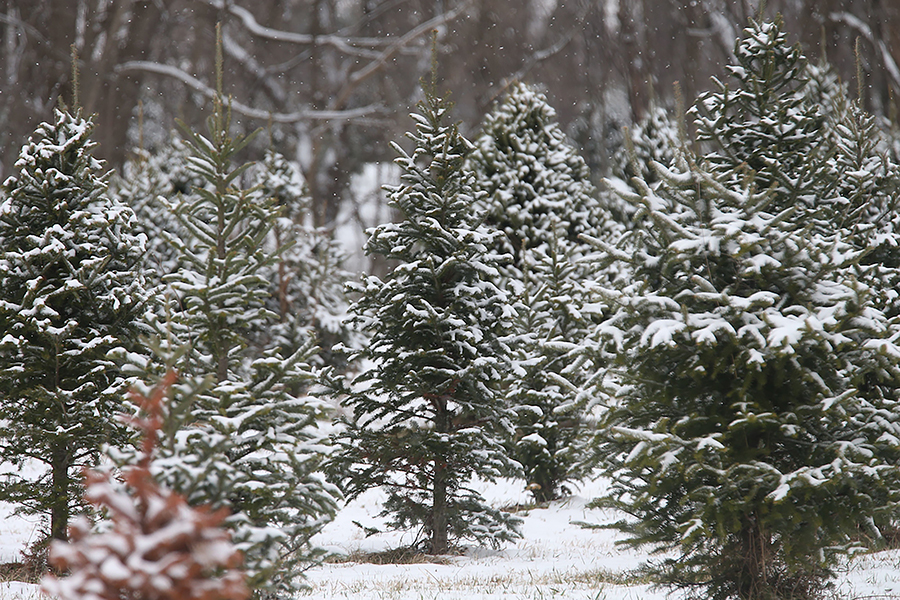 A real Christmas tree is an important part of a holiday celebration for many Hoosier households. Consumers have several choices for purchasing a real tree, including pre-cut trees at retail outlets or seasonal sales locations, choose-and-cut trees at Christmas tree farms, or even live trees that can be replanted after the holidays. Purdue Extension offers two publications that can help you select and care for your tree: Tips for First-Time Buyers of Christmas Trees provides advice and direction on how to set up and care for your tree to improve safety and enjoyment. Selecting an Indiana-Grown Christmas Tree provides details on the characteristics of different species of real Christmas trees available in Indiana, as well as care instructions for cut and live Christmas trees.
Pre-cut real Christmas trees are available at many retail outlets like garden centers, supermarkets, or seasonal sales locations. If you are looking for local choose-and-cut Christmas tree farms you can consult local media and advertising outlets or the Indiana Christmas Tree Growers Association. Some garden centers and Christmas tree farms may also offer live trees for sale.
If you are considering growing your own Christmas trees for personal use or sale, the Extension publications Growing Christmas Trees and A Choose-and-Cut Pine and Fir Christmas Tree Case Study outline economic and management considerations for growing Christmas trees.
Check out the Ask an Expert: Holidays in the Wild as the experts answer questions regarding Christmas trees along with wildlife you may see while you walk in the woods this winter. In this Ask an Expert video they share resources about picking a real Christmas tree and how to access real trees locally in Indiana as well as collecting decoration materials like cones, seed pods and nuts form the wild for crafting and decorating. They also discuss how you can provide habitat and supplemental food for wildlife using Christmas trees and wreaths before, during and after the holiday season.
Resources:
A Choose-and-Cut Pine and Fir Christmas Tree Case Study, The Education Store, Purdue Extension’s resource center
Living Christmas Trees For The Holidays and Beyond, IN Yard & Garden, Purdue Consumer Horticulture
Tips for First-Time Buyers of Real Christmas Trees, The Education Store
Growing Christmas Trees, The Education Store
Selecting an Indiana-Grown Christmas Tree, The Education Store
Winterize Your Trees, The Education Store
Tree Installation: Process and Practices, The Education Store
What do Treed Do in the Winter?, Got Nature? Blog, Purdue Extension – Forestry and Natural Resources (FNR)
Forest/Timber Playlist, subscribe to Purdue Extension – Forestry and Natural Resources (FNR) YouTube Channel
Ask the Expert: Holidays in the Wild, Purdue Extension – FNR YouTube Channel
ID That Tree: Balsam Fir, Purdue Extension – FNR YouTube Channel
ID That Tree: Scotch Pine, Purdue Extension – FNR YouTube Channel
To identify other pine trees view ID That Tree, Purdue Extension – FNR YouTube Channel
Lenny Farlee, Extension Forester
Hardwood Tree Improvement and Regeneration Center
Purdue Department of Forestry & Natural Resources
In this episode of A Woodland Management Moment, Purdue Extension forester Lenny Farlee discusses the benefits of maintaining certain areas of your forest land with alternative types of cover rather than traditional forest. It’s a good idea to keep some areas open not only for recreational purposes but also for future timber harvesting and to provide habitat for many wildlife. By allowing some of your land to be open, you help maintain the natural habitat around you and can even get some interesting plants that will grow on their own.
If you have any questions regarding trees, forests, wildlife, wood products or other natural resource topics, feel free to contact us by using our Ask an Expert web page.
Resources:
A Woodland Management Moment, Playlist, Purdue Extension – Forestry and Natural Resources (FNR) YouTube Channel
Learn How to Support Oak-Hickory Ecosystems, Purdue Extension – FNR Got Nature? Blog
The Nature of Oaks Webinar, Purdue Extension-FNR YouTube Channel, Shared from Indiana Forestry & Woodland Owners Association
Oak Leaf Tatters, Purdue Landscape Report
Inonotus Dryadeus, Butt and Root Rot of Oaks, Purdue Extension – FNR Got Nature? Blog
Predicting the Height Growth of Oak Species Reproduction Over a 23-year Period Following Clearcutting, Hardwood Tree Improvement & Regeneration Center (HTIRC)
Conservation Tree Planting: Steps to Success, Purdue Extension – FNR YouTube Channel
Shrubs and Woody Vines of Indiana and the Midwest, The Education Store, Purdue Extension Resource Center
Native Trees of the Midwest, The Education Store
ID That Tree, Playlist, Purdue Extension – FNR YouTube Channel
Investing in Indiana Woodlands, The Education Store
Woodland Stewardship for Landowners Video Series, Playlist, Indiana Department of Natural Resources YouTube Channel
Ask an Expert: Tree Selection and Planting, Purdue Extension – FNR YouTube Channel
Forest Improvement Handbook, The Education Store
Find an Indiana Professional Forester, Indiana Forestry & Woodland Owners Association (IFWOA)
Purdue Arboretum Explorer
Lenny Farlee, Extension Forester
Hardwood Tree Improvement and Regeneration Center
Purdue Department of Forestry & Natural Resources
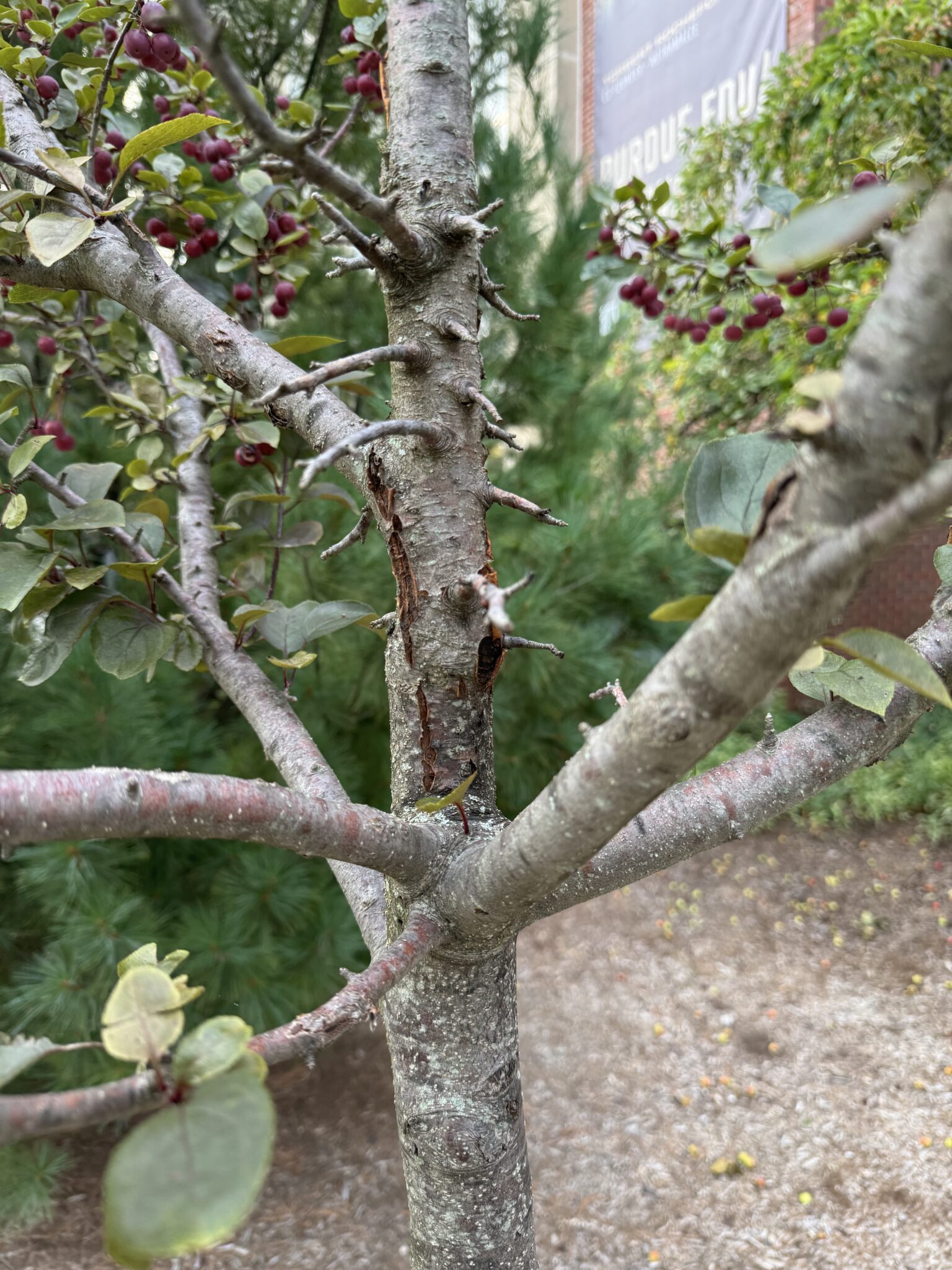
Figure 1: This crabapple tree was attacked first by fire blight and later by Botryosphaeria canker, killing the main trunk.
Purdue Landscape Report: Dieback and canker diseases caused by Botryosphaeria, Sphaeropsis, Diplodia and other closely related fungal pathogens are exceptionally common on woody landscape plants. This group of diseases are often referred to collectively as Botryosphaeria diseases and this article will follow that convention to discuss them as a group. Examine any mature oak tree long enough and you’re likely to find at least some stems dying due to Botryosphaeria. Check the base of dying stems of cranberry bush viburnum and you’re likely to find a Botryosphaeria canker. Look closely at sunken cracked stems and dieback on redbud and, you guessed it, more Botryosphaeria.
Botryosphaeria is opportunistic and is often seen killing individual branches that have been wounded or attacked by other diseases, providing an entry point for the fungus. (Fig 1) Stress factors like drought, freezing or defoliation due to disease or insect attack increases susceptibility to infection, and reduces plant defenses so that existing infections often move faster down the stem. However, wounds are not required for infection. In susceptible trees and shrubs, the fungus may attack the smallest twigs and later spread to larger branches where they cause cankers.
Symptoms:
Discoloration and death of leaves on individual stems may point to Botryosphaeria canker at the base of the dying stem (Fig 2). As the canker girdles a stem, the portion of the stem above the canker gradually dies. Smaller twigs with immature bark may become discolored as the pathogen spreads. Symptoms may vary depending on the plant species infected. In many cases the infection fails to completely encircle the stem, resulting in stems with half necrotic and half living stem tissue (Fig 3).
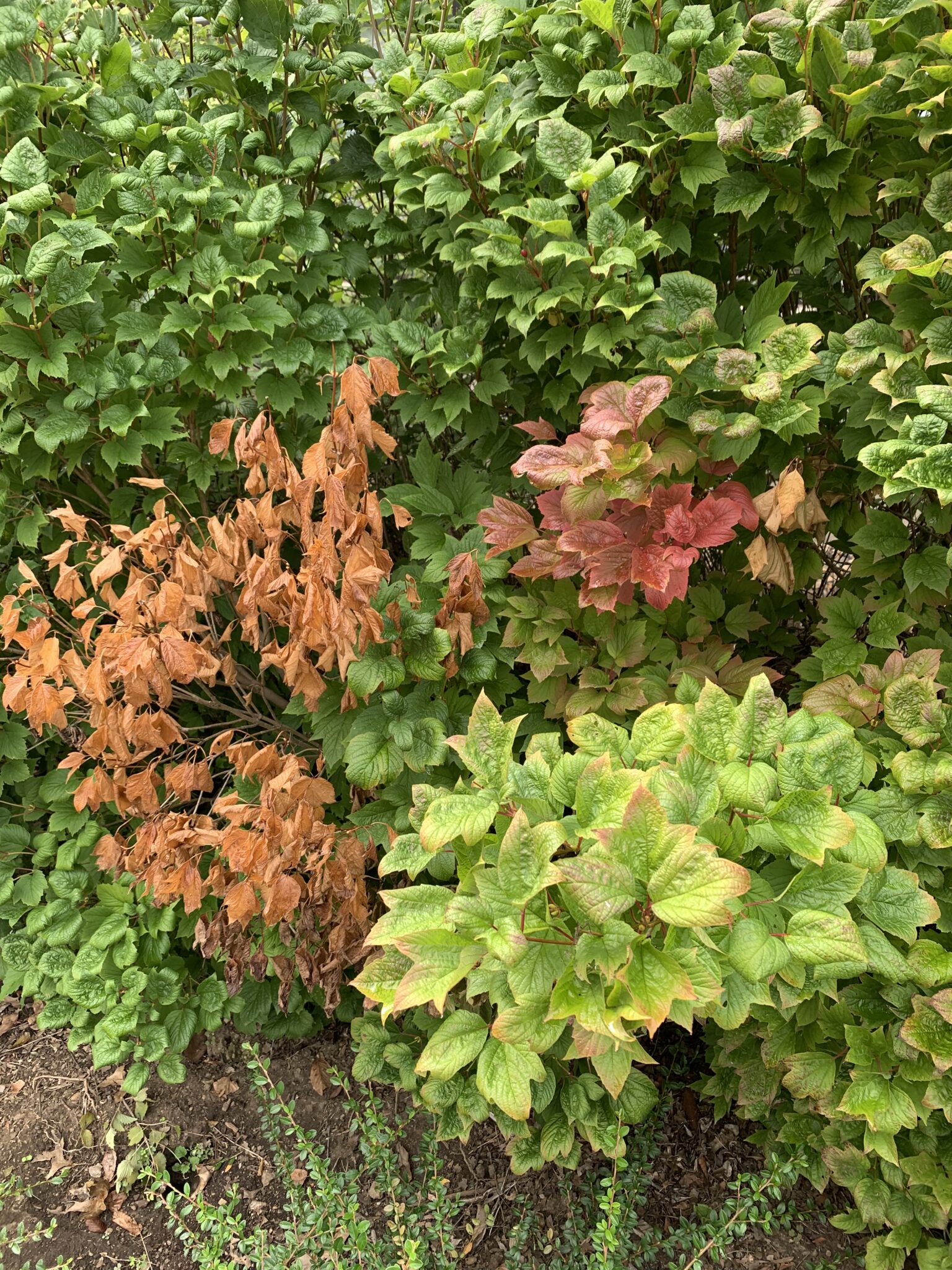
Figure 2: A viburnum hedge with dieback caused by Botryosphaeria. Leaf color may progress from yellow to red to brown as branches die.
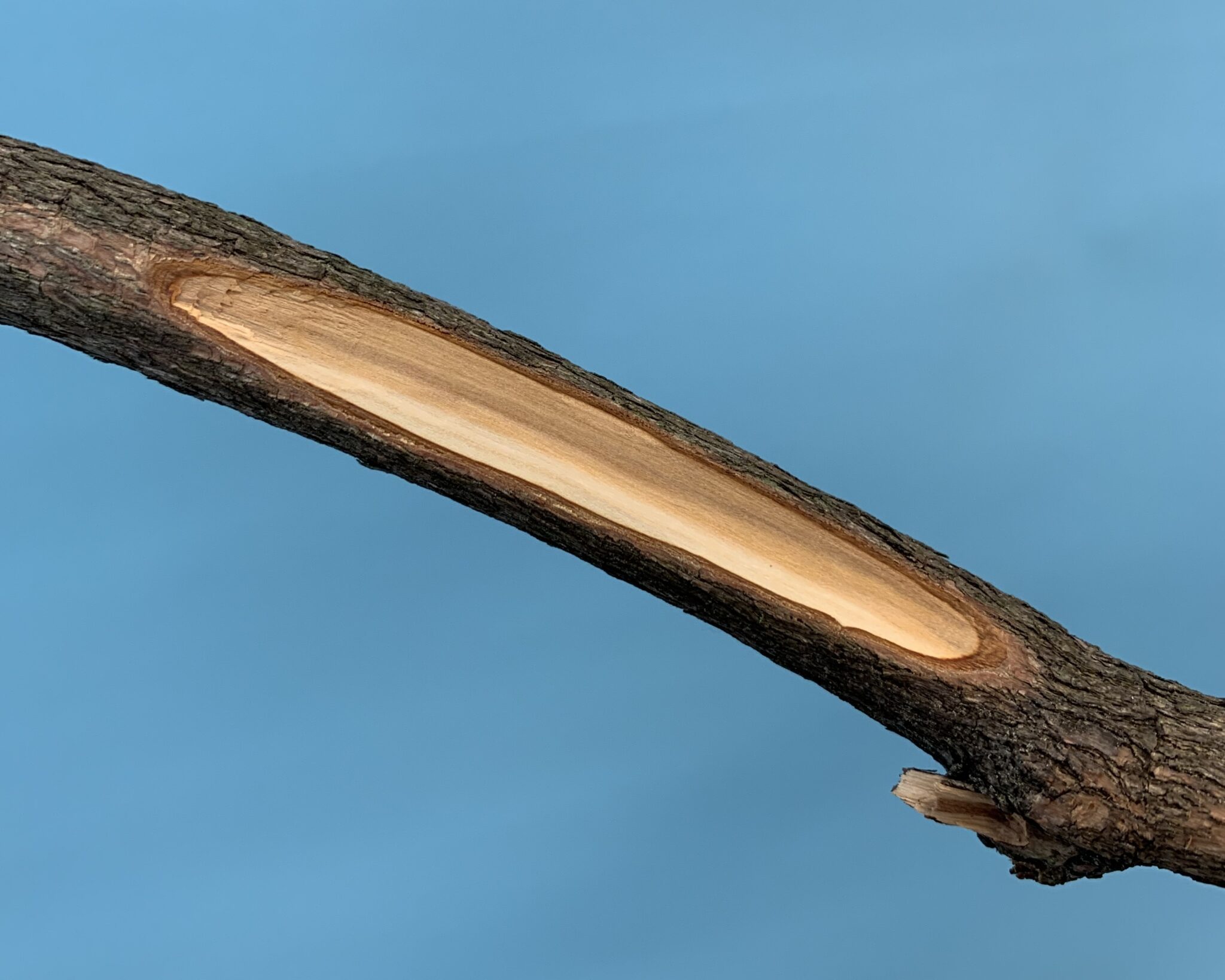
Figure 3: A rhododendron stem showing one-sided necrosis caused by Botryosphaeria infection. The tan to brown discoloration in the wood is typical of Botryosphaeria on many deciduous trees and shrubs.
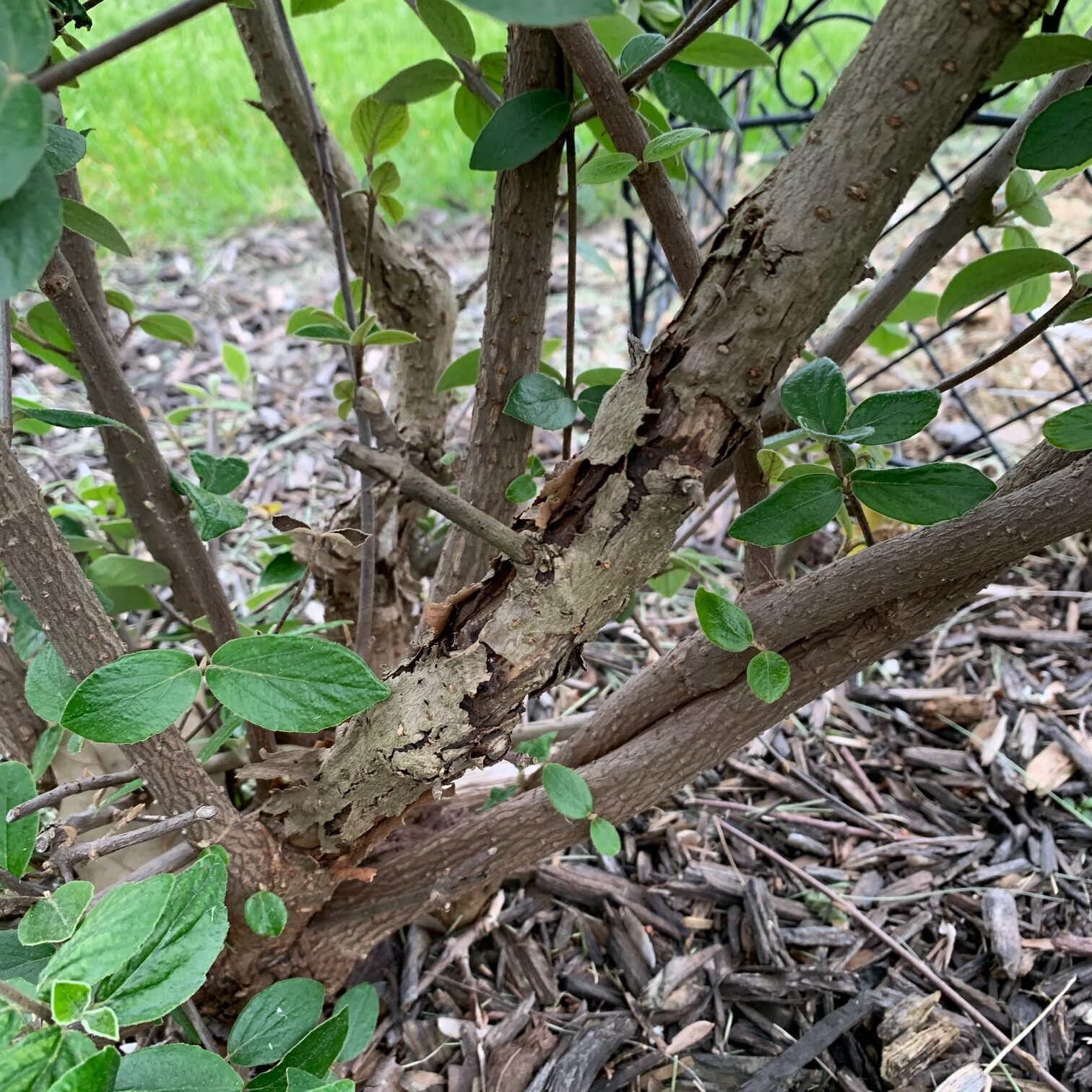
Figure 4: This Viburnum x burkwoodii stem has a large Botryosphaeria canker at the base, killing the branch above that point. After the branch was pruned out the remainder of the shrub survived.
Botryosphaeria cankers usually cause bark to be cracked, sunken and discolored (Fig 4). Fruiting bodies of the fungus appear as pinhead-sized black specks embedded in the bark, which may be raised in small bumps covering the cankers.
Management:
Prevention of infection depends mainly upon avoiding unnecessary wounding and minimizing environmental stresses that induce susceptibility. Avoid allowing trees and shrubs, especially those recently transplanted, to become drought stressed. Keep plants in good condition and in moderate growth. Avoid high fertilizer rates that induce rapid, succulent growth that may be more susceptible to infection.
Prune out and destroy any dead branches at least six inches below discoloration in the bark or sapwood. Be sure to clean pruning tools with a disinfectant after working on infected plants.
Fungicides have not been effective at preventing infections, and once the fungus is inside the wood fungicides can’t touch it, so they are generally not recommended in the landscape.
Avoid using highly susceptible plants, such as Viburnum trilobum or Salix spp., in drought prone sites.
Resources:
Botryosphaeria Canker, Purdue Plant Doctor
Beat Back Borers Attacking Pines, Purdue Landscape Report
Black Spot of Elm, Purdue Landscape Report
Inonotus Dryadeus – Butt and Root Rot of Oaks, Purdue Landscape Report
Stories in the Bark – Patterns and Growth, Purdue Extension – Forestry & Natural Resources Got Nature? Blog
Root Rot in Landscape Plants, The Education Store, Purdue Extension resource center
Dead Man’s Fingers, Purdue Landscape Report
ID That Tree Fall Color: Sugar Maple, Purdue Extension – Forestry and Natural Resources (FNR) YouTube Channel
ID That Tree Fall Color Edition: Black Gum, Purdue Extension – FNR YouTube Channel
An Introduction to Trees of Indiana, The Education Store
Tree Defect Identification, The Education Store
Tree Wound and Healing, Got Nature? Blog, Purdue Extension – FNR
Shrubs and Woody Vines of Indiana and the Midwest, The Education Store
Ask an Expert: Tree Selection and Planting, Purdue Extension – FNR YouTube playlist
ID That Tree, Purdue Extension – FNR YouTube playlist
Invasive Species, Playlist, Purdue Extension – FNR YouTube Channel
Report Invasive Species, Purdue Invasive Species
Find an Arborist, International Society of Arboriculture
Subscribe, Purdue Extension – FNR YouTube Channel
Tom Creswell, Plant & Pest Diagnostic Laboratory Director
Purdue Botany and Plant Pathology

Recent Posts
- Popular Landscape Shrub is Invasive
Posted: October 15, 2026 in Alert, Forestry, Forests and Street Trees, Invasive Plant Species, Plants, Woodlands - Purdue Extension’s Regional Teams Are Here: Connecting Communities with Expertise and Opportunity
Posted: October 14, 2026 in Community Development, Forestry, Forests and Street Trees, Gardening, How To, Timber Marketing, Urban Forestry, Wildlife, Woodlands - Why Do Our Trees Go From Green Leaves to Different Colors?
Posted: in Forestry, Forests and Street Trees, Urban Forestry, Woodlands - Deer and Turkey Archery Seasons Opening Soon, MyDNR
Posted: October 13, 2026 in Alert, Safety, Wildlife - Distinguishing Dogwoods
Posted: in Forestry, Urban Forestry, Wildlife, Woodlands - It’s Not Too Early To Start Planning For Spring Tree Planting
Posted: in Forestry, How To - Can I Plant Trees in the Fall?
Posted: October 12, 2026 in Forestry, How To, Land Use, Plants, Urban Forestry, Wildlife - Burning for Benefits: Why Fire Belongs in Indiana
Posted: in Forestry, Safety, Woodlands - Publication Helps Midwest Fish Producers “Catch a Following” with Consumers
Posted: in Aquaculture/Fish, Aquatic/Aquaculture Resources, Wildlife - Disease May Cause Wilting and Eventual Death of Certain Trees and Shrubs, Purdue Landscape Report
Posted: October 5, 2026 in Disease, Forestry, Plants
Archives
Categories
- Alert
- Aquaculture/Fish
- Aquatic/Aquaculture Resources
- Ask the Expert
- Christmas Trees
- Community Development
- Disease
- Drought
- Forestry
- Forests and Street Trees
- Gardening
- Got Nature for Kids
- Great Lakes
- How To
- Invasive Animal Species
- Invasive Insects
- Invasive Plant Species
- Land Use
- Natural Resource Planning
- Nature of Teaching
- Plants
- Podcasts
- Ponds
- Publication
- Safety
- Spiders
- Timber Marketing
- Urban Forestry
- Webinar
- Wildlife
- Wood Products/Manufacturing
- Woodland Management Moment
- Woodlands