 Purdue University - Extension - Forestry and Natural Resources
Got Nature? Blog
Purdue Landscape Report: In the last newsletter, an article on triclopyr brought up much discussion on the Roundup brands now containing multiple active ingredients other than glyphosate. Professionals in the industry may encounter a client with herbicide damage symptoms that mimic growth-regulator injury instead of typical glyphosate damage symptoms. While the client may have used Roundup, they didn’t necessarily use glyphosate. Going forward, it’s important to keep in mind that Roundup no longer means glyphosate in the consumer market.
Roundup has been one of the most used herbicides for many different weed control applications. Roundup, with the active ingredient glyphosate, was first registered with the EPA in 1974. When Roundup went off patent in 2000, glyphosate started being sold under many different names. According to the National Pesticide Information Center there are currently over 750 products containing glyphosate. Formulations may differ with salt carriers, adjuvants, concentrations, and mixed with other herbicides.
Recently, Bayer announced glyphosate would be phased out of consumer Roundup products. In its place, consumer Roundup products include other active ingredients. This can lead to confusion in the consumer market. It’s important to note that professional-use Roundup (turf and ornamental, agronomic crops, etc.) still contains glyphosate.
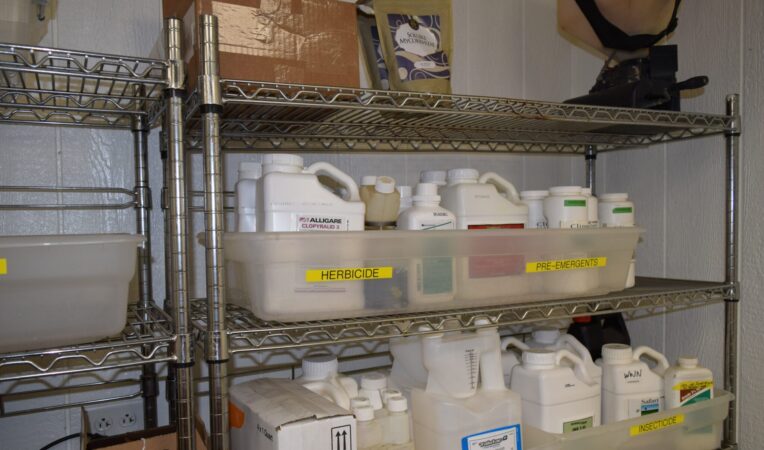
Figure 1. Consumer versions of Roundup are no longer glyphosate. Pay close attention to the active ingredients on labels to prevent unwanted plant injury.
Within the consumer Roundup product line, there are many different formulations designed for specific purposes, which include Roundup Weed and Grass Killer, Roundup for Lawns, Roundup for Lawns: Crabgrass Destroyer, Roundup Dual Action Weed and Grass Killer, Roundup Poison Ivy and Tough Brush Killer, among others. Each of these products contains distinct active ingredients that target different types of weeds.
Roundup Weed and Grass Killer: Glyphosate as the Active Ingredient
The original Roundup herbicide contains glyphosate as its primary active ingredient. Glyphosate is a systemic, non-selective herbicide, meaning it is absorbed by the plant and translocated throughout the vascular system, ultimately leading to the plant’s death. Glyphosate works by inhibiting the enzyme 5-enolpyruvylshikimate-3-phosphate synthase (EPSPS), which is a key component of the shikimic acid pathway—a pathway critical for the synthesis of aromatic amino acids in plants.
Active Ingredient:
- Glyphosate: The ‘traditional’ version of Roundup that controls many different weeds. Can take 10-14 days to kill weeds.
- Pelargonic Acid: A contact herbicide that quickly breaks down cell walls. This is added to provide a quick burndown of the weed.
Roundup Dual Action Weed and Grass Killer Plus 4 Month Preventer: Multiple modes of action
Round Dual Action is a formulation that includes four very different herbicides that is intended for use in areas with limited vegetation (i.e. sidewalks, driveways, mulched beds). In addition to postemergence herbicides, this product includes two preemergence active ingredients.
Active Ingredients:
- Triclopyr: Systemic herbicide that mimics auxins. Very effective herbicide for woody plants, which is used frequently in invasive species treatments.
- Fluazifop: Grass-specific herbicide (graminicide) that controls several annual and perennial grasses.
- Diquat: Contact herbicide that exhibit symptoms rapidly. Good for annual weeds.
- Imazapic: Pre- and Postemergence control of several grasses and broadleaf weeds.
Roundup for Lawns: A Combination of Selective Herbicides
Roundup for Lawns is a specialized formulation designed for residential use, particularly for controlling broadleaf weeds in lawns. Unlike traditional Roundup, which contains glyphosate, Roundup for Lawns contains a combination of selective herbicides, including MCPA, quinclorac, dicamba, and sulfentrazone. These ingredients are chosen for their ability to target broadleaf weeds and grassy weeds without harming most turfgrass species. This product is similar to the traditional ‘three-way’ herbicides that are commonly used in turf.
Active Ingredients:
- MCPA: MCPA is a selective herbicide that mimics the action of natural plant hormones known as auxins. When absorbed by broadleaf weeds, it causes uncontrolled growth, leading to the plant’s death.
- Quinclorac: Quinclorac is effective against grassy weeds, primarily used for crabgrass control in turf. It can be similar to auxin herbicides, causing epinasty, curling, and a change of color.
- Dicamba: Similar to MCPA, dicamba disrupts the growth of broadleaf weeds by mimicking natural plant hormones.
- Sulfentrazone: Pre- and postemergence activity in turf. Very effective on nutsedge.
Roundup for Lawns: Crabgrass Destroyer
Roundup for Lawns: Crabgrass Destroyer is a product designed to control grassy weeds and several broadleaf weeds in cool-season turf. In addition to crabgrass, other grassy weeds and some broadleaves can be controlled.
Active Ingredients:
- Topramezone: Very effective herbicide for several annual and perennial grassy weeds and some common broadleaf weeds.
Roundup Poison Ivy and Tough Brush Killer: Triclopyr for Tough Woody Plants
Roundup Brush Killer is formulated to tackle tough, woody plants, such as brush, brambles, and small trees. The active ingredient in this product is triclopyr, a selective herbicide that targets broadleaf plants with less damage to grasses. This product can be effective on invasive woody plants.

Figure 2. Glyphosate damage to sycamore.
Active Ingredients:
- Triclopyr: Systemic herbicide that mimics auxins. Very effective herbicide for woody plants, which is used frequently in invasive species treatments.
- Glyphosate: The ‘traditional’ version of Roundup that controls many different weeds. Can take 10-14 days to kill weeds.
Conclusion
All of the consumer Roundup products contain unique active ingredients tailored to specific weed control needs. There can be understandable confusion around these products due to the historical uses of glyphosate. The Green Industry needs to be aware of the confusion around these products to better inform their clients. Understanding the active ingredients and mechanisms of action of these herbicides is crucial for their effective and safe use in various settings.
View the original article here: When Roundup Isn’t Roundup: Clearing up the confusion between products
Subscribe and receive the newsletter: Purdue Landscape Report Newsletter.
Resources:
Beyond Roundup: Alternatives to consider adding to your weed management plan, Purdue Landscape Report
Diagnosing Herbicide Injury on Garden and Landscape Plants, The Education Store, Purdue Extension’s resource center
Herbicide Injury, Purdue Plant Doctor
Find an Arborist video, Trees are Good-International Society of Arboriculture (ISA)
ID That Tree, Playlist, Purdue Extension – FNR YouTube Channel
Invasive Species Playlist, Playlist, Purdue Extension – FNR YouTube Channel
A Woodland Management Moment, Playlist, Purdue Extension – FNR YouTube Channel (Against Invasives, Garlic Mustard, Autumn Olive)
Woodland Stewardship for Landowners, Playlist, Purdue Extension – FNR YouTube Channel (Common Buckthorn, Japanese Barberry)
Report Invasive Species, Purdue Invasive Species
The GLEDN Phone App – Great Lakes Early Detection Network
EDDMaps – Early Detection and Distribution Mapping System
Episode 11 – Exploring the challenges of Invasive Species, Habitat University-Natural Resource University
What Are Invasive Species and Why Should I Care?, Purdue Extension-FNR Got Nature? Blog
Emerald Ash Borer Information Network, Purdue University and Partners
Aquatic Invasive Species, Illinois-Indiana Sea Grant (IISG)
Invasive plants: impact on environment and people, The Education Store
Subscribe Purdue Extension-Forestry and Natural Resources YouTube Channel
Kyle Daniel, Commercial Landscape and Nursery Crops Extension Specialist
Purdue Horticulture & Landscape Architecture
 Agricultural & Natural Resources (ANR) Newsletter: This fall marks the conclusion of the fourth consecutive year of the American Citizen Planner – Indiana program. Launched during the pandemic in 2020, the program has successfully been offered statewide twice a year and has trained more than 250 community leaders. Participants come from diverse backgrounds, such as elected officials, professional planners, members of plan commissions, boards of zoning appeals, surveyors, engineers, and engaged citizens interested in local planning issues.
Tailored for Indiana’s planning statutes by the Purdue Land Use Team, the program has evolved to include new modules on Environmental Planning and Community Engagement, Enhancing Equity in Planning, and features invited guest speakers, alongside 28 online content modules. The core curriculum covers a wide range of topics essential for planning including ethics, decision making, a wide range of comprehensive planning and zoning topics, and engaging the public in the planning process. Registration for the 16-week virtual program opens each February and July, with Purdue Extension educators meeting with participants online four times throughout the course to facilitate discussions and interactive scenarios.
Feedback from participants underscores the program’s positive impact on their communities. A recent long-term follow-up survey revealed that many have utilized their newfound knowledge to update codes and ordinances, incorporate natural resource planning, and about 75% indicated they would share insights with their peers. One participant noted, “As a member of the town council in a community of about 230, this course has greatly enhanced my understanding of the planning process in our county. I feel much better equipped to evaluate zoning requests and look forward to leveraging planning to further develop our community!” Those who complete all course requirements are eligible to take the comprehensive exam and earn a course certificate.
The American Citizen Planner – Indiana program is available in your community. Follow Extension’s social media for registration updates and reach out to your local ANR educator to request an in-person workshop.
Resources:
Implementation Examples of Smart Growth Strategies in Indiana, The Education Store, Purdue Extension’s resource center
Conservation Through Community Leadership, The Education Store
Climate Change and Sustainable Development, The Education Store
Climate Change: Are you preparing for it?, The Education Store
Enhancing the Value of Public Spaces: Creating Healthy Communities, The Education Store
One Water Approach to Water Resources Management, The Education Store
Community Soundscape Planning Guide: Controlling Noise & Protecting Natural & Cultural Sonic Spaces, The Education Store
Agricultural Best Management Practices, The Education Store
Urban Best Management & Low Impact Development Practices, The Education Store
Rainscaping Education Program, Purdue Extension
Community Development, Purdue Extension
Community Planning Playlist, Purdue Extension-Forestry & Natural Resources (FNR) YouTube Channel
Rainscaping and Rain Gardens, Purdue Extension YouTube Channel
Conservation through Community Leadership, Purdue Extension You Tube Channel
Enhancing the Value of Public Spaces Program, Purdue Extension YouTube Channel
Indiana Creek Watershed Project – Keys to Success, Partnerships and People, Purdue Extension You Tube Channel
Subscribe to Purdue Extension – Forestry and Natural Resources YouTube Channel
Dan Walker, Community Development regional Educator
Purdue Forestry and Natural Resources/Illinois-Indiana Sea Grant/Purdue Extension
Kara Salazar, Assistant Program Leader for Community Development and Sustainable Communities Extension Specialist
Purdue Forestry and Natural Resources/Illinois-Indiana Sea Grant/Purdue Extension
Wild Bulletin, IN DNR, Division of Fish & Wildlife: Epizootic hemorrhagic disease (EHD) is a naturally occurring viral disease commonly seen in the Indiana deer herd. Each year, typically in late summer, Indiana DNR receives reports of deer displaying signs of EHD throughout the state.
This year, DNR confirmed a significant EHD outbreak that began in the northern region of the Hoosier State. In some years, EHD can affect a larger-than-normal portion of the deer and becomes widespread across a county. In those instances, DNR lowers the County Bonus Antlerless Quotas (CBAQs) in the impacted counties to offset the effect of the counties’ EHD outbreak on the deer herd in that region.
EHD is transmitted by biting midges, also known as sand gnats or “no-see-ums.” Deer infected with EHD may display unusual behaviors such as lethargy, excessive salivation, or disorientation. EHD also causes fever in deer, which can cause deer to seek water. As a result, many deer that die from EHD are found in or near open water sources like ponds and rivers. Anyone who finds a deer showing signs of EHD or dead in water is asked to report it at on.IN.gov/sickwildlife.
County bonus antlerless quotas reduced in three counties for 2024-25
 Due to the number of reported deer mortalities and extent of EHD in the region, DNR has lowered the County Bonus Antlerless Quotas (CBAQs) in Wabash, Porter, and Allen counties from two bonus antlerless deer to one to help offset the effects of EHD on the deer herd in that region. During the winter, DNR biologists will fully evaluate the effects of EHD and will propose changes to bag limits as required. Hunters can stay informed about CBAQ changes at on.IN.gov/EHD-quotas.
To find out more view the Indiana Department of Natural Resources EHD Antlerless Bonus Quota Reductions.
Resources:
Be on the Watch for Epizootic Hemorrhagic Disease (EHD) in Deer, Got Nature? Blog, Purdue Extension – FNR
Report a Sick or Dead Deer, Indiana Department of Natural Resources (IN-DNR)
EHD Virus in Deer: How to Detect and Report video, Quality Deer Management Association
Epizootic Hemorrhagic Disease (pdf), Cornell University
How to Score Your White-Tailed Deer video, Purdue Extension – FNR YouTube Playlist
Deer Harvest Data Collection, Purdue FNR Got Nature? blog
Woodland Stewardship for Landowners: Managing Deer Damage to Young Trees, Purdue Extension-FNR YouTube Channel
Introduction to White-tailed Deer Impacts on Indiana Woodlands, Deer Impact Toolbox, Got Nature? Blog & The Education Store
Purdue Extension Pond and Wildlife Management
Managing White-tailed Deer Impacts on Indiana Woodlands, The Education Store
How to Build a Plastic Mesh Deer Exclusion Fence, The Education Store
Managing Your Woods for White-Tailed Deer, The Education Store
Deer Harvest Data Collection, Got Nature? Blog, Purdue Extension – FNR
Handling Harvested Deer Ask an Expert? video, Purdue Extension – FNR YouTube Channel
Subscribe to Purdue Extension-Forestry & Natural Resources YouTube Channel, Wildlife Playlist
A Woodland Management Moment – Deer Fencing, Purdue Extension – FNR YouTube Video
Division of Fish and Wildlife, Indiana Department of Natural Resources
Purdue Landscape Report: We have received a few elm tree samples this year with a disease we do not often see, but which is relatively common: black spot of elm. This disease, also called elm anthracnose, is caused by the fungus Stegophora ulmea and can affect most species of elm with American elm varieties being more susceptible.

Figure 1. Elm foliage with chlorotic spotting and black fungal structures caused by Stegophora ulmea.
The fungus becomes active in the spring at temperatures of 45 deg F or above. It can release spores that will infect newly unfolding leaves leading to chlorotic leaf spots or blotches on the upper leaf surface. Black fungal fruiting bodies will develop within the affected tissue, making it seem like the leaves have been dotted with tar. These fungal structures are raised and will give the leaf a bumpy texture. As more spots develop and coalesce, they will create white areas of dead tissue that can eventually turn brown.
The black fungal stromata can produce asexual spores (conidia) which can cause new infections during the growing season. Conidia are produced in a mucilage which becomes loose in humid conditions and can be spread by water splash (rain or irrigation). While leaf infections are the most commonly observed symptom, Stegophora can also infect leaf petioles and twigs. Premature leaf drop due to severe leaf spotting can occur, but significant defoliation may also develop when petioles are infected. Stem infections can lead to shoot blighting and small limb dieback.

Figure 2. Elm foliage with large black fruiting bodies of Stegophora ulmea.
Black spot is generally worse when the weather is cool and moist over an extended period of time. The fungus can reinfect the tree throughout the season during rainy. When the summer turns hot and dry, disease development will slow down and trees with twig blighting may show some recovery by pushing out new growth from dormant buds below affected shoots. Please note that twig blighting may look similar to flagging branches associated with Dutch elm disease (DED), so we recommend pruning off the branch and looking for internal vascular streaking to rule out DED.
Fungicides are not normally recommended to manage this disease for mature trees in landscapes since it is impractical to get full coverage of the foliage and damage is not usually severe. However, preventative applications may be warranted in nursery settings when the disease is severe to protect new growth and slow down disease spread until drier weather occurs, especially where overhead irrigation is used. Raking up leaf litter and pruning out infected stems will remove inoculum for the following season and help prevent existing infections from spreading.
Click here for more information on Dutch elm disease and view this original article here: A New Threat to Elms in North America
Subscribe and receive the newsletter: Purdue Landscape Report Newsletter.
Resources:
Intro to Trees of Indiana: American Elm, Got Nature? Blog, Purdue Extension – FNR
Intro to Trees of Indiana: Slippery Elm, Got Nature? Blog, Purdue Extension – FNR
ID That Tree, Playlist, Red Elm, Siberian Elm, Winged Elm, Purdue Extension – Forestry and Natural Resources (FNR) YouTube Channel
Invasive Species Playlist, Playlist, Purdue Extension – FNR YouTube Channel
A Woodland Management Moment, Playlist, Purdue Extension – FNR YouTube Channel
Woodland Stewardship for Landowners, Playlist, Purdue Extension – FNR YouTube Channel
Indiana Department of Natural Resources: Invasive Species
Indiana Invasive Species Council
Cooperative Invasive Species Management Area (CISMA)
Report Invasive, Purdue Extension
Episode 11 – Exploring the challenges of Invasive Species, Habitat University-Natural Resource University
What are invasive species and why should I care?, Got Nature? Blog, Purdue Extension – FNR
Native Trees of the Midwest, The Education Store
Investing in Indiana Woodlands, The Education Store
Forest Improvement Handbook, The Education Store
John Bonkowski, Lead Extension Administrator
Purdue Department of Botany and Plant Pathology
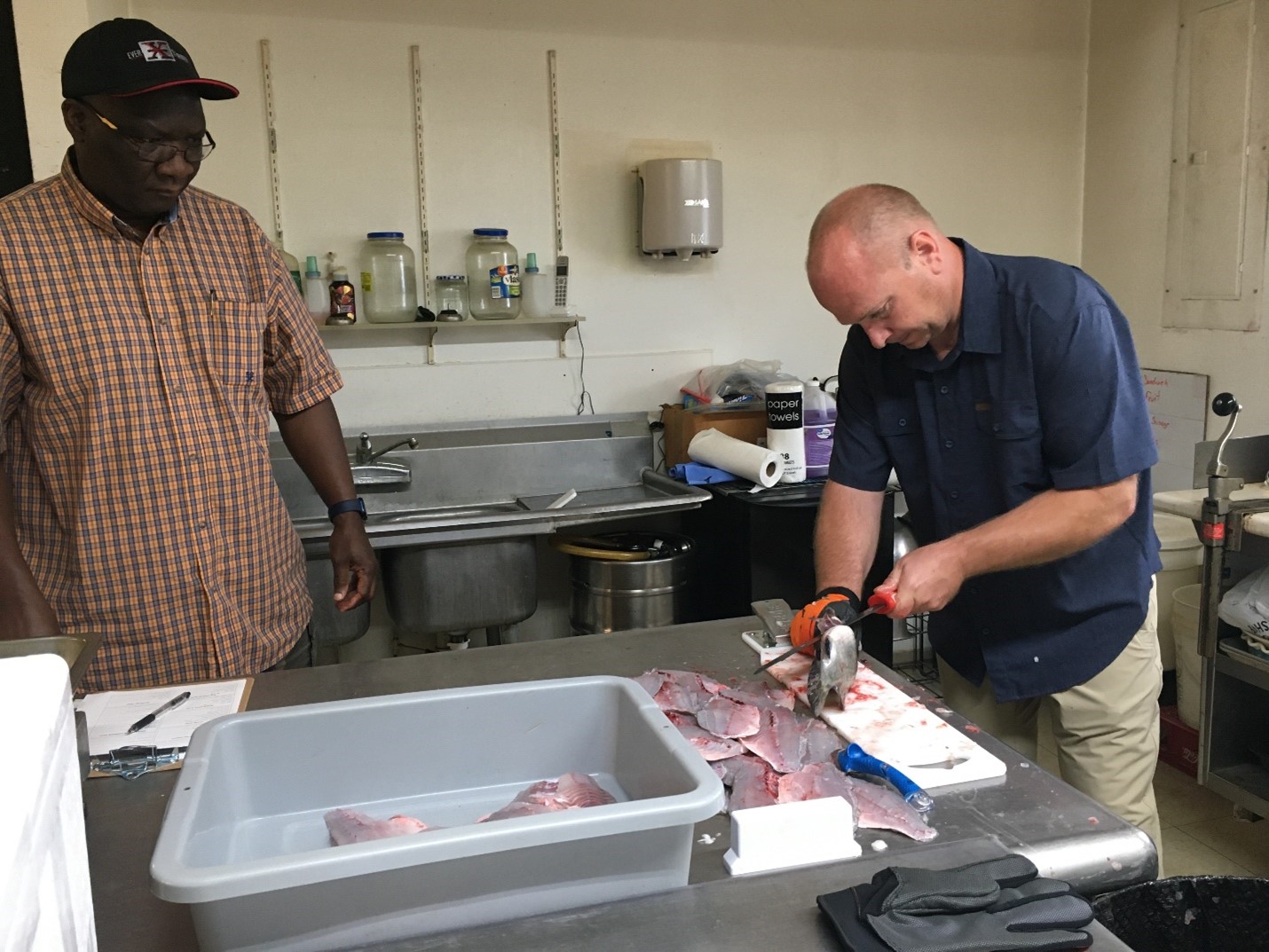
Hanilu Farms in Indiana participating in a small-scale fish processing case study. Photo by Kwamena Quagrainie.
Agricultural & Natural Resources (ANR) Newsletter: The Extension activities of Kwamena Quagrainie, clinical engagement professor in the Departments of Agricultural Economics and Forestry and Natural Resources, relate to economics in aquaculture and aquaponics. Kwamena is also affiliated with the Illinois-Indiana Sea Grant (IISG) program at Purdue University and the University of Illinois.
One aspect of his outreach activities relates to small-scale fish processing. He explored processing fish in shared-use commercial kitchens and on-farm processing facilities in local communities and hosted free HACCP training and pilot training workshops in seafood processing and food safety for fish farmers in Indiana and Illinois. Information from potential use of shared-use commercial kitchens and small on-farm fish processing kitchens were gathered to construct business models, costs, regulations, etc., as case studies, which are published in a handbook as a guide for small-scale fish farmers. The Handbook on Processing Fish for Small-Scale Fish Farmers outlines various aspects of understanding the process, including regulations, required training, requirements for renting a commercial kitchen and what it takes to own an on-farm facility. Fish farmers interested in processing their fish can use the handbook to decide if processing is a feasible pathway to add to their fish production business or to simply get into fish processing using any local facilities.
The other aspect relates to aquaponics as a sustainable food production enterprise and outreach to high schools interested in aquaponics in the classroom. Aquaponics is integrating aquaculture and hydroponics to produce seafood and plants using less land and water resources when compared with conventional food production methods. Kwamena’s primary focus with aquaponics is addressing the challenges in the adoption of aquaponics in the Midwest and helping farmers make informed decisions about getting into Aquaponics as a business. View YouTube video Aquaponics: What to consider before starting your business. Farmers are expressing interest in aquaponics as small farms and, in some cases, as urban farming, which could have some economic benefits because of its small footprint and use of less water and land resources.
The aquaponics in schools program is in its initial stages and is aimed at introducing students to basic scientific concepts through the lens of an aquaponics system. The program has lessons aligned with Science and Engineering Process Standards, incorporating material from biology, chemistry, and environmental science. An aquaponics curriculum developed by IISG is currently being pilot tested by high school teachers. The program will be implemented together with a water quality test kit loan program to schools in Indiana and Illinois.
To learn more about Dr. Quagrainie’s research and publications view: Kwamena Quagrainie, Forestry and Natural Resources profile page.
Resources:
A Guide to Marketing for Small-Scale Aquaculture Producers, The Education Store
A Guide to Small-Scale Fish Processing Using Local Kitchen Facilities, The Education Store
Marine Shrimp Biofloc Systems: Basic Management Practices, The Education Store
Aquaculture Industry in Indiana Growing, Purdue Today
Walleye Farmed Fish Fact Sheet: A Guide for Seafood Consumers, The Education Store, Purdue Extension resource center
Sustainable Aquaculture: What does it mean to you?, The Education Store
The Benefits of Seafood Consumption The Education Store, Purdue Extension Resource Center
Walleye Farmed Fish Fact Sheet: A Guide for Seafood Consumers, The Education Store, Purdue Extension resource center
Pond and Wildlife Management website, Purdue Extension
Fish Cleaning with Purdue Extension County Extension Director, Got Nature? Blog, Purdue Extension – Forestry and Natural Resources
Aquatics & Fisheries, Playlist, Purdue Extension – Forestry and Natural Resources
Eat Midwest Fish, Illinois-Indiana Sea Grant online resource hub
Agricultural & Natural Resources (ANR), Purdue Extension
Diana Evans, Extension & Web Communications Specialist
Purdue University Department of Forestry and Natural Resources
 The USDA Natural Resources Conservation Service, shares news article announcing the December 6, 2024 deadline for the Southern Indiana Sentinel Landscape Regional Conservation Partnership Program (RCPP).
Funding Available to Landowners Through the Southern Indiana Sentinel Landscape Regional Conservation Partnership Program
October 8. 2024
Damarys Mortenson, State Conservationist for USDA’s Natural Resources Conservation Service (NRCS) in Indiana announced today the deadline to apply for funding through the Southern Indiana Sentinel Landscape Regional Conservation Partnership Program (RCPP) is Dec. 6.
RCPP is a partner-led program, with NRCS directing technical and financial assistance to priorities identified by partners. Led by the Conservation Law Center, and the Southern Indiana Sentinel Landscape Partnership (SISL), this RCPP is part of a larger initiative to address pressing environmental concerns in the region.
“SISL is a great example of public, private and non-profit organizations working together to solve local concerns,” said Mortenson. “The partners are building on years of successful collaborations focused on natural resource protection, making a greater environmental impact within the focus area.”
Beginning about 20 miles south of Indianapolis, SISL comprises a unique patchwork of land uses. It is anchored by four critical Department of Defense installations and ranges and also contains state parks, state forests, state fish and wildlife areas, state-dedicated nature preserves, the Hoosier National Forest, and National Wildlife Refuges.
These natural and working lands provide an opportunity for partners and stakeholders to sustainably manage forests, build soil health and resiliency on agricultural lands, improve ecosystem health and maintain areas compatible with the military mission. SISL’s overarching goals are to preserve and protect military missions, support sustainable farming and forestry, restore and sustain ecosystems, ensure thriving human communities, and improve climate resiliency. Combined, these efforts have the potential to mitigate the effects of existing encroachment threats or avoid them altogether.
“Protecting Indiana’s oak-hickory ecosystems is essential not just for preserving our natural heritage, but also for safeguarding biodiversity, water quality, soil health and wildlife habitats,” said Mortenson. “The Southern Indiana Sentinel Landscape plays a major role in helping to maintain ecological balance, support countless species and provide clean air and water for southern Indiana communities.”
For full article view: Funding Available to Landowners Through the Southern Indiana Sentinel Landscape Regional Conservation Partnership Program.
For more information regarding the Southern Indiana Sentinel Landscape view The Sentinel Landscapes Partnership website, Southern Indiana Sentinel Landscape.
The Sentinel Landscapes Partnership is a coalition of federal agencies, state and local governments, and non-governmental organizations that work with willing landowners and land managers to advance sustainable land use practices around military installations and ranges. Founded in 2013, the partnership aligns the objectives of the U.S. Department of Agriculture, Department of Defense, Department of the Interior, and Federal Emergency Management Agency to strengthen military readiness, conserve natural resources, bolster agricultural and forestry economies, increase public access to outdoor recreation, and enhance resilience to climate change.
Landowner and Wildlife Habitat Assistance, Indiana Department of Natural Resources, Division of Fish and Wildlife
Timber Harvesting and Logging Practices for Private Woodlands, The Education Store
Investing in Indiana Woodlands, The Education Store
Marketing Timber, The Education Store
Woodland Wildlife Management, The Education Store
A Landowner’s Guide to Sustainable Forestry: Part 3: Keeping Your Forest Healthy and Productive, The Education Store
Indiana Department of Natural Resources Division of Forestry
The Nature of Teaching: Trees of the Midwest, The Education Store
Indiana Woodland Steward, Institute promoting the wise use of Indiana’s forest resources
Indiana Forestry Educational Foundation, Indiana Forestry & Woodland Owners Association
Forest Improvement Handbook, The Education Store
Invasive plants: impact on environment and people, The Education Store
Managing Your Woods for White-Tailed Deer, The Education Store
New Deer Impact Toolbox, Got Nature? Blog, Purdue Extension, Forestry and Natural Resources
Subscribe: Deer, Forest Management, ID That Tree, Woodland Management Moment, Invasive Species and many other topic video playlists Purdue Extension-Forestry and Natural Resources YouTube Channel
USDA Natural Resources Conservation Service
Diana Evans, Extension & Web Communications Specialist
Purdue University Department of Forestry and Natural Resources
Purdue Landscape Report: The elm zigzag sawfly (EZS), Aproceros leucopoda, is a non-native insect recently detected in several midwestern states. Originally from eastern Asia, this insect is rarely considered a problem in its native range, having several natural enemies and environmental factors able to keep it in check.
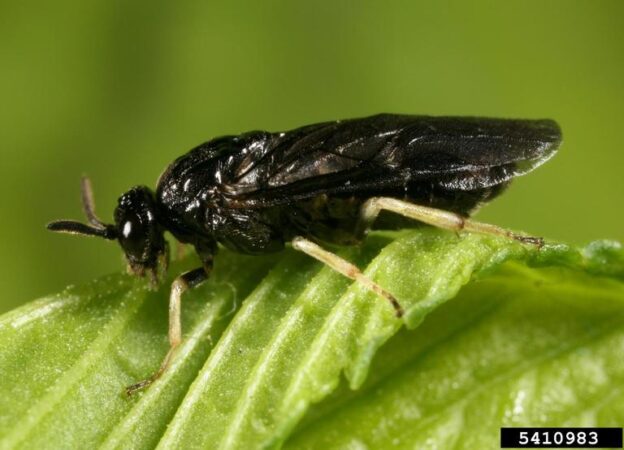
Figure 1. Elm zigzag sawfly adult, Gyorgy Csoka, Hungary Forest Research Institute, Bugwood.org
However, when in new landscapes, aspects of this insect’s life cycle enhance its ability to spread across new habitats and do significant damage to its host plant, the elm tree. EZS was first detected outside of its native range in Europe in 2003. Then, in 2020, it was found in North America for the first time in Quebec. It has since been detected in several states in the US, spreading first through the Northeast before entering the Midwest. It has not yet been detected in Indiana, but has been in the surrounding area.
Elm zigzag sawfly is a member of the insect order Hymenoptera, which includes bees, ants, and wasps. More specifically, sawflies belong to a suborder known as Symphyta, whose members are noted for a broad-waisted appearance and a saw-shaped ovipositor. Sawflies are a fairly common group of insects, though observers will often overlook them or confuse them for other insects. Adult EZS are generally small, darkly-colored insects that are easy to write off as ‘just another black bug’ you see around the garden or yard (Fig. 1).
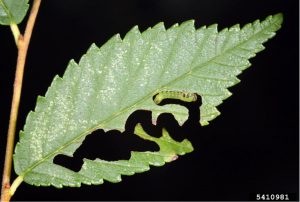
Figure 2. Elm zigzag sawfly larva feeding, Gyorgy Csoka, Hungary Forest Research Institute, Bugwood.org
They resemble wasps, but possess a broad waist with no narrowing of space between the thorax and abdomen, and they lack a stinger. EZS larvae closely resemble caterpillars in both form and feeding habits, with pale green coloration, a black stripe that runs down the length of the body, and dark T-shaped markings on the legs (Fig. 2). The larvae, like moth and butterfly caterpillars, will also possess six pairs of fleshy prolegs that are lost upon reaching maturity. While the larvae bear chewing mouthparts to consume the leaf material of many kinds of plants, the adults are nectar and pollen-feeding. It should be noted that EZS larvae chew zigzag patterns into elm leaves, thus the common name of the insect. Like bees and wasps, sawflies also possess wings, but are typically lazy fliers, choosing to fly only during warm, sunnier periods of the day.
View the rest of the article here: A New Threat to Elms in North America
Subscribe and receive the newsletter: Purdue Landscape Report Newsletter.
Resources:
Intro to Trees of Indiana: American Elm, Got Nature? Blog, Purdue Extension – FNR
Intro to Trees of Indiana: Slippery Elm, Got Nature? Blog, Purdue Extension – FNR
ID That Tree, Playlist, Red Elm, Siberian Elm, Winged Elm, Purdue Extension – Forestry and Natural Resources (FNR) YouTube Channel
ID That Tree, Playlist, Purdue Extension – FNR YouTube Channel
Invasive Species Playlist, Playlist, Purdue Extension – FNR YouTube Channel
A Woodland Management Moment, Playlist, Purdue Extension – FNR YouTube Channel
Woodland Stewardship for Landowners, Playlist, Purdue Extension – FNR YouTube Channel
Indiana Department of Natural Resources: Invasive Species
Indiana Invasive Species Council
Cooperative Invasive Species Management Area (CISMA)
Report Invasive, Purdue Extension
Episode 11 – Exploring the challenges of Invasive Species, Habitat University-Natural Resource University
What are invasive species and why should I care?, Got Nature? Blog, Purdue Extension – FNR
Native Trees of the Midwest, The Education Store, Purdue Extension’s resource center
Investing in Indiana Woodlands, The Education Store
Forest Improvement Handbook, The Education Store
Bob Bruner, Exotic Forest Pest Educator
Purdue Entomology
Purdue Agriculture News: As autumn settles in, we eagerly await the transformation of leaves into vibrant hues of red, orange and yellow. However, this year might tell a different story due to prolonged periods of hot weather. Ben McCallister, urban forestry specialist in Purdue University’s Department of Forestry and Natural Resources, sheds light on what to expect this fall.
The Impact of Weather on Fall Foliage Timing
“Right now, we’re seeing a mix of fall coming in and shifting temperatures, which is causing trees to respond. This back-and-forth hot weather is creating some color changes related to drought and stress. This can be expressed as brown color where leaves are starting to wilt and look a little crunchy from exposure to heat and drought stress,” McCallister explains.
While the typical color change occurs from mid-September to early November, it’s not unusual for leaves to remain green at this point in the season. McCallister suggests that while the hot weather “most likely won’t affect anything visually, it could influence fall foliage over time as climate change progresses.”
He anticipates a more pronounced display of fall colors extending through October, with some species showing their colors into November. Ultimately, the vibrancy and timing of these changes will depend on daily temperature fluctuations and the amount of sunlight trees receive.
The environment also plays a significant role in how trees respond. For instance, urban areas with more concrete and buildings create a “urban heat island” effect, which can delay color changes compared to more rural settings.
The science of fall foliage is both fascinating and complex. McCallister explains that different tree species respond to autumn at varying times, with chlorophyll being a key player in this process.
“Changes in chlorophyll production leads to the color changes in leaves. Chlorophyll allows leaves to take up sunlight and convert it into energy, creating carbohydrates in the form of sugars – really anything that gives energy to the tree to help it grow, sustain itself and compartmentalize,” McCallister notes.
As temperatures cool and the sunlight diminishes, chlorophyll production declines, allowing the green hues of leaves to fade. This decline reveals carotenoids and anthocyanins – two chemicals essential to fall foliage. Carotenoids contribute to the yellow and orange shades, while anthocyanins produce reds and purples. As chlorophyll wanes, these vibrant colors emerge.
“It’s a very cool process,” McCallister adds. “Each color absorbs different spectrums of light, altering energy uptake and preparing trees for leaf drop and dormancy. As leaves in deciduous trees transition, trees store energy in their roots and wood so they can brave the winter.”
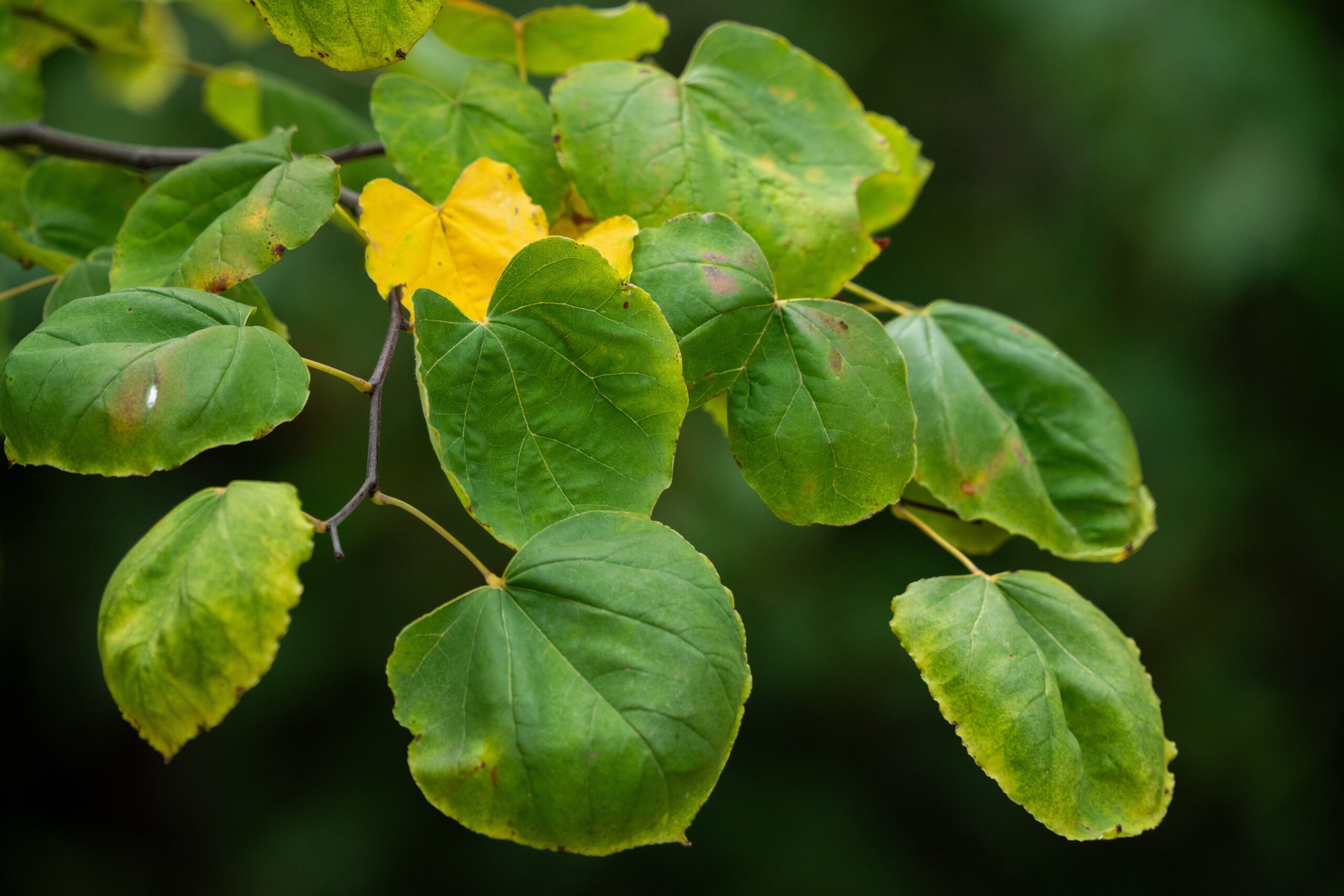
When it comes to enjoying fall foliage, McCallister emphasizes that Indiana offers many great viewing locations not far from Purdue’s campus.
Locally, Martell Forest, which is open to the public, is a great spot to check out the fall foliage and immerse yourself in the woods,” says McCallister.
Leaf drop is likely to occur anytime from mid-October into December, although this process may take longer than usual due to the milder winters we’ve been experiencing. Similar to color changing, the timing of leaf drop varies by tree species and their growth patterns, as well as the overall weather conditions.
“For instance, ginkgo trees turn this brilliant yellow and have a cool reaction to leaf drop. Typically, all their leaves fall within a day or so, creating a carpet of yellow. In contrast, trees like maples and oaks, which have a mix of yellow, orange and red leaves, tend to hold onto their foliage a bit longer,” McCallister recalls.
It’s also important to note that while coniferous trees, like pines, spruces and furs, retain their needles year-round, some conifers like bald-cypress trees drop theirs. This sometimes causes confusion for homeowners who mistake these deciduous conifers for dying trees.
To provide the best care for your trees during these changing weather patterns, McCallister advises familiarizing yourself with different tree species. Resources like Google and dichotomous keys in forestry books can help with species identification and lead to tips for care. Regularly checking your trees’ health is essential year-round. Specialists in your local county Extension offices and ISA Certified Arborists can be valuable resources for proper tree management.
To view the original article along with other news and stories posted on the Purdue Agriculture website see: Is fall foliage a sign of seasonal change or response to heat waves?
Resources:
Find an Arborist video, Trees are Good-International Society of Arboriculture (ISA)
ID That Tree, Playlist, Purdue Extension – FNR YouTube Channel
Invasive Species Playlist, Playlist, Purdue Extension – FNR YouTube Channel
A Woodland Management Moment, Playlist, Purdue Extension – FNR YouTube Channel (Against Invasives, Garlic Mustard, Autumn Olive)
Report Invasive Species, Purdue Invasive Species
Invasive Plants of the Eastern U.S.: An Introduction to the Problematic Non-Native Species, The Education Store, Purdue Extension’s resource center
Why Fall Color is Sometimes a Dud, Purdue Landscape Report
\U.S. Forest Service Fall Colors, Forest Service, U.S. Department of Agriculture
ID That Tree Fall Color: Sugar Maple, Purdue Extension – Forestry and Natural Resources YouTube Channel, ID That Tree Playlist
What Are Invasive Species and Why Should I Care?, Purdue Extension-FNR Got Nature? Blog
Emerald Ash Borer Information Network, Purdue University and Partners
Invasive plants: impact on environment and people, The Education Store, Purdue Extension’s resource center
Subscribe Purdue Extension-Forestry and Natural Resources YouTube Channel
Devyn Raver, Media Relations and Content Development Specialist
Purdue Forestry & Natural Resources
Ben McCallister, Urban Forestry Specialist
Purdue Forestry & Natural Resources
Question: We have a large 60+ foot mulberry tree in our backyard that is located by our pond. This is the first year I have seen these dark streaks on the bark of the tree. Should I have concerns?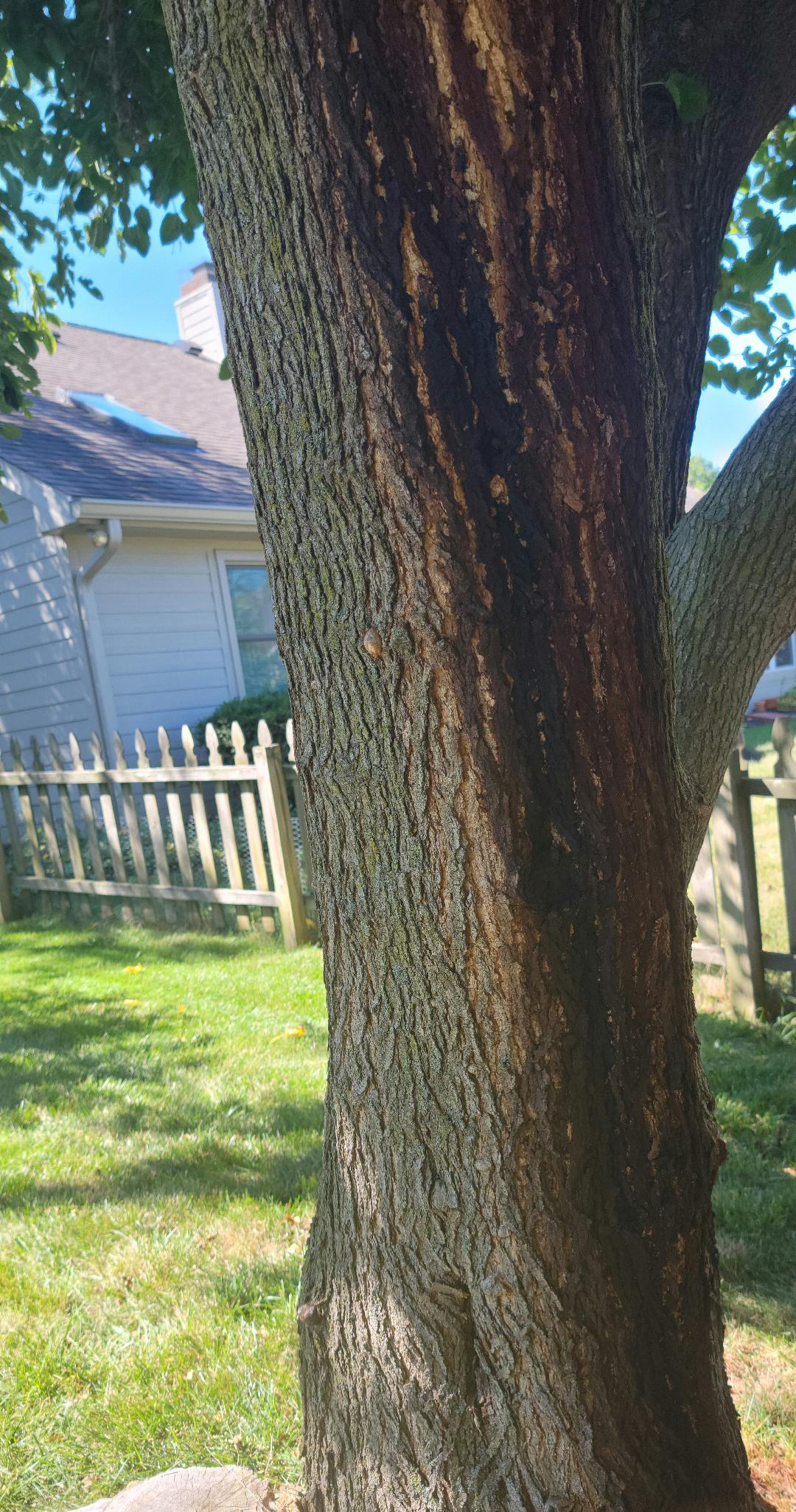
Answer: From the photos, it looks like wet wood/slime flux is affecting your tree. It is a bacterial infection on trees and in most cases is not a serious issue, but unfortunately, there is nothing to be done about it. Many years ago they used to drill holes to try and allow gases and liquids drain from an area with the slime flux but through research and experience this practice is not recommended.
The Purdue Landscape Report titled Slime Flux of Trees shares more about this disease:
Slime flux (also known as wet wood) is a dark, foul-smelling and unsightly seepage of sap from tree trunks. The disease is not usually a serious problem but the appearance can be alarming. Slime flux is caused by common surface-inhabiting bacteria or yeast fungi that enter the trunk through wounds associated with improper pruning, stem breakage, injections, cracks from freeze injury or weak limb crotches. The bacteria and yeast may live on sap nutrients within injured trees for many years without any outward evidence.
Symptoms
The main symptom is the appearance of the dark sap oozing on the trunk exterior which happens when gasses produced by growth of the bacteria and yeast cause the internal pressure of the sap to become high enough to force the sap out through cracks in the bark. The dark streaks usually turn light gray or white upon drying. Oozing sap may be frothy and white at the point of exit. Airborne bacteria, yeasts, and fungi often colonize the wet oozing material, which ferments and releases a foul odor. Slime flux may delay wound healing (callus formation).
For prevention and other resources view: Slime Flux of Trees.
Resources
Purdue Landscape Report
Find an Arborist video, Trees are Good-International Society of Arboriculture (ISA)
Tree Pruning Essentials, Publication & Video, The Education Store, Purdue Extension resource center
Tree Pruning: What Do Trees Think?, The Education Store
Tree Installation Process and Practices, The Education Store
Tree Pruning for the Landscape, Webinar, Purdue Extension – Forestry and Natural Resources YouTube channel
Tree Wounds and Healing
Why Is My Tree Dying?, The Education Store
Tree Risk Management, The Education Store
What Are Invasive Species and Why Should I Care?, Got Nature? Blog Post, Purdue Extension – FNR
Purdue Plant & Pest Diagnostic Lab (PPDL)
Subscribe – Purdue Extension-FNR YouTube Channel
Ben McCallister, Urban Forestry Specialist
Purdue Forestry & Natural Resources
Lenny Farlee, sustaining hardwood Extension specialist for Purdue’s Department of Forestry and Natural Resources (FNR), has been named a 2024 Fellow of the Society of American Foresters (SAF). The SAF Fellow Award, one of the highest honors bestowed on an SAF member by their peers, recognizes long-standing service to forestry at the local, state, regional and national levels.
Farlee was honored with the award during the 2024 SAF National Convention, which took place in Loveland, Colorado from Sept. 17-20.

Zhao Ma accepts the 2024 Family Forests Education Award on behalf of Lenny Farlee and the other project team members.
“Being named a Fellow of the Society of American Foresters is particularly meaningful to me since it originates from a nomination by my peers at the state level,” Farlee said. “I am very grateful that my colleagues in forestry here in Indiana considered my service worthy of recognition, and I owe much of the credit to them for their support of me through my career. It has been my privilege to serve the people and the profession as an Extension forester here at Purdue.”
Farlee educates people about forestry in many ways, including through the popular Extension YouTube series “ID That Tree,” which has over 100,000 views.
Farlee was also recognized at the convention with the 2024 Family Forests Education Award. The National Woodland Owners Association (NWOA) and the National Association of University Forestry Resources Programs (NAUFRP) gave an award to Farlee, project lead, and his team for their course “Forest Management for the Private Woodland Owner.”
Farlee, Ronald Rathfon, Don Carlson, Jonathan Ferris, Dave Osborne and Phil Woolery worked together to develop the course. The course introduces forest landowners to the biology and management of forests and what resources and professional assistance are available. According to survey results from 2021 participants, “94.4% stated that the information was useful to help them make future decisions and 92.5% stated that the information was useful to help act to manage their property objectives.”
“We in FNR, along with forestry professionals in Indiana and the landowners who have communicated with Lenny and his colleagues through the ‘Forest Management for the Private Woodland Owner’ course, know how valuable this program has been to sustainable forest management in Indiana,” said Zhao Ma, interim department head and professor of forestry and natural resources. “So it is absolutely wonderful when others outside of our FNR community and beyond Indiana also recognize the excellent work that Lenny and his colleagues have been doing…, I would also like to share one more note about Lenny – not only has Lenny been a highly valued and respected member of FNR and the forestry profession for many years, but he is also one of the nicest people I have met. He is knowledgeable yet humble, effective yet gentle, serious about his work yet able to have fun, very busy yet always willing to help others and try to be present. We are lucky to have Lenny as our colleague in FNR.”
To view this article along with other news and stories posted on the Purdue Forestry and Natural Resources website view: Purdue FNR Extension specialist receives national recognition for work in forestry
Resources:
ID That Tree – Video Playlist, Purdue Extension – Forestry and Natural Resources (FNR) YouTube Channel
Purdue Arboretum Explorer
Conservation Tree Planting: Steps to Success, Purdue Extension – FNR YouTube Channel
A Woodland Management Moment, Playlist, Purdue Extension – FNR YouTube Channel
Woodland Stewardship for Landowners, Playlist, Purdue Extension – FNR YouTube Channel
Indiana Department of Natural Resources: Invasive Species
Indiana Invasive Species Council
Cooperative Invasive Species Management Area (CISMA)
Report Invasive, Purdue Extension
Shrubs and Woody Vines of Indiana and the Midwest, The Education Store
Native Trees of the Midwest, The Education Store
Professional Forester, Indiana Forestry Woodland Owners Association
Forest Improvement Handbook, The Education Store
Find an Arborist, International Society of Arboriculture

Recent Posts
- Beetle that attacks Tree-of-Heaven found in Indiana, Purdue Landscape Report
Posted: March 20, 2026 in Invasive Insects, Wildlife, Woodlands - ID That Tree: Dwarf Chinkapin Oak
Posted: in Forestry, Urban Forestry, Wildlife, Woodlands - IN-PREPared: Essential Resources for Indiana’s Severe Weather Season
Posted: March 11, 2026 in How To, Safety - DNR Hiring for Indiana Conservation Officer Positions, MyDNR
Posted: March 9, 2026 in Urban Forestry, Wildlife, Woodlands - ID That Tree: Shumard Oak
Posted: in Plants, Urban Forestry, Wildlife, Woodlands - A Woodland Management Moment: Windbreak Around Walnut Plantings
Posted: March 3, 2026 in Forestry, Urban Forestry, Woodland Management Moment - Getting Certified as an Indiana Certified Prescribed Burn Manager
Posted: March 2, 2026 in How To, Urban Forestry, Woodlands - Uniting Indiana Residents Against Invasive Species
Posted: February 27, 2026 in Community Development, Invasive Insects, Wildlife - Have You Seen a Soaring Eagle Lately? Morning Ag Clips
Posted: February 25, 2026 in Urban Forestry, Wildlife - Register for Natural Resources Teacher Institute’s Class of 2026
Posted: February 19, 2026 in Forestry, Wildlife, Woodlands
Archives
Categories
- Alert
- Aquaculture/Fish
- Aquatic/Aquaculture Resources
- Ask the Expert
- Christmas Trees
- Community Development
- Disease
- Drought
- Forestry
- Forests and Street Trees
- Gardening
- Got Nature for Kids
- Great Lakes
- How To
- Invasive Animal Species
- Invasive Insects
- Invasive Plant Species
- Land Use
- Natural Resource Planning
- Nature of Teaching
- Plants
- Podcasts
- Ponds
- Publication
- Safety
- Spiders
- Timber Marketing
- Uncategorized
- Urban Forestry
- Webinar
- Wildlife
- Wood Products/Manufacturing
- Woodland Management Moment
- Woodlands