 Purdue University - Extension - Forestry and Natural Resources
Got Nature? Blog
As hellbenders continue to decline, Dr. Rod Williams and his research team have been sharing awareness of how important it is that these salamanders continue to thrive in the current ecosystem.
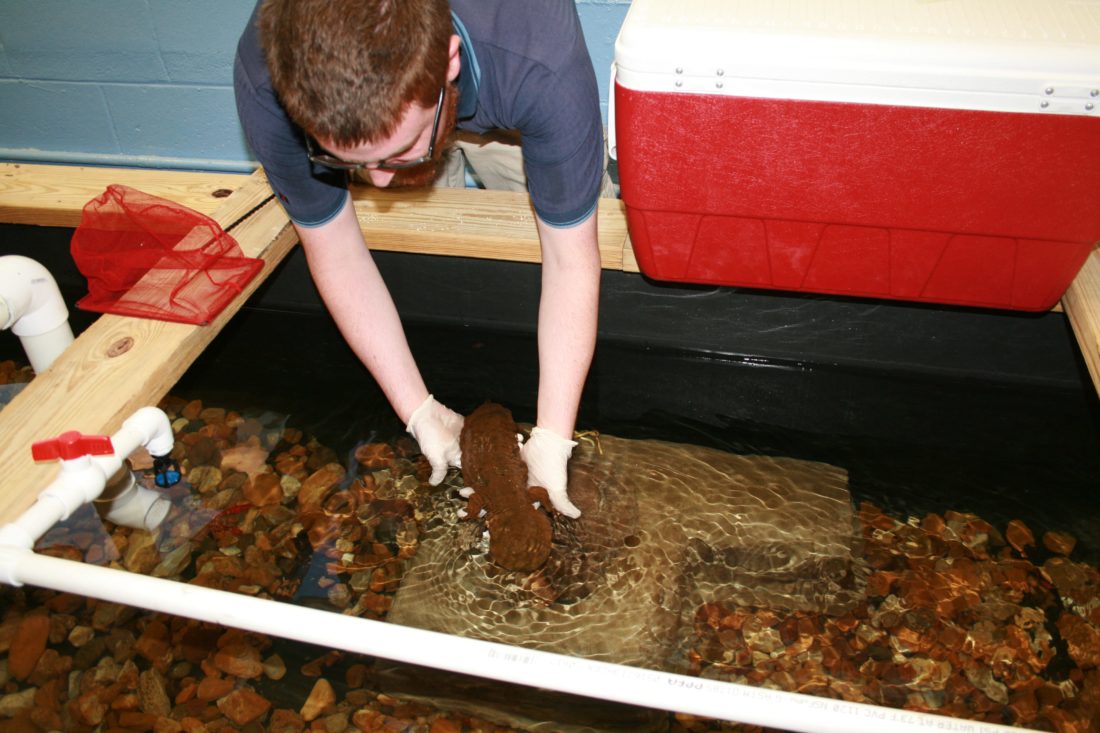
Eastern hellbenders are the largest salamander in North America. Adults can reach 29 inches in length, though most individuals are typically 11-24 inches long. Clean water is important for Hellbenders because they obtain most of their oxygen from the water by “breathing” through their skin. When breathing, their fleshy folds expand in surface area, enabling them to absorb more oxygen from the water.
Hellbender populations are declining across their range, from Missouri to New York. This decline, which affects the hellbender population in Indiana’s Blue River, is likely caused by human influences such as habitat degradation and destruction. The stream-bottom habitat of hellbenders can be degraded by sediment from eroded banks and fields and destroyed when streams are dammed or dredged. Hellbenders are also captured inadvertently by anglers or purposefully for illegal sale in the pet trade. Finally, emerging diseases may be impacting some populations of hellbenders.
Many states are developing conservation programs to help the hellbender. For more information and to learn more on conservation efforts, view Help the Hellbender.
Dr. Rod Williams and his hellbender research team have recently made national news:
CBS News
Trying To Save The Hellbender, America’s Largest Salamander
July 10, 2014
Resources:
Help the Hellbender Facebook page
Ask the Expert: Learn All About Hellbenders and Take a Tour, Subscribe Purdue Extension – Forestry & Natural Resources (FNR) YouTube Channel
Ask the Expert video: Help the Hellbender – Dr. Stephen Spear of The Wilds, Purdue Extension – FNR YouTube Channel
Ask the Expert video: Live with Mesker Park Zoo and Botanical Gardens – Hellbenders, Purdue Extension – FNR YouTube Channel
A Moment in the Wild video: Hellbender Hide, Purdue Extension – FNR YouTube Channel
A Moment in the Wild video: Release Moment of Hellbenders,
How Anglers and Paddlers Can Help the Hellbender video, Purdue Extension – FNR YouTube Channel
Eastern Hellbender ID Video, Purdue Extension – FNR YouTube Channel
Hellbenders Rock!, The Education Store, Purdue Extension’s resource center
Help the Hellbender, North America’s Giant Salamander, The Education Store
How Our Zoos Help Hellbenders, The Education Store
The Nature of Teaching: Adaptations for Aquatic Amphibians, The Education Store
Healthy Water, Happy Home – Lesson Plan, The Education Store
Purdue Expert: Hellbender Salamander, Purdue University News YouTube Channel
FNR Assists in First Natural Breeding of Eastern Hellbender in Captivity, Purdue FNR News & Stories
Helping the Hellbender: Mesker Park Zoo Begins Captive Breeding Efforts, Purdue Agriculture News
Rod Williams, Professor of Wildlife science and Assistant Provost for Engagement at Purdue University
Department of Forestry and Natural Resources, Purdue University
Diana Evans, Extension Information Coordinator
Department of Forestry and Natural Resources, Purdue University
Indiana Department of Natural Resources (INDNR) recently received inquiries asking what to do with an abandoned animal. The INDNR web resource titled Orphaned and Injured Animals has steps to follow as you decide if the animal is truly abandoned.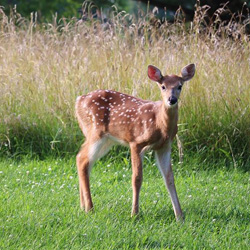
Resources
Got Nature? Orphaned Animals, author Brian MacGowan, extension wildlife specialist, Purdue University:
In most cases, the young animal is simply “spreading its wings” and exploring, or mom simply left it to get something to eat. Fawn deer are programmed to hide and remain motionless while mom is away. The fact is wildlife rarely abandons their young. They may leave briefly only to return.
Remember that you should never handle wild animals unless absolutely necessary. Any animal can bite you, and many harbor diseases and pests that can be transmitted to people.
In Indiana, wildlife rehabilitators have necessary state and federal permits to house and care for sick or injured wild animals. If you think you have found a sick or injured animal, you can find a list of licensed Wild Animal Rehabilitators in your area on the DNR Division of Fish and Wildlife’s website.
Mammals of Indiana, J.O. Whitker and R.E. Mumford
Common Indiana Mammals, R.N. Chapman and R.N. Williams, publication number FNR-413-W
Orphaned and Injured Animals, Indiana DNR
The Education Store (Search keywords to find the resources you need)
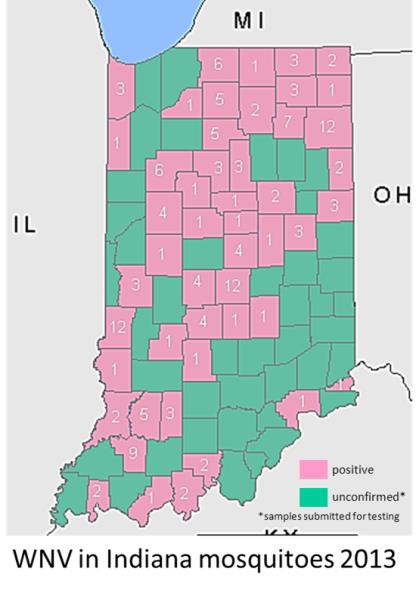
As foresters, woodland owners and tree and wildlife enthusiasts, we hear the word safety and immediately think about making sure our hard hat is packed, our gas tank is full, our cell phone is charged and we have a buddy to call in case of an emergency. How many of us think about diseases? Who thinks about West Nile Virus (WNV) or Eastern Equine Encephalitis (EEE)? For those of us that take our pets into the field, WNV and EEE are very real threats. West Nile Virus originated in Africa but spread quickly throughout the United States after an outbreak in New York in 1999. By 2003, 46 states had been infected, and nearly 10,000 people had fallen ill.
Although not contagious by contact with an infected person or animal, a protective layer is recommended when handling potential infected subjects. Most infected humans show no symptoms while a minority exhibit fevers, headaches, skin rashes, meningitis or encephalitis. Very few people die from WNV (< 1:1,000), but precautions should always be taken to prevent exposure. A total of 156 cases of WNV have been reported in Indiana this year with one sample being human. Other cases have been found in bordering states with 741 cases (mosquito) in Illinois, two mosquito and four human cases in Michigan, 64 mosquito cases in Ohio and zero cases of any kind in Kentucky as of August 20, 2013.
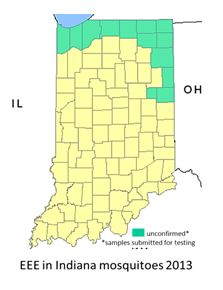
Eastern Equine Encephalitis is a rare viral disease that can be transmitted from host mosquitoes to a number of other animal species. Historical accounts of the disease show that in Midwestern states, EEE is most often found in southwestern Michigan; however, infected horses in Indiana have been found. EEE infects nearly all game birds, amphibians and reptiles, and last year in Michigan, an 8-week-old puppy.
Humans are not immune to EEE. Nearly 30% of people that develop the disease die, and approximately 50% of survivors have permanent neurological complications. Symptoms of infection may or may not occur and will often take between three and 10 days to be realized. EEE symptoms in humans range from fever, headache and nausea to abdominal pain, paralysis, seizures and fainting. An elderly woman in New England died on August 21, 2013, and was the first human casualty of the disease this year. A vaccine has been developed to prevent EEE in horses; however, no vaccine or treatment is available to protect humans or other animals from EEE or WNV. Elimination of standing water is our only defense against potential EEE and WNV threats.
As the summer is in full swing and more and more of us head out to the field, please do not forget to protect yourself and your pets from potential exposure to mosquitoes.
Sourced Information:
Beasley, D.W.C. et al. (2013) Resurgence of West Nile neurologic disease in the United States in 2012: What happened? What needs to be done? Antiviral Research 99:1–5.
Wendell, L.C. et al. (2013) Successful Management of Severe Neuroinvasive Eastern Equine Encephalitis. Neurocritical Care 19:111–115.
USGS Disease Maps
Van Buren County Horse Dies of Eastern Equine Encephalitis, Horse Owners Urged to Vaccinate Animals, MLIVE Media Group
Weymouth Officials Urge Caution After EEE Death, The Patriot Ledger
Resources
Mosquitoes, Purdue Extension Entomology
Shaneka Lawson, Plant Physiologist
Hardwood Tree Improvement and Regeneration Center (HTIRC)
Department of Forestry and Natural Resources, Purdue University
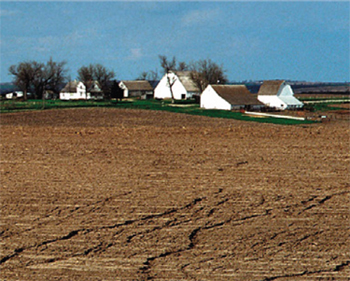 Because agriculture dominates the midwestern landscape, it has a huge impact on environmental quality. Agricultural producers are often advised to adopt practices that help to reduce the impact of agriculture on the environment. However, like all humans, they are often reluctant to change, which makes the work of conservation professionals extremely challenging. In this publication, we explore the myths and realities around what motivates farmers to adopt conservation practices. We draw on the authors’ combined research and applied practitioner experience with farmer adoption of conservation practices. Most evidence is based on studies and observations of traditional row-crop farmers in the midwestern United States.
Adoption of Agricultural Conservation Practices
The Education Store
Purdue Extension
Spring time brings a cacophony of frog calls around ponds and wetlands, but as spring slowly transitions into summer, the warmer temperatures signal the breeding season for many of our native reptiles. One of the oldest and most primitive reptile groups are the turtles. These ancient reptiles have remained relatively unchanged for 225 million years. There are currently ~300 species of turtles worldwide, and 18 species are found in Indiana. Most turtles in Indiana are associated with water, particularly waters that provide a variety of food items, basking sites and adjacent upland habitats. While Indiana is home to a diversity of turtle species, many are declining in number across their range. There are many factors contributing to these declines, but one that is particularly important this time of year is road mortality.
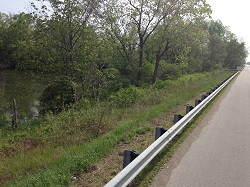
Figure 1: Small pond containing semi-aquatic turtles with a major road intersecting adjacent breeding habitat.
Why do you see so many turtles crossing the road in late spring and early summer (May-June)? This is the time of year when most of our turtles are searching for adequate nesting sites. Unlike amphibians that generally lay their eggs directly in the water, female turtles search for nesting spots in open, unshaded areas where the soil is not muddy or subject to flooding. Nests are often located on the nearest spot of land providing these conditions, but females of some species may travel 1-2 kilometers in search of a suitable net site.
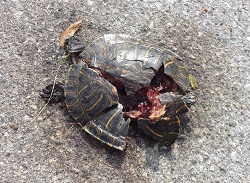
Figure 2: Female Red-eared Slider killed while attempting to cross the road to lay eggs at nearby upland nesting site.
Unfortunately, many of the upland sites are separated from ponds, lakes and streams by roads (Figure 1). As the females leave the ponds to lay eggs, they are forced to cross busy roads and may suffer incredibly high mortality rates (Figure 2). Females are more prone to road mortality than males (which are not required to leave the water to lay eggs), resulting in some populations consisting of nearly all male turtles. Increased female mortality lowers population growth rates (once the female is killed, so are the eggs she was carrying). To further complicate matters, turtles are long-lived species (up to 100 years), and females may not reach sexual maturity for 8-25 years.
What can you do to help? Increase vigilance and slow down when driving, especially in areas where roads intersect ponds and adjacent uplands. If you encounter an injured turtle that needs medical attention, call the Indiana DNR at 800-893-4116 or 317-232-4080 during business hours, 765-473-9722 (northern half of Indiana) or 812-837-9536 (southern half of Indiana) after hours or visit wildlifehotline.info.
For more information on turtles:
The Turtles of Indiana
The Education Store (Search keywords for more information)
Rod Williams, Associate Professor of Wildlife Science
Department of Forestry and Natural Resources, Purdue University
The month of May is not only known for producing flowers but the start of the white-tailed deer fawning season. In fact, nearly 90% of all white-tailed deer fawns are born between mid-May and mid-June. This time of year coincides with many of the outdoor activities that we all enjoy (hiking, mushroom hunting and shed hunting) and may sometimes bring us into contact with deer fawns.
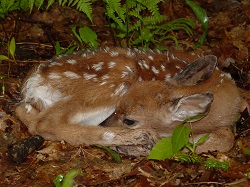
Figure 1. White-tailed deer fawn hiding in cover while the mother is off feeding.
When out enjoying nature, it is not uncommon to come upon a fawn tucked away under brushy cover, alone (Figure 1). At first glance, it may appear that the fawn has been abandoned by its mother, but this is rarely the case. This is actually part of the doe’s strategy to keep her fawn alive. Caching fawns in heavy cover serves to keep the fawn out of sight and away from would-be predators. A fawn will instinctively stay bedded down, remain motionless and silent until its mother returns from feeding. However, if harassed, the fawn may eventually leave the safety of cover and bleat in distress which results in the doe returning immediately to her fawn.
If you happen upon a fawn in the wild, you should not handle or harass it. Handling young fawns can distress not only the fawn, but the mother that is likely close by. If you happen to find a fawn cached in the woods, admire its hiding spot, spotted camouflage pattern and perhaps snap a photo. Take pride in knowing that the young fawn is not an abandoned orphan and will soon grow into the largest wild mammal in Indiana.
Under no circumstance should you remove a fawn from its hiding place. Removing wildlife from the environment is illegal without a proper handling permit from the Department of Natural Resources. If you find a sick or injured animal, you should contact your DNR law enforcement district or regional headquarters. The DNR does not care for injured animals but can connect you to licensed wildlife rehabilitators with the appropriate permits to care for injured wildlife.
Sources
Mammals of Indiana, J.O. Whitker and R.E. Mumford
Common Indiana Mammals, R.N. Chapman and R.N. Williams, FNR-413-W
Indiana DNR Orphaned and Injured Animals
Rod Williams, Associate Professor of Wildlife Science
Department of Forestry and Natural Resources, Purdue University
Box turtles are so-called because unlike most turtles, they can completely close up their shell, much like a box. They have a hinged belly that can close so tightly that even an ant couldn’t get inside. They have probably evolved this capability in order to be safe from predators such as raccoons and opossums. There is a wonderful British Broadcasting Corporation (BBC) video called Eastern Box Turtle.
We have two box turtle species in Indiana, the ornate box turtle and the eastern box turtle. Both are protected by law from disturbance of any kind with the single exception of moving them out of danger, such as helping one cross a road (place it on the side it was headed; it will cross again if you return it to the original side). 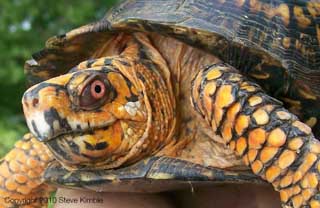 Both box turtles in Indiana are state protected because their numbers are declining, probably due to habitat loss and road deaths. What can you do to help? Slow down when driving, especially on rainy spring, summer or fall mornings. If you wish to have a box turtle as a pet, make sure that it was captive-reared, not wild-caught, though both are illegal in Indiana. If you encounter an injured box turtle that needs medical attention, call the Indiana DNR at 800-893-4116 or 317-232-4080 during business hours, 765-473-9722 (northern half of Indiana) or 812-837-9536 (southern half of Indiana).
To learn more about box turtles and other turtle species in Indiana, visit The Education Store for Turtles of Indiana.
Steve Kimble, Post Doctoral Research Associate
Department of Forestry and Natural Resources, Purdue
Rod Williams, Associate Professor of Wildlife Science
Department of Forestry and Natural Resources, Purdue
Salamanders are often mistaken for lizards, but the two groups are very different.
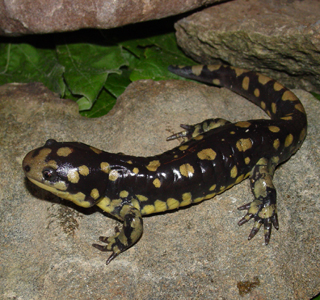
Tiger salamanders are a common species found in Indiana. The bright spotting is probably a sign to predators that they taste bad.
Though they both have similar body shapes, lizards are reptiles (along with turtles, snakes, crocodiles, dinosaurs, and yes, birds) while salamanders are amphibians (along with toads, frogs and a weird and rarely seen group called caecilians). This means lizards have dry scaly skin, while salamanders have moist, porous skin. Lizards all must breathe with lungs, just as humans do. Salamanders, on the other hand, can breathe through their skin, via gills, via lungs or in some cases via their skin and lungs!
Another major difference between lizards and salamanders is their reproduction. Lizards have leathery, partly calcified (shelled) eggs that are typically buried in sand or dirt, but a few species are hatched while still inside the mother before birth. Salamanders, as amphibians, mostly lay their eggs in water where the larvae hatch and after some time usually metamorphose and return to land. Lizards can be found most anywhere on land, while salamanders must stay where they won’t dry out: under logs or leaves, underground or directly in water. We have about six species of lizards and 23 species of salamanders here in Indiana.
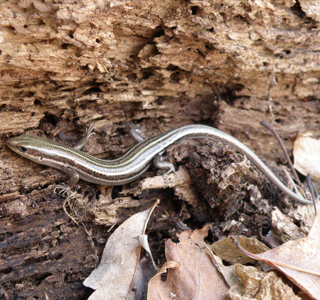
The five-lined skink is another Indiana native. Females will aggressively guard their nests, sometimes biting a threatening finger (don’t worry, they’re not venomous).
Several of the salamander species are listed as Special Concern or State Endangered. Regardless of their legal status, all wildlife should be left where you find it unless it’s in immediate danger, such as on a road.
For more information on how to identify Indiana salamanders and lizards:
Salamanders of Indiana book
Snakes and Lizards of Indiana
Place keywords in the search field at the Purdue Extension resource center for more information: The Education Store.
View Help The Hellbender website for more information on salamanders.
Steve Kimble, Post Doctoral Research Associate
Department of Forestry and Natural Resources, Purdue
Rod Williams, Associate Professor of Wildlife Science
Department of Forestry and Natural Resources, Purdue
Although perhaps a bit late, spring has seemingly sprung upon us. One of the best signals of spring is the symphony of calling frogs and toads in and around wetlands, ponds and lakes throughout Indiana. Amphibians native to Indiana are an important component of healthy ecosystems. They play important roles as both predator and prey in food webs. We can also consider many amphibians as “bio-indicators” of environmental health. Unfortunately, many species of amphibians and reptiles are thought to be in the decline. While the causes for declines are species-specific, the actions that people take can be a contributing factor.
Unlike other vertebrates, most amphibians and reptiles can be observed up close or even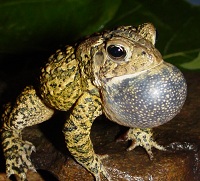 captured by hand – some more easily than others. Exploring natural habitats while searching for, catching and photographing reptiles and amphibians are great ways to gain hands-on experience with nature. However, be mindful that some activities, or the manner in which they are conducted, can harm the very creatures we value. Reptiles and amphibians represent numerous examples where interactions between wildlife and people can have negative consequences despite the best of intentions.
When you go outdoors to enjoy our amphibians and other wildlife, follow some of these simple tips:
Stay on designated roads and trail systems – Human foot traffic can affect plants and animals in some habitats (e.g., you may have noticed the compressed soil and lack of vegetation on even lightly used foot trails). Focusing foot traffic on trails can minimize human impacts on sensitive plants and animals. It is also required on some public properties.
Be a responsible pet owner – Dogs make good companions when hiking outdoors. However, research has demonstrated dogs can disturb, harass or even kill wildlife. While impacts on reptiles and amphibians are unclear, it is good practice to keep your dog leashed while exploring natural areas. Many parks and properties require dogs to be leashed.
Be a good steward of the land – Carelessly turning over logs and coarse woody debris in search of reptiles and amphibians can destroy microhabitat features that took decades to create. It is also prohibited on many public properties. If you do find an animal under a log or rock, return the object to its original location, then place the animal next to it rather than rolling the object directly over the animal.
Minimize or avoid handling animals – If you must handle a wild amphibian or reptile,  there are safe ways to hold and restrain them. Avoid handling amphibians for long periods of time. Amphibians are prone to desiccation (drying out). There are no formal guidelines on the length of time to handle an amphibian, and it is not clear how handling impacts an animal’s health and wellbeing. Common sense dictates that handling time should be minimized to the greatest extent possible. If a frog or salamander feels “dry,” you have handled it too long, and it should be returned to its location of capture immediately. Keep your hands moist and free of chemicals (e.g., bug spray or sunscreen).
Use good hygiene – The transmission of many diseases among animals can be facilitated by people. There are a number of safeguards that can be implemented to not only protect you, but also the animal populations as well. To prevent spreading diseases and pathogens from one site to another, regularly wash clothing and especially boots that you use in the field. All equipment that contacts an animal or the water the animal was in should be decontaminated using a 1-3 percent bleach solution or air dried for at least three hours before traveling to another water body. You also should use hand sanitizer before and after handling animals in nature. Before eating or handling food, thoroughly wash hands in hot, soapy water if possible; hand sanitizer is an acceptable substitute for remote locations.
For more information about responsibly enjoying wildlife and nature, see Appreciating Reptiles and Amphibians in Nature.
Resources:
Sounds of Frogs & Toads, Purdue Extension – Forestry and Natural Resources (FNR)
Frogs & toads of Indiana, The Education Store, Purdue Extension resource center
Salamanders of Indiana Book, The Education Store
Amphibians: Frogs, Toads, and Salamanders, Purdue Nature of Teaching
The Nature of Teaching: Adaptations for Aquatic Amphibians, The Education Store
Hellbender ID, Playlist, Purdue Extension – FNR YouTube Channel
A Moment in the Wild, Playlist, Purdue Extension – FNR YouTube Channel
Dr. Brian MacGowan, Extension Wildlife Specialist
Department of Forestry & Natural Resources, Purdue University
A recent article in ScienceDaily titled “Excessive Deer Populations Hurt Native Plant Biodiversity” shares how an overpopulation of deer is hurting native plant growth. Landowners seek best management practices as these challenges arise.
For the article from the University of Miami, view: “Excessive deer populations hurt native plant biodiversity.” ScienceDaily, 20 March 2014.
Resources
Preventing Wildlife Damage, Purdue EVERYTHING Wildlife
How to Build a Plastic Mesh Deer Exclusion Fence, Purdue Extension Publication

Recent Posts
- ID That Tree: Nannyberry Viburnum
Posted: July 22, 2026 in Forestry, Plants, Wildlife, Woodlands - ID That Tree: Eastern Swamp Privet
Posted: in Forestry, Plants, Wildlife, Woodlands - Bovine Tuberculosis in Wild White-tailed Deer: Background and Frequently Asked Questions
Posted: July 20, 2026 in Disease, Natural Resource Planning, Wildlife - ID That Tree: Carolina Buckthorn
Posted: July 15, 2026 in Forestry, Wildlife, Woodlands - Bat Roost Reporting Tool
Posted: July 8, 2026 in Alert, Community Development, Invasive Animal Species, Wildlife - Thank You, Turkey Trackers! Your Brood Counts Make a Difference – MyDNR
Posted: in Alert, Community Development, Wildlife - Identifying Evergreens
Posted: June 24, 2026 in Forestry, Wildlife, Woodlands - Celebrate Pollinator Week With Flowers of June Tour
Posted: June 15, 2026 in Forestry, Gardening, How To, Wildlife - Pruning Highlight-Pollarding Trees: A Traditional Pruning Practice with Modern Uses
Posted: June 11, 2026 in Forestry, Forests and Street Trees, Urban Forestry, Wildlife, Woodlands - Danielle Howard Hired as FNR Extension Prescribed Fire Specialist
Posted: June 10, 2026 in Forestry, Wildlife, Woodlands
Archives
Categories
- Alert
- Aquaculture/Fish
- Aquatic/Aquaculture Resources
- Ask the Expert
- Christmas Trees
- Community Development
- Disease
- Drought
- Forestry
- Forests and Street Trees
- Gardening
- Got Nature for Kids
- Great Lakes
- How To
- Invasive Animal Species
- Invasive Insects
- Invasive Plant Species
- Land Use
- Natural Resource Planning
- Nature of Teaching
- Plants
- Podcasts
- Ponds
- Publication
- Safety
- Spiders
- Timber Marketing
- Urban Forestry
- Webinar
- Wildlife
- Wood Products/Manufacturing
- Woodland Management Moment
- Woodlands