 Purdue University - Extension - Forestry and Natural Resources
Got Nature? Blog
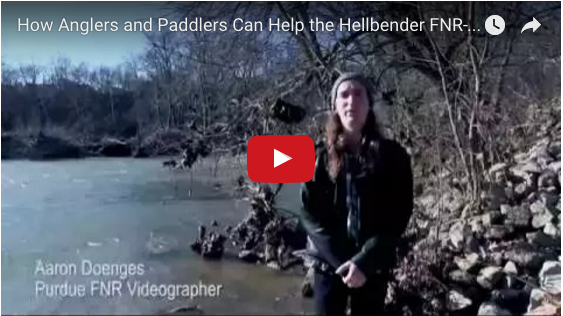 Paddling and fishing are great ways to enjoy our rivers and streams. However, these seemingly harmless activities can actually be harmful to the eastern hellbender and other aquatic wildlife if the proper precautions are not followed.
In this video, Purdue videographer Aaron Doenges speaks with Tom Waters and Ranger Bob Sawtelle, two professionals around Indiana’s Blue River, to learn more about safe ways to paddle and fish. By following a few simple tips, paddlers and anglers can still enjoy these aquatic activities without harming the local wildlife.
If we all do our part to help the hellbender, this at-risk species can survive and grow. Anglers and paddlers aren’t the only people that can help. Farmers can also check out the video Improving Water Quality Around Your Farm to learn healthy farming practices to improve water quality for the hellbender and other aquatic wildlife, and landowners are encouraged to check out Improving Water Quality At Your Livestock Operation to learn about how to manage livestock without polluting nearby rivers and streams.
To stay current with the latest news and research on the eastern hellbender, please visit the Help the Hellbender website.
Resources:
How Anglers and Paddlers Can Help the Hellbender – The Education Store, Purdue Extension Resource Center
Improving Water Quality Around Your Farm – The Education Store
Improving Water Quality At Your Livestock Operation – The Education Store
Eastern Hellbender ID Video – The Education Store
Help the Hellbender – Purdue Extension
Rod Williams, Associate Head of Extension and Associate Professor of Wildlife Science
Purdue University Department of Forestry and Natural Resources
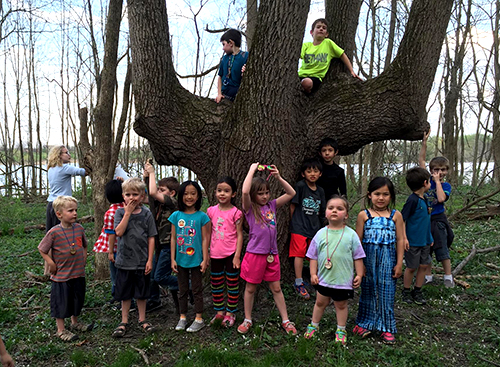 Children today spend an average of 20 minutes outside. Since the dawn of television, video games, and other indoor activities, children are spending more and more of their time indoors and missing out on the many benefits of interacting with nature. Various studies have shown that engaging with nature improves concentration, coordination, creativity, and more. Hands of the Future, Inc. is a nonprofit organization started to educate children about the beauty of nature and help them connect with it.
Hands of the Future, Inc. has several programs for kids to get involved with. The Junior Nature Club is a free after school program for children in pre-kindergarten through the eighth grade that meets every three weeks to learn about nature through games, crafts, and other activities. The Living Schoolyard Program is a partnership with Indiana schools bringing bits of nature to schools in the forms of “outdoor classrooms” like butterfly gardens and raised bed veggie gardens. A Children’s Forest is even being discussed as Hands of the Future, Inc. becomes more and more successful.
For summer fun sign up for Hands of the Future program! Registration is free.
Volunteers & Interns:
Older students and adults can apply to be a volunteer. Volunteers are always appreciated, no past experience necessary. If you love nature and kids you will enjoy this program. Internships are available for college students, contact Zonda Bryant.
This month’s Junior Nature Club theme is soil, and is taking place on June 21st for pre-kindergarteners to second graders, June 23rd for third to fifth graders, and June 28th for sixth to eighth graders at the Lilly Nature Center at Celery Bog. Look forward to upcoming themes including “Monarch Madness” and “Floating on Air!”
For more information, please check out the Hands of Future, Inc. and Junior Nature Club websites listed below.
Resources:
PK-12 Programs – Purdue FNR Extension
Zonda Bryant, Director
765.366.9126
director@hands-future.org
Purdue Extension Contact:
Rebecca Busse, Extension Associate
Purdue Department of Forestry and Natural Resources
busser@purdue.edu
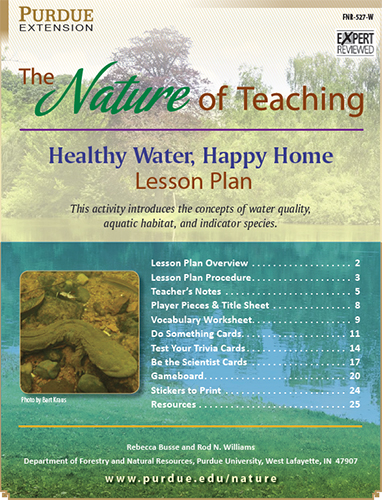 Many choices we make in our daily lives can have an impact on the water quality of rivers and streams around us. Animals like the eastern hellbender need clean water for their habitats, and they depend on us to make environmentally friendly choices whenever possible. Small changes to our daily routines such as sweeping sidewalks and driveways instead of hosing them off can improve water quality around us.
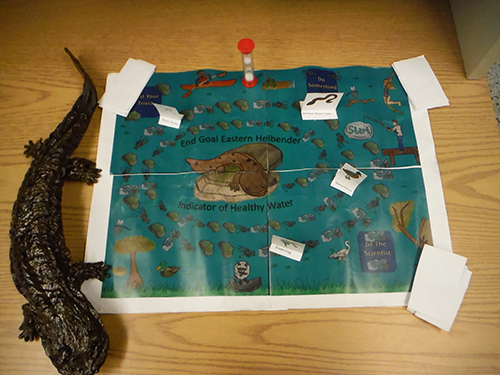
The new lesson plan from The Nature of Teaching titled Healthy Water, Happy Home offers a fun way for 4th and 5th grade students to learn about healthy water choices they can make in their home and community, along with learning how to identify aquatic animal species like the eastern hellbender. Healthy Water, Happy Home is available as a free download in The Education Store which includes a board game, vocabulary worksheet, accompanying lesson notes and power point slides for the teacher. It can be used as a 60-90 interactive classroom lesson on water quality. The board game allows students to choose an aquatic species like the northern water snake or water strider as their player piece, travel along the riverbed answering questions along with completing fun and educational tasks about positive water quality choices. The first group to make it to the hellbender, indicating the highest level of water quality, wins the game.
 Teachers are highly encouraged to check out Healthy Water, Happy Home as well as the rest of The Nature of Teaching lesson plans for educational wildlife activities for the classroom. To keep updated on resources involving the eastern hellbender conservation efforts, please visit HelpTheHellbender.org.
Resources:
Healthy Water, Happy Home – Lesson Plan – The Education Store, Purdue Extension Resource Center
The Nature of Teaching – Purdue Extension
Lesson Plans – Help the Hellbender
Kids Resources – Help the Hellbender
Hellbender Havoc video game – Google Play Store
Rebecca Busse, Extension Associate
Purdue Department of Forestry and Natural Resources
Rod Williams, Associate Professor of Wildlife Science
Purdue Department of Forestry and Natural Resources
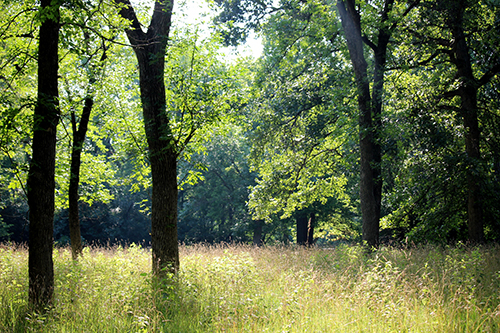 What you do on your property is your choice first and foremost. I commonly get questions or comments related to the need to manage one’s property rather than setting the land aside and let nature take its course. One is not necessarily better than the other, but the outcomes will likely be very different. Certainly keeping land in a more ‘natural’ state provides better habitat for wildlife compared to a parking lot – both scenarios above achieve this. However, there are several reasons why you should at least consider a more active management approach.
The way our landscape is configured now is different from long ago so we can’t expect processes to function the same way as they once did. Setting land aside for preservation often has the goal of letting the land return to pre-settlement conditions. While looking into our past can help inform management decisions, it doesn’t make much sense biologically to completely rely on this approach. At what point in time should it be? Remember, part of the Indiana was covered by glaciers and flocks of passenger pigeons (now extinct) numbering in the billions used to call Indiana home. Just think about what your car looks like after parking under a tree occupied by a few dozen starlings – imagine what billions of birds roosting do to tree limbs and the soil nutrient levels. Moreover, natural processes, or wildlife responses to them, may not be desirable. For example, having too many deer or raccoon may be problematic.
Invasive species have also completely changed the way we view habitat management. Their control requires regular monitoring and appropriate control measures, preferably before they become overabundant. Simply letting nature take its course can have unintended, and undesirable, consequences. Setting land aside is certainly one option to consider. Just don’t be mistaken that approach is best for wildlife and our natural resources.
I would argue it is better to inventory what you have on your property, identify what you want out of your land out of potential options, and then determine the approach that meets these objectives.
To learn more about this active style of property management, read Wildlife Extension Specialist Brian MacGowan‘s publication “Assessing Your Land’s Potential for Wildlife.”
Resources:
Assessing Your Land’s Potential for Wildlife – The Education Store, Purdue Extension Resource Center
Woodland Wildlife Management – The Education Store
Managing Forest & Wildlife Resources: An Integrated Approach – The Education Store
Forest Management for Reptiles and Amphibians: A Technical Guide for the Midwest – The Education Store
How to Construct a Scent Station – Purdue FNR Extension
Brian MacGowan, Extension Wildlife Specialist
Purdue Department of Forestry and Natural Resources
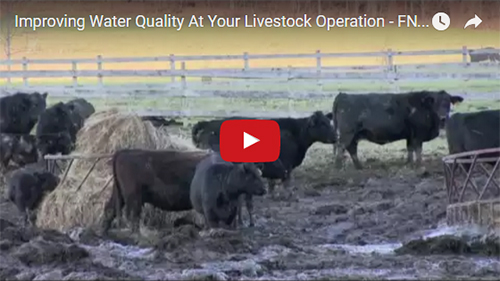 Hellbenders have been rapidly declining since the 1980s due to various factors, including poor water quality. Many ecological issues contribute to poor water quality, and one important issue we can focus on is how we use the land around rivers and streams. Livestock operations produce a lot of nutrients – largely in the form of manure. When next to a river, this can flow into the water, which reduces water quality through the high nutrient input and added sedimentation. However, livestock owners can greatly reduce the impact of their operations on water quality using a number of different management practices.
In this new video “Improving Water Quality at Your Livestock Operation,” we focus on how livestock owners can use management practices on their farm that improve water quality while still meeting their production goals. Bob Sawtelle, a livestock owner along the Blue River, uses a forested riparian buffer to filter out runoff from his cattle pen, resulting in cleaner water and healthier wildlife. In this video, he discusses the ecological and economic benefits to this practice in further detail.
Please visit the Help the Hellbender website for more information about other management practices that improve water quality, and also check out the National Resource Conservation Services website (NRCS) for news and other information related to soil and resource conservation.
Resources:
Improving Water Quality At Your Livestock Operation – The Education Store, Purdue Extension Resource Center
Improving Water Quality Around Your Farm – The Education Store
Options for Farmers – Help the Hellbender
Identifying Benefits and Barriers Associated with Reforesting Riparian Corridors – Purdue Engineering
Riparian Area Management – United States Environmental Protection Agency
Megan Kuechle, Undergraduate Extension Intern
Purdue Department of Forestry and Natural Resources
Dr. Rod Williams, Associate Head of FNR Extension and Associate Professor of Wildlife Science
Purdue Department of Forestry and Natural Resources
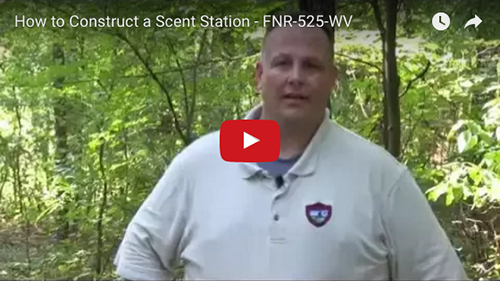 Have you ever wanted to set up your own scent station? Here’s a great video that will teach you how! Scent stations are a non-invasive alternative to other trapping methods for determining what species of wildlife populate an area. Scent stations work by using a scent lure surrounded by sand in which animals will leave their tracks. These tracks can then be identified later for each species that visits the scent station.
However, it can be difficult to set up an animal scent station for the first time. In this video, Robert Cordes, assistant regional wildlife biologist at the Maine Department of Inland Fisheries and Wildlife, shows you step-by-step how to construct your own scent station.
“How to Construct a Scent Station” is a companion to Lesson 2 in The Nature of Teaching’s Unit 1: Animal Diversity and Tracking. This free lesson plan includes a data sheet you can fill out after setting up your scent station, as well as other fun projects that can be used in a classroom. You can find other free lesson plans at the Nature of Teaching website with topics like food webs, watersheds, and the scientific method.
Resources:
How to Construct a Scent Station – The Education Store, Purdue Extension Resource Center
The Nature of Teaching Unit 1: Animal Diversity and Tracking – The Education Store
The Nature of Teaching – Purdue Extension
Nature Publications – The Nature of Teaching
Megan Kuechle, Undergraduate Extension Intern
Purdue Department of Forestry and Natural Resources
Dr. Rod Williams, Associate Head of Extension and Associate Professor of Wildlife Science
Purdue Department of Forestry and Natural Resources
In an effort to provide Indiana bats with more places to live and monitor their population, the Indiana Department of Natural Resources Division of Fish and Wildlife is launching two new projects that property owners can take part of. The first project involves the distribution of 100 bat houses to Hoosier properties that meet certain habitat requirements. Interest in this project has been very positive, and more than enough people have already signed their properties up for the bat houses.
The second project is open to everyone in the state, and its mission is to document the amounts of bats traveling to and from their roosting spots in different areas of the state, whether they are in barns, trees, or in the newly installed bat houses. Participants are asked to count bats for eight to twelve nights between May 17th and July 17th. This data will be helpful to the biologists as it will aid them in knowing where to find bats during summer months. Farmers and foresters may benefit too, since these bats feed on moths of caterpillar species that damage crops and trees.
Check out SFGate’s article “Monitoring, bat house projects aim to help flying mammals” to learn more. For further questions or to get involved with the bat count, please contact Assistant Nongame Biologist Cassie Hudson at chudson@dnr.IN.gov.
Resources:
Monitoring, bat house projects aim to help flying mammals – SFGate
Indiana Bats – Indiana Department of Natural Resources
Nongame & Endangered Wildlife – Indiana Department of Natural Resources
Summer Bat Roost Monitoring Project – Indiana Department of Natural Resources
Bats – The Education Store, Purdue Extension Resource Center
Cassie Hudson, Assistant Nongame Biologist
Indiana Department of Natural Resources Division of Fish and Wildlife
The Department of Forestry and Natural Resources’ extension team have received four Purdue Extension Issue-Based Action Team (IBAT) awards out of seven. These new initiatives have been chosen from 30 submitted proposals. In an ever-changing world, Purdue Extension is launching big ideas to identify and address priority issues to enhance quality of life as well as the efficiency and/or effectiveness of organizations through research-based education.
Congratulations to the following FNR teams that are moving the world forward:
ENHANCING THE VALUE OF PUBLIC SPACES: HEALTH, WELLNESS, AND DESIGNING THE BUILT ENVIRONMENT
Project Overview: Expand upon the existing Enhancing the Value of Public Spaces program to include a health component — building community capacities for accessible means for physical activity. $50,000.
Team: Michael Wilcox, Assistant Program Leader for Community Development Extension, Purdue Center for Reginal Development; and Kara Salazar, Sustainable Communities Extension Specialist, Department of Forestry & Natural Resources; Donna Vandergraff, Extension Specialist, Nutrition Science; Lisa Graves, Assistant Program Leader and Extension Specialist, Nutrition Science; Melissa Maulding, Director, Nutrition Education Programs; and Steve Yoder, Extension Educator, Agriculture and Natural Resources (ANR), Tippecanoe County.
MARKET BASKET 360
Program Overview: A wealth of resources on a website, educational workshop agendas, certification programs, uniform materials for cooking demonstrations, and more for Farmers’ Market Masters, producers, and consumers. Market Basket 360 centralizes, streamlines, and enhances existing farmers’ market resources available through Purdue Extension, Indiana State Department of Health, the USDA Agricultural Marketing Service, and other industry organizations.
Team: James Wolff, Extension Educator, Agriculture and Natural Resources (ANR), Allen County; Julie Gray, Central District Director, ANR; Morgan Roddy, Extension Educator/Health & Human Sciences (HHS), ANR, Henry County; Curt Campbell, Extension Educator, ANR, Wabash County; Jodee Ellett, Local Foods Coordinator, Purdue Extension; Vickie Hadley, HHS Extension Educator/CED, ANR, Allen County; Nancy Manuel, HHS Extension Educator, ANR, Adams County; Gail Peitzmeier, HHS Extension Educator, Crawford County; Tim Vining, Development Educator, ANR; Teresa Witkoske, HHS Extension Educator/CED, Wabash County; Kwamena Quagrainie, Aquaculture Marketing Director and Associate Professor, Department of Forestry & Natural Resources and Agriculture Economics; Bob Rode, Aquaculture Research Lab Manager and Extension Specialist, Department of Forestry and Natural Resources.
NATURAL RESOURCES LEADERSHIP PROGRAM
Program Overview: Expanding Extension’s capacity to develop and deliver statewide natural resource programs and enhance decision-making for implementation at the community level. $30,000.
Team: Kara Salazar, Assistant Program Leader for Community Development and Sustainable Communities Extension Specialist, Department of Forestry and Natural Resources/Illinois-Indiana Sea Grant; Angie Tilton, Extension Educator, Agriculture and Natural Resources (ANR), Hendricks County Team; Lenny Farlee, Sustaining Hardwood Extension Specialist, Department of Forestry and Natural Resources; Liz Jackson, Hardwood Tree Improvement and Regeneration Center (HTIRC), Engagement Specialist and Executive Director of the Indiana Forestry and Woodland Owners Association and the Walnut Council; Steve Yoder, Regional Extension Educator, Community Development
THE NATURE OF HEALTH
Project Overview: A multifaceted approach to engaging families in nature-learning opportunities that will utilize emerging research to connect Health and Human Sciences and Agriculture and Natural Resources using curriculum developed by Rod Williams titled “The Nature of Teaching.” $20,000.
Team: Rod Williams, Professor of Wildlife Science, Department of Forestry & Natural Resources; Angie Frost, Extension Specialist-Healthy Living, College of Agriculture; Stephanie Woodcox, Extension Specialist-Health & Wellness, College of Health and Human Sciences; Deb Arseneau, Extension Educator, Agriculture Natural Resources (ANR), Newton County; Jay Christiansen, Extension Educator, ANR, Vigo County; Jan Dougan, Extension Educator, ANR, Dubois County; Molly Hoag, Extension Educator, ANR, Wells County; Molly Hunt, Extension Educator, ANR, Delaware County; Gracie Marlatt, Extension Educator, ANR, Rush County; Kelsie Muller, Extension Educator, ANR, Benton County; Lindsey Pedigo, Extension Educator, ANR, Howard County; Katie Zuber, Extension Educator, ANR, Lawrence County.
View the College of Agriculture Strategic Plan and the Purdue Extension Annual Report for more information on Purdue Extension.
For extension resources on Forestry and Natural Resources view Purdue Extension-FNR website.
Diana Evans, Extension and Web Communications Specialist
Purdue University Department of Forestry and Natural Resources
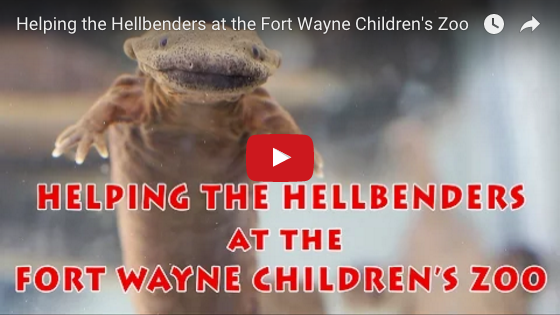 The Fort Wayne Children’s Zoo is one of three Indiana zoos working with Purdue University to study and raise hellbenders in captivity until they are ready to be released into the wild in an effort to grow their native population. Last spring, Rod Williams and his team at the Aquaculture Research Lab transferred young hellbenders to the zoo, where they will be reared for the next couple years. The zoo also puts on an outreach program called Kids4Nature where hellbenders were featured as one of the animals children could vote for with their quarters, collecting money for the hellbenders and other conservation projects.
In this new video, former Education and Communications Director Cheryl Piropato explains more about the zoo’s outreach process with the hellbenders, and Hellbender Keeper Dave Messmann offers a behind-the-scenes look at the hellbenders themselves. Check out “Helping the Hellbenders at the Fort Wayne Children’s Zoo” to see for yourself and learn more about the Fort Wayne Children’s Zoo’s involvement in the Help the Hellbender initiative.
The other two Indiana zoos are also doing great things to help the hellbenders. Columbian Park Zoo in Lafayette held a “Help the Hellbender Day” last summer with educational games and activities for the whole family to learn more about this at-risk species. Mesker Park Zoo in Evansville is preparing a public hellbender exhibit that will be available later this spring. To stay updated in the world of hellbender outreach, check out HelpTheHellbender.org.
Resources:
Helping the Hellbenders at the Fort Wayne Children’s Zoo – Purdue Extension
HelpTheHellbender.org – Purdue Extension
Help the Hellbender Day at Columbian Park Zoo a Great Success – Got Nature?
Purdue partners with Indiana zoos for hellbender conservation – Purdue Agriculture News
Rod Williams, Associate Head for Extension and Associate Professor of Wildlife Science
Purdue University Department of Forestry and Natural Resources
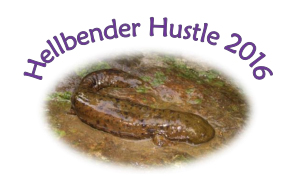 Come to the 13th consecutive Hellbender Hustle 5K Run/Walk at the O’Bannon Woods State Park in Corydon, Indiana to learn more about hellbenders and how they are faring in the nearby Blue River. The race is part road, part trail, and fun for the whole family. After crossing the finish line, enjoy the outstanding refreshments that are a hallmark of this event. Awards will be given to top finishers and there will be a drawing for a handcrafted door prize, made exclusively for the Hellbender Hustle. And if running/walking a 5K isn’t your thing, come and take a look at the Nature Center exhibits or just kick back and relax and listen to the sounds of a local traditional band.
Resources:
Help the Hellbender – Purdue Extension
Nick Burgmeier, Research Biologist and Extension Wildlife Specialist
Purdue Department of Forestry and Natural Resources

Recent Posts
- ID That Tree: Nannyberry Viburnum
Posted: July 22, 2026 in Forestry, Plants, Wildlife, Woodlands - ID That Tree: Eastern Swamp Privet
Posted: in Forestry, Plants, Wildlife, Woodlands - Bovine Tuberculosis in Wild White-tailed Deer: Background and Frequently Asked Questions
Posted: July 20, 2026 in Disease, Natural Resource Planning, Wildlife - ID That Tree: Carolina Buckthorn
Posted: July 15, 2026 in Forestry, Wildlife, Woodlands - Bat Roost Reporting Tool
Posted: July 8, 2026 in Alert, Community Development, Invasive Animal Species, Wildlife - Thank You, Turkey Trackers! Your Brood Counts Make a Difference – MyDNR
Posted: in Alert, Community Development, Wildlife - Identifying Evergreens
Posted: June 24, 2026 in Forestry, Wildlife, Woodlands - Celebrate Pollinator Week With Flowers of June Tour
Posted: June 15, 2026 in Forestry, Gardening, How To, Wildlife - Pruning Highlight-Pollarding Trees: A Traditional Pruning Practice with Modern Uses
Posted: June 11, 2026 in Forestry, Forests and Street Trees, Urban Forestry, Wildlife, Woodlands - Danielle Howard Hired as FNR Extension Prescribed Fire Specialist
Posted: June 10, 2026 in Forestry, Wildlife, Woodlands
Archives
Categories
- Alert
- Aquaculture/Fish
- Aquatic/Aquaculture Resources
- Ask the Expert
- Christmas Trees
- Community Development
- Disease
- Drought
- Forestry
- Forests and Street Trees
- Gardening
- Got Nature for Kids
- Great Lakes
- How To
- Invasive Animal Species
- Invasive Insects
- Invasive Plant Species
- Land Use
- Natural Resource Planning
- Nature of Teaching
- Plants
- Podcasts
- Ponds
- Publication
- Safety
- Spiders
- Timber Marketing
- Urban Forestry
- Webinar
- Wildlife
- Wood Products/Manufacturing
- Woodland Management Moment
- Woodlands