 Purdue University - Extension - Forestry and Natural Resources
Got Nature? Blog
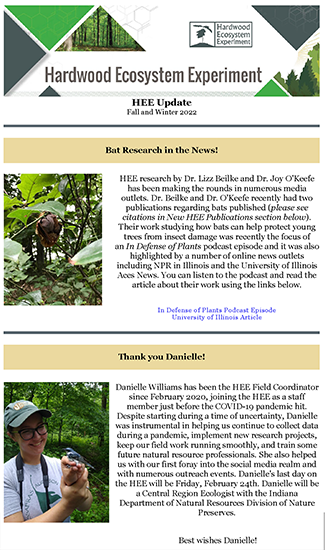 The Fall/Winter 2022 HEE Update newsletter is now available online. Research highlights and student news include:
- Bat Research in the News
- Thank You Danielle
- We Are Hiring
- A Second HEE Departure
- Welcome New Graduate Students
- HEE Publications
“The HEE Update” is distributed to anyone interested in receiving updates on the Hardwood Ecosystem Experiment (HEE). The newsletter includes updates of field work, media attention, committee meetings, extension events, job announcements, publications, and presentations. Anyone can receive this newsletter. If you would like to be added to the newsletter list email Dr. Mike Saunders, associate professor of silviculture, Purdue Forestry and Natural Resources, at msaunder@purdue.edu.
What is HEE?
The focus of forest science is increasingly shifting to the management of forests as complex systems rather than as simple agricultural landscapes—with a much greater appreciation for the interactive ecosystem processes. In addition, now for many forest landowners, the ecological value of their land is at least as important as the economic return. It is, therefore, vital to understand how forest management affects not only timber production, but also the overall function of forested ecosystems.
The Hardwood Ecosystem Experiment (HEE) is a long-term, large-scale experimental study of forest management and its impacts. The project was initiated in 2006 with partners including: Ball State University, Drake University, Indiana State University, Purdue Entomology, Indiana Department of Natural Resources (IN DNR), and the Indiana Chapter of the Ruffed Grouse Society.
For information about study sites, harvesting treatments, sampling design, and more, see our Project Overview and Design page and US Forest Service General Technical Report NRS-P-108, The Hardwood Ecosystem Experiment: A Framework For Studying Responses to Forest Management.
Resources
Hardwood Ecosystem Experiment, Website
Hardwood Ecosystem Experiment (HEE), YouTube Playlist, Purdue Extension–Forestry and Natural Resources (FNR)
Prescribed Fire, Hardwood Ecosystem Experiment (HEE) YouTube Video
Ask an Expert: Hardwood Ecosystem Experiment (HEE) Birds and Salamander Research, Video, Purdue Extension-FNR YouTube Channel
Hardwood Ecosystem Experiment – Wildlife Responses to Timber Harvesting, The Education Store, Purdue Extension’s resource center
The Hardwood Ecosystem Experiment: Indiana Forestry and Wildlife, The Education Store
The Help the Hellbender Project is a joint project involving partners from across the country. The conservation outreach continues as the team shares how important it is that our household and farm management practices are aiming to help keep our rivers and streams clean.
 The Help the Hellbender conservation efforts will continue expanding as the U.S. Department of Agriculture (USDA) announced it is awarding $197 million for 41 locally led conservation projects through the Regional Conservation Partnership Program (RCPP). RCPP is a partner-driven program that leverages partner resources to advance innovative projects that address climate change, enhance water quality, and address other critical challenges on agricultural land. The “Farmers Helping Hellbenders” project, led by Dr. Rod Williams and Purdue Extension wildlife specialist/Help the Hellbender project coordinator Nick Burgmeier, is among the projects set to receive funding through the RCCP Classic fund, which uses NRCS contracts and easements with producers, landowners and communities in collaboration with project partners. To view article and the fourteen contributing partners in the article USDA Awards Farmers Helping Hellbenders Project $2.7 Million in Funding.
Help the Hellbender Recent Team Awards
- The team was honored by the Hoosier Outdoor Writers group with its 2022 Bayou Bill Conservation Award. The annual conservation award is given in memory of the legendary Crothersville, Indiana, outdoor writer Bayou Bill Scifres, who was a founding member of HOW in 1969, and had his outdoors column published in The Indianapolis Star newspaper for 50 years. View full article on the Purdue Forestry and Natural Resources’ News: Help the Hellbender Program Receives Hoosier Outdoor Writers Conservation Award.
- The team recently received the Budd Denneman Partners in Conservation Excellence Award, Indiana Department of Natural Resources, Division of Fish & Wildlife
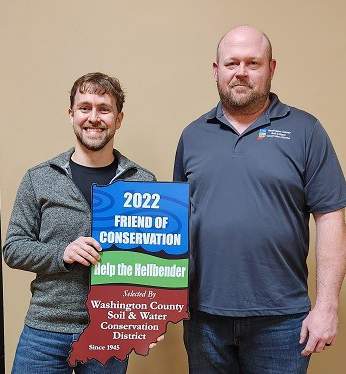
- Awarded the Friends of Conservation Award from the Washington County Soil and Water
The Help the Hellbender website is full of resources, activities, photos, posters, coloring pages and publications for homeowners, farmers, teachers and kids.
Resources:
Help the Hellbender Facebook page
Ask the Expert: Learn All About Hellbenders and Take a Tour, Subscribe Purdue Extension – Forestry & Natural Resources (FNR) YouTube Channel
Ask the Expert video: Help the Hellbender – Dr. Stephen Spear of The Wilds, Purdue Extension – FNR YouTube Channel
Ask the Expert video: Live with Mesker Park Zoo and Botanical Gardens – Hellbenders, Purdue Extension – FNR YouTube Channel
A Moment in the Wild video: Hellbender Hide, Purdue Extension – FNR YouTube Channel
A Moment in the Wild video: Release Moment of Hellbenders,
How Anglers and Paddlers Can Help the Hellbender video, Purdue Extension – FNR YouTube Channel
Eastern Hellbender ID Video, Purdue Extension – FNR YouTube Channel
Hellbenders Rock!, The Education Store, Purdue Extension’s resource center
Help the Hellbender, North America’s Giant Salamander, The Education Store
How Our Zoos Help Hellbenders, The Education Store
The Nature of Teaching: Adaptations for Aquatic Amphibians, The Education Store
Healthy Water, Happy Home – Lesson Plan, The Education Store
Purdue Expert: Hellbender Salamander, Purdue University News YouTube Channel
FNR Assists in First Natural Breeding of Eastern Hellbender in Captivity, Purdue FNR News & Stories
Helping the Hellbender: Mesker Park Zoo Begins Captive Breeding Efforts, Purdue Agriculture News
Diana Evans, Extension and Web Communication Specialist
Purdue University Department of Forestry and Natural Resources
The Help the Hellbender team, led by Dr. Rod Williams, professor of wildlife science, has been honored by the Hoosier Outdoor Writers group with its 2022 Bayou Bill Conservation Award.
The annual conservation award is given in memory of the legendary Crothersville, Indiana, outdoor writer Bayou Bill Scifres, who was a founding member of HOW in 1969, and had his outdoors column published in The Indianapolis Star newspaper for 50 years.
“The Hoosier Outdoor Writers group was introduced to Dr. Rod Williams in 2019 when he came to our annual conference and talked to us about his work with hellbenders and the Help the Hellbenders program,” Tom Berg, Executive Director of HOW, explained. “Our members were very interested in learning more about hellbender conservation and restoration, and also about his involvement with captive breeding and propagation efforts across the state. It was interesting to us to hear that Purdue University, the Indiana Department of Natural Resources and other groups were working together on management plans to re-introduce and re-populate hellbenders throughout much of their historical range. This is exactly the type of conservation story that our members like to hear and relate to their audiences. It also aligns very well with our strong belief in the conservation of Indiana’s natural resources, so choosing Dr. Williams and the “Help the Hellbenders” program for this award was an easy task.”
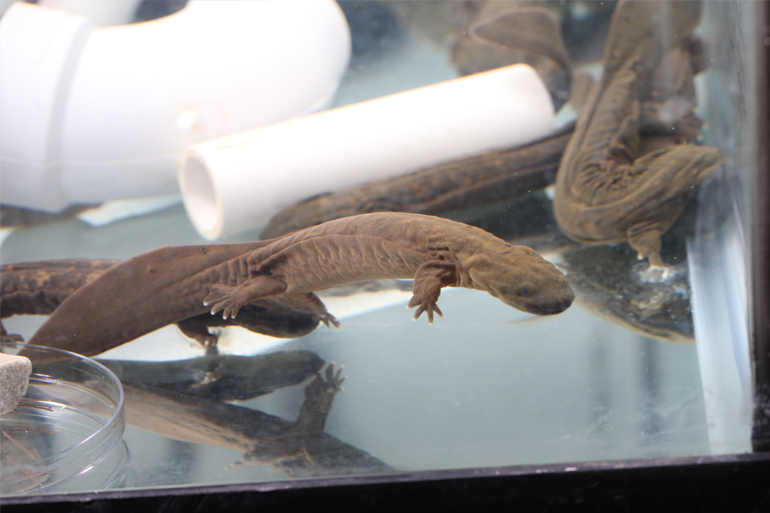 For much of the last 16 years, Williams and his team have been researching eastern hellbenders, spearheading regional conservation efforts and advancing hellbender captive propagation, or the rearing of this ancient animal in captivity and their eventual return to the wild.
After five years of breeding efforts, Williams’ partners at the Mesker Park Zoo in Evansville, Indiana, successfully bred eastern hellbenders naturally in captivity in October 2020, signifying the culmination of a long and collaborative effort to breed the species and restore this endangered species to its native environment.
Williams’ hellbender lab is actively collaborating with the Indiana Department of Natural Resources, Indiana Division of Fish and Wildlife and The Nature Conservancy as well as several other partners across 13 states on a number of conservation projects and educational opportunities for teachers and children, farmers and more.
For full article with additional photos view: Help the Hellbender Program Receives Hoosier Outdoor Writers Conservation Award.
Resources
Help the Hellbender website
Help the Hellbender Facebook page
Ask the Expert: Learn All About Hellbenders and Take a Tour, Subscribe Purdue Extension – Forestry & Natural Resources (FNR) YouTube Channel
Ask the Expert video: Help the Hellbender – Dr. Stephen Spear of The Wilds, Purdue Extension – FNR YouTube Channel
Ask the Expert video: Live with Mesker Park Zoo and Botanical Gardens – Hellbenders, Purdue Extension – FNR YouTube Channel
A Moment in the Wild video: Hellbender Hide, Purdue Extension – FNR YouTube Channel
A Moment in the Wild video: Release Moment of Hellbenders,
How Anglers and Paddlers Can Help the Hellbender video, Purdue Extension – FNR YouTube Channel
Eastern Hellbender ID Video, Purdue Extension – FNR YouTube Channel
Hellbenders Rock!, The Education Store, Purdue Extension’s resource center
Help the Hellbender, North America’s Giant Salamander, The Education Store
How Our Zoos Help Hellbenders, The Education Store
The Nature of Teaching: Adaptations for Aquatic Amphibians, The Education Store
Healthy Water, Happy Home – Lesson Plan, The Education Store
FNR Assists in First Natural Breeding of Eastern Hellbender in Captivity, Purdue FNR News & Stories
Wendy Mayer, FNR Communications Coordinator
Purdue University Department of Forestry and Natural Resources
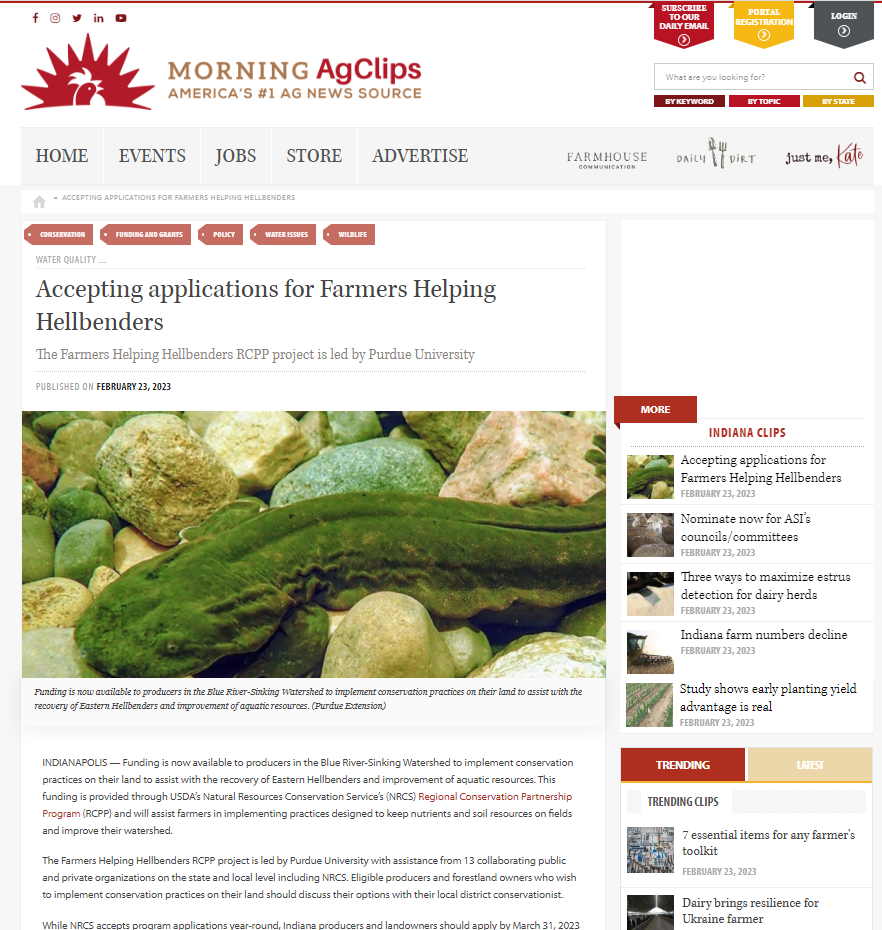 Morning AgClips, Indianapolis, Accepting Applications for Farmers Helping Hellbenders — Funding is now available to producers in the Blue River-Sinking Watershed to implement conservation practices on their land to assist with the recovery of Eastern Hellbenders and improvement of aquatic resources. This funding is provided through USDA’s Natural Resources Conservation Service’s (NRCS) Regional Conservation Partnership Program (RCPP) and will assist farmers in implementing practices designed to keep nutrients and soil resources on fields and improve their watershed.
The Farmers Helping Hellbenders RCPP project is led by Purdue University with assistance from 13 collaborating public and private organizations on the state and local level including NRCS. Eligible producers and forestland owners who wish to implement conservation practices on their land should discuss their options with their local district conservationist.
While NRCS accepts program applications year-round, Indiana producers and landowners should apply by March 31, 2023 to be considered for the current RCPP-Hellbender funding cycle. Applications received after March 31 will automatically be considered during the next funding cycle. For more information or to submit an application, contact your local district conservationist by visiting Farmers.gov/Service-locator.
The goals of the Farmers Helping Hellbenders project include improved water quality due to decreases in runoff, improved aquatic habitat due to decreases in sedimentation, increases in Hellbender and other aquatic wildlife populations due to improved habitat and water quality, increases in riparian and pollinator habitat due to implementation of riparian buffers and pollinator-friendly species, and increased protection of karst due to reduced runoff into sinkholes.
“The Farmers Helping Hellbenders RCPP project enables us to leverage partnerships to make a lasting positive impact on the habitat of the Eastern Hellbender salamander,” said Acting State Conservationist Dan Hovland. “This project will enable Indiana farmers and forestland owners to conserve the vital natural resources on their land while also protecting the habitat for hellbenders and other aquatic animals. It is a win-win.”
The total financial assistance to landowners over the three-year project is more than $1.9 million and is available for agricultural lands in portions of Washington, Harrison, Crawford, and Floyd counties, the only remaining area in Indiana where the Eastern Hellbender can be found and is currently being actively managed.
“This project is the perfect opportunity for land managers to help an imperiled species, while maintaining productive working lands,” said Brianne Lowe, Indiana NRCS state biologist. “Hellbenders are particularly susceptible to sedimentation in the water. Farmers and forest landowners that implement conservation practices can help improve water quality by keeping soil on the land and protecting aquatic nesting beds for the hellbender.”
Indiana eligible practices for farmers in the Blue River-Sinking Watershed for this funding period include conservation cover, grassed waterways, wildlife habitat planting, and nutrient management, riparian buffers and many others. Eligible farmers are encouraged to contact their local NRCS office before March 31 to apply for the current funding cycle. This funding will enable producers to improve the health and productivity of their operations.
Visit https://www.nrcs.usda.gov/indiana/RCPP to learn more about RCPP or click visit www.farmers.gov/working-with-us/service-center-locator find your local USDA-NRCS service center.
USDA Natural Resources Conservation Service
Channel catfish, commonly known as catfish, are freshwater finfish in the Ictaluridae family. Their native range extends from southern Canada and the Central US to Mexico. They are popular to catch and eat and have been introduced throughout the US and the world for food and recreation. This fact sheet publication shares how to identify the catfish, where they can be found, where you can find catfish products and if they are safe to eat. You will also enjoy the recipe found on this fact sheet.
The Channel Catfish publication is the seventh in a series of consumer guides that describe fish and shellfish farmed in the Midwest region of the United States. (See FNR-608-W, Walleye Farmed Fish Fact Sheet, FNR-618-W, Yellow Perch Farmed Fish Fact Sheet, FNR-621-W, Tilapia Farmed Fish Fact Sheet, FNR-622-W, Rainbow Trout Farmed Fish Fact Sheet, FNR-623-W, Pacific White Shrimp Farmer Fish Fact Sheet and FNR-625-W, American Paddlefish Farmed Fish Fact Sheet). The fact sheet also includes culinary characteristics, cooking tips and a recipe for Classic Fried Catfish.
This publication is a collaborative project of Illinois-Indiana Sea Grant, the North Central Regional Aquaculture Center, University of Illinois Extension, and Purdue University’s Department of Forestry and Natural Resources.
About the Author
Amy Shambach is Illinois-Indiana Sea Grant’s (IISG) aquaculture marketing outreach associate who works with the aquaculture industry in the USDA’s North Central Regional Aquaculture Center. Her work focuses on the demand side of domestic farm raised seafood products. She provides outreach and extension services to producers, potential producers, and consumers. Along with Dr. Kwamena Quagrainie, producers, aquaculture associations, and consumers, she works to determine the needs of stakeholders.
To receive the free download for the Channel Catfish please visit The Education Store.
Resources:
Walleye Farmed Fish Fact Sheet, The Education Store, Purdue Extension’s resource center
Pacific White Shrimp Farmed Fact Sheet, The Education Store
Yellow Perch Farmed Fish Fact Sheet, The Education Store
Tilapia Farmed Fish Fact Sheet, The Education Store
Rainbow Trout Farmed Fish Fact Sheet, The Education Store
American Paddlefish, The Education Store
A Guide to Small-Scale Fish Processing Using Local Kitchen Facilities, The Education Store
Aquaculture Family Coloring Book Development, The Education Store
Eat Midwest Fish, Illinois-Indiana Sea Grant online resource hub
Aquatics & Fisheries Videos, Purdue Extension-Forestry and Natural Resources YouTube Channel Playlist
Amy Shambach, Aquaculture Marketing Outreach Associate
Purdue Department of Forestry and Natural Resources/Illinois Indiana Sea Grant Program
Despite their name, Indiana bats are found in more than 20 states. The species was first found in southern Indiana’s Wyandotte Caves where they live in close, social groups. During the winter, up to 500 bats can huddle for warmth underground within a single square foot. Their scientific name, Myotis sodalis, is actually Latin for “mouse ear companion.” While that companionship has helped Indiana bats survive for generations, it is now facilitating the spread of a deadly disease that is devastating their population.
First documented in 2006, white-nose syndrome spreads rapidly. It has killed millions of North American bats over the past decade. Named after a powdery white fungus that grows on the hairless parts of bats, white-nose syndrome spreads on surfaces and through bat-to-bat contact.
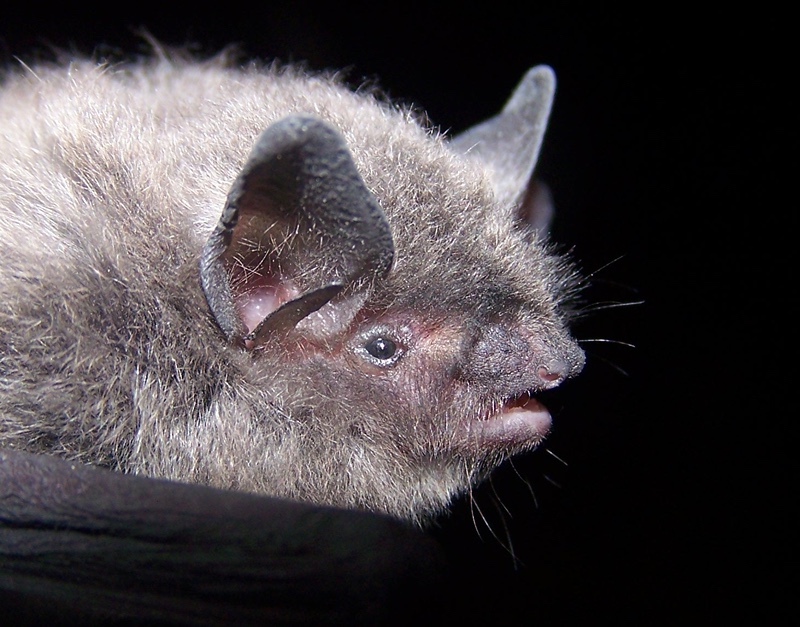
Photos provided by: Caroline Byrne, Bat Ecologist
“Bats spend a lot of time sleeping and really shut down when they hibernate in caves,” said Patrick Zollner, professor of quantitative ecology. During hibernation, bats lower their body temperature and metabolic rate, increasing their susceptibility to white-nose syndrome.
The fungus causes behavior changes in bats that make them more active than usual, burning the fat they need to survive and killing the vast majority of those infected.
“One reason bat populations are so sensitive is they are not prolific breeders like other small mammals,” said Zollner. Indiana bats give birth to a single pup each summer, making it hard for their numbers to rebound.
Though the effects of the population decline are visible, specifics are hard to determine. This fall, Sally Martinez, a graduate student in Zollner’s lab, began work to unravel the impact.
For full article please visit Unexpected Plants and Animals of Indiana: Indiana Bats.
If you have any questions regarding trees, forests, wildlife, wood products or other natural resource topics, feel free to contact us by using our Ask an Expert web page.
Resources:
Hardwood Ecosystem Experiment (HEE) Highlights: Bats, Video, Purdue Extension – Forestry and Natural Resources (FNR) YouTube Channel
Bats in the Belfry, Purdue Extension – FNR Got Nature? Blog
Ask An Expert: Bats on the Hardwood Ecosystem Experiment (HEE), Video, Purdue Extension – FNR Facebook
Bats in Indiana, Indiana Department of Natural Resources (IN DNR)
Bat Houses, Bat Conservation International
Creating a Wildlife Habitat Management Plan for Landowners, The Education Store, Purdue Extension’s resource center
The Hardwood Ecosystem Experiment (HEE): Indiana Forestry and Wildlife, The Education Store
HEE, YouTube Playlist, Purdue Extension – FNR
HEE – Wildlife Responses to Timber Harvesting, The Education Store
Pat Zollner, Professor Wildlife Science
Department of Forestry and Natural Resources
Robert Chad Campbell, Writer
College of Agriculture
You may have many reasons why you want to plant trees on your land and this webinar Conservation Tree Planting will help you as you define your objectives and plan your planting. This webinar explains the difference between conservation tree planting and ornamental or landscape tree planting. The research based techniques and resources shared will help guide you as you work toward meeting your goals.
Lenny Farlee, Purdue extension forester, discusses topics including:
- reforestation
- tree species
- growth rates
- ordering seedlings
- weed control/herbicides
- equipment
- erosion control
- windbreaks
- soil health
- post-planting care/thinning
- fencing options
- wildlife habitat management
We Want to Hear From You:
After you have viewed the webinar please fill out the Qualtrics Survey and let us know if the video was helpful.
Resources:
Resources and Assistance Available for Planting Hardwood Seedlings, The Education Store, Purdue Extension’s resource center
Creating a Wildlife Habitat Management Plan for Landowners, The Education Store
Planting Forest Trees and Shrubs in Indiana, The Education Store
Forest Improvement Handbook, The Education Store
How to Build a Plastic Mesh Deer Exclusion Fence, The Education Store
Woodland Stewardship for Landowners Purdue Extension – Forestry & Natural Resources (FNR) Extension YouTube Playlist
Woodland Management Moment, Purdue Extension – FNR YouTube Playlist
Lenny Farlee, Sustaining Hardwood Extension Specialist
Purdue University Department of Forestry and Natural Resources
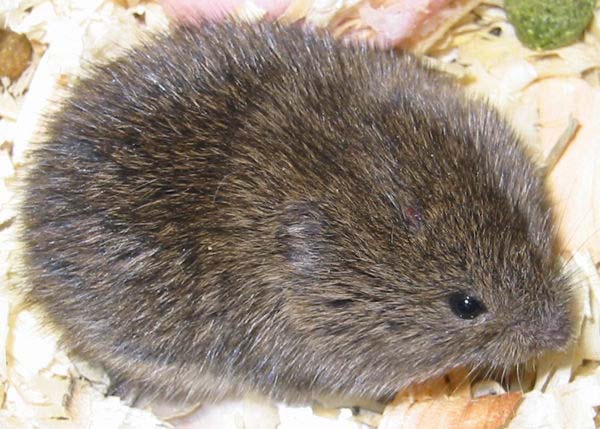 Question: I’m interested in doing regeneration planting of oaks and hickories on my property, and have made attempts with both direct seeding, as well as starting in Rootmaker containers and then planting the seedlings after one year of growth. I have been having a major problem with voles, despite my best attempts at barriers, and am wondering if there is anyone who would be able to advise me?
As an example, I had a black oak seedling, one year old, with great growth, about 18″ tall and with a root ball of comparable size, which I planted this fall. After 2-3 months, in December, the entire root system was eaten and all that remained of the seedling was the stalk, with clear gnaw-marks where it had been chewed off at the base. It was protected by a wire mesh enclosure that covered all sides plus the top, and was set about four inches into the ground. The mesh was finer than the standard chicken wire; the openings were about dime-size.
I would appreciate any guidance your experts can share.
Answer: Based on your description, it certainly sounds like pine (=woodland) voles, Microtus pinetorum, although trapping would be needed to confirm. I am no longer doing work on voles, but earlier work, Selective Feeding of Pine Voles on Roots of Seedlings, showed that they really do like roots of oak seedlings.
When I want to exclude small mammals, I use ¼ inch mesh size or smaller. One other approach I’ve used with success is to create an “apron” of hardware cloth underground and extending outward several inches from the cylinder. Since pine voles create tunnels below the ground surface, this isn’t a guarantee of exclusion, but it certainly should discourage them.
If the problem is too severe for you to tolerate, a rodenticide bait such as zinc phosphide is another option. Thiram is a repellent that could be used – like all repellents, it has variable and short-term effectiveness (but still tends to be better than other commercial products).
The following link offers some practical tips on voles and vole control, including trapping to verify that voles are present, and methods of scouting and treating with rodenticide to reduce exposure risk to other nontarget wildlife and pets, Controlling Voles in Horticulture Plantings and Orchards in Missouri, University of Missouri Extension.
Resources:
Voles!, Purdue Extension-Agronomy
Voles (remember the V), Turfgrass Science, Purdue Horticulture & Landscape Architecture
Dealing with Mole Damage in Your Yard video, Purdue Extension-Forestry & Natural Resources YouTube Channel
Orphaned Wildlife, Got Nature? blog
A Template for Your Wildlife Habitat Management Plan, The Education Store, Purdue Extension resource center
Forest Improvement Handbook, The Education Store
Wildlife Habitat Hint, Purdue Extension – Forestry & Natural Resources (FNR) YouTube Playlist
Conservation Tree Planting: Steps to Success, Purdue Extension – FNR YouTube Video
Woodland Stewardship for Landowners, Purdue Extension – FNR YouTube Playlist
Woodland Management Moment, Purdue Extension – FNR YouTube Playlist
Rob Swihart, Professor of Wildlife Ecology
Department of Forestry and Natural Resources, Purdue University
The classic and trusted book “Fifty Common Trees of Indiana” by T.E. Shaw was published in 1956 as a user-friendly guide to local species. Nearly 70 years later, the publication has been updated through a joint effort by the Purdue Department of Forestry and Natural Resources, Indiana 4-H, and the Indiana Department of Natural Resources, and reintroduced as “An Introduction to Trees of Indiana.”
The full publication is available for download for $7 in the Purdue Extension Education Store. The field guide helps identify common Indiana woodlot trees.
Each week, the Intro to Trees of Indiana web series will offer a sneak peek at one species from the book, paired with an ID That Tree video from Purdue Extension forester Lenny Farlee to help visualize each species as it stands in the woods. Threats to species health as well as also insight into the wood provided by the species, will be provided through additional resources as well as the Hardwoods of the Central Midwest exhibit of the Purdue Arboretum, if available. 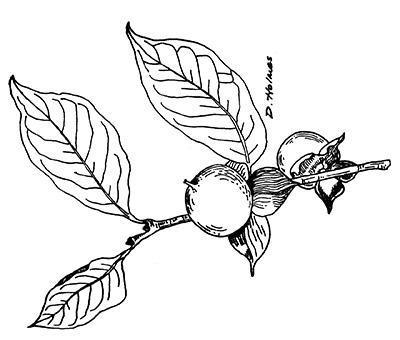
This week, we meet the persimmon or Diospyros virginiana, one of Indiana’s fruit producing trees.
The alternately held leaves of persimmon are oval shaped with smooth margins, with no lobes or teeth. The thick dark green leaves turn yellow or reddish-purple in the fall. The buds are dark colored, while leaf stems are light brown.
The bark resembles alligator hide with deep broken ridges, often with an orange coloring between the ridges.
The fruit, a pumpkin orange colored fleshy plum-like fruit, is a standout characteristic and is favored by both wildlife and humans. Once it ripens and falls from the tree, persimmon is soft and sweet. If picked from the tree, this fruit can be green, very hard, gummy in texture and acidic. The seed count in persimmon is variable with some seedless varieties and some with as many as 10 seeds.
Persimmon trees, which grow 35 to 60 feet tall, are native to southern Indiana but can be found planted across the state. This species grows best in full sun and in moist, well-drained soils, but are tolerant of alkaline soil, clay, dry sites, and occasional drought. The natural range of the persimmon is the lower Midwest and southeastern United States reaching up into southern Illinois.
For full article with additional photos view: Intro to Trees of Indiana: Persimmon, Forestry and Natural Resources’ News.
If you have any questions regarding wildlife, trees, forest management, wood products, natural resource planning or other natural resource topics, feel free to contact us by using our Ask an Expert web page.
Other Resources:
Hardwoods of the Central Midwest: Persimmon
ID That Tree: Persimmon
Morton Arboretum: Persimmon
Persimmons, The Education Store
Persimmon, Native Trees of Indiana River Walk, Purdue Fort Wayne
The Woody Plant Seed Manual, U.S. Forest Service
Fifty Common Trees of Indiana
An Introduction to Trees of Indiana
Native Trees of the Midwest, The Education Store
Shrubs and Woody Vines of Indiana and the Midwest, The Education Store
Investing in Indiana Woodlands, The Education Store
Forest Improvement Handbook, The Education Store
ID That Tree, Purdue Extension-Forestry & Natural Resources (FNR) YouTube playlist
Woodland Management Moment , Purdue Extension-FNR YouTube playlist
Wendy Mayer, FNR Communications Coordinator
Purdue University Department of Forestry and Natural Resources
Lenny Farlee, Sustaining Hardwood Extension Specialist
Purdue University Department of Forestry and Natural Resources
Wild Bulletin, IN DNR Fish and Wildlife: Bobcats, the only resident native wild cat in Indiana, are common in southern and parts of central Indiana, and increasing in northern Indiana. They are rarely seen because of their ability to blend into their surroundings and move silently.
Bobcats have been reported from almost every Indiana county but are most common in southern and west-central Indiana. A study conducted by the DNR in south-central Indiana revealed that bobcats are capable of dispersing up to 100 miles from where they were born. The DNR collects reports of bobcat sightings, trail-camera photos, and mortalities. Bobcat reports are also collected through the annual Archer’s Index, in which volunteer deer bow hunters report the number of hours they hunted and the species they saw while hunting. Snapshot Indiana, a citizen-science trail-camera survey, also helps document bobcat presence in some areas.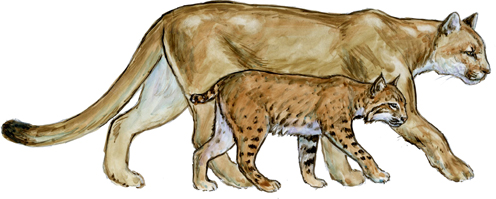
Bobcats prefer forested areas that have brushy areas, fields, or clear cuts that are beginning to regrow mixed in. Female bobcat home ranges may vary from 6–12 square miles, and male bobcat home ranges may vary from 30–75 square miles. Bobcats are primarily nocturnal, hunting and moving during early-morning and late-evening hours; however, seeing a bobcat during the day is not cause for concern.
To identify and learn more about Bobcat, please visit the Bobcat basics: Indiana’s Only Native Wild Cat.
Resources
A Template for Your Wildlife Habitat Management Plan, The Education Store, Purdue Extension resource center
Managing Your Woods for White-Tailed Deer, The Education Store
Woodland Stewardship for Landowners, Playlist, Purdue Extension – Forestry and Natural Resources YouTube channel
A Woodland Management Moment, Purdue Extension – FNR playlist
Wildlife Habitat Hint, Purdue Extension – FNR playlist
Ask an Expert: Wildlife Food Plots, Video, Purdue Extension – Forestry and Natural Resources YouTube channel
Indiana Department of Natural Resources

Recent Posts
- Beetle that attacks Tree-of-Heaven found in Indiana, Purdue Landscape Report
Posted: March 20, 2026 in Invasive Insects, Wildlife, Woodlands - ID That Tree: Dwarf Chinkapin Oak
Posted: in Forestry, Urban Forestry, Wildlife, Woodlands - DNR Hiring for Indiana Conservation Officer Positions, MyDNR
Posted: March 9, 2026 in Urban Forestry, Wildlife, Woodlands - ID That Tree: Shumard Oak
Posted: in Plants, Urban Forestry, Wildlife, Woodlands - Uniting Indiana Residents Against Invasive Species
Posted: February 27, 2026 in Community Development, Invasive Insects, Wildlife - Have You Seen a Soaring Eagle Lately? Morning Ag Clips
Posted: February 25, 2026 in Urban Forestry, Wildlife - Register for Natural Resources Teacher Institute’s Class of 2026
Posted: February 19, 2026 in Forestry, Wildlife, Woodlands - ID That Tree: Fragrant Sumac
Posted: February 4, 2026 in Plants, Urban Forestry, Wildlife - Woodsy Owl Edition for Educational Learning, USDA – U.S. Forest Service
Posted: January 21, 2026 in Forestry, Forests and Street Trees, Got Nature for Kids, Urban Forestry, Wildlife - Opt-in to the Deer Management Survey, MyDNR
Posted: January 12, 2026 in Forestry, Wildlife
Archives
Categories
- Alert
- Aquaculture/Fish
- Aquatic/Aquaculture Resources
- Ask the Expert
- Christmas Trees
- Community Development
- Disease
- Drought
- Forestry
- Forests and Street Trees
- Gardening
- Got Nature for Kids
- Great Lakes
- How To
- Invasive Animal Species
- Invasive Insects
- Invasive Plant Species
- Land Use
- Natural Resource Planning
- Nature of Teaching
- Plants
- Podcasts
- Ponds
- Publication
- Safety
- Spiders
- Timber Marketing
- Uncategorized
- Urban Forestry
- Webinar
- Wildlife
- Wood Products/Manufacturing
- Woodland Management Moment
- Woodlands