 Purdue University - Extension - Forestry and Natural Resources
Got Nature? Blog

Brian MacGowan, Wildlife Extension Specialist and Extension Coordinator.
Agriculture Natural Resources (ANR) Newsletter: Dr. Brian MacGowan is an Extension wildlife specialist and Extension coordinator in the Department of Forestry and Natural Resources (FNR). Brian grew up in rural St. Joseph County and began his career in Extension in 1999.
Part of Brian’s Extension program focuses on professional development in cooperation with many agencies and organizations including the Indiana Chapter of the Wildlife Society, Natural Resources Conservation Service, Indiana Department of Natural Resources, and Fur Takers of America. For example, Brian works with the FTA and DNR to conduct the Professional Trappers College Furbearer Management Short Course held annually since 1980. Nuisance wildlife control operators, conservation officers, wildlife biologists, and trappers attend a week-long workshop. Almost all participants report improved trapping skills (98%) and that the knowledge gained will help them in their professional career (87%).
Much of his Extension and research has focused on management on public and private woodlands. He served as a co-PI on the Hardwood Ecosystem Experiment (www.heeforeststudy.org) where he studied the effects of timber harvesting on movement and survival of timber rattlesnakes and box turtles. More recently, Brian worked with Dr. Linda Prokopy to evaluate the impact of the Forest Management for the Private Woodland Owner Course and its role in the landowner decision-making process.
Brian also co-instructs (with Dr. Rod Williams) FNR506 Theory and Application of Natural Resources Extension Programming. Since 2012, graduate students per department policy develop a logic model, an Extension plan and an Extension deliverable. In FNR506, students increase their familiarity with natural resource Extension programs, create a logic model based on their own research and Extension interests, develop a plan that outlines extension goals, and increase skills for communicating with non-scientific audiences. To date 270 students have completed the course and produced more than 400 Extension deliverables. A recent academic review showed that “integration of Extension training and activity into the graduate program has been a great success, helping students better understand the role of Extension and outreach into the land grant mission.” Based on data from course evaluations, student interest in Extension has increased 66 percent as a result of the class and 42 percent of students said they would consider a career in Extension.
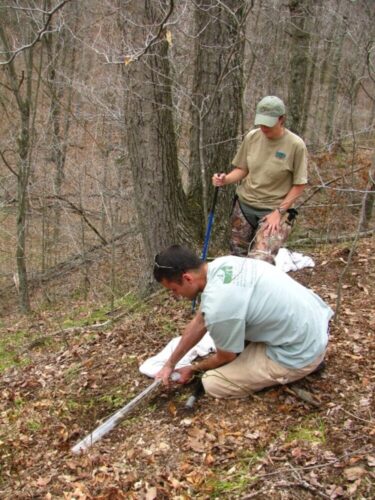
Brian conducting field work in the woods.
MacGowan launched the Natural Resources Extension internship program in 2015. This program, which is funded through the Renewable Resources Extension Act (RREA), helps students develop leadership and decision-making skills, increase communication skills, build professional references, and clarify career goals while also enhancing the scope and capacity of the FNR Extension program. Proposals are submitted to a departmental committee, which selects up to three paid internships to be awarded each funding cycle. Eric Norland, the RREA National Program leader, described the internship program as “unique and innovative” and noted “how forward-looking and beneficial (this program is) to both the program and the intern.” Thus far, 21 students have participated in internships, producing 30 videos and 16 publications, helping organize 22 workshops, making 19 presentations, hosting booths at 12 events, and contributing to 15 demonstration areas. A survey following the internships showed a 64 percent increase in a student considering a career in Extension and a 52 percent improvement in ability to speak with non-scientific audiences.
According to Brian, he received some valuable advice early in his career. “One of the best things about working in Extension is you are only limited by time and your imagination. If you have an idea that is good enough, someone will work with you to see it through.”
Agriculture & Natural Resource (ANR) is comprised of many specialists from Purdue Extension and from departments at Purdue. The Purdue Extension Educators serve as research based, unbiased information source for county and state constituents on a variety of topics including: crops, ag business, livestock, natural resource, horticulture, small farms, urban ag, pesticide use, and land conservation. In partnership with Purdue University subject matter experts, ANR Extension Educators can provide relevant and proven best management practices to address many client’s situational needs.
Resources:
Wildlife, Playlist, Purdue Extension – Forestry and Natural Resources (FNR) YouTube Channel
Ask the Expert: Birdwatching, Purdue Extension – FNR YouTube Channel
How to Stop Woodland Animals from Digging in Your Flower Pots, Got Nature? Blog with video, Purdue Extension FNR
Considerations for Trapping Nuisance Wildlife with Box Traps, The Education Store
Hardwood Ecosystem Experiment (HEE) – Wildlife Responses to Timber Harvesting, The Education Store
Snakes and Lizards of Indiana, The Education Store
Turtles of Indiana, The Education Store
Attracting Hummingbirds to Your Yard, The Education Store
Agriculture Natural Resources (ANR)
Wild Bulletin, Indiana Department of Natural Resources (DNR) Fish and Wildlife: The Eastern box turtle (Terrapene carolina) is a species of hinge-shelled turtle that lives on forested land in Indiana. Box turtles are long-lived, slow to mature and have few offspring per year. This, coupled with the high mortality rate of box turtles being hit on roads, has resulted in Eastern box turtles being a species of special concern in Indiana.
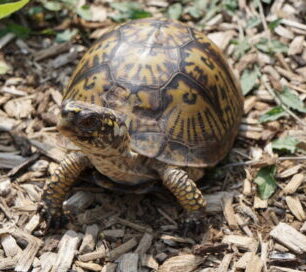
Eastern box turtles are listed as a species of special concern in Indiana due to population declines involving habitat loss, road mortality, and collection for pets. If you see one this summer, be sure to keep these guidelines in mind:
- Eastern box turtles may not be collected from the wild; however, if you accidentally catch an Eastern box turtle from Indiana from the wild, please contact the Division of Fish & Wildlife at DFW@dnr.IN.gov; do not release it into the wild. Its chances of survival are low, and it could transmit diseases to other wild Eastern box turtles.
- Sick or injured Eastern box turtles should be left in the wild. Don’t fret—box turtles are surprisingly resilient to damage and disease. If left alone, they will likely heal on their own. If a box turtle appears severely injured, it can be given to a licensed rehabilitator or licensed veterinarian.
If you see a wild Eastern box turtle crossing a busy road, you can pick it up and move it to the other side of the road in the direction it was facing. DNR appreciates your efforts to conserve wildlife.
To identify and learn more about the Eastern box turtle, please visit the DNR: Fish and Wildlife: Eastern Box Turtle website
Resources
Turtles of Indiana, The Education Store
Appreciating Reptiles and Amphibians in Nature, The Education Store
Forestry Management for Reptiles and Amphibians: A Technical Guide for the Midwest, The Education Store
The Nature of Teaching, Unit 3: Reptiles, Amphibians, and the Scientific Method, The Education Store
Partners in Amphibian and Reptile Conservation (PARC)
Ask An Expert, Purdue Extension – FNR Playlist
Indiana Department of Natural Resources
What is phenology and how do we observe seasonal changes in nature? In this webinar hosted by Indiana Forestry & Woodland Owners Association (IFWOA), presenter Amanda Wanless of Indiana Phenology discusses how you can observe seasonal change on your landscape and ways to monitor the changes. Find out how to join a citizens science network collecting long term data.
Check out the Indiana Forestry & Woodland Association YouTube Channel for videos including: What is IFWOA?; A New Carbon Program for Hardwood Landowners Webinar, Indiana’s Native Orchids, Magnificent Trees of Indiana, Be Tick Aware and much more.
The Indiana Forestry & Woodland Owners Association (IFWOA) was founded in 1977 and is a non-profit organization dedicated to conservation and sustainable management of woodlands in Indiana. IFWOA advocates for scientific best practices for management to achieve objectives of clean water, wildlife habitat, soil protection, native species diversity, timber production, recreation, carbon sequestration and many others.
IFWOA is an affiliate of the National Woodland Owners Association. IFWOA is a partner, collaborator or is represented on leading National and State organizations. These memberships or collaborations are selected to advance Indiana Woodland owner’s interests. IFWOA monitors and influences legislation and economic trends impacting Indiana woodlands and landowners for our members. Membership in IFWOA provides a valuable network linkage to information and resources at the leading edge of science, industry and politics impacting Indiana woodlands.
Resources:
Nature’s Notebook, USA National Phenology Network
Forest Improvement Handbook, The Education Store, Purdue Extension’s resource center
Harvesting our forests, the wildlife debate, Purdue Extension – Forestry and Natural Resources (FNR) Got Nature? Blog
Wildlife Responses to Timber Harvesting, The Education Store
Breeding Birds and Forest Management: the Hardwood Ecosystem Experiment and the Central Hardwoods Region, The Education Store
Forest Management for Reptiles and Amphibians: A Technical Guide for the Midwest, The Education Store
Hardwood Ecosystem Experiment – Forest Birds , Purdue Extension – FNR YouTube Channel
Managing Woodlands for Birds , Purdue Extension – FNR YouTube Channel
Sustaining Our Oak-Hickory Forests , Purdue Extension – FNR YouTube Channel
Ask the Expert: Hardwood Ecosystem Experiment – Birds and Salamander Research, Purdue Extension – FNR
Subscribe to Purdue Extension-FNR YouTube Channel
Liz Jackson, Engagement Lead
Indiana Forestry & Woodland Association
In this webinar, hosted by Indiana Forestry & Woodland Owners Association (IFWOA), presenter LeAnne Barta of Indiana Lyme Connect shares strategies for preventing tick bites and discuss the ticks found in Indiana, their life stages, and symptoms of tick-borne illnesses like Lyme disease.
Check out the Indiana Forestry & Woodland Association YouTube Channel for videos including: What is IFWOA?; A New Carbon Program for Hardwood Landowners Webinar, Indiana’s Native Orchids, Magnificent Trees of Indiana, Observing Seasonal Changes in Nature and much more.
The Indiana Forestry & Woodland Owners Association (IFWOA) was founded in 1977 and is a non-profit organization dedicated to conservation and sustainable management of woodlands in Indiana. IFWOA advocates for scientific best practices for management to achieve objectives of clean water, wildlife habitat, soil protection, native species diversity, timber production, recreation, carbon sequestration and many others.
IFWOA is an affiliate of the National Woodland Owners Association. IFWOA is a partner, collaborator or is represented on leading National and State organizations. These memberships or collaborations are selected to advance Indiana Woodland owner’s interests. IFWOA monitors and influences legislation and economic trends impacting Indiana woodlands and landowners for our members. Membership in IFWOA provides a valuable network linkage to information and resources at the leading edge of science, industry and politics impacting Indiana woodlands.
Resources:
Find an Indiana Professional Forester, Indiana Forestry & Woodland Owners Association (IFWOA)
Purdue Arboretum Explorer
Native Trees of the Midwest, Purdue University Press
Shrubs and Woody Vines of Indiana and the Midwest, Purdue University Press
Investing in Indiana Woodlands, The Education Store
Forest Improvement Handbook, The Education Store
ID That Tree, Purdue Extension-Forestry & Natural Resources (FNR) YouTube playlist
Woodland Management Moment , Purdue Extension-FNR YouTube playlist
Liz Jackson, Engagement Lead
Indiana Forestry & Woodland Association
Illinois-Indiana Sea Grant Newsroom: During large rainstorms, many Illinois residents brace themselves for flooding in their basements, streets and neighborhoods. A new online tool, Illinois Groundwork, provides communities and stormwater professionals with resources on green stormwater infrastructure, which provides a way for rain to be absorbed into soil where it lands.
Green stormwater infrastructure offers a way to enhance traditional or “grey” infrastructure using a rain garden or permeable pavement but this approach doesn’t always work as well as it might. Improving access to, and use of, data, research and other resources can help increase the effectiveness of green infrastructure in addressing stormwater management challenges.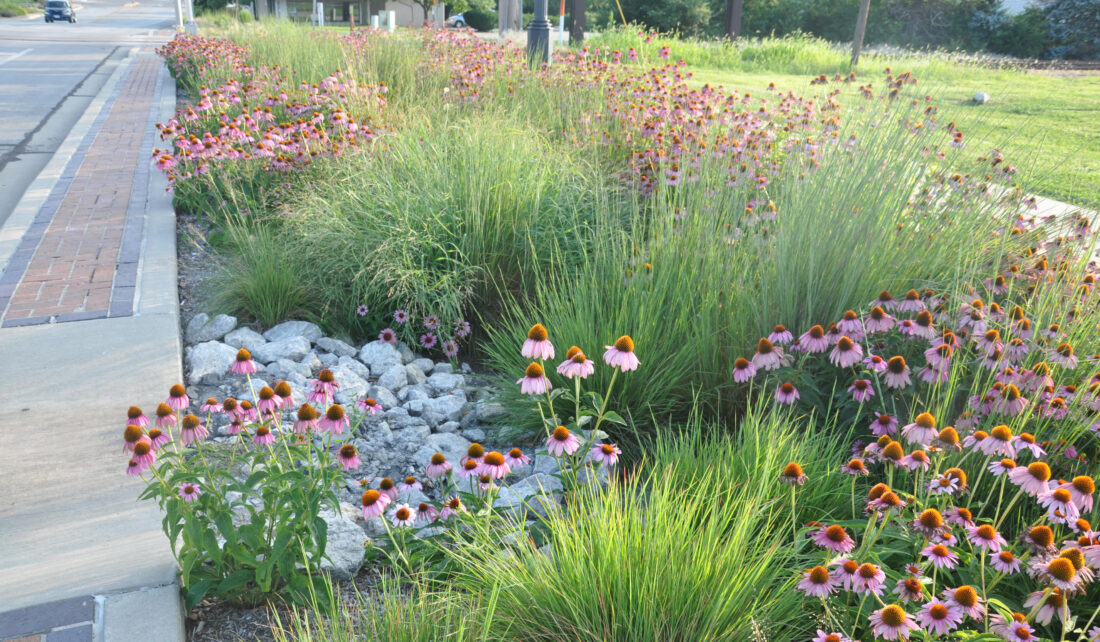
“The University of Illinois not only has relevant research and data across many departments, but also real-world examples of successful green infrastructure, along with other extension and education tools, such as the Red Oak Rain Garden,” said C. Eliana Brown, University of Illinois Extension stormwater specialist. “This new tool brings these resources together, providing a robust platform to access green infrastructure knowledge.”
For full article and videos please visit Illinois Groundwork provides a rich supply of green infrastructure resources – IISG
About IISG: These are trying times for the environment. Climate change and other concerns such as population growth, aquatic invasive species, contaminated waters, and loss of natural habitat, the southern Lake Michigan region faces many challenges. Illinois-Indiana Sea Grant (IISG), with its unique mandate to bring the latest science to those who can best use the information, serves a critical role in empowering people to solve problems in sustainable ways. The program is funded through National Oceanic and Atmospheric Administration (NOAA), the University of Illinois and Purdue University, but IISG also works in partnerships with key organizations, institutions, and agencies in the region to reach more audiences and multiply opportunities for success. IISG brings together scientists, educators, policy makers, community decision makers, outreach specialists, business leaders, and the general public to work towards a healthy environment and economy.
Resources
Center For Great Lakes Literacy (CGLL), Website
Ask An Expert: Hot and Cold, Video, Purdue Extension – Forestry and Natural Resources YouTube channel
Informing the Development of the Great Lakes Region Decision Support System, The Education Store, Purdue Extension’s resource center
Urban Best Management & Low Impact Development Practices, The Education Store
Improving Water Quality Around Your Farm, The Education Store
New website: Eat Midwest Fish, Got Nature? Blog, Purdue Extension – Forestry and Natural Resources (FNR)
Scientists bring the Great Lakes to students learning from home, Got Nature? Blog
Adaptations for Aquatic Amphibians Activity 2: Water Quality Sneak Peak, Purdue Nature of Teaching
Illinois-Indiana Sea Grant (IISG)
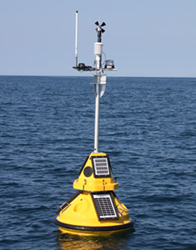
Illinois-Indiana Sea Grant Newsroom: May 2022, Illinois-Indiana Sea Grant (IISG) launched its third buoy in southern Lake Michigan—this one based in the busy waters off Navy Pier. This new buoy with its flow of in-the-moment data is helping the National Weather Service (NWS) Chicago develop more accurate forecasts and warnings, especially related to nearshore wave heights and wind speeds.
This third buoy, known affectionately as Chuoy, joins IISG buoys in the nearshore waters of Michigan City, Indiana and Wilmette, Illinois. Together, these three, along with two University of Illinois buoys closer to the Wisconsin border, paint a comprehensive picture of coastal lake conditions in the two states. In addition to meteorologists, the data is used by scientists, boaters, anglers and beach goers.
“Information from these buoys allows recreational water users to make better informed decisions when it comes to safety,” said Ben Szczygiel, IISG buoy specialist. “The data allows people to plan for current conditions and avoid the water when there are increased safety concerns.”
For full article and videos please visit New to Navy Pier waters, Chuoy the Buoy proved a valuable forecasting tool-IISG
About IISG: These are trying times for the environment. Climate change and other concerns such as population growth, aquatic invasive species, contaminated waters, and loss of natural habitat, the southern Lake Michigan region faces many challenges. Illinois-Indiana Sea Grant (IISG), with its unique mandate to bring the latest science to those who can best use the information, serves a critical role in empowering people to solve problems in sustainable ways. The program is funded through National Oceanic and Atmospheric Administration (NOAA), the University of Illinois and Purdue University, but IISG also works in partnerships with key organizations, institutions, and agencies in the region to reach more audiences and multiply opportunities for success. IISG brings together scientists, educators, policy makers, community decision makers, outreach specialists, business leaders, and the general public to work towards a healthy environment and economy.
Resources
Center For Great Lakes Literacy (CGLL), Website
Ask An Expert: Hot and Cold, Video, Purdue Extension – Forestry and Natural Resources YouTube channel
Informing the Development of the Great Lakes Region Decision Support System, The Education Store, Purdue Extension’s resource center
Urban Best Management & Low Impact Development Practices, The Education Store
Improving Water Quality Around Your Farm, The Education Store
New website: Eat Midwest Fish, Got Nature? Blog, Purdue Extension – Forestry and Natural Resources (FNR)
Scientists bring the Great Lakes to students learning from home, Got Nature? Blog
Adaptations for Aquatic Amphibians Activity 2: Water Quality Sneak Peak, Purdue Nature of Teaching
Illinois-Indiana Sea Grant (IISG)
MyDNR, Indiana’s Outdoor Newsletter: The Indiana Natural Resources Foundation, in partnership with the Division of Forestry, is planning another busy year for the Indiana Tree Project. In 2022, more than 11,000 trees were added to Indiana’s public lands through Indiana Tree Project plantings, and this year is expected to be another successful year.
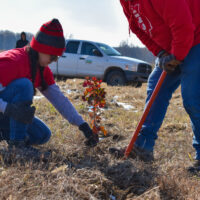
Through a partnership with the Division of Forestry, we are helping Indiana’s forests grow, one tree at a time, with the Indiana Tree Project. Healthy forests in Indiana promote wildlife habitats, clean air and an abundance of outdoor recreation opportunities. It is estimated that 85 percent of Indiana was once forested. Today, only 19 percent of the state is forested. The Indiana Tree Project is much more than just planting trees. Through this project we are adding new acreage to Indiana’s State Forests and we’re trying to add 1,000 acres of new forested land.
When you support the Indiana Tree Project, we provide you with an official tree certificate to demonstrate your support for the smart management of Hoosier forests. It includes the coordinates for the acre on which your tree is, or will be, planted.
Newsletter can be found online: MyDNR Email Newsletter
For more information please visit Help Grow Indiana’s Forests – MyDNR
Resources:
Forest Improvement Handbook, The Education Store, Purdue Extension’s resource center
Harvesting our forests, the wildlife debate, Purdue Extension – Forestry and Natural Resources (FNR) Got Nature? Blog
Wildlife Responses to Timber Harvesting, The Education Store
Breeding Birds and Forest Management: the Hardwood Ecosystem Experiment and the Central Hardwoods Region, The Education Store
Forest Management for Reptiles and Amphibians: A Technical Guide for the Midwest, The Education Store
Hardwood Ecosystem Experiment – Forest Birds , Purdue Extension – FNR YouTube Channel
Managing Woodlands for Birds , Purdue Extension – FNR YouTube Channel
Sustaining Our Oak-Hickory Forests , Purdue Extension – FNR YouTube Channel
Ask the Expert: Hardwood Ecosystem Experiment – Birds and Salamander Research, Purdue Extension – FNR
Subscribe to Purdue Extension-FNR YouTube Channel
Indiana Department of Natural Resources, Department of Fish & Wildlife
In this episode of ID That Tree, Recep Yildiz a FNR graduate student shares his expertise on how to ID black alder. Black alder, which is also known as common alder or European alder, is found in most of Europe and extends into North Africa and Asia. It is easily identified by its gummy twigs and leaves. Learn more about the black alder tree and how it was introduced to Indiana with now current warning signs of being an invasive species.
If you have any questions regarding wildlife, trees, forest management, wood products, natural resource planning or other natural resource topics, feel free to contact us by using our Ask an Expert web page.
Resources:
ID That Tree, Playlist, Purdue Extension – Forestry and Natural Resources YouTube Channel (Invasive White Mulberry, Siberian Elm, Tree of Heaven)
Invasive Species Playlist, Playlist, Purdue Extension – FNR YouTube Channel (Asian Bush Honeysuckle, Burning Bush, Callery Pear, Multiflora rose)
A Woodland Management Moment, Playlist, Purdue Extension – FNR YouTube Channel (Against Invasives, Garlic Mustard, Autumn Olive)
Woodland Stewardship for Landowners, Playlist, Purdue Extension – FNR YouTube Channel (Common Buckthorn, Japanese Barberry)
Report Invasive Species, Purdue Invasive Species
The GLEDN Phone App – Great Lakes Early Detection Network
EDDMaps – Early Detection and Distribution Mapping System
How long do seeds of the invasive tree, Ailanthus altissima remain viable? (Invasive Tree of Heaven), USDA Forest Service
Indiana Department of Natural Resources: Invasive Species
Indiana Invasive Species Council
Cooperative Invasive Species Management Area (CISMA)
Aquatic Invasive Species, Illinois-Indiana Sea Grant (IISG)
Episode 11 – Exploring the challenges of Invasive Species, Habitat University-Natural Resource University
What are invasive species and why should I care?, Got Nature? Blog, Purdue Extension – FNR
Spotted Lanternfly Feeds on Over 70 Plus Plant Species, Got Nature? Blog, Purdue Extension – FNR
Shrubs and Woody Vines of Indiana and the Midwest, The Education Store, Purdue Extension Resource Center
Native Trees of the Midwest, The Education Store
Investing in Indiana Woodlands, The Education Store
Forest Improvement Handbook, The Education Store
Recep Yildiz, FNR graduate student
Purdue Department of Forestry & Natural Resources

The clitellum, the set of pale, milky colored segments, is the reproductive organ of earthworms.
Purdue Landscape Report: Asian jumping worms, a group of invasive earthworms, have gained a significant amount of media attention in the last several weeks, and for good reason. Unlike the nightcrawlers and other earthworms we know, Asian jumping worms do not improve soil health to the benefit of plants. Instead, jumping worms (also called crazy worms, snake worms, or ‘Alabama jumpers’) almost completely strip nutrients out of soil, altering the soil structure and severely impairing the ability to develop many kinds of plants. After they are done with an area, Asian jumping worms leave behind soil that has a texture similar to that of coffee grounds and very low nutritional value. On top of this, Asian jumping worms are capable of reproducing asexually, allowing their population to grow very rapidly and making them an invasive species of some concern.
Identification
The good news is that Asian jumping worms are not well-suited to Indiana’s environment. They aren’t capable of surviving winters in any life stage except as an egg, meaning their activity periods are limited to late June to the first hard frost of the year. If you see worms outside of this period, it’s highly unlikely an Asian jumping worm. There are also a few traits the worms have that you can use to visually confirm their identity. First off, Asian jumping worms are accurately named; when handled, they writhe and thrash similar to snakes, setting them apart from common earthworms and nightcrawlers. Jumping worms also tend to have drier skin that has an almost iridescent appearance, as compared to the slimy, moist texture of the beneficial earthworms we need for good soil health. The most consistent feature is an organ known as the clitellum, or the reproductive organs of worms. On common earthworms, this looks like a saddle-shape that partially covers several segments, is normally reddish-brown, and is raised off the surface of the body. On an Asian jumping worm, however, the clitellum is indistinguishable from other segments, save for their pale, milky color.
To view this article and other Purdue Landscape Report articles, please visit Purdue Landscape Report.
Subscribe and receive the newsletter: Purdue Landscape Report Newsletter.
Resources:
The Purdue Landscape Report
Purdue Landscape Report Facebook Page
Gardeners Asked to be Vigilant This Spring for Invasive Jumping Worm, Purdue Extension – FNR Got Nature? Blog
Fall webworms: Should you manage them?, Purdue Landscape Report
Mimosa Webworm, The Education Store, Purdue Extension resource center
Sod Webworms, Turf Science at Purdue University
Bagworm caterpillars are out feeding, be ready to spray your trees, Purdue Extension Forestry & Natural Resources (FNR) Got Nature? Blog
Purdue Plant Doctor App Suite, Purdue Extension-Entomology
Landscape & Ornamentals: Bagworms, The Education Store
What are invasive species and why should I care? (How to report invasives.), Purdue Extension – FNR Got Nature? Blog
Indiana Invasive Species Council
Ask An Expert, Purdue Extension-Forestry & Natural Resources
Bob Bruner, Exotic Forest Pest Specialist
Purdue Department of Entomology
This is the eighth in a series of consumer guides that describe fish and shellfish farmed in the Midwest region of the United States. The fact sheet also includes culinary characteristics, cooking tips and a recipe for Easy Baked Salmon.
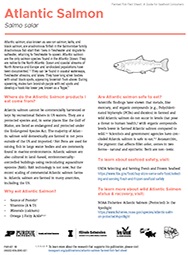
Atlantic salmon, also known as sea-run salmon, kelts, and black salmon, are anadromous finfish in the Salmonidae family. Anadromous fish start their lives in freshwater and migrate to saltwater, returning to freshwater to spawn. Atlantic salmon are the only salmon species found in the Atlantic Ocean. They are native to the North Atlantic Ocean and coastal streams of North America and Europe and landlocked populations have been documented.1,2 They can be found in coastal waterways, freshwater streams, and lakes. They have long silver bodies with small black spots, appearing brownish from above. During spawning, males turn bronzish-purple with red spots and develop a hook-like lower jaw, known as a “kype.”
To receive the free download for the Atlantic Salmon Farmed Fish Fact Sheet please visit The Education Store.
Resources:
Walleye Farmed Fish Fact Sheet, The Education Store, Purdue Extension’s resource center
Pacific White Shrimp Farmed Fact Sheet, The Education Store
Yellow Perch Farmed Fish Fact Sheet, The Education Store
Tilapia Farmed Fish Fact Sheet, The Education Store
Rainbow Trout Farmed Fish Fact Sheet, The Education Store
American Paddlefish, The Education Store
A Guide to Small-Scale Fish Processing Using Local Kitchen Facilities, The Education Store
Aquaculture Family Coloring Book Development, The Education Store
Eat Midwest Fish, Illinois-Indiana Sea Grant online resource hub
Aquatics & Fisheries Videos, Purdue Extension-Forestry and Natural Resources YouTube Channel Playlist
Channel Catfish, The Education Store
Amy Shambach, Aquaculture Marketing Outreach Associate
Purdue Department of Forestry and Natural Resources/Illinois Indiana Sea Grant Program

Recent Posts
- Purdue Extension’s Regional Teams Are Here: Connecting Communities with Expertise and Opportunity
Posted: October 14, 2026 in Community Development, Forestry, Forests and Street Trees, Gardening, How To, Timber Marketing, Urban Forestry, Wildlife, Woodlands - Deer and Turkey Archery Seasons Opening Soon, MyDNR
Posted: October 13, 2026 in Alert, Safety, Wildlife - Distinguishing Dogwoods
Posted: in Forestry, Urban Forestry, Wildlife, Woodlands - Can I Plant Trees in the Fall?
Posted: October 12, 2026 in Forestry, How To, Land Use, Plants, Urban Forestry, Wildlife - Publication Helps Midwest Fish Producers “Catch a Following” with Consumers
Posted: in Aquaculture/Fish, Aquatic/Aquaculture Resources, Wildlife - Minecraft Meets the Hellbender
Posted: September 22, 2026 in Aquaculture/Fish, Aquatic/Aquaculture Resources, Wildlife - What You Plant Matters to Wildlife
Posted: September 16, 2026 in Plants, Urban Forestry, Wildlife - Woodland Flowers of Late Summer
Posted: September 14, 2026 in Forestry, Gardening, Wildlife, Woodlands - Heavy August Rains Bring More Mosquitoes to Indiana
Posted: September 9, 2026 in How To, Invasive Insects, Safety, Wildlife - New Indiana Woodland Steward Newsletter
Posted: August 12, 2026 in Forestry, Urban Forestry, Wildlife, Woodlands
Archives
Categories
- Alert
- Aquaculture/Fish
- Aquatic/Aquaculture Resources
- Ask the Expert
- Christmas Trees
- Community Development
- Disease
- Drought
- Forestry
- Forests and Street Trees
- Gardening
- Got Nature for Kids
- Great Lakes
- How To
- Invasive Animal Species
- Invasive Insects
- Invasive Plant Species
- Land Use
- Natural Resource Planning
- Nature of Teaching
- Plants
- Podcasts
- Ponds
- Publication
- Safety
- Spiders
- Timber Marketing
- Urban Forestry
- Webinar
- Wildlife
- Wood Products/Manufacturing
- Woodland Management Moment
- Woodlands