 Purdue University - Extension - Forestry and Natural Resources
Got Nature? Blog
In this webinar hosted by Indiana Forestry & Woodland Owners Association, ecologist Michael Homoya discusses the many naturally occurring species of orchids in Indiana and their range, habitats and blooming seasons. This presentation will look at a selection of them and discuss their floral characteristics as well as range, habitat, and blooming seasons. Michael Homoya served as Botanist/Plant Ecologist for the Indiana Department of Natural Resources, Division of Nature Preserves for 37 years before retiring in 2019. He has written over 75 scientific papers, popular articles, and books about Indiana’s natural features, including Orchids of Indiana, Wildflowers and Ferns of Indiana Forests: A Field Guide, Wake Up, Woods, and Wildflowers of the Midwest.
Check out the Indiana Forestry & Woodland Association YouTube Channel for videos including: What is IFWOA?; A New Carbon Program for Hardwood Landowners Webinar, Indiana’s Native Orchids, Magnificent Trees of Indiana, Be Tick Aware and much more.
The Indiana Forestry & Woodland Owners Association (IFWOA) was founded in 1977 and is a non-profit organization dedicated to conservation and sustainable management of woodlands in Indiana. IFWOA advocates for scientific best practices for management to achieve objectives of clean water, wildlife habitat, soil protection, native species diversity, timber production, recreation, carbon sequestration and many others.
IFWOA is an affiliate of the National Woodland Owners Association. IFWOA is a partner, collaborator or is represented on leading National and State organizations. These memberships or collaborations are selected to advance Indiana Woodland owner’s interests. IFWOA monitors and influences legislation and economic trends impacting Indiana woodlands and landowners for our members. Membership in IFWOA provides a valuable network linkage to information and resources at the leading edge of science, industry and politics impacting Indiana woodlands.
Resources:
Orchids of Indiana, Google Books
Wildflowers and Ferns of Indiana Forests: A Field Guide, Google Books
Wildflowers of the Midwest, Google Books
Magnificent Trees of Indiana, Purdue University Press
Forest Improvement Handbook, The Education Store, Purdue Extension’s resource center
Planting Hardwood Seedlings – The Education Store
Ordering Seedlings from the State Forest Nursery System, Got Nature? – Purdue Extension-FNR
Importance of Hardwood Tree Planting – The Education Store, Purdue Extension Resource Center
Forest Improvement Handbook – The Education Store
Designing Hardwood Tree Plantings for Wildlife – The Education Store
ID That Tree – YouTube Playlist
Forest Management for Reptiles and Amphibians: A Technical Guide for the Midwest, The Education Store
Hardwood Ecosystem Experiment – Forest Birds , Purdue Extension – FNR YouTube Channel
Managing Woodlands for Birds , Purdue Extension – FNR YouTube Channel
Sustaining Our Oak-Hickory Forests , Purdue Extension – FNR YouTube Channel
Ask the Expert: Hardwood Ecosystem Experiment – Birds and Salamander Research, Purdue Extension – FNR
Subscribe to Purdue Extension-FNR YouTube Channel
Liz Jackson, Engagement Lead
Indiana Forestry & Woodland Association
Before embarking on a 40-plus year career guiding students and constituents across the state on the topics of timber tax and forest economics, becoming known as the Purdue Forestry and Natural Resources historian or pitching in on various community projects to promote forest maintenance and recreation, Dr. Bill Hoover began his career of service in the U.S. Army Corps of Engineers as a basic training officer and later a combat engineering battalion operations officer in Vietnam.
Hoover grew up with military men on both sides of his family and was mentored by several World War II veterans as a member of the Boy Scouts.
“Most of my Boy Scout leaders took it as their role to prepare us for military service,” Hoover explained. “Attending Penn State, a land grant college, meant I was required to take ROTC courses and drills for two years. Advanced ROTC seemed like the logical choice since serving as an officer was better than as an enlisted grunt.”
After graduating from Penn State in December 1966 with his bachelor’s degree in forest management and a commission as a second lieutenant reserve officer in the U.S. Army, Hoover reported for training in Ft. Belvoir, Virginia, where he learned to be a combat engineer junior officer. From there, he moved on to Ft. Lewis, Washington, where he taught classes on all phases of military life and supervised enlisted officers, and finally to the Mojave Desert, where he participated in training evaluation. Just after Christmas in 1967, Hoover deployed to Vietnam as a combat engineer in the 39th engineer battalion, 18th engineer brigade.
Just over a year later, Hoover returned home on Dec. 29, 1968, and was relieved from active duty two weeks later. Months later, he was awarded a Bronze Star for Meritorious Service for his efforts, which included everything from construction of bunkers and other structures to bridge building and culvert replacements, supervision of material distribution to field companies, and daily mine sweeps.
“I don’t remember ever firing my weapon. I learned to work with men in tough situations and I experienced a new culture,” Hoover said. “The recommendation from the Battalion Commander got me into graduate school at Penn State, not my academic record. The GI Bill with the assistantship provide sufficient income to lead a pleasant life in State College. I didn’t use up the GI Bill benefit until my first year at Iowa State University for my PhD program.”
In 1974-75, an influx of talent joined the FNR faculty ranks. Joe O’Leary, Harmon “Mickey” Weeks, Harvey Holt, Ann Spacey and Bill Hoover were all hired that year and all would go on to join the ranks of FNR’s professor emeritus list.
“Mr. Bill Hoover, a candidate for the PhD in economics from Iowa State, joined the faculty as a teacher and research in forest economics with a specialization in econometrics,” first year department head Mason Carter said in his opening letter of the 1975 FNR Log book.
While Hoover may have been hired for his knowledge of econometrics, or the application of statistics and economic models, he would make his impact on the department in other ways.
“My value appeared to be in other places and I was hired to work with the folks in the wood research lab in marketing and feasibility studies working with Carl Eckelman on laminated veneer lumber and Mike Hunt on composite panels,” Hoover said. “The nature of the work was to identify potential markets, help design a product that would best serve those, produce samples, test them and give samples to potential use adopters. Laminated veneer and lumber type products were less common at the time. The price of lumber got high enough that substitute products made sense and I did economic feasibility studies for the manufacturers of the products.”
Hoover’s name also became synonymous with wood products throughout the state of Indiana through his production of the Indiana Forest Products Price Report, a yearly publication he undertook his second year at Purdue and continued until he handed it off to the Indiana Division of Forestry upon his retirement in 2013. The later-defunct publication is currently being revived in a virtual format by Dr. Mo Zhou.
“It was a survey of mills,” Hoover explained. “It was a questionnaire asking for the prices they paid for delivered logs for a wide variety of species, for sawed logs of four grades and of veneer logs of five species and two grades. It was done in cooperation with Ag statistics. I maintained the mailing list and they mailed it out. It had increased validity come from that group.”
To view this full article, please visit our 2023 FNR News & Stories page.
Resources:
FNR Former Faculty
Investing in Indiana Woodlands, The Education Store, Purdue Extension’s resource center
Financial and Tax Aspects of Tree Planting, The Education Store
Determining Tax Basis of Timber, The Education Store
How to Treat Timber Sale Income, The Education Store
Protection of Forest Land in Indiana, The Education Store
Tax Treatment of Conservation Easements, The Education Store
Marketing Timber, The Education Store
Tips on How to Get the Most from Your Timber Harvest, The Education Store
Predicting Black Walnut Log Prices, The Education Store
Wendy Mayer, FNR Communications Coordinator
Purdue University Department of Forestry and Natural Resources
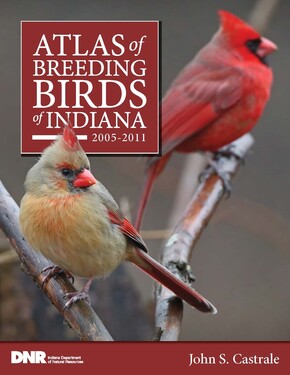 MyDNR, Indiana’s Outdoor Newsletter: The latest Breeding Bird Atlas is available. The Division of Fish & Wildlife thanks all atlas participants for their hard work and patience as we worked together to complete this multi-year feat.
The 2005-2011 Atlas of Breeding Birds of Indiana is essential to conservation efforts, as it provides information on breeding occurrences and habitats of rare birds. Not only does it identify new habitat locations for our state’s birds, but it also provides baseline data that can be used for studies on future populations.
Add some color to your day by browsing through the atlas and its beautiful photos of the native birds of Indiana.
Newsletter can be found online: MyDNR Email Newsletter
For more information please visit DNR: Fish & Wildlife: Breeding Bird Atlas.
Resources:
Breeding Birds and Forest Management: the Hardwood Ecosystem Experiment and the Central Hardwoods Region, The Education Store, Purdue Extension – Forestry and Natural Resources
Forest Birds, The Education Store
Managing Woodlands for Birds, The Education Store
Managing Woodlands for Birds Video, Purdue Extension-Forestry and Natural Resources (FNR) YouTube Channel
Breeding Birds and Forest Management: the Hardwood Ecosystem Experiment and the Central Hardwoods Region, The Education Store
The Birders’ Dozen, Profile: Baltimore Oriole, Indiana Woodland Steward
Ask An Expert, Playlist, Purdue Extension – FNR YouTube channel
It’s For the Birds, Indiana Yard and Garden-Purdue Consumer Horticulture
Birds and Residential Window Strikes: Tips for Prevention, The Education Store, Purdue Extension resource center
No Room at the Inn: Suburban Backyards and Migratory Birds, Education Store, Purdue Extension resource center
Indiana Department of Natural Resources, Department of Fish & Wildlife
 MyDNR, Indiana’s Outdoor Newsletter: Did you know that Indiana’s waterways can be altered by the presence of aquatic invasive species? Non-native plants, animals, and organisms can disrupt bodies of water and ecosystems, threatening sport fisheries and other commercial resources.
If you’re wondering what you can do to help prevent the spread of aquatic invasive species, there are many easy steps that Hoosiers and out-of-state visitors can take to stop aquatic hitchhikers:
- Clean off any animals, plants, and mud from any angling or boating gear.
- Drain the water from watercrafts, bladder tanks, bilges, motors, livewells, and portable bait containers before leaving the water access area.
- Make sure everything air-dries for five days or longer or is dried with a towel.
- Dispose of any unwanted or unused bait, fish parts, and packing materials in the trash, rather than on the ground or in water. Remember, littering harms the environment.
DNR is counting on you to help protect Indiana’s waterways and species.
Newsletter can be found online: MyDNR Email Newsletter
For more information please visit DNR: Fish & Wildlife: Aquatic Invasive Species (AIS).
Resources:
Invasive Mussels, IN DNR Fish and Wildlife
Aquatic Invasive Species in the Great Lakes: The Quagga Mussel, Purdue Extension – Forestry & Natural Resources (FNR) Got Nature? Blog
Aquatic Invaders in the Marketplace, Illinois-Indiana Sea Grant (IISG)
Invasive Species, Playlist, Purdue Extension – FNR YouTube Channel
What are invasive species and why should I care?, Got Nature? Blog, Purdue Extension – Forestry and Natural Resources
Report Invasive Species, Purdue Invasive Species
The GLEDN Phone App – Great Lakes Early Detection Network
EDDMaps – Early Detection and Distribution Mapping System
Indiana Department of Natural Resources: Invasive Species
Indiana Invasive Species Council
Cooperative Invasive Species Management Area (CISMA)
Great Lakes Sea Grant Network (GLERL), NOAA – Great Lakes Environmental Research Laboratory
A Field Guide to Fish Invaders of the Great Lake Regions, Illinois-Indiana Sea Grant (IISG)
Purdue Researchers Get to the Bottom of Another Quagga Mussel Impact, Illinois-Indiana Sea Grant (IISG)
Invasive plants: Impact on Environment and People, The Education Store, Purdue Extension’s resource center
Protect Your Waters, U.S. Fish and Wildlife Service & U.S. Coast Guard
Nongame and Endangered Wildlife, Indiana Department of Natural Resources
Indiana Department of Natural Resources, Department of Fish & Wildlife
 MyDNR, Indiana’s Outdoor Newsletter: Out with the old, in with the new! Our upgraded, free DNR smartphone app is now available to guide you to the best places for outdoor exploration in Indiana. View the nearest State Parks, Fish & Wildlife areas, State Forests, Archery & Shooting Ranges, Nature Preserves, and more.
With a fresh interface, better maps, and more content, you’ll be the most prepared explorer in the wild. DNR app-reciates you!
Whether you are just visiting, hunting, fishing or staying at a campground or state park inn, we hope you will find this portable guide to DNR properties and services useful. Please send questions or suggestions to dnrwebmaster@dnr.IN.gov. Don’t forget to leave a review on the app stores.
Newsletter can be found online: MyDNR Email Newsletter
For more information please visit Communications: Indiana DNR Smartphone Apps
Resources:
Wildfire Prevention, National Association of State Foresters
Ask the Expert: Learn All About Hellbenders and Take a Tour, Subscribe Purdue Extension – Forestry & Natural Resources (FNR) YouTube Channel
Managing Woodlands for Birds Video, Purdue Extension-Forestry and Natural Resources (FNR) YouTube Channel
Ask the Expert: What’s Buzzing or Not Buzzin About Pollinators, Purdue Extension – FNR YouTube Channel.
Observing Seasonal Changes in Nature-IFWOA Webinar | Purdue Extension Forestry & Natural Resources , Purdue Extension – FNR Got Nature? Blog
Report if You See a Spotted Lanternfly – MyDNR , Purdue Extension – FNR Got Nature? Blog
What are invasive species and why should I care?, Got Nature? Blog, Purdue Extension – FNR
Report Invasive, Purdue College of Agriculture – Entomology
Indiana Department of Natural Resources, Department of Fish & Wildlife
Join alumna Megan Benage, a regional ecologist for the Minnesota Department of Natural Resources, and Bee Redfield, a postgraduate research assistant, as they explore the world of pollinators. They cover the who’s, the what’s and how’s of pollination as well as how you can help bring pollinators to your yard and help the pollinator population in general. They also share about ongoing research and cool projects related to pollinators.
If you have any questions regarding wildlife, trees, forest management, wood products, natural resource planning or other natural resource topics, feel free to contact us by using our Ask an Expert web page.
Resources
Protecting Pollinators: Biology and Control of Varroa Mites in Bee Hives, The Education Store, Purdue Extension resource center
The Complex Life of the Honey Bee: Environmental, Biological, and Chemical Challenges to Colony Health, The Education Store
Pollinator Protection, Website, Purdue Extension
Gardening for Pollinators, Purdue Graden Articles
Megan Benage, Regional Ecologist
Minnesota Department of Natural Resources
Bee Redfield, Postgraduate Research Assistant
Purdue Forestry and Natural Resources
MyDNR, Indiana’s Outdoor Newsletter: Blotchy bass syndrome (BBS) is the occurrence of black ink-like spots (hyperpigmentation) on the skin, fins, and/or mouths of freshwater bass species.
Researchers once thought that melanosis was caused by sun exposure or stress related to fishing, temperature, or pollution; however, researchers recently discovered that a family of viruses was associated with the black spots in fish that were in poor body condition.
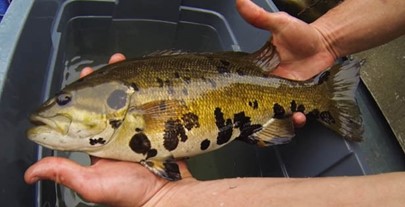
Photo courtesy of USGS
The Division of Fish & Wildlife is partnering with the United States Geological Survey (USGS) to collect samples from black bass species to test for BBS and needs your help. DNR encourages anglers to report observations of affected bass when you are fishing, so they and USGS can learn more about the effect of this family of viruses.
How to participate:
- Download the MyCatch app from Angler’s Atlas.
- Register for the “Blotchy Bass Bonanza.”
- Take photos of all the bass you’ve caught (preferably on a measuring board) while fishing and upload them to the MyCatch app.
The Blotchy Bass Bonanza runs from March 1, 2023 —Feb. 29, 2024. The Indiana DNR is not associated with the MyCatch app or the Blotchy Bass Bonanza.
Newsletter can be found online: MyDNR Email Newsletter
For more information please visit Investigating blotch bass syndrome in black basses.
Resources:
FNR Extension Aquaculture and Aquatic Resources
FNR Extension Publications
Indiana Pond Fish, Species Identification Card Set, Purdue Extension – Forestry and Natural Resources (FNR)
Walleye Farmed Fish Fact Sheet, The Education Store, Purdue Extension’s resource center
Pacific White Shrimp Farmed Fact Sheet, The Education Store
Yellow Perch Farmed Fish Fact Sheet, The Education Store
Tilapia Farmed Fish Fact Sheet, The Education Store
Rainbow Trout Farmed Fish Fact Sheet, The Education Store
American Paddlefish, The Education Store
A Guide to Small-Scale Fish Processing Using Local Kitchen Facilities, The Education Store
Aquaculture Family Coloring Book Development, The Education Store
Eat Midwest Fish, Illinois-Indiana Sea Grant online resource hub
Aquatics & Fisheries Videos, Purdue Extension-Forestry and Natural Resources YouTube Channel Playlist
Indiana Department of Natural Resources, Department of Fish & Wildlife
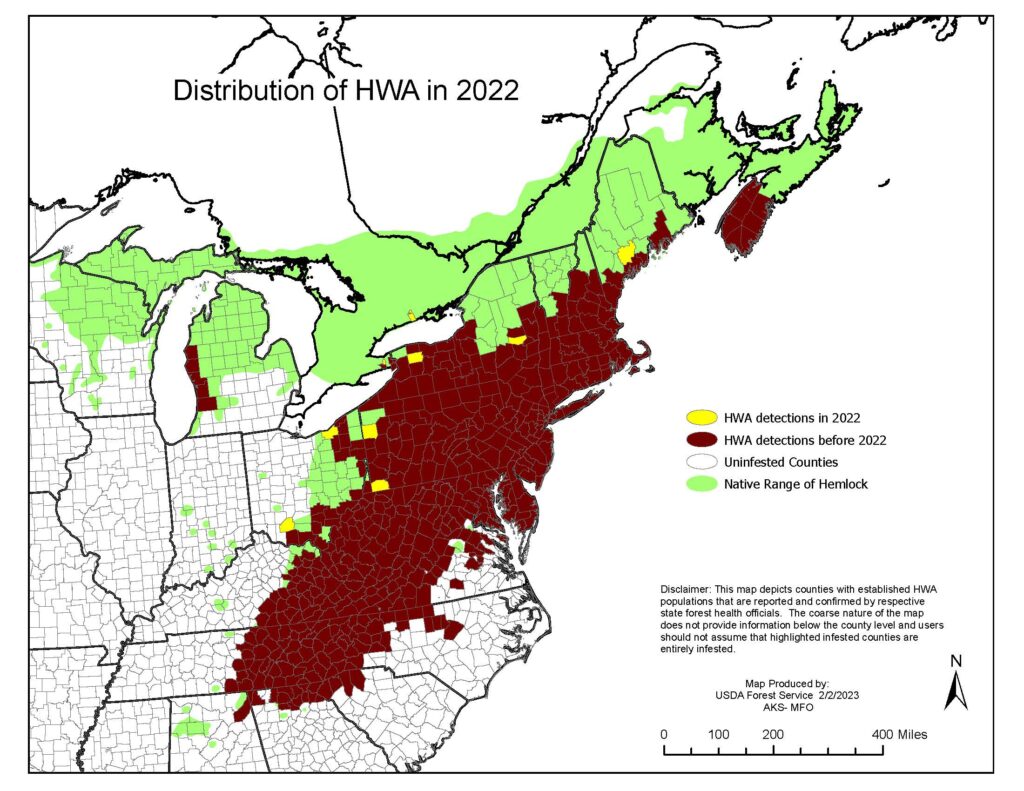
Photo of the distribution of hemlock woolly adelgid in 2022.
Purdue Landscape Report: The hemlock woolly adelgid (Adelges tsugae) continues its eastward spread across the US. In 2022, seven new counties were added to the distribution map of this invasive insect. While it is not present in Indiana yet, it is confirmed throughout the eastern USA from northern Georgia to Maine, extending west into Michigan, Ohio, and Kentucky.
Since its introduction in the 1950s, hemlock woolly adelgid has caused severe mortality of eastern hemlock in the United States. Not only is this a significant impact on our native tree diversity, hemlock losses are linked to a decline in several native bird species in the New England and mid-Atlantic forests (Ellison et al. 2018). In Indiana, eastern hemlock has a scattered native range in isolated locations of the west-central and southern regions of the state. It typically grows on steep slopes, canyons, and ravines. Hemlock woolly adelgid is also a threat to ornamental hemlocks, which are frequently used in landscaping.
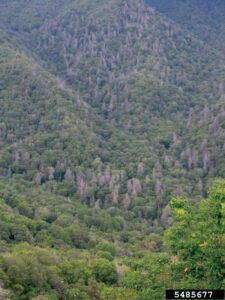
Photo of forest in hills, forest mortality, hemlock woolly adelgid.
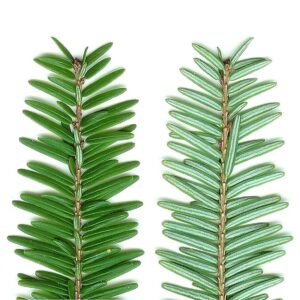
Photo of needles from eastern hemlock.
Identifying Eastern Hemlock
Hemlock woolly adelgid will only feed on hemlocks, so proper tree identification is crucial. If you’re not sure whether your conifer is hemlock, check the color, shape, and arrangement of the needles. The needles of eastern hemlock grow singly (not in clusters) in alternate or opposite positions. The needles are flattened, and have two white stripes on the underside. The cones are small (1-2 cm), and when dry, they can resemble a rosette.
Monitoring for Hemlock Woolly Adelgid
The white “wool” balls are the most tell-tale sign of this pest. Check the undersides of the branches at the base of the needles, and look for small, round, white cottony masses that cover the twig. These are actually the egg sacs of the hemlock woolly adelgid. You may also notice the “crawlers”, or the mobile nymphs, which are tiny, oval-shaped, reddish-brown insects.
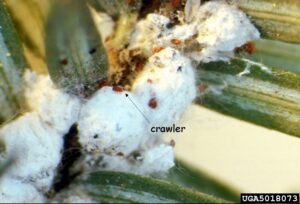
Photo of egg sacs of the hemlock woolly adelgid. These white “wool” balls are the most tell-tale sign of this pest.
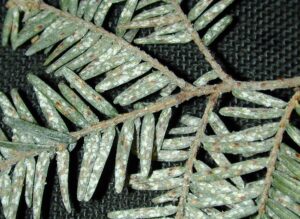
Photo of elongate hemlock scale with flattened white spots.
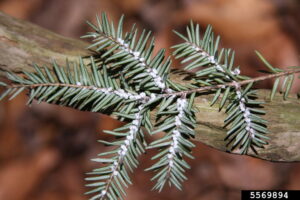
Photo of hemlock wooly adelgids with egg sacks along the twig.
If you frequently check hemlock trees, you may see other white spots that resemble the woolly adelgid. The cocoons of elongate hemlock scale are often confused with hemlock woolly adelgid. However, note how the white “spots” from the scale infestation are flattened and cover the needles. Hemlock wooly adelgids congregate at the base of the needles along the twig, not on the needles themselves, and the egg sacs are round in shape. Single, large egg sacs found throughout the branch are often spider egg sacs or oak skeletonizer cocoons.
Report any suspected findings of hemlock woolly adelgid at the Early Detection Distribution Map System (EDDMapS) website.
To view this original article and other Purdue Landscape Report articles, please visit Purdue Landscape Report.
Resources:
ID That Tree: Eastern Hemlock, video, Purdue Extension – Forestry and Natural Resources (FNR) YouTube Channel
Distinguishing Hemlock From Yew, The Purdue Landscape Report
Normal Needle Drop: Even Healthy Evergreens are not Evergreen, Purdue Plant & Pest Diagnostic Lab (PPDL)
Recognizing and Managing Poison Hemlock, Purdue Landscape Report
Be Careful Around Highly Toxic Poison Hemlock Plant This Summer, Purdue Extension – FNR
Phomopsis Dieback of Spruce, The Education Store, Purdue Extension resource center
Chlorosis of Pine Trees, The Purdue Landscape Report
Borers of Pines and Other Needle Bearing Evergreens in Landscapes, The Education Store
Stress-related Conifer Dieback, The Education Store
Certified Soil Testing Laboratories, Purdue Extension-Master Gardener Program
Tree Installation: Process and Practices, The Education Store
Planting Your Tree Part 1: Choosing Your Tree, video, Purdue Extension – FNR YouTube Channel
Tree Defect Identification, The Education Store
Shrubs and Woody Vines of Indiana and the Midwest, The Education Store
Tree Risk Management – Got Nature? Blog, Purdue Extension – FNR
Consumer Horticulture: Collecting Soil Samples for Testing, The Education Store
Find an Arborist website, Trees are Good, International Society of Arboriculture (ISA)
Purdue Pest and Plant Diagnostic Lab, send in photo or samples
Alicia Kelley, Cooperative Agricultural Pest Survey (CAPS) Coordinator
Purdue Extension – Entomology
Everyone experiences phenology. What is phenology and how can observing plant and animal life cycle stages help us understand changes in climate, water, light and other abiotic factors? In this webinar hosted by Indiana Forestry & Woodland Owners Association (IFWOA), presenter Amanda Wanless of Indiana Phenology explains what phenology is and how each season is unique. Phenology includes the leafing and flowering, the ripening of crops in the fields, the emergence of insects, the migration of birds and much more. Amanda discusses how you can observe seasonal change on the landscape, and ways to monitor on your own or join a citizens science network collecting long term data.
Check out the Indiana Forestry & Woodland Association YouTube Channel for videos including: What is IFWOA?; A New Carbon Program for Hardwood Landowners Webinar, Indiana’s Native Orchids, Magnificent Trees of Indiana, Be Tick Aware and much more.
The Indiana Forestry & Woodland Owners Association (IFWOA) was founded in 1977 and is a non-profit organization dedicated to conservation and sustainable management of woodlands in Indiana. IFWOA advocates for scientific best practices for management to achieve objectives of clean water, wildlife habitat, soil protection, native species diversity, timber production, recreation, carbon sequestration and many others.
IFWOA is an affiliate of the National Woodland Owners Association. IFWOA is a partner, collaborator or is represented on leading National and State organizations. These memberships or collaborations are selected to advance Indiana Woodland owner’s interests. IFWOA monitors and influences legislation and economic trends impacting Indiana woodlands and landowners for our members. Membership in IFWOA provides a valuable network linkage to information and resources at the leading edge of science, industry and politics impacting Indiana woodlands.
Resources:
Magnificent Trees of Indiana, Purdue University Press
Forest Improvement Handbook, The Education Store, Purdue Extension’s resource center
Planting Hardwood Seedlings – The Education Store
Ordering Seedlings from the State Forest Nursery System, Got Nature? – Purdue Extension-FNR
Importance of Hardwood Tree Planting – The Education Store, Purdue Extension Resource Center
Forest Improvement Handbook – The Education Store
Designing Hardwood Tree Plantings for Wildlife – The Education Store
ID That Tree – YouTube Playlist
Forest Management for Reptiles and Amphibians: A Technical Guide for the Midwest, The Education Store
Hardwood Ecosystem Experiment – Forest Birds , Purdue Extension – FNR YouTube Channel
Managing Woodlands for Birds , Purdue Extension – FNR YouTube Channel
Sustaining Our Oak-Hickory Forests , Purdue Extension – FNR YouTube Channel
Ask the Expert: Hardwood Ecosystem Experiment – Birds and Salamander Research, Purdue Extension – FNR
Subscribe to Purdue Extension-FNR YouTube Channel
Liz Jackson, Engagement Lead
Indiana Forestry & Woodland Association
Purdue Landscape Report: Each spring the PPDL receives several samples of oak trees showing curled, twisted, stunted and/or generally ratty looking leaves. When there are holes in the leaves or leaf edges are missing tissue, we add another symptom name to the mix: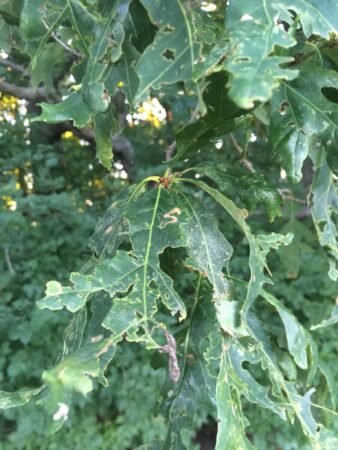 tatters.
Distorted new growth and tatters are most common on white oaks and may occasionally show up on red oak, hackberry and other trees. Upon initial inspection the leaves look as if they have been shredded or severely fed upon by insects. However, a closer observation of the leaves will reveal that the leaf tissue has not been removed, but rather, it never developed normally. We have seen this problem on white oaks for many years in Indiana and it has been reported in other states throughout the Midwest.
Several possible causes for this symptom have been proposed, including poor growing conditions, insect injury, leaf diseases, late spring frost damage and herbicide drift; however, no single factor serves to explain all the cases. In 2020 we saw a distinct link between tattered oak leaves and a late spring frost that year but the connection is not always so clear cut. See PLR article: Oaks Will Persist After Ugly Summer Start.
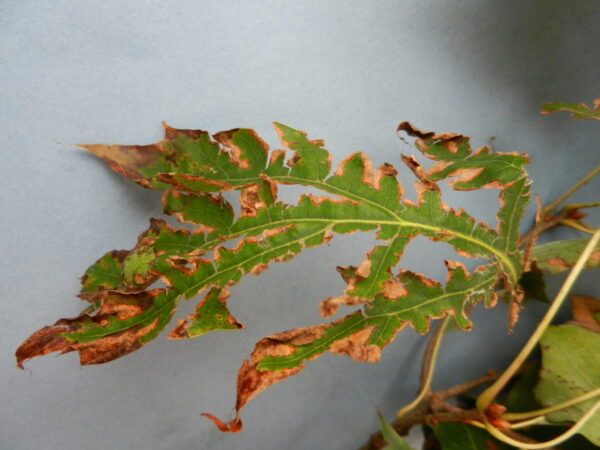
Researchers have shown that acetochlor and s-metolachlor drift can cause tatters-like symptoms but results were variable, and in some treatments red oaks were more affected than white oaks, contrary to the expected results. In many instances there is no direct link to herbicide drift. We once had samples from a white oak tree that showed symptoms of tatters and leaf curl every year, yet was located in the middle of a heavily forested area miles away from any agricultural fields that might have been a source of herbicide drift. While the exact cause may not be clear, it does appear that conditions that lead to tatters occur while the leaves are still developing.
To view this full article and other Purdue Landscape Report articles, please visit Purdue Landscape Report.
Subscribe and receive the newsletter: Purdue Landscape Report Newsletter.
Resources:
The Purdue Landscape Report
Certified Soil Testing Laboratories, Purdue Extension-Master Gardener Program
Consumer Horticulture: Collecting Soil Samples for Testing, The Education Store
Purdue Landscape Report Facebook Page
Find an Arborist website, Trees are Good, International Society of Arboriculture (ISA)
Tree Installation: Process and Practices, The Education Store
Planting Forest Trees and Shrubs in Indiana, The Education Store
Planting Your Tree Part 1: Choosing Your Tree, Video, Purdue Extension – Forestry and Natural Resources YouTube Channel
Tree Defect Identification, The Education Store, Purdue Extension resource center
Tree wounds and healing, Got Nature? Blog
Tree Pruning Essentials, Publication & Video, The Education Store
Shrubs and Woody Vines of Indiana and the Midwest, The Education Store
Tree Risk Management – Got Nature? Blog, Purdue Extension – FNR
Why Is My Tree Dying? – Got Nature? Blog, Purdue Extension – Forestry and Natural Resources
Tom Creswell, Plant & Pest Diagnostic Laboratory Director
Purdue Botany and Plant Pathology

Recent Posts
- Purdue Extension’s Regional Teams Are Here: Connecting Communities with Expertise and Opportunity
Posted: October 14, 2026 in Community Development, Forestry, Forests and Street Trees, Gardening, How To, Timber Marketing, Urban Forestry, Wildlife, Woodlands - Deer and Turkey Archery Seasons Opening Soon, MyDNR
Posted: October 13, 2026 in Alert, Safety, Wildlife - Distinguishing Dogwoods
Posted: in Forestry, Urban Forestry, Wildlife, Woodlands - Can I Plant Trees in the Fall?
Posted: October 12, 2026 in Forestry, How To, Land Use, Plants, Urban Forestry, Wildlife - Publication Helps Midwest Fish Producers “Catch a Following” with Consumers
Posted: in Aquaculture/Fish, Aquatic/Aquaculture Resources, Wildlife - Minecraft Meets the Hellbender
Posted: September 22, 2026 in Aquaculture/Fish, Aquatic/Aquaculture Resources, Wildlife - What You Plant Matters to Wildlife
Posted: September 16, 2026 in Plants, Urban Forestry, Wildlife - Woodland Flowers of Late Summer
Posted: September 14, 2026 in Forestry, Gardening, Wildlife, Woodlands - Heavy August Rains Bring More Mosquitoes to Indiana
Posted: September 9, 2026 in How To, Invasive Insects, Safety, Wildlife - New Indiana Woodland Steward Newsletter
Posted: August 12, 2026 in Forestry, Urban Forestry, Wildlife, Woodlands
Archives
Categories
- Alert
- Aquaculture/Fish
- Aquatic/Aquaculture Resources
- Ask the Expert
- Christmas Trees
- Community Development
- Disease
- Drought
- Forestry
- Forests and Street Trees
- Gardening
- Got Nature for Kids
- Great Lakes
- How To
- Invasive Animal Species
- Invasive Insects
- Invasive Plant Species
- Land Use
- Natural Resource Planning
- Nature of Teaching
- Plants
- Podcasts
- Ponds
- Publication
- Safety
- Spiders
- Timber Marketing
- Urban Forestry
- Webinar
- Wildlife
- Wood Products/Manufacturing
- Woodland Management Moment
- Woodlands