 Purdue University - Extension - Forestry and Natural Resources
Got Nature? Blog
Check out the new publication entitled Benefits of Connecting with Nature now available in The Education Store!
Times are constantly changing with the growth and integration of technology within society. As we become more and more reliant on technology for information and entertainment, we seem to be detached from many vital aspects of our world. People, especially children, are losing their touch with the outdoors. Recent reports show that children ages 6–11 spend an average of 28 hours per week watching television. The average amount of time children spent using mobile devices tripled between 2011–2013.
Natural environments have positive impacts on people’s mental health and well-being. Studies consistently show that natural settings link to much stronger developmental benefits for children.
This unit will help teachers explore student’s relationship between nature and mental health. It contains four 30-40 minutes activities: Emotion Vocabulary Exploration, Guided Imagery, Creative Writing and Exploring Nature with your Senses.
Resources:
The Nature of Teaching – Purdue Extension
Appreciating Reptiles and Amphibians in Nature –The Education Store
Frogs and Toads of Indiana – The Education Store
Molly Hunt, Extension Educator, Delaware County
Purdue University Extension Health and Human Sciences
Katie Zuber, Extension Educator, Lawrence, Jackson, Monroe and Brown County
Purdue University Extension Health and Human Sciences
Lindsey Pedigo, Extension Educator, Howard County
Purdue University Extension Health and Human Sciences
Rod N Williams, Associate Head of Extension & Associate Professor of Wildlife Science
Purdue University Department of Forestry and Natural Resources
In Tennessee, magnolia and the highly invasive ornamental pear trees are in full bloom. In New Jersey, crocuses and buttercups are vibrant spectacles of color. Here in Indiana, flowering dogwood, pawpaw, and red oak have responded to an early spring with a burst of blooms as well. This vibrant display is the result of a mild winter. Unfortunately, there is a downside. A sudden cold freeze after this swathe of warm weather could severely damage blossoms, buds, and significantly reduce yields in fruit and nut trees.
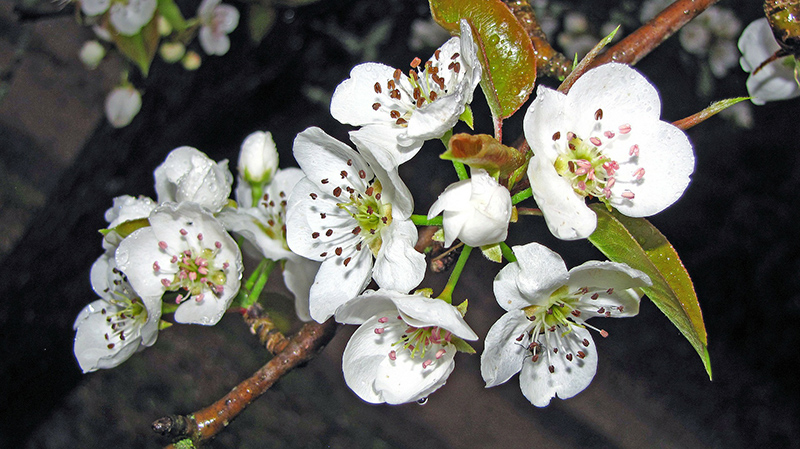
Blooms on pear tree.
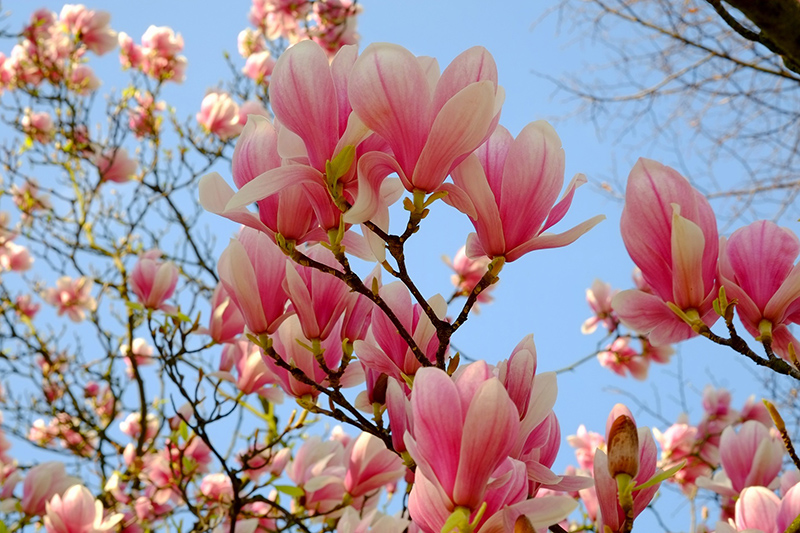
Blooms on magnolia tree.
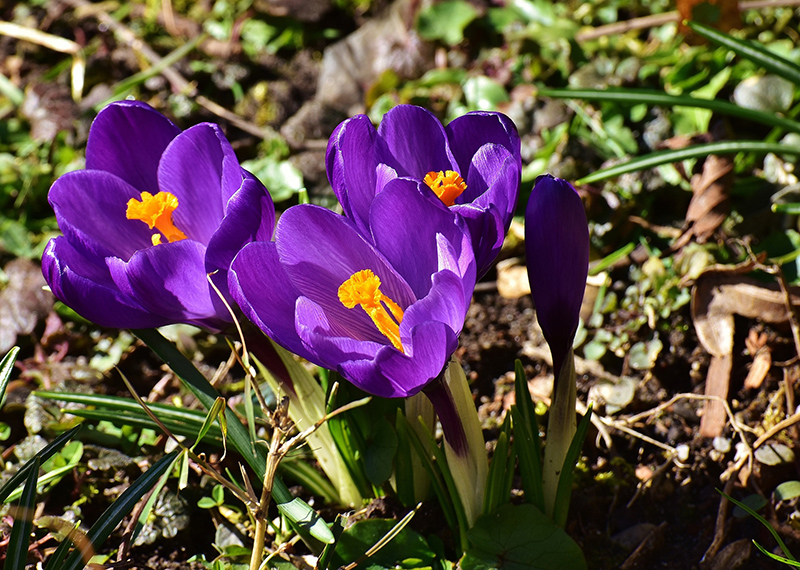
Crocus blooms.
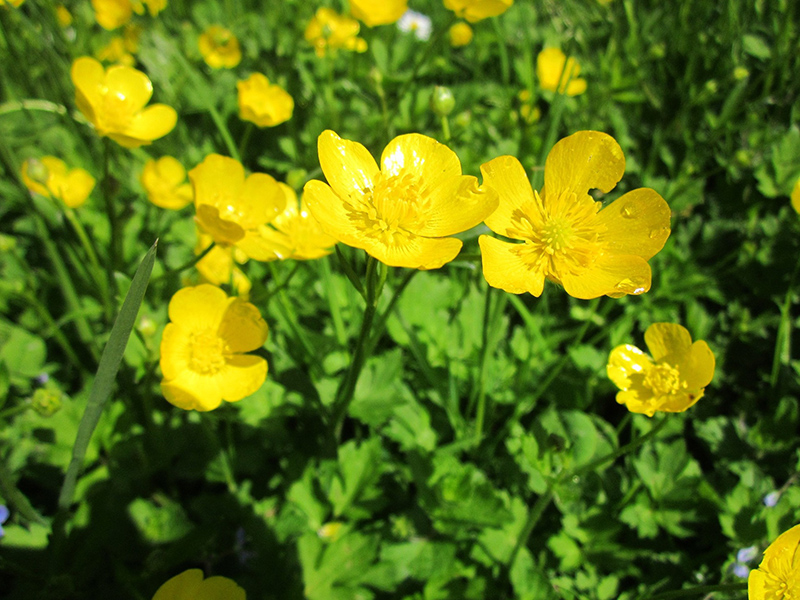
Buttercup blooms.
Growth of a tree or flower is the result of the weather and the perpetuation of its natural growth cycle. To store sufficient resources for the following year, trees use the winter season as an opportunity to shuttle nutrients to their roots. With cold temperatures keeping pests at bay, fewer nutrient resources are needed for defense and maintenance. These nutrients will be shuttled to the branches the following spring to support the growth of buds and blossoms. Interruption in the storage process caused by early spring conditions interferes with nutrient supplies and kickstarts the growing cycle again.
Nutrients once slated for root storage are now being sent to the branches to begin fruit and bud production despite having fewer resources in storage than usual. A freeze that occurs after leaves and buds begin to appear will damage the new growth and likely delay flowering and fruiting until much later in the year when surfeit energy is available to support a second growth effort. While trees are usually able to leaf out a second time, there are often more issues with low yield and early leaf drop.
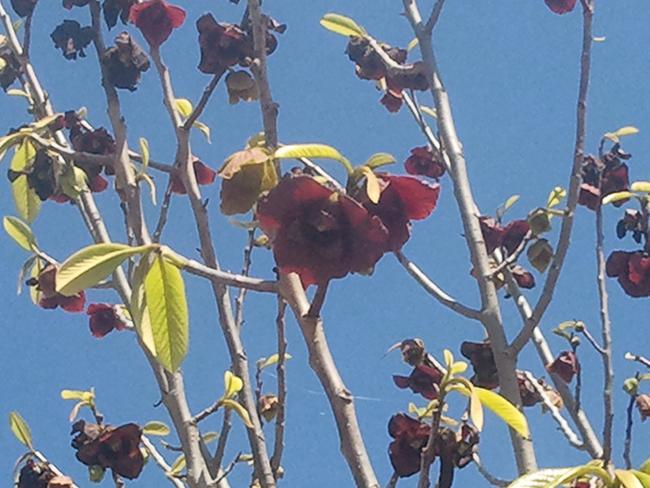
Pawpaw
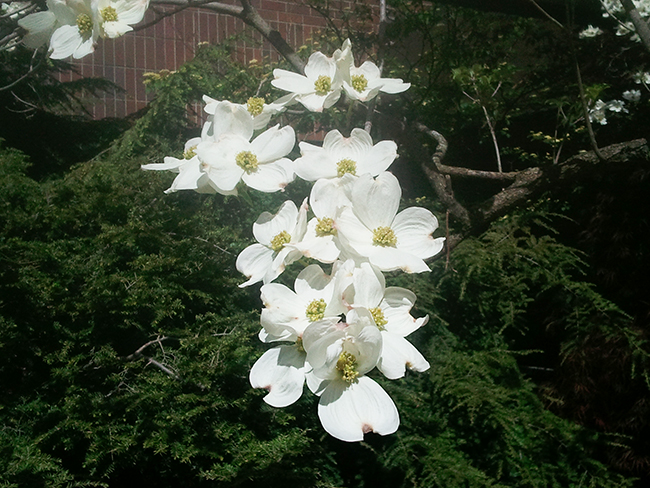
Dogwood
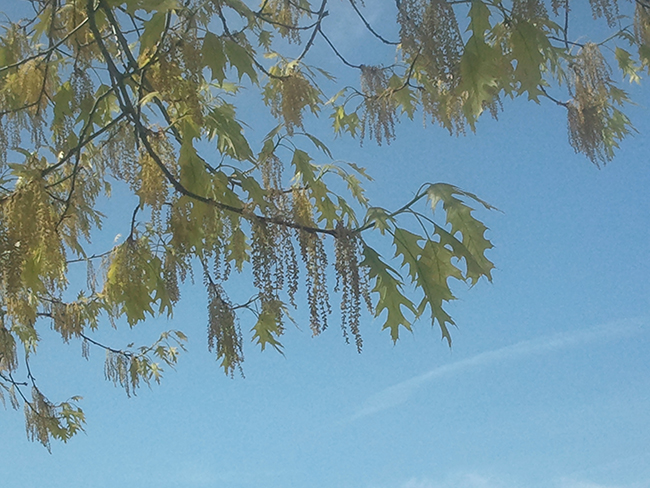
Red oak
Also, insect pests, usually subdued by cold winter temperatures are likely to be out much earlier than usual and with greater numbers. This increase in insect presence does not necessarily bode well for plant pollinator populations. If, for example, a tree flowers earlier than honeybee populations are available, then it is possible that those trees will go unpollinated. Also, if other pollinators are also unavailable, there will be no fruits the following year on that tree.
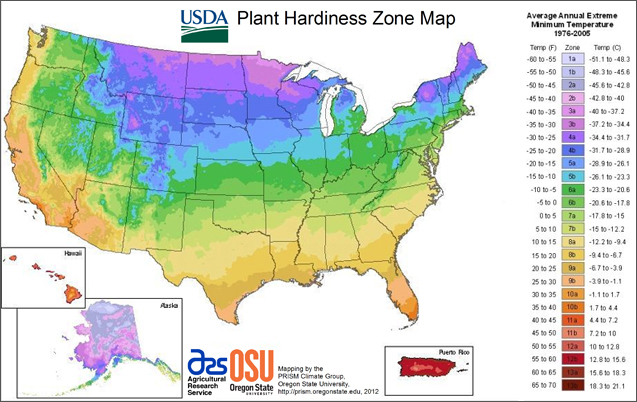
USDA Plant Hardiness Zone Map. Agricultural Research Service, U.S. Department of Agriculture, planthardiness.ars.usda.gov.
Ultimately, the state of our seed, fruit, and nut production depends on two major events; pollination and lack of a cold freeze. If we see a sudden cold snap that damages the trees and eliminates pollinators, then next spring will be a time of sorrow rather than an exciting start to the growing season. The dramatic shifts in weather temperatures over the last decade have led the Department of Agriculture to reevaluate and reassess plant hardiness zones. For the first time in thirty years, an updated map with new zones has now been created, USDA Plant Hardiness Zone Map.
Resources:
Purdue Plant Doctor App, Purdue Extension
Purdue Plant and Pest Diagnostic Laboratory, Purdue Agriculture
Planting & Transplanting Landscape Trees and Shrubs, The Education Store, Purdue Extension resource center
Tree Planting Part 1: Choosing a Tree – video, The Education Store
Tree Installation: Process and Practices, The Education Store
Shaneka Lawson, USDA Forest Service/HTIRC Research Plant Physiologist/Adjunct Assistant Professor
Purdue University Department of Forestry and Natural Resources
Lenny Farlee, Sustaining Hardwood Extension Specialist
Purdue Department of Forestry and Natural Resources
 If you or someone you know loves to learn about wildlife, especially reptiles and amphibians, then you will be interested in our new special offer package. We are offering our complete collection of reptile and amphibian field guides (4 softcover books) for 10% of the price of each individual book. These books cover all of the reptiles and amphibians that are found in the state of Indiana. They include detailed physical descriptions, distribution maps, and interesting information about the ecology of each species. All of the included books have been peer-reviewed by experts in the field of herpetology.
The Indiana Amphibian and Reptile ID Package can be purchased from the Purdue Education Store for $36.00.
Additional Resources, The Education Store, Purdue Extension:
Frogs and Toads of Indiana
Salamanders of Indiana
Snakes and Lizards of Indiana
Turtles of Indiana
More Resources Available:
Help the Hellbender, Purdue Extension
The Nature of Teaching, Lesson Plans K-12, Purdue Extension
Nick Burgmeier, Research Biologist and Extension Wildlife Specialist
Purdue Department of Forestry and Natural Resources
Nearly all creatures exhibit differing behavior during the day and night. Songbirds sing and fly about during the day and roost at night. Owls forage for food primarily at night and rest during the day. Many of us have noticed how flowers seem to droop at night and appear to be sleeping before resuming a more erect posture at sunrise. Is it possible that despite the carbon reinforced bark trees do the same thing? New research says “Yes!”
It’s true! Trees droop their branches at night and lean over. This drooping is not the full bow often associated with a Broadway play in New York. Research scientists in Austria, Finland, and Hungary have used laser scanners to observe and record this “sleeping” behavior in silver birch (Betula pendula) thus it is natural to assume other tree species behave similarly.
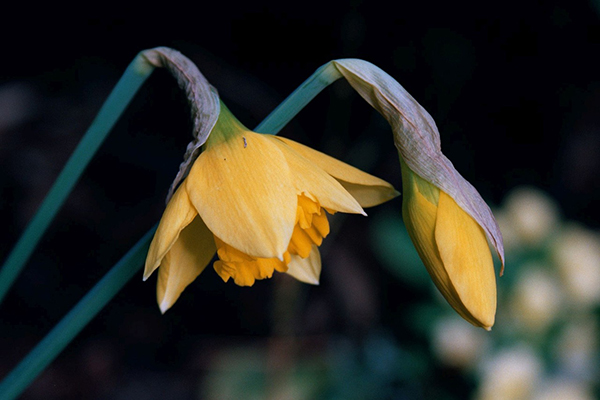
NIGHT
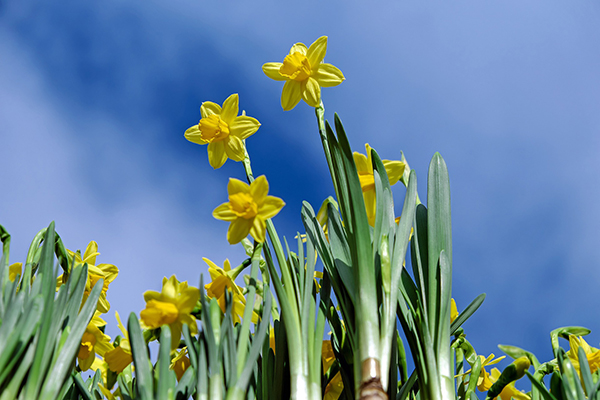
DAY
This leaning phenomenon has been calculated to only be 10 cm (~4 in in trees that were roughly 5 meters tall (16 ft 4 in). Repeated measurements have assured that these changes in overall tree height are genuine and repeatable.
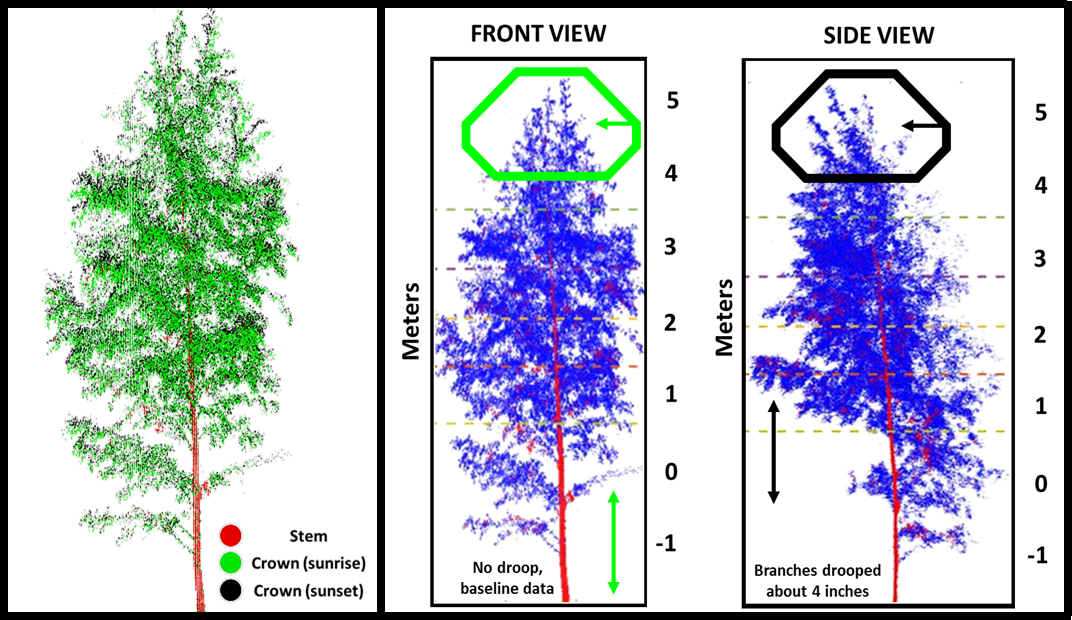
Point clouds measured from the Finnish birch at the time of sunset (black) and sunrise (green). Stem and branch points have been separated based on their spectral properties. Photo credit: Eetu Puttonen, Finnish Geospatial Research Institute (FGI) in the National Land Survey of Finland.
Scientists ruled out wind, elevation, and other weather effects by conducting the experiment in both Finland and Austria.
It was thought that water balance may have been responsible for this movement but has been ruled out as the lasers use infrared light that is reflected and not absorbed by the plant for photosynthesis. This allows the entire tree to be mapped quickly and with high resolution.
Future work is to be directed at increasing the scope of the experiment to measure larger areas (orchards, plantations) and adding in day and night water use measurements to better understand tree influences on regional climates. This work shows that, at the end of the day, even trees need a nap.
Literature Cited:
Puttonen E, Briese C, Mandlburger G, Wieser M, Pfennigbauer M, Zlinszky A, Pfeifer N. 2016. Quantification of overnight movement of birch (Betula pendula) branches and foliage with short interval terrestrial laser scanning. Frontiers in Plant Science doi: 10.3389/fpls.2016.00222.
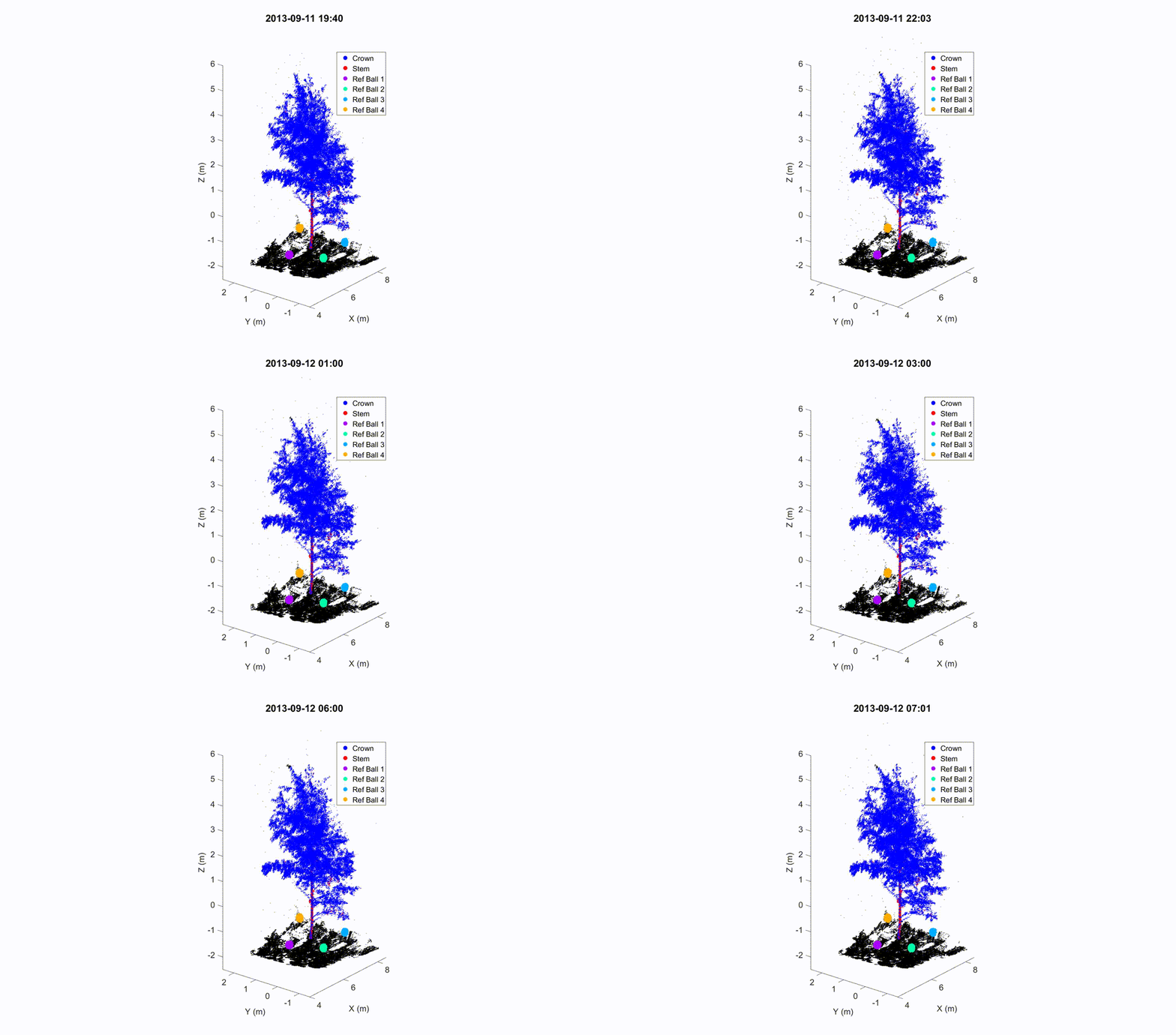
Animation of the point cloud change in Finnish test over time. The scanned birch is in the middle. Each frame corresponds to a single terrestrial laser scan. Animation credit: Eetu Puttonen, Finnish Geospatial Research Institute (FGI) in the National Land Survey of Finland.
Additional resources:
How do trees go to sleep, Technische Universität Wien
Scientists have found trees ‘sleep’ at night too, GeoBeats News, YouTube
Shaneka Lawson, USDA Forest Service/HTIRC Research Plant Physiologist/Adjunct Assistant Professor
Purdue University Department of Forestry and Natural Resources
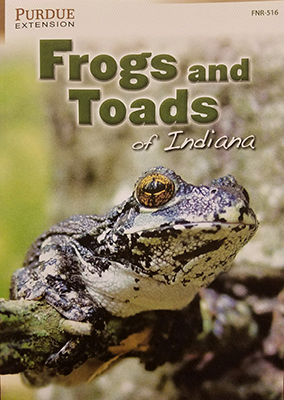 Frogs and Toads of Indiana is the latest and final addition to Purdue Extension’s line of field guides focused on the reptiles and amphibians of Indiana. Readers of this guide will not only learn how to ID the Anuran species of Indiana but will also learn about their distribution throughout the state along with their habits and behaviors. The guide is richly illustrated, filled with interesting facts, and has been peer-reviewed by expert herpetologists.
As many herpetologists and recreational herpers can attest, seeing what you are hearing is not always possible. With this in mind, we developed a website The Frogs and Toads of Indiana for users that wish to learn the calls of Indiana Anuran species.
The Frogs and Toads of Indiana, FNR-516, can be purchased from the The Education Store for $10.00.
Resources, The Education Store-Purdue Extension resource center:
Salamanders of Indiana
Snakes and Lizards of Indiana
Snakes of the Central and Northeastern United States
Turtles of Indiana
Additional resources:
The Nature of Teaching, Lesson Plans K-12, Purdue Extension
Nick Burgmeier, Research Biologist and Extension Wildlife Specialist
Purdue Department of Forestry and Natural Resources
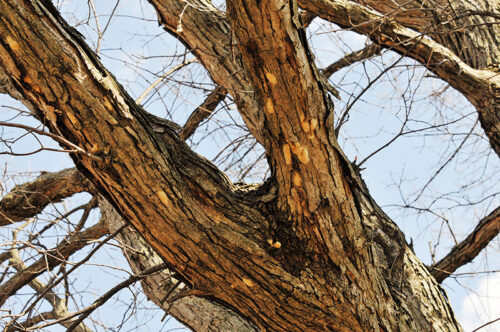
Figure 1: Spongy moth caterpillar, credit to John Obermeyer.
In the late 1860s, French scientist Étienne Trouvelot brought over a seemingly harmless insect from Europe called the gypsy moth to conduct breeding experiments with American moths. When they escaped his backyard and entered into an ecosystem without their native predators, their population exploded. 150 years later, these moths are still a destructive forest pest in Indiana and other states. Every year an effort is made to attempt to curb their population. This year, the Indiana Department of Natural Resources will continue the fight to save our forests from these invasive insects.
Phase one consists of a crop dusting of bacterial chemical spray over the gypsy moth caterpillars’ food sources. This spray is harmless to humans and native wildlife, but is lethal to the caterpillars. Later in the summer, a pheromone will be dispersed over the moths, disrupting the mating process and causing fatal exhaustion.
This huge undertaking isn’t estimated to stop the gypsy moth – in fact, state entomologists don’t see an end in sight. We can only continue to manage this forest pest and aim for reducing populations to a level where local predators can manage them on their own. Indiana citizens can help combat this pest by understanding the gypsy moth problem and learning about its management.
For more information and when the aerial treatments will be conducted in your county visit the Indiana Department of Natural Resources, 2017 Indiana Gypsy Moth Treatment Program. For Tippecanoe view Purdue News.
Resources:
Gypsy Moth (Spongy Moth) website, Purdue Extension-Entomology
Spongy Moth – Indiana Department of Natural Resources
The Gypsy Moth in Indiana – The Education Store, Purdue Extension resource center
Indiana Department of Natural Resources
‘Twas the day before Arbor Day, when all through the park
Not a creature was stirring, no chirp, squeak, or bark;
The birds were perched on the utility wires with care,
In hopes that many trees soon would be there;
All types of squirrels, gray, fox, and red;
Had visions of oak trees dancing in their head;
And mamma with her overalls, and I my work jeans,
Were prepared and ready to make the park green,
When out in the park there arose such a clatter,
I sprang to my window to see what was the matter.
Away out my door I flew like a flash,
Running to the crowd that was gathered ‘round the ash.
The dead looking tree with no leaves to show,
Gave a glimmer of midday through its branches to objects below,
When what to my wondering eyes came ‘round the corner with ease,
But a miniature truck and in the bed, eight tiny trees,
With a little old driver so lively and quick,
I knew in a moment it must be Mayor Nick.
The trees looking so healthy and flourishing as they came,
He whistled, and shouted, and called them by name:
“White Oak! Red Cedar! Silver Maple and Black Cherry!
Cottonwood, Black Walnut, American Beech and Hackberry!
It is time to grab your gloves, shovels, and spades!” He did call,
“Now plant away! Plant away! Plant away all!”
With his blueprints out he started to show,
Where in the park each tree would go;
So excited and anxious with all my gear I flew
To the truck full of trees, and Mayor Nicolas too.
And then, in a moment, I heard on the road
The roaring of more trucks with trees overflowed.
As I lifted my head, and was turning around,
The city forester and many arborists came with a bound.
Mayor Nick had called in the professionals to help us out,
So we all would understand what this project was all about.
“Before we start planting, I want to explain
the benefits from these trees the city will gain!
Trees increase property value and improve living conditions.
They also relieve stress and help with CO2 emissions.
Better air and water quality, and sound barriers, too,
And the best part is the beautiful new view!”
After Mayor Nick’s speech, the city forester stepped in
“Whose ready to plant some trees?” He said with a grin.
The crowd cheered and the project was now on its way
Making the park beautiful and green in honor of Arbor Day.
First thing we had to do, was remove the dead trees.
The park was originally filled with ash, which was a feast for EAB.
The arborists cut all the trees down one by one.
There was so much help, in no time the cleanup was done.
As we finally started planting, the professionals came around
Making sure we were putting the trees properly into the ground.
I learned that you cut and remove only 1/3-1/2 of the B&B,
Then, you check the roots, the most important part of the tree.
If the tree has spiraling roots, all four sides must be sawed,
So the tree’s way of nutrient uptake and anchorage is not flawed.
It is also important that the root flare is not below the soil line,
Many people tend to bury it, thinking their tree will be fine.
Before planting your tree, consider the tree’s full-grown size.
Improper planting can cause the tree to die otherwise.
I’m so glad I decided to volunteer today
I learned so much about planting trees the right way!
After countless hours of hard work and sweat,
Mayor Nick’s goals for the park were finally met.
He thanked everyone, and as he drove out of sight,
He shouted “Happy Arbor Day to all, and to all a good night!”
Arbor Day Paper, FNR-445 Urban Forestry Topics
Author: Erin Hipskind, BS 2016
Arbor Day is an annual observance that celebrates the role of trees in our lives and promotes tree planting and care. As a formal holiday, it was first observed in 1872, in Nebraska, but tree planting festivals are as old as civilization. The tree has appeared throughout history and literature as the symbol of life. Arbor Day celebrations for 2017 is on Saturday, April 29th. Check out activities around your area: Purdue Extension County Offices, Indiana Department of Natural Resources or Tippecanoe Soil & Water Conservation District.
Other resources:
Tree Installation: Process and Practices, The Education Store-Purdue Extension resource center
Tree Planting Part 1: Choosing a Tree – video, The Education Store
Tree Planting Part 2: Planting Your Tree – video, The Education Store
Lindsey Purcell, Urban Forestry Specialist
Purdue University, Department of Forestry and Natural Resources

Issue:
Professional arborists, horticulturists, including lawn and tree care companies, garden centers, and landscapers, require training in proper management techniques and pest control to better serve their customers and protect the environment.
What Has Been Done:
The Professional Landscape Management School is a two-day workshop offered every winter to local commercial lawn and tree care companies, landscapers, nurseries, grounds managers, and garden centers. The topics chosen for the program are based on current trends and needs. I located speakers, created the program schedule and brochure, and advertised it to over 1000 professionals, using both print mail and email.
Results:
- Over 160 professional horticulturists attended the Professional Landscape Management School in 2015. Out of this number, 49 returned completed surveys. Some of the notable results:
- Did you get your money’s worth from attending this year’s school? All forty-nine attendees replied – Yes.
- Do you think that you as an individual will benefit in the coming year because of your attending the 2015 Professional Landscape Management School? 100% said yes.
- Do you think that your company will benefit in the coming year because of your attending the 2015 Professional Landscape Management? 100% said yes.
- What horticultural practices do you think you will change in the coming year, based on what you learned at the 2015 Professional Landscape Management School?
- Plan on adding more native plants to my installations and designs.
- Will be more aware of honeybees when selecting and using pesticides.
- Tree Risk Assessment process can save lives and reduce my liability. Will definitely take further training in this subject.
- Will use information from Landscape Plants to Save Time and Money topic to reduce our campus manpower needs and budget requests.
- My staff and I have more knowledge to better serve our customers.
Purdue Commercial Nursery & Professional Landscape
This comprehensive written abstract titled Tools for Staging and Managing Emerald Ash Borer in the Urban Forest shares research gathered in an eight-year period with a variety of management strategies.
Advances in control can help municipal foresters save ash trees from emerald ash borer (EAB) [Agrilus planipennis (Fairmaire)]
in urban forests. Although ash trees of any size can be protected from this pest, cities often do not implement programs because they fail to recognize and act o incipient populations of EAB. In this study, researchers develop a model for predicting ash mortality over an eight-year period, and validated with data from the removal of >14,000 ash trees killed by EAB in Fort Wayne, Indiana, U.S. researchers then developed a sampling scheme to help foresters map their ash trees along the expected progression of ash decline. This model was then used to modify a web-based EAB cost calculator that compares discounted annual and cumulative costs of implementing a variety of management strategies. It was determined that strategies that most heavily relied on saving ash trees were less expensive and produced a larger forest than those strategies that mostly removed and replaced ash trees. Ratios of total discounted costs to discounted cumulative benefits of strategies that saved most ash trees were over two-thirds lower than strategies of proactive tree removal and replacement. Delaying implementation of an ash management program until damage would be visible and more obvious to the community (Year 5 of the model) decreased the cost–benefit ratio by <5%. Thus, delays that rely on the abundance of locally damaged trees to bolster community support do not necessarily diminish the utility of implementing a control strategy.
For full article: Tools for Staging and Managing Emerald Ash Borer
Resources:
Tree Doctor App, The App Store
Invasive Species – Indiana Department of Natural Resources (IDNR)
Ask an Expert – Purdue Extension-Forestry and Natural Resources
Indiana Invasive Species Council – Includes: IDNR, Purdue Department of Entomology and Professional Partners
Great Lakes Early Detection Network App (GLEDN) – The Center for Invasive Species & Ecosystem Health
National Invasive Species Awareness Week: February 27-March 3, 2017
Invasive Species Week a reminder to watch for destructive pests, Purdue entomologist says – Purdue Agriculture News
Cliff Sadof, Professor
Purdue University Department of Entomology
Matt Ginzel, Associate Professor
Purdue University Department of Forestry and Natural Resources & Department of Entomology
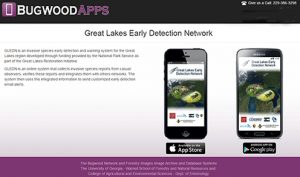 The Forest Pest Outreach and Survey Project at Purdue reminds us that early detection is the best way to slow the spread of invasive species. You can report invasive species by calling the Invasive Species hotline at 1-866-NO-EXOTIC (1-866-663-9684) or using the free Great Lakes Early Detection Network smartphone app, which can be downloaded on iTunes or Google Play. View video to see how easy it is to use the app, Great Lakes Early Detection Network App (GLEDN).
If you’re interested in learning more about invasive pests and how to report them, sign up for one of our free Early Detector Training workshops!
National Invasive Species Awareness Week: February 27-March 3, 2017.
Resources:
Invasive Species – Indiana Department of Natural Resources (IDNR)
Ask an Expert – Purdue Extension-Forestry and Natural Resources
Indiana Invasive Species Council – Includes: IDNR, Purdue Department of Entomology and Professional Partners
Invasive Species Week a reminder to watch for destructive pests, Purdue entomologist says – Purdue Agriculture News
Sara Stack, MS student
Purdue Department of Entomology

Recent Posts
- Popular Landscape Shrub is Invasive
Posted: October 15, 2026 in Alert, Forestry, Forests and Street Trees, Invasive Plant Species, Plants, Woodlands - Purdue Extension’s Regional Teams Are Here: Connecting Communities with Expertise and Opportunity
Posted: October 14, 2026 in Community Development, Forestry, Forests and Street Trees, Gardening, How To, Timber Marketing, Urban Forestry, Wildlife, Woodlands - Why Do Our Trees Go From Green Leaves to Different Colors?
Posted: in Forestry, Forests and Street Trees, Urban Forestry, Woodlands - October Is Firewood Month: Protect Indiana’s Forests by Making Smart Choices
Posted: October 1, 2026 in Forestry, Forests and Street Trees, How To, Invasive Insects, Urban Forestry - Question: Why Did the Shagbark Hickories Survive the Tornado?
Posted: August 27, 2026 in Forests and Street Trees, How To, Urban Forestry - Jarred Brooke Receives Early Career Award for Prescribed Fire Work
Posted: July 20, 2026 in Forestry, Forests and Street Trees, Natural Resource Planning, Safety - Pruning Highlight; Espalier Pruning: Training Trees into Living Patterns
Posted: July 8, 2026 in Forestry, Forests and Street Trees, Gardening - Pruning Highlight-Pollarding Trees: A Traditional Pruning Practice with Modern Uses
Posted: June 11, 2026 in Forestry, Forests and Street Trees, Urban Forestry, Wildlife, Woodlands - Flat-Faced Longhorn Beetle Found in Hardwood Logs – IDNR Division of Entomology
Posted: June 8, 2026 in Alert, Forestry, Forests and Street Trees, Invasive Insects, Urban Forestry, Wildlife, Woodlands - Connecting Research to Practice: Natural Resources & Land Use Spring Training
Posted: June 5, 2026 in Forestry, Forests and Street Trees, How To, Invasive Animal Species, Invasive Plant Species, Land Use, Natural Resource Planning, Urban Forestry, Wildlife, Woodlands
Archives
Categories
- Alert
- Aquaculture/Fish
- Aquatic/Aquaculture Resources
- Ask the Expert
- Christmas Trees
- Community Development
- Disease
- Drought
- Forestry
- Forests and Street Trees
- Gardening
- Got Nature for Kids
- Great Lakes
- How To
- Invasive Animal Species
- Invasive Insects
- Invasive Plant Species
- Land Use
- Natural Resource Planning
- Nature of Teaching
- Plants
- Podcasts
- Ponds
- Publication
- Safety
- Spiders
- Timber Marketing
- Urban Forestry
- Webinar
- Wildlife
- Wood Products/Manufacturing
- Woodland Management Moment
- Woodlands