 Purdue University - Extension - Forestry and Natural Resources
Got Nature? Blog
Many of the invasive plant issues we experience in the urban ecosystem is due to improper plant selection when landscaping our homes and businesses. Often times, nurseries and garden centers stock trees and shrubs that create major issues in nearby natural areas. Landscapers everywhere seek beautiful, unusual, exceptionally hardy, drought-tolerant, or fast-growing plants. Unfortunately, plants selected for their resilience may be invasive because of their adaptable nature. Plants selected for their aesthetic value may be hard to banish from garden centers even after their invasive tendencies are revealed. These plants are typically prolific seed-producers which birds deposit everywhere creating competition for native plants.
Invasive species are damaging because they: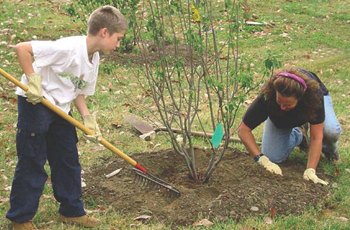
- produce large numbers of new plants each season.
- tolerate many soil types and weather conditions.
- spread easily and efficiently, usually by wind, water, or animals.
- grow rapidly, allowing them to displace slower growing plants.
- spread rampantly when they are free of the natural checks and balances found in their native range.
One of the worst offenders for invasive qualities is the Callery Pear. This ornamental pear, famous for its prolific white flowers in spring, creates a beautiful display in many landscapes. However, it is a poor choice for two major reasons. It is highly invasive and can take over entire natural areas with its heavy seed production. In addition, it is a very weak-wooded tree with poor branch structure, leaving it susceptible to splitting and breaking under heavy winds. Check out this publication for more information on the Callery Pear. See Invasive Plant Species: Callery Pear video for more information.
To help prevent the spread of invasive species, choose plants wisely. Use the following publication as a guide for alternatives for invasive landscape plants, Commercial Greenhouse and Nursery Production: Alternative Options for Invasive Landscape Plants.
Resources:
Invasive Plant Species: Callery Pear – The Education Store, Purdue Extension Resource Center
Invasive Plant Species: Oriental Bittersweet – The Education Store
Invasive Plant Species: Wintercreeper – The Education Store
Invasive Plant Species Fact Sheets: Poison Hemlock – The Education Store
Mile-a-minute Vine – The Education Store
Commercial Greenhouse and Nursery Production: Alternative Options for Invasive Landscape Plants, The Education Store
Invasive Species – Purdue Extension
Indiana’s “Most Unwanted” Invasive Plant Pest List – Indiana Cooperative Agricultural Pest Survey (CAPS) Program
Indiana Invasive Species Council – Includes: IDNR, Purdue Department of Entomology and Professional Partners
Invasive Species – Indiana Department of Natural Resources (IDNR)
National Invasive Species Awareness Week: February 27-March 3, 2017
Lindsey Purcell, Urban Forestry Specialist
Purdue University, Department of Forestry and Natural Resources

Issue:
Woodlands provide a multitude of environmental (e.g., carbon sequestration, enhance water quality, wildlife habitat), economic (e.g., timber, wood products manufacturing, tourism), and social (e.g., recreation, aesthetics) benefits to Indiana residents. The sustainability of these benefits is strongly tied to stability of the resource. In Indiana, 75 percent of the 4.65 million acres of forestland is owned by families. Actions they take on their property can impact the benefits woodlands provide all Indiana residents. However, many do not understand available options or sources of assistance.
What Has Been Done:
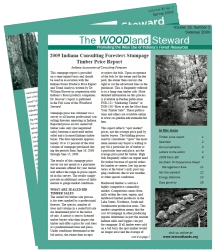 The Department of Forestry and Natural Resources, in partnership with many other organizations, helps produce and mail over 31,000 copies of the Indiana Woodland Steward to woodland owners three times each year. This 16-page, two-color publication includes in-depth articles on forest stewardship and health, invasive species and pests, wildlife habitat management, economics, and more.
Results:
Subscribers owned more woods (71.6 ac) for a longer tenure (33 years) than the average woodland owner in Indiana based on data from the National Woodland Owner Survey. As a group, they were also more active managers based on the proportion enrolled in assistance programs and who had a written stewardship plan. Fifty-four percent regularly utilized information from the Woodland Steward. In addition, 51 percent of respondents have implemented at least one practice they read about from The Woodland Steward, potentially impacting an estimated 1.2 million acres of forestland. His use of print media to communicate with woodland owners could be considered expensive, but clearly a large number of woodland owners regularly read and utilize the information making the average investment per landowner much lower.
Videos:
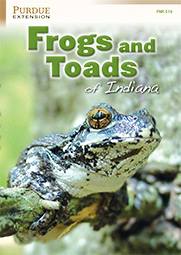
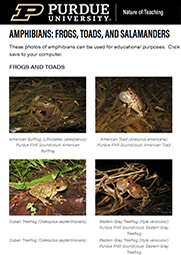
Ask an Expert: Anurans (Frogs and Toads)
Ask an Expert: Salamanders
A Moment in the Wild: Wood Frogs
A Moment in the Wild: American Toad
A Moment in the Wild YouTube Playlist-Subscribe
Reptiles, Amphibians & the Scientific Method
Learn All About Hellbenders and Take a Tour
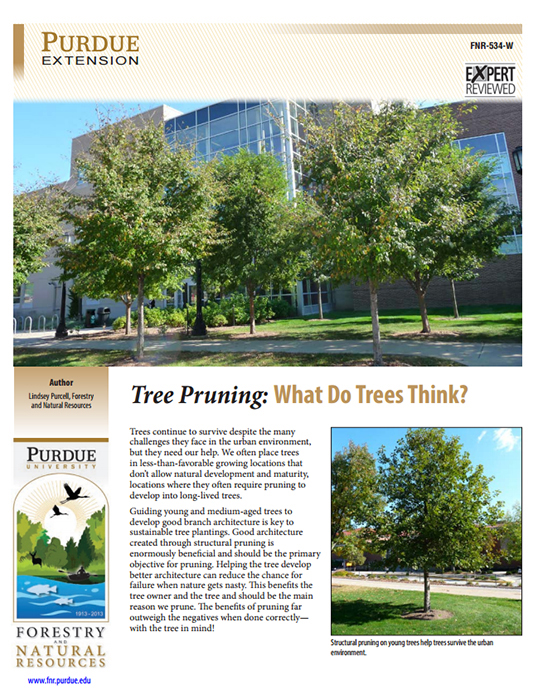 The Tree Pruning: What Do Trees Think publication explains the physiological and physical changes that happen within trees as a response to pruning. Guiding young and medium-aged trees to develop good branch architecture is key to sustainable tree plantings. Good architecture created through structural pruning is enormously beneficial and should be the primary objective for pruning. Helping the tree develop better architecture can reduce the chance for failure when nature gets nasty. The benefits of pruning far outweigh the negatives when done correctly–with the tree in mind!
Resources:
Tree Pruning Essentials – publication, The Education Store, Purdue Extension Resource Center
Tree Pruning Essentials – video, The Education Store
Trees and Storms, Got Nature?
Tree Risk Management – Got Nature? Blog, Purdue Extension – FNR
Lindsey Purcell, Urban Forestry Specialist
Purdue University, Department of Forestry and Natural Resources
Pruning has been called “one of the best, worst maintenance practices,” especially when performed on urban trees. The process creates wounds, which have a major impact on plant processes. Improper cutting on a tree causes severe damage or even death. Be sure to watch this before pruning trees! Tree Pruning Essentials video.
View publication for more details: Tree Pruning Essentials – FNR-506-W at the Education Store.
Resources
Tree Pruning Essentials – publication, Purdue Extension
Trees and Storms: Understanding Damage, Risk and Recovery – Got Nature? Blog, Purdue Extension – FNR
Tree Risk Management – Got Nature? Blog, Purdue Extension – FNR
Lindsey Purcell, Urban Forestry Specialist
Purdue University, Department of Forestry and Natural Resources
Trees and all forestlands are a major asset to our cities, towns, and communities. They work hard to provide aesthetic, functional and environmental benefits to improve the quality of life. A well-planted and maintained tree will grow faster and live longer than one improperly planted or maintained. Before planting your tree consider selection, placement, and maintenance to ensure an outcome that will meet your needs. This video will walk you through everything you need to know before you plant your tree.
Resources:
Tree Planting Part 1: Choosing a Tree, The Education Store
Tree Installation: Process and Practices, The Education Store
Financial and Tax Aspect of Tree Planting, The Education Store
Tree Risk Management – Got Nature? Blog, Purdue Extension – FNR
Designing Hardwood Tree Plantings for Wildlife, The Education Store
Planning the Tree Planting Operation, The Education Store
Lindsey Purcell, Urban Forestry Specialist,
Purdue Department of Forestry and Natural Resources
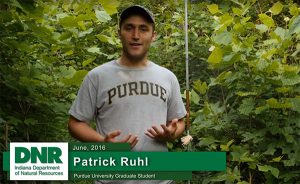 The Indiana Department of Natural Resources (IDNR) has released its latest video – Indiana’s Working Forests.
This video explores the origins of Indiana’s state forest system that developed after pioneer settlers cleared the original forests and left behind a nearly barren landscape.
State forests were established to demonstrate how to use science to grow and sustain healthy forest systems. Beginning with just 2,000 acres at Clark State Forest in 1903, the DNR Division of Forestry has expanded to cover more than 156,000 acres at 15 sites.
In the video, IDNR Forestry professionals discuss how management practices contribute to forest health by mimicking natural disturbances. Those practices promote regeneration of oaks and hickories that are valuable food sources for many forest wildlife species. They explain that although timber harvests have increased in recent years, the selective approach they use removes less than 1 percent of the available trees in any given year.
FNR graduate wildlife student Patrick Ruhl, Purdue adviser Dr. J. Barny Dunning, Jr., shares how the Hardwood Ecosystem Experiment provides him the opportunity to study the effects of forest management and the changes that are taking place among migratory songbirds. This project is a collaborative effort with the following sponsors: Indiana Department of Natural Resources, Division of Forestry; Indiana Department of Natural Resources, Division of Fish and Wildlife, Wildlife Diversity Section; Purdue University; Indiana Chapter of the Ruffed Grouse Society; National Geographic Society; and The Wildlife Management Institute. To view more partners view the Hardwood Ecosystem Experiment website: heeforestudy.org.
Resources:
A Landowner’s Guide to Sustainable Forestry: Part 1: Sustainable Forestry – What does it mean for Indiana?, The Education Store, Purdue Extension’s resource center
Indiana Forest Issues and Recommendations, The Education Store
The Hardwood Ecosystem Experiment: Indiana Forestry and Wildlife, The Education Store
Forest Ecosystem Management in Indiana, The Education Store
Forest Ecosystem Management in the Central Hardwood Region, The Education Store
Phil Bloom, Director
Indiana Department of Natural Resources
Choosing and planting a tree should be a well-informed and planned decision. Proper selection and planting can provide years of enjoyment for you and future generations as well as increased property value, improved environmental quality, and economic benefits. On the other hand, an inappropriate tree for your site or location can be a continual challenge and maintenance problem, or even a potential hazard, especially when there are utilities or other infrastructure nearby. This informative video will describe everything needed to know about choosing the right tree.
Resources:
Financial and Tax Aspect of Tree Planting, The Education Store
Tree Risk Management – Got Nature? Blog, Purdue Extension – FNR
Designing Hardwood Tree Plantings for Wildlife, The Education Store
Importance of Hardwood Tree Planting, The Education Store
Planning the Tree Planting Operation, The Education Store
Purdue Extension – Forestry and Natural Resources

It’s a tough neighborhood for trees in the built environment. It is an ecosystem unlike any other, because it is dynamic, fragmented, high-pressure, and constantly under siege. There are continual extremes and challenges in this “un-natural” area as opposed to the environment in a more natural woodland. It’s a place where trees die young, without proper selection, planting, and care. Successful tree selection requires us to think backwards—beginning with the end in mind— to get the right tree in the right place…in the right way. This publication, Tree Selection for the “Un-natural” Environment, takes a look at some important components of the decision-making process for tree selection. There is both a publication and a video resource on this topic, both of which can be found below.
The video can be watched here:
Planting Your Tree Part 1: Choosing Your Tree
Resources:
Tree Selection for the “Un-natural” Environment, The Education Store, Purdue Extension’s resource center
Tree Installation: Process and Practices, The Education Store
Construction and Trees: Guidelines for Protection, The Education Store
Diseases in Hardwood Tree Plantings, The Education Store
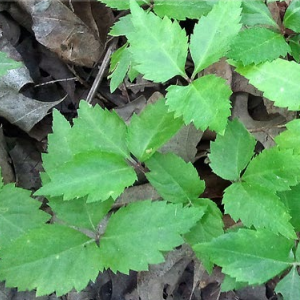 Forest farming in North America is becoming a popular practice that provides short-term income for owners of new forest plantations while their trees reach maturity. This income diversification is particularly relevant for many of the Indiana hardwood plantations planted in the last decade, but will not fulfill their economic potential until 60–70 years from establishment. This free download publication titled Costs and Returns of Producing Wild-Simulated Ginseng in Established Tree Plantations, FNR-530-W, is the second in a two-part series aimed at analyzing economic opportunities in forest farming for Indiana forest plantation owners. The first study explores growing hops along the tree line of newly established forest stands, while this second study investigates producing American ginseng in older (20- to 30-year-old) forest plantations.
Resources:
Costs and Returns of Producing Wild-Simulated Ginseng in Established Tree Plantations, The Education Store, Purdue Extension’s resource center
Energy Requirements for Various Tillage-Planting Systems, The Education Store
Home Gardner’s Guide, The Education Store
Planting Forest Trees and Shrubs in Indiana, The Education Store
Kim Ha, Research Assistant
Purdue Agricultural Economics
Lenny Farlee, Sustaining Hardwood Extension Specialist
Purdue Department of Forestry and Natural Resources

Recent Posts
- Popular Landscape Shrub is Invasive
Posted: October 15, 2026 in Alert, Forestry, Forests and Street Trees, Invasive Plant Species, Plants, Woodlands - Purdue Extension’s Regional Teams Are Here: Connecting Communities with Expertise and Opportunity
Posted: October 14, 2026 in Community Development, Forestry, Forests and Street Trees, Gardening, How To, Timber Marketing, Urban Forestry, Wildlife, Woodlands - Why Do Our Trees Go From Green Leaves to Different Colors?
Posted: in Forestry, Forests and Street Trees, Urban Forestry, Woodlands - October Is Firewood Month: Protect Indiana’s Forests by Making Smart Choices
Posted: October 1, 2026 in Forestry, Forests and Street Trees, How To, Invasive Insects, Urban Forestry - Question: Why Did the Shagbark Hickories Survive the Tornado?
Posted: August 27, 2026 in Forests and Street Trees, How To, Urban Forestry - Jarred Brooke Receives Early Career Award for Prescribed Fire Work
Posted: July 20, 2026 in Forestry, Forests and Street Trees, Natural Resource Planning, Safety - Pruning Highlight; Espalier Pruning: Training Trees into Living Patterns
Posted: July 8, 2026 in Forestry, Forests and Street Trees, Gardening - Pruning Highlight-Pollarding Trees: A Traditional Pruning Practice with Modern Uses
Posted: June 11, 2026 in Forestry, Forests and Street Trees, Urban Forestry, Wildlife, Woodlands - Flat-Faced Longhorn Beetle Found in Hardwood Logs – IDNR Division of Entomology
Posted: June 8, 2026 in Alert, Forestry, Forests and Street Trees, Invasive Insects, Urban Forestry, Wildlife, Woodlands - Connecting Research to Practice: Natural Resources & Land Use Spring Training
Posted: June 5, 2026 in Forestry, Forests and Street Trees, How To, Invasive Animal Species, Invasive Plant Species, Land Use, Natural Resource Planning, Urban Forestry, Wildlife, Woodlands
Archives
Categories
- Alert
- Aquaculture/Fish
- Aquatic/Aquaculture Resources
- Ask the Expert
- Christmas Trees
- Community Development
- Disease
- Drought
- Forestry
- Forests and Street Trees
- Gardening
- Got Nature for Kids
- Great Lakes
- How To
- Invasive Animal Species
- Invasive Insects
- Invasive Plant Species
- Land Use
- Natural Resource Planning
- Nature of Teaching
- Plants
- Podcasts
- Ponds
- Publication
- Safety
- Spiders
- Timber Marketing
- Urban Forestry
- Webinar
- Wildlife
- Wood Products/Manufacturing
- Woodland Management Moment
- Woodlands