 Purdue University - Extension - Forestry and Natural Resources
Got Nature? Blog
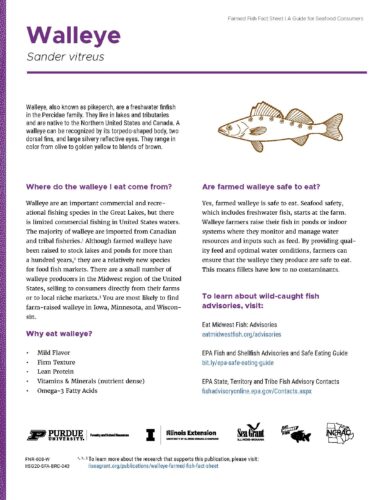 Seafood is a protein category that has many commercially and recreationally available options. Selecting seafood is more like shopping for fruits and vegetables than animal proteins. This publication is the first in a series of fact sheets that describe fish and shellfish produced in the Midwest region of the United States, where commercially available fish comes from, food safety, culinary characteristics, and cooking tips.
View other seafood publications and video resources as you place keywords in the search field located on The Education Store website.
Resources
Sustainable Aquaculture: What does it mean to you?, The Education Store, Purdue Extension resource center
Best Practices Guide for Charter Fishing and COVID-19, The Education Store
Pond Management: Managing Fish Populations, The Education Store
Indiana Pond Fish, Species Identification Card Set, The Education Store
Fish Cleaning with Purdue Extension County Extension Director, Got Nature? Blog, Purdue Extension – Forestry and Natural Resources
Amy Shambach, Aquaculture Marketing Outreach Associate
Purdue Department of Forestry and Natural Resources/Illinois Indiana Sea Grant Program
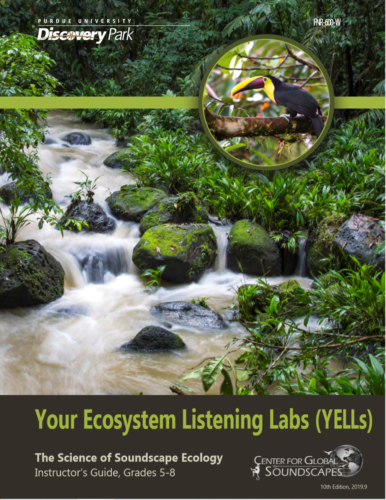 Your Ecosystem Listening Labs (YELLS): The Science of Soundscape Ecology Instructor’s Guide, Grades 5-8 is a 160-page publication, consisting of four chapters that focus on physics of sound, animal communication, soundscapes, and soundscape ecology.
The world around us is full of amazing sounds that are often ignored by humans. Unfortunately, many of the sources of these sounds are actually in danger of being destroyed by human activities. The activities contained in this package take students through the entire scientific method, from observations through conclusions, pairing the practice of science with the exploration of soundscape-based content.
To learn more about soundscape ecology and the sounds around us we might be missing or don’t know are there, visit Center for Global Soundscapes.
Resources
Record the Earth, APP
Community Soundscape Planning Guide: Controlling Noise & Protecting Natural and Cultural Sonic Spaces, The Education Store, Purdue Extension resource center
Bryan Pijanowski, Professor of Landscape and Soundscape Ecology
Purdue University Department of Forestry and Natural Resources
Kristen Bellisario, Post Doc Research Associate
Purdue University Department of Forestry and Natural Resources
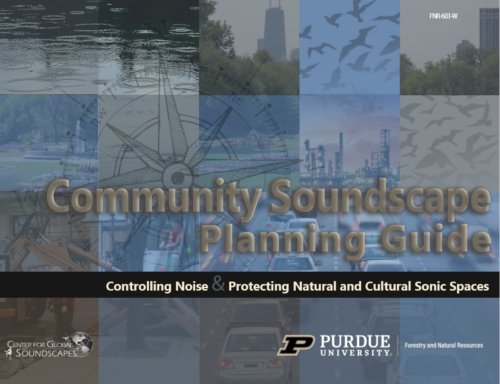 This Community Soundscape Planning Guide is to be used by communities in the United States and other places, to focus land use planning within the context of the sonic spaces of built and natural areas locally.
This guide focuses on:
– Learning the Basics: helping planners understand what a soundscape is and what is noise
– Impacts of Noise on People and Wildlife: summarizes what is known about how sound affects people and wildlife
– Soundscape Workbook: allowing individual planners or community groups to work through major issues related to natural and cultural soundscapes and the occurrence of noise in their community
– Planning Tools and Resources: which describes tools already in existence and new tools such as an app and online mapping system developed at Purdue University.
This planning guide is also associated with several Purdue Extension projects that are underway and which can be offered to communities.
Resources
Center for Global Soundscapes, Purdue University
Record the Earth, APP
Your Ecosystem Listening Labs (YELLS): The Science of Soundscape Ecology Instructor’s Guide, Grades 5-8, The Education Store, Purdue Extension resource center
Bryan Pijanowski, Professor of Landscape and Soundscape Ecology
Purdue University Department of Forestry and Natural Resources
Kara Salazar, Assistant Program Leader and Extension Specialist for Sustainable Communities
Purdue University Department of Forestry and Natural Resources
Dan Walker, Community Planning Extension Specialist
Purdue University Department of Forestry and Natural Resources
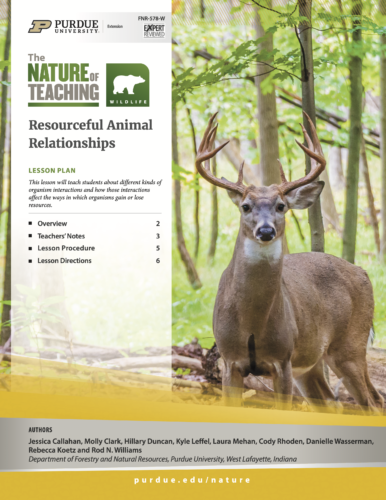 Resourceful Animal Relationships is one unit in a series available from The Nature of Teaching – the place to go for teaching resources that focus on wildlife, food waste, health and wellness. In this series teachers can find free lesson plans, printables, posters, a photo library, information on upcoming workshops and more.
This lesson will teach third- through fifth-grade students about different kinds of organism interactions and how those interactions affect the ways in which organisms gain or lose resources. Students will learn how to describe the differences between mutualism, parasitism,
and competition along with how to explain the different effects that relationships have on an organism and their resources.
It meets several grade-appropriate Next Generation Science Standards, English/Language Arts Standards, and Math Standards. This 19-page pdf is written by Dr. Rod Williams.
For more resources, please check the Education Store.
Resources
Benefits of Connecting with Nature, The Education Store, Purdue Extension resource center
The Nature of Teaching: Ecotoxicology and Environmental Health, The Education Store
The Nature of Teaching: Disease Ecology, The Education Store
The Nature of Teaching: Adaptations for Aquatic Amphibians, The Education Store
Adaptations for Aquatic Amphibians Activity 2: Water Quality Sneak Peak, Video, Purdue Extension YouTube channel
Rod Williams, Professor of Wildlife Science
Purdue University Department of Forestry and Natural Resources
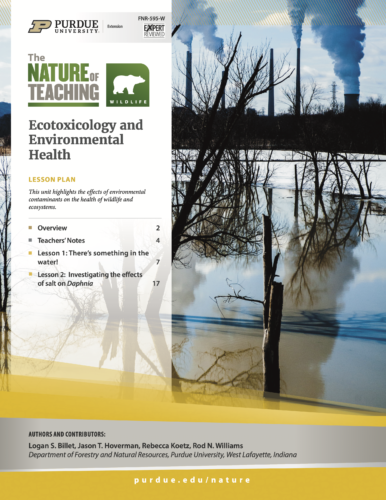 The Nature of Teaching: Ecotoxicology and Environmental Health is one unit in a series available from The Nature of Teaching – the place to go for teaching resources that focus on wildlife, food waste, health and wellness. In this series teachers can find free lesson plans, printables, posters, a photo library, information on upcoming workshops and more.
This unit highlights the effect of environmental contaminants on the health of wildlife and ecosystems with two lessons filled with worksheets, activities, lab report grading rubric sheet and more.
Lesson 1: There’s Something in the Water!
Lesson 2: Investigating the Effects of Salt Contamination on Daphnia
This 33-page PDF is written by Dr. Jason Hoverman; Logan Billet, Rebecca Koetz and Dr. Rod Williams.
For more resources, please check the Education Store.
Resources
Benefits of Connecting with Nature, The Education Store, Purdue Extension resource center
The Nature of Teaching: Disease Ecology, The Education Store
Resourceful Animal Relationships, The Education Store
The Nature of Teaching: Food Waste and the Environment, The Education Store
Adaptations for Aquatic Amphibians Activity 2: Water Quality Sneak Peak, Video, Purdue Extension YouTube channel
Rod Williams, Professor of Wildlife Science
Purdue University Department of Forestry and Natural Resources
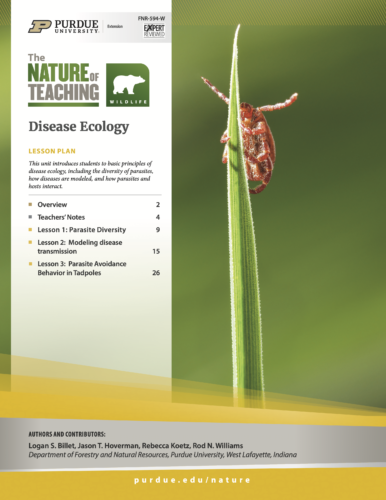 The Nature of Teaching: Disease Ecology is one unit in a series available from The Nature of Teaching – the place to go for teaching resources that focus on wildlife, food waste, health and wellness. In this series teachers can find free lesson plans, printables, posters, a photo library, information on upcoming workshops and more.
This unit introduces students to basic principles of disease ecology, including the diversity of parasites, how diseases are modeled, and how parasites and hosts interact. It includes three lessons with colorful animal cards to print along with worksheets and presentation.
Lesson 1: Parasite Diversity Activity
Lesson 2: Modeling Disease Transmission
Lesson 3: Parasite Avoidance Behavior in Tadpoles
This 33-page download PDF is written by Dr. Jason Hoverman; Logan Billet, Rebecca Koetz and Dr. Rod Williams.
For more resources, please check the Education Store.
Resources
Benefits of Connecting with Nature, The Education Store, Purdue Extension resource center
The Nature of Teaching: Ecotoxicology and Environmental Health, The Education Store
Resourceful Animal Relationships, The Education Store
The Nature of Teaching: Food Waste and the Environment, The Education Store
Rod Williams, Professor of Wildlife Science
Purdue University Department of Forestry and Natural Resources
Purdue Forestry & Natural Resources extension specialists gathered for a Facebook LIVE event held May 5th to answer questions on a wide range of topics from woodland management to wildlife habitat, ponds to invasive species and more.
Topics ranged from what to do about moles, voles and Canada geese causing damage in your yard, to how to pick the right tree for your landscape and how to measure the worth of your trees. The presentation also included segments on what to do about algae in your pond to how to know if you need to restock it as well as what to do about invasive plant species and how to protect your trees from deer damage.
Get advice from extension specialists Jarred Brooke, Lenny Farlee, Brian MacGowan, Lindsey Purcell, Rod Williams and Mitch Zischke in the video below.
If you have any further questions feel free to send your questions by submitting our Ask An Expert form.
Resources mentioned:
Purdue Extension – The Education Store
Purdue Report Invasive Species Website
Midwest Invasive Species Network Database
TreesAreGood.org
Find a Forester in Indiana
Improve My Property for Wildlife, Purdue Extension
Online Mole Program, Event May 14th, Purdue FNR Extension
Have you seen a hairless squirrel, Got Nature? Blog, Purdue FNR Extension
Stocking Fish, The Education Store, Purdue Extension Resource Center
Tree Selection for the “Un-natural” Environment, The Education Store
Selecting a Nuisance Control Operator, The Education Store
Forest Products Price Report (pdf), Indiana Department of Natural Resources (IDNR)
Indiana DNR Nuisance Goose Control Options (pdf), Indiana Department of Natural Resources (IDNR)
Turtles of Indiana, The Education Store
Salamanders of Indiana, The Education Store
Frogs and Toads of Indiana, The Education Store
Snakes and Lizards of Indiana, The Education Store
Aquatic Plant Management, The Education Store
Native Grasses, The Education Store
Preventing Deer Browsing on Trees/Shrubs, Video, Purdue Extension Youtube Channel
Brian MacGowan, Wildlife Extension Specialist
Purdue University, Department of Forestry and Natural Resources
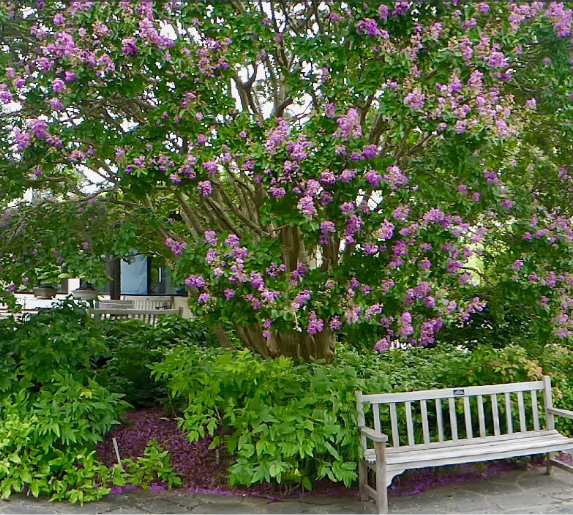 Trees provide many benefits and value to property owners in functional, aesthetic, social, environmental, and even economic ways. Functional benefits include mitigating climate change by storing carbon, removing pollution from the atmosphere, managing stormwater runoff, and improving air quality. Trees provide oxygen and many other benefits – such as shade, which can impact home cooling costs.
The collective value of trees makes a difference in people’s health and quality of life in cities and towns everywhere. This updated Purdue Extension publication Tree Appraisal and the Value of Trees describes methods used to appraise trees and landscapes that can determine their value and worth, reasons why a tree should be appraised, the factors that go into tree appraisal, what appraisal ratings mean, and sample scenarios.
Resources
The Nature of Teaching: Trees of the Midwest, The Education Store, Purdue Education Resource Center
Corrective Pruning for Deciduous Trees, The Education Store
Resources and Assistance Available for Planting Hardwood Seedlings, The Education Store
Tree Support Systems, The Education Store
Purdue University, Department of Forestry and Natural Resources
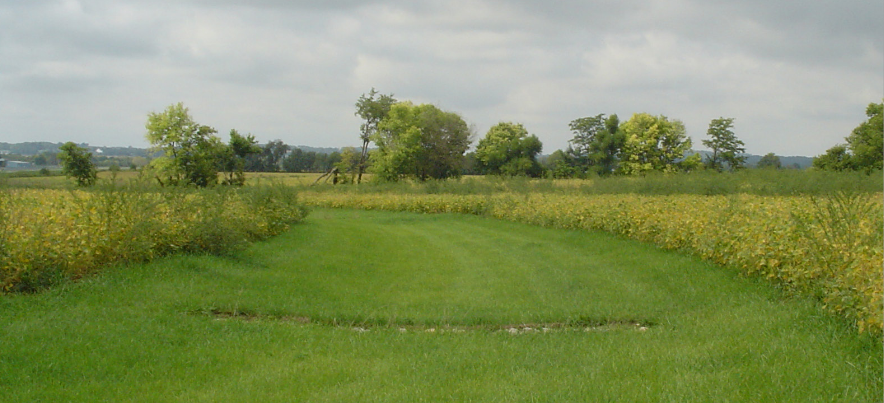 Agricultural Best Management Practices (BMPs) are intended to protect or improve water quality without significantly impacting production. This resource titled Tipping Point Planner Stormwater Definitions, Agricultural Best Management Practices, helps communities plan for a sustainable future. Authored by Ben Wegleitner, social science outreach associate, Daniel Walker, community planning extension specialist, Kara A Salazar, assistant program leader and extension specialist for sustainable communities, and Lydia Utley, data analyst, you will find references and get an overview of how the Tipping Point Planner program guides you through best management practices.
In this Long-Term Hydrologic Impact Assessment (L-THIA) model and the Tipping Point Planner program you will find the following BMPs: no-till practices, buffer strips, grassed waterway, nutrient management, grade stabilization structure and blind inlet.
With help from trained facilitators, the Tipping Point Planner program enables professional and citizen participation in the land use planning and management process.
Resources
Urban Best Management & Low Impact Development Practices, The Education Store, Purdue Extension resource center
Bioindicators of Water Quality: Quick Reference Guide, The Education Store
Improving Water Quality by Protecting Sinkholes on Your Property, video, The Education Store
Improving Water Quality At Your Livestock Operation, video, The Education Store
Improving Water Quality Around Your Farm, video, The Education Store
Healthy Water, Happy Home – Lesson Plan, The Education Store
Kara A Salazar, Assistant Program Leader and Extension Specialist for Sustainable Communities
Purdue University Department of Forestry and Natural Resources
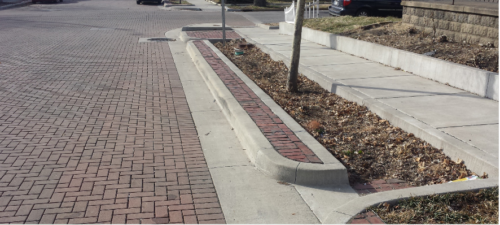 Urban best management practices (BMPs) and low-impact development practices are forms of green infrastructure designed to protect water quality and quantity by reducing stormwater runoff or by storing and treating stormwater before it reaches surface waters. Low-impact development practices are intended to mimic natural infiltration processes.
This publication titled Tipping Point Planner Stormwater Definitions: Urban Best Management Practices (BMPs) and Low Impact Development Practices is written by Ben Wegleitner, social science outreach associate, Daniel Walker, community planning extension specialist, Kara A Salazar, assistant program leader and extension specialist for sustainable communities, and Lydia Utley, data analyst. It discusses the benefits of several urban best management practices for protecting or improving water quality. These BMPs include: permeable pavement, rain barrels, bioretention system, grass strip (or buffer strip), grassed swale, retention ponds, wetland basin and detention basin. The following practices are used in the Long-Term Hydrologic Impact Assessment (L-THIA) model and the Tipping Point Planner. Through Tipping Point Planner, Great Lakes communities can plan sustainable futures by directly linking data to their local decision-making processes.
Resources
Tipping Point Planner Stormwater Definitions: Agricultural Best Management Practices, The Education Store, Purdue Extension resource center
Improving Water Quality by Protecting Sinkholes on Your Property, video, The Education Store
Improving Water Quality At Your Livestock Operation, video, The Education Store
Improving Water Quality Around Your Farm, video, The Education Store
Healthy Water, Happy Home – Lesson Plan, The Education Store
Kara A Salazar, Assistant Program Leader and Extension Specialist for Sustainable Communities
Purdue University Department of Forestry and Natural Resources

Recent Posts
- Publication – Direct Marketing Guidebook for Small/Medium-Scale Aquaculture Businesses
Posted: March 7, 2025 in Aquaculture/Fish, Aquatic/Aquaculture Resources, Publication - Publication – Handbook on Processing Fish for Small-Scale Fish Farmers
Posted: October 17, 2024 in Aquaculture/Fish, Aquatic/Aquaculture Resources, How To, Publication, Wildlife - Virtual Tour Brings Forest Management for Birds to Life
Posted: July 19, 2024 in Forestry, How To, Publication, Wildlife - Publication – Quality of Place and Community Development
Posted: July 18, 2024 in Community Development, Land Use, Publication, Urban Forestry - Publication – Introduction to White-tailed Deer Impacts on Indiana Woodlands
Posted: April 28, 2024 in Forestry, Land Use, Plants, Publication, Wildlife, Woodlands - Publication – Understanding White-tailed Deer and Their Impact on Indiana Woodlands
Posted: in Forestry, Land Use, Plants, Publication, Wildlife, Woodlands - Publication – Monitoring White-tailed Deer and Their Impact on Indiana Woodlands
Posted: in Forestry, Land Use, Plants, Publication, Wildlife, Woodlands - Publication – Managing White-tailed Deer Impacts on Indiana Woodlands
Posted: in Forestry, Land Use, Plants, Publication, Wildlife, Woodlands - New Deer Impact Toolbox
Posted: April 7, 2024 in Forestry, Land Use, Plants, Publication, Safety, Wildlife, Woodlands - Publication- Bluegill Farmed Fish Fact Sheet
Posted: December 15, 2023 in Aquaculture/Fish, Aquatic/Aquaculture Resources, Publication, Wildlife
Archives
Categories
- Alert
- Aquaculture/Fish
- Aquatic/Aquaculture Resources
- Ask the Expert
- Christmas Trees
- Community Development
- Disease
- Drought
- Forestry
- Forests and Street Trees
- Gardening
- Got Nature for Kids
- Great Lakes
- How To
- Invasive Animal Species
- Invasive Insects
- Invasive Plant Species
- Land Use
- Natural Resource Planning
- Nature of Teaching
- Plants
- Podcasts
- Ponds
- Publication
- Safety
- Spiders
- Timber Marketing
- Uncategorized
- Urban Forestry
- Webinar
- Wildlife
- Wood Products/Manufacturing
- Woodland Management Moment
- Woodlands