 Purdue University - Extension - Forestry and Natural Resources
Got Nature? Blog
The classic and trusted book “Fifty Common Trees of Indiana” by T.E. Shaw was published in 1956 as a user-friendly guide to local species. Nearly 70 years later, the publication has been updated through a joint effort by the Purdue Department of Forestry and Natural Resources, Indiana 4-H, and the Indiana Department of Natural Resources, and reintroduced as “An Introduction to Trees of Indiana.”
The full publication is available for download for $7 in the Purdue Extension Education Store. The field guide helps identify common Indiana woodlot trees.
Each week, the Intro to Trees of Indiana web series will offer a sneak peek at one species from the book, paired with an ID That Tree video from Purdue Extension forester Lenny Farlee to help visualize each species as it stands in the woods. Threats to species health as well as also insight into the wood provided by the species, will be provided through additional resources as well as the Hardwoods of the Central Midwest exhibit of the Purdue Arboretum, if available.
This week, we meet the Virginia pine, or Pinus virginiana. In Indiana, this species is native to the southern part of the state, namely Clark and Floyd counties in the dry, hilly areas known as the Knobs near the Ohio River, but it has been widely planted across the state.
This native conifer has clusters of two needles, approximately two inches long, which are often twisted.
The Virginia pine has an open canopy. Bark on the Virginia pine is flaky, with a combination of gray and red-orange tones. The bark gets more orange higher up the trunk. Cones are one to three inches long and have very sharp thorns at the end of the scales. Cones typically stay on the tree for several years.
For full article with additional photos view: Intro to Trees of Indiana: Virginia Pine, Forestry and Natural Resources’ News.
If you have any questions regarding wildlife, trees, forest management, wood products, natural resource planning or other natural resource topics, feel free to contact us by using our Ask an Expert web page.
Other Resources:
ID That Tree: Virginia Pine
Borers of Pines and Other Needle Bearing Evergreens in Landscapes, The Education Store, Purdue Extension’s resource center
Managing the Zimmerman Pine Moth, The Education Store
Purdue Arboretum Explorer
The Woody Plant Seed Manual, U.S. Forest Service
Native Trees of the Midwest, The Education Store
Shrubs and Woody Vines of Indiana and the Midwest, The Education Store
Investing in Indiana Woodlands, The Education Store
Forest Improvement Handbook, The Education Store
ID That Tree, Purdue Extension-Forestry & Natural Resources (FNR) YouTube playlist
Woodland Management Moment , Purdue Extension-FNR YouTube playlist
Wendy Mayer, FNR Communications Coordinator
Purdue University Department of Forestry and Natural Resources
Lenny Farlee, Extension Forester
Purdue University Department of Forestry and Natural Resources
Wild Bulletin, Indiana Department of Natural Resources (DNR) Fish and Wildlife: The Eastern box turtle (Terrapene carolina) is a species of hinge-shelled turtle that lives on forested land in Indiana. Box turtles are long-lived, slow to mature and have few offspring per year. This, coupled with the high mortality rate of box turtles being hit on roads, has resulted in Eastern box turtles being a species of special concern in Indiana.
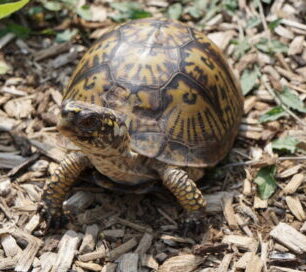
Eastern box turtles are listed as a species of special concern in Indiana due to population declines involving habitat loss, road mortality, and collection for pets. If you see one this summer, be sure to keep these guidelines in mind:
- Eastern box turtles may not be collected from the wild; however, if you accidentally catch an Eastern box turtle from Indiana from the wild, please contact the Division of Fish & Wildlife at DFW@dnr.IN.gov; do not release it into the wild. Its chances of survival are low, and it could transmit diseases to other wild Eastern box turtles.
- Sick or injured Eastern box turtles should be left in the wild. Don’t fret—box turtles are surprisingly resilient to damage and disease. If left alone, they will likely heal on their own. If a box turtle appears severely injured, it can be given to a licensed rehabilitator or licensed veterinarian.
If you see a wild Eastern box turtle crossing a busy road, you can pick it up and move it to the other side of the road in the direction it was facing. DNR appreciates your efforts to conserve wildlife.
To identify and learn more about the Eastern box turtle, please visit the DNR: Fish and Wildlife: Eastern Box Turtle website
Resources
Turtles of Indiana, The Education Store
Appreciating Reptiles and Amphibians in Nature, The Education Store
Forestry Management for Reptiles and Amphibians: A Technical Guide for the Midwest, The Education Store
The Nature of Teaching, Unit 3: Reptiles, Amphibians, and the Scientific Method, The Education Store
Partners in Amphibian and Reptile Conservation (PARC)
Ask An Expert, Purdue Extension – FNR Playlist
Indiana Department of Natural Resources
In this edition of ID That Tree, Purdue extension forester Lenny Farlee helps you identify American elderberry, a native shrub found in wetland areas and other areas with good-quality moist soils. This shrub produces small white flowers which turn to berries and are favored by birds and humans alike. It has opposite leaf arrangement with compound leaves and often is found as a cluster of stems with relatively smooth texture.
If you have any questions regarding wildlife, trees, forest management, wood products, natural resource planning or other natural resource topics, feel free to contact us by using our Ask an Expert web page.
Resources:
ID That Tree, Playlist, Purdue Extension – Forestry and Natural Resources YouTube Channel (Invasive White Mulberry, Siberian Elm, Tree of Heaven)
Invasive Species Playlist, Playlist, Purdue Extension – FNR YouTube Channel (Asian Bush Honeysuckle, Burning Bush, Callery Pear, Multiflora rose)
A Woodland Management Moment, Playlist, Purdue Extension – FNR YouTube Channel (Against Invasives, Garlic Mustard, Autumn Olive)
Woodland Stewardship for Landowners, Playlist, Purdue Extension – FNR YouTube Channel (Common Buckthorn, Japanese Barberry)
Report Invasive Species, Purdue Invasive Species
The GLEDN Phone App – Great Lakes Early Detection Network
EDDMaps – Early Detection and Distribution Mapping System
How long do seeds of the invasive tree, Ailanthus altissima remain viable? (Invasive Tree of Heaven), USDA Forest Service
Indiana Department of Natural Resources: Invasive Species
Indiana Invasive Species Council
Cooperative Invasive Species Management Area (CISMA)
Aquatic Invasive Species, Illinois-Indiana Sea Grant (IISG)
Episode 11 – Exploring the challenges of Invasive Species, Habitat University-Natural Resource University
What are invasive species and why should I care?, Got Nature? Blog, Purdue Extension – FNR
Shrubs and Woody Vines of Indiana and the Midwest, The Education Store, Purdue Extension Resource Center
Native Trees of the Midwest, The Education Store
Investing in Indiana Woodlands, The Education Store
Forest Improvement Handbook, The Education Store
Lenny Farlee, Extension Forester
Hardwood Tree Improvement and Regeneration Center
Purdue Department of Forestry & Natural Resources
What is phenology and how do we observe seasonal changes in nature? In this webinar hosted by Indiana Forestry & Woodland Owners Association (IFWOA), presenter Amanda Wanless of Indiana Phenology discusses how you can observe seasonal change on your landscape and ways to monitor the changes. Find out how to join a citizens science network collecting long term data.
Check out the Indiana Forestry & Woodland Association YouTube Channel for videos including: What is IFWOA?; A New Carbon Program for Hardwood Landowners Webinar, Indiana’s Native Orchids, Magnificent Trees of Indiana, Be Tick Aware and much more.
The Indiana Forestry & Woodland Owners Association (IFWOA) was founded in 1977 and is a non-profit organization dedicated to conservation and sustainable management of woodlands in Indiana. IFWOA advocates for scientific best practices for management to achieve objectives of clean water, wildlife habitat, soil protection, native species diversity, timber production, recreation, carbon sequestration and many others.
IFWOA is an affiliate of the National Woodland Owners Association. IFWOA is a partner, collaborator or is represented on leading National and State organizations. These memberships or collaborations are selected to advance Indiana Woodland owner’s interests. IFWOA monitors and influences legislation and economic trends impacting Indiana woodlands and landowners for our members. Membership in IFWOA provides a valuable network linkage to information and resources at the leading edge of science, industry and politics impacting Indiana woodlands.
Resources:
Nature’s Notebook, USA National Phenology Network
Forest Improvement Handbook, The Education Store, Purdue Extension’s resource center
Harvesting our forests, the wildlife debate, Purdue Extension – Forestry and Natural Resources (FNR) Got Nature? Blog
Wildlife Responses to Timber Harvesting, The Education Store
Breeding Birds and Forest Management: the Hardwood Ecosystem Experiment and the Central Hardwoods Region, The Education Store
Forest Management for Reptiles and Amphibians: A Technical Guide for the Midwest, The Education Store
Hardwood Ecosystem Experiment – Forest Birds , Purdue Extension – FNR YouTube Channel
Managing Woodlands for Birds , Purdue Extension – FNR YouTube Channel
Sustaining Our Oak-Hickory Forests , Purdue Extension – FNR YouTube Channel
Ask the Expert: Hardwood Ecosystem Experiment – Birds and Salamander Research, Purdue Extension – FNR
Subscribe to Purdue Extension-FNR YouTube Channel
Liz Jackson, Engagement Lead
Indiana Forestry & Woodland Association
In this webinar, hosted by Indiana Forestry & Woodland Owners Association (IFWOA), presenter LeAnne Barta of Indiana Lyme Connect shares strategies for preventing tick bites and discuss the ticks found in Indiana, their life stages, and symptoms of tick-borne illnesses like Lyme disease.
Check out the Indiana Forestry & Woodland Association YouTube Channel for videos including: What is IFWOA?; A New Carbon Program for Hardwood Landowners Webinar, Indiana’s Native Orchids, Magnificent Trees of Indiana, Observing Seasonal Changes in Nature and much more.
The Indiana Forestry & Woodland Owners Association (IFWOA) was founded in 1977 and is a non-profit organization dedicated to conservation and sustainable management of woodlands in Indiana. IFWOA advocates for scientific best practices for management to achieve objectives of clean water, wildlife habitat, soil protection, native species diversity, timber production, recreation, carbon sequestration and many others.
IFWOA is an affiliate of the National Woodland Owners Association. IFWOA is a partner, collaborator or is represented on leading National and State organizations. These memberships or collaborations are selected to advance Indiana Woodland owner’s interests. IFWOA monitors and influences legislation and economic trends impacting Indiana woodlands and landowners for our members. Membership in IFWOA provides a valuable network linkage to information and resources at the leading edge of science, industry and politics impacting Indiana woodlands.
Resources:
Find an Indiana Professional Forester, Indiana Forestry & Woodland Owners Association (IFWOA)
Purdue Arboretum Explorer
Native Trees of the Midwest, Purdue University Press
Shrubs and Woody Vines of Indiana and the Midwest, Purdue University Press
Investing in Indiana Woodlands, The Education Store
Forest Improvement Handbook, The Education Store
ID That Tree, Purdue Extension-Forestry & Natural Resources (FNR) YouTube playlist
Woodland Management Moment , Purdue Extension-FNR YouTube playlist
Liz Jackson, Engagement Lead
Indiana Forestry & Woodland Association
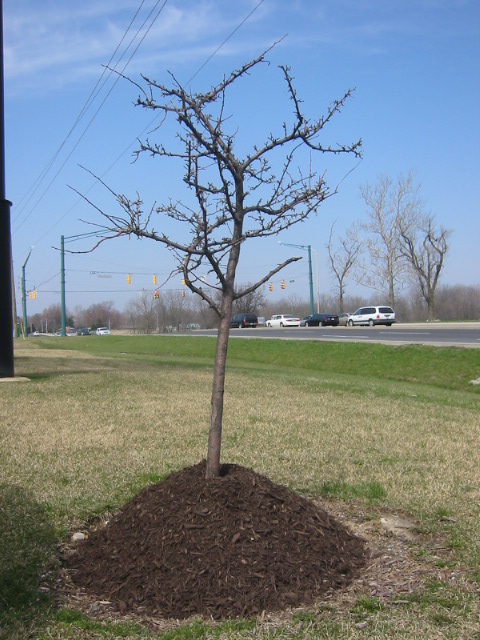
Figure 1: Volcano mulching around the base of the tree. Photo credit Lindsey Purcell.
Purdue Landscape Report: It’s that wonderful time of year again where temps are rising, life is coming back into the landscape, and people are thinking about how to improve the urban canopy around them. Well, maybe not that specifically, but we have the urge to plant trees. Whether it’s for Earth Day or Arbor Day or you just enjoy the act of planting, one of the hot topics is getting trees into the ground. That’s not what I’m here to talk about today, though.
As much as I love assisting communities with their greening efforts, getting the right tree in the right place, planting is not the only way to help grow the canopy around you. One of the topics that can be neglected is maintaining trees from previous plantings. Often, trees get placed in the ground, they are mulched, watered, and staked, then left on their own to make it in the world. New trees can take about 2-5 years to become established in their new homes and they could require assistance from us for much longer to thrive. Luckily, there is a simple activity to do assist trees, young and old.
Just like when they were placed in the ground, trees still benefit from mulch. Reapplying mulch benefits trees in multiple ways. It’s a natural way to prevent weeds and grass competing in the root zone and adds a protective buffer against mechanical damage from mowers and weed eaters. It will also help to maintain moisture levels in the soil as we transition into the hotter summer months. When applying new mulch, don’t worry about removing the old layer. It’s working its way into the soil around the tree adding organic matter, improving the quality of the soil.
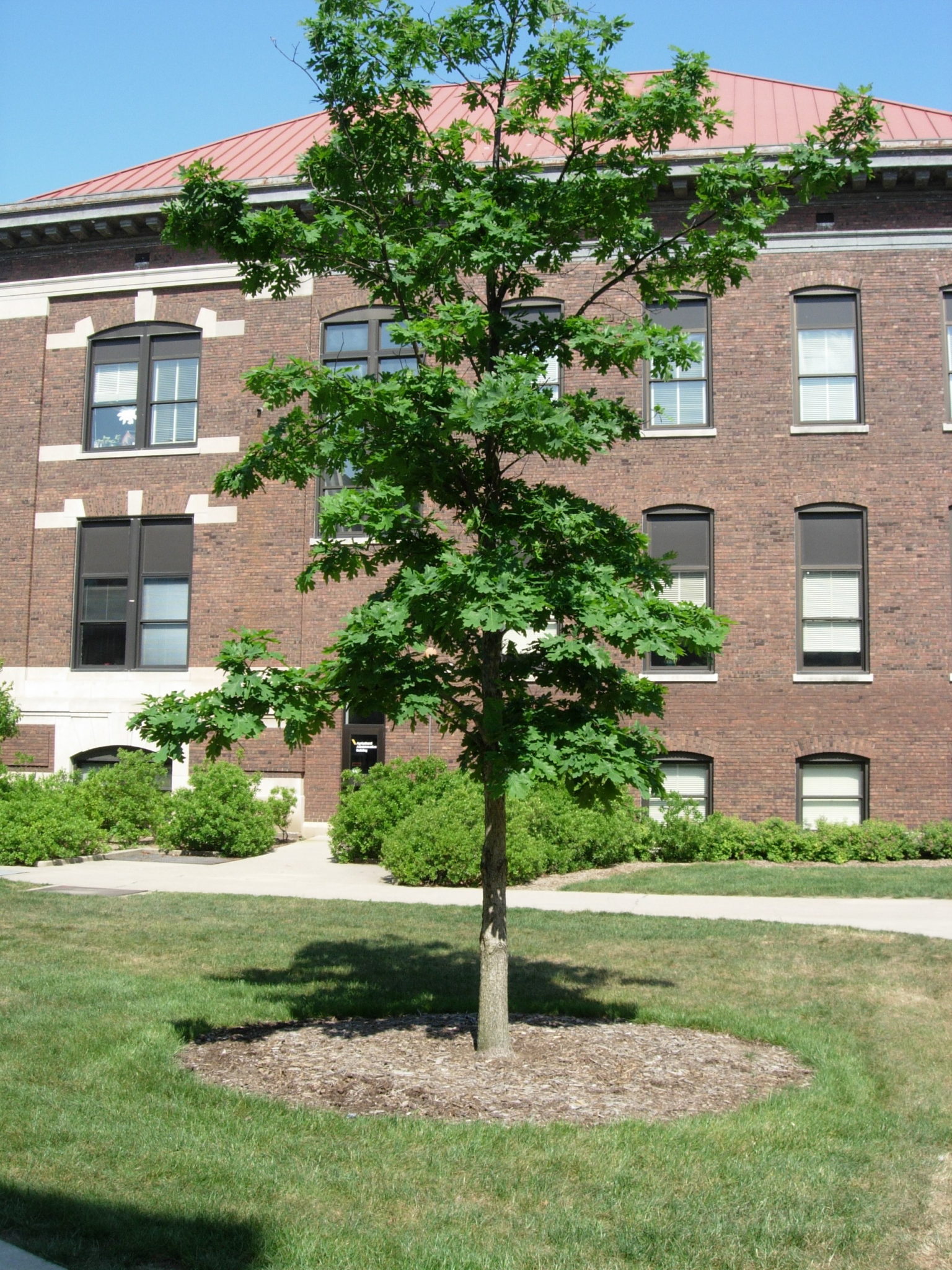
Figure 2: Correct application of mulch. Photo Credit John Bonkowski.
Add enough mulch so there is a 2–3-inch layer sloping away from the tree with at least a 3–5-foot radius around the stem (older, larger trees can benefit from larger mulch rings). No volcano mulching (Figure 1), make sure you also have around a 1-2-inch gap between the stem and the start of the mulch ring (Figure 2) to prevent unwanted root growth above ground and rot from excess moisture on the stem. Continuing this practice every year can help maintain soil moisture levels, while enriching the soil around your tree, maintaining a safety zone, and adding a nice aesthetic.
To view this article and other Purdue Landscape Report articles, please visit Purdue Landscape Report.
Subscribe and receive the newsletter: Purdue Landscape Report Newsletter.
Resources:
The Purdue Landscape Report
Purdue Landscape Report Facebook Page
Find an Arborist website, Trees are Good, International Society of Arboriculture (ISA)
Tree Installation: Process and Practices, The Education Store
Planting Forest Trees and Shrubs in Indiana, The Education Store
Planting Your Tree Part 1: Choosing Your Tree, Video, Purdue Extension – Forestry and Natural Resources YouTube Channel
Tree Defect Identification, The Education Store, Purdue Extension resource center
Tree wounds and healing, Got Nature? Blog
Tree Pruning Essentials, Publication & Video, The Education Store
Shrubs and Woody Vines of Indiana and the Midwest, The Education Store
Tree Risk Management – Got Nature? Blog, Purdue Extension – FNR
Why Is My Tree Dying? – Got Nature? Blog, Purdue Extension – Forestry and Natural Resources
ID That Tree, Purdue Extension-Forestry & Natural Resources (FNR) YouTube playlist
Subscribe to Purdue Extension-FNR YouTube Channel
Ben McCallister, Urban Forestry Specialist
Purdue Forestry and Natural Resources
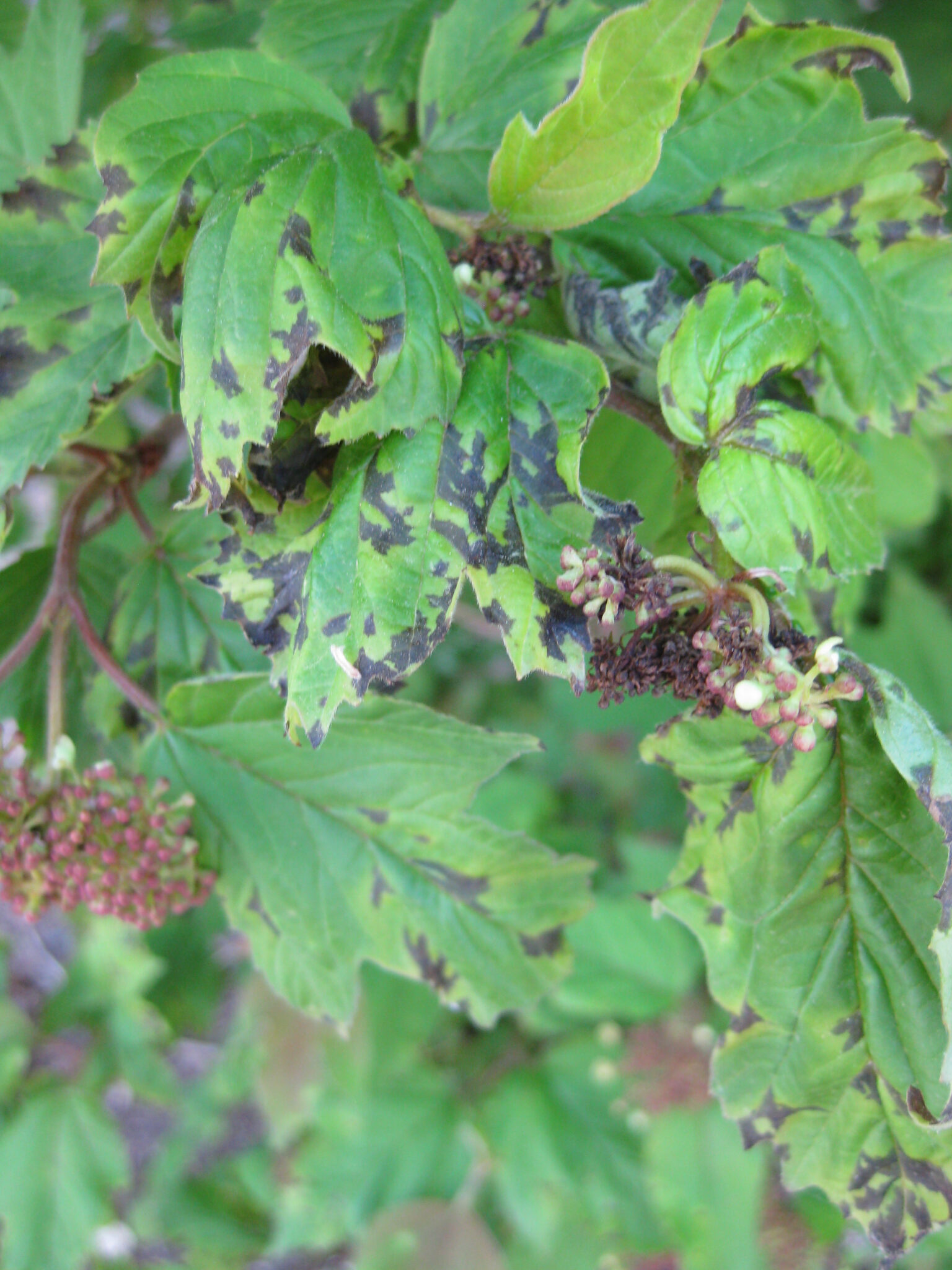
Bacterial leaf spots are often angular with chlorotic halos, as seen on this high bush-cranberry. Photo by Janna Beckerman.
Purdue Landscape Report: Pseudomonas syringae pv. syringae is an opportunistic bacterial pathogen that attacks a diversity of woody ornamental plants. The bacteria cause flower blights, cankers, shoot blights, and diebacks.
Symptoms
Symptoms often begin as expanding leaf spots. On lilac and viburnum, small spots expand to irregularly shaped brown lesions with yellow halos (Fig. 1). For most other hosts (cherry, pear, basswood, dogwood, hydrangea, high bush-cranberry, mountain-ash), infected leaves turn reddish brown or black and usually remain on the branch after they die (Fig. 2). As the bacteria spread into woody tissue, dark, sunken sections of the stem (cankers) expand, working their way back toward the trunk from infected leaves and flowers. Leaves attached to a cankered branch will wilt while the tip of the affected branch curls and droops like a shepherd’s crook (Fig. 3). Cloudy droplets of sticky fluid (ooze) may accumulate on leaf tips, leaf surfaces, stems, and even infected fruit.
Image of infected flowers result in blossom blast.
Figure 2. Infected flowers result in blossom blast. The continued growth of the bacteria can result in cankering and blight. Photo by George Sundin.
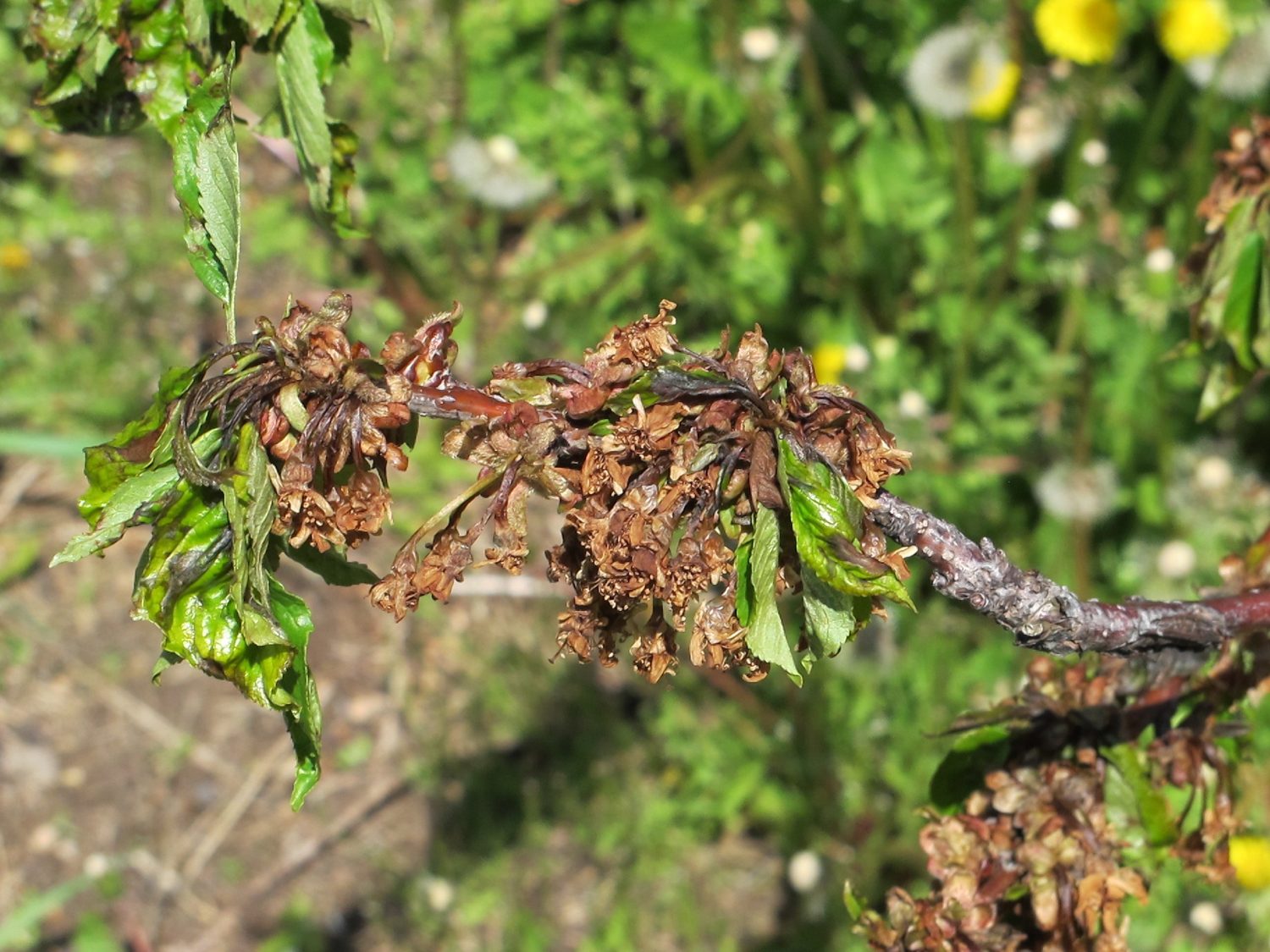
Figure 2. Infected flowers result in blossom blast. The continued growth of the bacteria can result in cankering and blight. Photo by George Sundin.
Life Cycle
The bacteria overwinter and persist in cankers, along with asymptomatic bud and twig tissue. In presence of water and warming temperatures, bacteria multiply and may ooze from infected tissue. Wind-driven rain, insect, or mechanical pruning spread Pseudomonas. Bacteria enter the plant through flowers or injury.
Management
All bacterial pathogens, including Pseudomonas, invade flowers or wounded tissue. To prevent or minimize the risk of infection:
- Use disease-free plants and budwood.
- Prune in the late winter/early spring.
- When pruning, do not mix pruning to shape woody ornamentals with pruning to manage disease.
- When pruning to remove infected shoots, be sure to disinfect shears between plants.
- Minimize overhead irrigation when possible to minimize splashing and pathogen spread.
- Avoid over-fertilization practices that drive excess succulent growth.
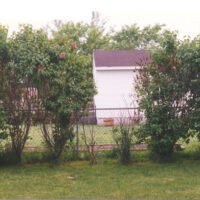
Figure 3. Bacterial blight is a common scourge to common lilac. Using resistant varieties is the best way to protect against the disease. Photo by Janna Beckerman.
- Avoid late season fertilization practices that prevent plants from achieving timely dormancy and promote freeze damage and/or winter injury (Fig. 4).
- Choose zone appropriate plants to avoid freeze damage and/or winter injury.
- Choose disease resistant plants, when available. The following lilac varieties were found to be resistant over a four-year trial: Donald Wyman, Royalty, Superba, Miss Kim, Edmund Boisier, Victor Lemoine, Dwarf Korean, Mme. Antoine Buchner Isabella, Sensation, Anna Amhof, Krasavitska Moskvy, Michael Buchner, and Alphonse Lavallée.

Foliar sprays of some copper-based bactericides (e.g., Camelot, Kocide, and Nu-Cop) were found to reduce disease incidence in trials on lilac (Vey and Palmer, 2018). Avoid using copper under cool, humid conditions to reduce the risk of phytotoxicity and damaging plants. Copper resistant populations of Pseudomonas syringae have been reported in other crops (vegetables, stone fruit). Products containing acibenzolar have provided inconsistent control in multiple trials but is labeled for use. Use of quaternary-ammonium disinfestants (KleenGrow) have been found to reduce bacterial populations and disease incidence and should be considered as part of any rotation with copper products. Due to the diversity of copper products, be sure to test for phytotoxicity issues prior to large scale treatment of crops.
To view this article and other Purdue Landscape Report articles, please visit Purdue Landscape Report.
Subscribe and receive the newsletter: Purdue Landscape Report Newsletter.
Resources:
The Purdue Landscape Report
Purdue Landscape Report Facebook Page
Find an Arborist website, Trees are Good, International Society of Arboriculture (ISA)
Phytophthora Diseases in Ornamentals, The Education Store, Purdue Extension’s resource center
Root Rot in Landscape Plants, The Education Store
Symptoms and Signs for Plant Problem Diagnosis, The Education Store
Tree Defect Identification, The Education Store
Tree Pruning Essentials, Publication & Video, The Education Store
Shrubs and Woody Vines of Indiana and the Midwest, Purdue University Press
Tree Risk Management – Got Nature? Blog, Purdue Extension – FNR
Equipment Damage to Trees, Got Nature? Blog
Tree wounds and healing, Got Nature? Blog
ID That Tree, Purdue Extension-Forestry & Natural Resources (FNR) YouTube playlist
Southwest Damage, Scalding, or Frost Cracking – Landscape Report
Subscribe to Purdue Extension-FNR YouTube Channel
Janna Beckerman, Professor of Plant Pathology
Purdue Department of Botany
This exotic invasive tree species is commonly found in Indiana landscape, callery pear. Callery pear has been planted as an ornamental tree in the midwest for decades. The original selection bradford pear was actually infertile and would not spread from seed but additional varieties have been planted and have crossed with the original Bradford and those are producing fertile seed. Find out how the seed spreads and what we can do to help our forest.
If you have any questions regarding wildlife, trees, forest management, wood products, natural resource planning or other natural resource topics, feel free to contact us by using our Ask an Expert web page.
Resources:
ID That Tree, Playlist, Purdue Extension – Forestry and Natural Resources YouTube Channel (Invasive White Mulberry, Siberian Elm, Tree of Heaven)
Invasive Species Playlist, Playlist, Purdue Extension – FNR YouTube Channel (Asian Bush Honeysuckle, Burning Bush, Callery Pear, Multiflora rose)
A Woodland Management Moment, Playlist, Purdue Extension – FNR YouTube Channel (Against Invasives, Garlic Mustard, Autumn Olive)
Woodland Stewardship for Landowners, Playlist, Purdue Extension – FNR YouTube Channel (Common Buckthorn, Japanese Barberry)
Report Invasive Species, Purdue Invasive Species
The GLEDN Phone App – Great Lakes Early Detection Network
EDDMaps – Early Detection and Distribution Mapping System (Report Invasives)
How long do seeds of the invasive tree, Ailanthus altissima remain viable? (Invasive Tree of Heaven), USDA Forest Service
Indiana Department of Natural Resources: Invasive Species
Indiana Invasive Species Council
Cooperative Invasive Species Management Area (CISMA)
Aquatic Invasive Species, Illinois-Indiana Sea Grant (IISG)
Episode 11 – Exploring the challenges of Invasive Species, Habitat University-Natural Resource University
What are invasive species and why should I care?, Got Nature? Blog, Purdue Extension – FNR
Shrubs and Woody Vines of Indiana and the Midwest, The Education Store, Purdue Extension Resource Center
Native Trees of the Midwest, The Education Store
Investing in Indiana Woodlands, The Education Store
Forest Improvement Handbook, The Education Store
Lenny Farlee, Extension Forester
Hardwood Tree Improvement and Regeneration Center
Purdue Department of Forestry & Natural Resources
This is the eighth in a series of consumer guides that describe fish and shellfish farmed in the Midwest region of the United States. The fact sheet also includes culinary characteristics, cooking tips and a recipe for Easy Baked Salmon.
Atlantic salmon, also known as sea-run salmon, kelts, and black salmon, are anadromous finfish in the Salmonidae family. Anadromous fish start their lives in freshwater and migrate to saltwater, returning to freshwater to spawn. Atlantic salmon are the only salmon species found in the Atlantic Ocean. They are native to the North Atlantic Ocean and coastal streams of North America and Europe and landlocked populations have been documented.1,2 They can be found in coastal waterways, freshwater streams, and lakes. They have long silver bodies with small black spots, appearing brownish from above. During spawning, males turn bronzish-purple with red spots and develop a hook-like lower jaw, known as a “kype.”
To receive the free download for the Atlantic Salmon Farmed Fish Fact Sheet please visit The Education Store.
Resources:
Walleye Farmed Fish Fact Sheet, The Education Store, Purdue Extension’s resource center
Pacific White Shrimp Farmed Fact Sheet, The Education Store
Yellow Perch Farmed Fish Fact Sheet, The Education Store
Tilapia Farmed Fish Fact Sheet, The Education Store
Rainbow Trout Farmed Fish Fact Sheet, The Education Store
American Paddlefish, The Education Store
A Guide to Small-Scale Fish Processing Using Local Kitchen Facilities, The Education Store
Aquaculture Family Coloring Book Development, The Education Store
Eat Midwest Fish, Illinois-Indiana Sea Grant online resource hub
Aquatics & Fisheries Videos, Purdue Extension-Forestry and Natural Resources YouTube Channel Playlist
Channel Catfish, The Education Store
Amy Shambach, Aquaculture Marketing Outreach Associate
Purdue Department of Forestry and Natural Resources/Illinois Indiana Sea Grant Program
A rain garden is a green infrastructure project that can improve the quality of stormwater, minimize pollution, and enhance biodiversity and pollinator habitat. Purdue, Iowa State and Illinois-Indiana Sea Grant researchers explain how to site, size, design, install and maintain a rain garden, and provide advice on plant selection, too.
When stormwater runs off streets, driveways, roofs, and other impervious surfaces, it can move pollutants such as oil, fertilizers, heat, and chemicals to storm drains and eventually to natural bodies of water, such as lakes, streams, and rivers. These natural water sources are valuable resources for recreation, irrigation, and drinking water. Green infrastructure projects, such as rain gardens, can improve the quality of stormwater, reduce flooding, minimize pollution, enhance biodiversity and pollinator habitat, and create educational and recreational opportunities.
Green infrastructure includes a range of practices that allows stormwater to infiltrate into the soil or be stored for later use, thereby reducing flows to sewer systems and surface waters (U.S. EPA, 2022). A rain garden is one such practice. It is a small-scale landscape feature planted with native shrubs, perennial plants, or flowers in a shallow depression. It captures and stores runoff, allowing it to slowly infiltrate into the soil. At the property scale and when properly located, rain gardens lessen erosion in steeply sloped areas, reduce the potential for water to flow into basements, and minimize ponding in areas with poor drainage. The net effect of multiple green infrastructure practices can reduce streambank erosion and downstream flooding as stream flows decrease. Water quality is also affected as plants and microbes in the soil filter nutrients and some heavy metals as the stormwater soaks into the soil.
To receive the free download for the Introduction to Rain Garden Design please visit The Education Store.
Resources:
Community Development, Purdue Extension Program
Environmental Planning in Community Plans, The Education Store, Purdue Extension’s resource center
Enhancing the Value of Public Spaces: Creating Healthy Communities, The Education Store
Conservation through Community Leadership, The Education Store
Tree Installation: Process and Practices, The Education Store
Planting Forest Trees and Shrubs in Indiana, The Education Store
Planting Your Tree Part 1: Choosing Your Tree, Video, Purdue Extension – Forestry and Natural Resources YouTube Channel
Subscribe – Purdue Extension – Forestry and Natural Resources YouTube Channel
Purdue Extension-Forestry and Natural Resources Calendar, workshops and Conferences
Kara A Salazar, Sustainable Communities
Purdue Community Development Extension Specialist
Sara Winnike McMillan, Associate Professor
Purdue University
Payton Ginestra, Natural Resources and Environmental Science
Purdue University
Laura Esman, Water Quality Program Coordinator
Purdue University
John Orick, Purdue Extension Master Gardener State Coordinator
Purdue University

Recent Posts
- October Is Firewood Month: Protect Indiana’s Forests by Making Smart Choices
Posted: October 1, 2026 in Forestry, Forests and Street Trees, How To, Invasive Insects, Urban Forestry - Heavy August Rains Bring More Mosquitoes to Indiana
Posted: September 9, 2026 in How To, Invasive Insects, Safety, Wildlife - Question: Why Did the Shagbark Hickories Survive the Tornado?
Posted: August 27, 2026 in Forests and Street Trees, How To, Urban Forestry - Indiana Fall Hunting Licenses on Sale and New Mobile App Available
Posted: August 12, 2026 in Forestry, How To, Wildlife - Trees and Storms: Understanding Damage, Risk and Recovery
Posted: in How To, Urban Forestry - Celebrate Pollinator Week With Flowers of June Tour
Posted: June 15, 2026 in Forestry, Gardening, How To, Wildlife - Connecting Research to Practice: Natural Resources & Land Use Spring Training
Posted: June 5, 2026 in Forestry, Forests and Street Trees, How To, Invasive Animal Species, Invasive Plant Species, Land Use, Natural Resource Planning, Urban Forestry, Wildlife, Woodlands - Indiana Monarch and Pollinator Conservation
Posted: June 1, 2026 in Forestry, Forests and Street Trees, Gardening, How To, Natural Resource Planning, Plants, Urban Forestry, Wildlife - Spring Storms Are Coming: How to Reduce Tree Damage and Risk
Posted: May 1, 2026 in How To, Urban Forestry, Wildlife, Woodlands - It’s Timberdoodle Time!
Posted: April 3, 2026 in Got Nature for Kids, How To, Wildlife
Archives
Categories
- Alert
- Aquaculture/Fish
- Aquatic/Aquaculture Resources
- Ask the Expert
- Christmas Trees
- Community Development
- Disease
- Drought
- Forestry
- Forests and Street Trees
- Gardening
- Got Nature for Kids
- Great Lakes
- How To
- Invasive Animal Species
- Invasive Insects
- Invasive Plant Species
- Land Use
- Natural Resource Planning
- Nature of Teaching
- Plants
- Podcasts
- Ponds
- Publication
- Safety
- Spiders
- Timber Marketing
- Urban Forestry
- Webinar
- Wildlife
- Wood Products/Manufacturing
- Woodland Management Moment
- Woodlands