 Purdue University - Extension - Forestry and Natural Resources
Got Nature? Blog
In this edition of ID That Tree, Purdue Extension Forester Lenny Farlee showcases the unique features of prickly ash. The northeast member of the Citrus family (not the Ash family!) is a shrub with stout, paired thorns, reddish-brown buds and also has other traits shared in the video that makes it easy to spot out in the wild. This video contains nice close-up shots so you can identify this plant, which is native to Indiana and an important part of the habitat.
If you have any questions regarding wildlife, trees, forest management, wood products, natural resource planning or other natural resource topics, feel free to contact us by using our Ask an Expert web page.
Resources:
ID That Tree: Firs and Spruces, Video Playlist, Purdue Extension – Forestry and Natural Resources (FNR) YouTube Channel
ID That Tree – Jack Pine, Scotch Pine, Red Pine, Virginia Pine, Eastern White Pine, Video Playlist, Purdue Extension – Forestry and Natural Resources (FNR) YouTube Channel
Beat Back Borers Attacking Pines and Other Cone Bearing Trees, Purdue Landscape Report
Tree Diseases: White Pine Decline in Indiana, The Education Store, Purdue Extension Resource Center
Purdue Arboretum Explorer
Conservation Tree Planting: Steps to Success, Purdue Extension – FNR YouTube Channel
A Woodland Management Moment, Playlist, Purdue Extension – FNR YouTube Channel
Woodland Stewardship for Landowners, Playlist, Purdue Extension – FNR YouTube Channel
Indiana Department of Natural Resources: Invasive Species
Indiana Invasive Species Council
Cooperative Invasive Species Management Area (CISMA)
Report Invasive, Purdue Extension
Episode 11 – Exploring the challenges of Invasive Species, Habitat University-Natural Resource University
Shrubs and Woody Vines of Indiana and the Midwest, The Education Store
Native Trees of the Midwest, The Education Store
Professional Forester, Indiana Forestry Woodland Owners Association
Forest Improvement Handbook, The Education Store
Find an Arborist, International Society of Arboriculture
Lenny Farlee, Extension Forester
Hardwood Tree Improvement and Regeneration Center
Purdue Department of Forestry & Natural Resources

Photo by Larry Caplan.
When do you need to discard your real Christmas tree? What options are there in disposing the tree?
Check out these tips from our Purdue experts:
Lenny Farlee, Purdue Extension Forester with Forestry and Natural Resources, in interview with the WLFI news team shares the first steps is to remove all decorations. “Several municipalities here in the area will either take the trees for mulching or composting. So if you don’t want to fool with the tree anymore, that’s a great option. You can just take it to the curb, or certain locations, and they’ll take care of it for you and it gets reused or recycled into usable material,” explains Farlee. Choosing to keep the tree in your backyard is a great wildlife friendly option. Lenny shares how important it is to remove your tree in a timely manner to avoid any fire hazards in your house. The video explains on how you can test your tree to see if it should be discarded. See video and full article for more options: Options for Getting Rid of Real Christmas Tree, wlfi.com.
John Woodmansee, Purdue Extension Educator-Agriculture Natural Resources (ANR), also shares tips in the Purdue Extension article Recycle Your Christmas Tree. If you have permission and/or have access to a private pond you can discard your tree in the pond to improve fish habitat.
Resources:
A Choose-and-Cut Pine and Fir Christmas Tree Case Study, The Education Store, Purdue Extension’s resource center
Living Christmas Trees For The Holidays and Beyond, The Education Store
Tips for First-Time Buyers of Real Christmas Trees, The Education Store
Growing Christmas Trees, The Education Store
Selecting an Indiana-Grown Christmas Tree, The Education Store
Repurposing Your Real Christmas Tree, Purdue Extension News
An Introduction to Trees of Indiana, The Education Store
Native Trees of the Midwest, The Education Store
Shrubs and Woody Vines of Indiana and the Midwest, The Education Store
ID That Tree, Playlist, Subscribe to Purdue Extension – Forestry and Natural Resources YouTube Channel
A Woodland Management Moment, Playlist, Purdue Extension – FNR YouTube Channel
Investing in Indiana Woodlands, The Education Store
Forest Improvement Handbook, The Education Store
Finding help from a professional forester, Indiana Forestry & Woodland Owners Association
District Foresters for 10 plus acres, Indiana Department of Natural Resources
Sustainable Biomaterials, FNR Concentration
Diana Evans, Extension & Web Communications Specialist
Purdue University Department of Forestry and Natural Resources
Lenny Farlee, Extension Forester
Hardwood Tree Improvement and Regeneration Center
Purdue Department of Forestry & Natural Resources
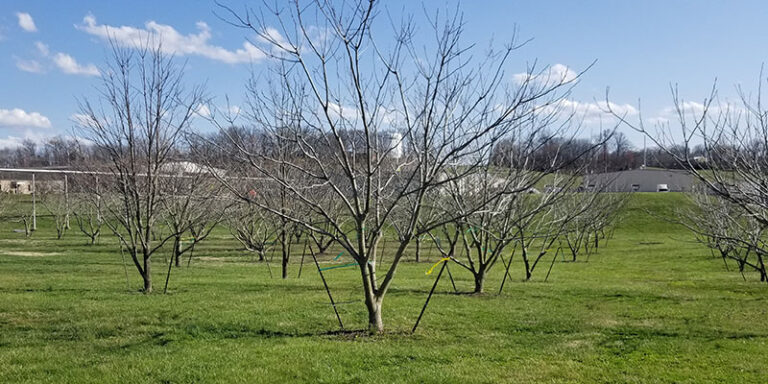
The Hardwood Tree Improvement and Regeneration Center (HTIRC) was conceived in 1998 to address a perceived void in hardwood tree improvement research in the Central Hardwood Forest Region (CHFR) and is committed to enhancing the productivity and quality of CHFR trees and forests for the economic and environmental benefits they provide. Scientists at the HTIRC are using conventional tree improvement breeding as well as molecular and genetic technologies to improve the wood quality, growth characteristics, and insect and disease resistance of trees like black walnut, black cherry, red and white oaks, butternut and American chestnut. Research in tree breeding, tree nursery practices, tree plantation establishment and management, and Central Hardwoods silvicultural systems is aimed at increasing the regeneration success rate for high-quality hardwood trees and forests.
In this Fall 2024 HTIRC Newsletter you will find current research happenings that include:
- Butternut Workshop Highlights North American Efforts to Conserve Species – Butternut, a close relative of black walnut, is a declining and in many locations an endangered tree due in part to a fungal disease called butternut canker. Researchers are examining both the tree and the disease to develop strategies for conservation and restoration of the species.
- Olivia Bigham Presents Sassafras Wilt Study Results on National Webinar Series – Olivia Bigham, a PhD student in the Ginzel Lab at Purdue University recently presented on Sassafras Wilt in Indiana on the Emerald Ash Borer (EAB) University webinar series, a national webinar series highlighting forest insect, disease, and health research and extension.
- U.S. Forest Service Presents Tree Improvement 101 Webinar Series – A webinar series covering some core considerations for tree improvement, plus additional webinars on specific topics like black walnut seed orchard management and best practices for seed handling, is available from the U.S. Forest Service Reforestation, Nurseries and Genetic Resources (RNGR) program.
- 2024 HTIRC Seed Harvest Summary is Available – Every year HTIRC staff and students harvest hundreds of pounds of seed to support forestry researchers and nursery stakeholders, especially the Indiana Division of Forestry’s Vallonia State Nursery. Starting this year, the HTIRC also began supplying seed from select seed trees to Tree Pro for private distribution.
- Digital Forestry Can Help Mitigate, Prevent Wildfires – Digital Forestry offers a variety of tools and technologies to address resource management challenges. One of the greatest challenges currently is catastrophic wildfires threating communities and natural resources around the world. Learn how researchers at Purdue University’s Institute for Digital Forestry are leveraging technology to get more complete and accurate measurements of forests to assist with management of wildfires.
- Morgan Furze, New Tree Physiology Lab Highlighted in Recent Article – The tree physiology research of Dr. Morgan Furze and several other collaborating HTIRC scientists was highlighted in a recent article. “We’re interested in how trees store and move carbohydrates throughout their bodies and how that impacts their ability to survive and thrive in their environments,” Furze said.
View the full Fall 2024 HTIRC Newsletter and learn more about the impact and awards received along with more current research articles.
Resources:
HTIRC 2023 Annual Report
Hardwood Tree Improvement & Regeneration Center (HTIRC)
Tropical Hardwood Tree Improvement & Regeneration Center (tropHTIRC)
Partners, Purdue Forestry & Natural Resources
An Introduction to Trees of Indiana, The Education Store, Purdue Extension resource center
Native Trees of the Midwest, The Education Store
Shrubs and Woody Vines of Indiana and the Midwest, The Education Store
ID That Tree, Playlist, Subscribe to Purdue Extension – Forestry and Natural Resources YouTube Channel
A Woodland Management Moment, Playlist, Purdue Extension – FNR YouTube Channel
Investing in Indiana Woodlands, The Education Store
Forest Improvement Handbook, The Education Store
Finding help from a professional forester, Indiana Forestry & Woodland Owners Association
District Foresters for 10 plus acres, Indiana Department of Natural Resources
Wood Products, FNR Concentration
Hardwood Tree Improvement Regeneration Center (HTIRC)
Join Purdue Extension forester Lenny Farlee and wildlife specialist Brian MacGowan as they help you prepare for the holidays while keeping your family and local wildlife safe. This video discusses everything from how to choose and care for a real Christmas tree as well as what to do with it after the season and also how to make wildlife/nature-friendly decorations.
Topics Include:
– What can I do with my tree after Christmas that would benefit wildlife?
– Are artificial structures legal in Indiana lakes?
– What types of items can I collect from the wild for holiday decorations?
– How do I do it in an environmentally responsible way?
– Are there some things I shouldn’t or can’t collect?
– What outdoor holiday decorations can benefit wildlife?
– How do I make it last longer?
– Can I avoid problems with non-target wildlife?
If you have any questions regarding trees, forest management, wildlife, wood products or other natural resource topics, feel free to contact us by using our Ask an Expert web page.
Resources
Selecting an Indiana-Grown Christmas Tree, The Education Store, Purdue Extension resource center
Tips for First-Time Buyers of Real Christmas Trees, The Education Store
Indiana Christmas Tree Growers Association
Purdue University Invasive Species resources
Indiana DNR Division of Fish and Wildlife for wildlife possession rules
Feed the birds with a DIY wreath, Audubon
Dan Cassens: Tips for First-Time Christmas Tree Buyers, Video, Purdue Agriculture
Dan Cassens: Starting Your Own Christmas Tree Farm, Video
Lenny Farlee, Sustaining Hardwood Extension Specialist
Purdue University Department of Forestry and Natural Resource
Brian MacGowan, Extension Wildlife Specialist
Department of Forestry & Natural Resources, Purdue University
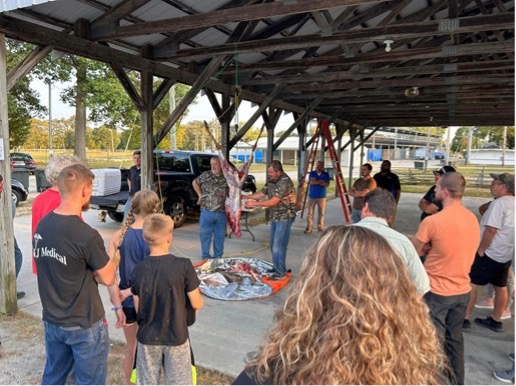
A Venison workshop recently conducted in Noble County. Photo credit by Jonathan Ferris.
Agricultural & Natural Resources: Hunting is a way of life for many citizens of Indiana. In 2022, 121,812 deer were harvested across the state. While some of these deer end up at commercial meat processing facilities, many are butchered by hunters at home. Of those who choose to process their harvested animals themselves, few have formal training about how to properly process a wild game animal and must rely on practices that have simply been passed down from relatives or learned from friends. In addition, commercial processors are often concerned by the dirty, spoiled deer carcasses that end up at their facilities.
In response to this need, Purdue Extension educators Dave Osborne and Jonathan Ferris conducted a series of venison processing workshops in Wayne, Noble and Tippecanoe counties. During each workshop, the educators discussed the proper techniques for field dressing and aging of deer; skinned and quartered the deer; discussed proper storage and preservation methods; cut up the meat and prepared it in a variety of ways for participants to taste. Extension wildlife specialist Jarred Brooke also presented information about proper meat handling and safety, and provided an update about deer health issues in Indiana. At the conclusion, participants had the opportunity to sample venison products prepared that evening as well as some donated from local deer processors.
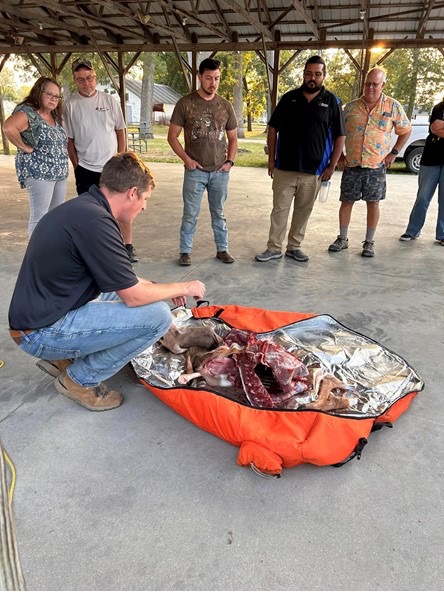
FNR Extension Wildlife Specialist Jarred Brooke is part of the Venison Processing workshop team. Photo by Jonathan Ferris.
Survey results showed that 78 participants representing 25 Indiana counties, as well as one county each from Michigan and Illinois, attended the programs. All respondents indicated they learned field-dressing tips that would help them keep the carcass clean and free of contamination, while also learning something about food safety. And 98% responded that they had learned butchering techniques that will allow them to make better use of the meat. Also, 96% of respondents indicated they planned to change how they handle their deer meat after attending this workshop, 100% indicated they would like to see similar workshops that focused on additional upland game and fish, and 66% indicated this was the first Extension program they had ever attended. When asked about the most valuable part of the program, one participant said, “I feel fully equipped to fill my freezer and provide for my family this upcoming deer season.”
Check out the Purdue Extension – Forestry and Natural Resources Calendar to view upcoming late summer and fall workshops.
View this article, along with other current extension projects, by visiting the December ANR Newsletter.
Resources:
Ask an Expert, Playlist, Purdue Extension – FNR YouTube Channel
Handling Harvested Game: Episode 1, Field Dressing, video, Purdue Extension – FNR YouTube Channel
Handling Harvested Game: Episode 2, Hanging & Skinning, video, Purdue Extension – FNR YouTube Channel
Handling Harvested Game: Episode 3, Deboning, video, Purdue Extension – FNR YouTube Channel
Handling Harvested Game: Episode 4, Cutting, Grinding & Packaging, video, Purdue Extension – FNR YouTube Channel
Introduction to White-tailed Deer Impacts on Indiana Woodlands, Got Nature? Blog & The Education Store
Purdue Extension Pond and Wildlife Management
Understanding White-tailed Deer and Their Impact on Indiana Woodlands, The Education Store
Monitoring White-tailed Deer and Their Impact on Indiana Woodlands, The Education Store
Managing White-tailed Deer Impacts on Indiana Woodlands, The Education Store
How to Build a Plastic Mesh Deer Exclusion Fence, The Education Store
Managing Your Woods for White-Tailed Deer, The Education Store
Deer Harvest Data Collection, Got Nature? Blog, Purdue Extension – FNR
Handling Harvested Deer Ask an Expert? video, Purdue Extension – FNR YouTube Channel
Subscribe to Purdue Extension-Forestry & Natural Resources YouTube Channel, Wildlife Playlist
A Woodland Management Moment – Deer Fencing, Purdue Extension – FNR YouTube Video
Agricultural & Natural Resources (ANR), Purdue Extension
Jarred Brooke, Wildlife Extension Specialist
Purdue Department of Forestry and Natural Resources
Jonathan Ferris, Wayne County Extension Director
Purdue Extension
Dave Osborne, County Extension Director
Purdue Extension – Ripley County
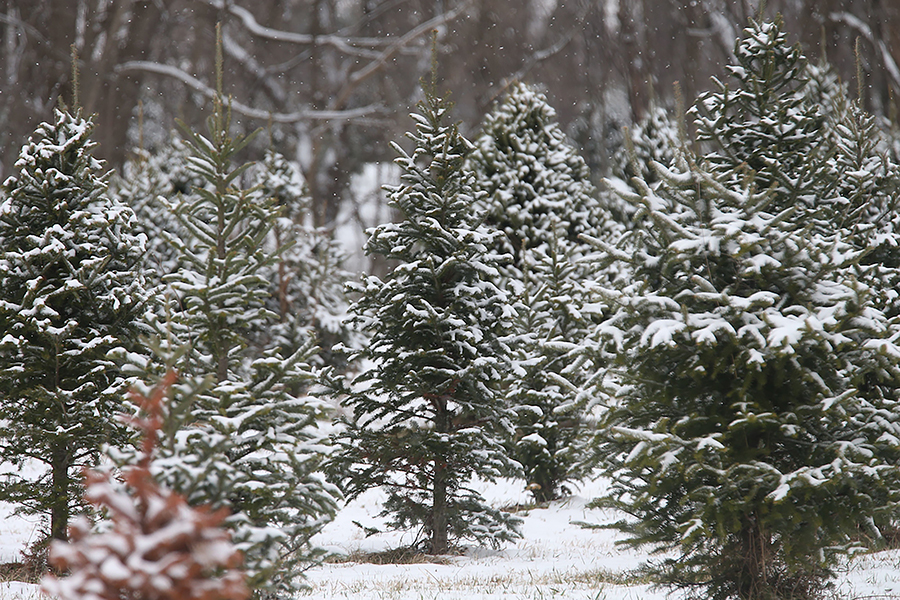 A real Christmas tree is an important part of a holiday celebration for many Hoosier households. Consumers have several choices for purchasing a real tree, including pre-cut trees at retail outlets or seasonal sales locations, choose-and-cut trees at Christmas tree farms, or even live trees that can be replanted after the holidays. Purdue Extension offers two publications that can help you select and care for your tree: Tips for First-Time Buyers of Christmas Trees provides advice and direction on how to set up and care for your tree to improve safety and enjoyment. Selecting an Indiana-Grown Christmas Tree provides details on the characteristics of different species of real Christmas trees available in Indiana, as well as care instructions for cut and live Christmas trees.
Pre-cut real Christmas trees are available at many retail outlets like garden centers, supermarkets, or seasonal sales locations. If you are looking for local choose-and-cut Christmas tree farms you can consult local media and advertising outlets or the Indiana Christmas Tree Growers Association. Some garden centers and Christmas tree farms may also offer live trees for sale.
If you are considering growing your own Christmas trees for personal use or sale, the Extension publications Growing Christmas Trees and A Choose-and-Cut Pine and Fir Christmas Tree Case Study outline economic and management considerations for growing Christmas trees.
Check out the Ask an Expert: Holidays in the Wild as the experts answer questions regarding Christmas trees along with wildlife you may see while you walk in the woods this winter. In this Ask an Expert video they share resources about picking a real Christmas tree and how to access real trees locally in Indiana as well as collecting decoration materials like cones, seed pods and nuts form the wild for crafting and decorating. They also discuss how you can provide habitat and supplemental food for wildlife using Christmas trees and wreaths before, during and after the holiday season.
Resources:
A Choose-and-Cut Pine and Fir Christmas Tree Case Study, The Education Store, Purdue Extension’s resource center
Living Christmas Trees For The Holidays and Beyond, The Education Store
Tips for First-Time Buyers of Real Christmas Trees, The Education Store
Growing Christmas Trees, The Education Store
Selecting an Indiana-Grown Christmas Tree, The Education Store
Winterize Your Trees, The Education Store
Tree Installation: Process and Practices, The Education Store
What do Treed Do in the Winter?, Got Nature? Blog, Purdue Extension – Forestry and Natural Resources (FNR)
Forest/Timber Playlist, subscribe to Purdue Extension – Forestry and Natural Resources (FNR) YouTube Channel
Ask the Expert: Holidays in the Wild, Purdue Extension – FNR YouTube Channel
ID That Tree: Balsam Fir, Purdue Extension – FNR YouTube Channel
ID That Tree: Scotch Pine, Purdue Extension – FNR YouTube Channel
To identify other pine trees view ID That Tree, Purdue Extension – FNR YouTube Channel
Lenny Farlee, Extension Forester
Hardwood Tree Improvement and Regeneration Center
Purdue Department of Forestry & Natural Resources
In this episode of A Woodland Management Moment, Purdue Extension forester Lenny Farlee discusses the benefits of maintaining certain areas of your forest land with alternative types of cover rather than traditional forest. It’s a good idea to keep some areas open not only for recreational purposes but also for future timber harvesting and to provide habitat for many wildlife. By allowing some of your land to be open, you help maintain the natural habitat around you and can even get some interesting plants that will grow on their own.
If you have any questions regarding trees, forests, wildlife, wood products or other natural resource topics, feel free to contact us by using our Ask an Expert web page.
Resources:
A Woodland Management Moment, Playlist, Purdue Extension – Forestry and Natural Resources (FNR) YouTube Channel
Learn How to Support Oak-Hickory Ecosystems, Purdue Extension – FNR Got Nature? Blog
The Nature of Oaks Webinar, Purdue Extension-FNR YouTube Channel, Shared from Indiana Forestry & Woodland Owners Association
Oak Leaf Tatters, Purdue Landscape Report
Inonotus Dryadeus, Butt and Root Rot of Oaks, Purdue Extension – FNR Got Nature? Blog
Predicting the Height Growth of Oak Species Reproduction Over a 23-year Period Following Clearcutting, Hardwood Tree Improvement & Regeneration Center (HTIRC)
Conservation Tree Planting: Steps to Success, Purdue Extension – FNR YouTube Channel
Shrubs and Woody Vines of Indiana and the Midwest, The Education Store, Purdue Extension Resource Center
Native Trees of the Midwest, The Education Store
ID That Tree, Playlist, Purdue Extension – FNR YouTube Channel
Investing in Indiana Woodlands, The Education Store
Woodland Stewardship for Landowners Video Series, Playlist, Indiana Department of Natural Resources YouTube Channel
Ask an Expert: Tree Selection and Planting, Purdue Extension – FNR YouTube Channel
Forest Improvement Handbook, The Education Store
Find an Indiana Professional Forester, Indiana Forestry & Woodland Owners Association (IFWOA)
Purdue Arboretum Explorer
Lenny Farlee, Extension Forester
Hardwood Tree Improvement and Regeneration Center
Purdue Department of Forestry & Natural Resources
MyDNR, Indiana’s Outdoor Newsletter: Donate your harvested deer to feed hungry Hoosiers. In Indiana, you can enjoy a great day hunting and also help Hoosiers in need. In fact, one donated deer can provide 200 meals for a Hoosier family!
Follow these simple steps:
- Enjoy a deer hunting experience.
- Harvest a deer.
- Drop off the field-dressed deer at a local participating processor.
- Processing fees are paid for by Hunt for Hunger (at no cost to you).
- The processor creates healthy venison burgers to distribute to food banks.
This is a part of the program Indiana Hunt for Hunger (also known as Sportsmen’s Benevolence Fund). The Indiana Department of Natural Resources launched this in 2008 to provide an easy way for hunters across Indiana to help hungry Hoosiers in need. Since its launch, the program has grown across the state to collect thousands of deer donations, providing hundreds of thousands of meals for Hoosiers.
For more information, visit the Hunt for Hunger page.
To subscribe to the newsletter, visit MyDNR Email Newsletter.
Resources:
Ask an Expert: Wildlife Food Plots, video, Purdue Extension – Forestry and Natural Resources (FNR) YouTube Channel
Handling Harvested Game: Episode 1, Field Dressing, video, Purdue Extension – FNR YouTube Channel
Handling Harvested Game: Episode 2, Hanging & Skinning, video, Purdue Extension – FNR YouTube Channel
Handling Harvested Game: Episode 3, Deboning, video, Purdue Extension – FNR YouTube Channel
Handling Harvested Game: Episode 4, Cutting, Grinding & Packaging, video, Purdue Extension – FNR YouTube Channel
Deer Harvest Data Collection, Got Nature? Blog, Purdue Extension – FNR
How to Score Your White-tailed Deer, video, The Education Store, Purdue Extension Resource Center
White-Tailed Deer Post Harvest Collection, video, The Education Store
Age Determination in White-tailed Deer, video, The Education Store
Handling Harvested Deer Ask an Expert? video, Purdue Extension – FNR YouTube Channel
How to Build a Plastic Mesh Deer Exclusion Fence, The Education Store
Bovine Tuberculosis in Wild White-tailed Deer, The Education Store
Woodland Stewardship for Landowners: Managing Deer Damage to Young Trees, video, Purdue Extension – FNR YouTube Channel
Integrated Deer Management Project, Purdue FNR
New Deer Impact Toolbox, Purdue Extension-Forestry and Natural Resources (FNR)
Indiana Department of Natural Resources, Department of Fish & Wildlife
Agricultural & Natural Resources (ANR) Newsletter: Since joining the faculty at Purdue in 1997, Rado Gazo, a professor of wood processing and industrial engineering, has educated students, industry professionals and the general public about the possibilities of the wood products industry.
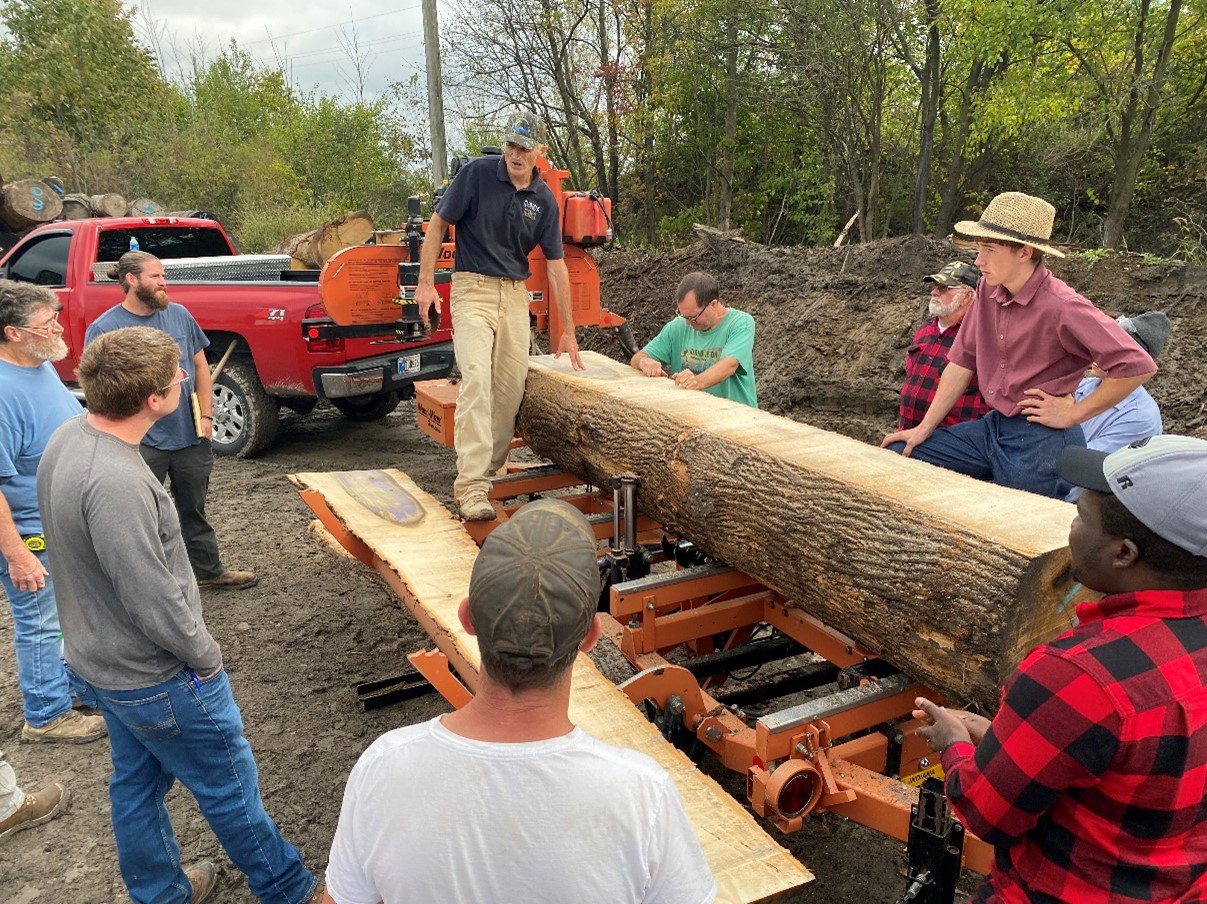
Prof. Gazo demonstrates hardwood log grade-sawing process on a portable Wood-Mizer sawmill.
In addition to teaching undergraduate courses in Properties of Wood, Wood Products Manufacturing and Furniture Design for CNC Manufacturing, Gazo conducts research focused on evaluating tree, log and lumber quality using CT (X-ray computed tomography), laser and image scanning and related manufacturing. He also investigates the competitiveness of furniture manufacturers as well as the application of industrial engineering techniques to value-added wood products manufacturing.
In 2020, Gazo created Hardwood University, a self-sustaining collaborative program with the Indiana Hardwood Lumbermen’s Association, which aims to provide hardwood industry professionals and landowners in the Central Hardwood region with cutting-edge information and training. Gazo is one of the primary instructors for the program.
Hardwood University, which consists of 10 sessions annually, is intended for new employees in the hardwood industry as well as those preparing for advancement or cross-training. The program, which takes place monthly at various Indiana hardwood plants and Purdue agricultural centers, offers informational and technical sessions on topics ranging from forest taxation to tree and log scaling and grading; log bucking; marketing hardwood veneer, stave and sawlogs; grade-sawing lumber; air drying and kiln drying lumber; hardwood lumber grading; lean manufacturing and logistics; and sawmill efficiency and quality control.
In addition, Gazo has worked with nearly 300 companies, providing technical assistance, troubleshooting and consulting services as well as implementation of manufacturing best practices.
To learn more about Rado Gazo’s work view: Rado Gazo, Forestry and Natural Resources profile page.
To read the rest of the newsletter and view the original article, see the ANR November 2024 Newsletter.
Resources:
Wood Products Manufacturing Technology Minor, FNR Minor
Hardwoods of the Central Midwest, The Purdue Arboretum
Wood Products, Purdue Extension – Forestry & Natural Resources (FNR)
Wood is Best Video, Forestry and Natural Resources YouTube Channel, Woodisbest.org
An Introduction to Trees of Indiana, The Education Store, Purdue Extension resource center
Native Trees of the Midwest, The Education Store
Shrubs and Woody Vines of Indiana and the Midwest, The Education Store
ID That Tree, Playlist, Subscribe to Purdue Extension – Forestry and Natural Resources YouTube Channel
A Woodland Management Moment, Playlist, Purdue Extension – FNR YouTube Channel
Investing in Indiana Woodlands, The Education Store
Forest Improvement Handbook, The Education Store
Finding help from a professional forester, Indiana Forestry & Woodland Owners Association
District Foresters for 10 plus acres, Indiana Department of Natural Resources
Hardwood Tree Improvement & Regeneration Center (HTIRC)
Agricultural & Natural Resources (ANR), Purdue Extension
Wild Bulletin, Indiana Department of Natural Resources (DNR) Fish and Wildlife: Interested in processing your own deer? Head over to our new webpage to view instructional videos from our partners at the International Hunter Education Association (IHEA) and National Deer Association (NDA). They’ll guide you through each step, including grinding and preserving the meat. Plus, you can download our printable PDF that includes step-by-step instructions for skinning and processing your own deer.
To learn more, view the Deer Processing page on the official Indiana DNR website. This is where you can find the instructional PDF along with training videos and other resources!
Subscribe to the Indiana Department of Natural Resources YouTube Channel.
Resources:
Ask an Expert, Playlist, Purdue Extension – FNR YouTube Channel
Handling Harvested Game: Episode 1, Field Dressing, video, Purdue Extension – FNR YouTube Channel
Handling Harvested Game: Episode 2, Hanging & Skinning, video, Purdue Extension – FNR YouTube Channel
Handling Harvested Game: Episode 3, Deboning, video, Purdue Extension – FNR YouTube Channel
Handling Harvested Game: Episode 4, Cutting, Grinding & Packaging, video, Purdue Extension – FNR YouTube Channel
Introduction to White-tailed Deer Impacts on Indiana Woodlands, Got Nature? Blog & The Education Store
Purdue Extension Pond and Wildlife Management
Understanding White-tailed Deer and Their Impact on Indiana Woodlands, The Education Store
Monitoring White-tailed Deer and Their Impact on Indiana Woodlands, The Education Store
Managing White-tailed Deer Impacts on Indiana Woodlands, The Education Store
How to Build a Plastic Mesh Deer Exclusion Fence, The Education Store
Managing Your Woods for White-Tailed Deer, The Education Store
Deer Harvest Data Collection, Got Nature? Blog, Purdue Extension – FNR
Handling Harvested Deer Ask an Expert? video, Purdue Extension – FNR YouTube Channel
Subscribe to Purdue Extension-Forestry & Natural Resources YouTube Channel, Wildlife Playlist
A Woodland Management Moment – Deer Fencing, Purdue Extension – FNR YouTube Video
Indiana Department of Natural Resources – Division of Fish & Wildlife

Recent Posts
- ID That Tree: Dwarf Chinkapin Oak
Posted: March 20, 2026 in Forestry, Urban Forestry, Wildlife, Woodlands - A Woodland Management Moment: Windbreak Around Walnut Plantings
Posted: March 3, 2026 in Forestry, Urban Forestry, Woodland Management Moment - Register for Natural Resources Teacher Institute’s Class of 2026
Posted: February 19, 2026 in Forestry, Wildlife, Woodlands - Southwest Damage, Scalding or Frost Cracking
Posted: January 30, 2026 in Forestry, Urban Forestry - Forest Landowners: Share Your Experience with Regeneration and Restoration
Posted: January 27, 2026 in Forestry, How To, Timber Marketing, Woodlands - Woodsy Owl Edition for Educational Learning, USDA – U.S. Forest Service
Posted: January 21, 2026 in Forestry, Forests and Street Trees, Got Nature for Kids, Urban Forestry, Wildlife - It’s Not Too Late to Order Trees for Spring Planting
Posted: January 13, 2026 in Forestry, How To, Plants - Opt-in to the Deer Management Survey, MyDNR
Posted: January 12, 2026 in Forestry, Wildlife - FNR Extension Offering Forest Management for the Private Woodland Owner Course in Spring 2026
Posted: January 5, 2026 in Forestry, Urban Forestry, Wildlife, Woodlands - A Woodland Management Moment: Black Walnut in Pine Plantation
Posted: December 19, 2025 in Forestry, Forests and Street Trees, Urban Forestry, Woodlands
Archives
Categories
- Alert
- Aquaculture/Fish
- Aquatic/Aquaculture Resources
- Ask the Expert
- Christmas Trees
- Community Development
- Disease
- Drought
- Forestry
- Forests and Street Trees
- Gardening
- Got Nature for Kids
- Great Lakes
- How To
- Invasive Animal Species
- Invasive Insects
- Invasive Plant Species
- Land Use
- Natural Resource Planning
- Nature of Teaching
- Plants
- Podcasts
- Ponds
- Publication
- Safety
- Spiders
- Timber Marketing
- Uncategorized
- Urban Forestry
- Webinar
- Wildlife
- Wood Products/Manufacturing
- Woodland Management Moment
- Woodlands