 Purdue University - Extension - Forestry and Natural Resources
Got Nature? Blog
 Discover how to manage non-native cool-season grasses like tall fescue and Kentucky bluegrass in native conservation plantings. This guide reveals how these invasive species form dense sod layers, which limits wildlife mobility, and also provides control options for these invasive species. Controlling Introduced Cool-Season Grasses is essential for anyone dedicated to preserving native ecosystems and enhancing biodiversity.
Check out the Managing Conservation Plantings Series which include details on how to control invasive species and other problematic plants in Conservation Reserve Program (CRP) plantings and native warm-season grass and wildflower conservation plantings.
Publications in this series include:
- Golden Rod Control
- Thinning Native Warm-Season Grasses
- Sericea Lespedeza Control
- Woody Encroachment and Woody Invasives
- Jonhsongrass Control
- Reed Canarygrass Control
- Teasel Control (Common and Cut Leaved)
- Controlling Introduced Cool-Season Grasses
- Crownvetch, Sweetclover and Birdsfoot Trefoil Control
Resources:
Deer Impact Toolbox & Grassland Management, Purdue Extension Pond and Wildlife Management
Pond and Wildlife Management, Purdue Extension
Forestry for the Birds Virtual Tour and Pocket Guide, Got Nature? Blog, Purdue Extension – FNR
Frost Seeding to Establish Wildlife Food Plots and Native Grass and Forb Plantings – Purdue Extension – FNR YouTube channel
Wildlife Habitat Hint: Tips for Evaluating a First Year Native Grass and Forb Plantings, Purdue Extension – FNR YouTube Channel
Drone Seeding Native Grasses and Forbs: Project Overview & Drone Setup, Purdue Extension – FNR YouTube channel
Ask an Expert: Wildlife Food Plots, video, Purdue Extension – FNR YouTube Channel
Handling Harvested Game: Episode 1, Field Dressing, video, Purdue Extension – FNR YouTube Channel
Managing Your Woods for White-Tailed Deer, The Education Store
Forest Improvement Handbook, The Education Store
Forest Management for Reptiles and Amphibians: A Technical Guide for the Midwest, The Education Store
A Template for Your Wildlife Habitat Management Plan, The Education Store
Woodland Stewardship for Landowners, Playlist, Purdue Extension – FNR YouTube channel
Nature of Teaching Unit 1: Animal Diversity and Tracking, The Education Store
Nature of Teaching, Purdue College of Agriculture
Invasive Species Playlist, Playlist, Purdue Extension – FNR YouTube Channel
Report Invasive, Purdue Extension
Subscribe Purdue Extension – Forestry and Natural Resources YouTube Channel
Jarred Brooke, Wildlife Extension Specialist
Purdue Department of Forestry and Natural Resources
Once the leaves have fallen and the landscape is dominated by shades of brown and gray, bright colors like red catch our attention. There are several red fruits that we may encounter in the late fall and winter here in Indiana that add some color to the landscape. These fruits are retained on trees and shrubs for a variety of reasons. Some are not as palatable to wildlife, so they are eaten later in the season. Some are more resistant to freeze damage and thus cling to branches longer than delicate fruits. There may also be an advantage to their appearance. Many of these plants have seeds dispersed by wildlife like birds, which eat the seeds and excrete them later, providing an opportunity to produce new plants away from the parent. Many birds can see much of the same color spectrum we do, plus enhanced vision in the ultra-violet bands. Brightly-colored seeds with waxy skins may reflect more ultra-violet light and be more noticeable to the birds.
What are some of those red fruits?
One family of plants accounts for several red fruit we can see in late fall and winter, the rose family. This family includes apples, plums, cherries, hawthorns, pears and others as well as the roses. In Indiana we have several hawthorns (Crataegus species) that produce a fruit resembling a tiny apple. These vary in size by species but are typically ¼ to ½ inch diameter and often held in clusters. Hawthorns are typically small trees and may have long thin thorns on the twigs.

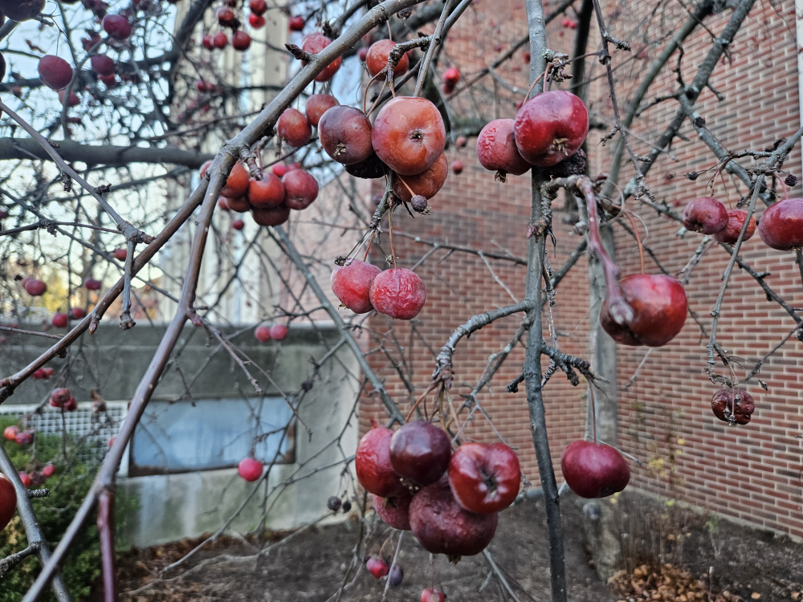
Another rose family member are the apples and crabapples with some small native trees like sweet crabapple, Malus coronaria, and several varieties of fruit-bearing apples and ornamental crabapples planted but sometimes escaping to natural areas. While our native crabapples are usually about 1-2 inches diameter and green to yellow, the domesticated apples and crabapples often have red fruit in various sizes from large apples to ½ inch diameter crabapples.

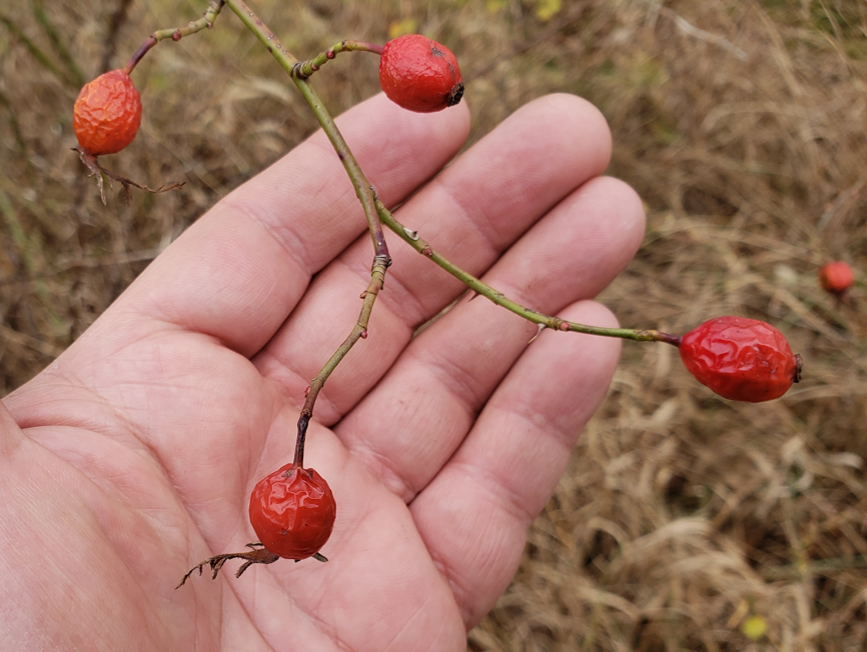
We also have several beautiful native roses in Indiana, and a particularly problematic exotic invasive rose in multiflora rose. Unfortunately, you are more likely to encounter multiflora rose with small ¼ inch clusters of red fruit. Our native roses typically have larger fruit and fewer fruit per cluster.

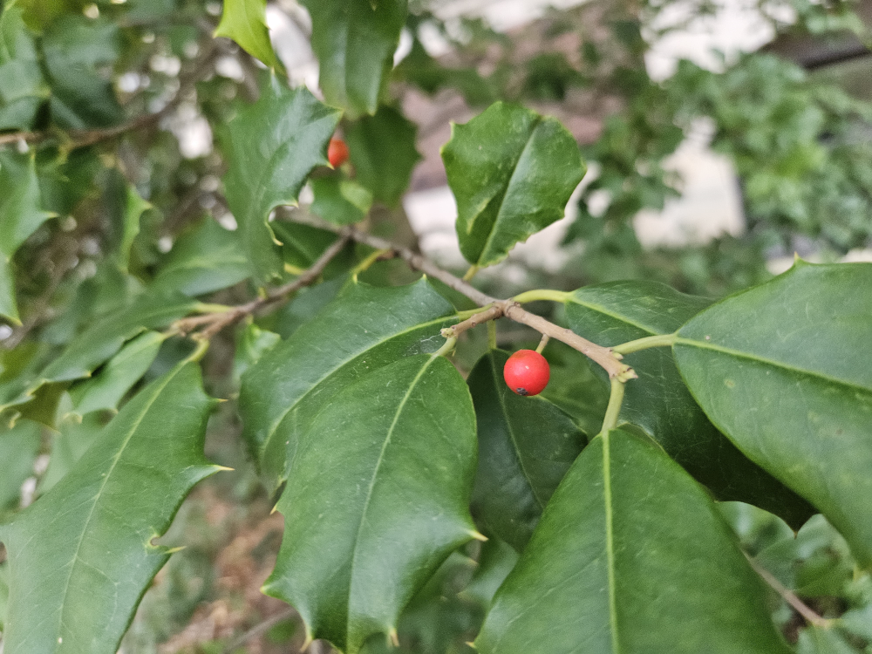
Holly is also noted for red fruit and some being evergreen as well. Our native Indiana hollies are all deciduous, losing their leaves in the fall but often retaining the red fruit on the female plants into winter. The most widespread species is winterberry, Ilex verticillate, a shrub which is seeing more use ornamentally due to its striking red fruit held past Christmas most years. American holly, an evergreen broadleaved tree, is well-known for its glossy, spiny foliage and red fruit on the female trees. Although not native to Indiana, it is spreading from plantings into natural areas. Several evergreen hollies from Europe and Asia are also common in ornamental plantings and may escape into natural areas.
Not only are these late-season showy fruit attractive, but they also provide some important nourishment for wildlife when the many other fruits are long-gone.
Resources:
Ask An Expert: Holidays in the Wild, Purdue Extension – Forestry and Natural Resources (FNR) YouTube Channel
Selecting a Real Christmas Tree, Got Nature? Blog Post, Purdue Extension – FNR
Tips on How You Can Recycle Your Christmas Tree, Got Nature? Blog Post, Purdue Extension – FNR
ID That Tree, Playlist, Purdue Extension – FNR YouTube Channel
ID That Tree: Prickly Ash, Purdue Extension – FNR YouTube Channel
A Woodland Management Moment, Playlist, Purdue Extension – FNR YouTube Channel
Shrubs and Woody Vines of Indiana and the Midwest, The Education Store, Purdue Extension Resource Center
Native Trees of the Midwest, Purdue University Press
Investing in Indiana Woodlands, The Education Store
Forest Improvement Handbook, The Education Store
Tree Installation: Process and Practices, The Education Store
Tree Planting Part 1: Choosing a Tree, video, The Education Store
Lenny Farlee, Extension Forester
Hardwood Tree Improvement and Regeneration Center
Purdue Department of Forestry & Natural Resources
Discover how to effectively manage the invasive common and cut-leaved teasel, which threatens open areas like prairies, savannas, sedge meadows, roadsides and conservation plantings. This publication provides essential information for exploring effective control options. Essential reading for conservationists and land managers interested in grassland ecosystems: Teasel Control (Common and Cut Leaved).
Check out the Managing Conservation Plantings Series which include details on how to control invasive species and other problematic plants in Conservation Reserve Program (CRP) plantings and native warm-season grass and wildflower conservation plantings.
Publications in this series include:
- Golden Rod Control
- Thinning Native Warm-Season Grasses
- Sericea Lespedeza Control
- Woody Encroachment and Woody Invasives
- Jonhsongrass Control
- Reed Canarygrass Control
- Teasel Control (Common and Cut Leaved)
- Controlling Introduced Cool-Season Grasses
- Crownvetch, Sweetclover and Birdsfoot Trefoil Control
Resources:
Deer Impact Toolbox & Grassland Management, Purdue Extension Pond and Wildlife Management
Pond and Wildlife Management, Purdue Extension
Forestry for the Birds Virtual Tour and Pocket Guide, Got Nature? Blog, Purdue Extension – FNR
Frost Seeding to Establish Wildlife Food Plots and Native Grass and Forb Plantings – Purdue Extension – FNR YouTube channel
Wildlife Habitat Hint: Tips for Evaluating a First Year Native Grass and Forb Plantings, Purdue Extension – FNR YouTube Channel
Drone Seeding Native Grasses and Forbs: Project Overview & Drone Setup, Purdue Extension – FNR YouTube channel
Ask an Expert: Wildlife Food Plots, video, Purdue Extension – FNR YouTube Channel
Handling Harvested Game: Episode 1, Field Dressing, video, Purdue Extension – FNR YouTube Channel
Managing Your Woods for White-Tailed Deer, The Education Store
Forest Improvement Handbook, The Education Store
Forest Management for Reptiles and Amphibians: A Technical Guide for the Midwest, The Education Store
A Template for Your Wildlife Habitat Management Plan, The Education Store
Woodland Stewardship for Landowners, Playlist, Purdue Extension – FNR YouTube channel
Nature of Teaching Unit 1: Animal Diversity and Tracking, The Education Store
Nature of Teaching, Purdue College of Agriculture
Invasive Species Playlist, Playlist, Purdue Extension – FNR YouTube Channel
Report Invasive, Purdue Extension
Subscribe Purdue Extension – Forestry and Natural Resources YouTube Channel
Jarred Brooke, Wildlife Extension Specialist
Purdue Department of Forestry and Natural Resources
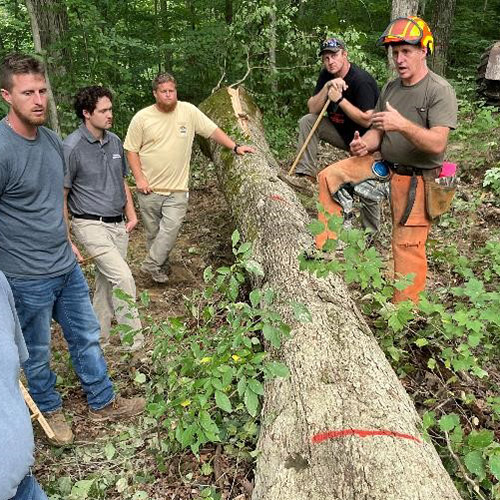
The Purdue FNR extension team was named as a recipient of the Family Forests Comprehensive Education Program Award presented by the National Woodland Owners Association (NWOA) and National Association of University Forest Resources Programs (NAUFRP).
The award, which is the nation’s top honor for forestry extension programming, recognizes superior performance across nine rigorous criteria, celebrating the standard of excellence for the profession. Drs. Zhao Ma and Mike Saunders received the award on the team’s behalf at the NAUFRP annual meeting at the 2025 Society of American Foresters (SAF) national convention in Hartford, Connecticut, in October.
 The Family Forests Comprehensive Education Program Award criteria includes:
- Faculty involved (including number and multi-disciplinary involvement)
- Educational needs assessment (including involvement of clients)
- Educational materials, events and other resources used
- Applied research incorporated
- Collaborations among disciplines, agencies and organizations
- Results, impacts or outcomes
- Evidence of program quality
- Degree of innovation
- Emulation of the program by others
NAUFRP extension chair Bill Hubbard, who oversaw the competition said “After a thorough review by our three judges and myself, the committee determined that both the University of Minnesota and Purdue University programs demonstrated such profound and differentiated excellence across the nine core criteria that it was decided to recognize them both.”
According to the NAUFRP announcement, “Purdue’s program was honored for its massive scale, its deep connection to a long-term research asset, and its commitment to building future workforce capacity.”
Program highlights include:
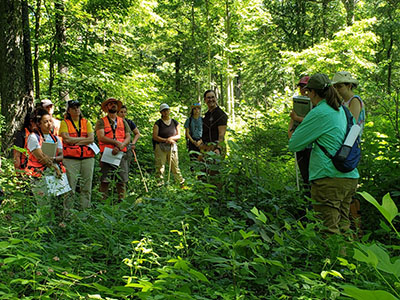
- HEE Integration: The program directly integrates findings from the Hardwood Ecosystem Experiment (HEE)—a 100-year research study—into its curriculum, providing landowners with unbiased, real-time data on management issues like oak/hickory regeneration and wildlife response to timber harvest.
- Economic & Ecological Scale: The program supports the multibillion-dollar hardwood industry by having an impact on over 57,000 acres and engaging a network of tens of thousands of landowners through its extensive publications.
- Curricular Innovation: Purdue was recognized for its pioneering move to formally incorporate Extension training into its undergraduate and graduate curricula, ensuring the next generation of forestry professionals is equipped with crucial outreach skills.
The Purdue team includes five faculty and nine professional staff members. Over the past five years, the group boasts many standout accomplishments including:

- Development of publications that have been downloaded more than 2.1 million times
- Publication and dissemination of the Indiana Woodland Steward newsletter, which has reached more than 31,000 family forest owners, impacting more than 1.2 million acres
- Creation of 215 training programs, which reached more than 50,000 landowners, impacting more than 57,000 acres of woodlands
- Production of 249 videos, downloaded more than 750,000 times, and 38 podcast episodes, reaching more than 50,000 listeners in the United States alone. Videos can be accessed on the FNR Extension YouTube channel. The Habitat University podcast is available as part of the Natural Resources University network.
- Awarded more than $4.4 million in extramural funding for faculty and staff
- Formally incorporated undergraduate and graduate students in Extension at the programmatic level
In the nomination packet, team personnel stated “We aim to address family forest owner needs through collaboration with many stakeholders. Our family forest education serves family forest owners, professional advisors, an industry that receives most of their product base from family forests and the general public who influence policy decisions affecting family forest owners. Our program focuses on adoption or maintenance of stewardship practices (e.g., invasive plant control, timber harvesting), developing or improving forestland planning, and engaging peer and professional advice. In doing these, family forest owners can make informed decisions that meet their personal land management objectives while enhancing the resource for all residents.”
Team members include:
- Jarred Brooke – Extension wildlife specialist; Specializing in wildlife conservation, habitat management and deer impact
- Diana Evans – Extension and web communications specialist; Specializing in website design and communications
- Lenny Farlee – Extension forester; Specializing in forest regeneration, hardwood management and genetics
- Dr. Rado Gazo – professor of wood processing and industrial engineering; Specializing in secondary wood products manufacturing processes
- Dr. Eva Haviarova – professor of wood products; Specializing in strength design and product engineering of furniture and product sustainability
- Liz Jackson – engagement specialist with the Indiana Forestry and Woodland Owners, Walnut Council and Purdue Hardwood Tree Improvement and Regeneration Center; Specializing in black walnut, oaks and landowner engagement
- Dr. Doug Jacobs – Fred M. van Eck professor of forest biology; Specializing in forest ecology, silviculture, regeneration and restoration
- Dr. Brian MacGowan – Extension wildlife specialist and extension coordinator; Specializing in wildlife habitat management, wildlife conservation and wildlife damage
- Wendy Mayer – communications coordinator; Specializing in social media and communications
- Jessica Outcalt – natural resources training specialist; Specializing in natural resources, conservation and professional development
- Henry Quesada – professor, assistant director of Extension and ANR program leader; Specializing in wood products, hardwood lumber, biomaterials, hardwood markets and industry
- Ron Rathfon – regional extension forester; Specializing in forest management, timber marketing, tree planting, oak regeneration and ecology and invasive vegetation management
- Dr. Mike Saunders – professor of ecology and natural resources; Specializing in disturbance-based silviculture, growth and yield, modeling, disturbance ecology and management effects on wood quality.
- Kat Shay – HEE forest project coordinator; Specializing in environmental science and restoration
From 2020 to 2024, the FNR Family Forest Education extension team conducted 788 programs, covering 1,005 sessions and including more than 50,000 individual contacts.
To view the original article along with other news and stories posted on the Purdue Forestry and Natural Resources website view: FNR Extension Team Receives Family Forests Comprehensive Education Award.
Resources:
Woodland Stewardship for Landowners YouTube Playlist, Purdue Extension – FNR
Wildlife Habitat Hint YouTube Playlist, Purdue Extension – FNR
Woodland Management Moment YouTube Playlist, Purdue Extension – FNR
Invasive Species YouTube Playlist, Purdue Extension – FNR
Forest Management for the Private Woodland Owner Course – Got Nature? Blog, Purdue Extension – Forestry and Natural Resources
Report Invasive Species, Purdue Invasive Species
Finding help from a professional forester, Indiana Forestry & Woodland Owners Association
Forest Improvement Handbook, The Education Store, Purdue Extension resource center
Indiana Woodland Steward Institute
Hardwood Ecosystem Experiment (HEE)
Hardwood Tree Improvement & Regeneration Center (HTIRC)
Help the Hellbender
The Nature of Teaching
Pond and Wildlife Management, website
Community Development, Purdue Extension
Subscribe Purdue Extension – Forestry and Natural Resources YouTube Channel
Wendy Mayer, FNR Communications Coordinator
Purdue University Department of Forestry and Natural Resources
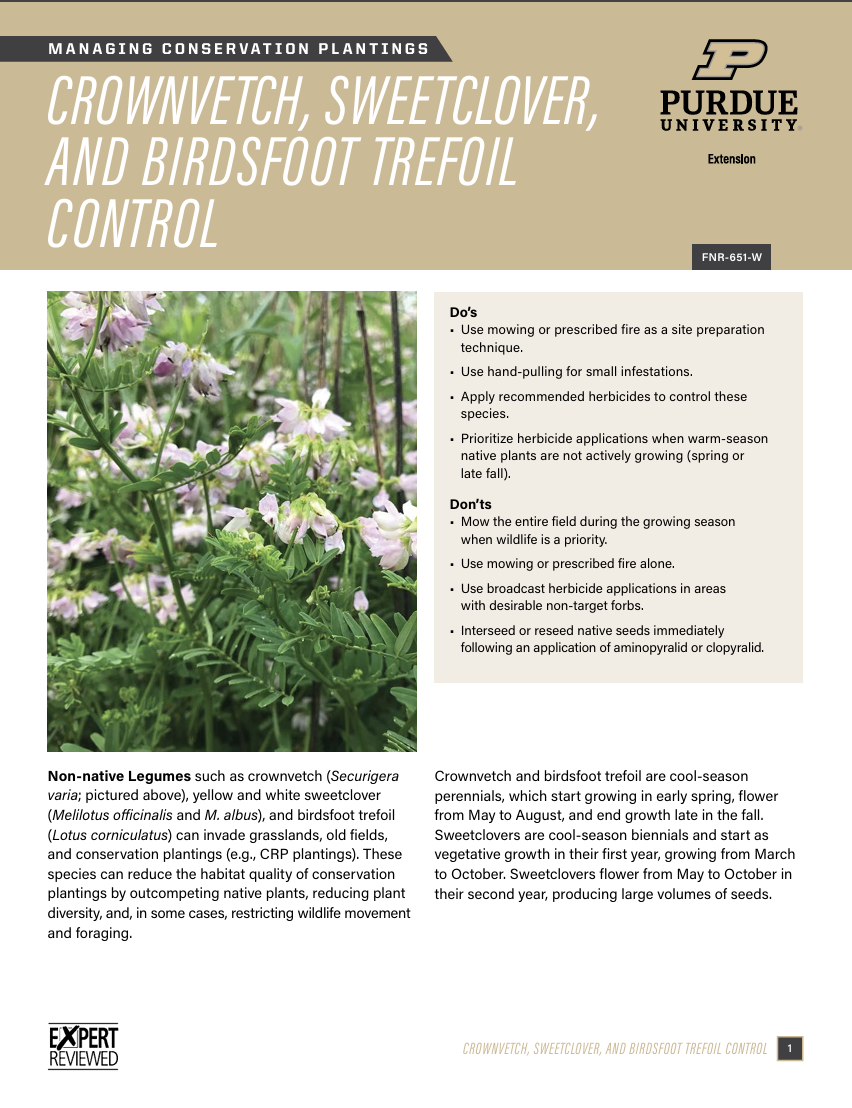 Discover the impact of non-native legumes like crownvetch, sweetclover, and birdsfoot trefoil on grasslands and conservation plantings. This guide provides control options for these non-native legumes. Essential reading for conservationists and land managers interested in grassland ecosystems: Crownvetch, Sweetclover and Birdsfoot Trefoil Control.
Check out the Managing Conservation Plantings Series which include details on how to control invasive species and other problematic plants in Conservation Reserve Program (CRP) plantings and native warm-season grass and wildflower conservation plantings.
Publications in this series include:
- Golden Rod Control
- Thinning Native Warm-Season Grasses
- Sericea Lespedeza Control
- Woody Encroachment and Woody Invasives
- Jonhsongrass Control
- Reed Canarygrass Control
- Teasel Control (Common and Cut Leaved)
- Controlling Introduced Cool-Season Grasses
- Crownvetch, Sweetclover and Birdsfoot Trefoil Control
Resources:
Deer Impact Toolbox & Grassland Management, Purdue Extension Pond and Wildlife Management
Pond and Wildlife Management, Purdue Extension
Forestry for the Birds Virtual Tour and Pocket Guide, Got Nature? Blog, Purdue Extension – FNR
Frost Seeding to Establish Wildlife Food Plots and Native Grass and Forb Plantings – Purdue Extension – FNR YouTube channel
Wildlife Habitat Hint: Tips for Evaluating a First Year Native Grass and Forb Plantings, Purdue Extension – FNR YouTube Channel
Drone Seeding Native Grasses and Forbs: Project Overview & Drone Setup, Purdue Extension – FNR YouTube channel
Ask an Expert: Wildlife Food Plots, video, Purdue Extension – FNR YouTube Channel
Handling Harvested Game: Episode 1, Field Dressing, video, Purdue Extension – FNR YouTube Channel
Managing Your Woods for White-Tailed Deer, The Education Store
Forest Improvement Handbook, The Education Store
Forest Management for Reptiles and Amphibians: A Technical Guide for the Midwest, The Education Store
A Template for Your Wildlife Habitat Management Plan, The Education Store
Woodland Stewardship for Landowners, Playlist, Purdue Extension – FNR YouTube channel
Nature of Teaching Unit 1: Animal Diversity and Tracking, The Education Store
Nature of Teaching, Purdue College of Agriculture
Invasive Species Playlist, Playlist, Purdue Extension – FNR YouTube Channel
Report Invasive, Purdue Extension
Subscribe Purdue Extension – Forestry and Natural Resources YouTube Channel
Jarred Brooke, Wildlife Extension Specialist
Purdue Department of Forestry and Natural Resources
In this edition of ID That Tree, Purdue Extension Forester Lenny Farlee introduces us to Norway Spruce, a non-native conifer that has become a familiar sight across Indiana. Originally brought over from Europe, this species is now commonly planted for windbreaks, landscaping and reforestation. Learn how to recognize its distinctive shape and why it’s often chosen for both farms and front yards. Whether you’re a student, landowner or simply curious about the trees around you, this video offers a quick look at one of Indiana’s most widespread introduced evergreens.
If you have any questions regarding wildlife, trees, forest management, wood products, natural resource planning or other natural resource topics, feel free to contact us by using our Ask an Expert web page.
Resources:
ID That Tree – Video Playlist, Purdue Extension – Forestry and Natural Resources (FNR) YouTube Channel
Purdue Arboretum Explorer
Conservation Tree Planting: Steps to Success, Purdue Extension – FNR YouTube Channel
A Woodland Management Moment, Playlist, Purdue Extension – FNR YouTube Channel
Woodland Stewardship for Landowners, Playlist, Purdue Extension – FNR YouTube Channel
Fifty Common Trees of Indiana, Purdue Extension – FNR
Indiana Invasive Species Council
Cooperative Invasive Species Management Area (CISMA)
Report Invasive, Purdue Extension
Habitat University, Episode 12 – Exploring the challenges of Invasive Species, Habitat University-Natural Resource University
Shrubs and Woody Vines of Indiana and the Midwest, Purdue University Press
Native Trees of the Midwest, Purdue University Press
Professional Forester, Indiana Forestry Woodland Owners Association
District Forester, Indiana Department of Natural Resources, 10+ acres
Find an Arborist, International Society of Arboriculture
Forest Improvement Handbook, The Education Store
Lenny Farlee, Extension Forester
Hardwood Tree Improvement and Regeneration Center
Purdue Department of Forestry & Natural Resources
Welcome to ID That Tree! In this episode, Purdue Extension Forester Lenny Farlee introduces us to a familiar and useful native shrub, the Blackberry. Commonly found along woodland edges, open fields and roadsides across Indiana, this hardy plant is easy to spot in summer thanks to its features. Learn how to identify Blackberry by its stems, leaves and growth pattern. Whether you’re a forager, landowner, or someone who simply enjoys exploring nature, this video offers a quick and engaging look at how to recognize Blackberry and appreciate its role in Indiana’s natural landscapes.
If you have any questions regarding wildlife, trees, forest management, wood products, natural resource planning or other natural resource topics, feel free to contact us by using our Ask an Expert web page.
Resources:
ID That Tree – Video Playlist, Purdue Extension – Forestry and Natural Resources (FNR) YouTube Channel
Purdue Arboretum Explorer
Conservation Tree Planting: Steps to Success, Purdue Extension – FNR YouTube Channel
A Woodland Management Moment, Playlist, Purdue Extension – FNR YouTube Channel
Woodland Stewardship for Landowners, Playlist, Purdue Extension – FNR YouTube Channel
Fifty Common Trees of Indiana, Purdue Extension – FNR
Indiana Invasive Species Council
Cooperative Invasive Species Management Area (CISMA)
Report Invasive, Purdue Extension
Habitat University, Episode 12 – Exploring the challenges of Invasive Species, Habitat University-Natural Resource University
Shrubs and Woody Vines of Indiana and the Midwest, Purdue University Press
Native Trees of the Midwest, Purdue University Press
Professional Forester, Indiana Forestry Woodland Owners Association
District Forester, Indiana Department of Natural Resources, 10+ acres
Find an Arborist, International Society of Arboriculture
Forest Improvement Handbook, The Education Store
Lenny Farlee, Extension Forester
Hardwood Tree Improvement and Regeneration Center
Purdue Department of Forestry & Natural Resources
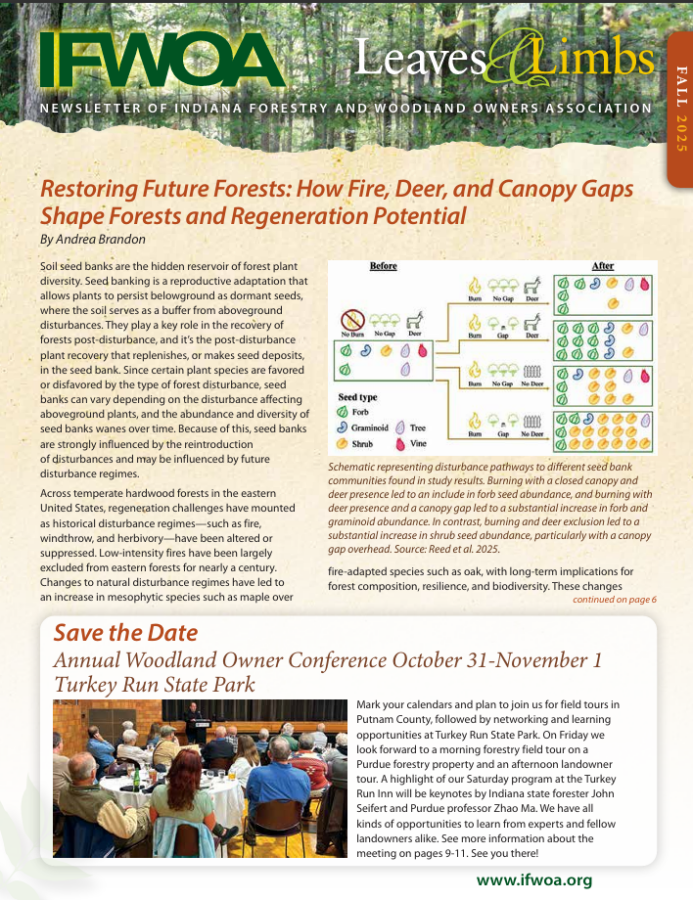 Indiana Forestry & Woodland Owners Association (IFWOA) is a non-profit organization dedicated to conservation and sustainable management of forests in Indiana. The Fall Leaves & Limbs Newsletter is now available online and is open to all who would like to view the articles and resources.
Fall 2025 Leaves & Limbs Newsletter includes:
-
- Restoring Future Forests: How Fire, Deer and Canopy Gaps Shape Forests and Regeneration Potential
- A Message from the IFWOA President, Lee Huss
- Upcoming forestry events
- Indiana 2025 Woodland Owner Conference (October 31-November 1 at Turkey Run): Agenda, field tours, overview, hotel and registration information
- Indiana Landowners to be Recognized for Their Stewardship
- District Nominees Share Their Passion
- Time to Order Tree Seedlings form Indiana DNR Vallonia Nursery
- Welcome New Executive Directory – Phil Woolery!
- New Resources from Purdue Extesion
- Program Overview: The Sourthern Indiana Sentinel Landscape (SISL) Regional Conservation Partnership Program
- What Can You Tell Me About the Dunstan Chestnut?
- Elm Zigzag Sawfly: New Pest to Elm
- Grasslands for Gamebirds and Songbirds Program
- Forestry Economic Contributions in Indiana and the U.S.
- What’s in a Name?, by Allen Pursell, Same Shine Foundation, Inc.
- Research on Indiana’s Paoli Experimental Forest
- Seven U.S. Animal Species That are Invasive in Other Countries
- And More!
More About IFWOA
IFWOA hosts the Indiana Woodland Owner Conference which include field programs and indoor sessions on wildlife and habitat, forest management and other topics for landowners. The 2026 conference is November 6-7 and is open to anyone. Over 200 landowners attend for discussions and networking.
IFWOA advocates for scientific best practices for woodland management to achieve objectives like clean water, wildlife habitat, soil protection, native species diversity, timber production, recreation, carbon sequestration and many others.
This Indiana association has members in every county of Indiana both woodland owners and non-owners, city and rural dwellers, family farmers, wildlife conservationists, agriculture and forestry professionals, tree farmers, loggers, scientists, educators — anyone who cares about the health of Indiana forests and woodlands, and wants to assure those lands receive the care and support they need.
Membership in IFWOA provides a valuable network linkage to information and resources at the leading edge of science, industry and politics impacting Indiana woodlands. If you would like to learn more about membership view Join Today, Indiana Forestry & Woodland Owners Association (IFWOA).
Resources:
Subscribe: Indiana Forestry & Woodland Owners Association (IFWOA) YouTube Channel
“Magnificent Trees of Indiana” webinar with author Carroll Ritter, IFWOA YouTube Channel
Forest Improvement Handbook, The Education Store, Purdue Extension’s resource center
Planting Hardwood Seedlings – The Education Store
Ordering Seedlings from the State Forest Nursery System, Got Nature? – Purdue Extension-FNR
Importance of Hardwood Tree Planting – The Education Store, Purdue Extension Resource Center
Designing Hardwood Tree Plantings for Wildlife – The Education Store
ID That Tree – YouTube Playlist
Forest Management for Reptiles and Amphibians: A Technical Guide for the Midwest, The Education Store
Hardwood Ecosystem Experiment – Forest Birds , Purdue Extension – FNR YouTube Channel
Ask the Expert: Hardwood Ecosystem Experiment – Birds and Salamander Research, Purdue Extension – FNR
Subscribe to Purdue Extension-FNR YouTube Channel
Phil Woolery, Forestry and Natural Resources
Walnut Council, IFWOA & HTIRC Engagement Specialist
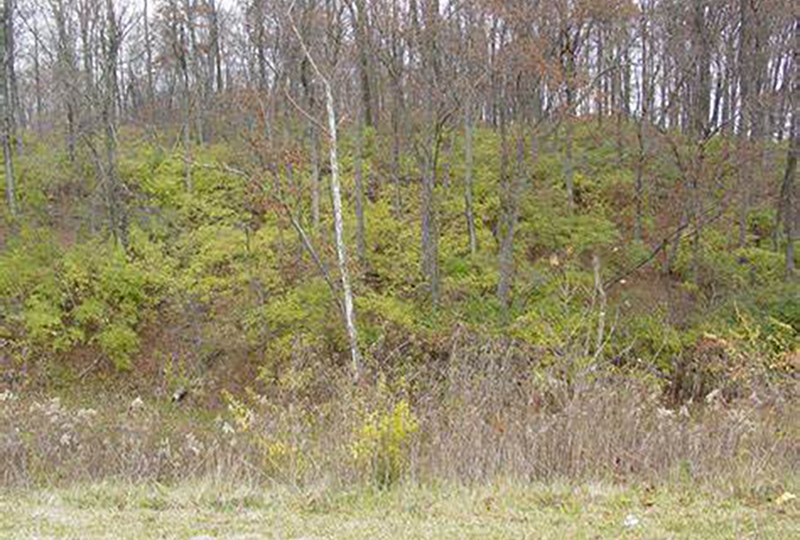
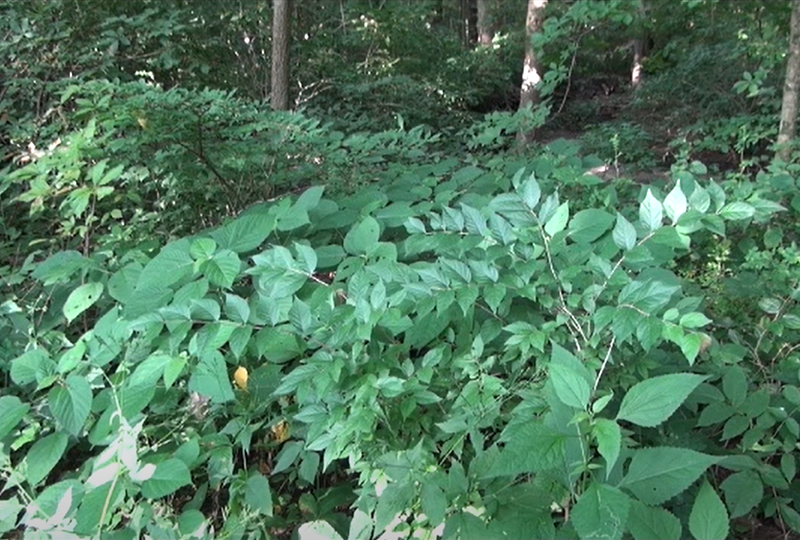
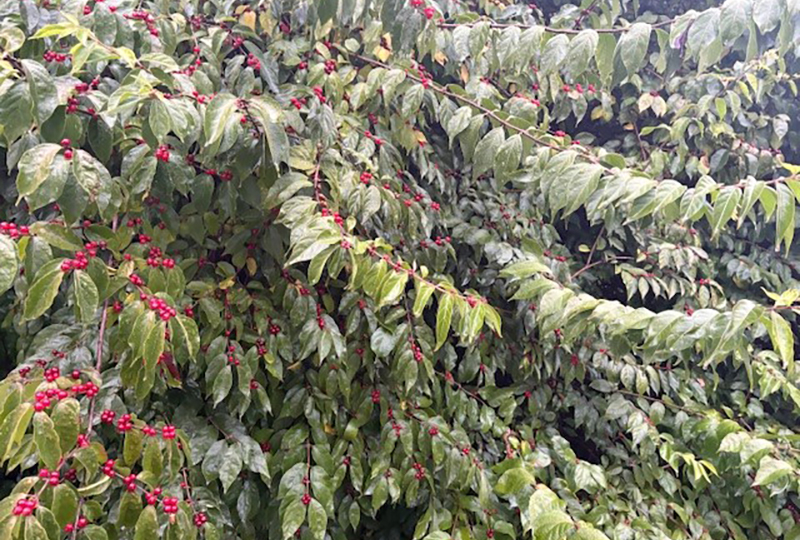
In early November, invasive bush honeysuckle is one of the only understory shrubs that are still green. While many of our native plants are dormant, Asian bush honeysuckle remains green longer making them easy to locate. Doing control measures this time of year also reduces impacts to non-target plants.
How do you control it? That depends on what resources you have available. Small plants can be easily pulled by hand; be sure to hang them on tree branch rather than laying them down on the ground so they don’t re-root. In most cases, some method of herbicide control will be necessary. Ohio State University has a good guide on various methods of control, Controlling Non-Native Invasive Plants in Ohio Forests: Bush Honeysuckle.
Not sure where to start on your property? One of the most daunting aspects of invasive plant control is where to begin. Ellen Jacquart, former Director of Stewardship for the Nature Conservancy in Indiana, wrote an article in the Indiana Woodland Steward. The Where do I Start?! Prioritizing Invasive Plant Control article describes how to plan your invasive plant control including prioritizing what to do first.
Click on the photos below for larger view to help as you identify Asian bush honeysuckle.

Resources:
Subscribe to the Indiana Woodland Steward Newsletter
Consider Fall Eradication of Asian Bush Honeysuckle, Purdue Landscape Report
Asian Bush Honeysuckle, Purdue Extension YouTube Video
A Woodland Moment: Asian Bush Honeysuckle, Purdue Extension – Forestry and Natural Resources (FNR) YouTube Video
Invasive Plants of the Eastern U.S.: An Introduction to the Problematic Non-Native Species, The Education Store, Purdue Extension’s resource center
Report Invasive Species, Purdue Invasive Species
Report Invasive Species: Asian Bush Honeysuckle, Purdue Invasive Species
The GLEDN Phone App – Great Lakes Early Detection Network
EDDMaps – Early Detection and Distribution Mapping System
Episode 11 – Exploring the challenges of Invasive Species, Habitat University-Natural Resource University
What Are Invasive Species and Why Should I Care?, Purdue Extension-FNR Got Nature? Blog
Emerald Ash Borer Information Network, Purdue University and Partners
Aquatic Invasive Species, Illinois-Indiana Sea Grant (IISG)
Invasive plants: impact on environment and people, The Education Store, Purdue Extension’s resource center
Subscribe Purdue Extension-Forestry and Natural Resources YouTube Channel
Brian MacGowan, Wildlife Extension Specialist
Department of Forestry and Natural Resources, Purdue University
Purdue Landscape Report: Spotted lanternfly (SLF) has been the subject of a lot of media attention in the last few years. In the east, states like Pennsylvania and New York have been dealing with heavy infestations since the insect was first detected in 2014. In Indiana, this invasive planthopper arrived three years ago, infesting two counties on the eastern side of the state. Since then, the Indiana Department of Natural Resources and Purdue University have been working together to mitigate the spread of this insect as well as educate Hoosiers on what they can do to help. Spotted lanternfly is still on the move, and this update will help refresh you on how this bug works, and where they are headed.
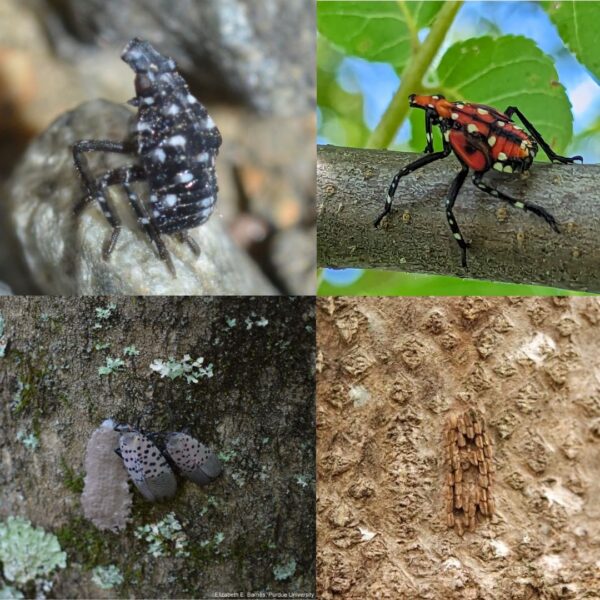
Figure 1. Upper left: early-instar SLF; upper right: late-instar SLF; bottom left: adult SLF with egg mass; bottom right: uncovered SLF eggs.
Life cycle
Spotted lanternfly is an annual insect, having only a single generation in a year under normal conditions. The insect goes through incomplete metamorphosis; immature stages, called nymphs, resemble smaller, wingless versions of the adults. Nymphs will begin to appear in April or May, developing through four instars, until they reach adulthood in late summer. With each instar, the period in between molting, the nymph will grow larger, develop wingpads, and eventually change color. Early instars are black with a white dot pattern, while later instars will be bright red with black and white patterning (Fig. 1). Late instar nymphs are often compared to milkweed bugs or lady beetles. Once they complete development in the late summer or early fall, they will mate and lay egg masses covered in a protective substance that makes them resemble mud. Eggs masses will overwinter until the spring, while adult insects will die as temperatures cool. In Indiana, depending on temperature, adults can be seen as late as early November.
Impact
Spotted lanternfly is a sap-feeding insect, using syringe-like mouthparts to drain nutrients directly from plant tissues. Like other sap-feeding insects, the activity of SLF wounds the plant, creating openings for various pathogens to exploit. Feeding by SLF has been shown to reduce overall health of their hosts, reducing their capacity to survive overwintering, and potentially kill the host plant depending on species. They also produce a sugary waste known as honeydew; while honeydew itself is not harmful, it acts as a growing substrate for sooty mold, which can have a serious impact the photosynthesis of understory foliage as well as attract other nuisance insects.
Spotted lanternfly is a generalist herbivore and can feed on over 100 different species of plant and tree in Indiana. However, this insect has shown strong preference towards certain species, often with devastating consequences. The most preferred host is tree-of-heaven, an invasive tree species in North America. Tree-of-heaven is the primary host of SLF in their shared native range, and the insect appears to experience high reproductive success on it even when they share a new environment. Grapes are also highly preferred by SLF, and infestations will typically result in overfeeding and the death of the plant. Black Walnut, American river birch, and various maple species are also at risk of severe damage from this insect. Evidence has also suggested that maple, when used for syrup production, will experience reductions in yield and quality when attack by spotted lanternfly.
Where are they now?
Spotted lanternfly has been present in Indiana since 2021, first arriving in Huntington and Switzerland Counties. In Huntington, the infestation occupies a stand of tree-of-heaven next to an industrial parking lot. Tree-of-heaven moved into the neighboring residential area, allowing SLF to also spread with it. The more rural infestation in Switzerland County was traced to a vehicle transported from Pennsylvania, and the insect has taken advantage of patches of tree-of-heaven in nearby wooded areas. While both infestations have strongly associated with the insect’s primary host, there is some evidence that SLF is beginning to take advantage of other nearby plants, such as maple. In the last year, SLF moved a significant distance and has been detected in several more counties, including Elkhart, St. Joseph, Porter, Allen, Dekalb, and Noble Counties. Most of the activity has been found on tree-of-heaven along rail lines, supporting the idea that the insect is dispersed by rail traffic moving westward out of infested areas.
It’s important to remember that trains aren’t the only vehicles that can have SLF passengers. These insects, and their egg masses, can be found on just about any surface, including the car you drive to work, the RV you used for recreation, semi-trucks that cross the country, and more. Purdue Entomology and Indiana DNR are encouraging everyone to inspect their vehicles when traveling through any of the infested areas. Also check all recreational vehicles and trailers for spotted lanternfly egg masses; if found, scrape them off into a bag or bucket filled with soapy water. This fall and winter, we also want to encourage everyone to please burn any firewood where you buy it, and please don’t move it off your property if you chop it yourself- especially if you are burning tree of heaven. Egg masses will stick to firewood and can survive our winters very well.
What can I do?
We are still learning about the spotted lanternfly’s distribution through Indiana, and we need the help of citizen scientists to effectively track the insect’s movement. If you believe you’ve seen spotted lanternfly, please report it using any of the resources listed below. You can also feel free to reach out to Bob Bruner, Exotic Forest Pest Educator, by emailing them at rfbruner@purdue.edu, or you can report sightings by calling 1-866-NOEXOTIC.
Original article posted: Spotted Lanternfly is on the Move!.
Subscribe and receive the newsletter: Purdue Landscape Report Newsletter.
Spotted Lanternfly Resources:
Spotted Lanternfly Found in Indiana, Indiana Woodland Steward
Spotted Lanternfly Feeds on Over 70 Plus Plant Species, Purdue Extension – Forestry and Natural Resources (FNR)
Spotted Lanternfly – includes map with locations, Indiana Department of Natural Resources Entomology
Spotted Lanternfly is on the Move!, Purde Landscape Report
Spotted Lanternfly Egg Hatch is Here, Purdue Landscape Report
Report Spotted Lanternfly, Purdue College of Agriculture Invasive Species
Other Resources Available:
Invasive plants: impact on environment and people, The Education Store, Purdue Extension’s resource center
Woodland Management Moment: Invasive Species Control Process, Video, Purdue Extension – Forestry and Natural Resources (FNR) YouTube Channel
Invasive Species, Playlist, Purdue Extension – FNR YouTube Channel
What are invasive species and why should I care?, Got Nature? Blog, Purdue Extension – FNR
Report Invasive, Purdue College of Agriculture – Entomology
ReportINvasive, Purdue Report Invasive Facebook posts include webinars and workshops
Bob Bruner, Exotic Forest Pest Educator
Purdue Entomology

Recent Posts
- Popular Landscape Shrub is Invasive
Posted: October 15, 2026 in Alert, Forestry, Forests and Street Trees, Invasive Plant Species, Plants, Woodlands - Purdue Extension’s Regional Teams Are Here: Connecting Communities with Expertise and Opportunity
Posted: October 14, 2026 in Community Development, Forestry, Forests and Street Trees, Gardening, How To, Timber Marketing, Urban Forestry, Wildlife, Woodlands - Why Do Our Trees Go From Green Leaves to Different Colors?
Posted: in Forestry, Forests and Street Trees, Urban Forestry, Woodlands - Distinguishing Dogwoods
Posted: October 13, 2026 in Forestry, Urban Forestry, Wildlife, Woodlands - It’s Not Too Early To Start Planning For Spring Tree Planting
Posted: in Forestry, How To - Can I Plant Trees in the Fall?
Posted: October 12, 2026 in Forestry, How To, Land Use, Plants, Urban Forestry, Wildlife - Burning for Benefits: Why Fire Belongs in Indiana
Posted: in Forestry, Safety, Woodlands - Disease May Cause Wilting and Eventual Death of Certain Trees and Shrubs, Purdue Landscape Report
Posted: October 5, 2026 in Disease, Forestry, Plants - October Is Firewood Month: Protect Indiana’s Forests by Making Smart Choices
Posted: October 1, 2026 in Forestry, Forests and Street Trees, How To, Invasive Insects, Urban Forestry - Woodland Flowers of Late Summer
Posted: September 14, 2026 in Forestry, Gardening, Wildlife, Woodlands
Archives
Categories
- Alert
- Aquaculture/Fish
- Aquatic/Aquaculture Resources
- Ask the Expert
- Christmas Trees
- Community Development
- Disease
- Drought
- Forestry
- Forests and Street Trees
- Gardening
- Got Nature for Kids
- Great Lakes
- How To
- Invasive Animal Species
- Invasive Insects
- Invasive Plant Species
- Land Use
- Natural Resource Planning
- Nature of Teaching
- Plants
- Podcasts
- Ponds
- Publication
- Safety
- Spiders
- Timber Marketing
- Urban Forestry
- Webinar
- Wildlife
- Wood Products/Manufacturing
- Woodland Management Moment
- Woodlands