 Purdue University - Extension - Forestry and Natural Resources
Got Nature? Blog
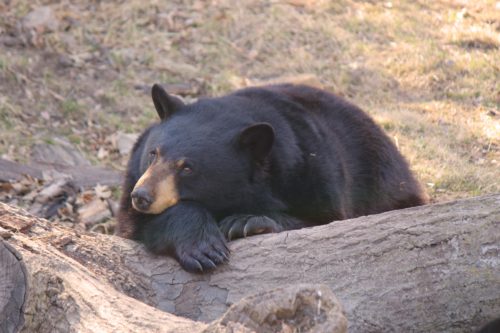 After being sighted in Indiana for the first time in 144 years on June 12 around South Bend, a second sighting of the bear has occurred in the Michigan City area, and this time, the bear has done a little bit of damage foraging for food. The bear had knocked over multiple bee hives and tore into some food at a local farm. It also bent poles holding up bird boxes, likely eating the baby birds inside.
The Department of Natural Resources is hoping the bear will return to upper Michigan on its own where the black bear population reaches around 15,000. However, they are continuing to monitor its movement and are prepared to trap it if needed.
While startling, it is important to note that black bears aren’t as dangerous as most people think. They are usually scared of humans, but it is a wise idea to move bird feeders, grills and trash cans out of your yard. If you encounter a bear, the DNR recommends standing your ground and making a lot of noise while slowly backing away. Do not turn and run. Black bears are also considered an exotic animal in Indiana, and shooting or killing one is a serious offense that can result in large fines or jail time.
Please report bear sightings to dfwinput@dnr.IN.gov or call 812-334-1137.
Resources
Black Bear, Indiana Department of Natural Resources
Black Bear Confirmed in Indiana For First Time in 144 Years, FOX59
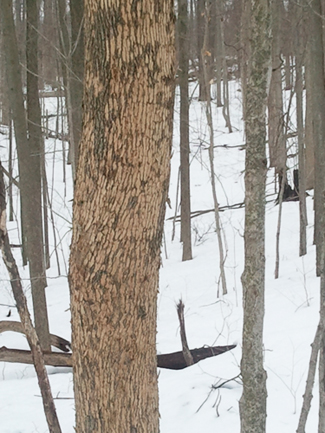 If you’re walking in the woods or maybe even traveling along a road this spring in Indiana, you may come across some trees that look like the one in the photos. Clearly, something unusual is going on here. What made the bark change color so quickly, and why are there holes in the bark?
The answer to both of those questions for ash trees around the state is Emerald Ash Borer and woodpeckers. As Emerald Ash Borer spreads across Indiana, the population of Emerald Ash Borer larvae overwintering under the bark of ash trees can quickly increase. These grubs provide a tasty treat and important winter and early spring nutrition to hungry woodpeckers.
 Woodpeckers of several species are experts at detecting and extracting these grubs by pounding holes in tree bark. Ash bark is generally gray on the surface, but the inner bark is a light corky tan color. Once the woodpeckers find the EAB larvae, their excavation activities flake off the outer bark to expose the lighter colored inner bark. This is actually one of the best indicators of the presence of Emerald Ash Borer in a tree. The woodpecker activity often starts in the upper main stem and branches of ash trees, but as the population of EAB larvae in the trees increase, the woodpecker activity spreads down the trunk of the tree. Trees with this much inner bark exposed indicate an advanced infestation of EAB and signal ash tree mortality in the next year or two.
If you would like to learn more about ash trees and the Emerald Ash Borer, visit the Purdue Emerald Ash Borer website.
Resources
Arrest That Pest! – Emerald Ash Borer in Indiana, Purdue Extension
Purdue Extension – Forestry & Natural Resources website with search bar, place “Invasive Insect”
Emerald Ash Borer, Indiana Department of Natural Resources (IDNR)
Emerald Ash Borer in Indiana, Purdue Extension
New Hope for Fighting Ash Borer, Purdue Extension – Forestry and Natural Resources Got Nature? blog
Lenny Farlee, Extension Forester
Purdue University Department of Forestry and Natural Resources
 FNR is pleased to announce a new program that will provide undergraduate extension internship opportunities for qualified students this summer. This is an exciting program with the potential to build on an already strong set of FNR extension programs while providing valuable experience and training for undergraduates.
Purdue University’s Department of Forestry and Natural Resources seeks candidates for extension internship positions. The department extension program has a broad environmental scope including fisheries, forest management, invasive species, urban forestry, sustainability, wildlife and wood products. Student interns can enhance their career potential through practical, hands-on experience. Our extension internship program can help you:
- Develop leadership and decision-making skills in handling creative challenges
- Gain experience developing extension products including publications, online videos, presentations and/or more
- Participate in professional development opportunities
- Build professional references and contacts
- Clarify career goals
- Learn from a diverse and experienced group of natural resources professionals
Internships are open to non-Purdue students. Requirements for the position(s) include status as a junior or senior level college student in natural resources or related discipline, minimum 3.0 GPA, evidence of initiative, independence and commitment to conservation of natural resources. Internships are available for summer term (up to 40 hours/wk., up to 8 weeks) with pay at a rate of $12 per hour. Internship start dates and work hours are flexible depending on the applicant’s availability.
Resources
FNR Extension Internship Information, Purdue Forestry and Natural Resources (FNR)
Brian MacGowan, Extension Wildlife Specialist
Department of Forestry and Natural Resources, Purdue University
 Trees in Rice Cemetery in Elkhart, IN, were cut down due to verticillium wilt, a disease causing discoloration and wilt of branches. The fungus causing this disease spreads through roots. Many trees in the cemetery have been marked with a red dot and will be removed. If all goes well, new younger trees will take their place in the fall. If you have witnessed verticillium wilt, please notify the Indiana Department of Natural Resources.
Resources
Rice Cemetery Trees Cut Down Due to Verticillium Wilt as Elkhart Forestry Workers Fight to Save Those Left, The Elkhart Truth
Verticillium Wilt of Shade Trees, The Education Store, Purdue Extension’s resource center
Diseases in Hardwood Tree Plantings, The Education Store
Forest Health Informer, Indiana Department of Natural Resources
How to Check for Verticillium Wilt, July “In The Grow” (Q&A), Indiana Yard and Garden – Purdue Consumer Horticulture
What are Invasive Species and Why Should I Care?, (What to do if you see any disease) Purdue Extension-Forestry & Natural Resources Got Nature? Blog
Diana Evans, Extension and Web Communication Specialist
Purdue University Department of Forestry and Natural Resources
Spring brings an opportunity to spend more time outdoors but also increases our exposure to tick bites and infection from some of the diseases that ticks carry. Taking some precautions to reduce risks of exposure and infection from ticks can make your outdoor activities more safe and enjoyable. Ticks can be found in almost any location that has animals and vegetation, so completely avoiding ticks is very difficult. But there are some practices that will help you prevent ticks from biting and passing disease organisms to you.
Here are several suggestions:
- Wear light-colored clothing that makes it easier to see ticks and remove them before they get to bare skin.
- Tuck in shirt-tails, tuck pants into boots or socks or use “tick gators” that are essentially a legging that covers where your pants and socks or boots meet.
- Wearing a hat is another good precautionary measure.
- Treat bare skin with repellants containing 20 to 30% DEET. Always read and follow label directions!
- Treat clothing (not skin!) with repellants containing permethrin prior to entering areas with ticks. Once dried on the clothing, permethrin can still be effective after several washes. Follow label directions.
- Upon your return, inspect clothing for any ticks. Tumbling clothes in a hot dryer for an hour will kill ticks. Shorter times may be effective if the clothes are not wet.
- Wash up after visiting tick-infested areas and do a body check for any ticks.
If you find a tick attached, remove it by using tweezers or a tick removal tool to grasp it as near to the skin as possible and pulling straight out. DO NOT use hot match heads or needles, nail polish, gasoline or similar techniques. Ticks that are removed shortly after they attach may not have the opportunity to pass disease organisms to you, so quick detection and removal are good prevention methods.
If you experience a rash, fever, chills, aching or other unusual symptoms after a tick bite or exposure to tick-infested areas, see your physician immediately. Most tick-borne diseases can be effectively treated with early detection.
Enjoy the outdoors by taking precautions to reduce your risks.
Purdue has an informational webpage on ticks at Purdue Medical Entomology.
The Center for Disease Control and Prevention has an information site on ticks and tick diseases.
Lenny Farlee, Sustaining Hardwood Extension Specialist
Hardwood Tree Improvement and Regeneration Center (HTIRC)
Forestry and Natural Resources, Purdue University
Early spring brings the emergence of new life in the forest. Unfortunately, not all that life actually belongs there. Several invasive plants are encroaching on woodlands and crowding out the desirable native plants we enjoy and wildlife depend upon for food and shelter. One of the characteristics of some invasive plants is early leaf emergence and growth, which allows us to scout for their presence more easily, while native species are still waking up from winter. Two species that start growing very early in the spring are garlic mustard and Asian bush honeysuckles. Both plants are rapidly greening up and growing as I speak. Look for the kidney to heart shaped leaves of garlic mustard on the forest floor. This biennial will soon be sending up flower stalks from the second season plants that will have white four-petaled flowers. The flower stalks can be up to three feet tall or more depending on the health of the plant and the quality of the growing site.
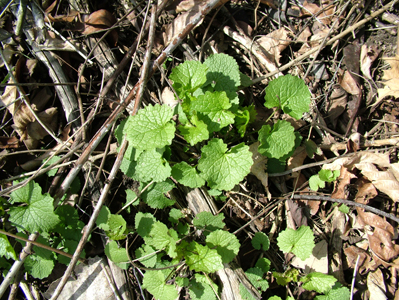
Early spring leaves of garlic mustard.
Asian bush honeysuckle is a medium to large bush that also inhabits the forest understory and edge or disturbed areas. Leaves and twigs area arranged opposite each other. If you slice the stems open, they are hollow inside with fuzzy brown or tan lining. Flowers are yellow, white or even pinkish and tube-shaped. The fine twigs and stems have a light tan or gray-tan color. Leaves are rapidly expanding now, so they will be easily detected until our native plants catch up with leaf cover.

Early growth of Asian bush honeysuckle.
Controlling these plants helps native plants continue to thrive and provide habitat for our wildlife. Garlic mustard can be pulled from moist soil. If seed pods are present, remove the plants from the area and burn or bury them. Foliar herbicides like glyphosate products may be used to spray garlic mustard. If the plants have already set seed pods, the seed may become viable even if the plant has been sprayed, so removal may be the only effective treatment at that time.
Asian bush honeysuckle can be controlled in several ways, depending on the size of the plants. Small plants can be pulled from moist soil. Foliar sprays with herbicides like glyphosate can be effective. Large bushes may be cut and the stumps treated with a brush-killing herbicide. For any herbicide application, read and follow label directions.
Purdue University has invasive species information resources at FNR Extension and Indiana’s ‘Most Unwanted’ Invasive Plant Pests/Indiana Cooperative Agricultural Pest Survey (CAPS) Program.
Lenny Farlee, Sustaining Hardwood Extension Specialist
Hardwood Tree Improvement and Regeneration Center (HTIRC)
Forestry and Natural Resources, Purdue University

Recent Posts
- Alert – Water Your Trees, Watch Video
Posted: June 20, 2025 in Alert, Drought, Forests and Street Trees, How To, Urban Forestry, Wildlife, Woodlands - IN DNR Deer Updates – Epizootic Hemorrhagic Disease Detected in Several Areas in Indiana
Posted: October 16, 2024 in Alert, Disease, Forestry, How To, Wildlife, Woodlands - 2024 Turkey Brood Count Wants your Observations – MyDNR
Posted: June 28, 2024 in Alert, Community Development, Wildlife - Spongy Moth in Spring Time – Purdue Landscape Report
Posted: June 3, 2024 in Alert, Forestry, Forests and Street Trees, How To, Invasive Insects, Urban Forestry - MyDNR – First positive case of chronic wasting disease in Indiana
Posted: April 29, 2024 in Alert, Disease, How To, Safety, Wildlife - Report Spotted Lanternfly – Purdue Landscape Report
Posted: April 10, 2024 in Alert, Forestry, Invasive Insects, Plants, Wildlife, Woodlands - Declining Pines of the White Variety – Purdue Landscape Report
Posted: in Alert, Disease, Forestry, Plants, Wildlife, Woodlands - Are you seeing nests of our state endangered swan? – Wild Bulletin
Posted: April 9, 2024 in Alert, Forestry, How To, Wildlife - 2024-25 Fishing Guide now available – Wild Bulletin
Posted: April 4, 2024 in Alert, Aquaculture/Fish, Aquatic/Aquaculture Resources, How To, Ponds, Wildlife - Look Out for Invasive Carp in Your Bait Bucket – Wild Bulletin
Posted: March 31, 2024 in Alert, Aquaculture/Fish, Aquatic/Aquaculture Resources, Invasive Animal Species, Wildlife
Archives
Categories
- Alert
- Aquaculture/Fish
- Aquatic/Aquaculture Resources
- Ask the Expert
- Christmas Trees
- Community Development
- Disease
- Drought
- Forestry
- Forests and Street Trees
- Gardening
- Got Nature for Kids
- Great Lakes
- How To
- Invasive Animal Species
- Invasive Insects
- Invasive Plant Species
- Land Use
- Natural Resource Planning
- Nature of Teaching
- Plants
- Podcasts
- Ponds
- Publication
- Safety
- Spiders
- Timber Marketing
- Uncategorized
- Urban Forestry
- Webinar
- Wildlife
- Wood Products/Manufacturing
- Woodland Management Moment
- Woodlands