The Bottom Line Archive
Newsletter articles from prior fiscal years are archived below.
FY25 Newsletter Articles
July – In Depth: Updated iLab Resources Now Available
July – July PERA Update: Email, Proposal & Award Records, AIMS
July – One Less Signature Initiative: Business Office for Student Organizations
July – Travel Regulation Changes
July – New Voluntary Support Process Resources
August – PERA Updates – Budget Allocation
August – One Less Signature – Purdue Online Rate Consolidation
August – Technical Tip: Need to Find Someone in a Specific Business Office?
August – Ad Hoc Delivery Address Review Process
August – Updated Training Matrix Available
August – New@Purdue Finance Plan for Mentoring Component
September – PERA Update – Launch Date: October 7!
September – Travel Aging Report
September – Collaborations Continue to Generate Wins in Ongoing Cost Avoidance Efforts
October – In Depth: PERA is Live!
October – Vendor Portal Update
November -Engagement Activities
November – Vendor Portal Update
November – I-9 Verification Centers
November – Support Staff Retreat
December – In Depth: BPARS Training Requirements
December – I-9 Employment Verification Centers
December – Vendor Portal Implementation Update
January – In Depth: Retroactive Payroll Changes to be Implemented February 1
January – Cybersecurity and You by Kathy Thomason
January – Vendor Portal Update
January – Location, Location, Location: New HR Location Status Codes
January – Finance Website Updates
February – In Depth: Vendor Portal Update
February – What is the Single Audit and How Does it Impact Purdue?
February – Audit Findings: Assigning the Correct General Ledger Account
March – In Depth: Audit Findings and Observations
March – Human Resources Launches Updated Personal Payments Website
April – Web Updates: Directory, Search Functionality, Business Management Resources and Research Account Management Resources (links are to actual pages)
April – Audit Findings: Direct Invoice/ZV60 Attachment Requirements
April: April PaymentWorks Implementation Updates
April: Cybersecurity Series: Instances of Check Fraud Continue to Grow
May: New Student Account Collections Systems
May: Lifecycle of an Account Series (BLCA) Undergoing Redesign and Refresh
May: Heads Up: Year End Key Dates
May: Account Information Management System Improvement Project
May: New Applied Excel Workshops in Development
May: iLab Requirements for Fiscal Approval Documentation
June: In Depth: Uniform Guidance Updates
June: SuccessFactors Learning Management System Tips
June: Training and Certification Updates
FY24 Newsletter Articles
July – Reducing Overpayments through Workflow Changes
August – In Depth: New Research Administration System Promieses Efficiencies Across the Organization
September – In Depth: Overpayments and Reconciliation Reminders
September – Cybersecurity and You
September – Reduction in Offcycle Availability
September – PERA Update: Meet the Finance Representatives on the PERA Initiative
September – Accounts Payable and Electronic Signatures
October – In Depth: Bot Updates
October – Team Dynamix Coming to Finance
October – Professional Development Retreat Planned for Finance Management/Professional Staff
October – Finance Service Project: Keep Your Community Warm!
November: It’s the One YearAnniversary of The Bottom Line!
November: In Depth Facilities and Administration Rate Comparisons and Applications
November: Financial Planning and Analysis Announces Professional Development Series
December: The Bottom Line Updates
December: Professional Development Retreat for Finance Management Professional Staff Held on Campus
December: Finance Service Project
December: Reduction in Off-Cycle Availability
December: Heads Up: TDX Coming in February
January: In Depth – TDX Transition Update
January: Transition of Purdue Global Payroll from ADP to ECP Completed
January: Highlighting Purdue Research: Does it Pay to be Nice at Work?
January: Termination Workflow Changes
January: New List Serve Moderation Tool Implemented in December
February: In Depth: Response to Travel Process Review Includes New Tools and Processes
February: TDX Transition Delayed
February: Attempts to Defraud the University Continue
March: In Depth: Payroll No Longer Approving “Saved” Timesheets
March: Sponsored Program Updates
March: One Less Signature Initiative
March: New Travel Dashboard Available to Business Office Staff
March: 2023-24 Performance Feedback Process and Resources:
April: One Less Signature Initiative (challenge)
April: In Depth: Purdue Service Portal Scheduled for Launch
April: PERA Update (with Current vs Future State Comparisons)
April: Other Topics of Interest
May: In Depth: Monthly Review of Transactions Less Than $1000
May: Purdue Service Portal Implementation Status
June: In Depth: iLab Billing Calendar Changes
June: PERA Update (Voluntary Support)
FY23 Newsletter Articles
(November launch through June)
November – Welcome to the Finance Newsletter!
November – In Depth: Nodine Named Assistant Treasurer
December – Welcome To: The Bottom Line!
December – Engagement Team: Culture and Communication Group
December – In Depth: Finance Reorganization
February – In Depth: Bot’s: Valuable New Tools in the GR/IR Process
March – In Depth: Subject Matter Experts: Making Impacts and Growing Leaders
April – In Depth: Research Card Pilot Program Announced
May – Technical Tips and Tricks
May – In Depth: Process Reviews General Procurement Reminders
May – Interviewing Reminders and Resources
June – New Finance Website and the Detailed Business Management Directory
FY25 Articles
Training Certification Updates
Training updates of general interest to a variety of Finance staff are summarized below.
Personal Payments – a new on demand Personal Payments (Course 107017) training module is now available. The content is based on the summer 2024 Personal Payments training but has been updated to include information about the new PaymentWorks vendor portal. It also references the updated Personal Payments – Guide to the Different Types of Personal Payments at Purdue website maintained by Human Resources.
The Foreign Corrupt Practices Act module has been removed from SuccessFactors for a refresh. Anyone who had it assigned to them (required for new employees) has had it removed from their assignments. An announcement will be made when the updated course is ready for enrollment.
All exempt Purdue employees are required to complete the Reportable Outside Activities Review and Acknowledgement. Exempt employees are automatically assigned the training in SuccessFactors, this is required to be completed annually reminders will be sent by email. This requirement applies to all exempt staff, whether part or full-time, professional or support. More information can be found in the Reportable Outside Activity Form Guidelines.
SuccessFactors Learning Management System (LMS) Tips
Want to review material from a course that you have already taken? If you want to view a specific part of a previously completed training session, you do not need to re-enroll in the course. You can access the course through the “History” tab. You can also find details in “How to View History and Review Content” QRG.
Do you want to “unenroll” in a SuccessFactors course? You can remove courses that you have enrolled in but are not planning to complete by following the instructions found in the “LMS How to Remove a Self Assigned Course” QRG.
Have you participated in a training activity outside of the LMS? SuccessFactors’ functionality allows individuals to create a training record that includes training or professional development activities that take place outside of SuccessFactors. Detailed instructions can be found in the “Record External Learning” QRG.
As a supervisor, do you want to assign a course to a direct report? Supervisors can assign specific courses to an employee and track the employees progress towards completion. The “How to Manage Team Learning” QRG provides details on how to assign/remove courses, register/withdraw courses and run reports on the training status of their team.
Are you interested in a LinkedIn learning course? LinkedIn Learning courses completed through Purdue SuccessFactors will be included in your Learning record. To ensure the course is captured, search for it and enroll from the LMS module in SuccessFactors in the same way you would search for any LMLS course. Once in LinkedIn, you should see a Purdue P in the upper right hand corner of the screen. Questions about this feature can be directed to the Human Resources training team at oelearning@purdue.edu.
In Depth: Uniform Guidance Upates
Sponsored Program Services and Managerial Accounting have been working together to communicate changes made by the Office of Management and Budget (OMB) to the Uniform Guidance, found in the Code of Federal Regulations. Uniform Guidance provides a standard framework to determine the allowability of charges on federal funds awarded to the university. All staff who assist with administering sponsored programs are required to understand and ensure adherence to these guidelines. Failure to effectively apply these guidelines can trigger financial penalties and endanger access to federal funds supporting awards across the university.
The changes, effective October 1, 2024, are being communicated through several channels including Research Account Professionals and Business Operations meetings as well as websites. Updates include changes to forms as well as processes and definitions. Some of the major updates are highlighted below along with links to supporting websites:
Certifications:
Project Financial Report, Form 425 & 270 (via ZGMFORMs) – New language has been added for all tiers of subrecipients who must now certify the accuracy of proposals, invoices, and financial reports. Certification language has also been added to the proposal process. Sub award commitment letter templates have been updated to reflect the new language. The new language has also been added to subaward agreements of reports and invoicing.
Single Audit Requirements
The major program requirement for Single Audit has been increased to $1,000,000 from $750,000. More information about the Single Audit and its impact on Purdue can be found in the February edition of The Bottom Line.
Website updates: Single Audit website
Participant Support Costs
New Definition
Participant generally means an individual participating in or attending program activities under a federal award, such as trainings or conferences, but who is not responsible for implementation of the Federal award. Individuals committing effort to the development or delivery of program activities under a federal award (such as consultants, project personnel, or staff members of a recipient or subrecipient) are not participants. Examples of participants may include community members participating in a community outreach program, members of the public whose perspectives or input are sought as part of a program, students, or conference attendees.
Revised definition of participant support costs
Participant support costs mean direct costs that support participants and their involvement in a Federal award, such as stipends, subsistence allowances, travel allowances, registration fees, temporary dependent care, and per diem paid directly to or on behalf of participants.
Prior agency approval is no longer needed to ADD participant support costs in a budget, but funds still may not be re-budgeted OUT of this category without agency approval. Classification of participant support costs must be documented in written policies and procedures
Website updates: Participant_Support_vs_Human_Incentives.pdf, Accounting and Financial Management Governance – Expense – Finance (Updated definitions under “other expenses”), Purdue SPS Handbook.
Anti-Human Trafficking
Awards that fund work outside of the US equal to or greater than $500,000 are required to certify a compliance plan that combats human trafficking. The plan needs to be recertified annually and implement mechanisms to “monitor, detect, and terminate any subrecipient, contractor, subcontractor or employee of the recipient” engaging in human trafficking.
Website updates: Anti-Human Trafficking
Cost Sharing
“Match” cost sharing is now included as a form of matching under the overall cost sharing definition. Proposals no longer need to call out “Matching” cost share separately in the proposal. The update also clarifies that Voluntary Committed Cost Share is not expected under federal research grants and should not be called out separately. Additional instructions for the treatment of voluntary cost share in indirect cost rate setting processes were provided. Questions can be directed to Kim Hoebel, Assistant Controller, Managerial Accounting.
Website Updates: Cost Sharing Website, Cost Sharing Guide
In addition to the websites highlighted above the Uniform Guidance webpages have also been updated. Frequently used web resources will continue to be monitored and updated as the university operationalizes the new guidance.
Questions about the changes can be directed to our Sponsored Program Services Account Manager, the Research Quality Assurance team, or Kim Hoebel, Assistant Controller, Managerial Accounting.
iLab Requirements for Fiscal Approval Documentation
Adequate approval documentation for all iLab billings is a requirement for all iLab charges. An internal review recently identified that fiscal approvals obtained outside of the iLab system via email were often not captured. This lack of documentation creates an audit risk for the university. Effective immediately, Business Office staff reviewing iLab billings need to audit for this information and add it when missing.
Email contents showing approval of the charges should be copied and pasted into the comment area of the invoice. More specific instructions for how to document the information has been added to the “iLab for Business Offices: Administration and Functionality” document. Users can find the information beginning on page 23 of the PowerPoint document.
iLab users are reminded of the extensive Training QRCs, including QRCs specifically designed for Financial Managers, and other business office staff that are available on the iLab Training website. If assistance is needed with technical or billing issues in iLab, please submit a ticket to ilabhelp@purdue.edu.
New Applied Excel Workshop Series in Development
“Excelling with Excel: Applied Workshops for Finance Staff” is a new professional development initiative targeted for launch in FY26. The series will utilize LinkedIn Learning courses for detailed content delivery and followed up with in person “applied” workshops using Finance themed data. Each topic will be covered in three parts.
Part 1 will be a LinkedIn Learning module assigned as a Pre Work requirement. It will be very important for participants to complete the Pre Work assignment as the series is a workshop format. All participants are expected to enter the session with similar foundational knowledge to create an inclusive and efficient learning environment.
Part 2 will be a Teams based workshop and include instructor led practice using the prepared data with exercises based on the LinkedIn Learning module content. Part 3 will follow 2-3 days later and will be an open forum, participant driven format. An evaluation deployed at the end of Part 2 will identify some topics, but the primary objective of Part 3 is to allow participants to bring their own spreadsheets and work product for discussion and assistance.
Initial topics in the series include Basic Formulas and Pivot Tables. Enrollment information will be provided in early June. The first course is expected to launch mid-July and the second course in September.
Account Information Management System Improvement Project
The Account Information Management System (AIMS) improvement team is wrapping up the second phase project and preparing to move on to Phase 3 in July. Phase 1 of the project which launched in September 2024, resulted in a Research Account Dashboard (RAD) which provided faculty researchers with a powerful new tool to manage their research accounts efficiently. Based upon a review of application data, the Research Account Dashboard has had more than 22,000 views in the last 6 months made by 1,372 unique individuals. In this timespan, that single dashboard more than doubles the total views by the combined dashboards of any other data area.
Phase 2 focused on evaluating and enhancing existing AIMS Projection tools in use by Business Office (BO) and Sponsored Program Services (SPS) staff. The team identified several areas for improvement and successfully implemented the following enhancements:
- Accrual data can be included or excluded based upon preference.
- Redesigned Excel exports are now available on each page.
- A fringe rate for graduate students that matches COEUS has been uploaded and insurance is removed.
- The percentage used to calculate fee remissions can now be changed to split the cost across more than one account.
- Fee remission projections are now calculated using the number of pay periods specified.
- FERAP is now also included as base pay in the same manner as the administrative supplement.
- Summer salary in AIMS will now match SEEMLESS summer pay amounts.
- Graduate salary calculations for AY and FY appointments are now functioning correctly.
Phase 3 is set to begin in July and will concentrate on developing a standard projection tool for use across the university, primarily targeting the business office with the following plan of action.
- Design- Implementation of a more user-friendly interface, emphasizing simplicity and searchability.
- Test Group- Testing the system for enhancements and ensuring its functionality
- Training Group- Creating comprehensive training materials and providing training across campus.
The AIMs improvement team is committed to delivering a robust and efficient system that meets the needs of all stakeholders. Please reach out to Kelly Cunningham or John Higgins if you would like to be involved in future development and stay tuned for further updates as Phase 3 progresses.
Questions about the AIMS Improvement project and the RAD can be directed to Kelly Cunningham.
Heads Up: Year End Key Dates
- July 3 – month end close for June.
- July 3 – year end close for FY24.
- Any documents not posted by July 3 will be deleted prior to closing the month.
- More detailed information can be found in the Year End Calendar SharePoint site, linked from the Year End Reports page.
From Procurement:
A May 19 Business@Purdue communication announced several Procurement and procurement related year end deadlines. The deadlines have also been published on the Procurement Services year end close activity website.
From Financial Planning & Analysis (FPA):
FPA has provided the following guidance to areas involved in a Reorgnization in July that is effective for FY26.
- Review all instructions and tabs in your project plan on the Teams SharePoint site by May 28.
- Open Purchase Orders – All impacted orders must be closed by 6/27. New orders should not be placed using reorg accounts if the POs cannot be fully received and invoiced no later than 6/28. Orders not completed will need to be canceled prior to 6/27.
- Ensure cost distribution is correct through June 30, 2025. Biweekly cost distribution should be updated July 1 at noon through 7pm EST. Monthly cost distribution should be updated by July 23 at 5pm EST.
- Master Data will be updating master data changes starting at midnight on June 30 through July 1. Name changes and hierarchy changes will occur in mid-July.
- For additional information regarding the reorg process, email cmdt@purdue.edu.
Lifecycle of an Account Series (BLCA) Undergoing Redesign and Refresh
Since its launch in 2021, the Lifecycle of Accounts training program has been a core resource for account management staff. The series covers ten key topics, including Cost Principles of Educational Institutions, Award Establishment, Day-to-Day Account Management Tasks, and Account Closings. Recognizing the many changes in regulations since 2021, leadership from Sponsored Program Services (SPS) and Finance recently approved a plan to update and redesign this foundational training series to meet training needs that are continually evolving.
Project Goals
The primary goal is to develop flexible and engaging training materials tailored to a variety of audiences and learning preferences. Content is expected to be spread over approximately 25 short and full length courses. Planned formats include:
- Short, topic-focused courses designed for faculty researchers, department heads and others.
- In-depth online modules featuring conceptual content, case studies, and best practices for account management staff.
- Where appropriate, the creation of desk manual-style resources with step-by-step instructions for account management staff.
Project Scope and Timeline The redesign effort will be a collaboration among SPS and HR training teams, along with Subject Matter Experts (SMEs) from SPS and Finance. The full project is expected to take approximately 15-18 months with full completion targeted for the Fall of 2026. Courses will be accessible and announced as they are finalized. We’ll continue to share updates in future newsletters and B@P announcements as the project progresses.
Questions about this effort can be directed to Susie Geswein (sgeswein@purdue.edu) or the Instructional Designers at rqaid@purdue.edu.
In Depth: New Student Account Collections System Creates Efficiencies
The Account Resolution Team has always been committed to supporting our students on their path to financial success—ready to step in whenever help and guidance is needed. Now, they’ve taken that commitment to the next level, helping even more students get back on track quickly and confidently. The successes have been powered by automation technology offered through the Collections Management module of Flywire, a vendor already in use by the Purdue Bursar Office. Since implementation, the team has recovered over $1 million in overdue payments and assisted nearly 600 students in resolving past-due balances through accessible payment plans—transforming the collections process for improved outcomes.
Chad Lester, Associate Bursar for Account Resolution and Loan Administration, recognized the need for a more efficient approach and remembered attending a presentation on Flywire’s Collections Management system at an IACUBO conference. With support from the Bursar and Controller, he led the implementation of the system, resulting in significant automation and time savings. “The addition of Collections Management has drastically reduced the time spent on manual tasks,” Chad noted. “It’s freed up my team to focus on other priorities, including counseling students directly where needed and collecting past due debt.”
Before implementing Collections Management, Purdue’s collections team sent past due notices to students three times a year, followed by phone or email outreach to discuss repayment—sometimes with as many as 400 individuals. Repayment plans were created and managed through one-on-one interactions and tracked monthly. This process was time-consuming and often ineffective, especially for students hesitant to confront their debt.
Students with overdue balances are now automatically entered into the system and sent an email explaining their balance and linking to payment plan options. They receive weekly reminders until a plan is set up. If no action is taken, accounts are escalated to internal and eventually external collections. The Bursar’s goal is to ensure this process is as clear and supportive as possible for students and their families, helping them regain financial stability and continue their academic progress. By offering proactive solutions, the team seeks to help students avoid escalation to collection activity that could result in additional costs or complications.
Students have responded positively to the new, more user friendly system. The low number of payment plans actually in place at launch illustrates the cumbersome nature of the old process. “Only 29 payment plans were in place at launch, highlighting how difficult finalizing payment plans had been. Automation has simplified this, allowing students to access account information, make payments, and set up repayment plans online—without needing to speak to anyone. Tracy Knox, Collection Administrator, noted, “Students love how easy it is to set up a payment plan, the flexibility to choose their due date, and the ability to tailor payments to their budget. And, from our perspective, the new tool provides the opportunity to work with the students sooner than was possible in the manual process. This aids with a quicker resolution which helps the students achieve their goals.” Currently, around 215 students are enrolled in payment plans, with the potential to recover over $900,000 in past due balances.
Flywire recently recognized Purdue’s effective use of its Collections Management system by featuring the implementation as a Case Study on their internal website. This acknowledgment reflects the meaningful improvements driven by the Purdue team. Congratulations to all involved!
Cybersecurity Series: Instances of Check Fraud Continue to Grow – submitted by Kathy Thomason
On March 25,2025, an Executive Order was signed by President Trump mandating that all federal departments and agencies discontinue their use of paper checks and switch to electronic payments by September 30, 2025. The White House press release stated, “Paper-based payments, such as checks and money orders, impose unnecessary costs, delays, and risks of fraud, lost payments, theft, and inefficiencies.” The American Bankers Association applauded the move, saying, “Despite a continued decline in business and consumer use of checks, check fraud has continued to rise.”
Check fraud, mail theft and identity scams have exploded in recent years, according to LexisNexis Risk Solutions government group. Although the use of checks declined significantly over the past 20 years, they continue to be the primary payment method for many people and businesses. Unfortunately, physical checks are one of the least secure methods of transacting payments.
Fraudsters, when they have the opportunity, obtain uncashed checks, which can be used to steal both personal/business identity information and money from the victim. Sometimes, thieves simply go to the mailbox or ingoing/outgoing mail bin in a place of business and take the mail pieces that look like they contain checks.
Once a fraudster has a check, they can sell the information on the dark web, which has become a marketplace for fraud tools, to get a quick payback. They could also keep the stolen information and use the dark web to buy check templates, guides on how to commit fraud, and professional-grade equipment to produce fraudulent checks with watermarks, holograms, and other security features that mimic legitimate checks. These types of activities make it increasingly difficult to distinguish fake from genuine checks.
There are multiple fraud detection options, such as Positive Pay utilized by Purdue and our banking partner, which can be used to avoid financial losses by a fraudster presenting a fraudulent check. But the best defense against this type of fraud is to ensure the security of any checks in our possession.
On either side of the transaction, if we receive or issue a check, we should get it processed as quickly and directly as possible. The fewer people handling unprocessed checks, the better. People who process the mail should be on the lookout for envelopes that potentially contain checks to ensure we do not have uncashed or returned checks laying around in unsecure places such as open mail slots or on employees’ desks.
As finance professionals, we are all responsible to safeguard both incoming and outgoing checks that pass through our hands. Processing them in a timely manner and keeping these documents secure until they process will keep both Purdue and our business partners safe from fraudulent attacks.
April PaymentWorks Implementation Updates
As Purdue enters the second month of using its new vendor portal, vendor onboarding continues at a steady pace. Business operations teams are finding that onboarding new vendors is faster and more efficient compared to the previous legacy processes.
PaymentWorks (PW) has significantly reduced the administrative burden of vendor onboarding for Purdue faculty and staff. Previously, these individuals were responsible for collecting the required forms and ensuring original signatures had been captured before submitting vendor information to their Purchasing Center. With the new system, they simply provide basic contact information, and onboarding initiators take over from there—sending invitations and tracking progress in real time.
Initiators and Accounts Payable personnel now have visibility into each vendor’s onboarding status, facilitating more timely and appropriate follow-up actions as needed. The process has not only become quicker, but vendors are also seeing faster payment turnaround times. Business Office staff can continue using the BP Vendor Look-up t-code in SAP to identify and verify their vendor’s data before contacting their purchasing center or the vendor data team for assistance.
Purchasing Center staff have shared positive feedback as they continue to adapt to the new system. According to staff, the platform offers a smoother, more transparent process. “As long as the vendor is responsive, the onboarding process is much quicker. The improved onboarding time is benefiting both our internal customers and our vendors, who are seeing quicker turnaround on their invoices,” says Megan Stratton, reflecting a growing consensus that the platform is user-friendly and efficient.
Finally, staff can take comfort in the indemnity offered through the use of PaymentWorks. Since vendors are responsible for entering their own data, indemnity of payments is automatically applied once they have been completely verified and validated by PaymentWorks during the onboarding process. “This enhanced protection for both Purdue’s resources and its staff marks a significant advancement for our University,” said Chief Audit Executive Madina Sabirova. “We can all feel more secure knowing this new level of security is in place.”
The team is currently developing a seamless integration process to allow real-time transfer of data between PaymentWorks and SAP. This will eliminate the manual transfer of data between platforms once implemented.
Information about the PaymentWorks implementation or processes can be found on the PaymentWorks Resources website. Feedback about the new process and any questions about the implementation can be directed to Whitney Beutel.
Audit Findings: Direct Invoice/ZV60 Attachment Requirements
The Sponsored Program Services Research Quality Assurance team has observed in recent audit preparation efforts instances where a contract payment is being made, such as a professional services agreement or a hospitality agreement, but a copy of the contract was not attached to the Direct Invoice/ZV60 workflow document. Without a copy of the contract and other pertinent backup documentation attached, fiscal approvers do not have the information needed to review and approve a document and it is not apparent that an appropriate fiscal approval took place. Furthermore, if the charge is identified as part of an audit, the lack of backup documentation can lead to questions about the adequacy of Purdue’s fiscal controls.
Module 1 of the AP 101 ZV60 training details the types of appropriate backup documentation that should be attached to a ZV60. Procurement Services also maintains a list of the various contract types in use at Purdue which should be attached to payment requests. These attachment expectations exist for all payments regardless of the funding source being charged.
Human Resources Launches Updated Personal Payments Website
In collaboration with the Tax Office and Finance staff, Human Resources recently launched and revised an updated Personal Payments web page in their Business@Purdue resources. Visitors familiar with the previous page will find a lot of similar information as before, only organized in a more easily accessible “at a glance” format. The new format allows visitors to quickly find the information they are seeking and then drill into the topic for more detail.
The new site also incorporates content from the Summer 2024 personal payments training. Each payment type includes taxability status, business purpose and examples of typical payees. The backup documentation required for each type of payment is also detailed.
An overview of the personal payment methods and FAQs from the Summer 2024 training are also included. A SuccessFactors-based training module on personal payments is also near completion and will be announced via B@P when launched. Questions about the site can be directed to tax@purdue.edu.
Vendor Portal Update
Ten weeks of implementation efforts came to fruition on March 17 with the full launch of PaymentWorks, a cloud-based vendor portal system. PaymentWorks is the first vendor portal system implemented by the university and allows vendors to directly enter their data into a secure platform. This direct entry is anticipated to increase efficiencies through elimination of data entry redundancies while also providing greater security and fraud protections for Purdue and the vendors.
Launch week was productive with vendors of Purdue, purchasing staff and campus faculty and staff beginning to access PaymentWorks and its processes. The following metrics reflect activity in the system through March 26:
- 598 onboarding invitations were issued to vendors. An onboarding invitation kicks off the onboarding process and invites vendors to access PaymentWorks and begin entering the data to establish their businesses with Purdue.
- Of the 598 invitations sent, 372 were “claimed.” A claimed invitation indicates that the vendor has begun the registration process.
- 293 vendors have submitted registration information to PaymentWorks for review and approval.
- PaymentWorks has approved 153 vendors to do business with Purdue.
While no major issues have been encountered in the launch process, individuals involved in the payment process should keep the following reminders in mind. As before, vendor invoice data needs to exactly match PaymentWorks data. Any changes in email address, physical address, phone number, etc. will cause a payment delay while the vendor updates their data. Account management staff submitting time sensitive payments can validate accuracy of invoice data with vendor data using the BP t-code (SAP vendor records remain the source of truth for Purdue’s vendor data). Purchasing center staff also complete a data validation review (including payment terms) before the invoice is routed for payment.
Account management staff should be aware that the length of time it takes to onboard a new vendor is primarily dependent on the length of time it takes for the vendor to claim an invitation and enter the required data. Invitations can be sent PRIOR to receipt of an invoice to ensure timely payment of an invoice.
The PaymentWorks website launched in April will continue to be updated with new FAQ’s and QRG’s as they become available. PW questions can be directed to your purchasing center contact or vendordata@purdue.edu.
In Depth: Audit Findings and Observations
The topics outlined below include findings from recent audits and reviews and are being shared to raise awareness of the finding throughout the Finance organization. Not all of the topics are audit findings. Some of these topics are also observations noted by the Sponsored Program Services Research Quality Assurance team during their data collection for audits or reviews. These observations are communicated below to help address potential issues before they become findings in a future audit.
Travel Report & Regulations
Whether you are a Business Manager, Business Assistant or Research Account Specialist, monitoring adherence to university travel policies is a critical responsibility of each member of the Business Management organization. Working in partnership with departmental staff and central office staff, the Business Management team supports faculty and staff who travel on university business. Observations and findings from recent audits revealed the need to highlight the use of review tools and other resources to ensure compliance with the applicable guidelines.
- University policy mandates that expense reports be submitted within 60 days after travel is completed. Timely submission of travel expenses ensures this requirement is met, travelers are not waiting too long for a reimbursement and supports current and accurate financial records. Business Office staff (with access) can use the Tcard Dashboard to help monitor outstanding expenses and work with the travelers to submit the expenses. It is expected that business office monitor the dashboard on a weekly basis and take action before unsubmitted expenses become an issue. If you don’t have access and believe that you should, please contact your supervisor or Kristi Mickle.
- Business Management staff should monitor the Fiscal Aging Travel Report, that shows how long an employee’s expense report has been with a fiscal approver. This report is sent every Monday to the Business Management list and regional campus fiscal representatives by Kristi Mickle. Recipients are expected to review this data on a weekly basis and take proactive action to resolve any reports on the list.
- Business Offices can proactively reduce the number of entries that appear on this list by incorporating a review of outstanding expense reports as part of off-boarding procedures for separating employees; inactivating travel cards for departing employees and highlighting expense reports associated with separating employees to the central travel office for expedited processing. Expense reports not processed before separation need to be moved to the ZV60 payment process.
- Reimbursements will generally not be allowed for any travel reimbursement requests that are 180 days or more from the last day of travel. Exceptions to this rule can be requested but must first be approved by the dean, department head and the traveler’s business office BEFORE the reimbursement is submitted in Concur. However, in keeping with IRS guidelines, these expenses could be reported as additional wages to the employee.
More details about these processes and other travel regulations can be found in the Travel Office Regulations.
VEN Reminders and Resources
Prior to purchasing equipment over $24,999 on federal funds, the university is required to review current equipment inventories to determine if the equipment already exists on campus and is available for use on the project. The Verification of Equipment Non-Availability (VEN) process is a federally required (2 CFR 200.318) due diligence component of the capital equipment procurement decision process.
Departments are responsible for completing this review before initiating the equipment procurement process. If the equipment exists elsewhere on campus, meets the projects’ requirements and can be reasonably accessed for use, the department seeking the equipment and the department in possession of the equipment should work together to facilitate use of the equipment.
Instructions for completing the review and other details about the VEN process can be found on the Property Accounting website. Links to this information have also been added to the Governance Manual, the Procurement Services Delegation Manual and the Procurement Special Purchases webpage.
Vendor Subrecipient Payments
Work associated with federal awards made to Purdue principal investigators (PI) is sometimes passed on to other non-federal entities through a subaward. These subrecipients then bill Purdue for work performed under their portion of the award. The Purdue PI is responsible for reviewing the invoice and approving it for payment in time to ensure the invoice is paid within 30 days of receipt. A recent audit found Purdue was deficient in meeting these deadlines.
The primary responsibility for meeting the 30 day approval payment deadline rests with Sponsored Program Services (SPS) and the Principal Investigator. SPS may reach out to Account Managers for assistance when PI’s have overlooked a specific payment request. In these instances, Account Management staff can highlight the invoice to their PI’s and encourage them to approve it or provide documentation as to why it has not been approved, such as missing deliverables. This allows Purdue to have documentation in an audit to explain why the 30 day payment deadline has not been met.
Account Management staff may also be contacted for assistance in ensuring the required backup documentation is attached to the invoice. Any information related to why there might be a delay in approving an invoice should be shared with subaward@purdue.edu.
Similar information about the subrecipient payment process has been communicated to Principal Investigators and other research staff. Questions about this information can be directed to the appropriate SPS subaward team or account manager. By staying vigilant in these areas—timely travel report submissions, proper VEN processes, and ensuring subrecipient payments are processed on time—we can help prevent audit findings and maintain compliance across the organization.
Audit Findings: Assigning the Correct General Ledger Account
The correct assignment of General Ledger (G/L) accounts may seem like a minor, almost inconsequential task, but the selection can be very impactful. G/L accounts, sometimes referred to as Commitment Items, are the mechanism by which the university records all financial activity. These assignments describe what the activity is while linking that activity to the financial statement and the institution’s programmatic activity. If an incorrect GL account is selected, the impact can go beyond a misstated financial statement and poor decision making to a potential audit finding and financial penalties. Below are several scenarios illustrating misassignment.
The G/L account assignment identifies the actual item purchased including an understanding of the overall purpose of the expense. To assist in assigning accurate G/L accounts, Research Account Specialists, Business Managers and other account management staff are encouraged to meet with Principal Investigators as part of the award establishment process to learn more about the research and how it will be conducted. From this collaboration, G/L impacts can be passed along to purchasing center staff and fiscal approvers. Without this knowledge, errors can more easily occur.
Example: A recent audit turned up an example of how a misassignment can generate incorrect financial statments and undermine institutional integrity. Auditors questioned “sports equipment” purchased on a federal research grant. Further investigation revealed that the items purchased, tennis balls, were used in a lab experiment. In this instance, a deeper understanding of the use of the tennis balls should have led to assignment of “lab supplies”, the correct G/L to assign.
The goal of institutional financial statements is to present a fair and accurate accounting of the institutions’ activities. An inappropriate G/L account assignment can lead to incorrect assumptions about an activity, and misleading information that is not in compliance with financial reporting frameworks and regulations.
Example: A gift received in support of a specific departmental program deposits as a “reimbursement of expense” on an expense G/L, the true expense of the program is understated. The support for the program is also misrepresented as the gift activity is not recognized on the financial statement statement in accordance with accounting guidelines and potential restrictions. Recording the gift on a voluntary support (gift) G/L is the correct assignment and presents a more accurate financial statement with properly recorded revenue and expense.
Incorrect G/L usage can also cause difficulties in annual plan and projection processes.
Example: If an activity has correctly been occurring on a specific G/L in Supplies Services and Minor Equipment for several years and then is changed (incorrectly) to a G/L in Information Technology, the trend analysis is impacted. This impact can create projection errors and create uncertainty in the reliability of data for trend analysis. Thoughtful assignment of G/L’s and prompt correction of incorrect G/L’s can avoid these types of issues.
G/L assignment consideration on sponsored program funds is crucial for consistent treatment of the expense. Effort must be expended to ensure the same G/L account is used across the related grant accounts for the same activities.
Example: A monthly cell phone charge posted with various G/L’s accounts such as Subscription, Telephone & Cellular Rental, Tele & Network Infrastructure all in the same grant. First step in this example is to make sure which G/L account is appropriate according to use in the project, if the proper G/L account is in question, then it should be reviewed to determine which is most appropriate and make any changes necessary to previous postings for accuracy and consistency.
The extra few minutes it takes to research a correct G/L account or reach out for more information before completing an assignment, can deter audit findings that could result in penalties and fines, reputational damage and influence status and funding with multiple organizations.
Questions about G/L accounts on a sponsored program can be directed to the appropriate award manager in Sponsored Program Services. Questions about G/L accounts on non-sponsored programs can be directed to Financial Planning and Analysis for planning and analysis purposes and to Accounting for questions on technical guidance related to accounting regulations and costing compliance.
What is the Single Audit and How Does it Impact Purdue?
According to the Sponsored Program Services (SPS) website, the annual Single Audit is a comprehensive audit of an institution’s financial statements and federal awards. Purdue is required to participate in the audit as a recipient of federal funds in excess of $1M per year. The audit is coordinated by the Research Quality Assurance (RQA) team in SPS. Audits can be conducted by the State Board of Accounts or a contracted firm. Purdue currently contracts with Plante Moran for our audit.
The audit process involves a detailed review of a sample of expenditures on federal awards. The expenditures are reviewed against Uniform Guidance standards as well as the awards’ terms and conditions. Findings can include inappropriate expenses, instances where Purdue did not follow documented procedures or inadequate documentation to support the purchase. In their audit coordination role, RQA staff also have an opportunity to observe processes and identify issues. For example, a recent observation by RQA was the inconsistent completion of the Verification of Equipment Non Availability process for purchase of capital equipment of $25K or more on federal funds. As a result, actions to increase awareness of the VEN process are currently underway.
The final Single Audit Report inclusive of findings and Purdue’s corrective action plan are reported to the Board of Trustees. The responsibility for implementing the correction actions rests with the RQA team. These actions can vary based on the complexity and impact of the finding. Some findings may require a modification to a process or procedure. Other findings may result in new or updated training modules. Or it may be determined that a reminder communication is needed to reset expectations around a specific guideline.
In addition to these internal actions, the audit is also published in the Federal Audit Clearinghouse and made available to the general public as well as other funding agencies and organizations. Consequently, current or potential funding on individual projects may require additional information from the PI and/or Sponsored Program Services, creating more administrative burden. In the worst case scenario, we could have to repay unallowable expenditures, incur fines, penalties, or loss of funding. Other consequences could include discredit to our public image, loss of institutional delegations or increased audit scrutiny.
While the final Plante Moran report has not been received for the most recently completed audit, SPS is aware of one finding. The finding and other observations will be highlighted in the next several issues of The Bottom Line. More information about the single audit can be found under “What does RQA Do” on the Research Quality Assurance website.
In Depth: Vendor Portal Update (February)
Efforts to prepare for the launch of the PaymentWorks (PW) Vendor Portal continue at a steady pace. Preparations include creation of a new website, training for staff who will hold new roles in the new systems and finalizing implementation and communication plans. See below for exciting updates on these activities.
New Website
A PaymentWorks website has been added to the Accounts Payable page. Introductory information about PW and the vendor portal concept can currently be found on this page with future updates targeted towards resources for vendors, training materials, Quick Reference Guides and FAQs.
Initiator Role
The launch of PW will result in a substantial decrease in the workload associated with vendor maintenance. The roles associated with vendor data will evolve to support this new environment. In PW, designated “Initiators” will be responsible for coordinating vendor communications and monitoring vendor data processes. Initiator roles will be assigned to select staff in the following units and locations: Purchasing Centers, Procurement Services, Regional Campuses and Sponsored Program Services. Initiators will receive detailed training in early March.
As part of the implementation activities, the current Vendor Update (AP300) and New Vendor (AP300C) roles will be deactivated for staff who are not designated as PW initiators. More information and key dates around deactivation of current roles and launch of new roles will be shared once finalized.
Implementation and Communications
The full launch date will more than likely occur in March and will include a “soft” launch in which 50+ current vendors will be invited to enter data in the portal. Initiators across campus will have an opportunity to validate system functionality as well as solidify procedures and reinforce training.
The communication plan incorporates Purdue Today, Business@Purdue, Unit Lead meetings and the use of Finance-moderated email where appropriate. The new PaymentWorks website will be updated frequently with communications and lessons learned. Questions about the vendor portal implementation can be directed to Whitney Beutel, your local Purchasing Center or Accounts Payable at ap@purdue.edu.
Website Updates
Several new resources have been added to the Finance website under the Operations tab. Finance Team Resources contains a Commonly Used T-Code list, a list of Campus Partner Websites and a list of Finance and Campus Partner Email Aliases. The website is intended to serve as a home for resources that all Finance staff may find helpful in conducting their jobs. Feedback on all three resources and suggestions for additions can be sent to Angie Delworth.
Location, Location, Location: New HR Location Status Codes
Location is important not just in real estate but also when it comes to employment law and tax status. Purdue employees are subject to the laws of the state where they physically work and Purdue is accountable for withholding applicable state and local income taxes as well as ensuring compliance with the state withholdings in the state where the employee is working. Ensuring Purdue’s compliance relies on having accurate records of employees’ work location (building) and location status.
HR Business Partners will work with supervisors and/or department heads to review the discrepancies and clean up the location and location status using the codes.
- Completely On-Site – 100% on campus, 5 days per week
- Mostly On-Site – 50% or more on campus, 3-4 days per week
- Mostly Remote – less than 50%, but more than 25% on campus, 1-2 days per week
- Completely Remote – not expected to perform work on campus on a regular/recurring basis
- Remote 100% (State outside of IN) – use when someone is physically located outside IN (Remote 100% – AZ)
- N/A – should not be used for faculty, staff, post docs, temps (one of the values listed above should be used)
The cleanup of this data is expected to last through the end of March. Business Office staff and others who interact with campus faculty and staff during onboarding and on other payroll matters can assist the process by reinforcing use of accurate location and location statuses based on the employees situation.
Clarification and more information about location and location status designations and the implementation process can be obtained from the Unit Leads or Matt Wade, the Finance HR Business Partner.
Vendor Portal Update (January)
The Vendor Portal implementation project officially kicked off on January 6 and is progressing on schedule towards a go-live target for the end of February. The project team includes representatives from Accounts Payable, the Controller, Treasury, Procurement and Information Technology. Other areas impacted by the change, including Sponsored Program Services and the Tax department, are being consulted as the team identifies ways Payment Works functionality creates vendor data maintenance process efficiencies and improve data accuracy .
A core group of Accounts Payable and Procurement staff are currently completing vendor provided training. The group is very impressed with both the security and the validation/verification functionality provided by Payment Works. For example, Payment Works will automatically validate TIN/SSN/EINs and verify phone number and banking information for all vendors in the portal. Payment Works also completes regular reviews of vendors and their data against a list of over 1,600 current watchlists and sanctions.
Training and communication plans are in development and will be shared directly with those most impacted by the implementation of this new tool. More information about the Vendor Portal project can be found in previous newsletters archived on The Bottom Line website.
Cybersecurity and You submitted by Kathy Thomason
Be diligent. Be skeptical. Be proactive. Be transparent. Be safe.
To start the new year, we thought it would be a good time to take a look at some of the trends in fraud and cybercrime attempts. You can hardly listen to the news without hearing about AI, ChatGPT, or GenAI. The trends point to maturing AI being a significant contributing factor to the rise in both quantity and quality of fraud attempts in the upcoming years.
Just as AI can be used as a tool to enhance our work productivity and provide tools to guard against fraud, it can also be used to assist fraudsters. AI tools enable cybercriminals to create very convincing content, including phishing emails, fake documents, photos, videos, and even fake voices, which can all be used to perpetrate fraud. Infosecurity magazine reports that between the launch of ChatGPT in November 2022 and May 2024, there was a 4,151% surge in malicious phishing messages. Yes, that’s over 4000%!
AI generated images, video and audio that swap one person’s image and/or voice for another have also become much more prevalent, with a 3,000% increase between 2022 and 2023. According to the 2025 Identity Fraud Report, one deepfake attempt now happens every five minutes on average.
The move from paper to digital documents and company information makes it easier for fraudsters to scrape authentic information and company logos from websites to create realistic forgeries. They can download company forms or documents from websites or use stolen personal identifiable information to create forged documents that are extremely difficult to discern from the real thing. With the help of AI, they can easily mimic the style of email communication to make the forgery even more convincing in their fraud attempt.
There is even a new emerging industry, Fraud-as-a-Service (FaaS) where cybercriminals offer a marketplace of tools, resources and expertise to potential fraudsters. GenAI tools like ChatGPT allow cybercriminals to generate phishing templates and other materials with ease, making sophisticated fraud accessible even to amateurs.
On the flip side, AI can also be used in developing multiple security layers to fight cybercrime. AI tools are also available to scan communications and identify potential fraud attempts. These types of tools, along with employee fraud training, employee adherence to security processes, and employee vigilance to always be on the lookout for fraud attempts that are more sophisticated day by day, are the things that will safeguard Purdue assets.
As we approach our daily activities, the following mindset can protect Purdue resources and you:
- Be diligent: persistent adherence to business processes.
- Be skeptical: confirm the authenticity of all paperwork and email.
- Be proactive: stay current on new fraud methods and share what you learn.
- Be transparent: report suspicious documentation or activities.
- Be safe: protect your Purdue data and your personal data by using passwords, VPN and other protective measures.
The Bottom Line (pun intended 😊) is that fraud isn’t going away, especially with the improvements AI brings for cybercriminals to create more realistic communication and documentation at a larger scale than ever before. As Finance employees, we are the first line of defense, and we all need to continue to be diligent in our quest to safeguard the University from fraud.
In Depth: Time Limits on Retroactive Payroll Changes to be Implemented February 1
As shared in a November 21 Business at Purdue message, time limits on the ability to retroactively modify payroll postings will be implemented in a phased approach beginning February 1. Payroll and business office staff often process retroactive payroll changes to redistribute salary and fringe charges to ensure the accuracy of our financial records. The 2019 implementation of the SuccessFactors SAP Payroll System did not include a limit on how far back payroll could be adjusted. While this flexibility is helpful, it can also create complicated and often unintended consequences including the adjustment of financial records from prior fiscal years and closed accounts.
The new schedule will reduce the administrative effort associated with reconciling retroactive payroll changes, decrease errors and ensure the stability of accounting data associated with closed fiscal years and sponsored projects. Account management staff across the university need to be familiar with the implementation timeline and its impact on the ability to retroactively correct payroll charges. The change will be implemented in a phased approach beginning February 1 and finishing in February 2026. The delimiting schedule is shown below:
– As of February 1, 2025, no retroactivity prior to July 1, 2023
– As of July 1, 2025, no retroactivity prior to January 1, 2024
– As of February 1, 2026, no retroactivity prior to July 1, 2024
By locking retroactive payroll changes for the previous 18-months in six months intervals, account management staff will have time to review payroll charges and accounts in a prioritized fashion as they prepare for the new 18 month retroactivity limit. Some situations, such as Payroll/Benefit Actions, PAR corrections and audit findings, will be treated as exceptions, and changes will be allowed prior to the retroactive limits. New resources developed to support these changes include a DocuSign form for exception requests and updated process documentation.
Questions about this information can be sent to payrollpayments@purdue.edu.
Vendor Portal Implementation Update (December)
Whitney Beutel, Director of Business Operations and Administration, provided an update on the PaymentWorks vendor portal implementation at the recent Business Operations meeting. The new vendor portal will provide a variety of advantages to the Purdue organization including improved fraud protection through a more direct and secure method for sharing sensitive data. Efficiencies around the verification of vendor data are also gained by providing vendors a method to input their data directly into the portal application. PaymentWorks then completes several checks and verifies if the information is accurate. This greatly reduces opportunities for fraudulent activity, as well as errors due to rekeying and transmission of data.
PaymentWorks has been chosen as the vendor portal solution for the University due to their existing relationship with JP Morgan Chase as well as their experience with a multitude of higher education entities.
The Vendor Portal will impact areas across the university including Sponsored Program Services, Administrative Operations and anyone involved in the vendor setup, maintenance and invoice payment process. The process team will transition from the data collection phase of the project and kick off the full implementation effort in early January. The eight to ten week timeline will include communications and trainings as needed to central office staff, external vendors, business offices and operation centers as well as other key campus constituents. The PaymentWorks system is anticipated to significantly decrease administrative effort for accounts payable and other Purdue Finance staff. Efforts saved will transfer to vendor data monitoring and other value-added activities. Questions about the implementation can be sent to Whitney Beutel.
I-9 Employment Verification Centers
An effort to share the administrative effort associated with onboarding 2000+ new employees in the spring semester will kick off shortly after we return from Winter Recess. The temporary Centralized I-9 Employment Verification Center will be open each workday from 9:00 am – 4:00 pm (EST) from January 6th through the 17th. Located in the Black Cultural Center, members of Employment Operation Centers across campus will team up to complete I-9 employment eligibility verifications for new staff including undergraduate and graduate staff as well as faculty.
Communications about the center have been forwarded to Finance Unit Leads for distribution to business offices and customers; the Graduate School for dissemination to the Graduate Coordinators and a Business@Purdue announcement. A second B@P will be shared immediately following Winter Recess. The announcements included location, parking information and a link to the Employment Verification Appointment booking tool.
Questions about this activity can be directed to your employment center or Kelly Cunningham.
In Depth: BPARS Training Requirements
To ensure compliance with federal standards, effective January 2025, BPARS 100 – Introduction to Certification of Effort will become a required course with Business Management staff receiving reminders to complete the course at the start of each PAR certification period. The change provides improved tracking to ensure Purdue meets a 2009 training commitment made in response to an NSF audit. BPARS 200 – Effort Certification Training will remain a recommended course with annual reminders.
Capturing and certifying the effort of Purdue faculty and staff on sponsored program research is a critical function of the Finance team. The change of BPARS 100 to a required course, along with web-based resources available to effort reporting staff, will support the correct and timely certification of staff using the SEEMLESS application. The BPARS courses are further detailed below:
- BPARS 100 – Completion of this course each PAR period is now required for all staff responsible for effort certification. Staff with a SEEMLESS role will receive a reminder to retake the course each PAR period and will have 14 days to complete the course. Reminders will be received January 1, May 1 and September 1. The course takes approximately 10 minutes to complete and provides an introduction to effort reporting for new staff and a refresher for more experienced staff. Completion of this course is required for all new employees before receiving the SEEMLESS role (effort reporting system).
- BPARS 200 – This course is a more detailed training course focused on the key components of the Effort Reporting process and tools and it isrecommended to be retaken annually. Anyone who has already completed the course will receive an annual reminder. Topics include reviewing, editing and approving PARs; SEEMLESS instructions; paper PAR scenarios and processes; use of the calculator; and the escalation process for late PARs. This course takes 30-45 minutes to complete and is also required for all new employees before obtaining the SEEMLESS role.
The Managerial Accounting Services group is responsible for the Effort Reporting process and maintains a Cost Distribution/Effort Reporting website. Resources available include cost distribution processes and forms as well as the Effort Reporting Policy, SEEMLESS and Procedures for Documenting Effort on Sponsored Projects.
Costing Office staff receive a periodic BPARS 100 and BPARS 200 course completion report.
Questions about the BPARS 100 requirement and other information in this article can be directed to effort@purdue.edu.
Suport Staff Retreat: The Reviews Are In!
Feedback surveys sent to both in-person and virtual participants were completed by over 100 of the participants in the October Support Staff Retreat. The survey focused on the relevance of the speakers as well as the location and food options.
Feedback on the speakers included:
- The majority of respondents were either Satisfied or Very Satisfied with “The Art of Delicate Communication.”
- The majority of respondents found Dr. Ron Turco’s presentation about the Agronomy Research Farm interesting and informative.
- The majority of respondents found the Fraud Prevention presentation relevant and appliable to their current position.
The audience also found value in the Finance Mission and Values exercise. In the “what did you like best about the retreat” responses were several comments expressing appreciation for the opportunity to provide this type of feedback to Finance leadership. One participant commented that they appreciated “how open our moderator was to items we discussed.” The information gathered during this activity has been summarized and shared with the Leadership team.
Feedback on the location and facility was also positive. Many appreciated the ability to get up and interact with others in attendance. Many expressed interest in getting out for a walk to explore the farm further but unfortunately due to the timing (during harvest season), that was not possible. Several comments were made about the acoustics in the building not being conductive to such a large group. If the space is to be utilized again, we will take that feedback into account.
Participants were also asked what they liked best about the retreat. Top responses included:
- Networking and talking with co-workers
- Meeting co-workers face to face
- All of it!
- The Mission and Values exercise (opportunity to provide feedback)
- Speakers
Participants were also asked what they liked least about the retreat. Top responses included, “nothing to mention” and other concerns about the sound system and the size of the space relative to the size of the group (too small).
The feedback has been shared with the Finance leadership team and will be used to help plan future retreats. Thank you to all who responded to the survey!
I-9 Verification Centers
At the start of the spring semester, new employees requiring I-9 employment eligibility verification will be served through a central I-9 verification center. Lightly modeled off of the pre-pandemic Graduate Payroll Orientation, the center will process I-9 employment eligibility verifications for all new faculty, staff, graduate student, and undergraduate student employees on-boarding in January. The center will be staffed by representatives from Employment Centers across campus and is expected to serve up to 2000 new employees.
The center will be open from 9:00 to 4:00 January 6th through January 17th. The center will be located in the Black Cultural Center located on 3rd St. between the main campus and the student residential area. Kelly Cunningham, Project Manager in Finance and Business Operations, is leading the effort and states, “We are really excited to be able to provide this service to the West Lafayette campus. New employees will be supported by experienced I-9 Verifiers from across campus. We are also thrilled that the Black Cultural Center has opened up their facility to us. This central location will be convenient to both main campus employees and students living in the residence halls.”
Details are still in process and will be shared as they become available. Business Management staff and others can expect to receive more details via email and through Business@Purdue messages in early December. Until then, questions can be directed to your employment center or Kelly Cunningham.
Vendor Portal Update (November)
Plans to implement a vendor portal with PaymentWorks are continuing to progress with a targeted launch of mid-late January. The planning group hopes to have additional information about implementation before the Winter Recess.
As a reminder, within a vendor portal, vendors enter and maintain their own business information including banking details, mitigating fraud risk for the University. It will also provide improved transparency for them regarding their pending and posted payments.
For Purdue, implementation of the portal is expected to significantly alleviate vendor record data entry work currently completed by Purchasing Centers, Procurement, and Accounts Payable staff. These individuals will be able to turn their attention to more value-added activities such as improving vendor relations and vendor data related audits. Purchasing center staff will be able to focus on improving the timeliness of payments and customer service.
Implementation details as well as training and communication strategies will be shared in future newsletters and other leadership communications.
PERA Update
The Purdue Excellence in Research Administration system was launched almost two months ago. Interest in the new system was high on launch day and continues to be significant. See below for some metrics recently shared by Sponsored Program Services as well as information about how Finance can use the TDX PERA ticketing system with role questions and needed updates.
On launch day, Sponsored Program Services reports that the PERA Launch Website had 544 unique visitors and 844 total visitors. Since then, daily traffic has averaged 250 unique visits and 400 total page visits daily. SPS also shared the timeline for deployment of additional modules:
- February 2025 – Safety-IBC module is scheduled to be deployed.
- April 2025 – Export Control module to be deployed.
- November 2025 – Conflict of Interest and Commitment (COI/COC), and Institutional Review Board (IRB) modules deployed.
- December 2025 – PERA system fully deployed.
Overall feedback has been positive. Dana Simms, Research Account Specialist in Engineering was quoted, stating “Overall the system is great. The ability to see who is working on what step and the actions that have taken place is a huge win in my opinion. We are still learning how best to find these statuses, but as we work in the system more, this will become easier.”
Within PERA, maintenance of the correct individuals in the correct roles is critical for smooth processing of common sponsored program actions such as cost sharing approval. The PERA webpage includes a PERA Help tab with a direct link to the PERA service request tickets in TDX. By making the following selections, users can select a “request type” for common business office update needs including those highlighted in step #3:
- PERA Module: Select General/Other
- Role: Select Business Office
- Request Type: Select from the list of options that inlcude: Business Office Staff Update, Access/Roles Issues, Change Cost Share approvers
As with use of TDX for purchasing and employment requests, ticket requests can be monitored and edited as needed through the TDX interface.
Questions about the PERA system or the TDX ticketing system can be directed to peracomms@purdue.edu.
In Depth: Engagement Activities
We’re about halfway through the performance year and many of us have a performance goal requiring participation in an engagement or networking activity. If you are in that situation, you may be interested to know what events are in the works for the remainder of the performance year. Below is a list of events currently being developed by the Culture and Communication committee. As details are finalized more information will be shared.
December/January:
- Think Again Book Club Continues
- Bravo and Promotion Event (December 2)
- Winter Recess Book Club (fun read)
- Chili Cook-Off / Food Drive / Blood Drive
January/February:
- Office 365 Training
- Wellness with Lindsay Bloom, Health Coach
March/April:
- Purdue Athletics Speaker
- National Pet Day / Adopt a Pet Day Happy Hour
Keep in mind that achievement of an engagement goal does not necessarily require participating in one of these activities. We are fortunate to work for a university with a variety of speakers and activities open to the public. Watch Purdue Today for other opportunities. An engagement activity might also be leading a discussion at one of your units about an article or video that is interesting from a professional development perspective.
Any of these types of activities could be applied towards your goal. If you have an event or activity in mind for this purpose, discuss it with your supervisor!
iLab Approvals and Billing Calendar Reminder
iLab Approvals
Timely review and approval of iLab invoices are required to validate the appropriateness of charges, maintain the financial integrity of our charging processes and ensure our institutional financial records are current and correct. All invoices are required to be reviewed regardless of the dollar amount.
Invoices over $1,000 need to be reviewed and approved by an individual with the fiscal authority appropriate for the invoice during the Department Account Review period. Invoices less than $1,000 should ideally be reviewed during the Department Account Review period or on a monthly basis at a minimum. If the approval function is not available for some reason, or if a fiscal or academic approval was provided in an email message, approvers should use the comments section using the following format: Date/Approved (or declined) and Fiscal Level/Department Name for Account being charged/Approver Alias. The email should then be attached to the invoice. Additional approval guidance for business offices can be found in the “iLab for Business Offices – Administration and Functionality QRC in the Financial Managers section of the iLab Training website.
Billing Calendar Reminder
We are in the 5th month of a new iLab Billing Calendar and iLab staff and others involved in the billing process should have fully adapted to the new schedule. The changes provided additional days for billing and invoice review. To accommodate these changes, the auto approval period in iLab changed from 10 days to 14 days. A detailed Recharge Center Billing Schedule can be found in the Training section of the iLabs website. Changes were also detailed in the June 12, 2024 Business at Purdue. ILab invoice approval or billing calendar questions can be sent to ilabhelp@purdue.edu
Vendor Portal Update (October)
As shared in the September Bottom Line, the Business Operations team has received approval to implement a Vendor Portal tool for use by Purdue Finance. The project took a big leap forward with the selection of Payment Works as the system provider.
The effort to implement the new system kicked off this month. At this time, the implementation timeline is estimated to be 8-10 weeks with the planned launch of the system in mid-January.
As shared in the September Bottom Line, the adoption of a Vendor Portal will eliminate the need for staff to manually gather and enter vendor information as part of the vendor record setup and maintenance process. Within a Vendor Portal, vendors enter and maintain their own business information including banking details. This eliminates the need for purchasing center staff to conduct banking verifications, reducing administrative effort.
Implementation details as well as training and communication strategies will be shared in future newsletters and other leadership communications.
Cybersecurity: Persistent Vigilance Required
The almost daily headlines about cybersecurity attacks against organizations around the world can be frightening. As Purdue Finance staff, we have certainly had our own experience with these attacks as well! To stay current on risk mitigation strategies, Finance staff are frequently provided opportunities to hear the latest strategies, including Fraud Prevention training at the Support Staff retreat and a virtual presentation led by JP Morgan Chase for Purdue Finance and IT staff. While excellent presentations, the information is typically in the context of our professional lives. To boil some of the information down into practical, actionable steps that can be applied to all of our activities, Dr. Eugene Spafford in Purdue’s Computer Science department recently shared some of his insights about our personal and work cyber security.
Dr. Spafford, known by many as “Spaf,” is the Executive Director Emeritus of the Center for Education and Research in Information Assurance and Security (CERIAS) at Purdue and is an internationally recognized expert on cybersecurity. Spaf was asked if there was one specific tactic he would recommend above all others to protect ourselves from fraud. Rather than one or two tactics, Spaf recommends deploying several strategies that, when combined, can greatly improve protection against fraud.
Don’t use the same password on multiple accounts.
This is a frequent warning by cybersecurity experts. But in a world where almost any online activity requires a password, maintaining separate passwords for all your online activities can be challenging. Spaf recommends using passwords that have no direct link to you personally and aren’t words. For example, a password that is the first letter of a specific phrase that is important to you, combined with capital/lowercase letters, numbers, and characters. i.e., ‘the best vacation was our 1995 cruise’ can be translated into “tbV*w01995c” where an asterisk is randomly added and a zero is used instead of an O. (Don’t use that as one of your passwords!). You can pick phrases that you can easily remember for each site.
Alternatively, you can generate random passwords, but it can be difficult to keep track of them across all of our personal cyber activities. Thus, he also explained the benefits of using a password manager. A password manager can be used to store passwords in a protected fashion, can be used to generate strong passwords, and some can even autofill browser information and allow for “family vaults” of passwords. He recommended several reputable password managers, including 1Password, Bitwarden, and LastPass. He cautioned that when selecting a password manager, one should look for password managers reviewed and recommended by trusted organizations such as CNET, Wired Magazine, or the NYT Wire Cutter. Spaf also advised user“don’t go cheap” and download something free found in a web search, warning that some scam password stealers have been circulated that way!
NEVER click on a link in an email OR a text message on your phone.
Be suspicious of every link sent to you electronically, especially if you were not expecting it. Rather than clicking the link, use a browser to go directly to the appropriate site and try to complete the requested transaction there. Another way to validate a link sent via email is to “hover” over it with your cursor and be sure that the website shown matches the website you have independently accessed.
Spaf adds to be extra suspicious of text messages with links to pay an invoice or log in to an account. Many of us feel more confident about messages sent to our phones. But Spaf explained that the security on our phones is not as strong as other forms of communication. “The way text messages work, I can fake any sending number I want.” Spaf went on to say, “If you get a message that says ‘Your account is overdrawn, call us.’ Don’t call the number they provide (in the text or email) because you can’t be sure that number or link is valid.” He offered the same advice for text message communications as email communications. Never reply or click a link. Call the institution directly using their published contact information or the number on the back of your bank/credit card.
Regularly back up your important data.
Use a removable device (disc, memory stick, etc.) to back up your financial and personal data on a regular basis. This provides security if you are ever a victim of ransomware or a system failure. Note that the removable device should actually be removed when not in use to avoid infection by malware.
In addition to these tips, Spaf addressed the following questions.
Does two-factor authentication minimize the need to change passwords frequently?
Many of our financial institutions now offer, or even require, two-factor authentication as part of the login process, but according to Spaf, passwords are still important. Users still need to follow good password rules. The codes are often sent to our phones, which don’t contain the same level of security as an email or computer system. He also said that “Duo Mobile” and other systems, such as Yubikey USB keys, used for two-factor authentication, have more reliable security than text messages.
Why is the use of Purdue’s Virtual Private Network so important?
A VPN establishes a secure virtual connection between our machines and the campus network. Using the VPN, Purdue’s network can validate that we are a trusted user and are allowed into the Purdue network to have access to the resources needed to do our jobs. When using our computers in a public space such as a coffee shop or airport, the VPN also protects us from others who might be trying to access our machines to collect information.
Is there more to know? Absolutely. In his book, “Cybersecurity Myths and Misconceptions: Avoiding the Hazards and Pitfalls that Derail Us,” Spaf goes deeper and debunks some of our common misconceptions and bad practices that open us up to cyber fraud and risks. Spaf states, “We wrote the book for non-technical people to understand things they have been told that aren’t necessarily correct or complete.” The book is available on Amazon, but he has donated two copies to the Purdue libraries for free checkout.
Thank you, Dr. Spafford, for taking the time to share your expertise with the Finance team!
In Depth: PERA Update: PERA is Live!
Countless hours spent in designing, testing and training paid off with the successful launch of the Purdue Excellence in Research Administration system on October 7. John Higgins, Assistant Vice President of Finance, Research Support recently provided a brief update on the implementation with Unit Leads. He shared that campus academic leadership including Deans, Department Heads and Associate Deans for Research have provided positive feedback on the implementation.
John also commented on the impressive way in which the business management staff have pivoted to using the new system. This quick adoption has been supported by robust participation in a business management PERA chat set up in Microsoft TEAMS. The site has proved to be an integral part of the rollout, providing a shared space to raise questions and problem solve issues.
The smooth transition was further supported by at least 17 formal training opportunities, with a total of 1,200 staff enrollments, many of whom participated in multiple sessions. Designed and led by the PERA super users and others, recordings of the sessions and other PERA task video “shorts” can be found on the PERA Finance Training Resources site. Special thanks go out to the PERA Finance Team including Erin Fetter, Dana Simms, and Andrea Kane for their work on the project, and to the Super User group who have contributed significant effort to develop and provide training while keeping up with their daily work. Well done!
Ken Sandel, Associate Vice President for Sponsored Program Services (SPS), also shared his thoughts including a reminder of what a significant accomplishment this launch represents. “This is one of the most extensive implementation of Huron products ever by Huron. The Huron team asked for three years to implement the eight modules we selected. Purdue aggressively pushed the plan into a two year implementation, and we met that timeline with the successful launch of the first three modules.” He offered his congratulations to the Finance team who worked so diligently to meet the deadline and to those who have embraced the new system.
Go-live doesn’t mean the end of implementation activities. The SPS post award team is busy getting caught up from the pre-implementation ‘cutover pause’ and the Finance team continues to field questions in the teams chat. Additionally, the Super User group, SPS and Finance leadership will continue evaluating the system including identifying additional reference documents and training courses as needed. Feedback and suggestions are welcome at the Pera-Finance@purdue.edu email and operational questions should continue to be shared on the TEAMS PERA chat. Additional updates will be shared in future issues of The Bottom Line.
Thank you to all who contributed to this monumental system implementation!
Collaborations Continue to Generate Wins in Ongoing Cost Avoidance Efforts
With a scheduled attachment audit approaching, the procurement and finance teams recently worked with Information Technology’s Robotic Process Automation (RPA) group to develop an automation on what would have been a very manual and time-consuming process to gather this data. The solution, an Ariba Attachment Audit Automation (bot), was used to review approximately 240,000 records across three fiscal years to address audit points including ensuring business areas are meeting compliance requirements.
“This automation was able to get us the information we need to analyze the auditing process and make decisions on how much risk the University will assume. The data gathered by the automation was also used to make recommendations on potential process improvements,” said Whitney Beutel, Director of Business Operations and Administration. “Our automations (bots) continue to provide cost avoidance wins as well as reduce risk from minor errors. These automations continue to protect the Purdue Brand reputation.”
With the ability to complete high-volume and repetitive digital tasks, automations implemented with support by RPA group continue to generate wins through cost avoidance and risk reduction. Anyone wishing to learn more about automations (bots) and their use at Purdue can visit the Robotic Process Automation webpage.
Note: this article was also published in the September issue of the Purdue Information Technology newsletter.
Vendor Portal (September)
A new initiative led by the Finance Business Operations team will generate efficiencies for business and accounts payable staff and others across the University through the implementation of a Vendor Portal. A Vendor Portal will eliminate the need for staff to gather vendor information and enter the information manually to update the existing vendor record or establish a brand-new vendor in the system. Within a Vendor Portal, vendors enter and maintain their own business information including banking details. This eliminates the need for purchasing center staff to conduct banking verifications, reducing administrative effort in this piece of the process.
In addition to relieving administrative efforts for many, a vendor portal also provides an additional layer of fraud protection and improved risk mitigation for the University. Judy Ewbank, Account Payable Manager, believes “a Vendor Portal will significantly increase consistency in the process, reduce errors, ensure regulatory compliance in monitoring sanction lists and improve vendor relationships for the University.”
The selection process for a provider began about a month ago with product demonstrations by vendors in which Purdue already has a relationship. Additional research efforts have included a survey sent to our higher-ed peers across the country to determine what suppliers they are currently utilizing in addition to requesting feedback on their experiences. Once the supplier selection is finalized, an implementation timeline will be developed with a target launch in the spring of 2025. Questions about the vendor portal project can be directed to Whitney Beutel or Judy Ewbank.
Travel Aging Report
In a change intended to improve the speed of traveler reimbursements as well as the accuracy of financial statements, a new report will now be delivered weekly to Business Management staff. The change was announced in late August by Kristi Mickle, Executive Director – Finance and Business Operations and the first report was delivered in early September. This is a Travel Dashboard supporting resource.
The report contains a list of pcard charges and travel expense reports pending with a fiscal approver and is updated and sent to you weekly for review. Business office staff are asked to review and act on items that have been on the list for more than 5 business days. Items that cannot be resolved within five business days are to be elevated to department leadership and the appropriate DFA/ADFA for their attention. Questions about this report can be directed to Kelly Cunningham. Questions about these expectations and associated processes can be directed to Kristi Mickle or the appropriate DFA/ADFA.
One Less Signature Initiative: Impact of Fiscal Approver Removal on Terminations and Data Changes
In January 2024, a SuccessFactors workflow change removed the requirement for Budget Approvers to act on employment terminations as part of the termination process. The change was recommended by Internal Audit in an effort to reduce the number of payroll overpayments associated with delayed approvals. The approval requirement was also removed from simple data change actions. The change, along with other improvement efforts, is showing a positive impact on the number of overpayments.
A year-over-year comparison of the count of overpayments across the Purdue system shows a 20% drop in the number of overpayments (886 vs 711) and a 31% drop in the overpayment amount ($850K vs $589K). In addition to these metrics, another benefit is the elimination of the manual effort associated with approving each termination. Since the change was implemented, over 2,500 termination actions that would have required a manual system approval have been processed.
The removal of the budget approval role in the termination process was replaced with a system generated notification. While these notifications still need to be monitored and generate administrative action at times, the removal of the Budget Approver stop from the termination workflow has saved countless hours of administrative effort. The continued diligence by staff across the Finance organization around monitoring and collection of overpayments is sincerely appreciated.
In Depth: PERA Update: Launch Date: October 7!
- Finance PERA Training has been in full force this month with more to come in October. The Upcoming PERA Finance training page contains links to register for remaining sessions including virtual and in person options. The Training Resources for Finance (NEW!) page contains recordings of past courses. Use these resources to keep on the lookout for upcoming announcements related to go live support, issue escalation, FAQs, and future trainings as PERA goes live.
- The Research Offices PERA page continues to be updated with new information including this video update from Karen Plaut, Executive Vice President for Research which touches on key transition activities impacting research processes from October 1-7. More detailed cutover information can be found on the PERA website.
- The Office of Research Training team has launched the PERA Training website. First-time visitors should be sure to watch the “Welcome to PERA Training” video.
- The Research Account Dashboard went live on September 12 and the project team is getting great feedback. Business Office staff are able to access the dashboards by entering the faculty member’s alias (must be entered exactly) in the search window at the top of the dashboard home page.
Do you have a Finance specific question about PERA? Please reach out to one of the Finance representatives on the PERA team or send your question directly to: pera-finance@purdue.edu. Thanks to all who have put so much time and effort into preparing for the launch of the new system!
New@Purdue Employee Experience Program
Human Resources recently announced the launch of a comprehensive orientation and onboarding program for new Purdue faculty and staff. The “New@Purdue” program was piloted in targeted areas of the university and has shown promising results including increased retention and high satisfaction with the program. The schedule spans an employee’s first year and as a “one stop shop” for onboarding activities, removes some pressure from the supervisor to coordinate and monitor activities common across the positions such as benefits enrollment and using SuccessFactors.
One of the key components of the program is a mentorship program. Finance will meet this requirement using “mentoring circles.” Each circle will contain up to 10 new staff members and will be led by a Finance manager or team leader. The goal of the mentorship circles is not to provide additional training but rather an opportunity for new staff to ask questions in an informal setting, share their experiences and build relationships with fellow employees. More information will be shared as the structure of these circles are finalized.
FAQ’s and other program information can be found on the New@Purdue Employee Experience Program page.
Updated Training Matrix Available
The Finance Training Matrix has been updated to include several new training modules recently added to the SuccessFactors Learning Management System. The following courses have been added:
- Global Support for Staff;
- New Hire Regulations and Payroll Responsibilities for Supervisors;
- Property Accounting;
- FERAP Summer Payroll Considerations (2024);
- FERAP Account Management & Appointment Set Up (2024);
- New Voluntary Support Process;
- PCI DSS Compliance Updates Town Hall Meeting (2024)
- FPA: Professional Development Series:
- Fringes: Central and Departmental Impacts
- Tuition and Fees
- PIPC Income and Endowment Distribution
- Construction
- Scholarships
An updated Excel version of the matrix is also available for download on the Training Matrix website. Questions about the matrix and its use can be directed to your supervisor or the Director of Finance Training and Communication.
Ad Hoc Delivery Address Review
Purchase orders submitted in the Ariba purchasing system typically make use of default “ship to” addresses that are preloaded and selected as part of the procurement process. These default addresses ensure packages make it to the correct building and are expected to be used as a standard business practice. However, the addresses can be changed to meet unique needs and the 2020 COVID pandemic was one such need.
In an effort to streamline procurement procedures during the pandemic, Purchasing Services opened up the “Ship to” field in Ariba, allowing users to enter an alternate shipping address such as home addresses. With that change, a two-part review of orders was established.
Prior to the order being placed, these orders “stopped” in procurement for a specific reasonableness review before the order was approved. Reasonableness was also part of a post review in the business office via an “Ad Hoc Ship to Orders” report generated biweekly and uploaded to the P2P SharePoint site. In an effort to further streamline approval processes and expedite orders, procurement recently removed the first review by eliminating the approval stop in procurement.
With this change it is now critically important that the business office staff regularly complete the after-the-fact reasonableness review on a regular basis. Business Office staff typically have the firsthand knowledge of a faculty or staff member’s business needs and are in the best position to review these orders and obtain further information from the requestor if needed. Changes that seem inappropriate should be elevated to the appropriate Finance or unit leadership.
Questions about this information can be directed to your Unit Lead or the Procurement Help Desk.
Technical Tip: Need to Contact Someone in a Specific Business Office?
Each business office on campus has a “generic” email address. When this address is used multiple, if not all, members of that business office will receive the message and the appropriate person can then respond. If that person is out of the office or otherwise unavailable, others in the group can respond. Business Offices are expected to respond promptly to messages sent to these addresses.
Sponsored Program Services and other central offices routinely use these email addresses to communicate critical and time-sensitive information. Use of these addresses for PERA, the new research administration system, means the addresses will be more closely monitored and maintained.
The generic email addresses are included in the Finance Directory. Individuals needing quick responses but aren’t sure who to contact can search for these addresses on the Directory page. Simply input a key word for the department you wish to contact in the search window and click the magnifying glass. All instances of the word in the directory should appear. Users can then locate and use the appropriate address to send their message.
If someone only has a cost center number but not a cost center name, they can use the cost center look up maintained on the SPS Generic Business Office Email Lookup page to find the appropriate email address. Questions about creation or maintenance of the generic email addresses can be sent to spstech@purdue.edu. Questions about the directory can be sent to the Director of Finance Training and Communication.
One Less Signature Initiative: Purdue Online Rate Request
A recent efficiency effort has led to a 60% reduction in the number of Purdue University Online rate requests needing separate routing and DocuSign approvals. Rates charged to Purdue students require approval of the Chief Financial Officer (CFO) or a designee and with over 100 programs, this demands significant administrative effort to prepare, route and monitor each request as well as the time required of each signatory to log into the DocuSign application. To reduce this effort, a new process was implemented for the 2024-25 academic year.
Under the new process, rate requests that are simple renewals are consolidated into a single document per college. This consolidation reduced the number of rate documents from 105 to 42. Given that a typical rate request contains at least five signatures, this reduction resulted in the elimination of over 300 signatures with a similar reduction in the DocuSign login requirements! Jason Dietz, Finance designee for Purdue University Online, commented, “Creating and tracking individual rate requests through the approval process can be time consuming. Consolidating renewals has eliminated preparation and tracking time as well as reduced the time our academic leaders spend approving simple renewals in DocuSign. This outcome reflects contributions from and close collaboration between the Purdue University Online programmatic and Finance teams.”
In preparation for the 2025-26 rate-setting process, Jason, Purdue University Online, and Kristi Mickle, Executive Director of Finance and Business Operations, are working on plans to further reduce the number of rates routing for approval.
In Depth: PERA Update / Launch Date: October 7!
The PERA team and the Finance Super Users have continued to meet for User Acceptance Testing activities and system demonstrations with significant attention given to the budget allocation process. The budget allocation procedures have evolved since the May Finance demonstration and now closely resemble the current budget allocation process only with new and improved tools.
Similar to today, the process will begin with an email notification. The message will be sent by Sponsored Program Services (SPS) through the PERA system using the ancillary review process and contain a link to the award in PERA. Business office account management staff can then navigate to the proposal budget to begin the budget allocation process using a template. The template is still in development but will feature improved functionality that allows business office staff to download the proposal budget as a starting point.
Once the budget has been updated, the business office will submit the template back through the ancillary review. The budget will then flow through the SPS review and approval process before it is uploaded into SAP.
SPS recently announced another round of PERA informational sessions. All account management staff are encouraged to attend one of the sessions. Registration information can be found in the session announcement. A recording of one of the sessions will be posted to the Toolkit page of the PERA website.
Training sessions offered by SPS and Finance will soon be finalized and shared with the Unit Leads and Business Management staff.
In Depth: Updated iLab Resources Now Available
Representatives from the Costing Office and the iLab at Purdue team have published new and updated reference materials on their respective websites.
Revised iLab QRC’s and training materials available on the iLab Training page include resources for business offices, principal investigators and lab members. One of the resources is the “iLab Role Review” training and it emphasizes the importance of reviewing role assignments on a regular basis. The document includes instructions for reviewing and updating iLab members and roles. Users can also find a link to the revised Recharge Center Billing Calendar that went into effect July 1.
The Costing Office has created a new resource: iLab and Manual Recharge Billing Management and Processes Guide. The guide provides an overview of the iLab Billing System, financial management aspects of iLab and manual recharge billings as well as instructions for completing corrections and maintaining the appropriate documentation. The new Gas Cylinder Billing and iLab Reporting processes are also covered. Users will find helpful links to iLab resources placed at the appropriate process step throughout the document. The guide has been published on the Managerial Accounting Services-Costing-iLab resources page under Billing Information.
All of these resources were reviewed by a group of iLab Subject Matter Experts before publication. Questions about the iLab materials can be directed to iLab Program Administrator Hugh Gardner. Questions about the billing guide can be directed to Cost Accountant Cheryl Cornell.
July PERA Update: Email, Proposal & Award Records, AIMS
Preparations for the October launch of the PERA project are proceeding. Please see below for project news that may impact you and your team:
- Most business offices on campus maintain a Generic Business Office Email in collaboration with Sponsored Program Services. These emails can be found on the SPS Generic Business Office Email Lookup site and in the Finance directory for use when unsure who to contact in a specific business office. The PERA system will also rely on the Generic Business Office Email for actions in which a specific business office contact is not known. While it is always important to ensure the accuracy of these lists, with the launch of PERA, accuracy will be even more important. A group of PERA team members are working with areas to complete a review and update of these lists.
- PERA will become the institutional “source of truth” for proposal and award records. Currently, contract and grant records are maintained in both Coeus and the Perceptive Content tool. In the new system, users will be able to view both proposal and award records in one system. The transparency associated with this feature is a significant efficiency gain for faculty and research professionals across the university. Note, while Perceptive Content will no longer be used to view contract and grant records it will remain the tool used to view financial transaction documentation such as invoices and payments. More information about this change will be shared as the COEUS-PERA cutover strategy evolves.
- While PERA will become the institutional home for proposal and award records, the Account Information Management System (AIMS), will remain the institutional home to view for financial transactions and account projection tools related to awarded grants. The AIMS data source will remain SAP, the institutional source of truth for financial records. To prepare AIMS for the PERA system, an AIMS Improvement Project Team is working to identify specific deliverables, timelines, and enhancements to the system and will collaborate with key stakeholders as the project evolves to identify and begin development of PERA based reports. As part of this effort, the group will assess the current state of AIMS, identify gaps in business needs and pain points in the current user experience with a focus on process enhancements that will provide faculty and staff with flexible account views and timely information. Details will be shared as the work progresses.
- Office of Research PERA site as well as the Finance PERA website. Users can find contact information for Finance PERA team members on the Finance site.
Travel Regulation Changes
Staff are reminded that several changes to Purdue Travel Regulations went into effect on July 1. The Travel Office webpage includes a summary of the more significant changes. Units are encouraged to highlight the following notable changes with faculty and staff who travel frequently:
- Expense reports with outstanding Travel Card transactions that are 180 days or longer after the last day of official business travel will be submitted by Purdue travel staff on behalf of the traveler. Personal reimbursement will not be allowable 180 days after the last day of official business travel.
- Eight hours is the new threshold for a flight upgrade to business class to be an allowed expense, and layovers are considered part of that time.
The Travel Office has updated the Travel Regulations document with all of the changes that went into effect July 1. The Travel Regulations document includes a ‘revision history’ at the end of the document with a detailed list of the changes.
One Less Signature Initiative: Business Office for Student Organizations
The Business Office for Student Organizations (BOSO) provides business support, including procurement services, for a growing number (1000+) of student organizations. With an average balance of only $8K and no backup funds, the BOSO procurement staff carefully monitors the student organization account balances and approves each transaction to avoid overdrafts. It is not uncommon for the staff to stop a transaction because it will overdraft an account. As BOSO credit card activity grew from $436K in FY22 to $1.5M in FY24, the pressure to complete the fiscal reviews and manage the increasing number of transactions led the student organizations staff to reconsider their processes.
BOSO staff focused their attention on credit card activity as the traditional credit card checkout processes were frequently inconvenient to students and this inconvenience often resulted in a significant number of students using personal funds to buy supplies. This was particularly impactful in BOSO due to the use of revolving funds and actual paper check reimbursements to support the unique business needs of student organizations. With a desire to reduce the administrative effort associated with credit cards and check writing, BOSO turned to Procurement Services for assistance.
In collaboration with Procurement Services, the group quickly identified the establishment of a BOSO specific Amazon store as a valid solution, received approval and moved forward with implementation. Once established, access to the store was limited to the president and treasurer of each student organization who agreed to participate. These individuals can access the store at whatever time is convenient to them, often outside of the normal 8:00-5:00 business office hours. BOSO staff then provide a fiscal review and approve the orders during their regular work hours. Through use of the store, BOSO has realized several process efficiencies:
- Increased procurement through the store has meant less foot traffic in and out of the business office, allowing BOSO staff to focus more on problem solving, account management training and other value added activities.
- Creation of a “ modern” procurement tool that students are comfortable using has contributed to a reduction of 714 personal reimbursement checks from FY23 to FY24.
- With use of the store, BOSO has direct access to the receipts needed to reconcile the credit cards, eliminating the need to reach out to students for assistance and streamlining the monthly reconciliation process.
According to Karil Sommers, Senior Business Manager for BOSO, “While we haven’t seen a reduction in the effort required to manage our procurement activities, these efficiencies have made it easier for us to absorb the growth in student organization activities while also providing a higher level of customer support”. Their efforts are appreciated by their customers: “We order lots of things off of Amazon for Purdue Hackers and in the past it’s been super frustrating to have to spend our own money & get reimbursed. This is game-changing. THANK YOU!”
BOSO is currently gathering feedback on the new store and plans to refine processes as they continue to roll out the store to additional organizations. If you have questions about the Amazon Store and other BOSO initiatives can contact Karil Sommers or Kelly High, Business Manager, Business Office Student Organizations.
New Voluntary Support Process Resources
New Voluntary Support administration processes went into effect on July 1. In preparation for the change, Business office staff responsible for processing Voluntary Support participated in a virtual “New Voluntary Support Process” training in late June. Links to this training and other resources supporting the new process have been added to the Finance website under Operations – Training and Development Materials. The site includes a link to the Form 44 Approval Flow tool. Users should bookmark this page as the official resource for Voluntary Support resources.
Questions about the Voluntary Support process can be sent to the voluntary support questions email: volsupportquestions@purdue.edu.
FY24 Newsletters
LMS Report Change
The LMS Training Report has been moved to a new location in Cognos. The report can now be found in the Team Content directory under the same report name: Team content > Standard Content > HR and Payroll: LMS Training Report.
The LMS training report was developed to support Finance staff and supervisors gather training data for the Employee Self-Assessment and Manager Assessment portion of the performance feedback cycle. The report includes attendance data for the courses on the Treasurer’s Training Matrix. The report is refreshed monthly throughout most of the year and weekly during the assessment period.
Users are encouraged to validate their data and contact Angie Delworth or Monique Rawles to address possible discrepancies.
Travel Regulation Changes
In the May 9 Purdue Today, Administrative Operations announced that updates will be made to Purdue Travel Regulations effective July 1. The changes are in response to a Travel Regulations review led by members of the Travel Department, Business Operations and Sponsored Program Services.
Several regulations have been clarified and expectations reiterated. These changes are already reflected in the Travel Regulations Manual. More information will be shared in July.
Research Card Relaunch
A revamped Research Card program has been approved for launch on July 1. With the goal of streamlining procurement processes and reducing the administrative burden on faculty researchers, a trial “Research Card” (Rcard) program was launched in March 2023. Using a dedicated credit card, twenty-nine faculty members participated in the project. Originally scheduled to end in June, the pilot was extended to December to gather more usage data that has led to several program changes.
Over the nine-month pilot, expenditures totaled $129K with over 350 transactions across the active cards. Several expenditure trends stand out over that period of time. The pace of expenditure peaked in August and the top categories of expenditures across the cards were electronic components at 33% and education, development and reference materials at 27%. The majority of individual transactions were less than $85.
Based on transaction data, faculty feedback and business office experiences, the following modifications were made to the program:
- The Research Cards will transition to Named Purchasing Cards;
- Purchasing Centers will reconcile the card on the cardholders behalf as is currently the process for purchasing cards;
- The monthly transaction limit will be set at $5k; and
- The option to mark a charge personal that allowed recovery of a personal expense directly from the card holder’s payroll has been turned off.
In preparation for the July 1 launch, the Pcard guidelines and application will be updated to incorporate information that was unique to the RCard guidelines and application.
To further integrate the functionality of the Rcard into the Pcard processes, the Purchasing Card policy will be updated to document the transactions that are allowed on the Rcard. These transactions will become part of the Pcard policy.
Faculty researchers eligible for a Pcard can request a new card as needed. To be eligible, the faculty member needs to have authority to charge S&E expenses to an externally-funded grant and the grant itself must be in good financial standing.
Questions about this program can be directed to your local Procurement Center or the Director of Business Operation and Administration.
PERA Update
Voluntary Support Impacts
As the PERA project progressed, it became apparent that adapting the current Voluntary Support administration process to the PERA configuration would require creation of significant ‘work-arounds,’ resulting in an administratively inefficient process. To avoid that scenario, a new, more efficient process that meets the university’s business needs while still adhering to university policy has been developed and will be effective July 1, 2024. The new process will ensure receipts supporting research are managed in the PERA system while non-research-oriented voluntary support is managed through departmental accounts.
The university defines Voluntary Support as “awards and donations from individuals, corporations, partnerships, foundations, associations, and other nongovernmental entities who provide this support without receiving or expecting equal value in return from the University. These awards and donations are further characterized by only minimal reporting requirements to the donor in the form of a general statement of how funds were used.” A Qualtrics-based decision tree built around these principles plus characteristics of contract support also included in the policy will assist administrators in determining if funds received should be managed in SPS/PERA as contractual commitments or through departmental accounts.
Following completion of the survey, a DocuSign form is created and routed to the appropriate organization for approval.
A recording of the training session will be posted in SuccessFactors within the next few weeks. Resources will also be posted on a Business Management PERA website currently in development. Questions about the new process can be directed to: volsupportquestions@purdue.edu.
Finance Super Users
Providing well-trained and accessible resources to support the PERA system roll-out is a primary focus of the implementation team. One strategy for meeting that need is the development of a group of Finance “Super Users.” Approximately 14 individuals will receive an in-depth orientation to the new system in the month of July. This group is expected to develop a deep understanding of the system and its functionality with the ultimate goal of providing support to their colleagues during implementation. These individuals will also have the opportunity to utilize and give feedback on the training resources as well as give input on training strategies.
More information including names of the Super Users will be shared in a future newsletter.
Did You Know?
IT service outages are regularly posted on the IT home page. If you are experiencing issues accessing a specific system, before submitting a ticket to ask about a possible service outage, check out their home page!
FERAP Pilot Continues
The Faculty Enhanced Research Appointment Program pilot launched in the spring of 2023 will continue as a pilot program in FY2025. The Faculty Enhanced Research Appointment Program recognizes the exceptional research-focused efforts, duties, and activities of specific tenured and tenure-track faculty and clinical faculty that advance the Purdue research enterprise. Faculty wishing to participate in the program were required to submit an application by May 31, 2024 and had to meet certain eligibility criteria. Finance staff work together with Sponsored Program Services and Human Resources to support this strategic initiative in several ways.
Faculty initiate a request for participation via an application. Once the application is submitted, the business management staff begin shepherding the application through a 10-step review and approval process. Part of the review includes a look at the faculty member’s effort across their other research projects and other commitments. Applications route for review and approval to a variety of offices including the faculty member’s primary business office, academic unit leaders, the Provost’s Office and Sponsored Program Services.
Once the application is approved, business offices work with EOBOC employment center to ensure the offer letter(s) and new position(s) are established or updated correctly. It is important the account manager set up and maintain the cost distribution to charge the FERAP appointment costs to the approved account(s).
Each application represents a unique standalone appointment(s) and once approved, the job of managing the faculty members total appointment rests with ongoing communications between the faculty member and their account manager. The account manager in turn works with the EOBOC employment center and others to manage the appointment throughout its duration.
Training and Web Resources
The Office of Research maintains resources on the Faculty Enhanced Research Appointment Program website. Four FERAP related courses can be found in SuccessFactors. FERAP Account Management & Appointment Set Up (recorded June 2024)(LMS 96002) incorporates current year program details and combines content previously covered in two sessions in 2023.
Staff new to the FERAP process may also want to review these additional training sessions:
- Summer FERAP Payroll Considerations (recorded spring 2024) – LMS 9303.
- FERAP Appointment Process (recorded in 2023) – LMS 84002
- FERAP Account Management (recorded in 2023) – LMS 88004.
FERAP questions can be directed to your supervisor.
In Depth: iLab Billing Calendar Update
As shared in the June 12, 2024 Business at Purdue, changes to the iLab Billing Calendar will go into effect on July 1. The changes will provide additional days for billing and invoice review. To accommodate these changes, the auto approval period in iLab will be changed from 10 days to 14 days. Under the new calendar:
- The billing and review period will be completed 14 days after the billing event.
- The Core Review period (when the billing event is created and invoices are sent) will be extended an additional two days (1st-7th calendar day of each month), with an expectation that events will continue to be created and invoices sent during the first five days and the additional two days used to provide flexibility for calendar fluctuations and other circumstances (staffing shortages, unusual processing of charges).
- The Department Account Review period (when business offices and PIs review/approve) will also be extended an additional two days (7th to 14th of each month), with an expectation that normal review will continue to occur during the first five days of the period, and the two additional days used to cover calendar fluctuations and other circumstances (staffing shortages, unusual processing of charges).
Business offices will still have the flexibility to begin their review upon receipt of the invoice, even if received earlier than the 8th day, and are still required to complete it by the 14th day of the month. Examples of how the new calendar provides additional flexibility in the process as well as the impact of varying invoice dates on the SAP posting date can be found in the B@P article.
The new Recharge Center Billing Schedule can be found in the Training section of the iLabs website. Questions about these changes can be sent to ilabhelp@purdue.edu.
Year End Reminders
As we approach the fiscal year end “finish line,” units with hierarchy reorganizations in FY24 should be aware of several critical year end activities. Business offices supporting these units should review the following important reminders and resources:
- Review the instructions tab on the FY2025 Reorg Teams Channel for detailed guidance and deadlines (units with reorgs should have access).
- After July 1, all cost distribution in ECP must be updated for employees impacted by a reorg or cost distribution set on a funded program changing cost centers or business areas. Biweekly cost distribution must be updated starting July 1 at noon through July 2 at 7pm EST. Monthly cost distribution must be updated by July 24. Additional guidance on the Reorg Teams Channel.
- Master Data will be updating changes starting the evening of June 30 through July 1. Name changes and hierarchy changes will occur in mid-July.
- Review the GRIR and Open PO weekly reports on the Procure-to-Pay SharePoint Site. All impacted orders must be closed by June 28.
- For additional information regarding the reorg process, email cmdt@purdue.edu.
All units should also be aware of key Year End deadlines. The official Year End Calendar should be reviewed for deadlines impacting your responsibilties.
PERA Update
Finance representatives on the PERA development team made two demonstration presentations in May. Both were recorded and one of the sessions will be accessible through a Finance specific PERA web page currently in development. Over 150 people logged in for the first glimpse of the system in action.
In addition, the PERA Information sessions held for the campus research community in April are available on Purdue Excellence in Research Administration website under NEWS.
Purdue Service Portal Implementation Status
Employment and Purchasing centers successfully launched the Purdue Service Portal (Team Dynamix tool) as the service request management tool on May 1. Campus users began using the new forms and functionality almost immediately. Initial feedback from center staff has been positive.
Positive feedback obtained by customers and center staff:
- “The system allows users to add a due date to specific requests without reopening the item.” (submitted by a center staff member)
- “Use of the system has allowed me to stop the “double work” associated with keeping track of everything. The new system has allowed me to get caught up on all of the email and work for the first time in a month!” (submitted by a customer)
- “The dashboard view is very helpful. I don’t have to look through as many pages.” (submitted by a center staff member)
- “As with most system implementations, as center staff started using the new tool, ideas for further efficiencies began flowing. Several “tweaks” have been implemented and more are in process.” (submitted by a center staff member)
The Purdue Service Portal (TDX) Resources page has been updated to reflect that the system is live. The “FAQ’s for Customers” document has been converted to a webpage and includes new FAQ’s.
Questions about the new system can be directed to your center staff or Whitney Beutel.
Teams Notification Tips
Since the pandemic, Microsoft Teams has become an integral part of our professional lives. Most of us regularly use Teams for virtual meetings, one-on-one and small group chats, storage for files and other records associated with projects as well as a place for large groups of people to collaborate and share tips on a particular topic. To maximize the benefit of these large group or project based chats, individuals should ensure that their “chat notification” settings are correct.
Teams notifications can be set globally across the Teams platform or customized for each team and chat. Check out the information found in the Manage notifications in Microsoft Teams article for details about how to set your notifications so you don’t miss out on important information! Please note that the article includes instructions within the “new” Teams, but the terminology is similar and should be applicable if you are using “old” Teams.
In Depth: Monthly Review of Transactions Less Than $1,000 without Prior Fiscal Approval Report: Reminders and Updates
Finance and Sponsored Program Services Research Quality Assurance (RQA) leadership would like to remind Business Offices about the importance of completing the Monthly Review of Transactions Less than $1,000 without Prior Fiscal Approval report. With implementation of the 2018 Transformation Project, fiscal approval of transactions less than $1,000 was removed from the procurement process. The Monthly Review process incorporates a post review sampling of transactions on sponsored programs and federal appropriated funds. This post review is intended to improve the fiscal integrity of our processes and financial records and is one of the most critical tasks performed by business offices across campus.
Importance of the Report
The review of monthly transactions is just as important as reviews of items over $1,000, if not more important, as it represents thousands of transactions less than $1,000 that are not fiscally reviewed. The process, results, and the completed, saved reports serve as a control and demonstrates to auditors that our process of representative sampling review is effective and compliant with audit standards. Regular and thorough completion of the Monthly Review of Transactions without Prior Fiscal Approval report provides an opportunity to correct these errors when found, but more importantly, provides an opportunity to correct our business processes to avoid them in the future.
Recent Findings
A key finding in a recent RQA sampling of transactions on grants and federal funds pulled from completed “Monthly Review of Transactions without Prior Fiscal Approval” reports revealed errors in G/L assignment, payment of sales tax, lack of IRB protocol #’s and lack of detailed receipts. In addition to these errors, 39% of pcard transactions reviewed did not have programmatic approval included in the backup documentation. Programmatic approval is a key element of any audit and can not only result in disallowance of the charge but also raise doubts about the integrity of our procurement processes.
When completing the less than $1,000 review, business office staff need to ensure programmatic approval is attached. While programmatic documentation is important in any transaction, it is critically important for transactions on grants and federal appropriated funds. When discovered as part of the monthly review, the process deficiency leading to the finding should be identified and corrected. For the specific transactions identified, programmatic approval should be obtained and attached in the backup documents of the source system of the purchase method.
Acceptable documentation of programmatic approval attached to the procurement document should be from the account owner or an authorized delegate via a signature on the Purchase Requisition form, an e-form submission record, or a Purdue Service Portal (TDX) or email request that can be readily provided from Business Office records upon audit request.
Please note that the Purdue Service Portal should NOT be viewed as a record retention tool. Programmatic approvals can be attached to a Service Portal submission but should also be maintained locally with other procurement documentation.
Recent Report Enhancements
Travel transactions were not adequately being covered for Tcard and ZB (traveler reimbursement) transactions under $1,000, so a new tab has been added to the monthly report. The tab pulls 10%, maximum 20 lines, as the other tabs in the report. The questions to be answered remain the same.
Additionally, Central Travel will now conduct a similar review of transactions under $1,000 based on Travel Regulations. Prompt questions for Travel Regulation differ in their report version to ensure proper review, see below.

The Business Office version of the report can be found in COGNOS/Standard Content in both the Account Management and SPS tiles. The Central Travel version with TCard & ZB Transaction in the title of the report can be found the SPS and Procurement tiles.
In addition, some areas may notice that the JN document review tab for recharge activity has been removed. This tab was frequently blank due to COGNOS reporting issues.
Questions about the report can be directed to your supervisor or Melissa Coghill, Senior Compliance Officer in the Research Quality Assurance office.
Other Topics of Interest
SPS Hot Topics
Sponsored Program Services held a Hot Topics in Research meeting on April 9. Agenda items included current research metrics, updates on research initiatives (FERAP, Proposal Deadline, etc.), updates from the Council on Government Relations, Large Scale Projects, Single Audit and PERA. A recording of the session has been placed on the Hot Topics in Research Administration website.
Cyber Financial Fraud Awareness
The Secure Purdue team recently offered a Cyber Fraud Financial Workshop. The workshop has been recorded and is on their website. Information presented can be applied to our personal and professional lives and is a great refresher on how to avoid fraud attempts as well as information about the latest “schemes.” The workshop video can be found on the Secure Purdue Cybersecurity Awareness webpage along with other cybersecurity information.
PERA Update
The Purdue Excellence in Research Administration (PERA) system implementation is continuing to make great progress towards the launch of the first modules in October of 2024. Participants in the March Unit Lead meeting were treated to a preview of the system in a presentation made by Erin Fetter, Associate Director for Financial Affairs in Engineering and a Business Management representative on the implementation team. The Grants workspace view is shown below and also illustrates the integration that is a core feature of this next generation research administration system. For example, the integration gives users the ability to move from Grants to IACUC modules within one system login.
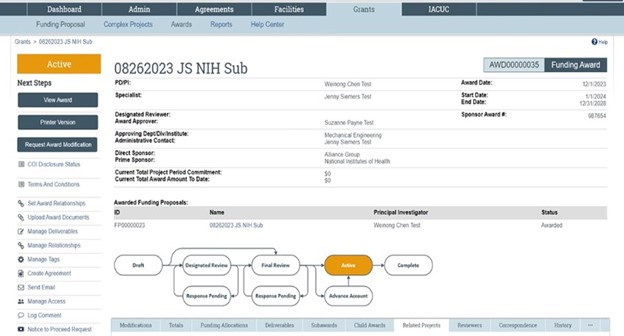
What other efficiencies and enhancements can users expect from the new system? The table below provides an “at a glance” reminder of the efficiencies the new system will bring to Purdue’s research administrators.
| Current State | Future State |
| Communication between parties is limited to emails (PI, finance, pre-award, post-award, contracting, regulatory, and sponsors) | More activities and communication kept within PERA for tracking and maintaining long term with some submissions automated |
| Proposals, awards, and agreements have limited relationship management | Transparent relationship management to connect all applicable activities |
| Multiple input applications to track research activity (COEUS, PIP, PDD, ROA, Cayuse) | Single, unified system for all research related activity |
| Status updates are manual and not updated regularly | Real-time status is available within the system and includes notifications |
| Efforts duplicated by PIs, pre-award, post-award, contracting, regulatory and finance teams | More automation and reduced duplication of efforts in a single system |
| Account manager for PI not tracked centrally | Will have field available for business office/account manager in faculty profile |
| Manual and paper systems for Export Control and Biosafety | Integrated modules dedicated to these functions and processes |
| Form 32s to track fiscal year cost-share commitments | Cost-share commitment will be pulled and managed by project and tracked at institutional and unit level |
| Budget allocations sent on Excel file via email to post-award | Direct entry of budget allocations into PERA |
| Voluntary support managed and maintained by Sponsored Program Services staff | Voluntary support managed and maintained by Purdue for Life Foundation along with other gift activity |
| Manual workflow and approvals occurring after the fact | Fewer required approvals and more reporting available |
| AY and FY salary input by effort percentage | AY and FY salary input by person-months |
| Department heads and deans included in workflow for proposals (pre-submission) and prior approvals (post award) | Department heads and deans reviews and approvals will be managed by reports and post submission reviews |
Over the next 6-9 months, the research community can expect to receive more information on the following topics:
- Opportunities to learn more about the user acceptance training (UAT) occurring late summer/early fall.
- Details about the launch of the initial PERA modules in late Fall of 2024: Grants (Pre Award and Post Award), Agreements, Safety – Institutional Biosafety Committee (IBC) and Institutional Animal Care and Use (IACUC).
- Finalization of various system roles and access provided by each role.
- Training modules that are currently in development.
Checkout these opportunities to stay informed on the PERA project:
- Finance staff will also be asked to participate in a PERA Finance Demo in May. Staff should hold time on their calendar for one of the two scheduled sessions: 9:30-11:00 on May 9 or 1:30-3:00 on May 16. A specific announcement with a registration link will be sent in the next week or two.
- Four PERA information sessions were held the week of April 22. A recording will be placed on the PERA website soon.
- The complete PERA presentation from the March Unit Lead meeting can be obtained from your Unit Leader.
- To keep users up to date on progress, a monthly “PERA Updates” newsletter was recently launched. The newsletter will be sent to sponsored programs staff, regulatory affairs and business management staf but can also be found on the PERA website referenced below.
- Finance staff are encouraged to submit questions to peracomms@purdue.edu.
- Finally, the PERA website is continually being updated with announcements, presentation slides and videos as well as Q&A documents.
Individuals with specific questions can also reach out to the Finance representatives on the initiative: John Higgins (Project Sponsor); Erin Fetter (Module Owner) and Functional Team members Andrea Kane and Dana Simms.
In Depth: Purdue Service Portal Scheduled for Launch
On Wednesday May 1, Team Dynamix (TDX) will replace FootPrints, the electronic ticketing system currently in use by the Employment and Purchasing Center teams to track service requests. TDX will be administered through the Purdue Service Portal.
Originally slated for a late winter launch, implementation was paused to allow for further development of the system and other change management activities. During the pause the team completed additional reviews and edits of the forms and resources as well as additional assessment of the request intake process. This pause has also provided additional opportunities for business operations center staff to become more familiar with the Service Portal. The team also met with faculty from across campus to provide a preview of the system and gather their feedback. Overall reactions were positive and feedback received has been addressed or taken into consideration as it relates to implementation and resources.
The deployment plan includes the ability for users who utilize email today to submit service requests to continue to do so. Customers who use forms today will be directed to use forms in the new system. Regardless of submission method, all customers will benefit from the ability to log into the Purdue Service Portal to track the status of a service request.
The overall goal will be to gradually migrate users to the form functions over the next few months. The use of forms promotes efficiencies for requestors by collecting all information needed to start a service request with the request submission, eliminating the need for follow-up questions that can delay task completion. Form usage also supports the potential future automation of some reconciliation and payment tasks.
Existing Footprints tickets that are “in process” at the time of cutover will be diligently worked for two weeks to resolve or close. Open tickets not resolved after two weeks will be transitioned to the new system. Historical ticketing documentation will remain accessible by center staff for reference.
Resources for business offices and other customers can be found on the Service Portal (TDX) Resources page hosted on the Finance website. Resources include a requester user guide, video tutorials and direct links to the Purdue Service Portal. The portal links will be live on May 1. TDX refresher training for center staff was held the week of April 22. Specific questions can be directed to Whitney Beutel, Director of Business Operations and Administration.
April: One Less Signature Initiative (challenge)
As shared in the March issue of The Bottom Line, the university has launched a “One Less Signature” initiative with the goal of reducing the number of approval “stops” within any university process. This type of efficiency initiative is not new to the Finance team. As part of the Business Process Reengineering (BPR) project that launched in July of 2018, our efforts resulted in the elimination of over 600K+ pages of paper annually, elimination of the rekeying of 40K+ forms and the streamlining of several approval processes.
A lot has changed since the BPR project was implemented. Strategic initiatives have been launched, research awards have set new records and new institutional leaders are in place. In our current environment, are there opportunities for Finance to participate in the One Less Signature initiative? What can we streamline? What approvals can be removed? All ideas are welcome and can be contributed via a project dedicated email: finprocess@purdue.edu.
Thank you for your consideration and all your ongoing contributions to the success of our organization.
~Eva Nodine
Vice President, Deputy Chief Financial Officer and Assistant Treasurer
Finance Blood Drive
We set a goal of 20 units, and through a combination of in-person and local donations, we surpassed that goal by 3 for a total of 23 units. The Versiti staff commented that we had AMAZING participation. Other than some unavoidable cancellations, everyone who signed up showed up, making our blood drive one of their most productive! Thanks to all who reported their local donations and those who were able and willing to donate in person! Watch for announcements about future blood drives!
2023-24 Performance Feedback Process and Procedures
Completing the Feedback Process
Performance Feedback Season is upon us! Performance management resources can be found on the Human Resources Performance Management @ Purdue website and includes the timeline shown above. Employees should be wrapping up their self-assessments now. Once the employee completes their work, the supervisor can begin their evaluation work.
It is important to note that Unit Leads should not discuss final performance ratings with employees until after the unit calibration meeting which should occur between April 8 and April 30.
LMS Learning History Query
The Cognos based Learning Management System training report will be refreshed weekly from March 4 – May 6. Anyone can access the report to obtain a list of training taken during the FY23-24 performance cycle. The report can be found at the following Cognos path: Team content > Departmental Content > PWL > Treasurer > Non-Standard > HR > 02 – In Testing > LMS Reporting > LMS Training Report. Questions about the report can be directed to Angie Delworth.
New Travel Dashboard Available to Business Office Staff
The travel dashboard announced in the February issue of The Bottom Line is now available to Business Office staff across campus. Business office staff have been granted access to the dashboard for use in monitoring the aging of pending reimbursements and identifying issues that need to be resolved. With this access, business office staff can: review expense reports pending with fiscal approvers; obtain additional data for use in evaluating requests for Travel Card (tcard) increases and cash advances; obtain reports on charges of significant dollar amount which may need reviewed; and access reports on the aging of charges and expense reports.
Questions about the dashboards and expectations for use can be directed to your supervisor.
One Less Signature Initiative
In support of their continued pursuit of excellence, a new initiative was announced by Chief Financial Officer and Treasurer Chris Ruhl, Provost and Executive Vice President for Academic Affairs and Diversity Patrick Wolfe and Executive Vice President for Research Karen Plaut in their March 6 Academic and Research Excellence Update. The “One Less Signature” initiative targets reductions in approval stops for any administrative process or form at Purdue.
The initiative asks, “where can processes be streamlined for improved efficiency?” Finance teams are encouraged to engage with units who are evaluating processes for approval streamlining. Finance teams are also asked to review their own processes. Where can a signature or approval “stop” be eliminated? While some approvals are required and cannot be eliminated, Principal Investigator signatures for example, others could be evaluated for elimination.
Do you have ideas for streamlining a form or approval process? Faculty and staff are encouraged to pass along their ideas by emailing finprocess@purdue.edu.
Sponsored Program Updates
New Training Videos from Sponsored Program Services
Sponsored Program Services (SPS) recently posted instructional videos and associated infographics for five different topics on their Training page including a great overview of Post Award Roles and Responsibilities in the Business Office and SPS. Finance staff with sponsored program responsibilities are encouraged to check them out.
PERA Update
The PERA project continues to progress. As milestones are achieved, established communication channels, including The Bottom Line, leadership meetings and the newly-created Business Management Listserv, will be used to provide updates, links to resources and training opportunities.
Specific questions about PERA can be directed to the PERA team directly at peracomms@Purdue.edu or to one of the Finance representatives on the project:
- John Higgins, Executive Director, Research Finance and Account Management (Executive Sponsor and member of the Steering Committee)
- Erin Fetter, Associate Director for Financial Affairs in Engineering (Module Sponsor)
- Dana Simms, Research Specialist in Engineering
- Andrea Kane, Extension Account Manager and Business Manager in Agriculture
Payroll No Longer Mass Approving “Saved” Timesheets
The March 7 Business at Purdue message highlighted a change in timesheet processing that can impact individuals who have not submitted their timesheets for approval. This change only impacts employees who have a positive time entry profile, typically students and temporaries, who have to submit their timesheet for approval each pay period.
Current Process: After the payroll deadline, payroll pulls a list of timesheet that have: 1) been submitted to their supervisor but have not been approved or 2) have made changes to their timesheet but have NOT submitted it to their supervisor (it is in saved status). Payroll currently pushes these two types of timesheets through the system and pays the hours.
New Process: In an attempt to pay employees more accurately and reduce overpayments, effective with the March 27-April 7 pay period, Central Payroll will no longer push the “saved” timesheets (2nd type of timesheet mentioned above) through for automatic payment.
Timesheets submitted to supervisors but unapproved will still be paid.
Employees needing a refresher on timesheet approval processes can reference these resources: Time Entry and Submittal – Positive Entry QRG or SuccessFactors Time Sheet Tour and Approvals to review instructions.
Questions about these changes can be directed to your Employment Center.
Attempts to Defraud the University Continue
Attempts to defraud the University continue and require all of us to remain diligent in evaluating requests for payment. Accounts Payable has received notices from several vendors who are experiencing fraud attempts on their bank accounts. Using an email address that closely resembles that of the real vendor, scammers are contacting customers and attempting to change where payments are sent.
Payables Manager Judy Ewbank shares that in the “past two weeks, six vendors have reached out regarding fraud attempts. All six vendors advised the attempts were related to slight changes in an email address.”
Below are the specific discrepancies shared by the vendors:
- JenKem’s domain is @jenkemusa.com; a scammer added an ‘s’ at the end, @jenkemusas.com.
- Production Automation Corp is @gotopac.com; the scammer added “inc” @gotopacinc.com.
- Applied Image is @appliedimage.com; scammer replaced “I” with “L” @appLiedlmage.com.
Staff are encouraged to review all vendor emails with skepticism and to rely on validated vendor data (using t-code BP) when evaluating new payment instructions. Vendor websites are also a good way to find the phone number to use to validate the vendor information in the email.
Staff needing assistance with locating a phone number to use for validation should contact the Vendor Data team at VendorData@purdue.edu.
TDX Transition Delayed
The transition from Footprints to Team Dynamix (TDX) announced in previous newsletters has been delayed until early March. The delay will allow for further training and orientation for center staff and allow more time for units to share details about the upcoming change to their customers. As implementation plans evolve, more details will be shared with center staff, unit leads and customers. Questions can be directed to the appropriate Procurement or Employment Center Lead or Whitney Beutel.
In Depth: Response to Travel Process Review Includes New Tools and Processes
Process reviews are a critical part of our internal control measures. A recent review of travel transactions by Internal Audit has resulted in new tools and process changes to support our oversight responsibility as it relates to travel expenditures. Tools, changes and reminders are highlighted below.
Business Offices will soon be able to access the Travel Dashboard currently in use by the central travel office. The dashboard will provide business office staff with access to: expense reports pending with fiscal approvers; data for use in evaluating requests for Travel Card (tcard) increases and cash advances; reports on charges of significant dollar amount which may need reviewed; reports on the aging of charges and expense reports. Business Office staff will be encouraged to review the dashboard weekly and act or elevate issues where needed. An overview of the Dashboard including access instructions will be provided to Unit Leads at their March meeting.
The travel office is responsible for managing the outstanding tcard charges and addressing tcard misuse with travelers. As the primary resource for campus travelers, the office is expected to reach out to the Business Office for assistance if issues arise with a specific charge or traveler. The travel office is also addressing misuse of tcards through the implementation of a new escalation process. The process is very similar to the purchasing card escalation process:
• 1st Violation – email to cardholder, supervisor, with copy to the Business Office manager.
• 2nd Violation – email to cardholder, supervisor, with copy to the Business Office manager and tcard is suspended.
• 3rd Violation – email to cardholder, supervisor, with copy to the Business Office manager and tcard is suspended for one year.
The travel review also highlighted issues with timely expense report submissions and approvals by employees. The University follows the IRS “accountable plan” rule on submitting and reimbursement of expenses found in IRS publication 463. It is helpful to regularly remind travelers that under these IRS rules, expense reports not cleared within 120 days after the last day of travel on official University business are reported as additional wages.
It is critically important that Fiscal Approvers process Travel expense reports within 3 business days for good customer service and accurate account management. Issues delaying approval need to be escalated to supervisors to avoid the expense report totals from being reported as taxable income for the employee.
With the help of the Travel Dashboard and the new escalation process, it is hoped that issues found in the travel review can be minimized in the future. Business offices should use these new tools and processes to monitor travel expenditure activity in their units. Roadblocks delaying completion of expense reports or other issues of concern should be elevated to Directors of Financial Affairs and to the Executive Director of Finance and Business Operation. Additional information and expectations will be shared after the March Unit Lead meeting.
TDX Transition Update
Planning for the transition from Footprints to Team Dynamix (TDX) is ongoing with a new go-live date of February 15. Leading up to that date, center staff will finalize the TDX interface, test functionality, complete training and develop reference resources for business offices and customers.
Transition planning includes cutover protocols. Anyone submitting an order to Footprints after February 15 will receive an autoreply with instructions for accessing the new submission process. Existing Footprints tickets that are “in process” at the time of cutover will be diligently worked for two weeks to resolve or close. Open tickets not resolved by February 29 will be transitioned to the new system on March 1 if still active. Historical ticketing documentation will remain accessible by center staff for reference.
Resources in development include a list of the forms available, step-by-step instructions for users, links to helpful videos about navigating in the TDX interface and communication resources for business offices to use with their customers. These resources will be assembled into a handbook to be shared in advance of the go-live date and also accessible via center websites.
The most notable process change, shared in previous newsletters, is the use of online forms to submit requests. In support of that transition, the implementation team is narrowing down the list of services that will require a unique form. The team is also focused on the appropriateness of the data collection fields that are incorporated into each of the forms. This will aid in collecting complete and accurate data at the time of submission which will eliminate “back and forth” communications that could delay execution of the request.
As February 15 approaches, additional information can be expected via direct email using the standard list serves, B@P communications and Purdue Today. Questions can be directed to employment and procurement center leads or Whitney Beutel.
New List Serve Moderation Tool Implemented in December
On December 16, 2023, Purdue IT switched their moderated email lists management platform from Mailman to LSoft Listserv. The most significant change is from the perspective of individuals who submit messages for distribution.
A security enhancement intended to minimize the impact of SPAM messages now requires some individuals who are submitting messages to the lists to confirm the message is legitimate. Individuals sending messages to a list need to monitor their in box to see if they receive an auto message asking them to “ok” to confirm they sent the message. If the sender does not reply, the message will not move forward to the moderators for review and release. Questions or concerns about the list serves can be addressed to Angie Delworth or the specific list moderator. A full list of Finance moderated lists can be found on the Finance Email Lists website.
Termination Workflow Changes
Effective January 1, terminations of employment processed through SuccessFactors will no longer require action from Budget Approvers. This change was recommended by Internal Audit following a review of payroll overpayments and discussed at the July Business Operations meeting. This workflow modification will eliminate a step in the termination process with the goal of streamlining the process and reduce the number of overpayments due to delayed approvals. Budget approvers will still receive a SuccessFactors workflow notification of these terminations.
At the January Unit Lead Meeting, there was a discussion to see if additional information could be provided in the notifications. More information will be shared when known.
Budget Approvers will also no longer approve non-pay employee data changes or terminations and instead will receive SuccessFactors workflow notification. Questions about either of these changes can be directed to Whitney Beutel.
Highlighting Purdue Research: Does it Pay to be Nice at Work?
In addition to our signature strengths in agriculture and engineering, many Purdue faculty researchers conduct research that directly impacts our work and personal lives. One such researcher is Dr. Allison Gabriel, Professor and Thomas J. Howatt Chair in Management and Director of the Center for Working Well. The center’s research blog has several articles of interest to working professionals and one such article is highlighted below.
Does a desire to help others at work make you better or worse off? “Being a Giver in the Workplace,” by Tobias Dennerlein, Assistant Professor of Management, highlights the positive impacts of being “prosocial” for individuals and teams. Prosocial is the term used by the author to characterize someone who has a strong motivation for helping others at work. This approximately five-minute read highlights how individuals and their teams can benefit from practicing “prosocial” characteristics.
If you have suggestions for additional Purdue research topics that would be of interest to the Finance team, please reach out to Angie Delworth.
Transition of Purdue Global Payroll from ADP to ECP Completed
Payroll associated with all three Purdue company codes, Purdue Applied Research Institute (PARI), Purdue Global (PG) and Purdue University, can now be processed in the Employee Central Payroll (ECP) system. Over the winter recess this transition was finalized with an import of employee data into SuccessFactors and ECP. The first PG payroll was successfully processed on January 9. Prior to this integration, PG employee payroll was processed in-house through ADP (payroll software).
With this transition comes a reminder that when planning a payroll action, the employee’s full appointment should be taken into consideration. Reporting changes are in process to make it easier to identify PG (and PARI) employees and view their full appointment. The central payroll team is working with Jennifer Helfrich on new Cognos reporting to assist with managing these appointments.
It is strongly encouraged that business office and employment center staff reach out to Central Payroll with questions or concerns when making changes that could impact appointments on other company codes. Questions about this information can be directed to Brittany Poore or Whitney Beutel.
Heads Up: TDX Coming in February
The rollout of Team Dynamix (TDX), the replacement for the Footprints tool, has shifted to early February to allow time for training of center staff as well as ensure thorough communication with all groups impacted is achieved. The implementation team is excited about the efficiencies the TDX tool will bring to both the procurement and employment center service request process.
The TDX tool has similar functionality as Footprints when it comes to managing requests for services received by the operation centers. The most significant change for customers will be that the new process will utilize forms instead of emails to submit the service request. The use of forms will ensure all information needed to start a service request is obtained at the time of the request, eliminating the back and forth email exchanges that can delay task completion as well as save time for customers and staff.
As mentioned previously, this tool is already being utilized by the Purdue IT department and will be implemented to a multitude of other groups across Purdue’s campus in calendar year 2024.
A communication plan detailing these process changes for center stakeholders and customers is in development. Be on the lookout for the finalized communications to be distributed in early in January.
Reduction in Off-Cycle Availability
As previously shared in the September Bottom Line, the 2024 payroll calendar will feature reduced off-cycle payroll opportunities. The changes are part of an overall effort to streamline payroll processes and reduce the administrative tasks associated with off-cycle payrolls. The 2024 payroll calendar has been modified to reflect these adjustments.
Business offices and employment centers should be prepared to adapt to the reduced off-cycle payrolls in the new calendar year. Where appropriate, departmental business office staff should educate customers on this change as well as communicate the impacts of these payments. Questions about the reduction of off-cycle payroll runs can be directed to Whitney Beutel.
Finance Service Project: Help Keep Your Community Warm
Thanks to the efforts of staff across the Finance team, nine boxes stuffed with hats, gloves, blankets and other supplies were donated to Lafayette Transitional Housing and the Lyn Treece Boys and Girls Club. In addition to warm clothing items, enough blankets were donated to Cover Lafayette to fill TWO of their collection bins!
Additional donations were delivered directly to the organizations by various members of the team. Thanks to all who made our first Finance service project a great success!
The Bottom Line – Updates
Feedback Survey Highlights
Thanks to all who contributed to the newsletter feedback survey! Below are a few takeaways from the results:
- 72% of respondents responded that they always read the newsletter; 28% said they sometimes read it.
- 100% of the survey respondents stated that the information in the newsletter was either Very Useful or Useful.
- 87% of respondents agreed with the statement “I feel better informed about the Finance organization thanks to The Bottom Line.”
In response to the question “What do you enjoy most about The Bottom Line”, responses included: it is finance specific and helps to build community; it is a good alternative communication source that helps me stay current on Finance news and issues; I like the variety of information and the new employee/welcome aboard section.
In terms of how The Bottom Line could be improved, suggestions ranged from content ideas to formatting changes. Some of the same content ideas appeared in response to a request for content suggestionsThese improvement ideas and content suggestions will be reviewed with the culture and communication committee for potential adoption.
Again, thanks to all who took the time to contribute their thoughts. The finance team is always busy and we really do appreciate the time each respondent took from their busy schedules to provide feedback on this new communication channel. It is sincerely appreciated.
Archive for Past Bottom Line Articles
Past articles from The Bottom Line are now available on the Finance website! Linked from the Culture and Communications page under Communication Channels, the searchable archive page will be updated each month with the business specific articles from The Bottom Line.
Professional Development Retreat for Finance Management/Professional Staff Held On Campus
Over 190 members of the Finance management professional staff gathered on the West Lafayette campus for a Professional Development Retreat on November 8. Objectives of the day-long event were to provide development opportunities for participants through presentations from experts on professional development topics, provide cross functional team building opportunities and promote re-engagement, networking, and retention with an in-person, on-campus experience.
Dr. Rick Johnson-Sheehan, Professor of English, kicked off the day with a presentation on “The Art of Delicate Communication” in which participants learned about our “Judge Brain” and our “Gator Brain.” Dr. Allison Gabriel, Thomas J. Howatt Chair in Management from the Daniels School of Business followed, presenting “Zoom Fatigue and the Science of Recovery – How We Can Thrive at Work and Home”, a topic that provided welcome tips for our remote and hybrid work environments.
The afternoon featured a Q&A with Tiffini Grimes, Deputy Athletics Director and Senior Woman Administrator for Purdue Athletics. Tiffini’s description of her career path and decisions she made along the way provided us with a great perspective on the power of persistent pursuit of our goals. Tiffini was followed by a panel of Purdue managers and an external executive coach who provided their own thoughts on the importance of owning our own professional development. The final presentation, “The Audited Financial Statement: How does it relate to your position?” highlighted the interconnected role we all play in the development of Purdue’s annual financial statement.
A post retreat evaluation found that participants felt the speakers were excellent and the content of the presentations were relevant to their positions. From Dr. Gabriel’s research on the impact of virtual work environments to Dr.Johnson’s presentation on difficult communiation, participants received information that could be immediately applied to their jobs. The survey also revealed that the highlight of the day for most participants was the opportunity to reconnect and network with colleagues from across the organization!
Copies of the presentations can be obtained from Angie Delworth.
Evaluation Request: Professional Development Retreat for Finance Management/Professional Staff Held On Campus
The management professional staff within Finance participated in a day long professional development retreat on November 8. Attended by over 190 management professional staff, the retreat featured speakers from across campus as well as campus and facility tours. If conversation, making connections and laughter were the barometers for evaluation, the retreat was a great success! However, to provide a more robust evaluation we want to hear from the participants.
Retreat participants are encouraged to complete the Finance Professional Development Retreat Evaluation.
Financial Planning and Analysis Announces Professional Development Series
The staff of Financial Planning and Analysis are pleased to announce a series of professional development opportunities targeted to business management staff (business managers, research account specialists, Assistant/Associate/Directors of Financial Affairs). The series topics, dates and times are shown below for calendaring purposes.
Dates and times may change. Specific invitations will be sent closer to the date.
- The Audited Financial Statement (see below)
- Fringes – Central / Department Impact (December 12, 1:30-2:30)
- PIPC Income & Endowment Distributions (January 30, 1:30-2:30)
- Scholarships (February 20, 1:30-2:30)
- Construction – Backstops and Non-Op (March 5, 1:30-2:30)
- Tuition and Fees (April 9, 1:30-2:30)
The Audited Financial Statement topic was presented at the November 8 professional development retreat. This material will be recorded and shared at a later date.
While specifically targeted to the business management staff previously mentioned, it may be beneficial for other staff to participate. If you have a staff member who would benefit from participation or you personally believe a specific topic is applicable to your position, please discuss with your supervisor.
In Depth: Facilities and Administration Rate Comparisons and Applications
In November of 2022, Purdue received approval to implement new Facilities and Administration (F&A) rates including an increase in the research rate from 55% to 57%. Rate changes, especially increases, often spur questions around the reasonableness of the rates. Are the rates reasonable? Or are they excessive? How do they compare to other institutions? At a recent Council on Governmental Relations meeting, Ken Sandel, Associate Vice President of Sponsored Programs Services (SPS) received data that can help address those questions.
In order to compare rates across institutions, COGR grouped higher education institutions by overall research expenditures. Purdue fell into the $400M+ grouping and shows that the average rate across these institutions sits at 58.4% compared to Purdue’s rate of 57%.
F&A Rate Comparisons
$400M+ Research Expenditures
| Rate Types | Average | Purdue |
|---|---|---|
| Instruction | 50.4 | 50.0 |
| Other Sponsored Prog | 35.7 | 38.0 |
| Research | 58.4 | 57 |
Knowing that Purdue’s F&A rates are in line with similar institutions, and in some cases actually lower, is helpful information to know when discussing research costs with faculty and staff. It is equally important to understand what F&A is and the role it plays in Purdue’s financial infrastructure.
F&A, sometimes referred to as indirect costs or overhead, are costs incurred to conduct research and sponsored program activity that cannot be easily allocated to a specific project. Examples include facility costs such as depreciation, utilities, general maintenance, and capital improvements as well as administrative costs such as departmental administrative costs and sponsored program administrative expenditures. F&A is recovered by charging the rate on a percentage basis to specific direct costs and allocated to the general fund as part of the annual plan.
Want more information? There is a briefing document on F&A available on the SPS web site. Additional questions about F&A and its use can also be directed to your supervisor, senior director or SPS post award staff.
It’s the One-Year Anniversary of The Bottom Line
The November issue marks the one-year anniversary of The Bottom Line! The newsletter was launched with the goal of creating a new communication channel for the Finance team. By providing an opportunity to gather input on a variety of topics using surveys, share details about new Finance initiatives and welcome new staff, we were seeking to not only build engagement among our teams but also greater awareness of Finance topics across the organization.
Finance Service Project: Help Keep Your Community Warm
As winter approaches, many in our communities face a very real struggle to stay warm. To help ease the need, the Finance team is invited to collect gloves, hats, scarves, blankets and even coats for donation to several Greater Lafayette community organizations. This service activity is sponsored and coordinated by the Culture and Communication Committee.
The Greater Lafayette organizations we are targeting are listed below.
- Lafayette Transitional Housing – LTHC Homeless Services (formerly Lafayette Transitional Housing Center) is the coordinated point of entry and initial assessment for anyone experiencing homelessness or a housing crisis in Tippecanoe County. Donated items will be distributed to LTHC clients.
- Lyn Treece and Boys and Girls Club – The Lyn Treece Boys & Girls Club of Lafayette is an after-school and summer youth development organization providing positive, educational, leadership, and character building programs for youth ages 6 to 18. Many of the children who participate in their programing lack winter clothing essentials and club staff will be happy to receive and distribute our donations!
- COVER Lafayette – The COVER Lafayette Project is a grassroots movement to collect and make available cover to any BODY (collect blankets in central locations and are available to anyone who needs them). Blankets will be collected at the retreat and delivered to a Cover Lafayette drop off location.
Our target agencies were very excited about our initiative. The Boys and Girls club shared that warm clothing is a persistent need among the young children they serve. How many hats or gloves can your team contribute? Or would your team want to focus on collecting scarves and hats? All are needed. Please contribute if you can!
There are several ways to participate:
- Individuals attending the November 8 Professional Development retreat for Management/Professional staff can tuck their items into their travel bags and bring them to the retreat.
- Work teams are encouraged to collaborate to identify the best collection and delivery method – either at the retreat or the organization directly – for your unique situation.
- Drop off your donation to one of the three organizations.
- Donations can be made directly to Lyn Treece and Lafayette Transitional Housing via their websites (please reference Purdue Finance in your donation).
- Don’t live in or around Lafayette? Feel free to make donations to similar organizations in your communities!
New items are preferred but clean, gently used items are also appreciated. All donations should be completed by November 17.
Do you have questions about this activity? Reach out to Yvette Rosas, Angie Delworth or any member of the C&C team. Also, if your team isn’t delivering items to the retreat, let us know if you were able to participate! We would love to have a report out in the November or December newsletter about this activity.
Let’s do what we can to help keep our communities warm!
Professional Development Retreat Planned for Finance Management/Professional Staff
Finance management/professional staff have been invited to campus for a Professional Development Retreat on November 8. With 170 staff committed to attend, this will be the largest in-person gathering of Finance staff since before the pandemic. Details are still being finalized but the day will feature networking opportunities, speakers from across campus and a panel discussion about professional development.
A program and logistics document will be shared with participants before the retreat.
This event has been developed as part of an ongoing effort of Finance leadership, in collaboration with the Culture and Communication group, to offer professional development opportunities for all Finance staff
Team Dynamix Coming to Finance
The electronic ticketing system, Footprints, currently in use by our Employment and Procurement Center teams is targeted to be replaced by Team Dynamix (TDX) in January 2024. TDX has been in use by the Purdue Information Technology teams since July of 2023. Deployment plans are just getting started and will include the development of communication strategies as well as standardization of processes. Details will be passed along to impacted parties as the transition schedule is finalized.
Anyone interested in learning more about TDX can visit the Information Technology Latest News page to access FAQ’s and other resources developed in support of the IT launch.
In Depth: Bot Update
Three bots (short for robot) launched since August 2022 have been quietly reducing the workload of procurement center staff across campus while improving our vendor relations and the accuracy of account management reports. The overarching goal of these new tools is to reduce the amount of attention required by skilled staff on repetitive tasks that, while important, are straightforward and simple. Specific examples of where the bots are being used and the impact on staff workloads are shown below:
- The Invoice Reconciliation (IR) bot launched in August of 2022 has saved 925 personnel hours by identifying when an invoice is needed and emailing the vendor.
- The Goods Receipt (GR) bot launched in February of 2023 has saved 924 personnel hours by identifying when a goods receipt is needed and contacting the requisitioners.
- The most recent bot to launch was in June of 2023 and it is tasked with gathering data for purchases less than $1000 on grant funds. By pulling data on 102K unique PO’s since June, the Less than $1K Bot avoided thousands of hours of manual work by providing staff with the backup documentation needed to spot check items that can require a higher level of scrutiny.
Since August of 2022, Ariba PO volume has increased by 10%. With bots taking care of these repetitive tasks, our staff has been able to absorb this higher volume more effectively and still provide value added services to customers; identify and address inefficiencies; and work with customers to resolve complex issues. Additionally, even with the increase in PO volume, the number of items on the GRIR report have decreased during this timeframe.
Additional Bots are in development. The EOBOC is testing a ZV60 bot that will read and extract data from an invoice and the associated footprints ticket and then log into SAP, locate the vendor and key the payment. The bot will also attach the backup documentation gathered as part of the process. Another Ariba invoice bot is currently in development with Accounts Payable will read and extract data from an invoice submitted for payment on an associated purchase order.
Bots are perfect for repetitive tasks that, when automated, can be processed very quickly, saving personnel hours across the organization. Do you have ideas for processes that would be perfect for completion by a bot? Reach out to Kristi Mickle or Whtiney Beutel to discuss further!
Accounts Payable and Electronic Signatures
Effective October 1, authenticated electronic signatures will now be accepted on W-9s and Purdue’s Sub W-9 and Purdue’s EFT/ACH form. A review of best practices of our peers, combined with the ongoing requirements of the global remote work environment that limits the ability of some vendors to obtain physical signatures has led to this change. Documents presented to the university by our vendors with an authenticated electronic signature can now be used to establish and update vendor master data. Filelocker continues to be Purdue’s preferred method for transmitting documents containing restricted data. Restricted data should never be sent via email. It is important to note, if Purdue initiates DocuSign, restricted information cannot be included.
What is an authenticated electronic signature? It is a specific type of electronic software that includes a security procedure designed to verify that a signature is that of a specific individual. We are not responsible for monitoring the system individual vendors are using to create their electronic signature. However, we ARE responsible to take every precaution necessary to minimize the risk of fraud and remain compliant with Purdue’s data handling requirement. Additionally, staff are required to validate the authenticity of the vendor and ensure any restricted data is safely shared among peers. Individuals seeking to refresh their knowledge in this area are encouraged to take (or retake) Fraud Prevention: Protecting Purdue, Protecting You (LMS 81004). Questions about this change can be directed to Judy Ewbank or Whitney Beutel
PERA Update: Meet the Finance Representatives on the PERA Initiative
As shared in the August issue of The Bottom Line, the Purdue Excellence in Research Administration (PERA) project will transform Purdue’s research administration environment. Several members of the Finance team are actively engaged in the project. John Higgins, Executive Director, Research Finance and Account Management, is serving as an Executive Sponsor and on the project Steering Committee; Erin Fetter, Associate Director for Financial Affairs in Engineering, is serving as a Module Sponsor; and Dana Simms, Research Specialist in Engineering and Andrea Kane, Extension Account Manager and Business Manager in Agriculture, are participating on the Functional Team.
While all have been busy in their various roles, in these early stages, Andrea and Dana have been involved in an exploratory activity referred to as “onboarding.” In onboarding, representatives from Huron, the software company, are meeting with the full project team to learn more about Purdue’s processes. Conversely, the Purdue team is learning more about Huron’s software. The end result will be a melding of practices and processes that best serve the Purdue research community.
This holistic approach is providing the Finance team with a deeper understanding of the efficiencies the system will bring to Sponsored Program Services (SPS). Kane shared, “I had no idea how much time SPS spends uploading documents to a shared location so that administrative staff can find them when needed.” The new system will feature an award record that incorporates all of the documentation associated with the award such as the actual proposal, associated agreements and amendments. According to Kane, “the elimination of this manual upload process will create efficiencies for both SPS and the Finance account management staff, who today have to log into a separate system to search for these resources.”
The Finance team is excited to share PERA updates as the project moves along. These updates will be featured in The Bottom Line as well as other communication channels. Additionally, a new PERA website is now live with a variety of reference resources. Do you have questions about the PERA project? Finance staff can also reach out to any of the Finance representatives listed here, or their senior director, with questions about the project.
Reduction in Off-Cycle Availability
The 2024 payroll calendar will feature reduced off-cycle payroll opportunities. Efforts to minimize the need for an off-cycle payroll have always been important due to their inherent inefficiencies but are even more important now due to the reduction of opportunities in the payroll calendar going forward. Off-cycle payrolls require extra auditing to ensure benefit contributions are processed in the correct amounts. In addition, off-cycles are taxed at a higher rate, resulting in a decrease to the employee’s net pay. These known issues, combined with the incorporation of Purdue Global payroll responsibilities, makes the historical quantity of unscheduled off-cycle payroll runs unsustainable.
The 2024 payroll calendar has been modified to reflect these adjustments. Business offices and employment centers should be prepared to adapt to the reduced off-cycle payrolls as we approach the new calendar year. Where appropriate, departmental business office staff should educate customers on this change as well as communicate the impacts of these payments. Questions about the reduction of off-cycle payroll runs can be directed to Whitney Beutel.
Cybersecurity and You
When it comes to cybersecurity protocols, it is important to stay on top of Phishing, SPAM and other cyber threats. The Secure Purdue group within the Information Technology organization have compiled a comprehensive Cybersecurity Awareness section on their website.
As SPAM and Phishing attempts have become an everyday occurrence in both our personal and professional lives, examples provided on this page can help us identify cyber threat email we receive in our inboxes. Check out the site for real-world example messages and the clues that can help us identify them as phishing emails. This area also contains Cybersecurity FAQs and Updates.
Need to report suspicious or malicious emails to the security team? You can report emails directly by forwarding them to abuse@purdue.edu. Users can also utilize the Report Message button inside Outlook, which can be found in the top banner or by right clicking an email in Outlook on the web (OWA).
In Depth: Overpayments and Reconciliation Reminders
The start of a new academic year brings a significant increase in the number of payroll actions and sometimes overpayments as well. Onboarding new students and faculty, combined with offboarding individuals who will not continue into the new academic year can lead to inadvertent overpayments. As we move towards the end of September, most of our new employee payroll actions are complete and it is time to turn our attention to reviewing overpayments. Communicating with employees and supervisors about overpayments during the next few months is especially critical as we approach the end of the calendar year.
Federal Tax Law stipulates that payroll overpayment repayments received in the subsequent tax year are to be repaid at the gross amount of the overpayment. Efforts focused on the accounting and collection of overpayments in a timely fashion not only benefits the university through clean financial statements, but also the individuals who have been overpaid. Additinally, payroll overpayments are unallowable on grants and federal funds and prompt attention can ensure these charges are removed.
From on-demand training courses to dashboards and process instructions, staff tasked with overpayment responsibilities have several resources available to help guide them through the various overpayment processes. A list of training modules and dashboard resources can be found below:
Training Resources: Comprehensive overpayments training is available through SuccessFactors and can be found using the training matrix. Direct links to each course can also be found in the Training Matrix maintained on the Finance Website under Operations and Training Resources. PDF versions of each course can be found on the Human Resources SuccessFactors site (see SuccessFactors Payroll Resources section below):
- Module One – Payroll Overpayment Repayment & Reconciliation Training General Overview
- Module Two – Payroll Overpayment Repayment & Reconciliation Training Processes and Expectations
- Module Three – Payroll Overpayment and Reconciliation Training – Overpayment Dashboard
- Module Four – Payroll Overpayment Repayment & Reconciliation Training – Account Management
- Module Five – Payroll Overpayment Repayment and Reconciliation Training – Overpayment Reconciliations
- Module Six – Payroll Overpayment Repayment & Reconciliation Training High Level Overview for Managers
- Module Seven – Timekeeping, Time Off Requests and Employee Pay Change Responsibilities for Supervisors
- Module Eight – Payroll Overpayment Repayment & Reconciliation Training – Resources
- Module Nine – Payroll Overpayment Reconciliation
SuccessFactors Payroll Resources: Human Resources maintains a multitude of payroll related resources on the SuccessFactors SharePoint site. In the Payroll Resources section, users can access email templates to use when communicating with supervisors and employees, process diagrams and fact sheets. Users can also find the Overpayment Dashboard Reports. The dashboard is a “drillable” report that allows users to easily access data for their units as well as for specific time periods.
Individuals tasked with Overpayment Reconciliation and Repayment responsibilities know that success is reliant on a team approach, with everyone doing their part. Managerial Accounting, business office account managers, business office leaders, sponsored program services and employment centers all play a key role in the overpayment reconciliation and repayment process. Thanks to all who are actively monitoring and taking the appropriate actions where needed. If you are unsure of your role in this process, please reach out to your supervisor.
In Depth: New Research Administration System Promises Efficiencies Across the Organization
This past April, the Board of Trustees approved an almost $9.9M investment in the development and implementation of a new research administration system. The Purdue Excellence in Research Administration (PERA) system represents Purdue’s first fully integrated research administration system and will replace a variety of independently configured research administration systems. PERA is a ‘next generation’ system that automates many processes required to apply for research grants, manage research funding, and apply to regulatory committees such as those responsible for the oversight of research with human subjects, vertebrate animals, biohazards, and compliance practices.
Selecting and launching such a comprehensive system that touches so many teams across Purdue, including Finance, requires considerable planning and integration. The Office of Research and subject matter experts from across the research enterprise participated in a 12-month evaluation and selection process, leading to the selection of the Huron Research Suite, rebranded as Purdue Excellence in Research Administration (PERA). Dana Simms, Research Specialist in Engineering, participated in the team that evaluated proposals from six different vendors and believes that the consolidation of a variety of systems into one will create greater transparency for all involved in managing a research project across its lifecycle. Simms shared that, “Today, if I need Institutional Review Board (IRB) information, I typically work through the Principal Investigator. Since they are very busy individuals, this can take days or even weeks to obtain. In the new system, I will have direct access to the IRB information needed or to process human subject payments. I truly believe research administration is going to become more efficient and better.”
To assist with the monumental implementation efforts, the Office of Research has hired instructional designers to assist with the development of training opportunities and is partnering with communication professionals to support dissemination of project updates across the organization. Following the April approval, project planning kicked into high gear over the summer months leading to an implementation plan that will span a little over two years. Initial efforts will focus on Grants (Pre and Post Award), Agreements, and IACUC – as well as implementation of an integrated Financial Forecasting module.
As the project moves forward and modules are developed and launched, Finance team members can anticipate regular updates through our standard Finance communication channels, including The Bottom Line, the website and using leadership meetings and email lists for the more critical and time sensitive updates. Through these communications and completion of new system training, it is anticipated that Finance staff will be prepared to transition their day-to-day grant related activities into the PERA system.
The links below are to previous communications as well as current websites containing helpful background information for anyone looking to get caught up on the initiative.
Resource links:
- Sponsored Program Services PERA
- Office of Research Academic and Research Excellence Update
- Board of Trustee Approval (Purdue Today)
Questions about the PERA project can be directed to your supervisor, Senior Director or to peracomms@purdue.edu.
Reducing Overpayments through Workflow Changes
The recent completion of an Internal Audit of overpayments is spurring changes in the SuccessFactors ‘Termination’ action workflow. Audit data revealed that in calendar year 2022, slightly over 1,000 terminations resulted in payroll overpayments totaling $1.1M. Why do terminations result in so many overpayments? The reasons vary from delays in communication of termination decisions between the supervisor and finance staff to delays in the approval of termination actions in SuccessFactors by Budget Approvers. Regardless of the reason, recovery of termination overpayments is extremely time consuming and some funds are never recovered. In response to the findings and in an attempt to reduce the number of overpayments, approval for a workflow process modification has been obtained.
Effective January 1, 2024, Budget Approvers will no longer directly approve termination actions. Instead, they will receive a system notification email whenever a termination action has been entered. The audit revealed that 94% of terminations processed through SuccessFactors workflow are approved without any changes and 33% take more than 4 days to approve. Given this high percentage of “no issue” actions and delays in SuccessFactors approvals, the switch from approval to notification is expected to significantly reduce the number of overpayments by speeding up the termination processes. This change will also be enacted for terminations of non-pay appointments as well.
This process modification was shared with Finance leaders at a recent Business Operations meeting. Process updates, training and communications about this change will continue through the fall semester. Individuals with questions about these changes should contact their supervisor or Senior Director.
Finance Website
Training Matrix
On the Finance website, the Treasurer’s Training Matrix is presented through “profiles” that are organized by position or area. Within these profiles, a direct link to SuccessFactors has been added to the LMS course number. By clicking the course number, users are taken directly (after login) to the registration for that specific course in SuccessFactors.
The training profiles have also been updated with recent course additions including: an Introduction to the Use and Management of Ag Funds; Summer Pay (SEEMLESS) for Business Offices and Payroll Centers; and Fraud Prevention: Protecting Purdue, Protecting You.
Similar updates have been made to the downloadable version of the Treasurer’s Training Matrix which can be found in the last section of the webpage.
Generic Email Addresses Added to Directory
Generic Business Office email addresses used by Sponsored Program Services and Business Offices across campus have been added to the Finance Directory. These addresses can be found by using the search box or the Department Selector dropdown box. Individuals needing assistance with a task associated with a specific unit but unsure who to contact can use these generic email addresses to connect with the right individual.
Questions about any of these changes can be directed to Angie Delworth.
November 2022 Launch – June 2023
The New Finance Website and the Detailed Business Management Directory
Users of the new Finance website may have noticed that the Detailed Business Manager directory was not migrated to the new site. Maintenance of the detailed directory was time intensive and the content was frequently out of date. Recognizing that some Finance staff used this directory to find business contacts for a specific unit, a tool shared in the May newsletter is an alternative method for finding this information. As many business office staff typically hold a Fiscal Approver role, results obtained from the “ZFI_WF_Approvers” t-code can help identify business office staff associated with a specific unit. Instructions for the t-code can be found on the Business Management page in the Fiscal Approvers section.
Technical Tips and Tricks
Do you need to know who the fiscal approver is for a specific business area? Lisa Rile, Assistant Director of Financial Affairs for the Office of the Provost, has documented a quick process to “Generate a List of Current Fiscal Approvers”. Using the ZFI_WF_Approvers SAP T-code, this easy to follow process creates a list of fiscal approvers for areas across the university including the regional campuses. Click the link above to download the process document and check it out! Do you have a tip or trick that others may find helpful? Feel free to send it to Angie Delworth so we can share with others!
Interviewing Reminders and Resources
Have you ever faced the task of filling a vacancy that you supervise? Or been asked to serve on a “peer” interviewing team?
Hiring new Finance staff is one of the most important aspects of our roles at Purdue.
Part of the process includes knowing what questions or topics are appropriate in an interview or should be avoided. Whether you are leading the interview or you are a member of a peer interview team, it is important to be familiar with these topics and be prepared to steer the conversation in other directions. Awareness of these topics is particularly important in the peer interviewing process. Candidates often feel more at ease in these settings and conversation may digress into sensitive areas.
Human Resources maintains a Staff Recruitment Manual with a section specifically dedicated to Appropriate and Inappropriate Interview Questions (page 24). The guide also provides guidance on the recruitment process including the use of search committees, actions that can ensure a good applicant pool, evaluating candidate credentials, sample interview questions and other helpful information.
Please take a few minutes to review this resource and keep it handy for future reference. Your supervisor or Justine Sailors, our Finance Human Resource Business Partner, are also great resources.
In Depth: Process Reviews Generate Procurement Reminders
Process reviews, whether conducted by an internal team of subject matter experts or through a formal audit, generally result in opportunities to improve processes and reinforce the importance of adhering to standard processes and guidelines. Recent reviews of our procurement processes are an example. Please see below for a refresher on critical steps of procurement and receiving processes.
Purchasing Processes and Procedures
Procuring goods and services is a vital operation within Purdue University. Stakeholders in every phase of the procurement system benefit from simple and efficient processes. Here are some helpful reminders to ensure compliance with process requirements
ENTERING PURCHASE REQUISITIONS IN ARIBA:
- The University’s e-Procurement tool, Ariba, is a valuable tool for procuring goods/services. Contingent on cost effectiveness and product suitability, Ariba’s built-in document storage, receipting processes and approval records make it the preferred procurement method.
- In order to be given access to procure goods/services, users are required to complete annual trainings. Requesters must receive an online certification for Purchasing Delegation Authority. This requirement includes two online courses, Delegation Authority Certification and P2P 201 – Creating Requisitions in Ariba. Both courses are available in the SuccessFactors Learning module and must be completed before the requisitioner role can be assigned to a position.
- Finally, to properly procure items, orders for goods should never be entered as a lumped together single line item. Each unique item purchased must be entered as a separate line item. Entering items as lump sum orders results in inaccurate receipting of goods.
RECEIPTING OF GOODS/SERVICES:
- Receipt of goods and services is a very critical step in the procurement system. Confirmation that the goods have physically been received is required for all orders, regardless of dollar amount, even in instances where the system automatically executes the goods receipt. Failure to confirm physical receipt of goods/services may result in loss of university resources and unidentified fraud. Preferred method of confirmation of goods receipt is attaching the packing slip to the order in Ariba.
- Confirmation of goods receipt varies based on procurement method. Below is a list of primary procurement methods and the preferred receipting method as well as alternative methods:
- e-Procurement System (e.g. Ariba)
- Preferred Method: Packing slip attached to the PO
- Other Acceptable Methods: Email/written notice confirming goods receipt
- Invoice Paid as a Direct Payment
- Preferred Method: Email/written notice confirming goods receipt
- Other Acceptable Methods: Packing slip, if available
- Procurement via Credit Card
- Preferred Method: Email/written notice confirming goods receipt
- Other Acceptable Methods: Packing slip, if available
- Assignment of the role required to receive goods/services in the e-Procurement (Ariba) System requires completion of an online certification available in the SuccessFactors Learning module: P2P 151 – Receiving in Ariba. If you are unsure if you should take this course, please contact your supervisor. Also, note that this course is available “on demand” anytime someone wants to take it as a refresher.
Valuable and informative training resources can be found on Procurement Services training website. For assistance on entering or receiving orders please reach out to pshelpdesk@purdue.edu. Questions can be directed to your local procurement center or contact Whitney Beutel, wbeutel@purdue.edu.
New Finance Website
A small team of Finance staff have been working with an outside vendor to create Finance webpages that reflect our current structure. Pages will also comply with Purdue branding standards and include some new content. The group plans to complete their work in April.
The publication date will be announced in Purdue Today and Business at Purdue articles.
In Depth: Research Card Pilot Program Announced
Reducing administrative burdens on faculty and increasing research productivity have been hot topics of conversation between Purdue researchers and campus leaders over the last year. One specific topic has also been a long standing goal: the ability to quickly obtain needed research supplies. The addition of Purchasing Cards (Pcards) over 20 years ago was a step towards that goal. Pcards are used when items are needed quickly, items need to be purchased in person or items are being purchased from vendors we use infrequently. Now, a new initiative takes the PCard innovation one step further in an effort to generate time savings for faculty researchers.
Announced in January by President Chiang, the Research Purchasing Card (RCard) pilot program is an opportunity for faculty researchers to more easily obtain the supplies needed for their externally funded research project. Representing six business areas across the West Lafayette campus, 25 faculty have been identified to participate in this program and have been issued Rcards in their name. These faculty signed RCard agreements addressing processes and responsibilities and have been provided resources for reference purposes. The resources are available on the Procurement Card Services page and will also be helpful to the Finance staff supporting the researchers.
The RCard pilot will conclude June 30. Pre and post surveys will gather metrics to help identify successes as well as opportunities for improvement. Examples of metrics gathered include number of transactions, dollar volume, workload impacts to both the faculty and administrative staff, and the type of items purchased. Lessons learned and follow-on recommendations will be summarized and used to tweak processes to gain further efficiencies in the effort to save time for faculty researchers.
In Depth: Subject Matter Experts – Making Impacts and Growing Leaders
Subject Matter Experts, also known as SMEs, play a special role in our organization. SMEs are individuals that hold deep knowledge or expertise in a specific area and serve as a resource to others, often advising leaders on process issues or developing training. SMEs exist in all organizations and within the Finance team SMEs have been integral in developing many of the processes and standards in place today. From research to payroll to the culture and communication group, eight SME groups are active across the organization with three in development.
Some SME groups are long running, providing strategic feedback and guidance that can have significant organizational impacts. When SEEMLESS, the university’s effort reporting and summer payroll system, was launched in 2018, the need for a SME team comprised of experienced finance staff quickly emerged. Kim Hoebel, Assistant Comptroller for Managerial Accounting Services, shared “these people aren’t newbies! We need our SMEs to know what they are doing. We take proposed solutions to them to ensure they really work. They help with testing and assist with training and communications to make sure we are hitting the mark.” By providing real world feedback, these SMEs help monitor and validate one of Purdue’s core financial systems.
An example of an ad hoc SME group is the I-9 Process Improvement Group. Formed in the spring of 2022 as a payroll and finance cross functional team, this group developed tools targeted to improving the timeliness of I-9 Employment Eligibility Verifications. The work of this group brought Purdue’s I-9 non-compliant rate from 48% in the Spring of 2022 down to 5.7% in the Fall of 2022.
Payroll isn’t the only business activity where cross functional teams can have an impact. When the Research Quality Assurance (RQA) team in Sponsored Program Services identified audit risks due to inadequate documentation for purchases less than $1000, RQA joined forces with Business Management and Financial Planning and Analysis staff to develop a review method. This ad hoc SME group built on efforts already underway in the Office of the Executive Vice President for Research and Partnerships and developed a process utilizing a Cognos query. “The query has made it incredibly easy to identify issues before they become problems,” said Donna Brown, Director of Financial Affairs for the College of Pharmacy. “Using data from the query, we have been able to identify individuals who need training on the documentation we need for purchases less than $1000 and have been able to build stronger processes,” Donna stated.
SME groups such as these not only add value to the organization, but participation also develops future leaders. SMEs gain an organizational perspective that cannot be obtained from their day to day role. This broader perspective opens up knowledge about career possibilities across the organization. Additionally, the development of negotiation, teamwork and process mapping skills can benefit the individual throughout their careers. In this way, SME groups can maintain the cycle of leadership development within our organization. Are you interested in becoming a SME? There are many ways to share your expertise either in one-on-one situations or as part of a SME group. Your supervisor can be a great resource in this area and you are encouraged to discuss your ideas further with them
In Depth – Bot’s: Valuable New Tools in the GR/IR Process
As research expenditures and student enrollments increase, associated procurement activities also increase. To address increased workloads, efforts are underway to minimize time spent on routine, repetitive tasks so procurement specialists can focus on more complex, value added activities. As part of this effort, Eva Nodine, Vice President, Deputy CFO and Assistant Treasurer, and Kristi Mickle, Executive Director of Finance and Business Operations, turned to a newly created Purdue team – the Robotic Process Automation (RPA) Center for assistance. According to Will Oprisko, interim manager of the center, the primary goal of the RPA Center is to “maximize the human element across the university and streamline business efficiency, by identifying standardized and routine processes that can be offloaded to a machine and completed automatically. We want to increase the feeling of meaningful work with all our campus partners by automating the monotony, so individuals can focus their time and energy solving more dynamic problems.”
These objectives aligned perfectly with what Nodine and Mickle were looking to achieve and a partnership was formed. Using tools developed through this partnership and in collaboration with outside vendors, the procurement operations group is realizing significant efficiencies with the assistance of customized “bots.” Read on for more information about these bots and how they are creating efficiencies in Procurement Centers across the organization.
What is a bot?
Bots are computer programs that can be configured to complete repetitive, routine tasks and since August 29, an Invoice Reconciliation (IR) Bot has been in place as a new Finance Team tool. Short for robot, the bot has been tackling some of the more simplistic tasks associated with the procurement related Goods Receipt/Invoice Receipt (GR/IR) process.
How does it know what to do?
Tammy Haddock, PARI Operations Coordinator Lead, assisted with the initial programming of the IR Bot. Working with potential bot vendors, Haddock demonstrated the steps taken by reconcilers when determining if an invoice is needed and also documented the amount of time this process typically takes for a reconciler. A bot was then programmed to complete these same steps.
What is it doing?
The IR Bot works an overnight schedule identifying orders where goods have been received and an invoice is needed from the vendor. The IR Bot logs into a SharePoint site where a weekly Procure-to-Pay report is maintained. The IR Bot reviews the spreadsheet and identifies line items marked “goods have been received” and then sends an email to the vendor asking for an invoice.
How do we know what the bot is doing?
The bot doesn’t work in a totally independent fashion. The appropriate procurement center is copied on the vendor communication and center staff will follow up as needed. Additionally, a weekly report of IR Bot activity is provided to Whitney Beutel, Director of Business Operations and Administration; Julie Smith, Procurement Serves Lead Business Analyst; and the IT support team.
Is the bot helping?
The answer is a resounding “Yes!” Since launch, the IR Bot has sent 11,349 emails and saved an estimated 473 hours of staff time. Since implementation, the number of items on the list for greater than 60 days has dropped 18% and procurement staff are getting vendor responses on a timelier basis, often within 24 hours. This results in GR/IR report items being cleared more quickly with minimal staff intervention and netting improved communication with vendors. Haddock reports that “we have been able to resolve more line items than before as the bot can send emails more quickly and regularly than our manual efforts. An added benefit is that we are receiving information from vendors beyond the actual invoices including Ariba adjustments that actually remove an item from the GR/IR report.”
What has surprised you about the impact of the bot?
Miranda Parsons, Business Assistant in the Purdue Veterinary Medicine Purchasing Service Center, finds that she now has more time to work on items that are more complex or need a personal touch. GR/IR report maintenance is one of her primary duties and until the bot started working, she didn’t realize how much of her time was consumed with “Invoice Needed” tasks. For example, a recent GR/IR report had 481 items and 436 were Invoice Needed items. “Knowing that the bot is going to take care of communications on all of those items means I have a much more manageable number of items to clear. It really ‘takes a weight off’ from a stress perspective.”
What is next?
A Goods Receipt Bot was launched on February 6. The GR Bot contacts requestors (using the Ariba on behalf of field, as applicable) when it finds that an invoice has been received but the item has not been marked received in Ariba. Marking an item received is a critical step in the Procure-to-Pay process but is often overlooked. In these instances, the GR Bot can speed up the resolution of GR report issues. As items continue to be cleared from the GR/IR through the work of the bots, the university should begin seeing quicker turnaround times in the invoicing process. This quicker turnaround will allow the time saved to be redirected to more complex, value added activities, reaping additional administrative savings to the university. It should also help to improve vendor relations which could have benefits beyond the initial scope. The procurement operations team will continue monitoring the work of both bots, refining their processes to take advantage of these new tools.
In Depth: Finance Reorganization
As recently shared at the December Bravo and Promotion events and in other communications from Eva, several organizational changes are in process and will be effective January 1. These changes are intended to group similar functions together for strategic advantage. Specifically,
- The Comptroller, Accounting Services, Treasury, Bursar and Accounts Receivable functions will report through Andrew Bean, newly promoted Associate Vice President of Finance and Accounting. He will continue to lead Financial Planning and Analysis.
- Kristi Mickle, newly promoted to Executive Director of Finance and Business Operations, will manage the strategic direction of the financial operations across the West Lafayette system, and assume responsibility for Accounts Payable. In addition, Kristi will lead the administrative components of the Finance organization. Kristi will retain responsibility for her current portfolio of administrative units.
- To provide a more strategic focus on research finance, John Higgins, newly promoted to Executive Director of Research Finance and Account Management, will assume oversight of units most integrated with the research enterprise including the Executive Vice Provost for Research and Partnerships, Centers and Institutes and Purdue Applied Research Institute in addition to his current responsibilities for several academic units.
- The final change, the movement of all West Lafayette finance staff under the Vice President for Finance and Deputy CFO organization, has been in process since the spring of 2022 and will conclude by Winter Recess. This change will create greater personnel transparency, improved ability to monitor financial and workload equity across positions and streamline communication and process change efforts.
Questions about these changes can be directed to your immediate supervisor or your Senior Director
Engagement Team: Culture and Communication Group
Earlier this semester, a new work group – the Culture and Communication team – was launched with members from across the Finance team. The objectives of this new group were simple: foster the development of a collaborative, supportive and accountable culture within the Finance unit by creating opportunities for engagement and communication across a variety of settings and channels. Some of our early initiatives have included a webinar on procrastination, the launch of two new book clubs, a series of Happy Hour events as well as resources to support the Emotional Intelligence initiative.
Members of the committee include Lisa Rile, Kelli McDowell, Donna Brown, Cassondra Rucker, Robin Becker, McKenna Williams, Felisha Clifton, Yvette Rosas and Alyssa Cotten.
Projects currently in development include the ongoing support of the Emotional Intelligence initiative, website improvements, generating newsletter content, and identifying and promoting a variety of engagement activities. The group will use this newsletter to solicit ideas for future events and to that end, we would like your suggestions for future Happy Hours.
Welcome to: The Bottom Line!
The Finance team has spoken! 233 of our teammates took the time to weigh in on a title for our newsletter and the top vote getter was “The Bottom Line”. See the results below and thanks to all who participated.
In Depth: Nodine Named Assistant Treasurer
Associate Vice President and Deputy CFO Eva Nodine was appointed as the new Assistant Treasurer for Purdue University at the August Board of Trustees meeting. The appointment represented a transition from retiring Jim Almond to Eva and ensured the continuation of key business processes. When a transition like this occurs, as a part of “routine business”, observers might interpret the role itself to be somewhat inconsequential. However, a deeper exploration of the role of the Assistant Treasurer reveals the importance of the position to the financial integrity and day to day operations of the university. So, what exactly is the role of the Assistant Treasurer?
The role begins with the functions of the Treasurer. As defined in the bylaws, the Treasurer shall “receive, take charge of and, under the direction of the Board, manage all securities, properties and funds belonging to the” University. To further support those functions, the bylaws allow for the election of an Assistant Treasurer who “shall have the authority and perform the duties of the Treasurer in the case of the Treasurer’s absence or incapacity and any other duties prescribed by the Board.” (Bylaws of the Trustees of Purdue University). The guidelines that operationalize those functions can be found in several university policies including Delegation of the President’s Authority (V.B.5) and further delegations in Executive Vice President and Treasurer Memorandums A-19 and A-35.
Within the authorities granted in these documents, the Assistant Treasurers duties range from executing contracts and agreements on behalf of the Treasurer to approving endowment agreements to directly approving any transaction or contractual commitment over $500,000. The Assistant Treasurer also assists with pre-reviewing and recommending approval contractual commitments over $500,000 including real estate leases and professional services.
And, finally, but perhaps the most significant role, the Assistant Treasurer is responsible for monitoring the delegation and application of treasurer authorities throughout the organization. This responsibility can be seen in the ongoing emphasis on training, transaction audits and process improvement initiatives within the Finance unit. It is through these activities that the role of the Assistant Treasurer, through the Finance team, safeguards the financial integrity of the university.
Welcome to the New Finance Newsletter!
We hope you find some helpful information in our “inaugural” edition of a new communication tool for the Finance team. The purpose of this new communication channel is to provide organizational updates and promote new initiatives. Content will be driven by organizational needs but also from suggestions and requests from Finance leaders and staff. The newsletter and the infrastructure around it are still under construction, however, there are several topics that are important to share. Please see below for information about the FY23 Engagement Initiatives, the recently launched Emotional Intelligence professional development initiative, and other Finance related information. Finally, don’t forget to vote for a Newsletter name!