 Purdue University - Extension - Forestry and Natural Resources
Got Nature? Blog
Reptiles and amphibians are an important and often times abundant part of forest communities. However, their presence in the woods are often overlooked. Learn about the biology, identification, and habitats of many reptile and amphibian species found in and around your woods. Presenter Brian MacGowan has been an Extension Wildlife Specialist with the Department of Forestry & Natural Resources at Purdue University since 1999.
Check out the Indiana Forestry & Woodland Association YouTube Channel for videos including: What is IFWOA?; A New Carbon Program for Hardwood Landowners Webinar, Indiana’s Native Orchids, Magnificent Trees of Indiana, Be Tick Aware and much more.
The Indiana Forestry & Woodland Owners Association (IFWOA) was founded in 1977 and is a non-profit organization dedicated to conservation and sustainable management of woodlands in Indiana. IFWOA advocates for scientific best practices for management to achieve objectives of clean water, wildlife habitat, soil protection, native species diversity, timber production, recreation, carbon sequestration and many others.
IFWOA is an affiliate of the National Woodland Owners Association. IFWOA is a partner, collaborator or is represented on leading National and State organizations. These memberships or collaborations are selected to advance Indiana Woodland owner’s interests. IFWOA monitors and influences legislation and economic trends impacting Indiana woodlands and landowners for our members. Membership in IFWOA provides a valuable network linkage to information and resources at the leading edge of science, industry and politics impacting Indiana woodlands.
Resources:
Frogs and Toads of Indiana, The Education Store
Forest Management for Reptiles and Amphibians: A Technical Guide for the Midwest, The Education Store
Appreciating Reptiles and Amphibians in Nature, The Education Store
Snakes and Lizards of Indiana, The Education Store
Salamanders of Indiana book, The Education Store
Turtles of Indiana, The Education Store
Ask the Expert: Hardwood Ecosystem Experiment – Birds and Salamander Research, Purdue Extension – FNR
Developing a Wildlife Habitat Management Plan, The Education Store
The Nature of Teaching, YouTube channel
Subscribe to Purdue Extension-Forestry & Natural Resources YouTube Channel, Wildlife Playlist
Liz Jackson, Engagement Lead
Indiana Forestry & Woodland Association
 The Purdue Extension-Nature of Teaching has recently released a new publication through The Education Store. The Nature of Teaching provides free Indiana Academic Standard-based lesson plans for students in grades second through sixth to guide them on how to help maintain a healthy environment.
Understanding adaptations for aquatic amphibians can help humans learn more about healthy ecosystems. Through this educational unit, students will be able to explain how amphibian adaptations benefit survival, describe the importance of Eastern Hellbender adaptations, and identify impacts that humans have on aquatic amphibians.
These packed lesson plans are great resources for school teachers, parents, 4-H leaders and other natural resource educators. View the Adaptations for Aquatic Amphibians for the latest installment in the Nature of Teaching resources. See below for other related publications, lesson plans and games.
Resources
Frogs and Toads of Indiana, The Education Store, Purdue Extension
Salamanders of Indiana, The Education Store
Snakes and Lizards of Indiana, The Education Store
Turtles of Indiana, The Education Store
Help the Hellbender, Purdue Extension
Hellbender Decline, Purdue Extension-FNR Youtube
The Nature of Teaching, Lesson Plans K-12, Purdue Extension
Nick Burgmeier, Extension Wildlife Specialist & Research Biologist
Purdue University Department of Forestry and Natural Resources
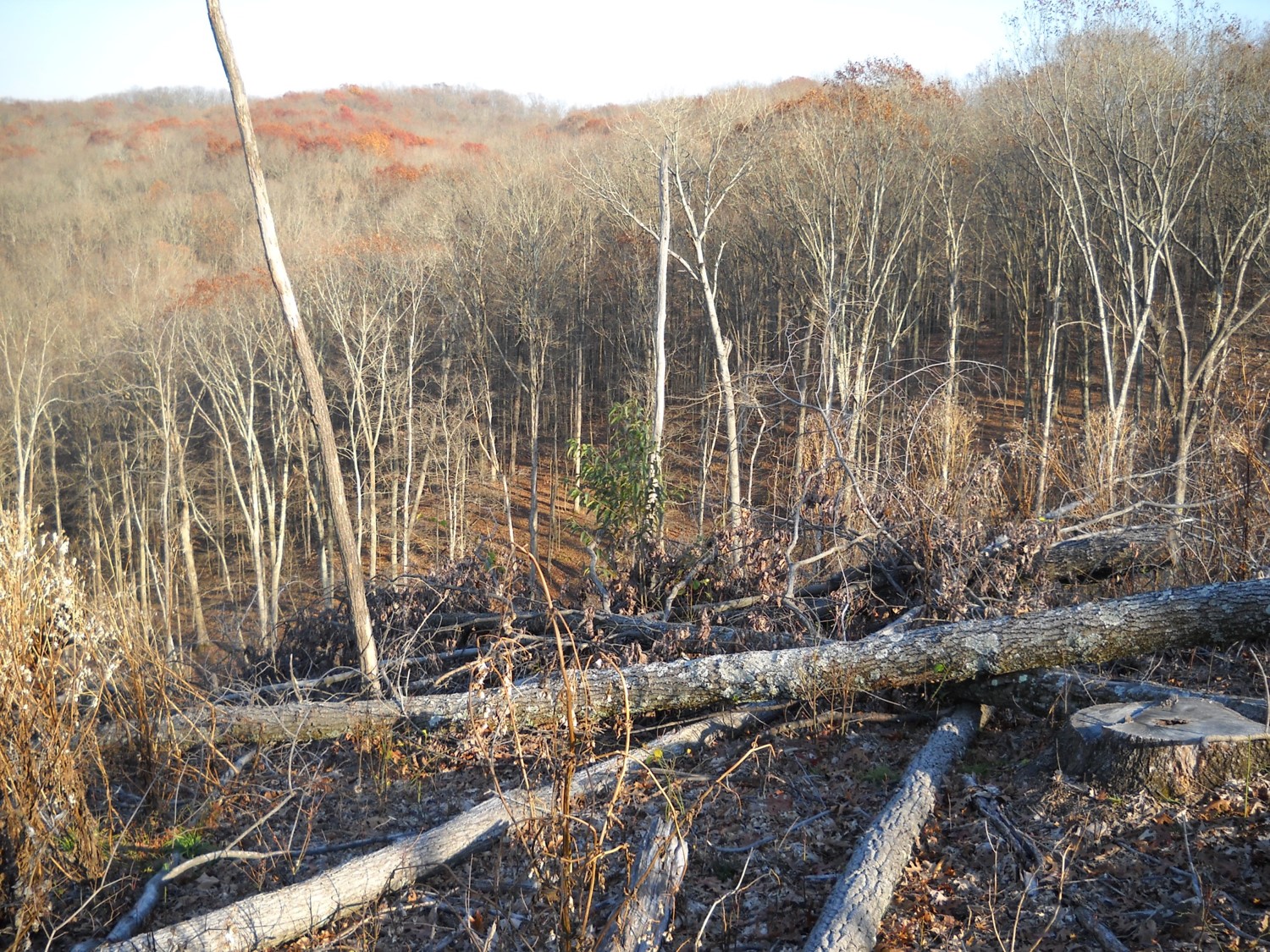 There has been much debate in the popular press lately regarding the role of timber harvesting on forest communities. A common focus of this debate is the perceived impacts to wildlife. Most believe that leaving our forests alone is best for wildlife. However, to provide habitat for all of our native forest wildlife species, forests need to be diverse in terms of age, species and area. Harvesting timber is the primary means of achieving this structural diversity. The purpose of this article is to summarize some key points regarding the effects of harvesting on reptiles and amphibians. These points are drawn mostly from the Hardwood Ecosystem Experiment (HEE), an ongoing research study in southern Indiana. Its primary focus is to study forest management and its effects on plants and animals. A more detailed summary may be found in Forest Management for Reptiles and Amphibians.
There has been several large-scale studies that have investigated the effects of tree canopy removal on amphibians and reptiles. These include the HEE in Indiana, the Missouri Ozark Forest Ecosystem Project (MOFEP), and the Land-use Effects on Amphibian Populations (LEAP). Much of the work from these projects has been published in the scientific literature. All of these studies demonstrate that the response of amphibians and reptiles to timber harvesting is variable—it cannot simply be quantified as good or bad. Indeed, avoiding negative impacts to all reptiles and amphibians as a result of timber harvesting is neither possible nor desirable since disturbance-dependent wildlife species1,2 and many mature forest species3, require early successional forests.
Timber Rattlesnake
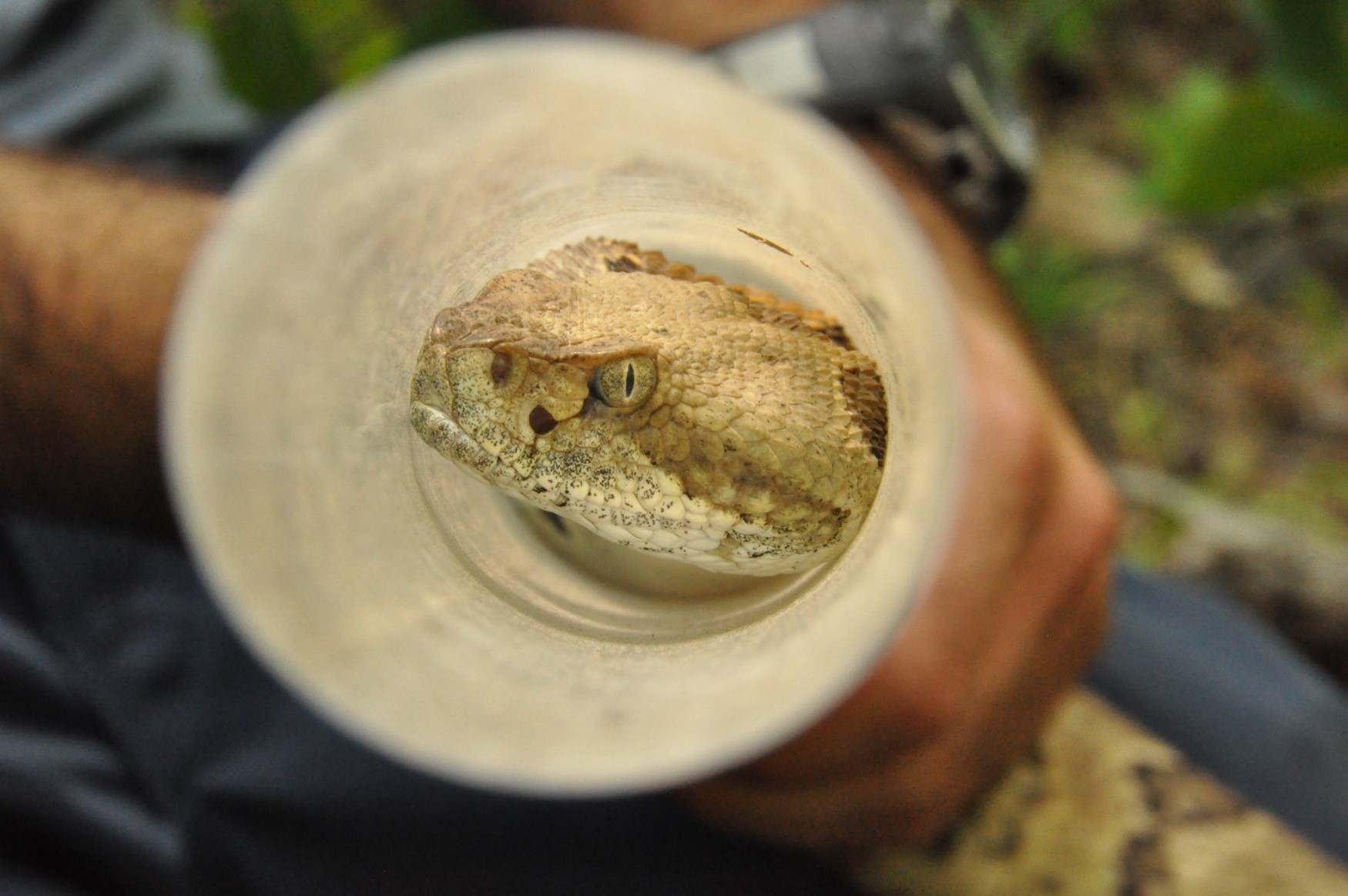
 For the focal species studied on the HEE, most exhibited moderate or no response in 1-3 years following timber harvests. The focal species I and colleagues have studied were timber rattlesnakes (Crotalus horridus), eastern box turtles (Terrapene carolina), and terrestrial salamanders. Timber harvests had no effect on the area male or female adult timber rattlesnakes used during the active season. There was no evidence that snakes changed movement behaviors to avoid clearcuts4. Indeed, several snakes were observed within clearcuts for several weeks and across multiple years. Annual survival of rattlesnakes on the HEE sites was high during the active season (72-98%) and winter (97-99%). Timber harvesting had no impact on survival. Declines in female survival was most affected by declines in prey abundance the previous year which were due to tree mast failures5. The level of acorns and nuts (i.e., mast) produced in woodlands naturally vary from year to year. When the small mammal population declined due to mast failure, these snakes were apparently impacted the following year.
Eastern Box Turtle
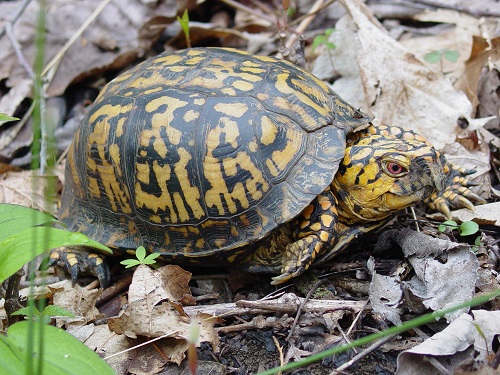
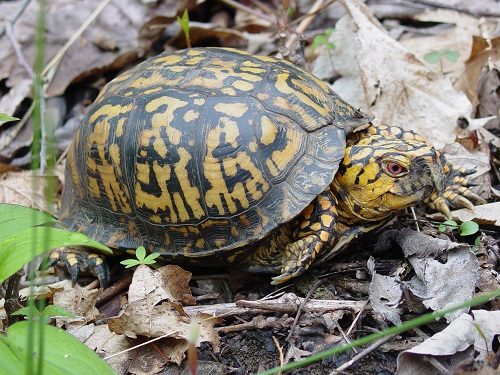 For box turtles, there was no effect of timber harvests on home-range size, but the average daily distance traveled by turtles decreased by 30 percent following harvest, and turtles maintained 9 percent higher body temperatures6. Temperatures in harvest openings were 29 percent warmer in the summer and 31 percent colder in the winter than forested sites. Despite this change, turtles continued to use harvest openings during the active season, but tended to make shorter, more frequent movements in and out of harvests. Turtles likely used harvest edges for cover, thermoregulation and, possibly, foraging opportunities6. Harvested areas offered potential hibernation sites based on soil profile temperatures, slope aspect and depth of hibernation7. Both active and hibernal data suggest the level of harvesting on the HEE has modest effects on box turtle behavior, at least in the short term. To date, there is no evidence to support whether these changes have any impact—positive or negative—on box turtles.
Woodland Salamanders
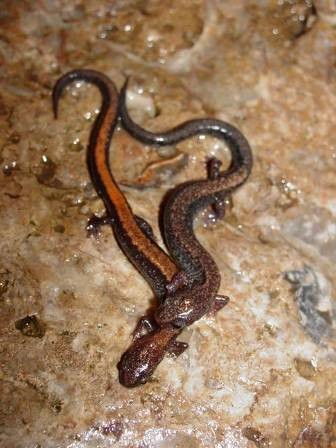
- The response of woodland salamanders to harvests was species-specific8. The relative abundance of eastern red-backed salamanders (Plethodon cinereus) and northern slimy salamanders (Plethodon glutinosus) declined from pre- to post-harvest in patch cuts (1 to 3 acres) and clearcuts (10 acres). Red-backed salamanders also declined in control sites, suggesting factors other than the harvests contributed to salamander declines over the study period. However, red-backed salamander declines observed in control sites were not as severe as those seen within patch cuts and clearcuts, indicating harvests were at least partially responsible for observed declines within the harvest boundaries. The relative abundance of northern zigzag salamanders (Plethodon dorsalis) did not decline from pre- to post-harvest in any harvest type, and increased on sites adjacent to clearcuts.
- These findings suggest canopy removal (2-10 acre gaps) has short-term local impacts on terrestrial salamanders in terms of relative abundance, but effects do not necessarily extend to the adjacent forest matrix. A caveat to these findings is that the ultimate fate of displaced individuals remains unknown. That is, changes in relative abundance does not mean declines in survival. Indeed, sites adjacent to clearcuts experienced an increase in counts of zigzag salamanders, which could reflect the evacuation of individuals from the clearcut into the intact forest. It is also important to note that other factors influence the abundance of terrestrial salamanders. For example, in addition to differences between seasons (spring versus fall), drought played a significant role in declines in salamander abundance across all study area.
Forest management sometimes leads to short-term loses for some species but is critical to the long-term sustainability of many other species. Looking at the responses of just a few species, within cutover areas for a few years paints an incomplete picture. A large-scale, long-term perspective is necessary when considering forest management. This is the true value of well-designed studies such as the HEE. With experimental control and replication, researchers can untangle the story on what are the true effects of forest management over a large area over many decades. The HEE has shed light on many answers so far. We can look forward towards many more to come.
Resources
Wildlife Responses to Timber Harvesting, Video-The Education Store-Purdue Extension Resource Center
Hardwood Ecosystem Experiment – Forest Birds, Video-The Education Store
Managing Woodlands for Birds, Video-The Education Store
Sustaining Our Oak-Hickory Forests, Video-The Education Store
Breeding Birds and Forest Management: the Hardwood Ecosystem Experiment and the Central Hardwoods Region, The Education Store
Forest Management for Reptiles and Amphibians: A Technical Guide for the Midwest, The Education Store
Hardwood Ecosystem Experiment (HEE)
Brian MacGowan, Extension Wildlife Specialist
Department of Forestry & Natural Resources, Purdue University
Citations
1 Thompson, F. R., III, and D. R Dessecker. 1997. Management of early-successional communities in central hardwood forests: with special emphasis on the ecology and management of oaks, ruffed grouse, and forest songbirds. U.S. Forest Service General Technical Report NC-195, St. Paul, MN, USA.
2 Greenberg, C. H., B. Collins, F. R. Thompson, III, and McNab, W. H. 2011. “What are early successional habitats, why are they important, and how can they be sustained?” Pages 1-10 in Sustaining young forest communities: ecology and management of early successional habitats in the Central Hardwood Region, USA. C. H. Greenberg, B. Collins, and F. R. Thompson, III., editors. Springer, New York, NY, USA.
3 Chandler, C. C., D. I. King, and R. B. Chandler. 2012. Do mature birds prefer early-successional habitat during the post-fledging period? Forest Ecology and Management 264:1-9.
4 MacGowan, B.J., Currylow, A.F.T., and MacNeil, J.E. 2017. Short-term responses of Timber Rattlesnakes (Crotalus horridus) to even-aged timber harvests in Indiana. Forest Ecology and Management 387(1):30-36.
5 Olson, Z.H., B.J. MacGowan, M.T. Hamilton, A.F.T. Currylow, and R.N. Williams. 2015. Survival of timber rattlesnakes: Investigating individual, environmental, and ecological effects. Herpetologica 71:274-279.
6 Currylow, A.F., B.J. MacGowan, and R.N. Williams. 2012a. Hibernal thermal ecology of eastern box turtles within a managed forest landscape. Journal of Wildlife Management 77(2):326-335.
7 Currylow, A.F., B.J. MacGowan, and R.N. Williams. 2012b. Short-term forest management effects on a long-lived ectotherm. PLoS ONE 7(7):e40473.
8 MacNeil, J.E. and R.N.Williams. 2014. Effects of timber harvests and silvicultural edges on terrestrial salamanders. PLoS ONE, 9(12):e114683.
 If you or someone you know loves to learn about wildlife, especially reptiles and amphibians, then you will be interested in our new special offer package. We are offering our complete collection of reptile and amphibian field guides (4 softcover books) for 10% of the price of each individual book. These books cover all of the reptiles and amphibians that are found in the state of Indiana. They include detailed physical descriptions, distribution maps, and interesting information about the ecology of each species. All of the included books have been peer-reviewed by experts in the field of herpetology.
The Indiana Amphibian and Reptile ID Package can be purchased from the Purdue Education Store for $36.00.
Additional Resources, The Education Store, Purdue Extension:
Frogs and Toads of Indiana
Salamanders of Indiana
Snakes and Lizards of Indiana
Turtles of Indiana
More Resources Available:
Help the Hellbender, Purdue Extension
The Nature of Teaching, Lesson Plans K-12, Purdue Extension
Nick Burgmeier, Research Biologist and Extension Wildlife Specialist
Purdue Department of Forestry and Natural Resources

Recent Posts
- Box Tree Moth Range is Expanding
Posted: May 27, 2026 in Forestry, Invasive Animal Species, Invasive Insects, Wildlife - Spotted Lanternfly Feeds on Over 70 Plus Plant Species
Posted: May 20, 2026 in Alert, Forestry, Forests and Street Trees, Gardening, Invasive Insects, Urban Forestry, Wildlife - Painted Hickory Borer, Purdue Landscape Report
Posted: May 14, 2026 in Forestry, Invasive Insects, Wildlife - Saving Giants of the Blue River: Purdue Team Earns Statewide Recognition
Posted: in Aquaculture/Fish, Aquatic/Aquaculture Resources, Wildlife - Restoring Roots to Save the Salamanders, USDA – Natural Resources Conservation Service
Posted: May 6, 2026 in Aquaculture/Fish, Forestry, Wildlife - Spring Storms Are Coming: How to Reduce Tree Damage and Risk
Posted: May 1, 2026 in How To, Urban Forestry, Wildlife, Woodlands - Cryptocline Leaf Spot (Anthracnose) of Elm, Purdue Landscape Report
Posted: April 30, 2026 in Disease, Forestry, Woodlands - Mechanical Damage to Trees: Mowing and Maintenance Equipment
Posted: April 24, 2026 in Forestry, Forests and Street Trees, Urban Forestry - A Woodland Management Moment: Growing Quality Black Walnut in Openings
Posted: April 20, 2026 in Urban Forestry, Woodland Management Moment, Woodlands - Spring Into Bloom With ID That Tree
Posted: in Forests and Street Trees, Urban Forestry, Woodlands
Archives
Categories
- Alert
- Aquaculture/Fish
- Aquatic/Aquaculture Resources
- Ask the Expert
- Christmas Trees
- Community Development
- Disease
- Drought
- Forestry
- Forests and Street Trees
- Gardening
- Got Nature for Kids
- Great Lakes
- How To
- Invasive Animal Species
- Invasive Insects
- Invasive Plant Species
- Land Use
- Natural Resource Planning
- Nature of Teaching
- Plants
- Podcasts
- Ponds
- Publication
- Safety
- Spiders
- Timber Marketing
- Urban Forestry
- Webinar
- Wildlife
- Wood Products/Manufacturing
- Woodland Management Moment
- Woodlands