 Purdue University - Extension - Forestry and Natural Resources
Got Nature? Blog
Are you a woodland owner who is just beginning to explore forest regeneration, restoration and reforestation activities?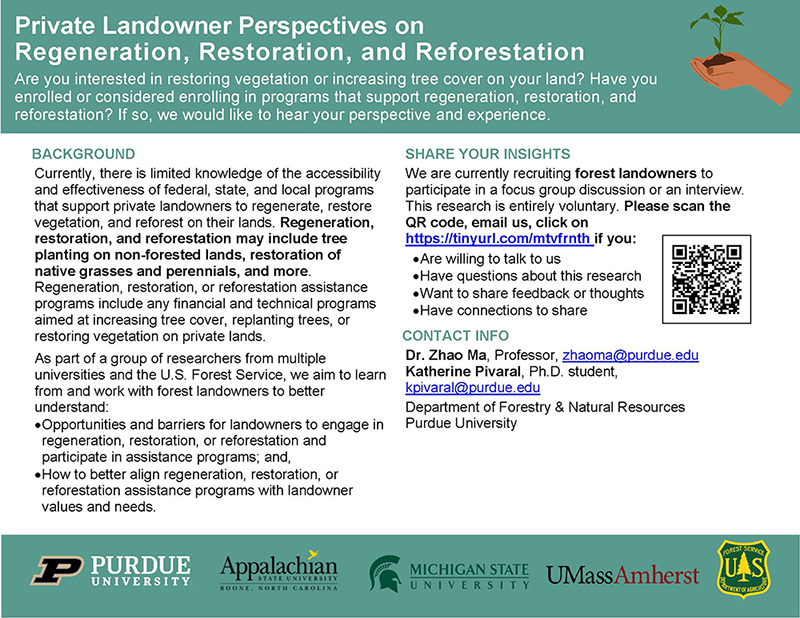
The Human Dimensions Lab at the Department of Forestry and Natural Resources with Purdue University is conducting research to understand private landowners’ perspectives on regeneration, restoration and reforestation. Private forest and woodland owners are key partners in forest and vegetation management efforts across the United States. These activities may involve tree planting, restoration of native vegetation or other practices aimed at enhancing forest and vegetation cover on private lands. Various federal, state and local programs offer financial and technical assistance to support these efforts and understanding landowner perspectives is important for informing future research and outreach.
About the Research
As part of a collaborative research effort involving multiple universities and the U.S. Forest Service, the Purdue University research team is working directly with private forest landowners to better understand real‑world experiences with regeneration, restoration and revegetation.
Specifically, the research aims to:
- Better understand the opportunities and barriers that landowners face when considering or engaging in regeneration, restoration or revegetation activities, including participation in assistance programs.
- Explore how assistance programs can better align with landowner values, needs and goals.
By learning directly from landowners, especially those who are in the early stages of exploring these activities, the researchers hope to generate insights that can improve the design and delivery of support programs in the future.
Who Can Participate?
The research team is currently recruiting forest and woodland owners who have recently begun exploring regeneration, restoration or reforestation topics and are willing to share their perspectives.
Participation may include an interview or focus group discussion, depending on participant preference and availability. All participation is entirely voluntary.
Why Participate?
By sharing your experiences, questions and thoughts, you can help researchers and land management agencies better understand what works, what doesn’t and what support landowners truly need. Your insights can contribute to more effective, landowner‑centered programs that support forest and woodland stewardship on private lands.
Learn More or Get Involved
If you are interested in participating, have questions about the research, would like to share feedback or know others who may be interested, please reach out before March 15 and visit the Landowners: Share Your Insight form provided by the Purdue Human Dimensions Lab.
Contact Information:
Primary: Katherine Pivaral, Ph.D. Student
Department of Forestry & Natural Resources, Purdue University
Email: kpivaral@purdue.edu
Dr. Zhao Ma, Professor
Department of Forestry & Natural Resources, Purdue University
Email: zhaoma@purdue.edu
FNR looks forward to learning from and collaborating with forest and woodland owners to better understand how regeneration, restoration and reforestation efforts can support both landowners and the landscapes they steward.
Katherine Pivaral, Ph.D. Student
Department of Forestry & Natural Resources, Purdue University
Resources:
Appalachian State University
Michigan State University
University of Massachusetts – Amherst
U.S. Forest Service
Hardwood Ecosystem Experiment (HEE)
Hardwood Tree Improvement & Regeneration Center (HTIRC)
Forest Improvement Handbook, The Education Store
Managing Your Woods for White-Tailed Deer, The Education Store
Deer Impact Toolbox, Purdue Extension
Virtual Tour Brings Forest Management for Birds to Life, Got Nature? Blog Post, Purdue Extension – Forestry and Natural Resources (FNR)
Silvics Succession Management Webinar, Purdue Extension-FNR YouTube Channel
Subscribe: Deer, Forest Management, ID That Tree, Woodland Management Moment, Invasive Species and many other topic video playlists Purdue Extension-FNR YouTube Channel
 Agricultural & Natural Resources (ANR) Newsletter: This fall marks the conclusion of the fourth consecutive year of the American Citizen Planner – Indiana program. Launched during the pandemic in 2020, the program has successfully been offered statewide twice a year and has trained more than 250 community leaders. Participants come from diverse backgrounds, such as elected officials, professional planners, members of plan commissions, boards of zoning appeals, surveyors, engineers, and engaged citizens interested in local planning issues.
Tailored for Indiana’s planning statutes by the Purdue Land Use Team, the program has evolved to include new modules on Environmental Planning and Community Engagement, Enhancing Equity in Planning, and features invited guest speakers, alongside 28 online content modules. The core curriculum covers a wide range of topics essential for planning including ethics, decision making, a wide range of comprehensive planning and zoning topics, and engaging the public in the planning process. Registration for the 16-week virtual program opens each February and July, with Purdue Extension educators meeting with participants online four times throughout the course to facilitate discussions and interactive scenarios.
Feedback from participants underscores the program’s positive impact on their communities. A recent long-term follow-up survey revealed that many have utilized their newfound knowledge to update codes and ordinances, incorporate natural resource planning, and about 75% indicated they would share insights with their peers. One participant noted, “As a member of the town council in a community of about 230, this course has greatly enhanced my understanding of the planning process in our county. I feel much better equipped to evaluate zoning requests and look forward to leveraging planning to further develop our community!” Those who complete all course requirements are eligible to take the comprehensive exam and earn a course certificate.
The American Citizen Planner – Indiana program is available in your community. Follow Extension’s social media for registration updates and reach out to your local ANR educator to request an in-person workshop.
Resources:
Implementation Examples of Smart Growth Strategies in Indiana, The Education Store, Purdue Extension’s resource center
Conservation Through Community Leadership, The Education Store
Climate Change and Sustainable Development, The Education Store
Climate Change: Are you preparing for it?, The Education Store
Enhancing the Value of Public Spaces: Creating Healthy Communities, The Education Store
One Water Approach to Water Resources Management, The Education Store
Community Soundscape Planning Guide: Controlling Noise & Protecting Natural & Cultural Sonic Spaces, The Education Store
Agricultural Best Management Practices, The Education Store
Urban Best Management & Low Impact Development Practices, The Education Store
Rainscaping Education Program, Purdue Extension
Community Development, Purdue Extension
Community Planning Playlist, Purdue Extension-Forestry & Natural Resources (FNR) YouTube Channel
Rainscaping and Rain Gardens, Purdue Extension YouTube Channel
Conservation through Community Leadership, Purdue Extension You Tube Channel
Enhancing the Value of Public Spaces Program, Purdue Extension YouTube Channel
Indiana Creek Watershed Project – Keys to Success, Partnerships and People, Purdue Extension You Tube Channel
Subscribe to Purdue Extension – Forestry and Natural Resources YouTube Channel
Dan Walker, Community Development regional Educator
Purdue Forestry and Natural Resources/Illinois-Indiana Sea Grant/Purdue Extension
Kara Salazar, Assistant Program Leader for Community Development and Sustainable Communities Extension Specialist
Purdue Forestry and Natural Resources/Illinois-Indiana Sea Grant/Purdue Extension
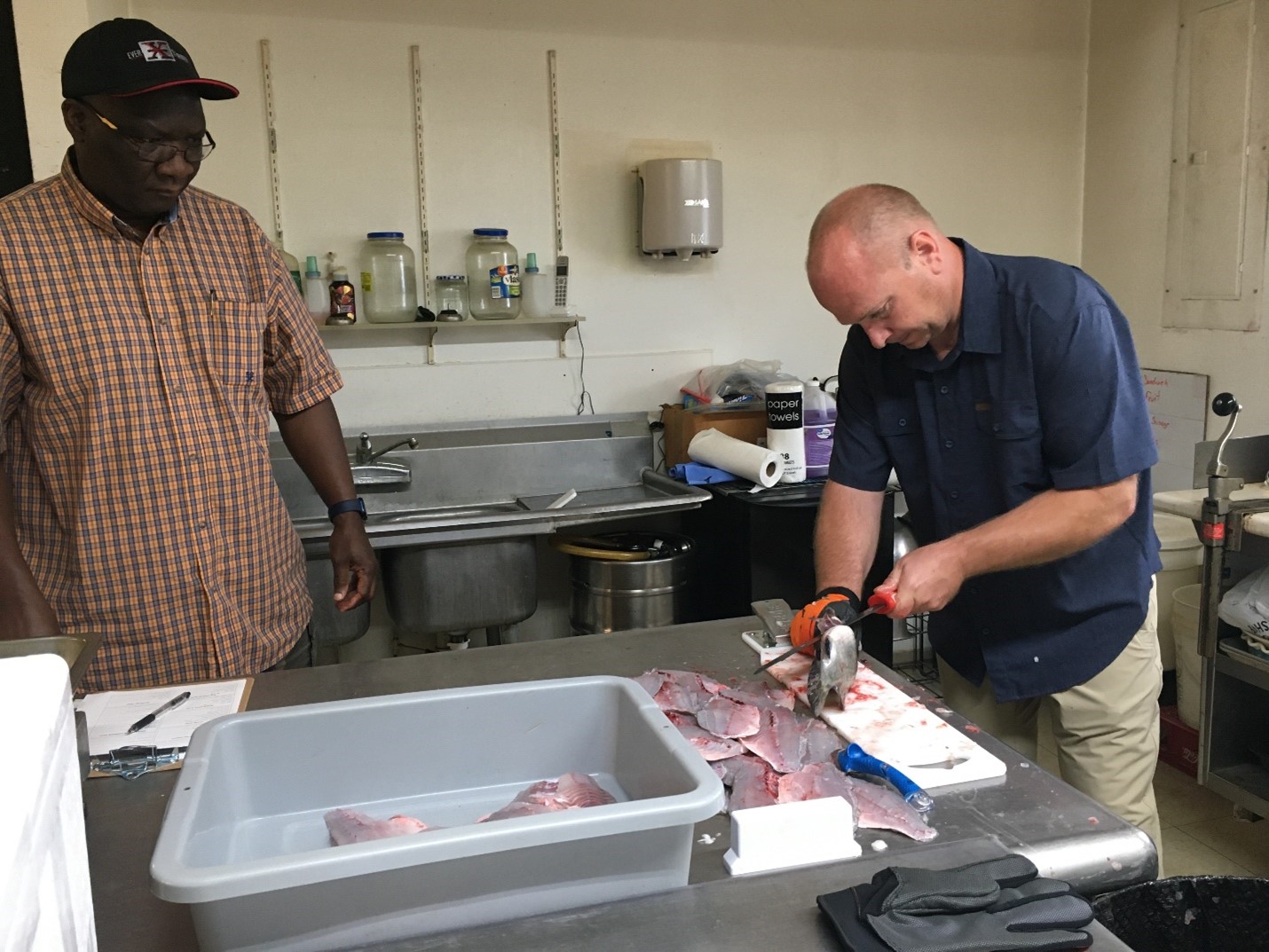
Hanilu Farms in Indiana participating in a small-scale fish processing case study. Photo by Kwamena Quagrainie.
Agricultural & Natural Resources (ANR) Newsletter: The Extension activities of Kwamena Quagrainie, clinical engagement professor in the Departments of Agricultural Economics and Forestry and Natural Resources, relate to economics in aquaculture and aquaponics. Kwamena is also affiliated with the Illinois-Indiana Sea Grant (IISG) program at Purdue University and the University of Illinois.
One aspect of his outreach activities relates to small-scale fish processing. He explored processing fish in shared-use commercial kitchens and on-farm processing facilities in local communities and hosted free HACCP training and pilot training workshops in seafood processing and food safety for fish farmers in Indiana and Illinois. Information from potential use of shared-use commercial kitchens and small on-farm fish processing kitchens were gathered to construct business models, costs, regulations, etc., as case studies, which are published in a handbook as a guide for small-scale fish farmers. The Handbook on Processing Fish for Small-Scale Fish Farmers outlines various aspects of understanding the process, including regulations, required training, requirements for renting a commercial kitchen and what it takes to own an on-farm facility. Fish farmers interested in processing their fish can use the handbook to decide if processing is a feasible pathway to add to their fish production business or to simply get into fish processing using any local facilities.
The other aspect relates to aquaponics as a sustainable food production enterprise and outreach to high schools interested in aquaponics in the classroom. Aquaponics is integrating aquaculture and hydroponics to produce seafood and plants using less land and water resources when compared with conventional food production methods. Kwamena’s primary focus with aquaponics is addressing the challenges in the adoption of aquaponics in the Midwest and helping farmers make informed decisions about getting into Aquaponics as a business. View YouTube video Aquaponics: What to consider before starting your business. Farmers are expressing interest in aquaponics as small farms and, in some cases, as urban farming, which could have some economic benefits because of its small footprint and use of less water and land resources.
The aquaponics in schools program is in its initial stages and is aimed at introducing students to basic scientific concepts through the lens of an aquaponics system. The program has lessons aligned with Science and Engineering Process Standards, incorporating material from biology, chemistry, and environmental science. An aquaponics curriculum developed by IISG is currently being pilot tested by high school teachers. The program will be implemented together with a water quality test kit loan program to schools in Indiana and Illinois.
To learn more about Dr. Quagrainie’s research and publications view: Kwamena Quagrainie, Forestry and Natural Resources profile page.
Resources:
A Guide to Marketing for Small-Scale Aquaculture Producers, The Education Store
A Guide to Small-Scale Fish Processing Using Local Kitchen Facilities, The Education Store
Marine Shrimp Biofloc Systems: Basic Management Practices, The Education Store
Aquaculture Industry in Indiana Growing, Purdue Today
Walleye Farmed Fish Fact Sheet: A Guide for Seafood Consumers, The Education Store, Purdue Extension resource center
Sustainable Aquaculture: What does it mean to you?, The Education Store
The Benefits of Seafood Consumption The Education Store, Purdue Extension Resource Center
Walleye Farmed Fish Fact Sheet: A Guide for Seafood Consumers, The Education Store, Purdue Extension resource center
Pond and Wildlife Management website, Purdue Extension
Fish Cleaning with Purdue Extension County Extension Director, Got Nature? Blog, Purdue Extension – Forestry and Natural Resources
Aquatics & Fisheries, Playlist, Purdue Extension – Forestry and Natural Resources
Eat Midwest Fish, Illinois-Indiana Sea Grant online resource hub
Agricultural & Natural Resources (ANR), Purdue Extension
Diana Evans, Extension & Web Communications Specialist
Purdue University Department of Forestry and Natural Resources
American Eagle Foundation: Our native vultures play a crucial role in reducing the spread of disease. However, as black vulture population increases, so too have reports of human-wildlife interactions. Researchers at Purdue University are currently performing research to better understand reports of black vulture depredation on livestock, and their ultimate goal is to find solutions that protect both livestock and birds.
AEF interviewed Dr. Pat Zollner, Dr. Zhao Ma, doctoral student Marian Wahl, and Ph.D. alumna Brooke McWherter for insight into their important research.
Check out the great information in this video discussing how this research was started and the concerns shared to the USDA office from state offices and the public.
Find out what types of vulture species are here in the United States and their roles in the story Protect Our Native Vultures, American Eagle Foundation.
Vultures have a role to play as nature’s garbagemen, cleaning up animal carcasses. If you have any questions regarding this research, or have any experiences to share, contact Marian Wahl.
Resources:
Black Vulture Research Highlighted by NY Times, Got Nature Blog, Purdue Extension-Forestry and Natural Resources
Citizen Participation Needed in Black Vulture Research, Purdue Forestry and Natural Resources News
Black Vulture Research, March Edition of Beef Monthly
Black Vulture Ecology and Human-Wildlife Conflicts, Purdue FNR, Dr. Pat Zollner’s WebsiteDiana Evans, Extension and Web Communication Specialist
Purdue University Department of Forestry and Natural Resources
Marion Wahl, Graduate Research Assistant
Purdue Forestry and Natural Resources
This comprehensive written abstract titled Tools for Staging and Managing Emerald Ash Borer in the Urban Forest shares research gathered in an eight-year period with a variety of management strategies.
Advances in control can help municipal foresters save ash trees from emerald ash borer (EAB) [Agrilus planipennis (Fairmaire)]
in urban forests. Although ash trees of any size can be protected from this pest, cities often do not implement programs because they fail to recognize and act o incipient populations of EAB. In this study, researchers develop a model for predicting ash mortality over an eight-year period, and validated with data from the removal of >14,000 ash trees killed by EAB in Fort Wayne, Indiana, U.S. researchers then developed a sampling scheme to help foresters map their ash trees along the expected progression of ash decline. This model was then used to modify a web-based EAB cost calculator that compares discounted annual and cumulative costs of implementing a variety of management strategies. It was determined that strategies that most heavily relied on saving ash trees were less expensive and produced a larger forest than those strategies that mostly removed and replaced ash trees. Ratios of total discounted costs to discounted cumulative benefits of strategies that saved most ash trees were over two-thirds lower than strategies of proactive tree removal and replacement. Delaying implementation of an ash management program until damage would be visible and more obvious to the community (Year 5 of the model) decreased the cost–benefit ratio by <5%. Thus, delays that rely on the abundance of locally damaged trees to bolster community support do not necessarily diminish the utility of implementing a control strategy.
For full article: Tools for Staging and Managing Emerald Ash Borer
Resources:
Tree Doctor App, The App Store
Invasive Species – Indiana Department of Natural Resources (IDNR)
Ask an Expert – Purdue Extension-Forestry and Natural Resources
Indiana Invasive Species Council – Includes: IDNR, Purdue Department of Entomology and Professional Partners
Great Lakes Early Detection Network App (GLEDN) – The Center for Invasive Species & Ecosystem Health
National Invasive Species Awareness Week: February 27-March 3, 2017
Invasive Species Week a reminder to watch for destructive pests, Purdue entomologist says – Purdue Agriculture News
Cliff Sadof, Professor
Purdue University Department of Entomology
Matt Ginzel, Associate Professor
Purdue University Department of Forestry and Natural Resources & Department of Entomology

Recent Posts
- Publication – Planting Forest Trees and Shrubs in Indiana
Posted: April 8, 2026 in Forests and Street Trees, Urban Forestry, Wildlife, Woodlands - ID That Tree: Virgin’s Bower Clematis
Posted: April 6, 2026 in Urban Forestry, Wildlife, Woodlands - It’s Timberdoodle Time!
Posted: April 3, 2026 in Got Nature for Kids, How To, Wildlife - Keep An Eye Out for Hammerhead Worms, Purdue Landscape Report
Posted: April 2, 2026 in Invasive Animal Species, Wildlife, Woodlands - When is the Peak Migration For Hummingbirds and How Can You Attract Them?
Posted: in How To, Wildlife - ID That Tree Featured in National Woodland Owners Association Newsletter
Posted: April 1, 2026 in Urban Forestry, Wildlife, Woodlands - New 2026 Indiana Woodland Steward Newsletter
Posted: March 30, 2026 in Urban Forestry, Wildlife, Woodlands - A Woodland Management Moment: Why Aspect Matters
Posted: in Urban Forestry, Woodland Management Moment, Woodlands - 2026 Winter Bat Survey In Progress, MyDNR
Posted: March 27, 2026 in How To, Wildlife - Fast-Growing Trees for the Landscape, Purdue Landscape Report
Posted: March 26, 2026 in Forestry, Urban Forestry, Woodlands
Archives
Categories
- Alert
- Aquaculture/Fish
- Aquatic/Aquaculture Resources
- Ask the Expert
- Christmas Trees
- Community Development
- Disease
- Drought
- Forestry
- Forests and Street Trees
- Gardening
- Got Nature for Kids
- Great Lakes
- How To
- Invasive Animal Species
- Invasive Insects
- Invasive Plant Species
- Land Use
- Natural Resource Planning
- Nature of Teaching
- Plants
- Podcasts
- Ponds
- Publication
- Safety
- Spiders
- Timber Marketing
- Uncategorized
- Urban Forestry
- Webinar
- Wildlife
- Wood Products/Manufacturing
- Woodland Management Moment
- Woodlands