 Purdue University - Extension - Forestry and Natural Resources
Got Nature? Blog
Are you a woodland owner who is just beginning to explore forest regeneration, restoration and reforestation activities?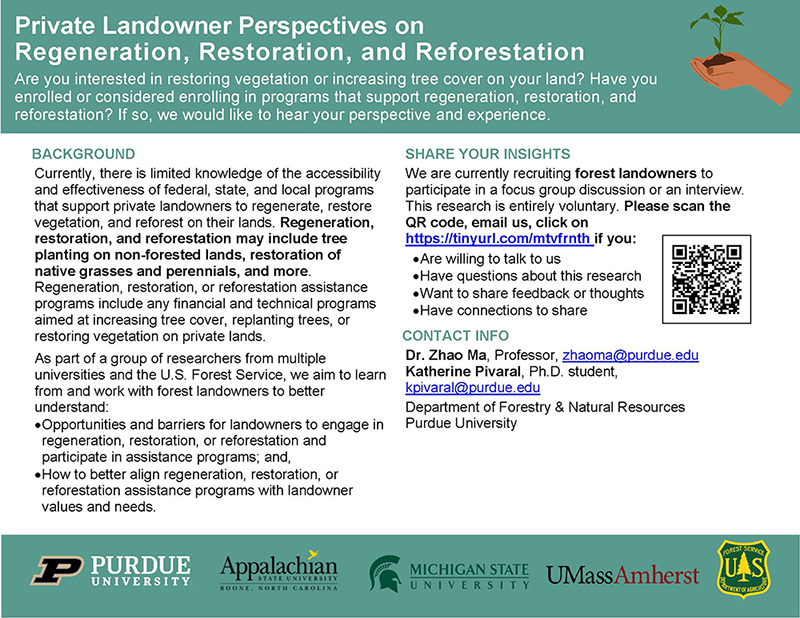
The Human Dimensions Lab at the Department of Forestry and Natural Resources with Purdue University is conducting research to understand private landowners’ perspectives on regeneration, restoration and reforestation. Private forest and woodland owners are key partners in forest and vegetation management efforts across the United States. These activities may involve tree planting, restoration of native vegetation or other practices aimed at enhancing forest and vegetation cover on private lands. Various federal, state and local programs offer financial and technical assistance to support these efforts and understanding landowner perspectives is important for informing future research and outreach.
About the Research
As part of a collaborative research effort involving multiple universities and the U.S. Forest Service, the Purdue University research team is working directly with private forest landowners to better understand real‑world experiences with regeneration, restoration and revegetation.
Specifically, the research aims to:
- Better understand the opportunities and barriers that landowners face when considering or engaging in regeneration, restoration or revegetation activities, including participation in assistance programs.
- Explore how assistance programs can better align with landowner values, needs and goals.
By learning directly from landowners, especially those who are in the early stages of exploring these activities, the researchers hope to generate insights that can improve the design and delivery of support programs in the future.
Who Can Participate?
The research team is currently recruiting forest and woodland owners who have recently begun exploring regeneration, restoration or reforestation topics and are willing to share their perspectives.
Participation may include an interview or focus group discussion, depending on participant preference and availability. All participation is entirely voluntary.
Why Participate?
By sharing your experiences, questions and thoughts, you can help researchers and land management agencies better understand what works, what doesn’t and what support landowners truly need. Your insights can contribute to more effective, landowner‑centered programs that support forest and woodland stewardship on private lands.
Learn More or Get Involved
If you are interested in participating, have questions about the research, would like to share feedback or know others who may be interested, please reach out before March 15 and visit the Landowners: Share Your Insight form provided by the Purdue Human Dimensions Lab.
Contact Information:
Primary: Katherine Pivaral, Ph.D. Student
Department of Forestry & Natural Resources, Purdue University
Email: kpivaral@purdue.edu
Dr. Zhao Ma, Professor
Department of Forestry & Natural Resources, Purdue University
Email: zhaoma@purdue.edu
FNR looks forward to learning from and collaborating with forest and woodland owners to better understand how regeneration, restoration and reforestation efforts can support both landowners and the landscapes they steward.
Katherine Pivaral, Ph.D. Student
Department of Forestry & Natural Resources, Purdue University
Resources:
Appalachian State University
Michigan State University
University of Massachusetts – Amherst
U.S. Forest Service
Hardwood Ecosystem Experiment (HEE)
Hardwood Tree Improvement & Regeneration Center (HTIRC)
Forest Improvement Handbook, The Education Store
Managing Your Woods for White-Tailed Deer, The Education Store
Deer Impact Toolbox, Purdue Extension
Virtual Tour Brings Forest Management for Birds to Life, Got Nature? Blog Post, Purdue Extension – Forestry and Natural Resources (FNR)
Silvics Succession Management Webinar, Purdue Extension-FNR YouTube Channel
Subscribe: Deer, Forest Management, ID That Tree, Woodland Management Moment, Invasive Species and many other topic video playlists Purdue Extension-FNR YouTube Channel
MyDNR, Indiana’s Outdoor Newsletter: The Indiana Cooperative Fish and Wildlife Research Unit, or CRU, that Purdue will host, brings together the U.S. Geological Survey, U.S. Fish and Wildlife Service, Purdue University, the DNR, and the Wildlife Management Institute.
Its focus will be on delivering actionable science addressing fish, wildlife, plants, and other natural resources in Indiana and beyond, including the connection between the health of wildlife and the health of people.
The CRU Program is results focused, bringing together natural resource managers and researchers to work as a team to address the most pressing natural resource management needs with science. As such, the partnerships formalized with the creation of CRUs lead to true co-production of research.
“The creation of this new unit is another milestone in the highly successful USGS Cooperative Research Units Program, and we are proud to join the state of Indiana, Purdue University, the USGS, Wildlife Management Institute, and others to address conservation questions facing Indiana and the region,” said U.S. Fish and Wildlife Service Science Applications Program Assistant Regional Director Craig Czarnecki. “We look forward to engaging with the students and professionals at Purdue University as we co-develop scientific research and support the next generation of conservationists.”
But CRUs don’t just tackle management needs. They do so while cultivating the next generation of scientists and resource managers. The new Indiana CRU will focus on education, training, and outreach related to natural resources vital not only to Indiana, but the Midwest and regional economies as well.
Like all CRUs, the Indiana CRU will consist of 2-5 federal scientists along with graduate students, postdoctoral fellows, and administrative specialists. Federal scientists will serve as faculty at Purdue University, teaching graduate-level courses, supervising graduate students and postdocs, offering workshops for students and cooperators, and conducting research on natural resources topics. Once created, each CRU formalizes research priorities, like aquatic conservation or wildlife disease. Indiana CRU partners will decide these in the coming months.
“We look forward to the tremendous opportunity that collaboration with the Indiana CRU will bring to our state and Purdue University,” said Karen Plaut, executive vice president of research at Purdue University. “It will have a direct impact on graduate education as well as research productivity and innovation.”
For full article please visit: The partnership is Indiana’s first U.S. Geological Survey Cooperative Fish and Wildlife Research Unit, Indiana DNR Calendar.
Sign up to receive the MyDNR Newsletter by email: MyDNR Email Newsletter
Resources:
Purdue Announces New USGS Cooperative Research Unit, Purdue Agriculture New
Wildlife Habitat Education Program: Wildlife Identification Guide, The Education Store, Purdue Extension resource center
Wildlife Habitat Education Program – Teaching and Learning Wildlife Management Practices, The Education Store
Wildlife Habitat Evaluation Program: Preparing for the Wildlife Challenge, The Education Store
Developing a Wildlife Habitat Management Plan, The Education Store
Woodland Wildlife Management, The Education Store
Purdue Integrated Deer Management Project, Purdue College of Agriculture
Purdue Extension-Forestry and Natural Resources (FNR) Publications
Indiana Pond Fish, Species Identification Card Set, Purdue Extension – Forestry and Natural Resources (FNR)
A Guide to Small-Scale Fish Processing Using Local Kitchen Facilities, The Education Store
Subscribe to Purdue Extension-FNR YouTube Channel
Invasive Species, Playlist, Purdue Extension – FNR YouTube Channel
What are invasive species and why should I care?, Got Nature? Blog, Purdue Extension – Forestry and Natural Resources
Invasive plants: Impact on Environment and People, The Education Store, Purdue Extension’s resource center
Indiana Department of Natural Resources, Department of Fish & Wildlife
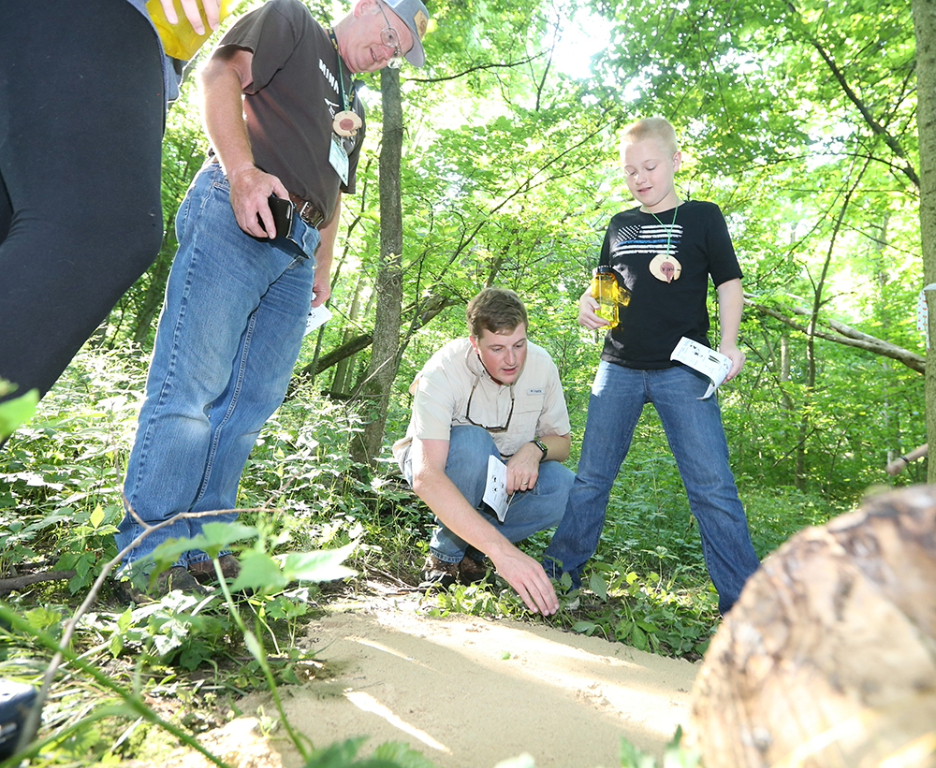 Purdue Extension wildlife specialist Jarred Brooke has been named as a recipient of the Purdue Cooperative Extension Specialists’ Association (PUCESA) Early Career Award, which recognizes an Extension specialist with less than 10 years of service.
Recipients must demonstrate Extension leadership; excellence in delivering public education programs; innovative approaches to program development and delivery; outreach efforts to county Extension educators; research that benefits Extension clientele through practical application; or through demonstrated collaboration with county educators, agencies or community leaders.
“I am truly grateful to be honored by my peers with this award, but most of my extension work would not have been possible without the wonderful people I work with both inside and outside of Purdue,” Brooke said. “I am indebted to them.”
Brooke, a 2012 wildlife science alum, returned to his alma mater in August 2016 as an Extension wildlife specialist after completing his master’s degree in wildlife management from the University of Tennessee in 2015. Over the past five years, Brooke has become a productive and effective extension specialist and has taken on multiple leadership roles, collaborated with partners in an outside of Extension, conducted applied research and worked to deliver impactful and innovative extension programming.
Brooke was honored with the PK-12 Outreach and Engagement Excellence Staff Award in April 2021 for his work with the 4H-Academy, the Wildlife Habitat Education Program and The Nature of Teaching.
Outside of Extension, Brooke helped form the Indiana Prescribed Fire Council, of which he has served as chair since 2018. He also is currently the Past President of the Indiana Chapter of the Wildlife Society, and served on the continuing education committee for the group. In these roles, Brooke collaborates with other natural resources professionals to plan and deliver natural resource-based programming to other professionals and landowners throughout Indiana.
Resources:
Jarred Brooke Receives PK-12 Council Staff Excellence Award, Got Nature? Blog, Purdue Extension-FNR
Brooke’s Prescribed Fire Videos Utilized in Global USFS Efforts, Got Nature? Blog, Purdue Extension-FNR
Pond and Wildlife Management, Purdue Extension-Forestry and Natural Resources
Natural Resources University, Deer, Fire, Pond and Habitat Podcasts
Creating a Wildlife Habitat management Plan for Landowners, Got Nature? Blog, Purdue Extension-FNR
A Template for Your Wildlife Habitat Management Plan, Got Nature? Blog, Purdue Extension-FNR
Subscribe to Purdue Extension – Forestry and Natural Resources YouTube Channel and view Jarred Brooke’s deer, fire and other wildlife videos.
Wendy Mayer, FNR Communications Coordinator
Purdue University Department of Forestry and Natural Resources
Jarred Brooke, Wildlife Extension Specialist
Purdue Forestry and Natural Resources
Join Rod Williams, Purdue FNR Professor of Wildlife Science, Jason Hoverman, Purdue FNR Professor of Invertebrate Ecology, and Michael Lannoo, Indiana University School of Medicine – Professor of Anatomy and Cell Biology, to learn interesting facts about frogs and toads, their natural history, research about the threats they face, and what can you do to help these species.
If you have any questions regarding wildlife, trees, forest management, wood products, natural resource planning or other natural resource topics, feel free to contact us by using our Ask an Expert web page.
Resources
Mythbusters, Got Nature? Blog, Purdue Extension – Forestry and Natural Resources
Frogs and Toads of Indiana, The Education Store, Purdue Extension resource center
Appreciating Reptiles and Amphibians in Nature, The Education Store
Forestry Management for Reptiles and Amphibians: A Technical Guide for the Midwest, The Education Store
The Nature of Teaching, Unit 3: Reptiles, Amphibians, and the Scientific Method, The Education Store
Ecotoxicology and Environmental Health, The Education Store
Disease Ecology, The Education Store
Okoboji Wetlands: A Lesson in Natural History, 1996, University of Iowa Press
Status and Conservation of Midwestern Amphibians, 1998
Amphibian Declines, 2005, University of California Press
Malformed Frogs: The Collapse of Aquatic Ecosystems, 2008
Leopold’s Shack and Rickett’s Lab: The Emergence of Environmentalism, 2010
The Iowa Lakeside Laboratory: A Century of Discovering the Nature of Nature, 2012
North American Amphibians: Distribution and Diversity, 2014
This Land is Your Land: The Story of Field Biology in America, 2018, The University of Chicago Press
The Call of the Crawfish Frog, 2020
AmphibiaWeb
Indiana Herp atlas
Amphibian Ecology and Conservation
Handbook of Larval Amphibians of the United States and Canada, Cornell Press
Rod Williams, Professor of Wildlife Science
Purdue University Department of Forestry and Natural Resources
Jason Hoverman, Professor of Vertebrate Ecology
Purdue University Department of Forestry and Natural Resources
In this prescribed fire ignition technique videos Purdue Extension wildlife specialist Jarred Brooke describes a ring fire. The igniters will light fires to encircle the unit. Ring fire technique usually creates more intense fire behavior than strip head fires.
If you have any questions regarding wildlife, trees, forest management, wood products, natural resource planning or other natural resource topics, feel free to contact us by using our Ask an Expert web page.
Resources
Wildlife Habitat Hint, Playlist, Purdue Extension – Forestry and Natural Resources YouTube channel
Wildlife Habitat Hint: Late Growing Season Prescribed Fire, Video
Renovating Native Warm-Season Grass Stands for Wildlife: A Land Manager’s Guide, The Education Store, Purdue Extension resource center
Prescribed fire: 6 things to consider before you ignite, Got Nature? Blog, Purdue Extension – 4Forestry and Natural Resources
Jarred Brooke, Wildlife Extension Specialist
Purdue Department of Forestry and Natural Resource
Get ready to receive your weekly dose of natural resources information via a new podcast network called Natural Resources University. Purdue Forestry and Natural Resources’ Jarred Brooke hosts the new podcasts Habitat University.
 Brooke, a Purdue Extension wildlife specialist, is the co-host of Habitat University along with Adam Janke, an extension wildlife specialist at Iowa State University. The pair will discuss the science behind wildlife habitat management and how landowners and managers can use different habitat management practices to improve their land for wildlife. Brooke and Janke will be joined on the podcast by other wildlife specialists, wildlife biologists, researchers and landowners. The first episode of Habitat University is here: Habitat University. You can also follow Habitat University on twitter at www.twitter.com/Habitat_U.
In total, Natural Resources University will include four science-based podcasts, covering different aspects of natural resource management. You can subscribe to the entire network, which will bring you a different podcast each week, or you can subscribe to an individual podcast, which will release one episode a month. Subscribe here: Natural Resources University
A full introduction to the Natural Resources University network team and to each podcast are available in this overarching episode: Episode 01 – Introduction to NRU.
The podcasts are categorized in four topics:
Deer University: Topics discussed include deer biology, ecology, and management to help landowners and hunters apply science to practical management objectives. Subscribe to Deer University: Deer University
Pond University: Conversations with aquatic scientists, landowners, and pond professionals will cover topics like pond habitat, fish stocking, vegetation control and pond construction. Listen to Pond University: Pond University
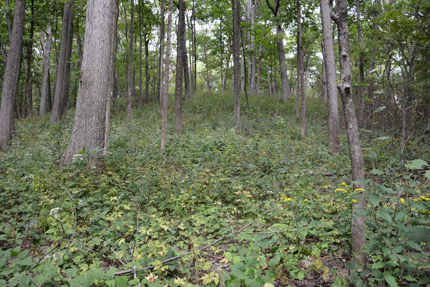 Fire University: Science-based podcast covering the latest research in fire ecology and how it relates to management of wildlife and plant communities. Subscribe to Fire University: Fire University
Habitat University: Discusses the science behind wildlife habitat management and how landowners and managers can use different habitat management practices to improve their land for wildlife. Subscribe to Habitat University: Habitat University.
The Natural Resources University podcast network, which is funded by the Renewable Resources Extension Act, is a partnership between the extension services at several land-grant universities, including Mississippi State University Extension Service, University of Florida Extension, Iowa State University Extension and Outreach and Purdue Extension.
Resources
Pond and Wildlife Management Website
Managing Your Woods for White-Tailed Deer, The Education Store, Purdue Extension resource center
A Pond Management Plan Template, The Education Store
Renovating native warm-season grass stands for wildlife: A Land Manager’s Guide, The Education Store
Megan Gunn, Recruitment and Outreach Specialist
Purdue Department of Forestry and Natural Resources
Jarred Brooke, Wildlife Extension Specialist
Purdue Department of Forestry and Natural Resources

Vaporeon, www.flickr.com
In August of 2016, we posted an article about how the online game Minecraft teaches forest regeneration and helps users understand the pros and cons of various tree species. This year, we bring you information about Pokémon GO a game designed for your smartphone. While the premise of the game is to find cute creatures to befriend and train for battle, this game ultimately teaches additional lessons about nature and conservation.
After being released July 6, 2016, popularity for Pokémon GO exploded around the globe. With more than 500 million downloads in the first two months, this mobile phone game has brought cartoon Pokémon from television to more children and adults than ever before. Virtual Pokémon on your mobile screen appear to be a part of your real-world environment. As you catch, train, and battle your Pokémon, lessons about natural history and conservation are being taught and absorbed without you being aware of it.
Playing Pokémon GO is akin to bird watching as these creatures exist as “real” animals found outdoors that can be caught and collected. In their efforts to catch rare species, more people are venturing outdoors and visiting parks and conservation areas. With the new interest in visiting the outdoors, interactions with ‘real’ animals in nature have also increased. The Twitter hashtag #Pokeblitz is a repository for photos of wildlife species observed during play.
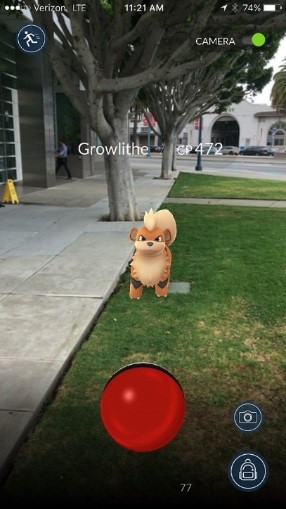
Growlithe beside the street, www.flickr.com.
Players learn basic concepts such as habitat preferences. For example, ‘Grass Pokémon’ are most often found in parks, forests, or conservation areas while water-types can be found nearest to water sources. In addition, lessons regarding native regions are also taught as some species can only be found in certain continental regions. The Pokémon ‘Tauros’, a bull with multiple tails, is native to the Americas, ‘Mr Mime’, humanoid fairy, to Western Europe, ‘Farfetch’d’, an aggressive duck-like creature, to Asia, and the marsupial-like ‘Kangaskhan’ to Australasia. The take-away lesson most players learn is that exploration of new areas and continents will yield new species.
Newly published research from scientists at Oxford, Cambridge, UNEP World Conservation Monitoring Centre, and the University College London (UCL) explored whether the game posed more problems for conservation efforts as gamers focused more on the virtual
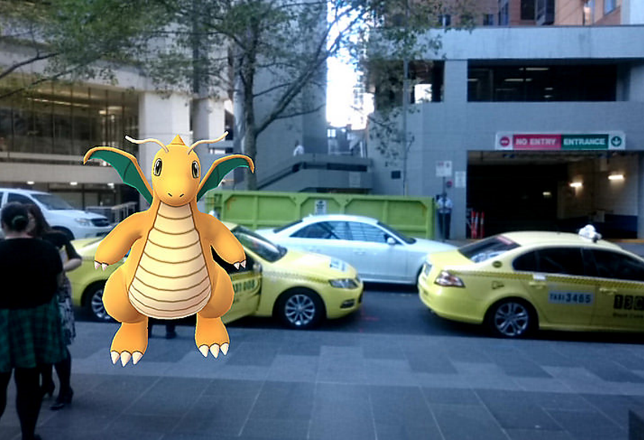
Dragonite in Melbourne, Australia, www.flickr.com.
than real animals or solutions to getting more people to explore the outdoors. They list pros and cons and their suggestions below:
The pros:
- More people are venturing outside and learning about nature
- There is a renewed interest in habitat conservation
- All you need is a smartphone
The cons:
- The brightly-colored and engaging Pokémon are not a true representation of actual wildlife
- Battling Pokémon in the game could encourage exploitation of ‘real’ animals.
Suggestions:
- Make the Pokémon more realistic (biology and ecology)
- Add real species to the Pokémon GO universe to raise awareness of these species
- Place Pokémon in more remote areas to draw people out of the cities
- Add a mechanism to catalogue real species to build upon #Pokeblitz
- Use Pokémon GO lessons to develop augmented reality (AR) games about real species and conservation efforts where users look for and catalog species for educational purposes.
If there were any doubts about the game’s popularity, hundreds upon hundreds of people converged in Central Park one night last summer in a contest to find the rare Pokémon ˈVaporeonˈ said to be inhabiting the park. A last thought from scientists was that true conservation efforts could wane as finding virtual species outweighs protecting endangered ˈrealˈ species. However, engagement efforts with the public regarding conservation can take notes from the responsive Pokémon as many current efforts are full of scientific terms and tend to be off-putting to a general audience. The popularity of Pokémon GO has implied that the public can be reached but we need other ways of relaying information that encourage additional learning.
Literature Cited:
Dorward LJ, Mittermeier JC, Sandbrook C, Spooner F. 2016. Pokémon Go: Benefits, Costs, and Lessons for the Conservation Movement. Conservation Letters doi: 10.1111/conl.12326.
Resources:
Can online gamin help improve your knowledge of forest trees?, Purdue Extension-FNR Got Nature?
Shaneka Lawson, USDA Forest Service/HTIRC Research Plant Physiologist/Adjunct Assistant Professor
Purdue University Department of Forestry and Natural Resources

Recent Posts
- Tree Risk Management: What Every Property Owner Needs to Know
Posted: April 17, 2026 in Forests and Street Trees, Wildlife, Woodlands - As the spring wildflowers emerge, so do the woodland invaders
Posted: April 16, 2026 in Forestry, Forests and Street Trees, Invasive Plant Species - Roadside Rehab: Rebuilding Soil and Cover After Utility Damage, Purdue Landscape Report
Posted: April 15, 2026 in Alert, Forests and Street Trees, Urban Forestry, Wildlife, Woodlands - Ash Trees have Disappeared. What is Taking Their Place?
Posted: in Forestry, Urban Forestry, Woodlands - Why Is My Tree Dying?
Posted: April 14, 2026 in Forestry, Urban Forestry, Woodlands - Replace Invasives with Natives: 2026 Plant Swap Program
Posted: April 13, 2026 in Invasive Plant Species, Urban Forestry - Publication – Planting Forest Trees and Shrubs in Indiana
Posted: April 8, 2026 in Forests and Street Trees, Urban Forestry, Wildlife, Woodlands - ID That Tree: Virgin’s Bower Clematis
Posted: April 6, 2026 in Urban Forestry, Wildlife, Woodlands - It’s Timberdoodle Time!
Posted: April 3, 2026 in Got Nature for Kids, How To, Wildlife - Keep An Eye Out for Hammerhead Worms, Purdue Landscape Report
Posted: April 2, 2026 in Invasive Animal Species, Wildlife, Woodlands
Archives
Categories
- Alert
- Aquaculture/Fish
- Aquatic/Aquaculture Resources
- Ask the Expert
- Christmas Trees
- Community Development
- Disease
- Drought
- Forestry
- Forests and Street Trees
- Gardening
- Got Nature for Kids
- Great Lakes
- How To
- Invasive Animal Species
- Invasive Insects
- Invasive Plant Species
- Land Use
- Natural Resource Planning
- Nature of Teaching
- Plants
- Podcasts
- Ponds
- Publication
- Safety
- Spiders
- Timber Marketing
- Uncategorized
- Urban Forestry
- Webinar
- Wildlife
- Wood Products/Manufacturing
- Woodland Management Moment
- Woodlands