 Purdue University - Extension - Forestry and Natural Resources
Got Nature? Blog
Early spring brings the emergence of new life in the forest. Unfortunately, not all that life actually belongs there. Several invasive plants are encroaching on woodlands and crowding out the desirable native plants we enjoy and wildlife depend upon for food and shelter. One of the characteristics of some invasive plants is early leaf emergence and growth, which allows us to scout for their presence more easily, while native species are still waking up from winter. Two species that start growing very early in the spring are garlic mustard and Asian bush honeysuckles. Both plants are rapidly greening up and growing as I speak. Look for the kidney to heart shaped leaves of garlic mustard on the forest floor. This biennial will soon be sending up flower stalks from the second season plants that will have white four-petaled flowers. The flower stalks can be up to three feet tall or more depending on the health of the plant and the quality of the growing site.
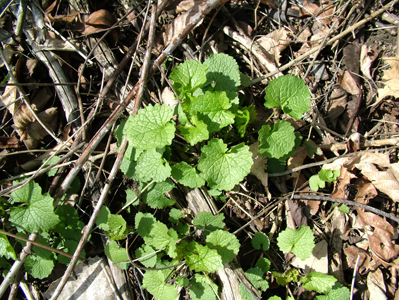
Early spring leaves of garlic mustard.
Asian bush honeysuckle is a medium to large bush that also inhabits the forest understory and edge or disturbed areas. Leaves and twigs area arranged opposite each other. If you slice the stems open, they are hollow inside with fuzzy brown or tan lining. Flowers are yellow, white or even pinkish and tube-shaped. The fine twigs and stems have a light tan or gray-tan color. Leaves are rapidly expanding now, so they will be easily detected until our native plants catch up with leaf cover.

Early growth of Asian bush honeysuckle.
Controlling these plants helps native plants continue to thrive and provide habitat for our wildlife. Garlic mustard can be pulled from moist soil. If seed pods are present, remove the plants from the area and burn or bury them. Foliar herbicides like glyphosate products may be used to spray garlic mustard. If the plants have already set seed pods, the seed may become viable even if the plant has been sprayed, so removal may be the only effective treatment at that time.
Asian bush honeysuckle can be controlled in several ways, depending on the size of the plants. Small plants can be pulled from moist soil. Foliar sprays with herbicides like glyphosate can be effective. Large bushes may be cut and the stumps treated with a brush-killing herbicide. For any herbicide application, read and follow label directions.
Purdue University has invasive species information resources at FNR Extension and Indiana’s ‘Most Unwanted’ Invasive Plant Pests/Indiana Cooperative Agricultural Pest Survey (CAPS) Program.
Lenny Farlee, Sustaining Hardwood Extension Specialist
Hardwood Tree Improvement and Regeneration Center (HTIRC)
Forestry and Natural Resources, Purdue University
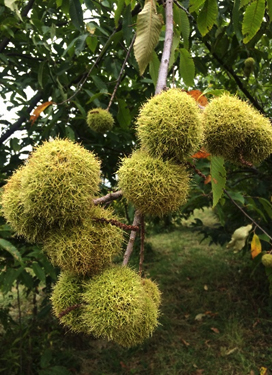
American chestnut fruit protected by a spiny bur. Photo: Dr. Shaneka Lawson, USDA Forest Service, Purdue HTIRC
In the late 1800s, 25% of hardwood trees in North America’s eastern forest were American chestnuts, 40 meters high and two meters across, they provided abundant resources for both people and wildlife in the form of food, shelter and building materials. Lightweight, rot-resistant, straight-grained and easy to work with, chestnut wood was used to build houses, barns, telegraph poles, railroad ties, furniture and even musical instruments. The rapid decline of the chestnut due to the pathogenic fungus Cryphonectria parasitica has been a subject of much debate and despair over the years, but now, chestnuts engineered to battle the fungus might give the iconic trees a chance to reclaim the North American stage.
Research conduced in 2014 was taking genes from wheat, Asian chestnuts, grapes, peppers and other plants and inserting them into American chestnut trees. William Powell of S.U.N.Y.–ESF and scores of collaborators, created hundreds of transgenic trees with the goal of almost 100 percent genetically identical wild American chestnut yet immune to C. parasitica. Testing and gathering data continues to help with future research.
Douglass Jacobs, the Fred M. van Eck Professor of Forest Biology at Purdue University, and a team of scientists at Purdue, use genomics which involves working with the complete set of an organism’s genetic material, to learn more about what causes disease. Genomics also can help identify the genes responsible for useful traits such as pest resistance.
Blight began afflicting the American chestnut in the 1900s, killing billions of trees. Despite being the target of decades-long tree-breeding efforts, the chestnut’s prospects remain in doubt. The list of at-risk species also includes ash, butternut, and bristlecone pine among other members of the five-needle white pine family.
The Hardwood Tree Improvement & Regeneration Center, a joint effort between Purdue and the Forest Service, for years has maintained a breeding program for pest resistance. Almost all of the center’s efforts to date have focused on traditional tree breeding and genomics.
“The chance to work with chestnut and help reintroduce it back to the landscape was a big reason I took the Purdue job in the first place back in December of 2001,” Jacobs said. “Watching species disappear from the landscape provides me personally with a lot of motivation to contribute whatever I can toward helping to save some of these at-risk species.”
To learn more about his research and collaboration with the U.S. Forest Service view full article Biotechnology offers holistic approach to restoration of at-risk forest tree species – Purdue University News, by Purdue Agriculture News.
Resources
A New Generation of American chestnut Trees May Redefine America’s Forests – Scientific American
Consequences of Shifts in Abundance and Distribution of American Chestnut for Restoration of a Foundation Forest Tree – Forests Open Access Forestry Journal
Transgenic American chestnuts show enhanced blight resistance and transmit the trait to T1 progeny – Science Direct (Plant Science)
Scientists Work to Create a Blight-Resistant Chestnut with Hopes of Restoring Tree to America, Forest Service, U.S. Department of Agriculture
FNR Hardwood – American Chestnut, Purdue Arboretum Explorer
Hardwood Tree Improvement Regeneration Center (HTIRC) Research Publications
American Chestnut Trees return to the Hoosier National Forest, Indiana Woodland Steward
Forest Regeneration and Restoration Laboratory, Purdue Forestry and Natural Resources, Dr. Doug Jacobs
Indiana American Chestnut Foundation
Purdue Extension – Forestry and Natural Resources (FNR)
Winter burn is a common occurrence to boxwood, holly, rhododendron and most conifers. Winter burn symptoms often develop when temperatures warm up in late winter and early spring. This type of winter damage is often misdiagnosed as an infectious disease or damage from excessively cold temperatures.
To understand winter injury, it is important to understand that while a plant is creating its food by photosynthesis, it is releasing large amounts of water through the process of transpiration (the evaporation of water from the plant). Over the course of a day, a large tree can lose hundreds of gallons of water. When plants are unable to obtain the water they need (due to drought or frozen soil), the water lost through transpiration cannot be replenished, resulting in dehydration, foliar damage and even death.
Contacts
Michael Mickelbart, Clinical Engagement Assistant Professor
Horticulture and Landscape Architecture
Purdue University
Janna Beckerman, Associate Professor
Botany and Plant Pathology
Purdue University
Tree owners who have broken limbs in their trees or are just taking advantage of early pruning opportunities may notice large amounts of “water” that seem to be pouring out of the branch. This is actually “sap” seeping out of the damaged area, and it would have been going into the limb or branch that was removed. However, since the limb is no longer there, the sap has nowhere to go but out of the freshly cut limb or wound.
Spring weather signals to trees to come out of dormancy, and all trees start pumping water, minerals and carbohydrates upwards into the tree to allow growth of buds, leaves and shoots and will continue throughout the growing season. Certain tree species, such as maple, birch, dogwood and elms, have an exceptionally heavy sap flow in the early spring. When pruned or wounded, these trees will “bleed” quite noticeably. Under normal circumstances, it is best to delay pruning these trees until later in the growing season when the flow of sap is slower.
There is no need for alarm if this sap flow occurs and the overall health of the tree is not going to be affected. The “bleeding” may be objectionable from a cosmetic standpoint, especially if the sap is dripping directly onto people, cars or other targets beneath the wounded area. As the affected area on the tree develops callus material and naturally seals off the wound, it will slow the flow to a stop.
It is not recommended to use any type of wound dressing or covering as this will impede the ability of the tree to seal off the damaged area. Be patient and allow natural healing of the wound to occur. Always use good pruning practices and minimize the size of cut branches to reduce wound size on the tree.
Refer to the following Purdue Extension publication, Trees Need a Proper Start: Prune Them Right, for more information.
Other resources can be found at The Education Store: Pruning Ornamental Trees and Shrubs.
Lindsey Purcell, Urban Forestry Specialist
Department of Forestry and Natural Resources, Purdue University
A recent article in ScienceDaily titled “Excessive Deer Populations Hurt Native Plant Biodiversity” shares how an overpopulation of deer is hurting native plant growth. Landowners seek best management practices as these challenges arise.
For the article from the University of Miami, view: “Excessive deer populations hurt native plant biodiversity.” ScienceDaily, 20 March 2014.
Resources
Preventing Wildlife Damage, Purdue EVERYTHING Wildlife
How to Build a Plastic Mesh Deer Exclusion Fence, Purdue Extension Publication
Don’t be fooled by the cold weather; EAB has plenty of life left.
Headlines have been circulating suggesting that EAB may “have met its match.” Although the Midwest experienced abnormally cold temperatures this winter, it is unlikely EAB populations felt these effects as significantly as your heating bill. EAB, as well as most insects in colder climates, are effective at surviving cold temperatures. One way they survive the cold is by producing an antifreeze-like substance that prevents water in their cells from crystallizing and causing damage. Also the extra insulation provided by the tree bark helps larvae withstand such cold temperatures. For EAB larvae overwintering within ash trees, death occurs when temperatures reach -28 degrees Fahrenheit.
A model produced by U.S. Forest Service scientists predicts areas in North America where temperatures were cold enough to kill EAB larvae. This model suggests that in the U.S., only northern parts of Minnesota and North Dakota have reached frigid enough temperatures to affect EAB populations.
Although some parts of the United States may have fewer adults emerging in the spring as a result of the cold temperatures, they probably won’t notice. Due to a high reproductive rate, it will likely be only a matter of time before populations rebound to previous levels.
Despite the cold weather, experts are still advising to continue with EAB management plans. One effective means of saving ash trees and reducing management costs is to partner with interested neighbors and hire a company to treat trees in your neighborhood. This collaborative approach will likely reduce transportation and consultation costs for the company, and the savings will be passed down to homeowners.
For more information on EAB, treatment options and NABB (Neighbors Against Bad Bugs), visit Emerald Ash Borer in Indiana, Purdue Extension website.
Contacts
Adam Witte, Exotic Forest Pest Educator
Department of Entomology
Matthew Ginzel, Associate Professor
Departments of Entomology & Forestry and Natural Resources
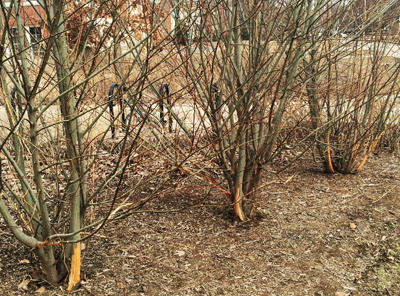 Cold winter winds, alternating extreme temperatures, ice and snow can be damaging to trees and shrubs. However, this spring, we are seeing additional damage due to the harsh winter conditions that is of the furry kind: rabbits and rodents. Mice and rabbits often damage young trees in the winter by feeding on the juicy, green cambium layer just under the bark and girdling the tree. Damage from these furry creatures occurs most commonly in winters when there is prolonged, heavy snow cover and food is scarce. Sound familiar? Rabbits feed on the bark above the snow while mice tunnel under the snow and feed near the ground level. Mouse damage is usually more severe when the trees are surrounded by heavy grass, weed cover or heavy mulch.
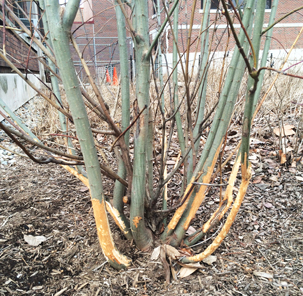 On young trees and multi-stemmed ornamental trees, rabbits remove the bark completely around the trunks and stems, effectively girdling them. All growth above the girdled areas will eventually decline and die, and for most situations, replacing the girdled trees is the best course of action. There are no applications that will mitigate the effects of rabbit damage or save severely damaged trees. Wound dressings, pruning paints, latex paints, wrappings and other alleged protective barriers do not help.
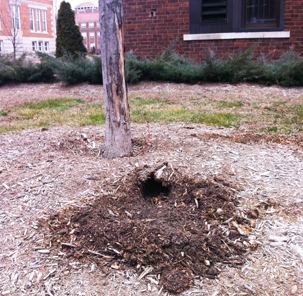 Many deciduous shrubs have the ability to produce new shoots or suckers at their base. Because of this ability, many severely damaged deciduous shrubs can recover. However, patience is required as several years may be required for some shrubs to fully recover. In early spring as the greening begins, prune off girdled stems just below the damaged areas. This will help rejuvenate the plant in most circumstances and replace the damage growth.
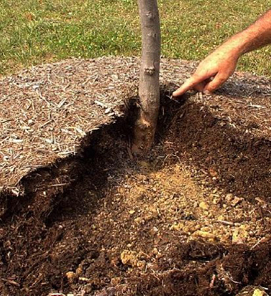 The most effective deterrent to girdling by mice or rabbits is to wrap the trunk and low branches of young trees with screen wire or hardware cloth. Be certain the wire wrap is buried below the ground line and extends high enough above the possible snow line to prevent rabbits from reaching to the trunk or branches. To help control mouse damage, maintain an area free of grass or weeds for a 1- to 2-foot radius around the base of the tree. Additionally, maintain proper mulch levels, never more than 2-3”, to eliminate the habitat for mice. Various chemicals are available to repel mice and rabbits, but these do not afford the reliability of a well-made barrier.
Resources
Preventing Wildlife Damage, The Education Store, Purdue Extension
Vole Damage in Pumpkins (and other crops), Purdue Extension – Forestry and Natural Resources (FNR) Got Nature? Blog
Moles, The Education Store, Purdue Extension resource center
Adjuvants and the Power of the Spray Droplet: Improving the Performance of Pesticide Applications, The Education Store
Preventing Wildlife Damage – Do You Need a Permit?, The Education Store
Attract Hummingbirds to Your Yard, Video, Purdue Extension Youtube Channel
How to Stop Woodland Animals from Digging in Your Flower Pots, Video, Purdue Extension Youtube Channel
Purdue Extension – Forestry and Natural Resources
Since the Polar Vortex subsided, there has been quite a bit of buzz about the Emerald Ash Borer (EAB), an exotic beetle that is killing ash trees across Indiana and the U.S., being killed by the multi-day sub-zero temperatures we experienced here in Indiana and elsewhere. Some recent research (the full paper can be accessed USDA Forest Service, Cold Hardiness of Emerald Ash Borer, Agrilus Planipennis: A New Perspective) predicts that when EAB larvae reach 0°F, 5% will die; at -10°F, 34% will die; at -20°F, 79% will die; and at -30°F, 98% will die. Based on some -15°F temperatures here at the Purdue West Lafayette campus, we might expect around 50% of the EAB will die, but some additional points need to be considered.

An adult emerald ash borer feeds off a leaf. (Purdue University Department of Entomology photo/John Obermeyer)
EAB larvae are located overwinter under the bark in infested ash trees, so the bark may offer some insulation. Snow is also an excellent insulator, so the lower trunk of ash trees in deep snow or drifts may not get as cold as ambient air temperatures. Some trees in town or near structures may remain warmer due to heat radiating or escaping from buildings. The message is, unfortunately, that the cold weather we experienced was probably not enough to solve our EAB problems.
It is good news that some of the population was probably killed by the cold weather, leaving fewer larvae to damage ash trees next spring. This will be a temporary setback for the borer, since one of the biological strengths of insects is their capacity to reproduce and grow populations quickly. Further north in places like Minnesota, the news for the ash trees may be better where temperatures below -30°F may have killed most of the larvae, providing some additional time to prepare for the EAB onslaught. Here in Indiana, we need to continue to monitor, prepare and act to limit the damage EAB will do.
Some basic steps include:
- Don’t move firewood – Firewood can harbor EAB and several other serious tree pests and spread them to new areas.
- Learn to identify ash trees, EAB and the symptoms of EAB damage.
- Learn about EAB control techniques.
- Learn how to decide if your ash tree should be treated with insecticide to protect it from EAB or removed and possibly replaced with another tree species.
- Work with your neighbors to monitor and manage the ash trees in your area.
Purdue Extension offers science-based recommendations to help you manage the EAB threat at Emerald Ash Borer in Indiana.
Resources:
New Hope for Fighting Ash Borer, Got Nature? Purdue Extension-FNR
Invasive Pest Species: Tools for Staging and Managing EAB in the Urban Forest, Got Nature?
Emerald Ash Borer Tools & Resources – Purdue Extension Entomology
Planting Your Tree Part 1: Choosing Your Tree, Purdue Extension YouTube Channel
Tree Planting Part 2: Planting a Tree, Purdue Extension – Forestry and Natural Resources YouTube Channel
Indiana Invasive Plant List, Indiana Invasive Species Council, Purdue Entomology
Landscape Report Shares Importance of Soil Testing, Purdue FNR Extension
Find an Arborist website, Trees are Good, International Society of Arboriculture (ISA)
Tree Risk Management – Got Nature? Blog, Purdue Extension – FNR
Lenny Farlee, Extension Forester
Hardwood Tree Improvement and Regeneration Center (HTIRC)
Forestry and Natural Resources, Purdue University
 Many insects are not actually the cause of tree mortality but simply “opportunists” and infest decaying wood. Spraying the remaining trees depends on the insects and their propensity for infesting live trees.
Cut wood, especially if infested, should never be moved out of the county to minimize the spread of harmful pests. See more at www.dontmovefirewood.org.
Resources
Walnut Anthracnose, Walnut Notes, U.S. Department of Agriculture, Forest Service, North Central Forest Experiment Station
Indiana Walnut Council, Industry Representatives include 45 states and 3 foreign countries
Diseases in Hardwood Tree Plantings, The Education Store, Purdue Extension resource center
Study: Fungus Behind Deadly Disease in Walnut Trees Mutates Easily, Complicating Control, Purdue Agriculture News
Indiana Walnut Council
Diseases in Hardwood Tree Plantings, The Education Store, Purdue Extension resource center
Why are my walnut trees dropping their leaves?, Purdue Extension – Forestry & Natural Resources (FNR) Got Nature? Blog
Invasive Species Walnut Twig Beetle Detected in Indiana, Purdue Extension – FNR Got Nature? Blog
Intro to Trees of Indiana: Black Walnut, Purdue Extension – FNR Got Nature? Blog
Resources and Assistance Available for Planting Hardwood Seedlings, The Education Store
Certified Arborist (International Society of Arboriculture)
Pests of Concern, Walnut Twig Beetle, Indiana Department of Natural Resources
Invasive Species Walnut Twig Beetle Detected in Indiana, Purdue Extension – Forestry & Natural Resources (FNR) Got Nature? Blog
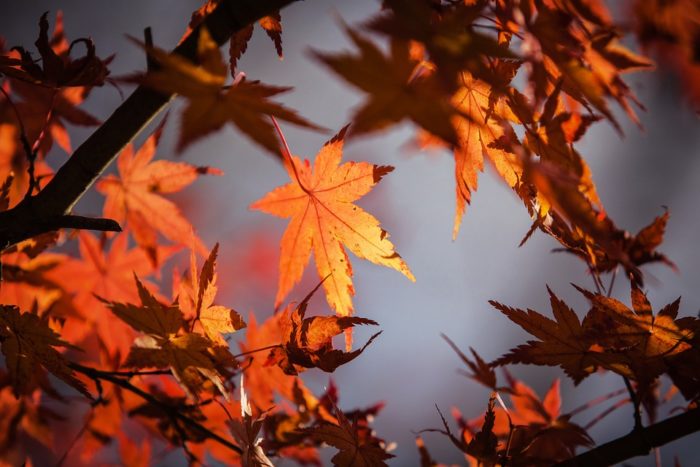 The display of color we enjoy each fall is explained by understanding plant pigments, the physiology and anatomy of leaves, and the influence of climate and seasonal weather conditions. Fall weather conditions favoring formation of bright red autumn color are warm sunny days followed by cool but not freezing nights. As days get shorter and temperatures cooler in the autumn, important physiological processes are triggered that make conditions for chlorophyll production less favorable.
Resources:
Intro to Trees of Indiana videos, Purdue Extension – Forestry and Natural Resources (FNR)
An Introduction to Trees of Indiana, The Education Store, Purdue Extension’s resource center
Native Trees of the Midwest, Purdue University Press
Shrubs and Woody Vines of Indiana and the Midwest, Purdue University Press
Forest Improvement Handbook, The Education Store
Trees and Storms: Understanding Damage, Risk and Recovery – Got Nature? Blog, Purdue Extension – FNR
Tree Risk Management – Got Nature? Blog, Purdue Extension – FNR
Planting Problems: Trees Planted Too Deep, Video, Purdue Extension – Forestry and Natural Resources YouTube Channel
Why Leaves Change Color, USDA Forest Service, Northeastern Area
Lenny Farlee, Extension Forester
Hardwood Improvement Regeneration Center (HTIRC)
Purdue Department of Forestry and Natural Resources

Recent Posts
- Opportunities for Prescribed and Wildland Fire Training
Posted: November 4, 2026 in Forestry, How To, Wildlife, Woodlands - Wildlife Issues and Solutions: A New Online Series
Posted: in Forestry, How To, Wildlife, Woodlands - Burning for Benefits: Where Fire Belongs in Indiana
Posted: in Forestry, Safety, Wildlife, Woodlands - Residents, Alumni Invited to Share Indiana Natural Resource, Spaces, Species Memories
Posted: in Forestry, Forests and Street Trees, Gardening, Urban Forestry, Wildlife - Now Is The Time To Control Non-Native Bush Honeysuckle
Posted: October 30, 2026 in Forestry, How To, Invasive Plant Species, Woodlands - Help Strengthen the Future of Indiana Maple Syrup
Posted: October 29, 2026 in Forestry, How To, Woodlands - Popular Landscape Shrub is Invasive
Posted: October 15, 2026 in Alert, Forestry, Forests and Street Trees, Invasive Plant Species, Plants, Woodlands - Purdue Extension’s Regional Teams Are Here: Connecting Communities with Expertise and Opportunity
Posted: October 14, 2026 in Community Development, Forestry, Forests and Street Trees, Gardening, How To, Timber Marketing, Urban Forestry, Wildlife, Woodlands - Why Do Our Trees Go From Green Leaves to Different Colors?
Posted: in Forestry, Forests and Street Trees, Urban Forestry, Woodlands - Deer and Turkey Archery Seasons Opening Soon, MyDNR
Posted: October 13, 2026 in Alert, Safety, Wildlife
Archives
Categories
- Alert
- Aquaculture/Fish
- Aquatic/Aquaculture Resources
- Ask the Expert
- Christmas Trees
- Community Development
- Disease
- Drought
- Forestry
- Forests and Street Trees
- Gardening
- Got Nature for Kids
- Great Lakes
- How To
- Invasive Animal Species
- Invasive Insects
- Invasive Plant Species
- Land Use
- Natural Resource Planning
- Nature of Teaching
- Plants
- Podcasts
- Ponds
- Publication
- Safety
- Spiders
- Timber Marketing
- Urban Forestry
- Webinar
- Wildlife
- Wood Products/Manufacturing
- Woodland Management Moment
- Woodlands