 Purdue University - Extension - Forestry and Natural Resources
Got Nature? Blog
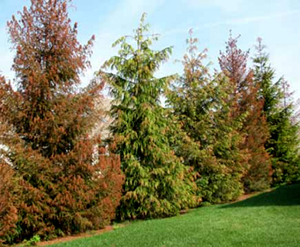 Question: I am noticing pine trees dying in my neighbors’ yards and along the streets in Carmel and NE Indianapolis. The needles turn rust colored and fall within a couple weeks – leaving a bare tree. Some of these trees are mature but most are young. Should I be concerned? What should I do to protect my pine trees? What should I be looking for if it is a pest?
Answer: Many Indiana trees are dying from stress caused by the extreme weather we have had in the last few years. Urban Forestry Specialist Lindsey Purcell and Extension Consumer Horticulture Specialist Rosie Lerner discuss this in more detail in the Purdue Agriculture News article “Purdue experts: Tree deaths across Indiana may be related to weather stress.” There are also other potential causes of foliar discoloration and branch dieback in pine trees that are explained in the publication “Stress-related Conifer Dieback“.
If you’d like to investigate the issue further, a certified arborist can conduct a ground evaluation or you can examine the trees on your own using the Purdue Tree Doctor app.
Resources:
Purdue experts: Tree deaths across Indiana may be related to weather stress – Purdue Agriculture News
Stress-related Conifer Dieback – The Education Store, Purdue Extension Resource Center
Purdue Plant Doctor App – Purdue Botany and Plant Pathology and Extension Entomology
Needle cast in Colorado Blue Spruce, Purdue Landscape Report
Blue Spruce Update, Purdue Landscape Report
Why Spruce Trees Lose Their Needles, Purdue Extension
Blue Spruce Decline, Purdue Extension
Diseases Common in Blue Spruce, Purdue Extension
Tree Installation: Process and Practices, The Education Store, Purdue Extension resource center
Tree Planting and Urban Forestry Videos, Subscribe to our Purdue Extension-FNR YouTube Channel
Find an Arborist, International Society of Arboriculture
Lenny Farlee, Sustaining Hardwood Extension Specialist
Purdue University Department of Forestry and Natural Resources
 Since 2010, farmers in the Indian Creek watershed in Illinois have been working together to implement conservation practices and nutrient management strategies to reduce nutrient loading in Indian Creek. Postdoctoral Research Associate Sarah Church led the process of evaluating this watershed project and understanding which social conditions contributed to the project’s success. Her findings are presented in this new publication “Indian Creek Watershed Project: Key Takeaways for Success.”
In continuing sharing the research regarding the issues of Indian Creek Purdue Extension’s Aaron Doenges produced two videos. These videos focus on two key reasons for the project’s success: the people involved with the project’s steering committee; and the partnerships formed with agribusinesses.
 In the first video, “Partnerships and People“, Terry Bachtold of the Livingston County Soil and Water Conservation District, Chad Watts of CTIC, and several others involved in the watershed project, talk about how crucial forming a locally-led steering committee was to the project’s success. Partnerships led to friendships as the group worked together to make a difference in their watershed.
In the second video, “Partnerships with Agribusinesses“, agronomists Harold Reetz, Marion Shier, and other people involved in the watershed project discuss the importance of getting retailers like Mike Trainor involved. Agribusinesses are trusted farmer advisors, provide unique insights, and offer valuable support that can strengthen watershed projects.
“Indian Creek Watershed Project: Takeaways for Success” and the accompanying videos can provide watershed and conservation organizations with valuable insights for their own watershed projects. Moreover, farmers and retailers are encouraged read this publication, view these videos and consider becoming part of something bigger. As members of a watershed join together, economic and environmental improvements can take place.
Resources:
Indian Creek Watershed Project: Takeaways for Success – The Education Store, Purdue Extension Resource Center
Indian Creek Watershed Project – Conservation Technology Information Center (CTIC)
Indian Creek Watershed Project – Reetz Agronomics
Indian Creek Watershed Project Presentation – United States Environmental Protection Agency
A Watershed Approach – United States Environmental Protection Agency
Sarah P. Church, Post Doctoral Research Associate
Purdue University, Department of Forestry and Natural Resources
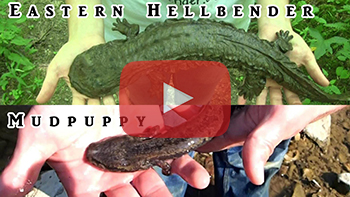 One of the main problems facing eastern hellbender (Cryptobranchus alleganiensis) conservation is that many people mistake this endangered salamander for another common species called a mudpuppy (Necturus maculosus). Conservationists and researchers encourage any outdoor enthusiasts to report eastern hellbender sightings by going to helpthehellbender.org or by reporting to a conservation officer. Unfortunately, many hellbender sightings are actually mudpuppy sightings. This can cause confusion in conservation efforts, so the need for public education on hellbender identification is strong.
We have created the “Eastern Hellbender ID Video” to teach people:
- How to identify an eastern hellbender
- How to tell the difference between a hellbender and a mudpuppy
- What to do if they see an eastern hellbender
Help the Hellbender Day at Columbian Park Zoo a Great Success – Got Nature?
Purdue partners with Indiana zoos for hellbender conservation – Purdue Agriculture News
The Nature of Teaching: Discovering the Watershed – The Education Store, Purdue Extension Resource Center
Purdue Department of Forestry and Natural Resources
Your real tree, once cut, is like fresh fruit in regards to its useful life expectancy. Just like fruit, care needs to be exercised in the trees selection and subsequent care according to Daniel Cassens, Professor in the Department of Forestry and Natural Resources, Purdue University and member of the National Christmas Tree Association. Over half of the tree’s weight consists of water when first cut and it is important that the water content be maintained.
First, it is important to select a fresh tree. If you cut the tree at a choose-and-cut farm, it has to be fresh. If the tree is pre-cut, make sure the needles are flexible and firmly attached to the stem. Also, the tree should look “normal” and not crushed with broken branches and distorted or missing needles. Fresh looking trees indicate they have been well cared for.
Fresh cut trees should be kept out of the sun and wind to prevent accelerated dehydration. If the tree needs to be temporarily stored, place it in an unheated building or on the north side of a building where it will be less exposed. It will also help to place the tree in a bucket of water.
Just before setting up the tree, using an inexpensive bow or other saw trim about one-half inch from the base of the trunk. The cut should be perpendicular to the main stem. If the tree cannot be set up within 6 to 8 hours, make another cut. About 6 to 8 hours after the cut is made, the living cells begin to die and become blocked so the tree cannot take up water.
The tree should now be placed in a stand capable of supporting the tree mechanically. Make sure the stand has extended legs to prevent the tree from tipping. Do not whittle down the outside diameter of the tree base. The outer layers of wood are the most effective in taking up water. The stand should also be able to hold at least one quart of water for each inch of stem diameter. A typical 7 foot tree will require a stand with a water holding capacity of about two gallons. Check the water level each day and add cool water as needed. Make sure the butt end of the tree stem is always in water contact. Some stands do not allow the stem to reach the bottom of the water holding container. Trees tend to take large quantities of water each day for the first week or so and then slow down. Remember, if the tree runs out of water, the cells in the very butt or exposed end will become blocked and subsequent water uptake will be prevented.
Some tree lights can also produce excessive heat. Small lights or those that produce low heat will also help to reducing localized drying of the tree.
For more information about Christmas trees or to locate a choose-and-cut tree farm near you, please visit the National Christmas Tree Growers Association.
Resources:
A Choose-and-Cut Pine and Fir Christmas Tree Case Study, The Education Store, Purdue Extension’s resource center
Selecting an Indiana-Grown Christmas Tree, The Education Store
Tips for First-Time Buyers of Real Christmas Trees, The Education Store
Daniel Cassens, Professor Emeritus
Department of Forestry and Natural Resources
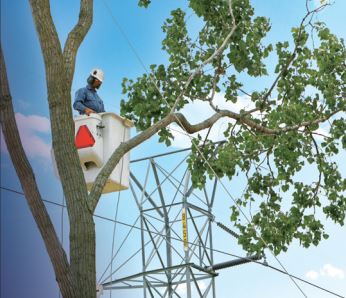 Electrical utility lines serve nearly every neighborhood, adding efficiency and luxury to every day of our lives.
Likewise, trees enhance our neighborhoods and bring beauty to our surroundings. Trees improve our air and water quality. They shade our homes, screen undesirable views, and help reduce noise along with many other ecosystem services.
We want both.
Purdue FNR Urban Forestry Specialist Lindsey Purcell addresses the conflicts that sometimes arise when trees and electrical lines must share space and ways to avoid them in his latest publication “Trees and Electric Lines“. Check out the publication to learn more about how to avoid boundary issues, safety concerns, power outages, and more while dealing with trees and electric lines.
Resources:
Trees and Electric Lines – The Education Store, Purdue Extension Resource Center
Tree Risk Management – Got Nature? Blog, Purdue Extension – FNR
Trees and Storms: Understanding Damage, Risk and Recovery – Got Nature? Blog, Purdue Extension – FNR
Urban Forestry and Arboriculture – Purdue Forestry and Natural Resources
Power Friendly Trees – Indiana Department of Natural Resources
Lindsey Purcell, Urban Forestry Specialist
Purdue University Department of Forestry and Natural Resources
The debate over rather the use of a real tree or an artificial tree is better for the environment continues, especially as the Holiday season nears. Real tree growers point out that their product is renewable, each species has its own characteristic odor, consumes carbon dioxide and gives off oxygen, can be recycled, provides wildlife habitat and creates jobs in rural America. Artificial trees contain non biodegradable plastics and possible metal toxins such as lead. Most artificial trees are made in China and must be shipped long distances to the United States. On the other hand the artificial tree industry points out that their product can be reused and thus saves several real trees from being harvested. The industry goes on to claim that their trees do not need fertilizers or pesticides and do not create a mess or hassle. These are just examples of claims being made by two distinctly different industries. Considering the entire production cycle for real and artificial trees, it is difficult to determine which type of tree is best for the environment, based on scientific based data. Conducting a “Life Cycle Assessment” (LCA) for real and artificial trees would be one approach to answer this question.
Real Christmas trees, like all green plants, consume carbon dioxide and produce oxygen. The carbon dioxide is absorbed through the leaves or needles, combined with sunshine and water to make food and release oxygen. This process is called photosynthesis. The “carbon” is stored in the wood, needles, and leaves and constitutes about one-half of the dry weight. If the trees are burned or otherwise decomposed the “stored” or sequestered carbon is released back into the atmosphere. Other existing or planted trees absorb the carbon making trees carbon neutral. Some of the carbon is also stored in the soil. Growing trees also require some carbon dioxide back into the atmosphere.
Artificial trees use petroleum based products. Petroleum based products are ancient, stored sources of carbon dioxide and if burned as in the case of gasoline, release new carbon dioxide into the atmosphere. Transportation becomes a significant source of carbon release regardless of the tree being real or artificial.
Carbon dioxide is important because it traps heat from the earth’s surface. This is often referred to as the “greenhouse effect”. The amount of carbon dioxide in the atmosphere has been increasing since the late 1800’s and scientific data shows a particularly significant increase since the 1960’s. “Global warming” is the term being used to describe an increase in the world’s average surface temperature as a result of more heat being trapped.
“Cradle to Grave” or “Life Cycle Assessments” are used to summarize all of the positive and negative activities associated with developing a product and delivering it to the consumer. LCA’s become complicated, costly and the results are dependent on exactly which set or sets of circumstances are considered. Only one documented study on real and artificial trees is available. A Canadian Environmental consulting firm, Ellipsos has completed a LCA for both real and artificial trees. (Ellipsos/Strategists in Sustainable Development)
In this study, the carbon balance for an individual 7 foot high real Christmas tree was about +24 Kg (53 lbs) of CARBON DIOXIDE after all factors such as labor, use of machinery, transportation, and other inputs are considered. The tree was grown south of Montreal, Canada. It was assumed that the tree was grown in the nursery for four years and in the field for 11 years. In Indiana, two year old nursery stock and about 7 years in the field to produce a 7 foot tree are more typical and would probably result in less carbon being released. The “+” indicates that the overall process of growing a tree is carbon positive (i.e. carbon is released).
The carbon balance for a similar six foot artificial tree was about +48Kg (106 lbs) of CARBON DIOXIDE or twice that of the real tree. Most of the positive carbon release in this case is due to the manufacturing of the tree and transportation of the tree by boat from China to Vancouver and then by train to Montreal, Canada.
For comparison purposes, the average American car emits about 1.5 tons or 3000 pounds of carbon into the atmosphere on a yearly basis. (Green Car Congress)
The Ellipsos report assumed that the real tree would be burned for fuel at the end of the life cycle, thus releasing all of the stored carbon in the tree. If the real tree is recycled for mulch or fish habitat or other uses the carbon budget would be closer to zero at least until the tree finally decomposes. The study goes on to conclude that considering climate change impact along with environmental and public health impact, real trees appear to be a better choice for a responsible customer and that artificial trees must be displayed for more than 20 years in order for it to compare favorably with the real Christmas tree.
The assessment method used for the life cycle analysis groups problems into four damage oriented impacts areas on the environment. These are 1) climate change, 2) human health, 3) ecosystem quality, and 4) resource depletion. The results for the Ellipsos report are interesting. Considering climate change, the real tree has much less impact due to a smaller amount of carbon being released into the atmosphere as discussed above. The LCA also considers the products impact on human health, ecosystem quality and resource depletion. Considering human health, the artificial tree is a slightly better choice than the real tree. Considering ecosystem quality, the artificial tree is a better choice. This is likely due to the use of land for plantations and associated cultural practices (fertilizer, pesticide, irrigation) for real trees. In regards to both climate change (global warming) and resource depletion (use of non-renewable energy and mineral extraction), the real tree is a better choice than the artificial tree. The Ellipsos report titled “Comparative life Cycle Assessment (LCA) of Artificial vs Natural Christmas trees” can be viewed by Googling “Ellipsos report 1043-RF3-09.”
Both real and artificial trees have positive and negative attributes. Based on this study, the real tree has less effect on global warming than the artificial tree ie less carbon is released. The amount of carbon released by either the real or artificial tree is relatively small compared to that released by the average car over the course of the year. To reduce carbon production, consumers might be better advised to limit (plan ahead) the use of the car over the holiday season.
For more information about Christmas trees or to locate a choose-and-cut tree farm near you, please visit the National Christmas Tree Growers Association.
Other resources:
A Choose-and-Cut Pine and Fir Christmas Tree Case Study, The Education Store, Purdue Extension’s resource center
Selecting an Indiana-Grown Christmas Tree, The Education Store
Tips for First-Time Buyers of Real Christmas Trees, The Education Store
Daniel Cassens, Professor Emeritus
Department of Forestry and Natural Resources
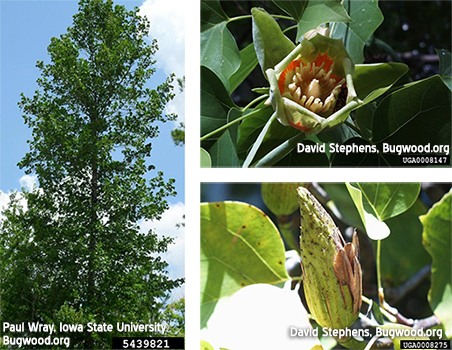 Tulip poplar (Liriodendron tulipifera) is one of the largest trees in Indiana and the eastern portion of the country. Tulip poplar reaching heights in excess of 50-60 m (160-200 ft) with a diameter at breast height (dbh) of 3 m (10 ft) have been reported while the majority of these eastern giants are between 20-30 m (70-100 ft) tall. This tree is fast-growing, has few health problems, and can live upwards of 200 years.
The tree looks best between April and June when it begins to flower as it is covered with large pale green to yellow flowers with an orange band encircling the tepals. These flowers are brimming with nectar and draw in large quantities of bees, birds, and butterflies. The tree has been deemed so magnificent that it is the state tree of Indiana, Kentucky, and Tennessee.
American ginseng (Panax quinquefolius) is an herbaceous perennial member of the ivy family that has traditionally been used in North America by Native Americans for its medicinal properties and cultivated in China for use in herbal remedies. In years past, American ginseng was widespread throughout the eastern United States until overharvesting, habitat fragmentation, urbanization, and deer browsing decimated wild populations.
Though not scientifically proven, ginseng is believed to remedy numerous health conditions such as inflammation, the flu, cancer, insomnia, erectile dysfunction, and hangovers. The herb has become one of the most popular unproven remedies in the world.
A new study noted that wild populations of American ginseng could benefit from being planted near tulip poplar. The data stated that new strategies need to be pursued in conservation efforts to save the rare American ginseng plant. The study advised that planting American ginseng on sites equally suited to tulip trees had the potential to increase outplanting success. The authors recommended planting in isolated, mostly closed canopy areas free of disturbances (trespassers, timber harvesting, large deer populations) and against planting in sites with wild sarsaparilla (Lindera benzoin).
Resources:
Ginseng: Old Crop, New Directions – Purdue University Department of Horticulture
Ginseng – Indiana Department of Natural Resources
American Ginseng – U.S. Fish & Wildlife Service
Liriodendron tulipifera – The IUCN Red List of Threatened Species
Can putative indicator species predict habitat quality for American ginseng? – ScienceDirect – Science Direct
Shaneka Lawson, Plant Physiologist
Purdue University Department of Forestry & Natural Resources
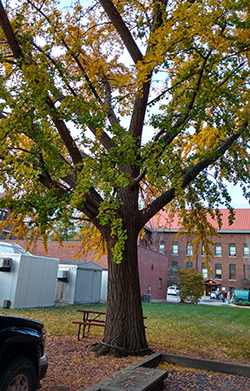 Ginkgo (Ginkgo biloba) trees also known as Maidenhair trees are slow-growing, relatively pest-free, wind-pollinated trees that can be found in all fifty of the contiguous United States. The only tree species within division Ginkgophyta to escape extinction, Ginkgo biloba is known as an ancient tree with prehistoric fossils dating back 270 million years found on every continent except Antarctica and Australia.
Ginkgo grow best in full sunlight and can reach heights greater than 35 m (115 ft). Ginkgo trees are valuable street trees because of their low susceptibility to smoke, drought, or low temperatures. These trees grow slowly and perform relatively well in most soil types provided they are well-drained. The leaves turn a vibrant yellow during autumn but drop soon after its brilliant fall color is observed.
Unfortunately, in late autumn, the dirty secret that female ginkgo trees hide is revealed. The “fruit” produced by female ginkgo trees is foul smelling (has been compared to rancid butter or animal excrement) and is cast in the fall following the first frost. Though immature when cast, the embryos within the fruit continue to mature on the ground for up to two months afterwards. This means that anyone unfortunate enough to step on the fruit during that time is exposed to its pungent odor.
Extreme caution should be used when selecting ginkgo trees for landscape ornamentals or for street trees since there is no way to discern a male from a female at the seedling stage. Several “Boys Only” cultivars have been developed such as ‘Autumn Gold’ or ‘Lakeview’ to ensure that you do not end up with a 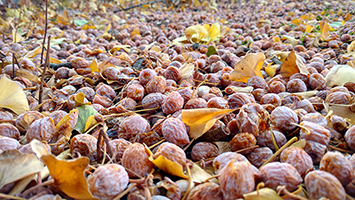 stinky yard or street when the trees begin to fruit. While the scent of the seed coat may be undesirable, the seed kernel is highly valued in Eastern Asia as a food product. In the United States, herbal extracts composed of ginkgo leaves are believed to improve short-term memory and concentration.
On the campus of Purdue University several ginkgo trees can be found although unfortunately for students the vast majority of these are female and the scent of crushed seed pods often follows many students to class on the bottoms of their shoes. A word of warning, the ginkgo trees planted near Pfendler Hall, Forestry, and the Cordova Center are all females. Watch your step this winter and this is the one rare example of when boys ARE better than girls.
Resources:
Ginkgo biloba – Purdue Arboretum Explorer
Ginkgo – Encyclopedia.com
Ginkgo biloba L. – USDA Forest Service
Shaneka Lawson, Plant Physiologist & Adjunct Assistant Professor
Purdue University Department of Natural Resources
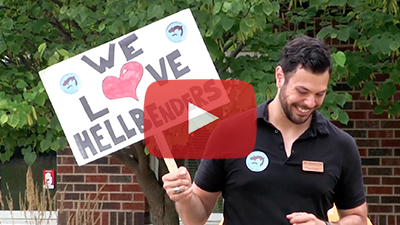 On August 29th, the Colombian Park Zoo in Lafayette hosted ‘Help the Hellbender Day’, an outreach event filled with fun and educational activities to promote awareness of this fascinating at-risk salamander. Partners in the community including Purdue University, Illinois – Indiana Sea Grant, Tippecanoe County Partnership for Water Quality, and the Wabash River Enhancement Corporation provided activities and booths to teach the community about water quality issues and how they can get involved to help the hellbender. The Salamander Tale exhibit featuring the Hellbender Havoc video game made an appearance as well.
To play the Hellbender Havoc video game visit:
Hellbender Havoc Game, Apple Store
Hellbender Havoc Game, Google Play
Perhaps the most interesting part of the day was the zoo sharing a rare glimpse of the juvenile hellbenders. As one of Purdue University’s partners the zoo is helping raise the hellbenders to increase their numbers. The three hellbenders showed in the video were hatched at the Purdue’s Aquaculture Research Lab by Professor of Wildlife Science Rod Williams and his team. They were then transferred to the zoo last spring, where they will be studied and raised until they are mature enough to be released in the wild.
Purdue FNR Extension’s Aaron Doenges filmed this exciting day at the zoo and put together a Help the Hellbender Day video featuring zoo director Ron Breeding, education coordinator Amber Frederick, and hellbender keeper Noah Shields. The FNR team returned to the zoo on October 21st for its annual Boo at the Zoo event sharing resources on hellbenders.
Resources:
Help the Hellbender Day at Columbian Park Zoo video – Purdue Extension
Help the Hellbender – Purdue Extension
Help the Hellbender Facebook page
Ask the Expert: Learn All About Hellbenders and Take a Tour, Subscribe Purdue Extension – Forestry & Natural Resources (FNR) YouTube Channel
Ask the Expert video: Help the Hellbender – Dr. Stephen Spear of The Wilds, Purdue Extension – FNR YouTube Channel
Ask the Expert video: Live with Mesker Park Zoo and Botanical Gardens – Hellbenders, Purdue Extension – FNR YouTube Channel
A Moment in the Wild video: Hellbender Hide, Purdue Extension – FNR YouTube Channel
A Moment in the Wild video: Release Moment of Hellbenders,
How Anglers and Paddlers Can Help the Hellbender video, Purdue Extension – FNR YouTube Channel
Eastern Hellbender ID Video, Purdue Extension – FNR YouTube Channel
Hellbenders Rock!, The Education Store, Purdue Extension’s resource center
Help the Hellbender, North America’s Giant Salamander, The Education Store
How Our Zoos Help Hellbenders, The Education Store
The Nature of Teaching: Adaptations for Aquatic Amphibians, The Education Store
Healthy Water, Happy Home – Lesson Plan, The Education Store
Purdue Expert: Hellbender Salamander, Purdue University News YouTube Channel
FNR Assists in First Natural Breeding of Eastern Hellbender in Captivity, Purdue FNR News & Stories
Helping the Hellbender: Mesker Park Zoo Begins Captive Breeding Efforts, Purdue Agriculture News
Purdue partners with Indiana zoos for hellbender conservation – Purdue Agriculture News
Purdue-Zoo Partnership Aims To Save The Hellbender – WFYI
Rod Williams, Professor of Wildlife Science and Assistant Provost for Engagement at Purdue University.
Purdue Department of Forestry & Natural Resources
The Wildlife Habitat Education Program (WHEP) is an environmental education program for youth ages 8-19 that teaches all about wildlife habitat and damage management through hands-on activities. This program is the largest of its kind in the nation, and has been awarded the Conservation Education Award by The Wildlife Society, the only professional organization that certifies wildlife biologists around the world.
Purdue Extension’s “WHEP – Wildlife Habitat Education Program” video takes a deeper look at the program through the testimonials of students and staff members involved with the program, including Extension Wildlife Specialist Rob Chapman and Professor of Wildlife Ecology Rod Williams.
Each year, WHEP has a national contest for its senior level (ages 14-19) youth consisting of three individual events and one team event. The first event, the wildlife challenge, consists of 30 general knowledge questions and 20 animal identifications based on skins and/or skulls. With only 30 minutes allowed for this event, it can be a challenging task.
Competitors can look to the WHEP manual for help studying for the general knowledge questions. The new publication “Wildlife Habitat Evaluation Program: Preparing for the Wildlife Challenge” assists further by providing flashcards for all of the species found on the identification questions, complete with pictures of the animal’s skins and a list of characteristics. Practicing with these flashcards is an extremely effective way to learn the material and perform better in the event.
This year’s event has come to a close, with 1st place going to Tennessee, 2nd place to Alabama, and 3rd to North Carolina. Study with the “Wildlife Habitat Evaluation Program: Preparing for the Wildlife Challenge” publication to prepare for next year!
Resources:
Wildlife Habitat Evaluation Program: Preparing for the Wildlife Challenge – The Education Store, Purdue Extension Resource Center
National WHEP Manual – Wildlife Habitat Education Program
Developing a Wildlife Habitat Management Plan – The Education Store
Wildlife Habitat Education Program – Teaching and Learning Wildlife Management Practices – The Education Store
Rod Williams, Professor of Wildlife Ecology
Purdue University Department of Forestry and Natural Resources
Rob Chapman, Extension Wildlife Specialist
Purdue University Department of Forestry and Natural Resources

Recent Posts
- Heavy August Rains Bring More Mosquitoes to Indiana
Posted: September 9, 2026 in How To, Invasive Insects, Safety, Wildlife - Question: Why Did the Shagbark Hickories Survive the Tornado?
Posted: August 27, 2026 in Forests and Street Trees, How To, Urban Forestry - New Indiana Woodland Steward Newsletter
Posted: August 12, 2026 in Forestry, Urban Forestry, Wildlife, Woodlands - Indiana Fall Hunting Licenses on Sale and New Mobile App Available
Posted: in Forestry, How To, Wildlife - Trees and Storms: Understanding Damage, Risk and Recovery
Posted: in How To, Urban Forestry - Lighting a Spark: Prescribed Burn Associations
Posted: August 6, 2026 in Community Development, Forestry, Safety, Wildlife - ID That Tree: Nannyberry Viburnum
Posted: July 22, 2026 in Forestry, Plants, Wildlife, Woodlands - ID That Tree: Eastern Swamp Privet
Posted: in Forestry, Plants, Wildlife, Woodlands - Jarred Brooke Receives Early Career Award for Prescribed Fire Work
Posted: July 20, 2026 in Forestry, Forests and Street Trees, Natural Resource Planning, Safety - Bovine Tuberculosis in Wild White-tailed Deer: Background and Frequently Asked Questions
Posted: in Disease, Natural Resource Planning, Wildlife
Archives
Categories
- Alert
- Aquaculture/Fish
- Aquatic/Aquaculture Resources
- Ask the Expert
- Christmas Trees
- Community Development
- Disease
- Drought
- Forestry
- Forests and Street Trees
- Gardening
- Got Nature for Kids
- Great Lakes
- How To
- Invasive Animal Species
- Invasive Insects
- Invasive Plant Species
- Land Use
- Natural Resource Planning
- Nature of Teaching
- Plants
- Podcasts
- Ponds
- Publication
- Safety
- Spiders
- Timber Marketing
- Urban Forestry
- Webinar
- Wildlife
- Wood Products/Manufacturing
- Woodland Management Moment
- Woodlands