‘Twas the day before Arbor Day, when all through the park
Not a creature was stirring, no chirp, squeak, or bark;
The birds were perched on the utility wires with care,
In hopes that many trees soon would be there;
All types of squirrels, gray, fox, and red;
Had visions of oak trees dancing in their head;
And mamma with her overalls, and I my work jeans,
Were prepared and ready to make the park green,
When out in the park there arose such a clatter,
I sprang to my window to see what was the matter.
Away out my door I flew like a flash,
Running to the crowd that was gathered ‘round the ash.
The dead looking tree with no leaves to show,
Gave a glimmer of midday through its branches to objects below,
When what to my wondering eyes came ‘round the corner with ease,
But a miniature truck and in the bed, eight tiny trees,
With a little old driver so lively and quick,
I knew in a moment it must be Mayor Nick.
The trees looking so healthy and flourishing as they came,
He whistled, and shouted, and called them by name:
“White Oak! Red Cedar! Silver Maple and Black Cherry!
Cottonwood, Black Walnut, American Beech and Hackberry!
It is time to grab your gloves, shovels, and spades!” He did call,
“Now plant away! Plant away! Plant away all!”
With his blueprints out he started to show,
Where in the park each tree would go;
So excited and anxious with all my gear I flew
To the truck full of trees, and Mayor Nicolas too.
And then, in a moment, I heard on the road
The roaring of more trucks with trees overflowed.
As I lifted my head, and was turning around,
The city forester and many arborists came with a bound.
Mayor Nick had called in the professionals to help us out,
So we all would understand what this project was all about.
“Before we start planting, I want to explain
the benefits from these trees the city will gain!
Trees increase property value and improve living conditions.
They also relieve stress and help with CO2 emissions.
Better air and water quality, and sound barriers, too,
And the best part is the beautiful new view!”
After Mayor Nick’s speech, the city forester stepped in
“Whose ready to plant some trees?” He said with a grin.
The crowd cheered and the project was now on its way
Making the park beautiful and green in honor of Arbor Day.
First thing we had to do, was remove the dead trees.
The park was originally filled with ash, which was a feast for EAB.
The arborists cut all the trees down one by one.
There was so much help, in no time the cleanup was done.
As we finally started planting, the professionals came around
Making sure we were putting the trees properly into the ground.
I learned that you cut and remove only 1/3-1/2 of the B&B,
Then, you check the roots, the most important part of the tree.
If the tree has spiraling roots, all four sides must be sawed,
So the tree’s way of nutrient uptake and anchorage is not flawed.
It is also important that the root flare is not below the soil line,
Many people tend to bury it, thinking their tree will be fine.
Before planting your tree, consider the tree’s full-grown size.
Improper planting can cause the tree to die otherwise.
I’m so glad I decided to volunteer today
I learned so much about planting trees the right way!
After countless hours of hard work and sweat,
Mayor Nick’s goals for the park were finally met.
He thanked everyone, and as he drove out of sight,
He shouted “Happy Arbor Day to all, and to all a good night!”
Arbor Day is an annual observance that celebrates the role of trees in our lives and promotes tree planting and care. As a formal holiday, it was first observed in 1872, in Nebraska, but tree planting festivals are as old as civilization. The tree has appeared throughout history and literature as the symbol of life. Arbor Day celebrations for 2017 is on Saturday, April 29th. Check out activities around your area: Purdue Extension County Offices, Indiana Department of Natural Resources or Tippecanoe Soil & Water Conservation District.
Cerulean Warbler captured in a mist net being processed by researchers.
Our oak-hickory forests provide us with many environmental, social and economic benefits. Without proper stewardship, these benefits and services can be reduced. Professional foresters have an innovative set of management options for the maintenance of healthy forest ecosystems. But some options raise public objections when applied to public lands (e.g., types of timber harvest, prescribed fire) and the effects of some management options on forests and their native inhabitants are poorly understood. Moreover, forest lands in the Indiana and Midwestern United States primarily are in small privately-owned parcels that change ownership relatively frequently. These lands are often managed for short-term financial gains rather than long-term sustainability.
To address this set of issues, the Hardwood Ecosystem Experiment (HEE), a long-term, large-scale experimental study of forest management and its impacts, was initiated in 2006. Two new videos developed from the HEE provide managers and landowners insights into sustaining our oak forests as well as how some wildlife responses respond to timber harvesting.
Invasive species are plants, animals, or pathogens that are nonnative (or alien) to the ecosystem under consideration and whose introduction causes or is likely to cause harm. An invasive species is a nonnative species that can cause significant environmental and economic losses. Invasive species are said to be the second leading cause of biodiversity loss, after habitat loss.
This lesson teaches students about the significant environmental and economic losses that can be caused by the introduction of invasive plant species. It includes a game that can be played in class, plus a worksheet. The lesson meets multiple Indiana science, natural resources, math, and social studies standards.
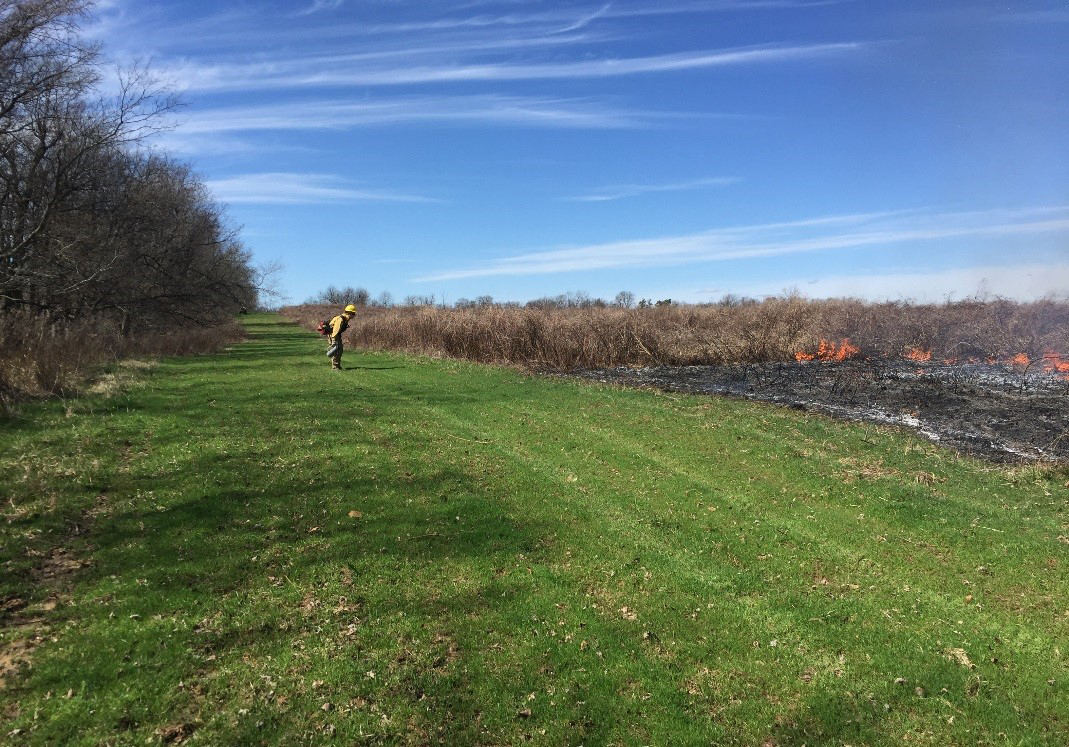
Fire can creep through or spot in cool-season grass firebreaks where thatch has accumulated potentially leading to an escaped fire.
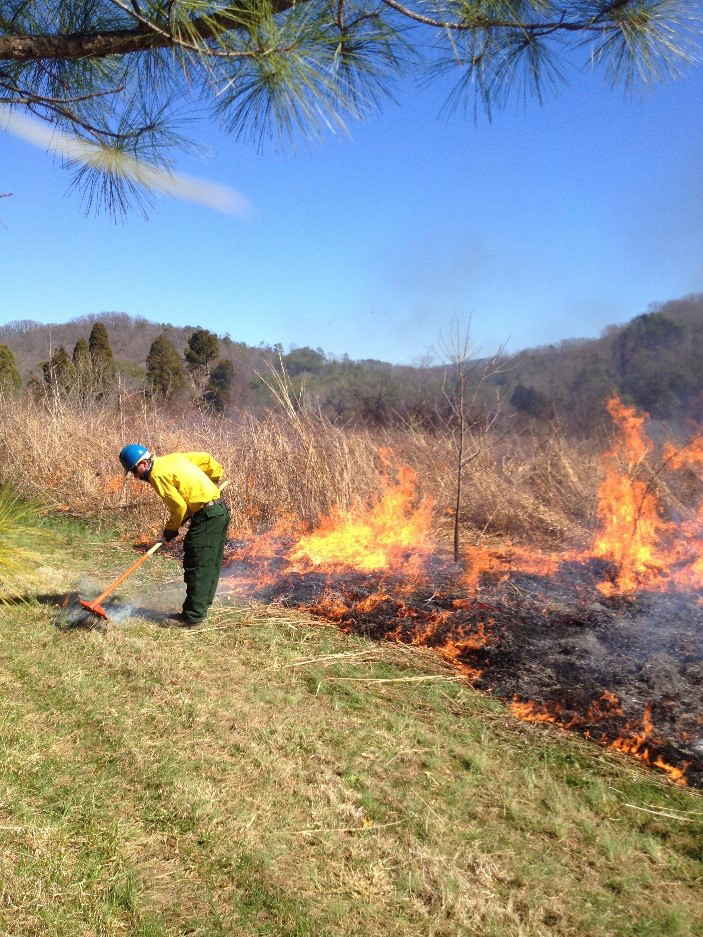
Prescribed fire is an important and effective wildlife habitat management and forestry tool. When used correctly, fire can improve habitat for a variety of wildlife species, forage for cattle, and conditions for oak regeneration among other things. Here are 6 things to consider before you light a prescribed fire in order to ensure it is conducted safely and effectively.
(1) What are your management objectives?
The management objectives you hope to accomplish with prescribed fire need to be outlined in your burn plan. Determining your management objectives will dictate how, when, and how often you burn. For example, you may not burn at the same frequency, in the same season, or with the same firing techniques if you were managing a field of native grasses for grassland songbirds vs. managing your woods for white-tailed deer. For grassland songbirds, you may burn a native-grass field with strip-heading fire during the dormant season every 1-2 years, whereas for white-tailed deer you should burn the woods with a low-intensity backing fire during the dormant or late-growing season every 3-5 years.
(2) Do you have a burn plan?
A well-written burn plan should address all relevant components of the prescribed fire and will answer all the other questions listed below. The plan should include management objectives, the weather prescriptions for the burn, the fuel type(s) (native grass, leaf litter, etc.) being burned, location and make-up of the firebreaks (bare soil, road, creek, etc.), equipment and personnel needed, who to contact before and after the burn, smoke sensitive areas (schools, hospitals, roads), proposed firing techniques, safety considerations, and contingency plan. The burn plan should also include a map of the burn unit and surrounding area. This will help to identify potential hazards or areas where the fire might escape.
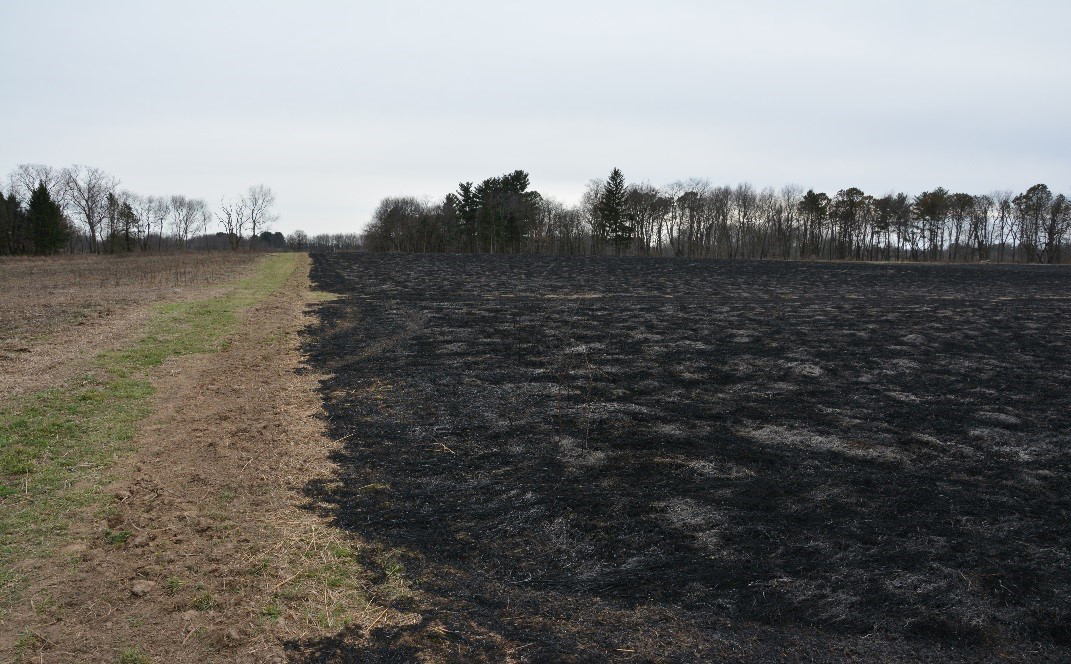
Green growing vegetation with no thatch such as wheat and clover (top picture) and disked or tilled areas (bottom picture) make ideal firebreaks. Wheat or clover firebreaks also double as food plots for various wildlife species and disked firebreaks are attractive to turkeys and bobwhite for brooding areas.
(3) Are your firebreaks in place?
Inadequate firebreaks are a common safety hazard when conducting a prescribed fire and a very likely place for an escape! The firebreak width and composition necessary to conduct your prescribed fire safely should be outlined in your burn plan and firebreaks should be inspected the day of the burn. DO NOT ignite a fire with inadequate firebreaks or if all firebreaks have not been inspected.Mowed cool-season grasses are not ideal firebreaks but they can be used. Dead plant material (thatch) can accumulate in cool-season grass firebreaks following mowing, and this could allow the fire to creep through the firebreak. If you do have mowed cool-season grass firebreaks, make sure thatch has not accumulated and watch them closely during the fire to ensure fire doesn’t creep through the break. You should also consider using water to create a “wet-line” firebreak to contain the fire.Bare soil creates the best man-made firebreak.Bare soil firebreaks can be created by disking, tilling, or bulldozing. Empty crop fields, green growing vegetation with no thatch (clover, wheat, alfalfa in the spring), paved, dirt, or gravel roads, and streams, creeks, or rivers also make great firebreaks. In the woods, a leaf blower can be used to remove leaf litter and expose bare mineral soil. Firebreaks should be at least 3 times the width of the adjacent vegetation. In fields of native grasses, firebreaks should be 15-50 feet. By mowing the grasses directly adjacent (10-20 feet) to a firebreak, you can reduce the necessary firebreak width. In the woods, firebreaks only need to be 3-10 feet in width, especially when using only backing fire.
(4) Have you notified the right people about the burn?
Your burn plan should outline who you need to call before and after a prescribed fire. Important people you should call before ignition are the county emergency dispatch (call the non-emergency number), local fire department, and adjacent landowners. You should also call the county dispatch after the fire is complete and extinguished.Calling the county dispatch and local fire department will make them aware of the prescribed fire and sometimes the local fire department might even be willing to lend a hand! Calling dispatch is important because they will likely receive calls from concerned citizens during the fire. Letting them know ahead of time that it is a “prescribed fire” and is being monitored will reduce the number of unnecessary trips by the local fire department.
(5) What are you going to do if the fire escapes?
Escapes do happen and you need to know what to do if your fire escapes. This is called a contingency or escaped fire plan and should be outlined in your burn plan. This plan outlines the roles each person plays if the fire escapes and determines at what point additional resources – fire department or others – should be called to assist in the suppression of the fire.
(6) Have you done your safety briefing?
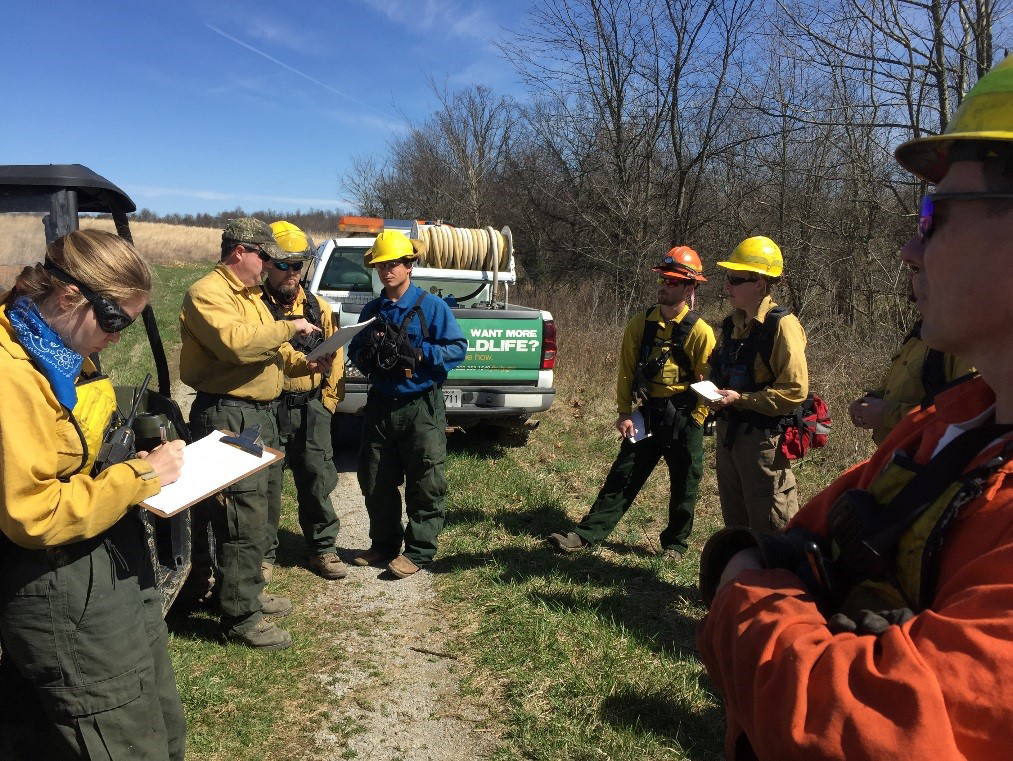
The last step before ignition of a prescribed fire is the safety briefing. The safety briefing will familiarize personnel with the area, conditions of the firebreaks, weather conditions, radio communication, safety zones and escape routes, contingency plan, and other relevant information. This ensures all the personnel are on the same page when it comes to safely completing the prescribed fire!
Safety briefings before ignition help familiarize personnel to the area, weather conditions, and potential hazards and help to ensure the fire is conducted safely.
Prescribed fire is an effective management tool, but is only effective if conducted safely! Safety on a prescribed fire is paramount and fires should only be conducted by experienced individuals. If you are interested in learning more about how and why to use prescribed fire on your property, contact your local IN-DNR wildlife biologist.
Spring is a time of awakening for our forests as the cold temperatures slowly move to another part of the world and the first crop of buds appear on the trees. These delicate buds are the physical representation of energy stored by the tree over the winter for later use in leaf production. This splurging of energy in springtime is an effort by the tree to produce as many leaves as possible to initiate photosynthesis and carbon assimilation for growth. Unfortunately for the trees, these juicy new leaf bundles are an irresistible temptation for the grazing animals in need of nutrients to replenish those stores lost during winter.
How can the trees thwart these hungry ungulates? One would be led to believe that the sedentary nature of trees renders them defenseless. Fortunately, that is not the case. In a research study published earlier this year, scientists at Leipzig University and the German Centre for Integrative Biodiversity Research (iDiv) have found that European beech (Fagus sylvatica L.) and Sycamore maple (Acer pseudoplatanus L.) trees use chemical warfare to fight back against foraging roe deer (Capreolus capreolus).
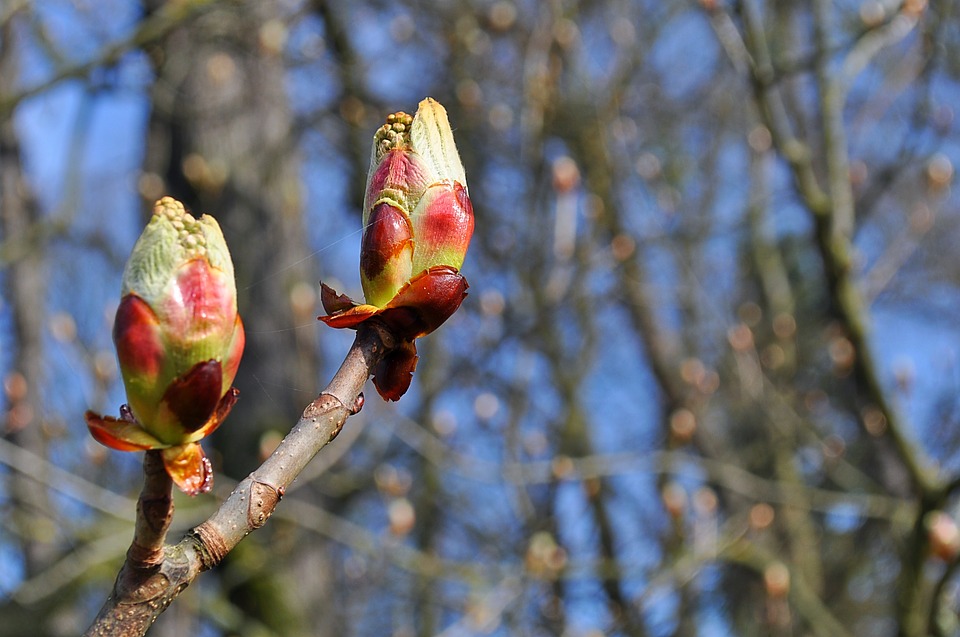
Buds in spring. https://pixabay.com/
In has been established in other forest species that feeding insects stimulate trees to produce chemicals to deter them from further feeding. This study is the first to present data that indicates that a tree species can identify and selectively defend against browsing deer. Manually clipping buds and leaves to simulate storm or mechanized (chainsaw) damage activated the jasmonic acid wound response pathways in both beech and maple but no defensive responses. However, introduction of deer saliva after clipping the buds and leaves led to increased production of salicylic acid (used in humans as a chemical exfoliant, antiseptic, and acne treatment) and tannins (bitter tasting substance used to cure leather and to make ink) in beech leaves with tannins and flavonol (used as an antioxidant in humans and also functions to block bacterial adhesion) being elevated in maple. These chemicals make the leaves and buds distasteful and difficult to digest.
The results of this study open up entirely new lines of research into tree defense responses. What types of responses do other tree species have? Do they produce stronger chemicals? Is deer browse preference based on the presence or absence of a chemical response? Do they wander from tree to tree to browse to avoid the full onslaught of the chemical response? I am certain that those are stories for another day.
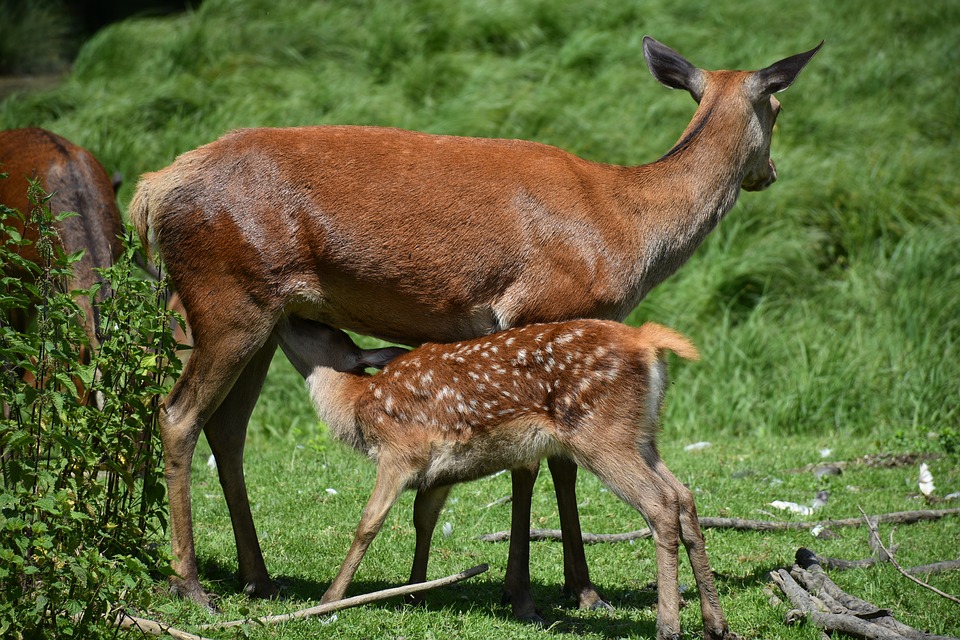
Deer. https://pixabay.com/.
Reference Materials Scientific Literature: Ohse, B., Hammerbacher, A., Seele, C., Meldau, S., Reichelt, M., Ortmann, S., and Wirth, C. 2016. Salivary cues: simulated roe deer browsing induces systemic changes in phytohormones and defense chemistry in wild-grown maple and beech saplings. Functional Ecology doi: 10.1111/1365-2435.12717.
Online site: German Centre for Integrative Biodiversity Research (iDiv) Halle-Jena-Leipzig. “Trees recognize roe deer by saliva: Smart defense mechanisms against browsing.” ScienceDaily. ScienceDaily, 12 September 2016. Last Accessed: October 10, 2016.
Shaneka Lawson, USDA Forest Service/HTIRC Research Plant Physiologist/Adjunct Assistant Professor
Purdue University Department of Forestry and Natural Resources
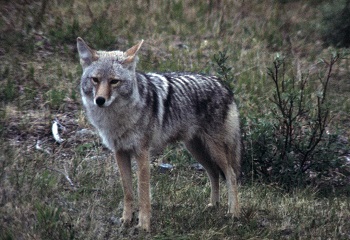
Coyote (Canis latrans) – Photo by Alfred Viola, Northeastern University, Bugwood.org
In acknowledging National Wildlife Week, #nationalwildlifeweek, it seems fitting to place this post regarding several concerned questions that we receive on coyotes. As Spring is just around the corner many urban residents are getting ready for the return of many birds, mammals and amphibians. While folks are quick to recognize the call of spring peepers, or the song of robins, they are surprised to know other types of critters can call their backyard home, or at least visit on occasion. One animal that is getting a lot more attention in recent years is the coyote.
Coyotes are actually native to Indiana, although their historical distribution is much smaller in the state than it is today. Their range expansion is simply the result of their adaptability. Things we have done to the broader landscape combined with less competing animals has opened up new resources to coyotes. You may tend to think that urban landscapes offer little for wildlife species and don’t offer the quality of rural or more “natural” areas. Perhaps surprising to many, urban environments can often support larger densities of wildlife presumably because of increased food resources and lower trapping or hunting pressure. For coyotes, studies have shown that urban coyotes tend to focus activities in natural habitats within the urban landscape. They will still use more well-developed areas and the extent of which varies among animals; however, coyotes will often shift their behavior to avoid human activity.
Coyotes are considered to be a nuisance or even a safety threat by some. They are probably one of the few animals that homeowners want removed simply by seeing them in their yard. However, these fears are rarely justified. Diet studies of urban coyotes indicate they eat primarily rodents and rabbits. Coyote predation may actually help reduce conflicts with other species of wildlife. As a primary predator of Canada goose nests they may limit population growth in urban environments. Similarly, coyotes may do the same for white-tailed deer populations through fawn predation.
Fear of coyotes is derived largely of perceived threats to pets or people. Coyotes have been documented to attack people, but only rarely. Habituation to humans seems to play a role but it is also unclear how other factors contribute to these attacks. For example, the age or social status of the offending coyote and the intentional feeding by humans preceding the attack may play roles. Moreover, not all attacks are the same. Coyotes may attack out of defense, because of disease (e.g., rabies), or other reasons.
The threat to pets, particularly cats or small dogs, is much more real. Coyotes are known predators of cats. In urban areas, predation of cats is slightly higher than in rural areas, although cats still make up only about one percent or less of their diet according to studies. Cat predation may be ecologically beneficial given the impact free ranging cats have on our native wildlife. Attacks on dogs are less common but do occur and are most frequent during the coyote breeding season, December through February. Small dogs are at most risk but larger breeds may be attacked by a pair or family group.
While these facts on coyote behavior may alarm some, the truth is these are all extremely rare cases. Coyotes are around many of us every day and we aren’t even aware of their presence. Coyotes are native to Indiana and can help control populations of other wildlife species that cause more widespread conflicts and property damage. However, there are a few common-sense steps we can do to avoid conflicts with urban coyotes. The most important is to never intentionally feed coyotes or other animals. They don’t need it. Intentional feeding can contribute to coyote’s habitation to people, which is believed to be a contributing factor to attacks. Some also recommend scaring off coyotes you see in the yard by banging pots and pans or similar actions. However, this may cause a defensive response in some animals and it not advisable.
As part of a new educational video project, Purdue Extension offers essential tips on how to select veneer trees and logs that demand a premium.
The video features Dan Cassens, a professor of wood products at Purdue University, and Greg Hartog of Danzer Americus in Edinburgh, Ind. They give comprehensive details about preferred tree species as well as characteristics, including defects, that are important to the veneer industry.
The advice should be of particular interest to landowners, log brokers, sawmill operators and forestry consultants in Indiana and throughout the hardwood region. Indiana has had a long history of supplying the industry with quality veneer logs and veneer since the early 1900s, Cassens said.
The Hellbender is a giant, aquatic salamander that has experienced severe population declines throughout its range. It is a sensitive species and there are a number of factors contributing to its declines. To help address the varied threats facing the Hellbender, Help the Hellbender has produced several new products focused on educating both stakeholders and the general public on ways that they can help protect hellbenders.
Help the Hellbender has updated our brochure on hellbender biology and created a series of videos focused and hellbender threats and the relevant stakeholders. The updated brochure expands on the previous edition by including updated information on hellbender biology and the many projects that groups around the country are involved in to help protect hellbenders. Our video series builds off of information in our brochure. The first in this series focuses on the basics of Hellbender population declines. Subsequent videos address practices aimed at improving water quality by implementing conservation practices at farms, livestock operations, and around sinkholes, and also how recreationists can avoid harming Hellbenders.
We have also published two lesson plans targeted at educators of K-5 students. Both lessons contain numerous activities to help keep students engaged while learning about hellbenders and the science of water quality and conservation. Hellbenders Rock! focuses on basic Hellbender biology and the threats that Hellbenders face. Hellbenders Rock! can be combined with the recently published Hellbender Havoc video game to further engage students in learning about hellbender biology and the importance of water quality. Hellbender Havoc is a free app available for download from iTunes and the Google Play Store. The Healthy Water, Happy Home lesson plan focuses on the importance of water quality and how it relates to people and wildlife. Both lesson plans meet Indiana academic standards.
All of our resources are free and can be found at The Education Store, the Purdue Extension resource center. The links are available below. For more information about Eastern Hellbenders and how you can help, please visit helpthehellbender.org.
Once aquatic invasive species (AIS) are established in a new environment, typically, they are difficult or impossible to remove. Even if they are removed, their impacts are often irreversible. It is much more environmentally and economically sound to prevent the introduction of new AIS through thoughtful purchasing and proper care of organisms. Check out Illinois-Indiana Sea Grant’s web page the Aquatic Invasive Species and find resources for teachers, water garden hobbyists, aquatic landscaping designers and to aquatic enthusiasts. The video titled Beauty Contained: Preventing Invasive Species from Escaping Water Gardens is also available which contains guidelines that were adopted from the Pet Industry Joint Advisory Council and the Aquatic Nuisance Species Task Force along with addressing the care and selection of plants and animals for water gardens.
Quagga mussels, which arrived in Lake Michigan in the 1990s via ballast water discharged from ships, have colonized vast expanses of the Lake Michigan bottom, reaching densities as high as roughly 35,000 quagga mussels per square meter. The invasive species that can have major economic impacts filters up to 4 liters of water per day, and so far seems unaffected by any means of population control. It is also a constant threat to other systems, as it is readily transported between water bodies.
Researchers have long known that these voracious filter feeders impact water quality in the lake, but their influence on water movement had remained largely a mystery.
“Although Lake Michigan is already infested with these mussels, an accurate filtration model would be imperative for determining the fate of substances like nutrients and plankton in the water,” Purdue University PhD candidate David Cannon said. “In other quagga mussel-threatened systems, like Lake Mead, this could be used to determine the potential impact of mussels on the lake, which could in turn be used to develop policy and push for funding to keep mussels out of the lakes.”