 Purdue University - Extension - Forestry and Natural Resources
Got Nature? Blog
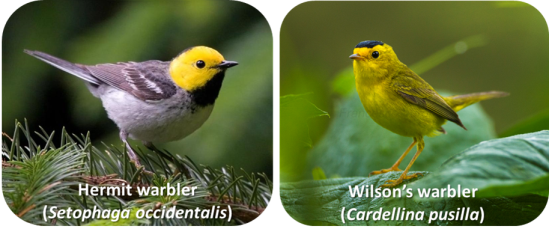
A new study published in Diversity and Distributions noted old-growth forests, with their diverse tree sizes and species may provide refuge for bird species in population decline resulting from climate shifts. Researchers at Oregon State University’s College of Forestry noted over the last 30 years that temperature increases during the breeding season limited population growth for two tracked species; Wilson’s warbler (Cardellina pusilla) and the hermit warbler (Setophaga occidentalis). These effects were mitigated in areas containing significant proportions of old-growth forest.
Using satellite imagery of the research areas allowed the research team, led by Matthew Betts, to calculate approximate distances to old-growth forests along each 25mi survey route. Their findings provide support for the importance of old-growth forest conservation in our current changing climate. Researchers on this project admit that more research is needed to identify specific qualities of old-growth forests that provide a buffer for these bird species however, they have stated that it could be that the trees are able to moderate temperatures by functioning as heat sinks with multiple canopy layers as climate buffers.
Reference:
Betts MG, Phalan B, Frey SJK, Rousseau JS, Yang Z. Old-growth forests buffer climate-sensitive bird populations from warming. Divers Distrib. 2017;00:1–9.
Resources:
Complex, old growth forests may protect some bird species in a warming climate, ScienceDaily.com
Forest Birds, The Education Store
Breeding Birds and Forest Management: the Hardwood Ecosystem Experiment and the Central Hardwoods Region, The Education Store
Forest Improvement Handbook, The Education Store
Shaneka Lawson, USDA Forest Service/HTIRC Research Plant Physiologist/Adjunct Assistant Professor
Purdue University Department of Forestry and Natural Resources
Prescribed fire is a great tool to improve the food and cover for a variety of wildlife species on your property. One of the most important aspects of using prescribed fire is making sure the fire is conducted safely. This point cannot be overstated, safe use of prescribed fire is paramount. Beyond taking the appropriate training courses or seeking help from a professional, one the most important aspects of safely conducting a prescribed fire is ensuring you have adequate firebreaks.
Firebreaks can serve multiple purposes related to the safe use of prescribed fire and can provide additional food and cover for wildlife. The main purpose of firebreaks is to stop the fire from escaping the burn unit, but they also can provide quick and easy movement around the burn unit, help reduce the amount of people required for the burn and can make igniting the fire safer. Here are a few examples of different types of firebreaks.
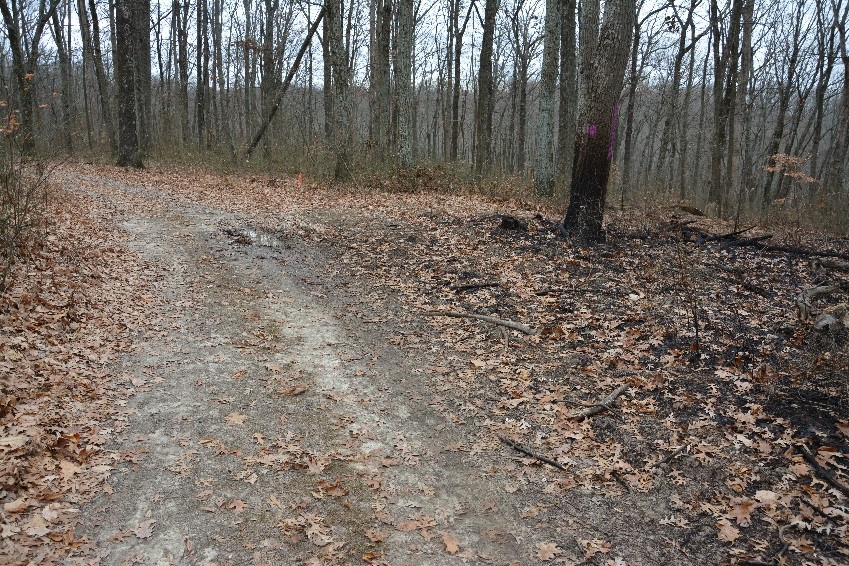
This logging road is a good example of an existing road that can be used as a firebreak.
Existing roads
Existing roads, whether they are paved, gravel, dirt, or logging roads, can serve as outstanding firebreaks, plus they require very little work to prepare prior to a burn. These are also one of the cheapest options for firebreaks. If you are using gravel, dirt, or logging roads as firebreaks, you need to make sure there is not excessive vegetation or leaf litter in the road. Too much vegetation
on the firebreak could lead to an escape.
Streams, creeks, or other bodies of water
Another cheap and easy option for firebreaks is to use existing streams, river, or bodies of water. If you are using water features as a firebreak, here are some things to consider: is the stream or river wide enough to stop the fire from escaping and can people helping with the fire move easily around, across, or through the stream or river to access various part of the burn unit or to stop an escaped fire?
Crop fields
Crop fields with cool-season grains (wheat, oats, rye) or cover crops can serve as a great firebreak. Crop fields with only soybean or corn stubble should be used with caution, as fire may creep through a field with excessive stubble. For fields with crop stubble, planting the edge of the field in a cool-season crop (wheat, clover, oats, etc.), disking the edge of the field, or wetting the crop stubble are all steps that can used to improve the field as a firebreak.
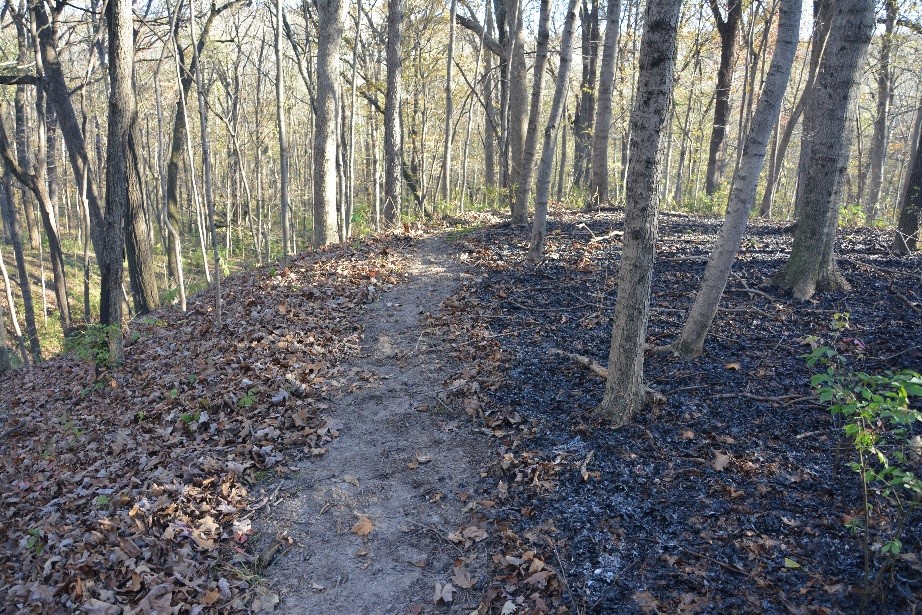
This leaf-blown firebreak was only 3-4 feet wide, but it easily stopped the fire in this situation.
Leaf-blown firebreaks
If you are burning in the woods, using a leaf blower to remove leaf litter and expose bare mineral soil is a quick and easy way to create a firebreak. These firebreaks do not need to be as wide as those in an old field or native grass stand because the flame length when burning in the woods is typically much shorter than burning in a field.
Disked firebreaks for multiple purposes
Disking or tilling to expose bare mineral soil is an extremely effective method of creating a firebreak. These breaks can also provide food and/or cover for various wildlife species if managed correctly. Disking the firebreak and then letting the firebreak remain fallow during the growing season creates outstanding cover for brooding turkeys, pheasants, and quail.
You can also plant the firebreaks after disking to create a food plot for various wildlife species. If you disk the firebreaks in the fall and plan to burn in the spring, you can plant the firebreaks with a mix of wheat and crimson clover or a mix of perennial clovers to create a great food plot for deer and turkey. You can also plant the firebreaks with millet, grain sorghum, or sunflowers after you have burned the field in the spring.

If you use mowed firebreaks you run the risk of fire creeping across the firebreak and escaping, especially if there is too much thatch in the firebreak.
My absolute favorite multiple purpose firebreak is one that is disked in Aug-Sep, planted to winter wheat (40-60 lbs/ac), and then left to remain fallow after the wheat has produced seed. This firebreak effectively stops fire, provide green browse from the fall through the spring, provides seed during the early summer, and provides excellent brood cover throughout the summer and early fall. This is truly an all-in-one firebreak.
Mowed grass firebreak
Mowed grass firebreaks are not ideal, but they can be used in certain situations. If mowed firebreaks are used, you must be sure that there is not excessive thatch built up in the break. Too much thatch will allow the fire to creep across the break and potentially escape. Even on firebreaks without excessive thatch, using water to create a “wet” firebreak is recommended.
No matter which type of firebreak you choose to use, taking the time to make sure the firebreak is adequately installed and is sufficient to stop the fire from escaping will help make the burn safer and will create less headaches for you when conducting the burn.
Additional Resources:
Firebreaks for Prescribed Burning, Oklahoma State University Extension
Prescribed fire: 6 things to consider before you ignite, Got Nature?, Purdue Extension-FNR,
On-line Basic Prescribed Fire Training, USDA, U.S. Forest Service
Publications Focus on Plan, Safety of Prescribed Burns, Iowa State Extension,
eFIRE, North Carolina State Extension
Renovating native warm-season grass stands for wildlife: A Land Manager’s Guide, The Education Store, Purdue Extension resource center
Calibrating a No-Till Drill for Conservation Plantings and Wildlife Food Plots, The Education Store
Jarred Brooke, Wildlife Extension Specialist
Purdue Department of Forestry and Natural Resources
Planting at the proper seeding rate is an important step to ensure a successful native warm-season grass and forb planting or a wildlife food plot. This video will discuss how to properly calibrate the seeding rate for a Truax No-Till Seed Drill. The video will also discuss a calibration method that can be used with multiple different types of seed drills.
Check out these detailed resources that are referenced in the video:
Seed Fillers and Carriers for Planting Native Warm-Season Grasses and Forbs
Pure Live Seed: Calculations and Considerations for Wildlife Food Plots
Resources:
Renovating Native Warm-Season Grass Stands for Wildlife: A Land Manager’s Guide, The Education Store, Purdue Extension resource center
Food Plots, Got Nature?, Purdue Extension-FNR
Food Plots for White-Tailed Deer, The Education Store
Jarred Brooke, Extension Wildlife Specialist
Purdue Department of Forestry and Natural Resources
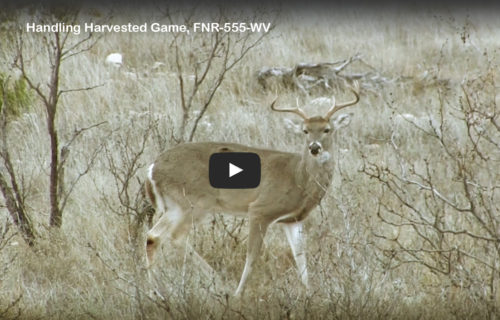 In this new video series Handling Harvested Game: Field Dressing, wildlife biologist Bob Cordes with the Maine Department of Inland Fisheries and Wildlife shows how to properly treat and handle deer in order to receive the best results for your venison. This video shares step by step safe handling techniques to reach your goals in providing a wholesome source of meat for you and your family.
More resources:
Handling Harvested Game – Episode 2, Purdue Extension-Forestry and Natural Resources YouTube Playlist
How to Score Your White-tailed Deer, video, The Education Store, Purdue Extension Resource Center
Age Determination in White-tailed Deer, video, The Education Store,
How to Build a Plastic Mesh Deer Exclusion Fence, The Education Store,
Bovine Tuberculosis in Wild White-tailed Deer, The Education Store,
Indiana Deer Hunting, Biology and Management, Indiana Department of Natural Resources (IDNR)
Rod Williams, Associate Professor of Wildlife Science/Engagement Faculty Fellow
Purdue University Department of Forestry and Natural Resources
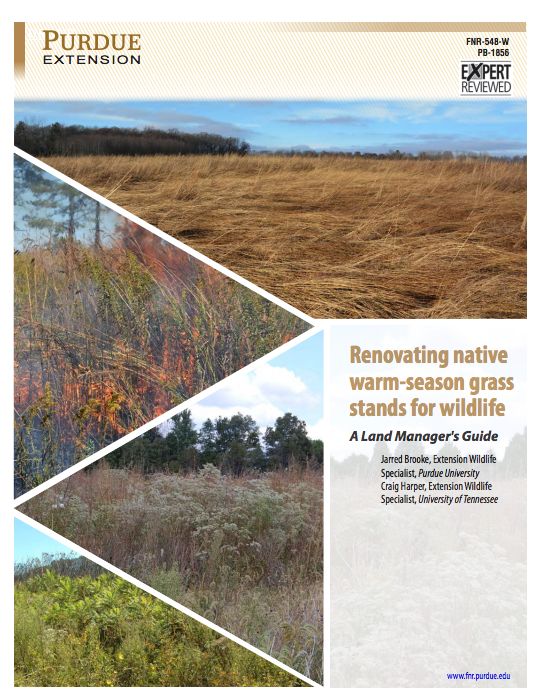 A new extension publication co-authored by Purdue Extension Wildlife Specialist, Jarred Brooke, and University of Tennessee Extension Wildlife Specialist, Dr. Craig Harper, provides landowners and land managers with practical recommendations to assist in the management and renovation of existing native-warm season grass stands for wildlife. The publication provides information on how to use various habitat management tools to fix common issues in planted native grass stands. The publication was produced in partnership with University of Tennessee Extension, Indiana DNR Fish & Wildlife Division, and the Indiana State Chapter of the National Wild Turkey Federation.
The electronic copy of the publication is available to download for free from the Purdue Education Store. Printed copies are also available from the Education Store for $10.
Resources:
Sericea Lespedeza, Plague on the Prairie, Got Nature?, Purdue Extension-FNR
Prescribed fire: 6 things to consider before you ignite, Got Nature?, Purdue Extension-FNR
If Your Native Grasses Look Like This, It’s Time for Management, Got Nature?, Purdue Extension-FNR
Jarred Brooke, Extension Wildlife Specialist
Purdue Department of Forestry and Natural Resources
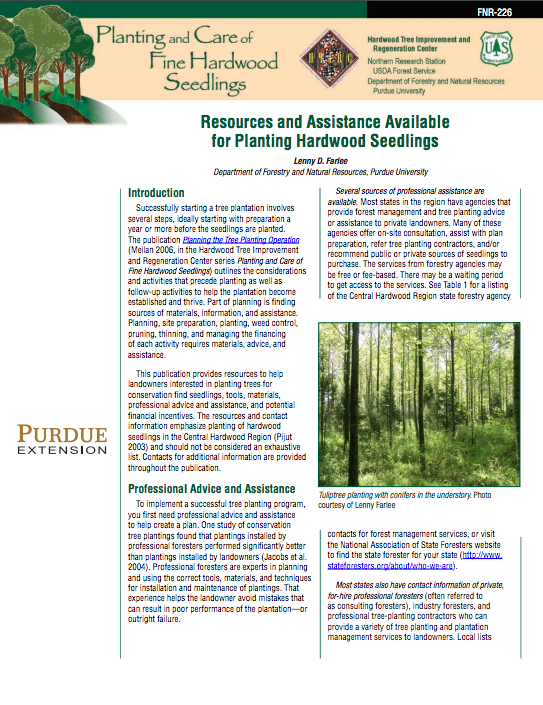 Successfully starting a tree plantation involves several steps, ideally starting with preparation a year or more before the seedlings are planted. This updated publication with current resources titled Resources and Assistance Available for Planting Hardwood Seedlings, landowners can find valuable information about planting trees for conservation, such as resources, contact information, tools, professional advice and assistance and financial incentives.
Resources:
Ordering Seedlings from the State Forest Nursery System, Got Nature?, Purdue Extension-FNR
Instructions for Ordering Tree Seedlings – Indiana DNR Division of Forestry
Importance of Hardwood Tree Planting – The Education Store, Purdue Extension Resource Center
Forest Improvement Handbook – The Education Store
Designing Hardwood Tree Plantings for Wildlife – The Education Store
Lenny D Farlee, Sustaining Hardwood Extension Specialist
Purdue University Department of Forestry and Natural Resources
 Question
I have raccoons in my attic. Before I evict them, I want to provide an alternate place for them to go. There aren’t really enough trees around here anyway, so I want to make a raccoon house or two. Do you have any plans you could recommend? Also, in order to deter them from trying to get back in, is it true that they dislike wire/hardware cloth, and so I could reinforce those areas with that on the outside?
They shouldn’t be pregnant yet, should they?
Answer
Raccoons usually breed in the end of January into February, but that is not a concern for your issue. Even sows with young can move from one “den” site to another. You will need to remove the raccoon prior to repairing how the animal got in. You need to be absolutely sure that the raccoon is not in the attic before you exclude it. If you simply put up a box and fix your house, that will likely not solve your problem. The raccoon will likely try and get back in your attic, which is their “den tree” from the animal’s perspective. You can lawfully trap and relocate raccoons without a permit. Check out the Indiana Department of Natural Resources (IDNR) Wildlife Removal website for more information
A resident landowner or tenant can legally capture these species of wild animals listed above without a permit on the property that he/she owns or rents if the animal is:
- causing or threatening to cause damage to property, or
- posing a health or safety threat to people or domestic animals.
The landowner/tenant also can designate another person to take the animal for them if:
- the landowner/tenant provides written permission (which must be on the person while taking the animal),
- and no compensation of any kind is given to the person who takes the animal.
- A hunting or trapping license, or a nuisance wild animal control permit, is required to take wild animals on land that you do not own or rent.
Within 24 hours of capture, the person who takes the animal must release it or euthanize it. Animals that are released must be released on land in the county where it was captured. Furthermore, the landowner or property manager must give permission for the release. These nuisance animals cannot be possessed for more than 24 hours and cannot be sold, traded, bartered or gifted.
For excluding the raccoon, or others, from your attic, you will need to use good materials. Hardware cloth or metal flashing typically work well. It isn’t that they don’t like those materials, they are sturdy enough to hold up. Also, repairing the damage to its original constructed method is good. Usually where animals enter it is either worn or damaged areas, or gaps in construction (even in new houses).
Resources:
Raccoon Box Plan – Pennsylvania Game Commission
Preventing Wildlife Damage – Do You Need a Permit?, The Education Store, Purdue Extension Resource Center
Selecting a Nuisance Wildlife Control Professional, The Education Store
Trapping Nuisance Wildlife, Got Nature?, Purdue FNR-Extension
Brian MacGowan, Extension Wildlife Specialist
Department of Forestry & Natural Resources, Purdue University
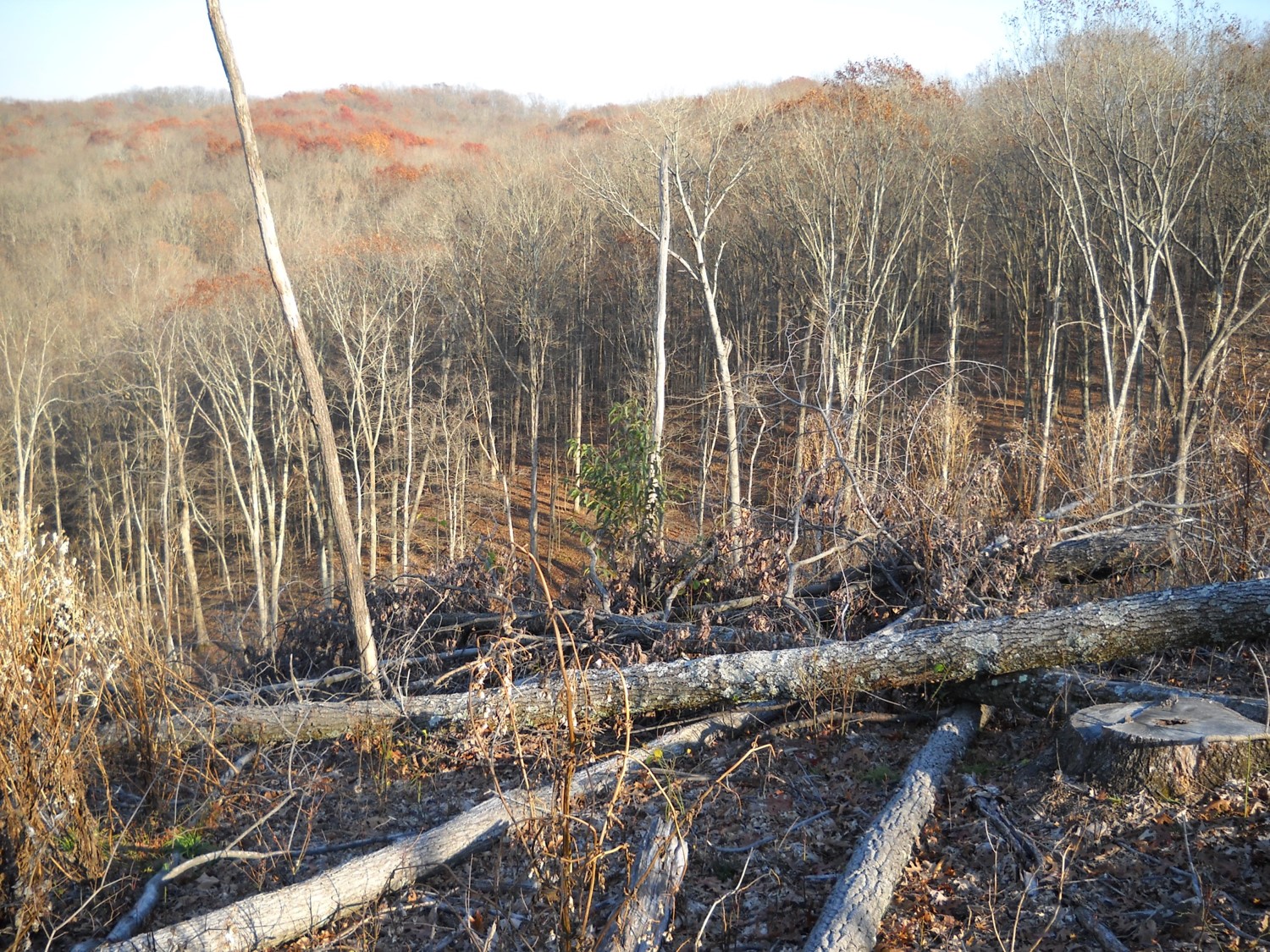 There has been much debate in the popular press lately regarding the role of timber harvesting on forest communities. A common focus of this debate is the perceived impacts to wildlife. Most believe that leaving our forests alone is best for wildlife. However, to provide habitat for all of our native forest wildlife species, forests need to be diverse in terms of age, species and area. Harvesting timber is the primary means of achieving this structural diversity. The purpose of this article is to summarize some key points regarding the effects of harvesting on reptiles and amphibians. These points are drawn mostly from the Hardwood Ecosystem Experiment (HEE), an ongoing research study in southern Indiana. Its primary focus is to study forest management and its effects on plants and animals. A more detailed summary may be found in Forest Management for Reptiles and Amphibians.
There has been several large-scale studies that have investigated the effects of tree canopy removal on amphibians and reptiles. These include the HEE in Indiana, the Missouri Ozark Forest Ecosystem Project (MOFEP), and the Land-use Effects on Amphibian Populations (LEAP). Much of the work from these projects has been published in the scientific literature. All of these studies demonstrate that the response of amphibians and reptiles to timber harvesting is variable—it cannot simply be quantified as good or bad. Indeed, avoiding negative impacts to all reptiles and amphibians as a result of timber harvesting is neither possible nor desirable since disturbance-dependent wildlife species1,2 and many mature forest species3, require early successional forests.
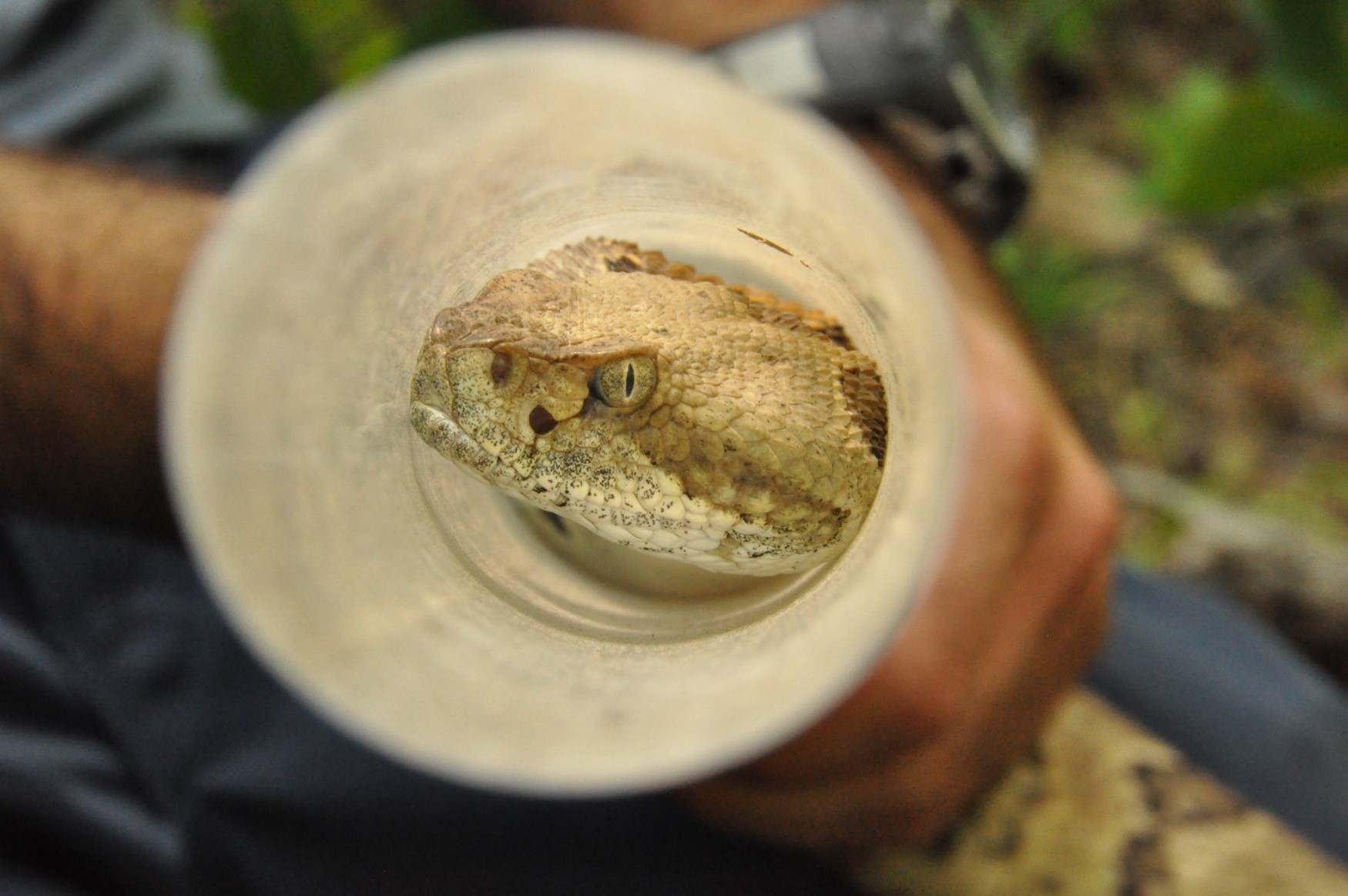
Timber Rattlesnake
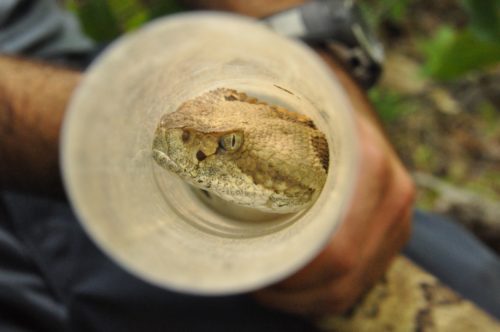 For the focal species studied on the HEE, most exhibited moderate or no response in 1-3 years following timber harvests. The focal species I and colleagues have studied were timber rattlesnakes (Crotalus horridus), eastern box turtles (Terrapene carolina), and terrestrial salamanders. Timber harvests had no effect on the area male or female adult timber rattlesnakes used during the active season. There was no evidence that snakes changed movement behaviors to avoid clearcuts4. Indeed, several snakes were observed within clearcuts for several weeks and across multiple years. Annual survival of rattlesnakes on the HEE sites was high during the active season (72-98%) and winter (97-99%). Timber harvesting had no impact on survival. Declines in female survival was most affected by declines in prey abundance the previous year which were due to tree mast failures5. The level of acorns and nuts (i.e., mast) produced in woodlands naturally vary from year to year. When the small mammal population declined due to mast failure, these snakes were apparently impacted the following year.
Eastern Box Turtle
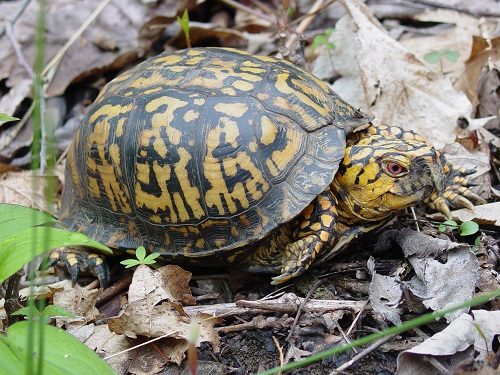 For box turtles, there was no effect of timber harvests on home-range size, but the average daily distance traveled by turtles decreased by 30 percent following harvest, and turtles maintained 9 percent higher body temperatures6. Temperatures in harvest openings were 29 percent warmer in the summer and 31 percent colder in the winter than forested sites. Despite this change, turtles continued to use harvest openings during the active season, but tended to make shorter, more frequent movements in and out of harvests. Turtles likely used harvest edges for cover, thermoregulation and, possibly, foraging opportunities6. Harvested areas offered potential hibernation sites based on soil profile temperatures, slope aspect and depth of hibernation7. Both active and hibernal data suggest the level of harvesting on the HEE has modest effects on box turtle behavior, at least in the short term. To date, there is no evidence to support whether these changes have any impact—positive or negative—on box turtles.
Woodland Salamanders
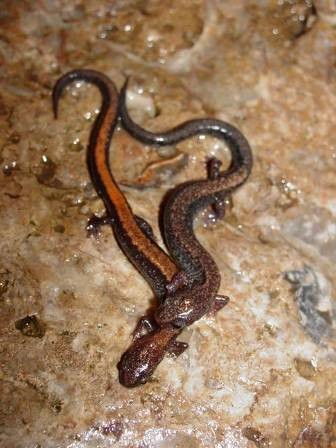 The response of woodland salamanders to harvests was species-specific8. The relative abundance of eastern red-backed salamanders (Plethodon cinereus) and northern slimy salamanders (Plethodon glutinosus) declined from pre- to post-harvest in patch cuts (1 to 3 acres) and clearcuts (10 acres). Red-backed salamanders also declined in control sites, suggesting factors other than the harvests contributed to salamander declines over the study period. However, red-backed salamander declines observed in control sites were not as severe as those seen within patch cuts and clearcuts, indicating harvests were at least partially responsible for observed declines within the harvest boundaries. The relative abundance of northern zigzag salamanders (Plethodon dorsalis) did not decline from pre- to post-harvest in any harvest type, and increased on sites adjacent to clearcuts.
- These findings suggest canopy removal (2-10 acre gaps) has short-term local impacts on terrestrial salamanders in terms of relative abundance, but effects do not necessarily extend to the adjacent forest matrix. A caveat to these findings is that the ultimate fate of displaced individuals remains unknown. That is, changes in relative abundance does not mean declines in survival. Indeed, sites adjacent to clearcuts experienced an increase in counts of zigzag salamanders, which could reflect the evacuation of individuals from the clearcut into the intact forest. It is also important to note that other factors influence the abundance of terrestrial salamanders. For example, in addition to differences between seasons (spring versus fall), drought played a significant role in declines in salamander abundance across all study area.
Forest management sometimes leads to short-term loses for some species but is critical to the long-term sustainability of many other species. Looking at the responses of just a few species, within cutover areas for a few years paints an incomplete picture. A large-scale, long-term perspective is necessary when considering forest management. This is the true value of well-designed studies such as the HEE. With experimental control and replication, researchers can untangle the story on what are the true effects of forest management over a large area over many decades. The HEE has shed light on many answers so far. We can look forward towards many more to come.
Resources
Wildlife Responses to Timber Harvesting, Video-The Education Store-Purdue Extension Resource Center
Hardwood Ecosystem Experiment – Forest Birds, Video-The Education Store
Managing Woodlands for Birds, Video-The Education Store
Sustaining Our Oak-Hickory Forests, Video-The Education Store
Breeding Birds and Forest Management: the Hardwood Ecosystem Experiment and the Central Hardwoods Region, The Education Store
Forest Management for Reptiles and Amphibians: A Technical Guide for the Midwest, The Education Store
Hardwood Ecosystem Experiment (HEE)
Brian MacGowan, Extension Wildlife Specialist
Department of Forestry & Natural Resources, Purdue University
Citations
1 Thompson, F. R., III, and D. R Dessecker. 1997. Management of early-successional communities in central hardwood forests: with special emphasis on the ecology and management of oaks, ruffed grouse, and forest songbirds. U.S. Forest Service General Technical Report NC-195, St. Paul, MN, USA.
2 Greenberg, C. H., B. Collins, F. R. Thompson, III, and McNab, W. H. 2011. “What are early successional habitats, why are they important, and how can they be sustained?” Pages 1-10 in Sustaining young forest communities: ecology and management of early successional habitats in the Central Hardwood Region, USA. C. H. Greenberg, B. Collins, and F. R. Thompson, III., editors. Springer, New York, NY, USA.
3 Chandler, C. C., D. I. King, and R. B. Chandler. 2012. Do mature birds prefer early-successional habitat during the post-fledging period? Forest Ecology and Management 264:1-9.
4 MacGowan, B.J., Currylow, A.F.T., and MacNeil, J.E. 2017. Short-term responses of Timber Rattlesnakes (Crotalus horridus) to even-aged timber harvests in Indiana. Forest Ecology and Management 387(1):30-36.
5 Olson, Z.H., B.J. MacGowan, M.T. Hamilton, A.F.T. Currylow, and R.N. Williams. 2015. Survival of timber rattlesnakes: Investigating individual, environmental, and ecological effects. Herpetologica 71:274-279.
6 Currylow, A.F., B.J. MacGowan, and R.N. Williams. 2012a. Hibernal thermal ecology of eastern box turtles within a managed forest landscape. Journal of Wildlife Management 77(2):326-335.
7 Currylow, A.F., B.J. MacGowan, and R.N. Williams. 2012b. Short-term forest management effects on a long-lived ectotherm. PLoS ONE 7(7):e40473.
8 MacNeil, J.E. and R.N.Williams. 2014. Effects of timber harvests and silvicultural edges on terrestrial salamanders. PLoS ONE, 9(12):e114683.
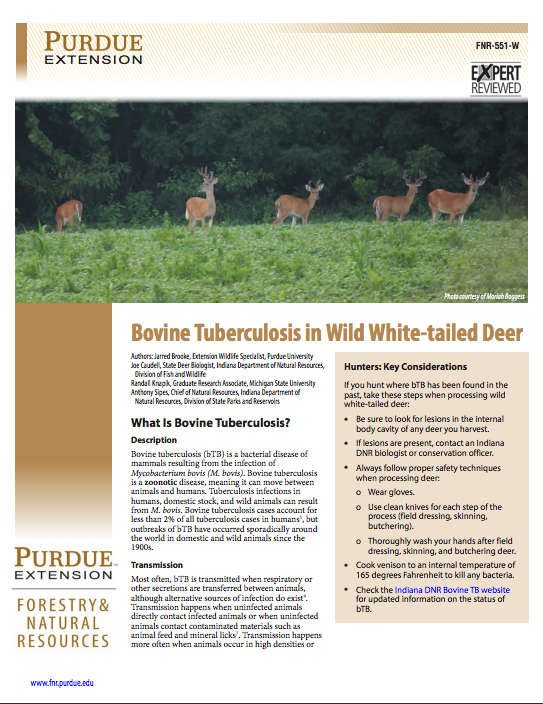 Outbreaks of bovine tuberculosis have occurred sporadically around the world since the 1900s. In Bovine Tuberculosis in Wild White-tailed Deer, Bovine tuberculosis transmission, hosts, current status in Indiana, clinical signs, effects on deer populations, effect on white-tailed deer meat, management, and monitoring is extensively covered. If you’re a hunter or cattle producer, the information provided within this free publication would greatly benefit you!
Resources:
Bovine Tuberculosis in wild white-tailed deer, Got Nature?, Purdue Extension-FNR
Jarred Brooke, Extension Wildlife Specialist
Purdue Department of Forestry and Natural Resources
It’s that time of year again. The desperate rush to find the ‘perfect’ tree for your annual year-end celebration is very real. Unfortunately, you chose a tree last year that died within a month and was disappointingly dull. This year, you are going to do your homework to find the best tree available.
Home preparations:
- Tree Location: Select an area out of direct sunlight and away from the heating vents in your house for the tree. Excessive sunlight and heat will cause your tree to fade and dry out more quickly.
- Ceiling height: Measure your ceiling heights and take into account the height of your tree stand and the tree topper or you’ll have to make excessive cuts in your tree to adjust for the differences. Write down these measurements.
- Tree shape: Visualize the shape of the tree that best fits the space you have available (tall and thin, short and broad) and keep that in mind. Certain tree types are more expensive therefore knowing your budget will help ensure you purchase the perfect tree for your household. Measure the width of the space and write down these measurements.
- Tree stand: Anticipate needing to support your tree stand and acquire a piece of plywood that you can bolt the stand to keep it level. Measure the inside diameter of the tree stand and write down the measurements.
Choosing a tree farm:
- Buy from a local farm if at all possible. These trees are bred to be hardy and to remain fresh longer.
Bring to the farm:
- List of required measurements for your perfect tree.
- A large unbreakable ornament to view branch spacing (ensures your ornaments will hang straight).
- Measuring tape to measure prospective trees before getting them home.
- Thick gloves for handling your tree as the needles may be sharp and the bark rough on your bare hands.
- An old blanket that can cover the truck bed or car roof to protect it from sap.
- Rope, twine, bungee cords, and twist ties to secure the tree to the car if these items are not provided by the tree farm.
Species selection:
- Each tree species is different so careful selection is important: Soft needle species (pines, firs) are best for homes with small children while hard needle species (spruce) are the adult choice.
- Firs often have shorter needles, strong stems, and well-spaced branches making it easier to hang lights and decorations.
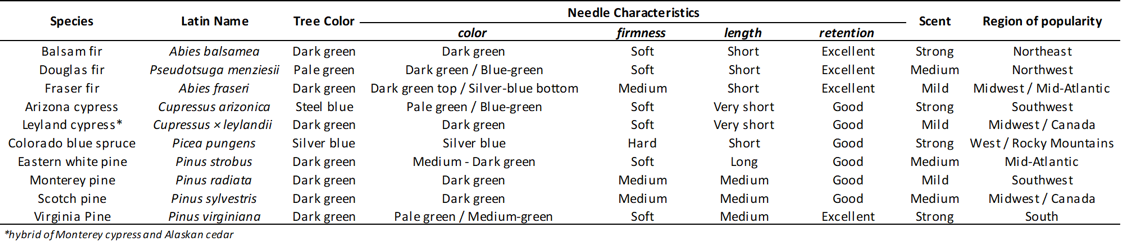 *click image to enlarge
At the tree farm:
- Check freshness: Bend a needle with your fingers (firs snap, pines ben).
- Gentle run your hand over the branch from inside to out or if possible, gently bounce the tree on the cut end. If a few interior needles come off, it is probably fresh; if many exterior needles fall off, choose a different tree.
- Remove and crush a few needles in your hand, if there is little scent choose another tree.
- The tree should have even coloration 360° around and needles should be fresh (shiny, green) and not old (dried out, brown).
When you and your tree get home:
- Protect Your Floor– Place a plastic or other waterproof covering on the floor where your tree will stand so you don’t ruin the carpet or get watermarks on hardwood flooring.
- Put down waterproof coverings or plastic sheeting under the tree skirt to prevent ruining the carpet or hardwood floor if water is spilled.
- Make a fresh cut at the base of the tree, take off ½” from the base so that tree can absorb more water (slows needle drop and helps maintain tree color) and immediately place the tree upright in the stand with lukewarm water.
- Trim any low-hanging branches that hit furniture or are too thin for ornaments parallel to the floor. Keep them in a bucket of water before using as decorations.
- Secure your tree to the wall or heavy furniture if you have pets and children that could knock it over or heavy ornaments that may sway the tree.
- Ensure that your tree stand always has water in it.
- Take a photo of your tree when set up and secured as a reminder for the following year.
After the holidays:
- Recycle your tree through your local waste management company.
- Trees can also be chipped for mulch. Never burn your tree because of the likelihood of starting a fire.
Examples of holiday tree types:
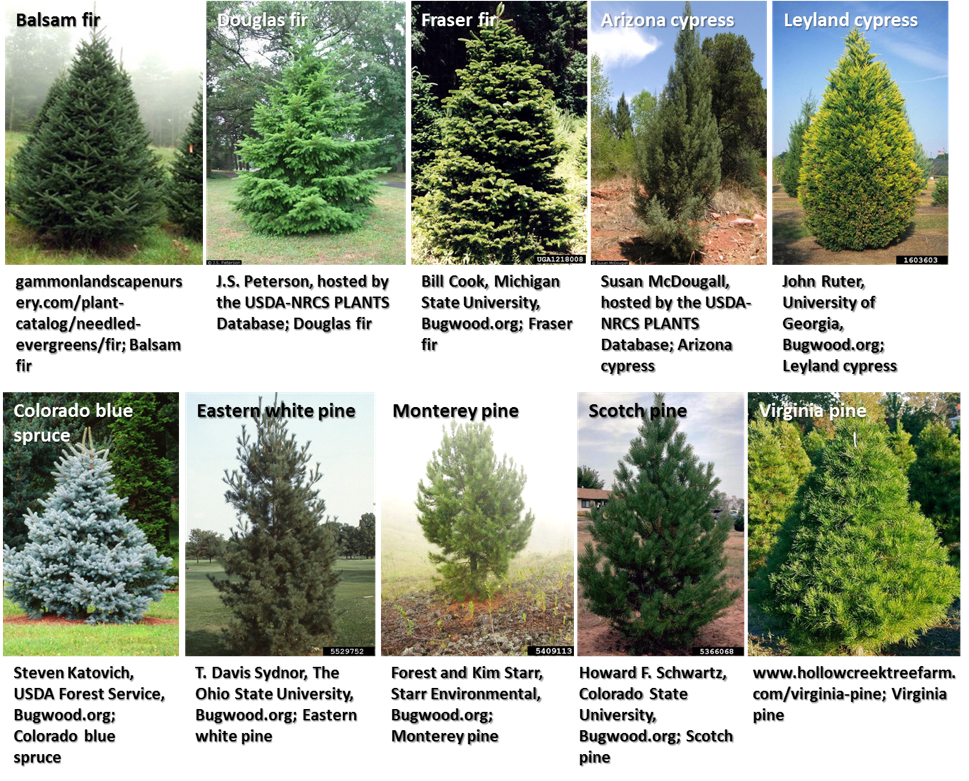 *click image to enlarge
Resources:
Which Real Indiana Christmas Tree Will You Select? – Got Nature?, Purdue FNR-Extension
Living Christmas Trees For The Holidays and Beyond, The Education Store
Tips for First-Time Buyers of Real Christmas Trees, The Education Store
Growing Christmas Trees, The Education Store
Shaneka Lawson, USDA Forest Service/HTIRC Research Plant Physiologist/Adjunct Assistant Professor
Purdue University Department of Forestry and Natural Resources

Recent Posts
- 2026 Winter Bat Survey In Progress, MyDNR
Posted: March 27, 2026 in Wildlife - Fast-Growing Trees for the Landscape, Purdue Landscape Report
Posted: March 26, 2026 in Forestry, Urban Forestry, Woodlands - Urban Tree Spotlight: Planting Deciduous Shade Trees, Purdue Landscape Report
Posted: March 25, 2026 in Forests and Street Trees, Urban Forestry, Woodlands - Beetle that attacks Tree-of-Heaven found in Indiana, Purdue Landscape Report
Posted: March 20, 2026 in Invasive Insects, Wildlife, Woodlands - ID That Tree: Dwarf Chinkapin Oak
Posted: in Forestry, Urban Forestry, Wildlife, Woodlands - IN-PREPared: Essential Resources for Indiana’s Severe Weather Season
Posted: March 11, 2026 in How To, Safety - DNR Hiring for Indiana Conservation Officer Positions, MyDNR
Posted: March 9, 2026 in Urban Forestry, Wildlife, Woodlands - ID That Tree: Shumard Oak
Posted: in Plants, Urban Forestry, Wildlife, Woodlands - A Woodland Management Moment: Windbreak Around Walnut Plantings
Posted: March 3, 2026 in Forestry, Urban Forestry, Woodland Management Moment - Getting Certified as an Indiana Certified Prescribed Burn Manager
Posted: March 2, 2026 in How To, Urban Forestry, Woodlands
Archives
Categories
- Alert
- Aquaculture/Fish
- Aquatic/Aquaculture Resources
- Ask the Expert
- Christmas Trees
- Community Development
- Disease
- Drought
- Forestry
- Forests and Street Trees
- Gardening
- Got Nature for Kids
- Great Lakes
- How To
- Invasive Animal Species
- Invasive Insects
- Invasive Plant Species
- Land Use
- Natural Resource Planning
- Nature of Teaching
- Plants
- Podcasts
- Ponds
- Publication
- Safety
- Spiders
- Timber Marketing
- Uncategorized
- Urban Forestry
- Webinar
- Wildlife
- Wood Products/Manufacturing
- Woodland Management Moment
- Woodlands