 Purdue University - Extension - Forestry and Natural Resources
Got Nature? Blog
The Help the Hellbender Project is a joint project involving partners from across the country. The conservation outreach continues as the team shares how important it is that our household and farm management practices are aiming to help keep our rivers and streams clean.
 The Help the Hellbender conservation efforts will continue expanding as the U.S. Department of Agriculture (USDA) announced it is awarding $197 million for 41 locally led conservation projects through the Regional Conservation Partnership Program (RCPP). RCPP is a partner-driven program that leverages partner resources to advance innovative projects that address climate change, enhance water quality, and address other critical challenges on agricultural land. The “Farmers Helping Hellbenders” project, led by Dr. Rod Williams and Purdue Extension wildlife specialist/Help the Hellbender project coordinator Nick Burgmeier, is among the projects set to receive funding through the RCCP Classic fund, which uses NRCS contracts and easements with producers, landowners and communities in collaboration with project partners. To view article and the fourteen contributing partners in the article USDA Awards Farmers Helping Hellbenders Project $2.7 Million in Funding.
Help the Hellbender Recent Team Awards
- The team was honored by the Hoosier Outdoor Writers group with its 2022 Bayou Bill Conservation Award. The annual conservation award is given in memory of the legendary Crothersville, Indiana, outdoor writer Bayou Bill Scifres, who was a founding member of HOW in 1969, and had his outdoors column published in The Indianapolis Star newspaper for 50 years. View full article on the Purdue Forestry and Natural Resources’ News: Help the Hellbender Program Receives Hoosier Outdoor Writers Conservation Award.
- The team recently received the Budd Denneman Partners in Conservation Excellence Award, Indiana Department of Natural Resources, Division of Fish & Wildlife
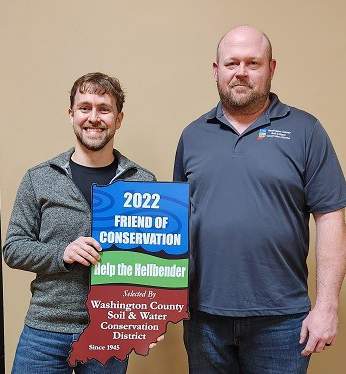
- Awarded the Friends of Conservation Award from the Washington County Soil and Water
The Help the Hellbender website is full of resources, activities, photos, posters, coloring pages and publications for homeowners, farmers, teachers and kids.
Resources:
Help the Hellbender Facebook page
Ask the Expert: Learn All About Hellbenders and Take a Tour, Subscribe Purdue Extension – Forestry & Natural Resources (FNR) YouTube Channel
Ask the Expert video: Help the Hellbender – Dr. Stephen Spear of The Wilds, Purdue Extension – FNR YouTube Channel
Ask the Expert video: Live with Mesker Park Zoo and Botanical Gardens – Hellbenders, Purdue Extension – FNR YouTube Channel
A Moment in the Wild video: Hellbender Hide, Purdue Extension – FNR YouTube Channel
A Moment in the Wild video: Release Moment of Hellbenders,
How Anglers and Paddlers Can Help the Hellbender video, Purdue Extension – FNR YouTube Channel
Eastern Hellbender ID Video, Purdue Extension – FNR YouTube Channel
Hellbenders Rock!, The Education Store, Purdue Extension’s resource center
Help the Hellbender, North America’s Giant Salamander, The Education Store
How Our Zoos Help Hellbenders, The Education Store
The Nature of Teaching: Adaptations for Aquatic Amphibians, The Education Store
Healthy Water, Happy Home – Lesson Plan, The Education Store
Purdue Expert: Hellbender Salamander, Purdue University News YouTube Channel
FNR Assists in First Natural Breeding of Eastern Hellbender in Captivity, Purdue FNR News & Stories
Helping the Hellbender: Mesker Park Zoo Begins Captive Breeding Efforts, Purdue Agriculture News
Diana Evans, Extension and Web Communication Specialist
Purdue University Department of Forestry and Natural Resources
The full publication is available for download for $7 in the Purdue Extension Education Store. The field guide helps identify common Indiana woodlot trees.
Each week, the Intro to Trees of Indiana web series will offer a sneak peek at one species from the book, paired with an ID That Tree video from Purdue Extension forester Lenny Farlee to help visualize each species as it stands in the woods. Threats to species health as well as also insight into the wood provided by the species, will be provided through additional resources as well as the Hardwoods of the Central Midwest exhibit of the Purdue Arboretum, if available. 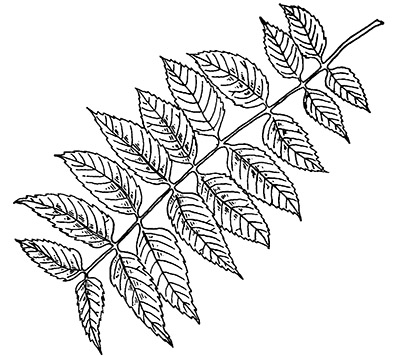
This week, we meet Black walnut or Juglans nigra.
Also known as American black walnut or eastern black walnut, this species has compound leaves with several pairs of leaflets along the individual leaf stems. The leaves, which are arranged alternately on the twigs, can be between one to two feet long. They are green in summer and turn yellow in the fall. The terminal and lateral buds are fuzzy and tan and can resemble suede.
The bark has long, strong running ridges and in older trees can resemble alligator hide. Under the surface of the bark is a dark, chocolate brown color.
Black walnut trees produce nuts, which are ridged and rounded with very heavy shells. Nuts are encased in a thick yellow-green husk, which can leave a dark brown stain on skin. The nut shells require a heavy hammer hit or sharp animal teeth or claws to break open. The nut meat has a very strong aromatic flavor.
Black walnuts, which grow 50 to 75 feet tall, prefer to grow in sunshine and in high quality soils that are deep and well-drained. This species is often found as one of the tallest in the woodlands where they grow. The best quality trees are frequently found on flood free ledges just above stream banks. This species will live on poorer soils, but growth is slow and the wood quality is generally poor.
The natural range of the black walnut is the from the east coast west through the Great Plains. It ranges from Texas and Georgia north to central Minnesota, Wisconsin, Michigan and southern Ontario.
For full article with additional photos view: Intro to Trees of Indiana: Black Walnut, Forestry and Natural Resources’ News.
If you have any questions regarding wildlife, trees, forest management, wood products, natural resource planning or other natural resource topics, feel free to contact us by using our Ask an Expert web page.
Other Resources:
ID That Tree: Black Walnut
Hardwoods of the Central Midwest: Black Walnut
Hardwood Lumber and Veneer Series: Black Walnut
Morton Arboretum: Black walnut
Facts About Black Walnut, The Education Store
Purdue Arboretum Explorer
Black Walnut, Native Trees of Indiana River Walk, Purdue Fort Wayne
The Woody Plant Seed Manual, U.S. Forest Service
Fifty Common Trees of Indiana
An Introduction to Trees of Indiana
Native Trees of the Midwest, The Education Store
Shrubs and Woody Vines of Indiana and the Midwest, The Education Store
Investing in Indiana Woodlands, The Education Store
Forest Improvement Handbook, The Education Store
ID That Tree, Purdue Extension-Forestry & Natural Resources (FNR) YouTube playlist
Woodland Management Moment , Purdue Extension-FNR YouTube playlist
Wendy Mayer, FNR Communications Coordinator
Purdue University Department of Forestry and Natural Resources
Lenny Farlee, Sustaining Hardwood Extension Specialist
Purdue University Department of Forestry and Natural Resources
The Help the Hellbender team, led by Dr. Rod Williams, professor of wildlife science, has been honored by the Hoosier Outdoor Writers group with its 2022 Bayou Bill Conservation Award.
The annual conservation award is given in memory of the legendary Crothersville, Indiana, outdoor writer Bayou Bill Scifres, who was a founding member of HOW in 1969, and had his outdoors column published in The Indianapolis Star newspaper for 50 years.
“The Hoosier Outdoor Writers group was introduced to Dr. Rod Williams in 2019 when he came to our annual conference and talked to us about his work with hellbenders and the Help the Hellbenders program,” Tom Berg, Executive Director of HOW, explained. “Our members were very interested in learning more about hellbender conservation and restoration, and also about his involvement with captive breeding and propagation efforts across the state. It was interesting to us to hear that Purdue University, the Indiana Department of Natural Resources and other groups were working together on management plans to re-introduce and re-populate hellbenders throughout much of their historical range. This is exactly the type of conservation story that our members like to hear and relate to their audiences. It also aligns very well with our strong belief in the conservation of Indiana’s natural resources, so choosing Dr. Williams and the “Help the Hellbenders” program for this award was an easy task.”
 For much of the last 16 years, Williams and his team have been researching eastern hellbenders, spearheading regional conservation efforts and advancing hellbender captive propagation, or the rearing of this ancient animal in captivity and their eventual return to the wild.
After five years of breeding efforts, Williams’ partners at the Mesker Park Zoo in Evansville, Indiana, successfully bred eastern hellbenders naturally in captivity in October 2020, signifying the culmination of a long and collaborative effort to breed the species and restore this endangered species to its native environment.
Williams’ hellbender lab is actively collaborating with the Indiana Department of Natural Resources, Indiana Division of Fish and Wildlife and The Nature Conservancy as well as several other partners across 13 states on a number of conservation projects and educational opportunities for teachers and children, farmers and more.
For full article with additional photos view: Help the Hellbender Program Receives Hoosier Outdoor Writers Conservation Award.
Resources
Help the Hellbender website
Help the Hellbender Facebook page
Ask the Expert: Learn All About Hellbenders and Take a Tour, Subscribe Purdue Extension – Forestry & Natural Resources (FNR) YouTube Channel
Ask the Expert video: Help the Hellbender – Dr. Stephen Spear of The Wilds, Purdue Extension – FNR YouTube Channel
Ask the Expert video: Live with Mesker Park Zoo and Botanical Gardens – Hellbenders, Purdue Extension – FNR YouTube Channel
A Moment in the Wild video: Hellbender Hide, Purdue Extension – FNR YouTube Channel
A Moment in the Wild video: Release Moment of Hellbenders,
How Anglers and Paddlers Can Help the Hellbender video, Purdue Extension – FNR YouTube Channel
Eastern Hellbender ID Video, Purdue Extension – FNR YouTube Channel
Hellbenders Rock!, The Education Store, Purdue Extension’s resource center
Help the Hellbender, North America’s Giant Salamander, The Education Store
How Our Zoos Help Hellbenders, The Education Store
The Nature of Teaching: Adaptations for Aquatic Amphibians, The Education Store
Healthy Water, Happy Home – Lesson Plan, The Education Store
FNR Assists in First Natural Breeding of Eastern Hellbender in Captivity, Purdue FNR News & Stories
Wendy Mayer, FNR Communications Coordinator
Purdue University Department of Forestry and Natural Resources
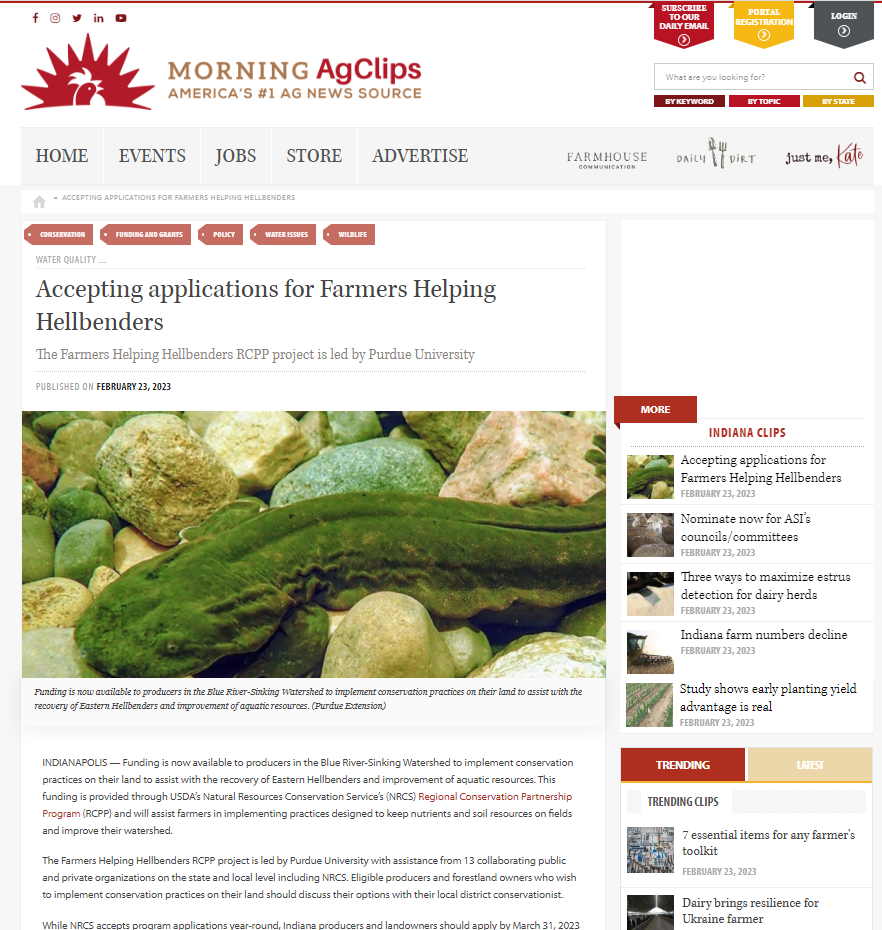 Morning AgClips, Indianapolis, Accepting Applications for Farmers Helping Hellbenders — Funding is now available to producers in the Blue River-Sinking Watershed to implement conservation practices on their land to assist with the recovery of Eastern Hellbenders and improvement of aquatic resources. This funding is provided through USDA’s Natural Resources Conservation Service’s (NRCS) Regional Conservation Partnership Program (RCPP) and will assist farmers in implementing practices designed to keep nutrients and soil resources on fields and improve their watershed.
The Farmers Helping Hellbenders RCPP project is led by Purdue University with assistance from 13 collaborating public and private organizations on the state and local level including NRCS. Eligible producers and forestland owners who wish to implement conservation practices on their land should discuss their options with their local district conservationist.
While NRCS accepts program applications year-round, Indiana producers and landowners should apply by March 31, 2023 to be considered for the current RCPP-Hellbender funding cycle. Applications received after March 31 will automatically be considered during the next funding cycle. For more information or to submit an application, contact your local district conservationist by visiting Farmers.gov/Service-locator.
The goals of the Farmers Helping Hellbenders project include improved water quality due to decreases in runoff, improved aquatic habitat due to decreases in sedimentation, increases in Hellbender and other aquatic wildlife populations due to improved habitat and water quality, increases in riparian and pollinator habitat due to implementation of riparian buffers and pollinator-friendly species, and increased protection of karst due to reduced runoff into sinkholes.
“The Farmers Helping Hellbenders RCPP project enables us to leverage partnerships to make a lasting positive impact on the habitat of the Eastern Hellbender salamander,” said Acting State Conservationist Dan Hovland. “This project will enable Indiana farmers and forestland owners to conserve the vital natural resources on their land while also protecting the habitat for hellbenders and other aquatic animals. It is a win-win.”
The total financial assistance to landowners over the three-year project is more than $1.9 million and is available for agricultural lands in portions of Washington, Harrison, Crawford, and Floyd counties, the only remaining area in Indiana where the Eastern Hellbender can be found and is currently being actively managed.
“This project is the perfect opportunity for land managers to help an imperiled species, while maintaining productive working lands,” said Brianne Lowe, Indiana NRCS state biologist. “Hellbenders are particularly susceptible to sedimentation in the water. Farmers and forest landowners that implement conservation practices can help improve water quality by keeping soil on the land and protecting aquatic nesting beds for the hellbender.”
Indiana eligible practices for farmers in the Blue River-Sinking Watershed for this funding period include conservation cover, grassed waterways, wildlife habitat planting, and nutrient management, riparian buffers and many others. Eligible farmers are encouraged to contact their local NRCS office before March 31 to apply for the current funding cycle. This funding will enable producers to improve the health and productivity of their operations.
Visit https://www.nrcs.usda.gov/indiana/RCPP to learn more about RCPP or click visit www.farmers.gov/working-with-us/service-center-locator find your local USDA-NRCS service center.
USDA Natural Resources Conservation Service
Tree-of-heaven is native to Asia but has been widely planted in North America and now spreads naturally as a serious invasive tree threat.
In this episode of ID That Tree, Purdue Extension forester Lenny Farlee identifies the invasive tree of heaven, also known as stinking sumac, due to the foul odor that permeates from nearly all parts of the tree. The alternately held compound leaves have teeth at the base of the leaflets on stout stems, while the bark is a medium gray with white wormy marks. This tree spreads through the seeds of its female trees and from suckers off its root system, and it is also the preferred host of an invasive insect, spotted lanternfly, now found in Indiana. Learning to recognize invasive pests a good first step to limiting their spread.
If you have any questions regarding wildlife, trees, forest management, wood products, natural resource planning or other natural resource topics, feel free to contact us by using our Ask an Expert web page.
Resources:
ID That Tree, Playlist, Purdue Extension – Forestry and Natural Resources YouTube Channel (Invasive White Mulberry, Siberian Elm, Tree of Heaven)
Invasive Species Playlist, Playlist, Purdue Extension – FNR YouTube Channel (Asian Bush Honeysuckle, Burning Bush, Callery Pear, Multiflora rose)
A Woodland Management Moment, Playlist, Purdue Extension – FNR YouTube Channel (Against Invasives, Garlic Mustard, Autumn Olive)
Woodland Stewardship for Landowners, Playlist, Purdue Extension – FNR YouTube Channel (Common Buckthorn, Japanese Barberry)
Report Invasive Species, Purdue Invasive Species
The GLEDN Phone App – Great Lakes Early Detection Network
EDDMaps – Early Detection and Distribution Mapping System (Report Invasives)
How long do seeds of the invasive tree, Ailanthus altissima remain viable? (Invasive Tree of Heaven), USDA Forest Service
Indiana Department of Natural Resources: Invasive Species
Indiana Invasive Species Council
Cooperative Invasive Species Management Area (CISMA)
Aquatic Invasive Species, Illinois-Indiana Sea Grant (IISG)
Episode 11 – Exploring the challenges of Invasive Species, Habitat University-Natural Resource University
What are invasive species and why should I care?, Got Nature? Blog, Purdue Extension – FNR
Spotted Lanternfly Feeds on Over 70 Plus Plant Species, Got Nature? Blog, Purdue Extension – FNR
Shrubs and Woody Vines of Indiana and the Midwest, The Education Store, Purdue Extension Resource Center
Native Trees of the Midwest, The Education Store
Investing in Indiana Woodlands, The Education Store
Forest Improvement Handbook, The Education Store
Lenny Farlee, Extension Forester
Hardwood Tree Improvement and Regeneration Center
Purdue Department of Forestry & Natural Resources
The classic and trusted book “Fifty Common Trees of Indiana” by T.E. Shaw was published in 1956 as a user-friendly guide to local species. Nearly 70 years later, the publication has been updated through a joint effort by the Purdue Department of Forestry and Natural Resources, Indiana 4-H, and the Indiana Department of Natural Resources, and reintroduced as “An Introduction to Trees of Indiana.”
The full publication is available for download for $7 in the Purdue Extension Education Store. The field guide helps identify common Indiana woodlot trees.
Each week, the Intro to Trees of Indiana web series will offer a sneak peek at one species from the book, paired with an ID That Tree video from Purdue Extension forester Lenny Farlee to help visualize each species as it stands in the woods. Threats to species health as well as also insight into the wood provided by the species, will be provided through additional resources as well as the Hardwoods of the Central Midwest exhibit of the Purdue Arboretum, if available.
This week, we meet Tulip tree or Liriodendron tulipifera.
The state tree of Indiana, also known as the tulip poplar or yellow poplar, however, is actually more closely related to the magnolia family than the poplar family. It is easily identified by its large, simple tulip shaped leaves held alternately on long leaf stems. The leaves, which feature three lobes, including the top lobe which is widely notched in the middle, turn from glossy green to a golden yellow in the fall.
The bark on young trees is smooth and gray with streaks of white between the ridges, while the bark of older trees is gray-brown and features deep, long running ridges. The trunk is very straight and column-like as it grows toward the sunlight and the tree self-prunes lower branches.
In the spring, the tulip tree produces colorful green and yellow, tulip like flowers with an orange band at the base of each petal, which bloom in May or June, but are often found high up on the tree.
The cone-shaped fruit is a collection of winged seeds that resembles a small, dry pineapple, approximately two-inches in length, which sits upright on the branches.
Tulip trees, which grow 70 to 90 feet tall, are often among the tallest trees in Indiana woodland areas as they are shade intolerant and prefer to grow toward the light. They can often be found in woodlands as large as three to four feet in width on the trunk. Tulip trees prefer acidic, moist, well-drained soil, but can tolerate alkaline soil.
The natural range of the tulip tree is the eastern United States. Its western reach extends from spots in central Louisiana across the eastern edge of Missouri and Illinois up through Indiana and the southern part of Michigan, and reaches eastward across the gulf states and the panhandle of Florida. It can be found throughout much of the Atlantic coast, reaching northward to Pennsylvania, New York and Connecticut.
The Morton Arboretum warns that tulip trees are highly susceptible to ice damage and are marginally hard with weak wood and branch structure.
For full article with additional photos view: Intro to Trees of Indiana: Tulip Tree, Forestry and Natural Resources’ News.
If you have any questions regarding wildlife, trees, forest management, wood products, natural resource planning or other natural resource topics, feel free to contact us by using our Ask an Expert web page.
Other Resources:
ID That Tree: Tulip Tree
Morton Arboretum: Tuliptree
Finishing and Restoring Wood and Structures: Yellow-Poplar Lumber for Exterior Architectural Applications in New Construction and for Historical Restoration, The Education Store
Purdue Arboretum Explorer
Tulip Tree-Native Trees of Indiana Riverwalk, Purdue Fort Wayne
The Woody Plant Seed Manual, U.S. Forest Service
Fifty Common Trees of Indiana
An Introduction to Trees of Indiana
Native Trees of the Midwest, The Education Store
Shrubs and Woody Vines of Indiana and the Midwest, The Education Store
Investing in Indiana Woodlands, The Education Store
Forest Improvement Handbook, The Education Store
ID That Tree, Purdue Extension-Forestry & Natural Resources (FNR) YouTube playlist
Woodland Management Moment , Purdue Extension-FNR YouTube playlist
Wendy Mayer, FNR Communications Coordinator
Purdue University Department of Forestry and Natural Resources
Lenny Farlee, Sustaining Hardwood Extension Specialist
Purdue University Department of Forestry and Natural Resources
The classic and trusted book “Fifty Common Trees of Indiana” by T.E. Shaw was published in 1956 as a user-friendly guide to local species. Nearly 70 years later, the publication has been updated through a joint effort by the Purdue Department of Forestry and Natural Resources, Indiana 4-H, and the Indiana Department of Natural Resources, and reintroduced as “An Introduction to Trees of Indiana.”
The full publication is available for download for $7 in the Purdue Extension Education Store. The field guide helps identify common Indiana woodlot trees.
Each week, the Intro to Trees of Indiana web series will offer a sneak peek at one species from the book, paired with an ID That Tree video from Purdue Extension forester Lenny Farlee to help visualize each species as it stands in the woods. Threats to species health as well as also insight into the wood provided by the species, will be provided through additional resources as well as the Hardwoods of the Central Midwest exhibit of the Purdue Arboretum, if available.
This week, we meet Sycamore or Platanus occidentalis
The large leaves of this species have three to five lobes and loosely resemble that of maples, but are significantly larger and are alternately held, versus the opposite leaf arrangement of maples. The bright green, broadly toothed leaves and stems are slightly fuzzy to the touch.
The bark on the lower part of the tree is scaly and brown, while the upper trunk and limbs are smooth, shiny and white. The bark peels revealing patches of white, gray and green.
The fruit of the Sycamore is a soft, one-inch brown ball-like seed head, which hangs on a long stem. The seeds shatter during winter months.
Sycamore trees, which grow 75 to 100 feet tall, are among Indiana’s largest deciduous trees. They are often found on stream or creek bottoms and other moist soil areas. This species is tolerant of clay soil, occasional flooding and road salt.
The natural range of the sycamore is the central and eastern United States. It extends from eastern Texas and Oklahoma and Kansas west across Iowa Illinois, Indiana, Ohio and up into southern Michigan and parts of New York and Massachusetts. It extends down the Atlantic coast to southern Georgia and across Alabama, Mississippi and Louisiana, but do not reach the Gulf coast.
The Morton Arboretum warns that sycamores are best planted in full sun as it does not tolerate shady sites and should not be grown near septic fields. This species can be affected by anthracnose, leaf spots, aphids, plant bugs, scale insects, bagworms and borers and is also susceptible to frost cracks.
For full article with additional photos view: Intro to Trees of Indiana: Sycamore, Forestry and Natural Resources’ News.
If you have any questions regarding wildlife, trees, forest management, wood products, natural resource planning or other natural resource topics, feel free to contact us by using our Ask an Expert web page.
Other Resources:
ID That Tree: Sycamore
Morton Arboretum: Sassafras
Hardwood Lumber and Veneer Series: Sycamore, The Education Store
Purdue Arboretum Explorer
Sycamore-Native Trees of Indiana Riverwalk, Purdue Fort Wayne
The Woody Plant Seed Manual, U.S. Forest Service
Fifty Common Trees of Indiana
An Introduction to Trees of Indiana
Native Trees of the Midwest, The Education Store
Shrubs and Woody Vines of Indiana and the Midwest, The Education Store
Investing in Indiana Woodlands, The Education Store
Forest Improvement Handbook, The Education Store
ID That Tree, Purdue Extension-Forestry & Natural Resources (FNR) YouTube playlist
Woodland Management Moment , Purdue Extension-FNR YouTube playlist
Wendy Mayer, FNR Communications Coordinator
Purdue University Department of Forestry and Natural Resources
Lenny Farlee, Sustaining Hardwood Extension Specialist
Purdue University Department of Forestry and Natural Resources
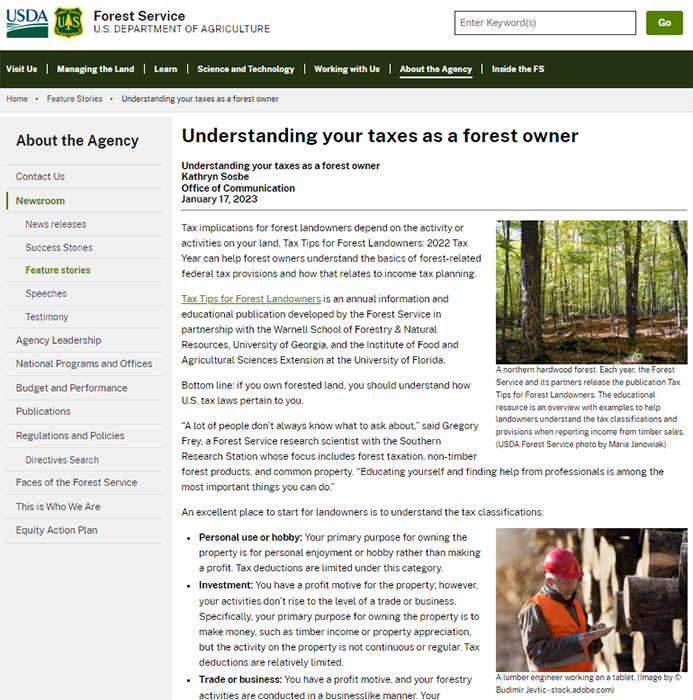 Tax preparation time usually brings with it questions about what is deductible, how do I report this income, and what can I do to save on my taxes in the future. Fortunately for forest landowners, this resource for tax tips from the U.S. Department of Agriculture-Forest Service provides several excellent resources to help you find some guidance. View Understanding Your Taxes as a Forest Owner.
The National Timber Tax Website, which is also shared in this article, addresses tax issues for forest landowners. This site provides updated tax tips for the 2022 filing year, as well as many guides and references to help you effectively plan a tax strategy for your property.
The USDA Forest Service mission of sustaining the health, diversity and productivity of the nation’s forests and grasslands to meet the needs of present and future generations, continues on as they provide many resources including managing your land, science and technology, and working with the U.S. Forest Service.
More resources: Purdue Extension – Forestry and Natural Resources offers some publications covering taxation issues for timber sales and tree planting.
How to Treat Timber Sale Income, The Education Store, Purdue Extension’s resource center
Determining Tax Basis of Timber, The Education Store
Financial and Tax Aspects of Tree Planting, The Education Store
The Education Store (for a list of all timber resources or woodlands place in search field: “timber” or “woodlands”)
Classified Forest and Wildlands Program , Indiana Department of Natural Resources: Division of Forestry
Find an Indiana Professional Forester, Indiana Forestry & Woodland Owners Association (IFWOA)
Channel catfish, commonly known as catfish, are freshwater finfish in the Ictaluridae family. Their native range extends from southern Canada and the Central US to Mexico. They are popular to catch and eat and have been introduced throughout the US and the world for food and recreation. This fact sheet publication shares how to identify the catfish, where they can be found, where you can find catfish products and if they are safe to eat. You will also enjoy the recipe found on this fact sheet.
The Channel Catfish publication is the seventh in a series of consumer guides that describe fish and shellfish farmed in the Midwest region of the United States. (See FNR-608-W, Walleye Farmed Fish Fact Sheet, FNR-618-W, Yellow Perch Farmed Fish Fact Sheet, FNR-621-W, Tilapia Farmed Fish Fact Sheet, FNR-622-W, Rainbow Trout Farmed Fish Fact Sheet, FNR-623-W, Pacific White Shrimp Farmer Fish Fact Sheet and FNR-625-W, American Paddlefish Farmed Fish Fact Sheet). The fact sheet also includes culinary characteristics, cooking tips and a recipe for Classic Fried Catfish.
This publication is a collaborative project of Illinois-Indiana Sea Grant, the North Central Regional Aquaculture Center, University of Illinois Extension, and Purdue University’s Department of Forestry and Natural Resources.
About the Author
Amy Shambach is Illinois-Indiana Sea Grant’s (IISG) aquaculture marketing outreach associate who works with the aquaculture industry in the USDA’s North Central Regional Aquaculture Center. Her work focuses on the demand side of domestic farm raised seafood products. She provides outreach and extension services to producers, potential producers, and consumers. Along with Dr. Kwamena Quagrainie, producers, aquaculture associations, and consumers, she works to determine the needs of stakeholders.
To receive the free download for the Channel Catfish please visit The Education Store.
Resources:
Walleye Farmed Fish Fact Sheet, The Education Store, Purdue Extension’s resource center
Pacific White Shrimp Farmed Fact Sheet, The Education Store
Yellow Perch Farmed Fish Fact Sheet, The Education Store
Tilapia Farmed Fish Fact Sheet, The Education Store
Rainbow Trout Farmed Fish Fact Sheet, The Education Store
American Paddlefish, The Education Store
A Guide to Small-Scale Fish Processing Using Local Kitchen Facilities, The Education Store
Aquaculture Family Coloring Book Development, The Education Store
Eat Midwest Fish, Illinois-Indiana Sea Grant online resource hub
Aquatics & Fisheries Videos, Purdue Extension-Forestry and Natural Resources YouTube Channel Playlist
Amy Shambach, Aquaculture Marketing Outreach Associate
Purdue Department of Forestry and Natural Resources/Illinois Indiana Sea Grant Program
Among the steel and concrete that make up the urban environment, trees provide welcome relief from heat and potentially unfavorable sights and smells. Trees provide value from ecosystem services, which can refer to any of the benefits humans obtain from nature. Trees in the built environment provide many benefits, such as storing carbon, reducing air temperature and air conditioning costs, filtering air and water pollutants, intercepting rainwater to reduce flooding, and increasing aesthetic value.
The Preparing Indiana’s Urban Forest for Climate Change is an overview of choosing species of trees that will thrive in urban settings has always required careful consideration, but climate change is making that task even more important. In this paper, Purdue and other researchers provide tools to help urban foresters, arborists and planners adapt so that the ecosystem services that trees provide can be maintained.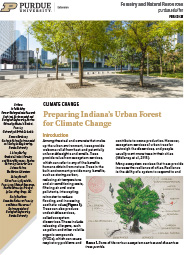
To receive the free download for the Preparing Indiana’s Urban Forest for Climate Change please visit The Education Store.
Resources:
Urban Forestry, Playlist, Purdue Extension – Forestry and Natural Resources (FNR) YouTube Channel
Community Development, Purdue Extension
How to Find an Arborist Near You!, Purdue Extension – FNR Got Nature? Blog
Storms Can Cause Damage and Tree Cleanup, What You Need to Know, Purdue Extension – FNR Got Nature? Blog
Purdue Landscape Report, Purdue Science-Based Midwest Landscaping
Forest Improvement Handbook, The Education Store, Purdue Extension’s resource center
Investing in Indiana Woodlands, The Education Store
Woodland Wildlife Management, The Education Store
ID That Tree, Playlist, Purdue Extension – Forestry & Natural Resources (FNR) YouTube Channel
Julie McAulay, Undergraduate Research Assistant in Environmental and Ecological Engineering
Purdue Department of Forestry and Natural Resources
Lenny Farlee, Sustaining Hardwood Extension Specialist
Purdue University Department of Forestry and Natural Resources
Brady Hardiman, Associate Professor for Environmental and Ecological Engineering
Purdue University Department of Forestry and Natural Resources

Recent Posts
- Beetle that attacks Tree-of-Heaven found in Indiana, Purdue Landscape Report
Posted: March 20, 2026 in Invasive Insects, Wildlife, Woodlands - ID That Tree: Dwarf Chinkapin Oak
Posted: in Forestry, Urban Forestry, Wildlife, Woodlands - IN-PREPared: Essential Resources for Indiana’s Severe Weather Season
Posted: March 11, 2026 in How To, Safety - DNR Hiring for Indiana Conservation Officer Positions, MyDNR
Posted: March 9, 2026 in Urban Forestry, Wildlife, Woodlands - ID That Tree: Shumard Oak
Posted: in Plants, Urban Forestry, Wildlife, Woodlands - A Woodland Management Moment: Windbreak Around Walnut Plantings
Posted: March 3, 2026 in Forestry, Urban Forestry, Woodland Management Moment - Getting Certified as an Indiana Certified Prescribed Burn Manager
Posted: March 2, 2026 in How To, Urban Forestry, Woodlands - Uniting Indiana Residents Against Invasive Species
Posted: February 27, 2026 in Community Development, Invasive Insects, Wildlife - Have You Seen a Soaring Eagle Lately? Morning Ag Clips
Posted: February 25, 2026 in Urban Forestry, Wildlife - Register for Natural Resources Teacher Institute’s Class of 2026
Posted: February 19, 2026 in Forestry, Wildlife, Woodlands
Archives
Categories
- Alert
- Aquaculture/Fish
- Aquatic/Aquaculture Resources
- Ask the Expert
- Christmas Trees
- Community Development
- Disease
- Drought
- Forestry
- Forests and Street Trees
- Gardening
- Got Nature for Kids
- Great Lakes
- How To
- Invasive Animal Species
- Invasive Insects
- Invasive Plant Species
- Land Use
- Natural Resource Planning
- Nature of Teaching
- Plants
- Podcasts
- Ponds
- Publication
- Safety
- Spiders
- Timber Marketing
- Uncategorized
- Urban Forestry
- Webinar
- Wildlife
- Wood Products/Manufacturing
- Woodland Management Moment
- Woodlands