 Purdue University - Extension - Forestry and Natural Resources
Got Nature? Blog
Don’t be fooled by the cold weather; EAB has plenty of life left.
Headlines have been circulating suggesting that EAB may “have met its match.” Although the Midwest experienced abnormally cold temperatures this winter, it is unlikely EAB populations felt these effects as significantly as your heating bill. EAB, as well as most insects in colder climates, are effective at surviving cold temperatures. One way they survive the cold is by producing an antifreeze-like substance that prevents water in their cells from crystallizing and causing damage. Also the extra insulation provided by the tree bark helps larvae withstand such cold temperatures. For EAB larvae overwintering within ash trees, death occurs when temperatures reach -28 degrees Fahrenheit.
A model produced by U.S. Forest Service scientists predicts areas in North America where temperatures were cold enough to kill EAB larvae. This model suggests that in the U.S., only northern parts of Minnesota and North Dakota have reached frigid enough temperatures to affect EAB populations.
Although some parts of the United States may have fewer adults emerging in the spring as a result of the cold temperatures, they probably won’t notice. Due to a high reproductive rate, it will likely be only a matter of time before populations rebound to previous levels.
Despite the cold weather, experts are still advising to continue with EAB management plans. One effective means of saving ash trees and reducing management costs is to partner with interested neighbors and hire a company to treat trees in your neighborhood. This collaborative approach will likely reduce transportation and consultation costs for the company, and the savings will be passed down to homeowners.
For more information on EAB, treatment options and NABB (Neighbors Against Bad Bugs), visit Emerald Ash Borer in Indiana, Purdue Extension website.
Contacts
Adam Witte, Exotic Forest Pest Educator
Department of Entomology
Matthew Ginzel, Associate Professor
Departments of Entomology & Forestry and Natural Resources
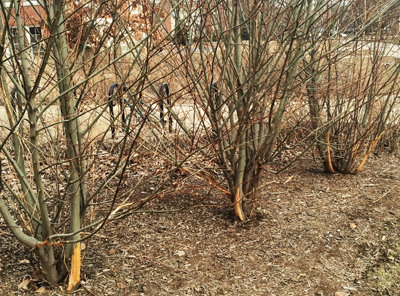 Cold winter winds, alternating extreme temperatures, ice and snow can be damaging to trees and shrubs. However, this spring, we are seeing additional damage due to the harsh winter conditions that is of the furry kind: rabbits and rodents. Mice and rabbits often damage young trees in the winter by feeding on the juicy, green cambium layer just under the bark and girdling the tree. Damage from these furry creatures occurs most commonly in winters when there is prolonged, heavy snow cover and food is scarce. Sound familiar? Rabbits feed on the bark above the snow while mice tunnel under the snow and feed near the ground level. Mouse damage is usually more severe when the trees are surrounded by heavy grass, weed cover or heavy mulch.
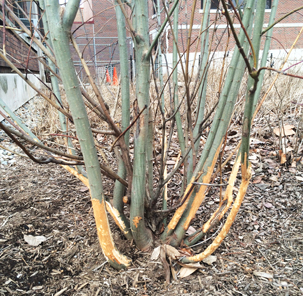 On young trees and multi-stemmed ornamental trees, rabbits remove the bark completely around the trunks and stems, effectively girdling them. All growth above the girdled areas will eventually decline and die, and for most situations, replacing the girdled trees is the best course of action. There are no applications that will mitigate the effects of rabbit damage or save severely damaged trees. Wound dressings, pruning paints, latex paints, wrappings and other alleged protective barriers do not help.
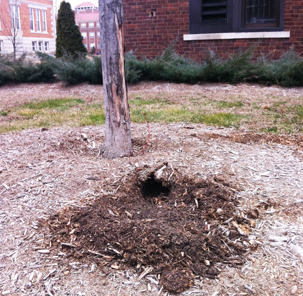 Many deciduous shrubs have the ability to produce new shoots or suckers at their base. Because of this ability, many severely damaged deciduous shrubs can recover. However, patience is required as several years may be required for some shrubs to fully recover. In early spring as the greening begins, prune off girdled stems just below the damaged areas. This will help rejuvenate the plant in most circumstances and replace the damage growth.
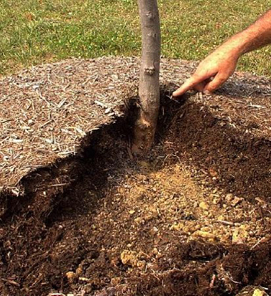 The most effective deterrent to girdling by mice or rabbits is to wrap the trunk and low branches of young trees with screen wire or hardware cloth. Be certain the wire wrap is buried below the ground line and extends high enough above the possible snow line to prevent rabbits from reaching to the trunk or branches. To help control mouse damage, maintain an area free of grass or weeds for a 1- to 2-foot radius around the base of the tree. Additionally, maintain proper mulch levels, never more than 2-3”, to eliminate the habitat for mice. Various chemicals are available to repel mice and rabbits, but these do not afford the reliability of a well-made barrier.
Resources
Preventing Wildlife Damage, The Education Store, Purdue Extension
Vole Damage in Pumpkins (and other crops), Purdue Extension – Forestry and Natural Resources (FNR) Got Nature? Blog
Moles, The Education Store, Purdue Extension resource center
Adjuvants and the Power of the Spray Droplet: Improving the Performance of Pesticide Applications, The Education Store
Preventing Wildlife Damage – Do You Need a Permit?, The Education Store
Attract Hummingbirds to Your Yard, Video, Purdue Extension Youtube Channel
How to Stop Woodland Animals from Digging in Your Flower Pots, Video, Purdue Extension Youtube Channel
Purdue Extension – Forestry and Natural Resources
 A recent discussion about Asian carp as a food source has generated some concerns about the level of contamination in their fillets, and thus, whether or not they are safe to eat. Several Indiana agencies cooperate to evaluate the risks of fish consumption to the public; the agencies include the Indiana Department of Natural Resources (INDNR), Indiana Department of Environmental Management (IDEM), Indiana State Department of Health (ISDH) and Purdue University. Most of the fish assessed for contaminants are those that are regularly caught by anglers. Numerous catfish, bass, sunfish and sucker species are commonly included in tissue surveys (see links below for more info). Indiana then divides people into two risk groups: 1) men (over 15 years) and women beyond childbearing age (typically 45 years or older) and 2) women pregnant or capable of becoming pregnant and children under 15. The second group is considered the sensitive group, and allowable contaminant levels (that is, the amount of fish that is safe to consume) are set significantly lower.
It is important to recognize that there are differences in allowable contaminants among population groups mentioned above, and it is equally important to recognize that the same fish species can have different amounts of contaminants in different water bodies. Asian carp are a riverine species that frequently travel long distances, and as such, they are exposed to varying levels of contaminants. Indiana and many other states try to minimize the effects of variation in individual fish fillet by combining tissue from multiple individual fish and analyzing it as a composite. Sampling the tissue as a composite reduces the risk of a heavily contaminated fish or a fish with little contamination, giving a false impression of the risk. By combining the fillets, Indiana also saves money by not analyzing large amounts of single fillets. Indiana does divide the fish into a couple of size classes for each composite because contamination increases significantly as fish size increases. They have yet to begin testing Asian carp fillets, at least partially because of their difficulty to capture using traditional fish survey techniques.
Although most states have not started regularly testing Asian carp, there has been some published research evaluating Asian carp fillets and comparing their contaminants to other species caught in the same location. Not surprisingly, the results of the research found that Asian carp have different concentrations of contaminants depending on where they are found, and they have different levels than other species of fish including common carp. Common carp have a completely different diet than Asian carp, so it is not surprising that contamination levels are different. Like most other fish, the most common problems associated with Asian carp are Mercury and PCBs. However, where the research was conducted in Illinois and Missouri, the recommended restriction on consumption was typically one meal per week for the most sensitive groups. Most studies have demonstrated that larger fish tend to have higher concentrations in their tissues than smaller fish found in the same environments. This relates to the way Mercury and PCBs bioaccumulate in tissues – the longer a fish is around, the more contaminants per gram we would expect them to contain. This is not to say that Asian carp in Indiana is safe for that level of consumption or that it even contains the same amount of contaminants as in other states. It still needs to be evaluated by the state, but studies cited below have shown that for the most part, Asian carp are likely no riskier to consume than most of the fish species that Indiana currently evaluates.
Resources
Fish Consumption Advisory
Indiana State Department of Health
Asian Carp Solutions: Take Them to Market
Illinois-Indiana Sea Grant (IISG) Newsroom
No Bones About It: New Video Lays Out Easy Steps For Filleting Tasty Asian Carp
Illinois-Indiana Sea Grant (IISG) Newsroom
Published Papers
Levengood, J.M., D.J. Soucek, G.G. Sass, A. Dickinson, and J.M. Epifanio. In press. Elements of Concern in Fillets of Bighead and Silver Carp From the Illinois River, Illinois. Chemosphere 2013.
Rogowski, D.L., D.J. Soucek, J.M. Levengood, S.R. Johnson, J.H. Chick, J.M. Dettmers, M.A. Pegg, and J.M. Epifanio. 2009. Contaminant Concentrations in Asian Carps, Invasive Species in the Mississippi and Illinois Rivers. Environmental Monitoring and Assessment
Resources:
Walleye Farmed Fish Fact Sheet, The Education Store, Purdue Extension’s resource center
Pacific White Shrimp Farmed Fact Sheet, The Education Store
Yellow Perch Farmed Fish Fact Sheet, The Education Store
Tilapia Farmed Fish Fact Sheet, The Education Store
Rainbow Trout Farmed Fish Fact Sheet, The Education Store
American Paddlefish, The Education Store
A Guide to Small-Scale Fish Processing Using Local Kitchen Facilities, The Education Store
Aquaculture Family Coloring Book Development, The Education Store
Eat Midwest Fish, Illinois-Indiana Sea Grant online resource hub
Aquatics & Fisheries Videos, Purdue Extension-Forestry and Natural Resources YouTube Channel Playlist
Department of Forestry and Natural Resources (FNR)
Illinois-Indiana Sea Grant (IISG)
Purdue University
Since the Polar Vortex subsided, there has been quite a bit of buzz about the Emerald Ash Borer (EAB), an exotic beetle that is killing ash trees across Indiana and the U.S., being killed by the multi-day sub-zero temperatures we experienced here in Indiana and elsewhere. Some recent research (the full paper can be accessed USDA Forest Service, Cold Hardiness of Emerald Ash Borer, Agrilus Planipennis: A New Perspective) predicts that when EAB larvae reach 0°F, 5% will die; at -10°F, 34% will die; at -20°F, 79% will die; and at -30°F, 98% will die. Based on some -15°F temperatures here at the Purdue West Lafayette campus, we might expect around 50% of the EAB will die, but some additional points need to be considered.

An adult emerald ash borer feeds off a leaf. (Purdue University Department of Entomology photo/John Obermeyer)
EAB larvae are located overwinter under the bark in infested ash trees, so the bark may offer some insulation. Snow is also an excellent insulator, so the lower trunk of ash trees in deep snow or drifts may not get as cold as ambient air temperatures. Some trees in town or near structures may remain warmer due to heat radiating or escaping from buildings. The message is, unfortunately, that the cold weather we experienced was probably not enough to solve our EAB problems.
It is good news that some of the population was probably killed by the cold weather, leaving fewer larvae to damage ash trees next spring. This will be a temporary setback for the borer, since one of the biological strengths of insects is their capacity to reproduce and grow populations quickly. Further north in places like Minnesota, the news for the ash trees may be better where temperatures below -30°F may have killed most of the larvae, providing some additional time to prepare for the EAB onslaught. Here in Indiana, we need to continue to monitor, prepare and act to limit the damage EAB will do.
Some basic steps include:
- Don’t move firewood – Firewood can harbor EAB and several other serious tree pests and spread them to new areas.
- Learn to identify ash trees, EAB and the symptoms of EAB damage.
- Learn about EAB control techniques.
- Learn how to decide if your ash tree should be treated with insecticide to protect it from EAB or removed and possibly replaced with another tree species.
- Work with your neighbors to monitor and manage the ash trees in your area.
Purdue Extension offers science-based recommendations to help you manage the EAB threat at Emerald Ash Borer in Indiana.
Resources:
New Hope for Fighting Ash Borer, Got Nature? Purdue Extension-FNR
Invasive Pest Species: Tools for Staging and Managing EAB in the Urban Forest, Got Nature?
Emerald Ash Borer Tools & Resources – Purdue Extension Entomology
Planting Your Tree Part 1: Choosing Your Tree, Purdue Extension YouTube Channel
Tree Planting Part 2: Planting a Tree, Purdue Extension – Forestry and Natural Resources YouTube Channel
Indiana Invasive Plant List, Indiana Invasive Species Council, Purdue Entomology
Landscape Report Shares Importance of Soil Testing, Purdue FNR Extension
Find an Arborist website, Trees are Good, International Society of Arboriculture (ISA)
Tree Risk Management – The Education Store, Purdue Extension’s resource center
Lenny Farlee, Extension Forester
Hardwood Tree Improvement and Regeneration Center (HTIRC)
Forestry and Natural Resources, Purdue University
 Many insects are not actually the cause of tree mortality but simply “opportunists” and infest decaying wood. Spraying the remaining trees depends on the insects and their propensity for infesting live trees.
Cut wood, especially if infested, should never be moved out of the county to minimize the spread of harmful pests. See more at www.dontmovefirewood.org.
Resources
Walnut Anthracnose, Walnut Notes, U.S. Department of Agriculture, Forest Service, North Central Forest Experiment Station
Indiana Walnut Council, Industry Representatives include 45 states and 3 foreign countries
Diseases in Hardwood Tree Plantings, The Education Store, Purdue Extension resource center
Study: Fungus Behind Deadly Disease in Walnut Trees Mutates Easily, Complicating Control, Purdue Agriculture News
Indiana Walnut Council
Diseases in Hardwood Tree Plantings, The Education Store, Purdue Extension resource center
Why are my walnut trees dropping their leaves?, Purdue Extension – Forestry & Natural Resources (FNR) Got Nature? Blog
Invasive Species Walnut Twig Beetle Detected in Indiana, Purdue Extension – FNR Got Nature? Blog
Intro to Trees of Indiana: Black Walnut, Purdue Extension – FNR Got Nature? Blog
Resources and Assistance Available for Planting Hardwood Seedlings, The Education Store
Certified Arborist (International Society of Arboriculture)
Pests of Concern, Walnut Twig Beetle, Indiana Department of Natural Resources
Invasive Species Walnut Twig Beetle Detected in Indiana, Purdue Extension – Forestry & Natural Resources (FNR) Got Nature? Blog
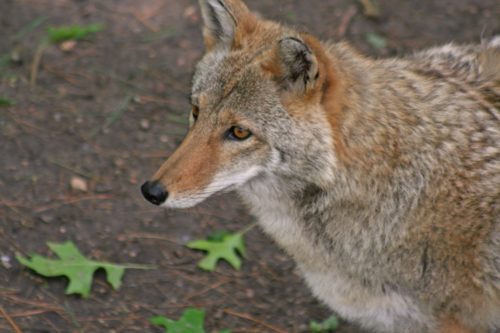 As you can imagine, there is no simple solution for this problem. There is no way to direct their movements. They will go where there is ample cover and food; yards and urban areas often have plenty of both. Also coyotes are territorial, so that plays an important role in their spatial ecology. What researchers are finding is that suburban and urban coyotes (and other wildlife for that matter) do not behave the same as their rural counterparts. Oftentimes, they need less space because resources are plentiful and close together.
Most biologists would agree that trapping and removing coyotes in general is not an appropriate management strategy. If you move them out, more will simply come in. However, trapping of specific problem coyotes can be part of a comprehension management approach. The best approach is to avoid problems, and this starts with preventing coyotes from getting comfortable around people. Never feed coyotes. Many problems in urban areas are the result of people feeding coyotes. If you see coyotes around your home or yard, scare them off by yelling, clapping your hands or with other loud noises.
Resources
Coyotes, IN DNR
Coyotes (PDF), Wildlife Conflicts, Department of Entomology, Purdue University
Should I Be Worried About Coyotes in My Yard?, Purdue Extension – Forestry & Natural Resources (FNR) Got Nature? Blog
Coexisting With Coyotes, Wild Bulletin, Indiana Department of Natural Resources, Division of Fish and Wildlife
Ask the Expert: Coexisting with Coyotes , Purdue Extension – FNR Got Nature? Blog
Urban Coyotes – Should You Be Concerned?, Purdue Extension – FNR Got Nature? Blog
Pets Disappearing? The Cause May Be Coyotes, Purdue Extension – FNR Got Nature? Blog
Question: Which is the correct species of coyotes I have on my land here in Indiana, coyote or coywolf?, Purdue Extension – FNR Got Nature? Blog
Permitted Wildlife Rehabilitators, Indiana Department of Natural Resources
How do you eliminate a nuisance animal on your property?, Indiana Department of Natural Resources (IN DNR)-Fish and Wildlife
Urban Coyote Research Center, Urban Coyote Ecology & Management, Cook County, Illinois
Brian MacGowan, Wildlife Extension specialist
Department of Forestry and Natural Resources, Purdue University
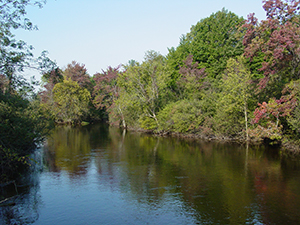 While we are awaiting the color change and dropping of leaves in October, it is also a good time to think about planting trees next spring. Indiana landowners have access to low-cost and high-quality seedlings through the state forest nurseries operated by the Indiana Department of Natural Resources Division of Forestry. The state nurseries began taking orders for seedlings available for planting next spring on October 1, and orders will be accepted until next spring or when all stock is sold. Ordering early is encouraged as demand for seedlings can be high.
Seedlings of many different deciduous and evergreen tree and shrub species useful for forest and wildlife management, windbreak establishment and erosion control are available for purchase. Seedlings are mostly one to three years old and are sold as bare-root stock packaged in moist sphagnum moss and wrapped into bales using special packaging paper. Landowners can order individual tree species in multiples of 100 or several multi-species packages aimed at different purposes like wildlife habitat or native tree nut production. The state nursery seedlings are sold for conservation planting purposes and are not to be resold or used for Christmas tree or landscape plantings. Private nurseries in Indiana and neighboring states can supply seedlings for these purposes. You can access the state nursery tree sales at Tree Seedlings Ordering Instructions.
Planting site research and preparation this fall to prepare for planting next spring will increase your chances for a successful planting. Learn what soils are present on your planting site by using the online tool, the Web Soil Survey. This soil mapping and information tool helps you discover what soils are located on your land, prepare soil maps and explore the capacity of your soils for growing trees, shrubs and crops as well as their suitability for a variety of activities including ponds and construction. The Web Soil Survey tool is provided by the USDA Natural Resources Conservation Service.
Controlling competing grasses, weeds and brush where you plan to plant seedlings can increase survival and growth. Perennial plants can be controlled in the summer or fall to prepare the site for spring planting. Herbicides, tillage or other mechanical or cultural treatments can be used to control these competing plants and give your planted seedlings the best chance for success. Deer can also pose a danger to your seedlings by their browsing and antler-rubbing. Fencing, shelters or repellants may be needed to protect the seedlings until they are large enough to resist browsing or antler damage.
Resources
Hardwood Seedling Production/Propagation (click Publications, then Research Publications), Hardwood Tree Improvement and Regeneration Center
Planting Forest Trees and Shrubs in Indiana, The Education Store
Tree Seedling Nurseries, Indiana Department of Natural Resources
Lenny D. Farlee, Extension Forester
Hardwood Tree Improvement and Regeneration Center
Forestry and Natural Resources, Purdue University
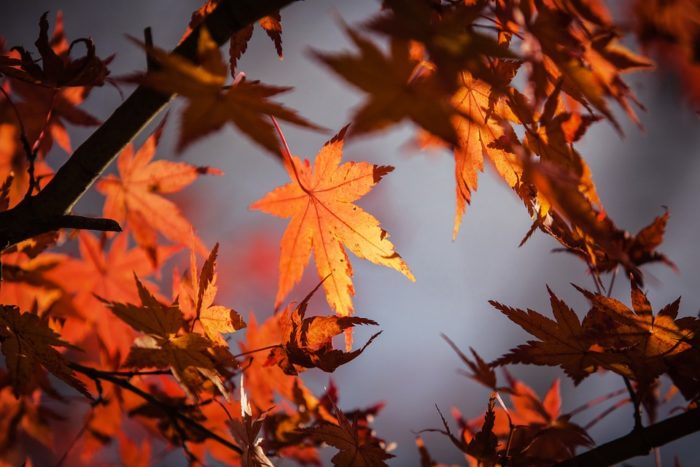 The display of color we enjoy each fall is explained by understanding plant pigments, the physiology and anatomy of leaves, and the influence of climate and seasonal weather conditions. Fall weather conditions favoring formation of bright red autumn color are warm sunny days followed by cool but not freezing nights. As days get shorter and temperatures cooler in the autumn, important physiological processes are triggered that make conditions for chlorophyll production less favorable.
Check out the Why Leaves Change Color publication for more details along with other hardwood tree information.
Resources:
Intro to Trees of Indiana videos, Purdue Extension – Forestry and Natural Resources (FNR)
An Introduction to Trees of Indiana, The Education Store, Purdue Extension’s resource center
Native Trees of the Midwest, Purdue University Press
Shrubs and Woody Vines of Indiana and the Midwest, Purdue University Press
Forest Improvement Handbook, The Education Store
Trees and Storms, The Education Store, Purdue Extension’s resource center
Tree Risk Management, The Education Store
Planting Problems: Trees Planted Too Deep, Video, Purdue Extension – Forestry and Natural Resources YouTube Channel
Lenny Farlee, Extension Forester
Hardwood Improvement Regeneration Center (HTIRC)
Purdue Department of Forestry and Natural Resources
Determining what causes holes in lawn and landscaping can be a challenging endeavor for any homeowner. The size of the hole, the presence of excavated dirt and the timing of activity are all good clues to consider. Recently, I had several holes along my driveway and sidewalk that perplexed me. I’m no stranger to holes in my yard. I’ve been combating moles in my yard (we will save that for another post) and had recently observed dead mice and shrews in my driveway. I also have many chipmunks and gray squirrels around the yard.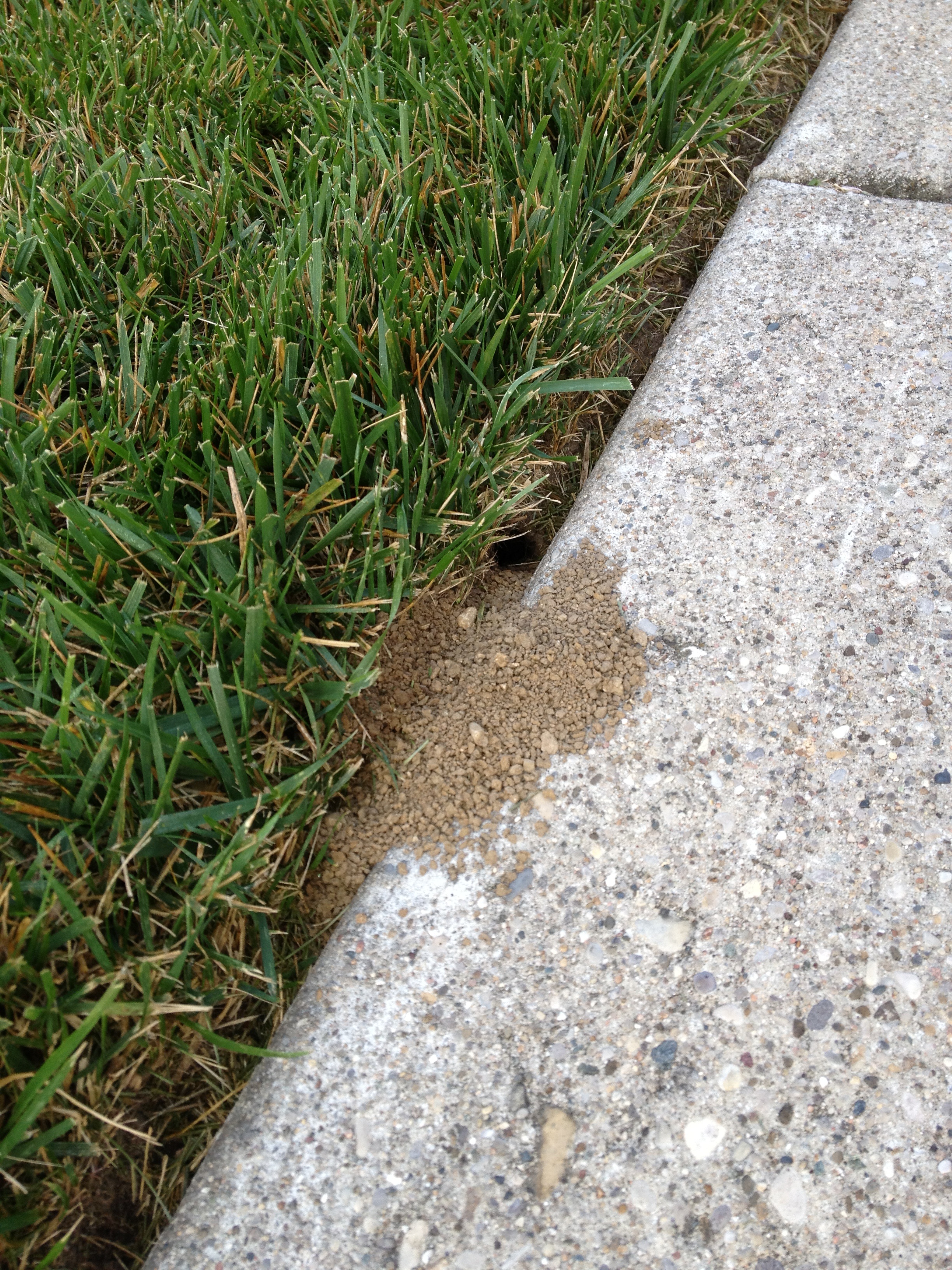 All of these can make holes of one type or another. However, these new holes looked different. They were clearly a tunnel/burrow with an entrance of 1.5 inches. Squirrels dig holes to bury/dig nuts or to feed on small plants. Chipmunks make 1.5 inch holes, but they carry the cast soil away in their mouths which results in a less conspicuous hole. Shrews and voles will excavate holes and tunnels, but these looked different. Voles usually are found in areas with overhead cover such as densely planted landscaping beds, areas with ground ivy or similar plants and beds with think mulch. These holes were exposed far from cover. So what were they?
It just so happens I was at a colleague’s house recently, and he mentioned all the cicada killers he has around the house. He literally had dozens of holes in areas with exposed soil just like the ones I observed at home. To my delight, I finally had the answer to my question.
Cicada killers are large wasps but unlikely to sting. Purdue’s Department of Entomology has more on cicada killers free downloadable pdf, Household and Structural, Cicada Killers.
Other resources:
Cicada killers: a nuisance or a danger?, Turfgrass Science at Purdue University
Cicada Killers, Plant & Pest Diagnostic Lab
Great Lakes Early Detection Network App (GLEDN) – The Center for Invasive Species & Ecosystem Health
EDDMaps – Early Detection and Distribution Mapping System
Report Invasives, College of Agriculture
Subscribe Purdue Extension – Forestry and Natural Resources YouTube Channel, Playlists include wildlife, Nature of Teaching, Moments in the Wild and much more.
Brian MacGowan, Wildlife Extension Specialist
Department of Forestry and Natural Resources
Purdue University
Wildlife identification guides are useful tools that help you figure out what kind of animal you may be looking at. However, they don’t always tell the complete story. Some animals such as garter snakes can have varied appearances which makes identification difficult. Some mammals have varied pelage such as striped skunks with some being almost completely black, white or some combination in between. A very small percentage of animals within a species may look dramatically different due to differences in pigment.
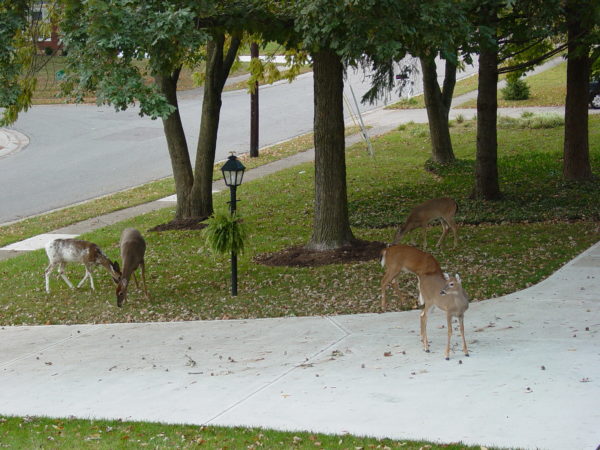 Albinos lack the ability to produce color pigment in their skin, hair, feathers, scales or eyes. Animals with this condition have a white appearance with red or pink eyes. The latter is the result of tiny blood vessels that are now visible. They are typically hidden by the colored iris which is transparent in albinos.
In wildlife, albinism is a rare occurrence at birth caused by a recessive gene. The rate in wildlife is estimated from 1 in 20,000 to 1 in 1 million. Their solid white coat of fur makes them more susceptible to predation, or conversely, would make it difficult for an albino predator to stalk its prey. Albinos also have poor vision or may even be blind. The combination of these factors results in low survival of albinos, further decreasing their proportion in the population.
Partial albinism occurs in some animals and is much more common than true albinism. In white-tailed deer, this is sometimes referred to as ‘piebald’ where their fur has a blotchy, white appearance, but they lack the pink eyes found in albinos. Piebald deer occur at a frequency of less than 1 percent in hunted populations. A greater incidence of physical deformities have been reported for piebald deer.
*View in photo the piebald deer on the far left side.
Resources:
Ask an Expert: Wildlife Food Plots, video, Purdue Extension – FNR YouTube Channel
Handling Harvested Game: Episode 1, Field Dressing, video, Purdue Extension – FNR YouTube Channel
Deer Harvest Data Collection, Got Nature? Blog, Purdue Extension – FNR
How to Score Your White-tailed Deer, video, The Education Store, Purdue Extension Resource Center
Age Determination in White-tailed Deer, video, The Education Store
Handling Harvested Deer Ask an Expert? video, Purdue Extension – FNR YouTube Channel
Woodland Stewardship for Landowners: Managing Deer Damage to Young Trees, video, Purdue Extension – FNR YouTube Channel
Managing Your Woods for White-Tailed Deer, The Education Store
Deer Impact Toolbox, Pond and Wildlife Management, Purdue Extension
Snakes and Lizards of Indiana, The Education Store
Subscribe Purdue Extension – Forestry and Natural Resources YouTube Channel, Playlists include wildlife, Nature of Teaching, Moments in the Wild and much more.
Brian MacGowan, Extension Wildlife Specialist
Department of Forestry and Natural Resources, Purdue University

Recent Posts
- 2026 Winter Bat Survey In Progress, MyDNR
Posted: March 27, 2026 in Wildlife - Fast-Growing Trees for the Landscape, Purdue Landscape Report
Posted: March 26, 2026 in Forestry, Urban Forestry, Woodlands - Urban Tree Spotlight: Planting Deciduous Shade Trees, Purdue Landscape Report
Posted: March 25, 2026 in Forests and Street Trees, Urban Forestry, Woodlands - Beetle that attacks Tree-of-Heaven found in Indiana, Purdue Landscape Report
Posted: March 20, 2026 in Invasive Insects, Wildlife, Woodlands - ID That Tree: Dwarf Chinkapin Oak
Posted: in Forestry, Urban Forestry, Wildlife, Woodlands - IN-PREPared: Essential Resources for Indiana’s Severe Weather Season
Posted: March 11, 2026 in How To, Safety - DNR Hiring for Indiana Conservation Officer Positions, MyDNR
Posted: March 9, 2026 in Urban Forestry, Wildlife, Woodlands - ID That Tree: Shumard Oak
Posted: in Plants, Urban Forestry, Wildlife, Woodlands - A Woodland Management Moment: Windbreak Around Walnut Plantings
Posted: March 3, 2026 in Forestry, Urban Forestry, Woodland Management Moment - Getting Certified as an Indiana Certified Prescribed Burn Manager
Posted: March 2, 2026 in How To, Urban Forestry, Woodlands
Archives
Categories
- Alert
- Aquaculture/Fish
- Aquatic/Aquaculture Resources
- Ask the Expert
- Christmas Trees
- Community Development
- Disease
- Drought
- Forestry
- Forests and Street Trees
- Gardening
- Got Nature for Kids
- Great Lakes
- How To
- Invasive Animal Species
- Invasive Insects
- Invasive Plant Species
- Land Use
- Natural Resource Planning
- Nature of Teaching
- Plants
- Podcasts
- Ponds
- Publication
- Safety
- Spiders
- Timber Marketing
- Uncategorized
- Urban Forestry
- Webinar
- Wildlife
- Wood Products/Manufacturing
- Woodland Management Moment
- Woodlands